2027 Fastest Online Economics Degree Programs

Co-Founder and Chief Data Scientist
Choosing the fastest online economics degree is usually not about finding a shortcut through easy coursework. It is about finding a legitimate, accredited program that lets you finish efficiently through transfer credits, flexible scheduling, multiple start dates, accelerated terms, or a degree-completion format. That distinction matters because economics is a quantitative field: employers and graduate schools care about whether you can analyze data, explain market behavior, evaluate policy trade-offs, and communicate evidence clearly.
This guide is for working adults, transfer students, military learners, career changers, and first-time undergraduates who want an economics degree without spending unnecessary time or money. It explains what online economics programs teach, how fast they can be completed, what they cost, how employers view them, and how to compare programs before enrolling. According to the U.S. Bureau of Labor Statistics, as of May 2024 there were approximately 17,500 employed economists in the U.S.
You will also find a ranked list of online economics-related programs, practical cost and financial aid guidance, common mistakes to avoid, and decision points that can help you determine whether economics is the right degree for your goals.
Quick answer: Is a fast online economics degree worth it?
A fast online economics degree can be worth it if the school is properly accredited, the curriculum includes statistics and econometrics, and the program fits your career target. It is especially useful for students who want roles in finance, analytics, consulting, policy, business strategy, or graduate study. However, students seeking economist roles in government, research, or academia should understand that many advanced economics positions prefer or require a master’s degree or PhD.
The fastest route is usually a bachelor’s completion pathway for students who already have college credits. Full-time students starting without transfer credits usually need about four years, while transfer students may reduce that timeline significantly depending on how many credits the university accepts.
What are the benefits of getting a degree in economics?
- Career flexibility: Economics graduates can move into roles such as economist, financial risk analyst, data analyst, policy analyst, budget analyst, market research analyst, consultant, and public sector specialist.
- Strong earning potential: The median annual salary for someone with an economics degree in the United States is approximately $82,064, with the top earners making up to $116,500 per year.
- Useful analytical training: Economics programs teach students how to evaluate incentives, interpret data, understand markets, and explain the consequences of business or policy decisions.
- Online flexibility: Online study can make a degree more realistic for students who are balancing employment, caregiving, military service, or other responsibilities.
- Preparation for graduate study: A strong economics background can support later study in business, public policy, law, finance, data analytics, or applied economics.
What can I expect from an economics degree?
An economics degree teaches how individuals, businesses, governments, and markets make decisions when resources are limited. Students usually study microeconomics, macroeconomics, statistics, econometrics, economic history, public policy, finance, and quantitative methods. The strongest programs do more than explain theory; they require students to apply models, analyze datasets, and defend conclusions with evidence.
At the bachelor’s level, the degree typically blends general education courses with major coursework. Students can expect written assignments, problem sets, graphs, spreadsheet work, statistical analysis, and research-based projects. Some programs are housed in liberal arts departments, while others are offered through business schools and place more emphasis on management, finance, or business decision-making.
| What you study | Why it matters | Skills you build |
| Microeconomics | Explains consumer behavior, firm strategy, prices, markets, and competition. | Market analysis, incentive analysis, problem-solving |
| Macroeconomics | Examines inflation, employment, growth, interest rates, and national economies. | Policy interpretation, forecasting, economic reasoning |
| Statistics and econometrics | Shows students how to test economic relationships using data. | Data analysis, modeling, evidence-based decision-making |
| Finance or business economics | Connects economic theory to investment, risk, pricing, and business strategy. | Financial analysis, strategic thinking, quantitative communication |
| Public policy or international economics | Applies economics to government action, trade, taxation, and global markets. | Policy evaluation, comparative analysis, research writing |
Where can I work with an economics degree?
Economics graduates work in many settings because the degree develops transferable analytical and communication skills. Common employers include banks, insurance firms, consulting companies, government agencies, technology companies, research organizations, nonprofits, healthcare organizations, and international development groups.
The best setting depends on the student’s coursework and experience. A graduate with strong econometrics and coding skills may be competitive for analytics roles. A student who focuses on finance may pursue banking or risk analysis. Someone interested in legislation, taxation, or social programs may move toward policy work or graduate study in public administration, law, or public policy.
| Career area | Typical entry points | Helpful preparation |
| Finance and banking | Financial analyst, risk analyst, credit analyst | Finance electives, Excel, statistics, internship experience |
| Data and business analytics | Data analyst, business analyst, research analyst | Econometrics, SQL or Python exposure, data visualization |
| Government and policy | Policy analyst, budget analyst, economic research assistant | Public economics, statistics, research writing |
| Consulting | Associate consultant, economic analyst, strategy analyst | Case analysis, communication, quantitative reasoning |
| Graduate or professional school | MBA, law school, public policy, applied economics | Strong GPA, math preparation, research or professional experience |
How much can I make with an economics degree?
Graduates with economics training can earn competitive salaries, but outcomes vary widely by role, location, experience, degree level, technical skills, and industry. With an economics degree, the average annual pay for someone with a bachelor’s in economics is about $82,064. Most salaries range from $69,000 at the 25th percentile to $98,500 at the 75th percentile, while top earners make up to $116,500 per year.
Advanced education or specialized experience can raise earning potential. For those with advanced degrees or specialized roles, the average salary can be even higher, reaching around $107,594 annually, with similar top-end earnings. Students should treat these figures as broad benchmarks rather than guaranteed outcomes. A graduate who combines economics with data tools, finance experience, or policy expertise may qualify for different roles than a graduate with only introductory coursework.
- Fastest Online Economics Degree Programs for 2027
- How long does it take to complete an online economics degree program?
- How does an online economics degree program compare to an on-campus program?
- What is the average cost of an online economics degree program?
- What are the financial aid options for students enrolling in an online economics degree program?
- What are the prerequisites for enrolling in an online economics degree program?
- What courses are typically in an online economics degree program?
- What types of specializations are available in an online economics degree program?
- How to choose the best online economics degree program?
- How can an online economics degree facilitate advanced education and leadership roles?
- Do employers value online economics degrees as much as traditional ones?
- How Can an Online Economics Degree Complement a Top MBA Online Program?
- What career paths are available for graduates of an online economics degree program?
- What is the job market for graduates with an online economics degree program?
List of the Fastest Online Economics Degree Programs for 2027
The programs below are useful starting points for students who want an online economics or economics-related degree. When reviewing this list, remember that “fastest” depends heavily on your transfer credits, term length, course availability, and whether the school allows heavier course loads. A program listed as four years may still be faster for a student who enters with previous college credit.
How do we rank schools?
Research.com evaluates schools using current, validated education datasets and a ranking process designed to help students compare accredited options. Accreditation is a key filter because it affects credit transfer, employer recognition, graduate school eligibility, and access to federal financial aid. More details are available on our ranking methodology page.
- Integrated Postsecondary Education Data System, also known as the IPEDS database
- Peterson’s database, including the Distance Learning Licensed Data Set
- College Scorecard database
- National Center for Education Statistics
| School | Online economics option | Program length | Cost per credit | Credits listed | Accreditation |
| Florida International University | Bachelor of Arts in Economics | 4 years | $205 | 60 credits | Southern Association of Colleges and Schools Commission on Colleges (SACSCOC) |
| Penn State World Campus | BS/BA in Economics | 4 years | $678 | 120 credits | Middle States Commission on Higher Education |
| UMass Dartmouth | BS/BA in Economics | 4 years | $434 | 120 credits | New England Commission of Higher Education (NECHE) |
| Liberty University | BSBA and Data Analysis – Economics | Not listed | $390 | 120 credits | Southern Association of Colleges and Schools Commission on Colleges (SACSCOC) |
| Ottawa University | Bachelor of Arts in Business Economics | 4 years | $499 | 51 credits | The Higher Learning Commission |
| Regent University | BS in Business with Economics concentration | 4 years | $450 | 120 credits | Accreditation Council for Business Schools and Programs |
| American Public University | Bachelor of Arts in Business | 4 years | $350 | 120 credits | Accreditation Council for Business Schools and Programs |
| Grand Canyon University | Bachelor of Science in Economics | 4 years | $485 | 120 credits | The Higher Learning Commission |
| Lakeland University | Economics minor | 4 years | $550 | 120 credits | The Higher Learning Commission |
| University of Arizona Global Campus | MBA with Business Economics specialization | 4 years | $460 | 120 credits | WASC Senior College and University Commission (WSCUC) |
1. Florida International University Bachelor of Arts in Economics
Florida International University offers an online Bachelor of Arts in Economics for students who want training in economic theory, quantitative reasoning, and applied analysis. The program is designed to help students interpret financial information, think critically about markets, and prepare for roles in business, finance, government, and related fields.
- Program Length: 4 years
- Cost per credit: $205
- Required credits to graduate: 60 credits
- Accreditation: Southern Association of Colleges and Schools Commission on Colleges (SACSCOC)
2. Penn State World Campus BS/BA in Economics
Penn State World Campus provides both Bachelor of Science and Bachelor of Arts pathways in Economics. The online format is built for students who need flexibility while developing skills in market analysis, pricing decisions, economic environment assessment, and data interpretation with spreadsheets and statistical software.
- Program Length: 4 years
- Cost per credit: $678
- Required credits to graduate: 120 credits
- Accreditation: Middle States Commission on Higher Education
3. UMass Dartmouth BS/BA in Economics
The University of Massachusetts Dartmouth offers online Bachelor of Science and Bachelor of Arts options in Economics. The curriculum combines economic theory with practical analysis, including how to gather data, evaluate results, interpret market trends, and make recommendations for business or policy decisions.
- Program Length: 4 years
- Tracks/concentrations: Economics
- Cost per credit: $434
- Required credits to graduate: 120 credits
- Accreditation: New England Commission of Higher Education (NECHE)
4. Liberty University Bachelor of Science in Business Administration (BSBA) and Data Analysis – Economics
Liberty University offers an online Bachelor of Science in Business Administration and Data Analysis – Economics. This option may appeal to students who want an economics-focused business degree rather than a traditional liberal arts economics major. Coursework includes macroeconomics, microeconomics, economic forecasting, data analysis, and international trade.
- Tracks/concentrations: Economics
- Cost per credit: $390
- Required credits to graduate: 120 credits
- Accreditation: Southern Association of Colleges and Schools Commission on Colleges (SACSCOC)
5. Ottawa University Bachelor of Arts in Business Economics
Ottawa University offers a fully online Bachelor of Arts in Business Economics. The program emphasizes economic decision-making in organizations and society, including how to analyze economic systems, use data to address business problems, and make recommendations related to efficiency and equity.
- Program Length: 4 years
- Cost per credit: $499
- Required credits to graduate: 51 credits
- Accreditation: The Higher Learning Commission
6. Regent University BS in Business with Economics concentration
Regent University offers a Bachelor of Science in Business with an Economics concentration online or on campus in Virginia Beach. The program combines business administration coursework with economics topics such as inflation, cost theory, market structure, capital budgeting, macroeconomics, microeconomics, political economy, entrepreneurship, and market processes.
- Program Length: 4 years
- Cost per credit: $450
- Required credits to graduate: 120 credits
- Accreditation: Accreditation Council for Business Schools and Programs
7. American Public University Bachelor of Arts in Business
American Public University offers an online Bachelor of Arts in Business that includes economics-related training within a broader business curriculum. Students learn to analyze data, apply critical thinking to organizational problems, and use market and economic information in business planning.
- Program Length: 4 years
- Cost per credit: $350
- Required credits to graduate: 120 credits
- Accreditation: Accreditation Council for Business Schools and Programs
8. Grand Canyon University Bachelor of Science in Economics
Grand Canyon University offers a Bachelor of Science in Economics focused on mathematical models, statistical techniques, markets, incentives, and economic behavior. Coursework includes microeconomics, macroeconomics, econometrics, financial systems, money and banking, investments, and economic policy analysis.
- Program Length: 4 years
- Cost per credit: $485
- Required credits to graduate: 120 credits
- Accreditation: The Higher Learning Commission
9. Lakeland University Economics minor
Lakeland University offers an Economics minor within its liberal arts curriculum. This option is better suited for students who want to pair another major with economic reasoning rather than complete a full economics major. The minor introduces economic theory and practical decision-making related to how people, businesses, and governments allocate limited resources.
- Program Length: 4 years
- Cost per credit: $550
- Required credits to graduate: 120 credits
- Accreditation: The Higher Learning Commission
10. University of Arizona MBA with Business Economics specialization
The University of Arizona Global Campus offers an online MBA with a Business Economics specialization. This is not the same as an undergraduate economics degree, but it may fit students who already have a bachelor’s degree and want graduate business training with economics content. The specialization addresses economic forces that affect organizations, including employment, inflation, monetary policy, and fiscal policy.
- Program Length: 4 years
- Cost per credit: $460
- Required credits to graduate: 120 credits
- Accreditation: WASC Senior College and University Commission (WSCUC)
How long does it take to complete an online economics degree program?
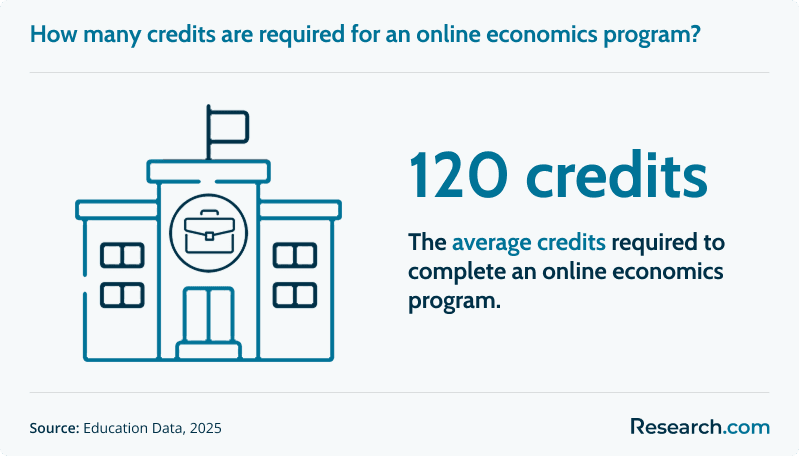
Most bachelor’s degrees in economics require about 120 credits and take approximately four years for full-time students who begin with no prior college coursework. The actual completion time can be shorter or longer depending on course load, transfer credits, academic calendar, and whether required courses are available every term.
Transfer students often have the fastest path. If a university accepts a large number of previously earned credits, a student may be able to complete the remaining major and upper-division requirements in as little as two years. Students who enroll year-round or take heavier course loads may also reduce their time to graduation, while part-time students may need five years or more.
| Student situation | Likely timeline | What affects speed |
| First-time full-time student | Approximately four years | Credit requirement, term structure, course sequencing |
| Transfer student with substantial credits | As little as two years | Transfer credit policy, major prerequisites, residency requirements |
| Accelerated or year-round student | Three years or less may be possible | Summer courses, heavier course loads, advising support |
| Part-time working student | Five years or more | Work schedule, course availability, maximum allowed completion time |
If your main goal is speed rather than a broad economics education, compare degree pathways with shorter workforce programs. For example, students reviewing the cheapest maintenance technician training online can see how trade-focused programs differ from a four-year degree in time, cost, and career purpose.
How does an online economics degree program compare to an on-campus program?
Online and on-campus economics degrees often cover the same academic foundations: microeconomics, macroeconomics, statistics, econometrics, electives, and general education requirements. The major difference is how students interact with faculty, classmates, support services, and coursework.
Online programs are usually more flexible. Many use asynchronous courses, allowing students to complete assignments around work or family schedules. Online study can also reduce commuting and housing expenses. Research indicates that online learning can be more time-efficient, requiring 40% to 60% less time than face-to-face classes, and students often retain more information in online settings. Students comparing fast, flexible degrees sometimes also review options such as the fastest online user experience design programs, especially if they are weighing analytical business careers against technology-focused careers.
On-campus programs may offer easier access to faculty office hours, tutoring, clubs, research assistantships, internships, and peer study groups. Studies have shown that students in traditional face-to-face economics courses generally achieve higher grades and success rates compared to those in fully online courses, especially among freshmen, sophomores, and less-prepared students. For online learners, success often depends on self-discipline, proactive communication, and consistent use of student support services.
| Factor | Online economics degree | On-campus economics degree |
| Schedule flexibility | Best for students who need to study around work, family, or military obligations. | Best for students who can attend scheduled classes and campus activities. |
| Networking | Depends on virtual events, discussion boards, faculty outreach, and career services. | Often easier through clubs, seminars, research projects, and in-person recruiting. |
| Cost considerations | May reduce housing, commuting, and relocation costs. | May include additional campus-related living costs. |
| Learning style | Works well for organized, independent learners. | Works well for students who want face-to-face structure and immediate feedback. |
| Employer perception | Strongest when the school is accredited and the transcript does not signal a lower academic standard. | Often familiar to employers, especially for schools with established recruiting pipelines. |
What is the average cost of an online economics degree program?
The average cost of an online economics degree program typically ranges between $30,000 and $70,000 in total tuition. Per-credit costs commonly vary from about $250 to $600 depending on the institution. Because most bachelor’s programs require around 120 credits, the total tuition bill depends heavily on the school’s per-credit rate and how many credits you still need to complete. Students comparing broad quantitative degrees may also review programs such as the most affordable online bachelor's degree in mathematics.
Several factors influence the final price: public versus private control, in-state versus out-of-state tuition, transfer credit acceptance, program length, fees, textbooks, technology requirements, and financial aid. A low tuition rate is helpful, but it does not always mean the program will be the cheapest overall if fees are high or few transfer credits are accepted.
Students can often lower total costs by transferring community college credits, using employer tuition assistance, applying for scholarships, taking advantage of military education benefits, or choosing an in-state public institution. Some learners also compare full bachelor’s degrees with shorter specialized credentials, including affordable online pediatric nurse practitioner graduate certificate programs, to understand how targeted credentials differ from full undergraduate degrees.
Online economics degrees may be less expensive than campus-based options when they eliminate commuting, housing, parking, and relocation costs. Still, students should calculate the full cost of attendance rather than tuition alone. Overall, prospective students can expect to invest approximately $250 to $600 per credit, resulting in an average total tuition of between $30,000 and $70,000 for a complete online bachelor's degree in economics.
| Cost factor | Why it matters | Question to ask |
| Transfer credit policy | Accepted credits can reduce both time and tuition. | How many previous credits will count toward the degree? |
| Per-credit tuition | This is the base rate used to calculate tuition. | Is the online rate different for in-state and out-of-state students? |
| Mandatory fees | Technology, student services, and graduation fees can add up. | What fees are charged each term or each course? |
| Course materials | Economics courses may require textbooks, software, or statistical tools. | Are materials included, open-source, or separately billed? |
| Pace of completion | Taking longer can increase total expenses and delay earnings. | Can I take courses year-round or accelerate safely? |
What are the financial aid options for students enrolling in an online economics degree program?
Online economics students may qualify for many of the same financial aid options as campus-based students, provided the institution and program meet eligibility requirements. The most important step is to confirm accreditation and financial aid eligibility before applying.
- Free Application for Federal Student Aid (FAFSA): Completing the FAFSA is usually the starting point for federal grants, loans, and work-study consideration.
- Direct Subsidized Loans: These loans are available to undergraduate students with demonstrated financial need. The U.S. Department of Education pays the interest while the student is enrolled at least half-time, during the grace period, and during deferment periods.
- State financial aid: Many states provide grants, scholarships, or tuition assistance programs. Rules vary, so students should check with their state higher education agency and confirm that online enrollment qualifies.
- Institutional scholarships: Universities may offer scholarships for transfer students, adult learners, military students, first-generation students, or high-achieving applicants.
- Private scholarships: Professional associations, foundations, employers, and community organizations may support students in economics, business, finance, public policy, or analytics. Students in fast-growing online fields, including accelerated online social media programs, may also encounter scholarships connected to digital marketing, analytics, and business communication.
- Employer tuition assistance: Working students should ask whether their employer reimburses tuition for job-related coursework in economics, analytics, finance, or business.
- Private student loans: Banks, credit unions, and private lenders offer education loans, but these often have higher interest rates or fewer borrower protections than federal loans. Students should usually review federal options first.
What are the prerequisites for enrolling in an online economics degree program?
Admission requirements depend on degree level, school selectivity, and whether the student is applying as a first-year or transfer applicant. Students researching long-term economist careers should also review what degree do you need to be an economist, because entry-level business roles and professional economist roles may require different levels of education.
- High school diploma or equivalent: Bachelor’s programs generally require proof of high school completion or a GED. Some schools may prefer or require a minimum high school GPA, such as 2.7 or 2.5.
- College transcripts for transfer students: Transfer applicants must usually submit transcripts from all previously attended colleges.
- Introductory economics coursework: Some programs prefer or require Principles of Microeconomics and Principles of Macroeconomics, especially for transfer students entering directly into upper-division major courses.
- General education readiness: Students must complete general education courses in areas such as English, humanities, social sciences, and natural sciences, either before transfer or within the degree.
- Math preparation: Economics is quantitative, so students should be ready for statistics and, in some programs, calculus or business calculus.
- Technology access: Online students need reliable internet, a computer, and access to required learning platforms or statistical tools.
What courses are typically in an online economics degree program?
Online economics programs are built around theory, quantitative analysis, and practical application. A strong curriculum should help students understand economic behavior and also give them the tools to analyze real data. Students who want analytics-heavy careers should pay close attention to the number of statistics, econometrics, and data-focused courses required.
- Principles of Microeconomics: Covers consumers, firms, industries, supply and demand, market structures, pricing, and resource allocation.
- Principles of Macroeconomics: Introduces inflation, unemployment, economic growth, money, banking, fiscal policy, and monetary policy.
- Statistics: Builds the foundation for probability, hypothesis testing, sampling, and interpretation of quantitative evidence.
- Econometrics: Teaches students how to use statistical methods to test economic theories and evaluate real-world data.
- Data Analysis/Big Data for Economists: Applies data tools to economic questions. Students who want stronger technical preparation may also consider a fast-track graduate certificate in data analytics online.
- Health Economics: Applies economic reasoning to healthcare markets, insurance, access, cost, and policy. Students interested in healthcare administration may later compare this pathway with the shortest online MBA in healthcare management.
- Economic History: Examines historical economic events, institutions, crises, development patterns, and long-term trends.
- Quantitative Methods/Business Analytics: May include forecasting, optimization, spreadsheet modeling, and data visualization.
Students who want to work in trade, operations, or global business sometimes combine economics with additional credentials such as the shortest online graduate certificate in logistics and supply chain management. This combination can be useful for careers involving forecasting, pricing, distribution, trade, and operational efficiency.
What types of specializations are available in an online economics degree program?
Specializations allow students to connect economic theory to a specific career direction. Not every online program offers formal concentrations, but many provide electives that function like a focus area. Students should compare specialization options carefully because they influence internships, graduate school preparation, and job fit. For a broad explanation of how economists apply their training, students can review this overview of economic theory in professional practice.
- Financial Economics / Finance: Focuses on financial markets, investment behavior, risk, corporate finance, and financial institutions. It is a strong fit for students targeting banking, investment analysis, or risk roles.
- International Economics: Covers trade, exchange rates, global finance, international development, and the effects of globalization on national economies.
- Data Analytics / Econometrics / Quantitative Economics: Emphasizes statistical modeling, predictive analysis, computational methods, and applied data work. Students who need additional technical training may compare degree coursework with affordable data science training programs online.
- Public Policy / Public Economics: Examines taxation, public spending, regulation, social programs, and the economic effects of government decisions.
- Behavioral Economics: Uses insights from psychology to explain decision-making that may not follow purely rational economic models.
- Business Economics: Applies economic analysis to pricing, competition, strategy, operations, and organizational decision-making.
| Specialization | Best for students interested in | Useful add-on skills |
| Financial economics | Banking, investment, risk, corporate finance | Financial modeling, Excel, accounting basics |
| Quantitative economics | Data analysis, forecasting, research | Statistics software, SQL, Python or R |
| Public policy | Government, nonprofits, regulation, social programs | Policy writing, program evaluation, public finance |
| International economics | Trade, development, global business | Foreign language ability, international finance, regional expertise |
| Behavioral economics | Consumer behavior, policy design, marketing, research | Experimental design, psychology, survey methods |
How to choose the best online economics degree program?
The best online economics degree is the one that is accredited, affordable for your situation, academically strong enough for your career goal, and realistic for your schedule. Do not choose based only on speed. A very fast program that lacks quantitative rigor, advising, or employer recognition may not provide the return you expect.
- Confirm institutional accreditation: Make sure the university is accredited by a recognized accrediting agency. Accreditation affects financial aid eligibility, graduate school admission, and employer confidence.
- Review the school’s reputation: A well-known institution is not automatically better for every student, but reputation can matter for graduate school, internships, alumni networks, and employer recognition.
- Check program-specific business accreditation when relevant: Economics programs usually do not require specialized accreditation, but if the degree sits inside a business school, accreditation such as the Association to Advance Collegiate Schools of Business (AACSB) may signal additional quality standards.
- Evaluate the quantitative coursework: Look for statistics, econometrics, calculus or business calculus, forecasting, and data analysis. These courses often matter more for career mobility than broad survey electives.
- Compare transfer credit policies: If you already have credits, ask for an official transfer evaluation before committing.
- Study the course rotation: A program may advertise flexible online study, but if required courses are offered infrequently, your graduation timeline may slow down.
- Ask about faculty access: Online students should know whether faculty hold virtual office hours, respond within a stated timeframe, and support undergraduate research or career guidance.
- Use rankings carefully: Rankings can narrow your search, but they should not replace accreditation checks, cost comparisons, curriculum review, and conversations with advisors.
| Question to ask before enrolling | Why it matters |
| Is the institution accredited? | Accreditation affects legitimacy, financial aid, transfer credit, and graduate school options. |
| How many credits will transfer? | This can determine whether the program is truly fast or affordable for you. |
| Are economics courses asynchronous, synchronous, or mixed? | The delivery format affects your ability to balance school with work and family responsibilities. |
| Does the curriculum include econometrics and statistics? | Quantitative training is essential for analytics, finance, policy, and graduate study. |
| What career services are available to online students? | Internship help, resume support, employer connections, and alumni access can affect outcomes. |
| What is the full cost after fees? | Tuition alone does not show the real price of the degree. |
Common mistakes when choosing a fast online economics degree
- Assuming “online” means easier: Economics can be demanding, especially in statistics, econometrics, and math-heavy courses.
- Ignoring accreditation: An unaccredited or poorly recognized institution can create problems with financial aid, transfer credits, employment, and graduate school.
- Focusing only on tuition: Fees, course materials, transfer credit limits, and delayed graduation can change the true cost.
- Choosing speed over curriculum quality: A faster program is not helpful if it lacks the quantitative coursework needed for your career.
- Not checking course sequencing: Some required courses may be available only during certain terms, which can slow completion.
- Assuming salary outcomes are guaranteed: Salaries depend on job role, location, experience, internships, technical skills, and degree level.
- Skipping career planning until senior year: Economics students should build experience early through internships, projects, data tools, and networking.
How can an online economics degree facilitate advanced education and leadership roles?
An online economics degree can prepare students for graduate education and leadership by developing analytical reasoning, data interpretation, market awareness, and decision-making discipline. These skills are useful in management, finance, consulting, public administration, and policy roles where leaders must evaluate trade-offs and make evidence-based recommendations.
Some graduates later pursue business education to add management, accounting, operations, and leadership training to their economics background. For cost-conscious students, affordable MBA online programs can be a practical next step if they want to move from analysis-focused roles into management or executive decision-making.
Do employers value online economics degrees as much as traditional ones?
Many employers care less about whether a degree was earned online and more about the institution’s accreditation, the student’s skills, and the relevance of the coursework. An online economics degree from a recognized university can be respected when the academic standards match the campus program and the graduate can demonstrate strong analytical, communication, and technical abilities.
Students should still be strategic. Employers may ask about projects, internships, software skills, and examples of applied analysis. Candidates can strengthen their resumes by completing data projects, learning spreadsheet and statistical tools, joining professional associations, and pursuing internships or research experience. Students comparing broad employability across fields may also review accelerated online bachelor degree programs in sports management to understand how different online degree pathways position graduates for industry-specific roles.
How Can an Online Economics Degree Complement a Top MBA Online Program?
Economics and MBA training can work well together. Economics develops the ability to understand markets, incentives, data, and policy effects. MBA coursework typically adds leadership, operations, marketing, accounting, finance, and organizational strategy. Together, these skills can support roles that require both quantitative analysis and business decision-making.
Students planning to apply to the top MBA online programs can use an economics background to strengthen their preparation for courses in managerial economics, finance, strategy, analytics, and global business. The combination is especially useful for students targeting consulting, corporate strategy, financial management, public-sector leadership, or entrepreneurship.
What career paths are available for graduates of an online economics degree program?
An online economics degree can lead to several career directions because the major trains students to analyze problems, interpret evidence, and explain complex systems. The strongest opportunities often go to graduates who pair economics coursework with internships, technical tools, writing ability, and industry knowledge.
- Finance and banking: Economics graduates often pursue financial analyst, credit analyst, investment support, risk analysis, or banking roles because they understand markets and quantitative decision-making.
- Data analysis and business intelligence: Graduates with econometrics and statistics training can pursue analyst roles. Students exploring how to become a data scientist should plan to add programming, machine learning, databases, and advanced analytics skills.
- Consulting: Economics majors can be strong consulting candidates when they can structure ambiguous problems, analyze evidence, build recommendations, and communicate clearly.
- Government and public policy: Economics training is relevant for budget analysis, policy research, regulatory analysis, labor market studies, and public finance roles.
- Market research: Graduates may analyze consumer behavior, pricing, demand, and competitive conditions.
- Graduate study: Students may continue into economics, finance, business, law, public policy, analytics, or public administration.
| Role | Typical work | Degree level often preferred |
| Financial analyst | Evaluate investments, budgets, business performance, or financial trends. | Bachelor’s degree, with finance or analytics preparation helpful |
| Policy analyst | Study public problems, evaluate policy options, and communicate recommendations. | Bachelor’s or graduate degree depending on employer |
| Data analyst | Clean, analyze, and visualize data to support business or policy decisions. | Bachelor’s degree plus technical skills |
| Economist | Research economic issues, build models, analyze data, and forecast trends. | Often graduate-level preparation for advanced roles |
| Consultant | Analyze organizational problems and recommend improvements. | Bachelor’s degree for entry-level roles; MBA or graduate degree for advancement |
What is the job market for graduates with an online economics degree program?
Graduates with online economics degrees can pursue opportunities in government, finance, business, consulting, healthcare, technology, research, and nonprofit organizations. The job market is strongest for students who can show applied skills, not just coursework. Employers often look for evidence that candidates can analyze data, write clearly, use spreadsheets or statistical tools, and connect economic reasoning to real organizational problems.
According to data from sources like Eastern Oregon University and the U.S. Bureau of Labor Statistics, economists earn a median annual salary of approximately $115,440, and the field is projected to grow at a rate of about 5%, which is significantly faster than the average salary of other professions such as business psychologist salary. Students should compare labor market data carefully because job outlook and salary figures can differ by source, role definition, degree level, and reporting year.
Common career paths include economist, financial analyst, policy analyst, market research analyst, actuary, budget analyst, and management consultant. These roles often involve interpreting economic conditions, evaluating risk, advising leaders, creating forecasts, or helping organizations make data-informed decisions.
Some economics graduates improve their career options by adding advanced analytics training. An accelerated master's degree in data analytics online can be useful for students who want deeper preparation in quantitative methods, data tools, and applied modeling.
Online economics graduates may be valuable in banking, government agencies, healthcare organizations, technology companies, consulting firms, and research groups. Professional organizations such as the American Economic Association and the National Association for Business Economics can also help students access networking, conferences, continuing education, and job resources. Students considering finance-focused graduate options may also want to review what jobs can you get with a masters in finance.
Current trends affecting economics students
- Data skills are increasingly important: Economics graduates who can use statistics, spreadsheets, databases, and visualization tools often have more career options.
- AI is changing analyst work: AI tools can speed up research, summarization, coding, and forecasting support, but employers still need people who can judge assumptions, validate data, interpret results, and explain trade-offs.
- Online degrees are more accepted when accredited: Employer skepticism is lower when the credential comes from a recognized institution with clear academic standards.
- Interdisciplinary preparation matters: Economics pairs well with finance, computer science, public policy, mathematics, political science, healthcare administration, and supply chain management.
- Graduate education may be needed for advanced economist roles: A bachelor’s degree can open many analyst and business roles, but research-intensive economist positions may require further study.
Practical steps to prepare for an economics career while enrolled online
- Build a quantitative foundation early: Take statistics, econometrics, and math requirements seriously because they shape your career options.
- Learn practical tools: Become comfortable with spreadsheets and, when possible, statistical or programming tools relevant to your target role.
- Create a project portfolio: Use public datasets to analyze inflation, housing, labor markets, consumer behavior, trade, or business trends.
- Seek internships or applied experience: Remote internships, part-time analyst work, research assistantships, and employer projects can make an online degree more marketable.
- Use career services before your final year: Ask for resume reviews, mock interviews, job boards, alumni contacts, and internship guidance.
- Join professional communities: Economics and business associations can provide networking, webinars, job leads, and industry insight.
- Match electives to your goal: Choose finance electives for banking, policy electives for government, and data electives for analytics roles.
Here's what graduates have to say about their online economics degree
-
: "
"Studying economics online changed what I thought was possible. I was able to keep my full-time job while learning how markets, incentives, and policy decisions affect real organizations. The flexibility helped me control my schedule, and I could use what I learned at work almost immediately." - Mariah
"
-
: "
"I wanted a clearer understanding of the global economy, but I did not expect online classes to feel so connected. Discussions with classmates from different backgrounds helped me see economic issues from more than one angle. The format was flexible, but it was still challenging and engaging." - Hector
"
-
: "
"My online economics degree gave me the analytical base I needed to move toward data analysis. Being able to work through models and assignments at my own pace helped me understand difficult material more deeply. The biggest benefit was that school fit into my life instead of replacing it." - Millie
"
Key Insights
- A fast online economics degree is usually fastest for students with transfer credits, not necessarily for students starting from zero credits.
- Most bachelor’s programs require about 120 credits and take approximately four years for full-time students, though transfer students may finish in as little as two years.
- The average total tuition for an online economics bachelor’s degree is typically between $30,000 and $70,000, with per-credit tuition commonly ranging from $250 to $600.
- The median annual salary for someone with an economics degree in the United States is approximately $82,064, while advanced or specialized roles may report higher averages.
- The strongest online economics programs include statistics, econometrics, quantitative methods, and applied data work. These courses are essential for finance, analytics, consulting, and policy roles.
- Employers are more likely to respect an online economics degree when it comes from an accredited institution and the graduate can demonstrate practical skills through projects, internships, and technical tools.
- The projected growth for economics is at a rate of about 14%, which is significantly faster than average.
- Before enrolling, confirm accreditation, transfer credit acceptance, total program cost, course availability, and whether the curriculum supports your target career or graduate program.
References:
- Hanson, M. (2024). Average Cost of Online College. Education Data Initiative.
- National Center for Education Statistics (NCES). (2024). Average undergraduate tuition, fees, room, and board charges for full-time students in degree-granting postsecondary institutions, by control and level of institution and state: Academic years 2021-22 and 2022-23. Digest of Education Statistics. NCES.
- U.S. Bureau of Labor Statistics. (2023, April 25). 15-2051 Data Scientists. Bureau of Labor Statistics. Retrieved January 15, 2024, from https://www.bls.gov/oes/current/oes152051.htm
- U.S. Bureau of Labor Statistics. (2023, April 25). 19-3011 Economists. Bureau of Labor Statistics. Retrieved January 15, 2024, from https://www.bls.gov/oes/current/oes193011.htm
- Zippia. (2023, July 21). Best Colleges and Degrees For Economists. Zippia. Retrieved January 15, 2024, from https://www.zippia.com/economist-jobs/education
Other Things You Need to Know About the Fastest Online Economics Degree Programs
Prior college coursework can shorten the timeline if the school accepts transfer credits. Many accelerated economics programs allow up to 90 transfer credits toward a 120-credit bachelor’s degree, leaving as few as 30 credits to finish after admission and transcript review.
Accelerated online economics degree programs in 2027 typically require a high school diploma or GED, a minimum GPA of 2.5, and potentially prerequisite courses in mathematics and economics. Standardized test scores like the SAT or ACT might also be required, depending on the institution.