
2027 Best Online Nursing Programs in Maine – Accredited RN to BSN Programs

Co-Founder and Chief Data Scientist
Choosing a nursing program in Maine is not just a school decision. It affects how quickly you can qualify for licensure, whether your credits will transfer, how much debt you may take on, and what kinds of nursing roles you can pursue in the state’s hospitals, rural clinics, long-term care facilities, home health agencies, and coastal communities. Maine can be attractive for nurses who want a smaller-state healthcare environment, access to rural and community-based practice, and flexible online pathways such as RN to BSN completion programs.
Pay is an important part of that decision, but it should not be the only one. The annual mean wage for registered nurses (RNs) in Maine is $82,860, compared with the national mean wage of $93,600 according to the U.S. Bureau of Labor Statistics (U.S. BLS, 2024). For many students, the better question is whether Maine’s nursing job market, cost of living, licensure rules, and online program options fit their long-term plans. If you are still weighing the broader reasons to pursue nursing as a career, Maine offers several practical pathways, but each comes with trade-offs.
This guide explains how to become a nurse in Maine, what online nursing programs can and cannot do, how much RN to BSN programs may cost, what financial aid options to check, and how to evaluate whether a Maine nursing career is the right move for you.
Best Online Nursing Programs in Maine Table of Contents
- Steps to become a licensed nurse in Maine
- Expected nursing program costs in Maine
- Scholarships and financial aid for Maine nursing students
- Typical timelines for Maine nursing pathways
- Using an online degree to become a nurse in Maine
- Online Nursing Programs in Maine for 2027
- Whether Maine is a strong state for nurses
- Telehealth and Maine nursing practice
- Maine nursing license renewal and compliance
- Career options with a nursing degree in Maine
- Rural healthcare and nursing careers in Maine
- How to compare online nursing programs in Maine
- Professional networks for Maine nurses
- How an LVN/LPN pathway may support a Maine nursing career
- Online RN to MSN options for Maine nurses
- Medical billing and coding skills for nurses
- Continuing education for Maine nurses
- Career pathways for LPNs in Maine
- How medical assistants support nursing workflows
- Specialized nursing roles with growth potential
- Transitioning into a nurse practitioner role in Maine
- Becoming a nurse midwife in Maine
Quick answer: Are online nursing programs in Maine worth considering?
Online nursing programs in Maine are most useful for licensed RNs who want to complete a BSN while continuing to work. They can also help students compare flexible pathways into advanced nursing education. However, online nursing is rarely 100% remote for initial licensure because clinical training, skills labs, practicums, or local field experiences may be required. Before enrolling, confirm accreditation, Maine Board of Nursing approval where applicable, clinical placement expectations, transfer credit policies, total cost, and whether the program supports your intended license or career goal.
| Best fit | Why it may work | What to verify first |
| Licensed RNs seeking a BSN | RN to BSN programs are commonly designed for working nurses and often offer online coursework. | Transfer credits, practicum or capstone requirements, accreditation, tuition, and employer reimbursement options. |
| ADN students planning ahead | An ADN can lead to RN licensure, and a later BSN may support advancement. | Whether your ADN credits transfer smoothly into a BSN completion program. |
| Career changers without a nursing license | Accelerated or prelicensure routes may be available, but they usually require in-person clinical training. | State approval, clinical sites, admission prerequisites, and NCLEX eligibility. |
| RNs targeting advanced practice | A BSN can be a stepping stone toward MSN, NP, nurse educator, or leadership pathways. | Graduate admission requirements, specialty certification rules, and clinical placement support. |
How to become a nurse in Maine?
Maine nursing licensure is handled through the Maine State Board of Nursing. Applications for new licenses, renewals, and reactivation requests are processed online, and the Board’s website is the primary place to confirm current requirements before you apply. This matters because licensure rules, documentation standards, background check procedures, and application workflows can change.
Maine participates in the Nurse Licensure Compact (NLC). This can be especially valuable if you expect to work across state lines, accept travel assignments, or relocate within compact states. A multistate license can allow eligible nurses to practice in Maine and other NLC member states, but you still need to meet compact eligibility rules.
Most Maine nursing pathways involve three core requirements:
- Complete the required education for the license level you are seeking, such as CNA training, an LPN program, an ADN, a BSN, or graduate nursing education for advanced practice.
- Pass the applicable exam, such as the NCLEX-PN for LPNs, the NCLEX-RN for RNs, or national certification exams for APRNs and nursing specialties.
- Complete the required background review, including disclosure of past convictions and information about licenses held in other jurisdictions.
If you already hold an active, equivalent, and unencumbered license in another state, you may be able to seek Maine licensure by endorsement. If your license is from another compact state and you do not plan to make Maine your primary state of residence, you may not need a separate Maine license. If you are moving permanently, confirm the process and timeline with the Board before you begin work.
What is the typical cost of nursing programs in Maine?
The cost of nursing school in Maine depends on the credential, school type, residency status, delivery format, transfer credits, fees, books, clinical requirements, and how long you take to finish. A public in-state pathway can look very different from a private program or an out-of-state online option. For a broader cost framework, review this guide to nursing school costs and tuition.
For online RN to BSN students, tuition often depends heavily on residency. The University of Maine at Augusta (UMA), for example, lists $252 per credit hour for Maine residents and $329 per credit hour for online students from other jurisdictions. UMA may also provide special rates for certain Canadian and New England residents through the New England Board of Higher Education (NEBHE) Regional Student Program (UMA, n.d.).
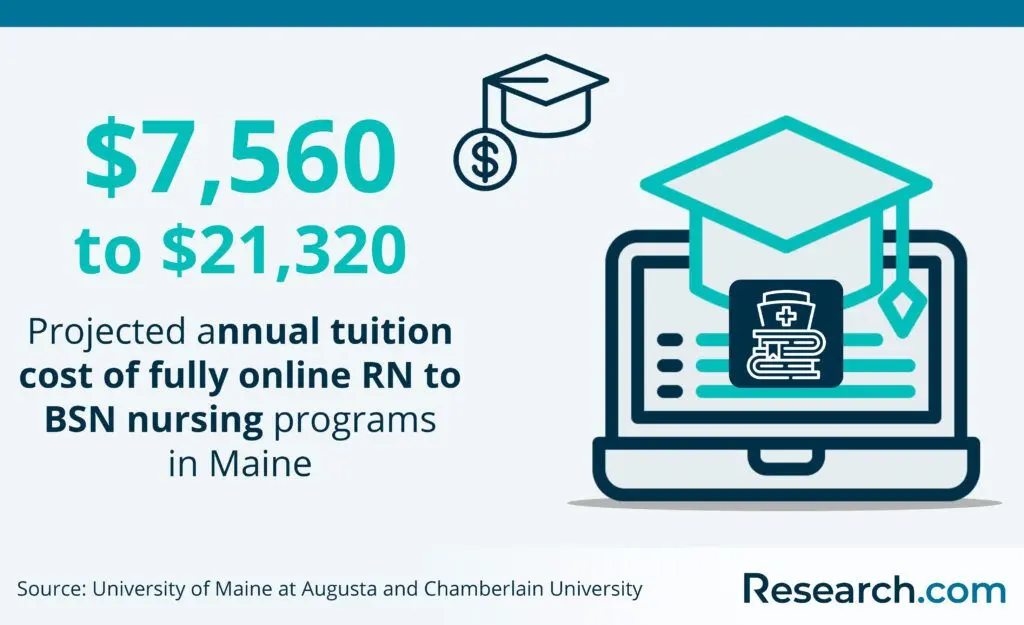
Based on posted tuition and cost information from selected Maine nursing schools, fully online RN to BSN programs in Maine may cost about $7,560 per year to $21,320 per year in tuition. Your actual out-of-pocket cost may be lower if you receive scholarships, grants, employer tuition reimbursement, discounted tuition, transfer credit, or tax benefits such as the lifetime learning credit.
Beal University provides a cost of attendance estimate for BSN students, and its online 14-month nursing program has a total COA of around $31,000 to $34,000 (Beal University, n.d.).
| Cost factor | Why it matters | Question to ask |
| Residency status | Some schools charge different rates for Maine residents and out-of-state online students. | Will I pay in-state, out-of-state, online, regional, or special program tuition? |
| Transfer credits | Accepted credits can shorten your program and reduce tuition. | How many credits will the school accept before I enroll? |
| Fees | Online technology, clinical, background check, exam, and graduation fees can add up. | What is the total program cost, not just tuition? |
| Clinical or capstone requirements | Some online programs still require local clinical, practicum, or community-based work. | Will I need to travel or pay for placement-related requirements? |
| Employer reimbursement | Many healthcare employers help working nurses pay for BSN or graduate study. | Does my employer reimburse tuition, and what grade or work commitment is required? |
Students who want a faster and potentially lower-cost entry route may consider LPN programs in Maine. However, online vocational nursing options may be limited in the state, and students may need to compare neighboring states or other jurisdictions if they specifically need online LPN coursework. If you are comparing practical nursing routes, see this overview of online LPN classes.
What scholarships and financial aid options are available in Maine?
Nursing students in Maine should build a funding plan before choosing a program. The cheapest school on paper is not always the most affordable once transfer credits, fees, commute costs, clinical requirements, and part-time enrollment are considered. Start with the FAFSA, then check state programs, institutional aid, employer benefits, and loan repayment opportunities tied to underserved areas.
- State-focused aid: The Maine Health Professions Loan Program offers forgivable loans for students in health-related fields, including nursing, who commit to serving underserved areas in Maine after graduation. The Maine Community Foundation also provides scholarships for Maine residents pursuing healthcare degrees, including nursing.
- School-based scholarships: Institutions such as the University of Maine System and St. Joseph’s College of Maine may offer need-based and merit-based awards. These can require GPA standards, enrollment minimums, or financial need documentation.
- National nursing scholarships: The HRSA Nursing Scholarship Program supports students who commit to working in underserved communities after graduation. The American Association of Colleges of Nursing (AACN) also lists scholarship opportunities for students enrolled in member institutions.
- Employer tuition reimbursement: Hospitals, clinics, long-term care facilities, and health systems in Maine may help employees pay for RN to BSN, MSN, certification, or continuing education programs. Always ask whether reimbursement is paid upfront or after grades are posted.
- Loan repayment programs: Nurses who work in rural or underserved communities may qualify for federal or state repayment programs, including the Nurse Corps Loan Repayment Program.
How long does it take to become a nurse in Maine?
Your timeline depends on whether you are entering the field for the first time, building on an existing nursing license, or moving into advanced practice. The fastest healthcare entry point is not always the best long-term path, so compare the credential with the work you actually want to do.
| Pathway | Typical time to complete | What happens after training |
| Certified Nursing Assistant (CNA) | Four to 12 weeks, with at least 180 hours of training | Pass the state competency exam and become listed as active on the Maine Registry before working as a CNA. |
| Licensed Practical Nurse (LPN) | 12 to 18 months | Complete an approved program, pass the NCLEX-PN, and obtain licensure before practicing. |
| Registered Nurse through ADN | Two to three years | Complete the associate degree, pass the NCLEX-RN, and apply for RN licensure. |
| Registered Nurse through BSN | Four years | Complete the bachelor’s degree, pass the NCLEX-RN, and qualify for RN roles that may prefer or require a BSN. |
| Certified Registered Nurse Practitioner (CRNP) | Usually two to four years after RN preparation, depending on program level | Complete graduate nursing education and meet national certification and Maine APRN requirements. |
| Certified Nurse Midwife (CNM) | Usually two to four years after RN preparation, depending on program level | Complete graduate midwifery-focused education, certification, and state requirements. |
After completing LPN or RN education, plan for additional time to study for the NCLEX, sit for the exam, and complete the licensing process. Many candidates set aside another month or three for exam preparation and application processing. Approval may take one to three weeks and is often sent by email.
APRNs should also account for the time needed to complete national certification exams and Maine licensure steps after finishing their graduate education. Nurse practitioners relocating from another state have 90 days from the time they move to Maine to obtain the RN compact license needed to practice in the state.
Can you become a nurse in Maine with an online degree?
Yes, but the answer depends on the nursing level. Online RN to BSN programs are common because they serve students who are already licensed RNs. Prelicensure nursing programs are different: even if lectures are online, students generally need in-person clinical experiences, labs, simulations, or supervised practice to meet licensure standards.
You may also study through an out-of-state online nursing program if it is properly accredited and meets applicable requirements from bodies such as the Commission on Collegiate Nursing Education (CCNE), the Accreditation Commission for Education in Nursing (ACEN), and the Maine State Board of Nursing. Before enrolling, confirm in writing that the program supports your intended Maine licensure or career goal.
The nursing shortage has pushed schools and healthcare leaders to expand flexible training models. Across University of Maine System institutions, nursing has become the fastest-growing undergraduate major. For A.Y. 2024-2025, nursing capacity expanded, with the BSN program admitting 75-90 incoming students and graduate nursing programs at the University of Maine at Fort Kent growing from 24 students in 2022 to 160 students enrolled.
- : "Online nursing can reduce scheduling barriers, but it does not remove licensure, clinical, accreditation, or hands-on training requirements. Always verify those details before paying a deposit."
Online Nursing Programs in Maine for 2027
Online RN to BSN programs are designed for licensed RNs who want to complete a bachelor’s degree without leaving the workforce. These programs can strengthen preparation in leadership, evidence-based practice, community health, quality improvement, professional communication, and graduate study readiness. They are not the same as entry-level nursing programs for students who do not yet hold RN licensure.
Coursework may be fully online, but some programs include a capstone, practicum, project, or community-based experience arranged near the student. Ask each school how placements work, who approves the site, and whether you are responsible for finding your own preceptor.
The following programs are included to help you compare cost, transfer credit, delivery format, accreditation, and completion timelines. Confirm all details directly with the institution before applying.
| School | Program length | Cost per credit | Credits and transfer policy | Accreditation |
| St. Joseph’s College of Maine | At least nine months | $378 per credit | 30 credits must be completed through SJC; total of 120 credit hours required; accepts up to 90 transfer credits | Commission on Collegiate Nursing Education (CCNE) |
| University of Maine Fort Kent | At least 10 months | $309 per credit hour | 120 credits with 30 credits completed at UMFK; general education courses are waived for those with prior bachelor’s degrees | Commission on Collegiate Nursing Education (CCNE) |
| Purdue Global | Approximately 18 months for full-time study | $315 per credit standard rate; $165 per credit for active duty military; $230 per credit for military veterans; $284 per credit for military spouses; $237 per credit for international students | Accepts up to 135 transfer credits | Commission on Collegiate Nursing Education (CCNE) |
| Colby-Sawyer College | At least 16 months | $300 per credit + $10 online technology fee per credit | 120 credits; accepts up to 90 transfer credits | Commission on Collegiate Nursing Education (CCNE) |
| University of Maine at Augusta | Three to five years | $252 per credit hour for Maine residents; $329 for out-of-state online students | 120 credit hours; accepts credits earned from selected nursing certificates and credits earned within the previous 10 years for courses comparable to baccalaureate-level nursing courses | Accreditation Commission for Education in Nursing (ACEN) |
1. St. Joseph’s College of Maine
The online RN to BSN program at St. Joseph’s College of Maine may appeal to RNs who want a quick completion route and already have many general education requirements finished. The program lets eligible students begin nursing coursework first, and applicants who satisfy general education prerequisites may transfer up to 75% of the credits required for graduation. Students can finish in as little as nine months, and SJC offers one free general education course for every nine nursing credits completed.
- Program Length: At least nine months
- Tracks/concentrations: RN to BSN
- Cost per Credit: $378 per credit
- Required Credits to Complete: 30 credits must be completed through SJC (total of 120 credit hours required, accepts up to 90 transfer credits)
- Accreditation: Commission on Collegiate Nursing Education (CCNE)
2. University of Maine Fort Kent
The University of Maine Fort Kent online RN to BSN program emphasizes leadership preparation and patient care improvement. UMFK highlights six annual start dates, seven-week asynchronous courses, and a tuition rate that includes all fees. Applicants generally need a current, unencumbered RN license, although UMFK may admit students who are awaiting NCLEX results under specific conditions.
- Program Length: At least 10 months
- Tracks/concentrations: RN to BSN
- Cost per Credit: $309 per credit hour
- Required Credits to Complete: 120 credits with 30 credits completed at UMFK (general education courses are waived for those with prior bachelor’s degrees)
- Accreditation: Commission on Collegiate Nursing Education (CCNE)
3. Purdue Global
Purdue Global offers an online RN to BSN program built for working nurses who want coursework in patient care, professional leadership, career planning, and portfolio development. Students complete clinical practice in their local community. The program includes a standard track for students with 50 transferable credits and an advanced start track for students with 90 transferable credits. Students may also choose courses connected to the Magnet Recognition Program® or the MSN Bridge Program.
- Program Length: Approximately 18 months for full-time study
- Tracks/concentrations: RN to BSN Standard Track; RN to BSN Advanced Start Track; Master of Science in Nursing Bridge Program
- Cost per Credit: $315 per credit standard rate, $165 per credit for active duty military, $230 per credit for military veterans, $284 per credit for military spouses, $237 per credit for international students
- Required Credits to Complete: Accepts up to 135 transfer credits
- Accreditation: Commission on Collegiate Nursing Education (CCNE)
4. Colby-Sawyer College
Colby-Sawyer College, located in nearby New Hampshire, has an articulation agreement with Southern Maine Community College, which offers an ADN. Its online RN to BSN program uses eight-week asynchronous courses and rolling admission. The curriculum includes upper-level nursing coursework and a capstone research project, with emphasis on evidence-based practice, leadership, quality, safety, community health, and public health. Academic advisers can help students build individualized plans and access online tutoring.
- Program Length: At least 16 months
- Tracks/concentrations: RN to BSN
- Cost per Credit: $300 per credit + $10 online technology fee per credit
- Required Credits to Complete: 120 credits (accepts up to 90 transfer credits)
- Accreditation: Commission on Collegiate Nursing Education (CCNE)
5. University of Maine at Augusta
The University of Maine at Augusta RN to BSN completion program combines online and blended learning. Some face-to-face events may be attended remotely through synchronized web conferencing. UMA’s curriculum uses an integral-holistic approach that covers contemporary nursing practice, sustainable care, meaningful professional practice, and nurse self-care strategies for managing work-related stress.
- Program Length: Three to five years
- Tracks/concentrations: RN to BSN
- Cost per Credit: $252 per credit hour for Maine residents, $329 for out-of-state online students
- Required Credits to Complete: 120 credit hours (accepts credits earned from selected nursing certificates and credits earned within the previous 10 years for courses comparable to baccalaureate-level nursing courses)
- Accreditation: Accreditation Commission for Education in Nursing (ACEN)
Is Maine good for nurses?
Maine can be a strong option for nurses who value community-based care, rural practice opportunities, compact licensure, and access to online degree-completion routes. It may be less ideal for nurses whose top priority is earning above the national RN wage average or living in a lower-cost state. The best answer depends on your specialty, employer, location, family budget, and lifestyle preferences.
Work environment and employment stability
The report The Nursing Workforce in Maine: Trends & Forecasts found that the unemployment rate among RNs in Maine is very low at 1.9%. It also reported that almost 9 in 10 licensed RNs in the state work as nurses full-time (69.6%), part-time (10%), or per diem (7.1%) in hospitals, ambulatory care, nursing homes, and other settings.
Some travel nurses have chosen to stay permanently in Maine facilities, citing supportive workplaces, compensation and benefits, advancement opportunities, local communities, and quality of life as reasons for making the move.
Education and workforce reform efforts
Maine has taken steps to strengthen nursing education and improve working conditions. RN members of the Maine State Nurses Association at Maine Medical Center recently reached an agreement addressing safe floating practices, breaks and meal periods, mandatory rotating shifts, and other workplace improvements.
State leaders have also supported workforce development. Maine Governor Janet Mills announced initiatives to attract and retain healthcare professionals, including proposals to expand scholarships and student loan repayment assistance for nurse educators, RNs, and other healthcare workers.
Local support has also helped expand nursing education infrastructure. A private donor and voters supported a $2.5 million simulation lab at the University of Southern Maine, the state’s largest nursing school. Investments like these can help increase program capacity and improve hands-on training quality.
Lifestyle: rural communities, coastal towns, and smaller cities
Maine offers a lifestyle that combines rural living, coastal communities, outdoor recreation, and small-city amenities. Nurses who enjoy skiing, snowboarding, hiking, fishing, boating, and seasonal changes may find the state appealing. Portland also offers restaurants, arts, and urban services while remaining much smaller than major metropolitan healthcare markets.
Cost of living
Maine’s cost of living is a serious consideration. The state has a cost of living index of 115.3, which is 15.3% higher than the U.S. average, and ranks 12th among states with the highest overall cost of living (Wisevoter, n.d.). Housing prices and transportation costs can affect how far a nursing salary goes, especially in desirable coastal areas.
As of this writing, the MIT Living Wage Calculator indicates that a single adult in Maine would need $34,382 per year ($16.53 per hour) to support themselves (MIT, n.d.). A cited U.S. BLS report lists an annual mean wage of $77,410 for nurses in Maine, which may support a comfortable lifestyle for some nurses. However, “comfortable” depends on housing, debt, dependents, location, benefits, overtime, and personal spending.
How is telehealth reshaping nursing practice in Maine?
Telehealth is especially relevant in Maine because many residents live in rural, coastal, or island communities where travel to healthcare facilities can be difficult. Nurses may use digital platforms for virtual check-ins, remote monitoring, care coordination, patient education, chronic disease follow-up, and communication with interdisciplinary teams.
For nurses, this trend creates a need for stronger skills in digital documentation, patient coaching, remote assessment, privacy compliance, escalation protocols, and technology-supported care. Telehealth does not replace bedside nursing, but it can expand access and improve continuity of care. If you are new to the state’s nursing pathway, this career guide explains how to become an RN in Maine.
What are the renewal and compliance requirements for a nursing license in Maine?
Initial licensure is only the first compliance step. Maine nurses must track renewal deadlines, keep contact information current, follow Board rules, and maintain documentation that may be required for practice, employment, compact privileges, or advanced certification. Requirements can differ for LPNs, RNs, and APRNs, so do not rely on a school advisor or employer alone. Review the current nursing license requirements in Maine before renewal or relocation.
What can I do with a nursing degree in Maine?
A nursing degree can lead to work in hospitals, ambulatory care, long-term care, home health, hospice, rural clinics, community health, veterans’ care, travel nursing, leadership, education, and advanced practice. Nurses who want additional flexibility may also continue through online nursing classes toward a master’s or doctoral degree.
Maine’s healthcare sector is one of the state’s major employers, but workforce shortages remain a concern. Recent studies and forecasts reported that Maine still had an 8% shortage of RNs, equal to 1,450 registered nurses. That shortage is expected to decline to 6%, or around 1,000 RNs, by 2026 (Nightingale, 2026), although workforce conditions can change.
Maine also ranks third among the top five states with the highest share of nursing facilities with staffing shortages. This does not guarantee a job for every graduate, but it does signal continued need in certain care settings.
The state is also home to Togus VA Medical Center, the first veterans’ facility in the U.S. The VA Maine healthcare system provides primary and specialty services, including addiction and substance abuse care, mental health, pain management, palliative and hospice care, physical medicine, and rehabilitation. It currently offers a signing bonus, education benefits, and high salaries for tenured staff.
How does Maine's rural healthcare system impact nursing careers?
Maine’s rural healthcare system can expand a nurse’s responsibilities and professional visibility. In smaller communities, nurses may work with broader patient needs, fewer nearby specialists, longer transport times, and closer patient relationships. This can be rewarding, but it also requires strong assessment, communication, triage, cultural awareness, and care coordination skills.
- Broader practice exposure: Rural nurses may encounter primary care, urgent needs, chronic disease management, geriatric care, behavioral health, home health, and community education in the same role.
- Preparation through BSN study: An RN to BSN program can support rural practice by strengthening leadership, population health, evidence-based practice, and community health skills.
- Potential incentives: Some rural or underserved settings may connect nurses with scholarships, loan repayment, or employer-supported education designed to improve recruitment and retention.
- Infrastructure improvement: Statewide efforts to strengthen healthcare access and working conditions, including policy discussions such as the Maine Quality Care Act, can affect how nurses experience rural practice.
If you do not yet have a nursing background but want to prepare for a rural nursing career, compare online BSN programs for non nurses carefully. Make sure any program you choose includes appropriate clinical preparation and supports licensure in your state.
What factors should I consider when evaluating online nursing programs in Maine?
Do not choose an online nursing program based only on speed or tuition. The right program should match your license status, work schedule, clinical needs, transfer credits, career plan, and budget. A program that is affordable but does not meet licensure or advancement requirements can become expensive later.
| Evaluation factor | Why it matters | What to ask the school |
| Accreditation | Employers, graduate schools, and licensing bodies may look for recognized nursing accreditation. | Is the nursing program accredited by CCNE or ACEN? |
| State authorization and licensure fit | Out-of-state online programs may not meet every state’s requirements. | Does this program meet Maine requirements for my intended license or role? |
| Clinical or practicum support | Online coursework may still require local hands-on experiences. | Who finds and approves clinical or practicum sites? |
| Total cost | Fees, transfer policies, and part-time pacing can change the final price. | What is my estimated total cost after transfer credit evaluation? |
| Schedule flexibility | Working nurses may need asynchronous courses or multiple start dates. | Are courses asynchronous, synchronous, blended, or fixed-time? |
| Student support | Advising, tutoring, library access, tech help, and career support can affect completion. | What support is available to online students? |
| Outcomes | Graduation, retention, licensure, and employment data can help assess program quality. | What outcomes data can you share for online nursing students? |
If you are benchmarking graduate nursing costs, this overview of the most affordable online MSN programs may help you compare pricing structures, but always verify whether a program meets your state and specialty requirements.
What professional support networks are available for Maine nurses?
Professional networks can help Maine nurses find mentors, learn about job openings, understand policy changes, prepare for specialty certification, and stay connected to local practice issues. Useful networks may include statewide nursing associations, specialty organizations, employer-based councils, alumni groups, clinical preceptor relationships, and continuing education communities.
Students can also build early connections through accredited nursing schools in Maine. When comparing schools, ask how they connect online learners with faculty, alumni, clinical partners, and professional development opportunities.
How can pursuing an LVN pathway complement your nursing career in Maine?
Maine commonly uses the Licensed Practical Nurse (LPN) title rather than Licensed Vocational Nurse (LVN), but students comparing national terminology may see both labels. A practical nursing pathway can offer a faster entry into patient care than an RN route and may later support bridge options toward RN or BSN study. This path can make sense if you want to start working sooner, build bedside experience, and continue your education in stages.
Before choosing this route, confirm the exact credential recognized in Maine, program approval, NCLEX eligibility, and whether credits will transfer into later nursing programs. For a related pathway overview, review how to become an LVN nurse in Maine.
Can I pursue an online RN to MSN program in Maine and advance my nursing practice?
An RN to BSN program can strengthen your foundation, but nurses who want advanced practice, nurse educator, leadership, or specialized clinical roles may eventually need an MSN or doctoral degree. Online RN to MSN programs may be available, but they still usually include clinical requirements that must be completed in approved settings.
When an RN to MSN pathway may make sense
- You want advanced practice options: An MSN can support preparation for nurse practitioner, clinical nurse specialist, nurse educator, or other advanced roles, depending on the program and certification pathway.
- You need flexibility: Online coursework can help working nurses continue earning income while progressing academically.
- You have a clear specialty goal: Graduate nursing study is most valuable when the track aligns with the population or role you want to serve.
What to check before applying
- Program availability: Online RN to MSN options may be less common than RN to BSN programs in Maine, so compare in-state and out-of-state options carefully.
- Admission prerequisites: Many RN to MSN programs require an RN license and a BSN, while bridge programs may have different requirements.
- Clinical placement rules: Ask whether the school helps secure placements in Maine or expects students to find their own sites.
Alternatives for aspiring advanced practice nurses
- Campus-based MSN programs: If online options are limited, a traditional MSN program in Maine may provide stronger local clinical placement support.
- ADN to MSN bridge programs: Nurses with an ADN may compare bridge routes that combine BSN and MSN preparation. This guide to RN to NP programs explains how some bridge options work.
How can developing proficiency in medical billing and coding enhance nursing practice in Maine?
Nurses who understand billing, coding, documentation, and revenue cycle basics can communicate more effectively with administrative teams and reduce errors that affect reimbursement, compliance, and patient records. These skills are especially useful for case management, care coordination, quality improvement, clinic leadership, utilization review, and roles that blend clinical and administrative responsibility.
Billing and coding knowledge is not a replacement for nursing expertise, but it can make a nurse more effective in systems where documentation accuracy and insurance processes affect patient access and organizational performance. If you want to explore that administrative pathway separately, see how to become a medical biller and coder in Maine.
What continuing education opportunities are available for nurses in Maine?
Continuing education helps nurses keep pace with clinical changes, technology, patient safety standards, specialty expectations, and employer requirements. Maine nurses should confirm current renewal rules with the Board and also track any continuing education required by employers, national certifications, compact practice, or advanced practice credentials.
Common professional development options include workshops, online courses, seminars, simulation training, specialty certifications, in-house hospital education, and graduate programs. Nurses pursuing advanced practice may compare nurse practitioner programs in Maine if they want to move into primary care, family health, or another advanced clinical track.
Employer support can be valuable. Many healthcare organizations offer tuition reimbursement, paid training, certification support, or career ladders, but benefits often come with conditions such as minimum grades, continued employment, or approved program lists.
What are the career pathways for LPNs in Maine?
LPNs provide important bedside care and can use practical nursing as either a long-term career or a bridge toward RN preparation. Common next steps include specialty experience, employer-based training, LPN-to-RN bridge programs, ADN completion, BSN study, and eventually graduate nursing education for those who continue advancing.
The best path depends on your timeline, finances, work schedule, and desired scope of practice. LPNs who want a clear starting point can review how to become an LPN in Maine for education and licensing guidance.
How can allied health roles, such as medical assistants, optimize nursing workflows in Maine?
Medical assistants and other allied health professionals can help nursing teams by handling routine clinical and administrative tasks such as rooming patients, collecting basic information, preparing charts, supporting documentation, and assisting with patient flow. When these roles are used well, nurses can spend more time on assessment, education, care planning, triage, medication-related tasks, and complex patient needs.
Healthcare teams in Maine may benefit when nurses understand how to delegate appropriately and collaborate with trained support staff. Students interested in this related pathway can compare medical assistant programs in Maine.
Which specialized nursing roles promise significant career growth in Maine?
Specialized nursing roles can offer stronger advancement potential when they align with Maine’s care needs, such as rural primary care, geriatrics, behavioral health, chronic disease management, acute care, pediatrics, women’s health, hospice, and community health. Advanced practice nurses may also have opportunities in underserved areas where access to physicians and specialists is limited.
Specialization should be chosen strategically. Do not pursue a certificate only because it sounds marketable. Look at local employer demand, clinical placement availability, certification requirements, scope of practice, and whether the credential supports your desired role. For salary-oriented comparisons, review this guide to highest paying nurse practitioner jobs, then verify Maine-specific demand before committing.
How can I transition into a nurse practitioner role in Maine?
To become a nurse practitioner in Maine, you generally need RN preparation, graduate nursing education, supervised clinical training, national certification in your population focus, and Maine APRN authorization. The process requires planning because NP programs differ by specialty, clinical placement support, online format, and certification outcomes.
Start by choosing the patient population you want to serve, such as family, adult-gerontology, psychiatric-mental health, pediatrics, women’s health, or acute care. Then confirm that the program is accredited, prepares graduates for the correct certification exam, and supports clinical placement where you live or plan to work. For a step-by-step pathway, see how to become a nurse practitioner in Maine.
How can I become a nurse midwife in Maine?
Nurse midwives provide care related to pregnancy, birth, postpartum health, reproductive care, and primary health needs within their scope. In Maine, this path typically requires RN licensure, graduate-level midwifery education, clinical training, national certification, and state authorization.
When comparing midwifery programs, look closely at clinical rotation quality, birth experience requirements, preceptor support, accreditation, certification pass preparation, and whether the program can place students in Maine or nearby communities. For detailed pathway guidance, review how to become a nurse midwife in Maine.
Common mistakes to avoid when choosing a nursing program in Maine
- Assuming “online” means no in-person requirements: Nursing education often includes clinical, lab, practicum, or capstone components even when coursework is online.
- Ignoring accreditation: Accreditation can affect graduate school admission, employer acceptance, and eligibility for some professional pathways.
- Looking only at tuition: Fees, transfer credit limits, clinical travel, books, exam costs, and time to completion can change the real price.
- Skipping licensure verification: Out-of-state online programs may not automatically meet Maine requirements. Confirm before enrolling.
- Overvaluing speed: A fast program is useful only if it provides the required preparation and fits your work and family schedule.
- Assuming salary outcomes are guaranteed: Pay depends on location, specialty, shift, employer, experience, benefits, overtime, and cost of living.
- Not asking about clinical placement: Some schools help secure placements; others expect students to arrange them. This can delay graduation.
- Forgetting transfer credit evaluation: Get an official or detailed preliminary transfer review before you commit to a program.
Questions to ask before enrolling in an online nursing program in Maine
- Is the program accredited by CCNE or ACEN?
- Does the program meet Maine licensure or advancement requirements for my intended role?
- How many of my previous credits will transfer?
- What is the full program cost after fees, books, technology charges, and clinical expenses?
- Are courses asynchronous, synchronous, blended, or self-paced?
- Will I need clinical, practicum, simulation, or capstone experiences?
- Who is responsible for finding clinical placements or preceptors?
- What student support is available to online learners?
- What are the graduation, retention, NCLEX, or certification outcomes?
- Does the school have employer partnerships or tuition reimbursement relationships in Maine?
Pursuing your nursing career in Maine
Maine can be a meaningful place to study and practice nursing, especially for nurses who want community-based work, rural healthcare experience, outdoor access, and flexible degree-completion options. It also presents real considerations: wages may be below the national mean, the cost of living is above the U.S. average, and rural practice can require broader responsibilities.
For licensed RNs, accredited RN to BSN online programs can provide a practical route to bachelor’s-level preparation without pausing employment. For new students, the best path depends on whether you want the quickest entry into care, the broadest RN preparation, or a long-term route toward advanced practice.
Maine’s ongoing efforts to strengthen nursing education and working conditions, including initiatives connected to the Maine Quality Care Act, may continue shaping the profession. Still, the best nursing program is the one that fits your license goal, budget, learning style, clinical needs, and career plan.
Key Insights
- Maine offers flexible RN to BSN options, but online nursing programs may still require clinical, capstone, practicum, or community-based work.
- The annual mean wage for RNs in Maine is $82,860, below the national mean wage of $93,600, so cost of living and employer benefits matter when evaluating ROI.
- Fully online RN to BSN tuition in selected Maine programs may range from about $7,560 per year to $21,320 per year, before scholarships, grants, reimbursement, or tax benefits.
- Maine is part of the Nurse Licensure Compact, which can help eligible nurses practice across compact states, but relocation and primary residence rules still matter.
- Rural healthcare is a major part of Maine nursing. It can offer broader responsibility and community impact, but it also demands strong independence, coordination, and adaptability.
- Before enrolling, verify accreditation, state licensure fit, total cost, transfer credits, clinical placement support, and online student services.
- Do not choose a program based only on speed or tuition. The right nursing pathway should support your intended license, specialty, budget, and long-term career mobility.
Related Articles for Nearby States
- 2027 Best Online Nursing Programs in New Hampshire – Accredited RN to BSN Programs
- 2027 Best Online Nursing Programs in Massachusetts – Accredited RN to BSN Programs
- 2027 Best Online Nursing Programs in Connecticut – Accredited RN to BSN Programs
- 2027 Best Online Nursing Programs in New York – Accredited RN to BSN Programs
- 2027 Best Online Nursing Programs in New Jersey – Accredited RN to BSN Programs
- 2027 Best Online Nursing Programs in Pennsylvania: Accredited RN to BSN Programs
- 2027 Best Online Nursing Programs in Delaware – Accredited RN to BSN Programs
- 2027 Best Online Nursing Programs in Maryland – Accredited RN to BSN Programs
- 2027 Best Online Nursing Programs in Ohio – Accredited RN to BSN Programs
- 2027 Best Online Nursing Programs in West Virginia – Accredited RN to BSN Programs
References:
- American Association of Colleges of Nursing. (2025). 2024-2025 Enrollment and Graduations in Baccalaureate and Graduate Programs. https://www.aacnnursing.org
- Massachusetts Institute of Technology. (n.d.). Living Wage Calculation for Maine. https://livingwage.mit.edu/states/23
- NurseJournal. (2025). The Top 20 Highest-Paying Nursing Specialties. https://nursejournal.org/articles/best-nursing-specialities-for-the-future/
- University of Maine at Augusta. (n.d.). Tuition & Fees. https://www.uma.edu/financial/costs/tuition
- Wisevoter. (n.d.). Cost of Living by State. https://wisevoter.com/state-rankings/cost-of-living-by-state
Other Things You Should Know About Online Nursing Programs in Maine
Yes. Many Maine online RN to BSN programs accept registered nurses licensed in another U.S. state, but they still require an active, unencumbered RN license and a regionally accredited associate degree or nursing diploma. Some schools also require Maine-specific background checks or residence for practicum placement.
Yes, various scholarships are available for online RN to BSN programs in Maine in 2027. These include state-funded incentives and institution-specific awards. Students should explore options like the Maine Nurse Corps Scholarship Program for potential financial support to help offset educational costs.
Online RN to BSN programs in Maine often require students to complete clinical practice hours at approved healthcare facilities. Typically, these range from 90 to 120 hours. Specific requirements vary, so it’s essential to confirm with individual programs for details about location and supervision criteria.


