2027 How to Become a Nurse in Maine

Co-Founder and Chief Data Scientist
Becoming a nurse in Maine is a practical career path for people who want a licensed healthcare role with clear education steps, steady demand, and options to advance into higher-responsibility positions. The state had approximately 14,770 registered nurses in 2023, with registered nurses earning an average annual salary of $84,340. Employment for registered nurses in Maine is projected to grow by 5.4% through 2032, with about 4,090 annual openings during that period.
This guide explains how to become a nurse in Maine, including the education routes, licensing process, license types, compact nursing rules, salary and job outlook, online program considerations, advanced practice options, and common mistakes to avoid. It is designed for prospective nursing students, career changers, current LPNs or RNs, and nurses relocating to Maine.
Quick Answer: How Do You Become a Nurse in Maine?
To become a nurse in Maine, you must complete a state-approved nursing education program, pass the appropriate NCLEX exam, apply for licensure through the Maine State Board of Nursing, complete required background checks, and renew your license on schedule. RNs typically complete an ADN or BSN program and take the NCLEX-RN. LPNs complete a practical nursing program and take the NCLEX-PN. Advanced practice nurses need graduate education and additional certification.
Key Things You Need to Know About Becoming a Nurse in Maine
- Maine has ongoing demand for nurses. Earlier projections pointed to a need for more than 3,000 additional nurses by 2025, and current long-term projections still show continued openings for registered nurses.
- RN pay is strong compared with many occupations in the state. Registered nurses in Maine earned an average annual salary of about $84,340 in 2023.
- The job outlook is positive but not guaranteed for every applicant. Registered nursing employment is projected to grow by 5.4% through 2032, with about 4,090 annual openings, but hiring conditions vary by specialty, location, employer, and experience level.
- There is more than one education route. Students may choose an ADN, BSN, LPN program, RN-to-BSN pathway, accelerated BSN, MSN, DNP, or PhD depending on their starting point and career goal.
- Licensure matters. You cannot legally practice as a nurse in Maine without the appropriate nursing license, and online programs should be checked carefully for state approval, accreditation, clinical placement support, and licensure eligibility.
- Steps to becoming a nurse in Maine
- Education requirements for Maine nurses
- Types of nurses who can practice in Maine
- Maine nursing licensing requirements
- Types of nursing licenses in Maine
- Compact nursing practice in Maine
- Practicing nursing without a license in Maine
- Current state of nursing in Maine
- Nursing job outlook in Maine
- Related healthcare careers in Maine
- Financial aid for Maine nursing students
- Nursing program options in Maine
- Nurse practitioner education requirements
- RN-to-BSN online options in Maine
- Technology and career-building skills
- LVN and LPN pathways in Maine
- Flexible online nursing programs
- Maintaining a Maine nursing license
- Rural nursing in Maine
- Advanced nursing education in Maine
- Becoming a nurse midwife in Maine
What are the steps to becoming a nurse in Maine?
The steps depend on whether you want to become an LPN, RN, or advanced practice nurse. The overall process is similar: choose the right nursing role, complete an approved education program, pass the required licensing exam, apply to the Maine State Board of Nursing, and keep your license active through renewal and professional development.
| Step | What to Do | Why It Matters |
| 1. Choose your nursing role | Decide whether you want to become an LPN, RN, nurse practitioner, nurse midwife, nurse anesthetist, or another advanced practice nurse. | Your role determines the degree level, exam, license, scope of practice, and career timeline. |
| 2. Complete an approved nursing program | LPNs complete a practical nursing program. RNs usually complete an ADN or BSN. APRNs need graduate-level nursing education. | Maine requires formal nursing education before licensure. |
| 3. Pass the licensing exam | RNs take the NCLEX-RN. LPNs take the NCLEX-PN. | The NCLEX is required to demonstrate entry-level nursing competence. |
| 4. Apply for a Maine license | Submit the application, required documents, background check information, and fee to the Maine State Board of Nursing. | You must receive a license before practicing as a nurse in Maine. |
| 5. Maintain your license | Renew your license every two years and follow continuing competency requirements. | Renewal keeps your authority to practice active and in good standing. |
- Education comes first. Aspiring RNs must complete an approved RN program, while LPNs complete a practical nursing program. Nurse practitioners, certified nurse-midwives, and other APRNs generally need a graduate degree.
- Licensing exams are required. RN candidates take the NCLEX-RN, and LPN candidates take the NCLEX-PN.
- Application fees apply. In Maine, the application fee is $75 for RNs and $50 for LPNs. Nurses licensed in another state may use endorsement when eligible.
- Renewal is ongoing. Maine nursing licenses must be renewed every two years, aligned with the nurse’s birthday. The renewal fee is $75, and nurses must demonstrate continued competency through professional development.
If you are considering advanced practice later, review career earnings carefully before committing to graduate school. For example, comparing the DNP salary by state can help you understand how doctoral nursing roles may differ by location and specialty.
In 2023, Maine had around 14,770 registered nurses. The chart below shows employment levels for selected nursing occupations in the state.
What are the educational requirements for becoming a nurse in Maine?
Maine offers several nursing education pathways. The best option depends on how quickly you want to enter the workforce, whether you already have college credits or a bachelor’s degree, and whether your long-term goal is bedside nursing, leadership, education, or advanced practice.
| Program Type | Typical Purpose | Best For | Key Consideration |
| Practical nursing program | Prepares students for LPN licensure | Students who want a shorter route into nursing care | Scope of practice is more limited than RN practice. |
| Associate Degree in Nursing (ADN) | Prepares students for RN licensure | Students who want an efficient RN pathway | Some employers may prefer or require a BSN for certain roles. |
| Bachelor of Science in Nursing (BSN) | Prepares students for RN licensure and broader career options | Students interested in hospital roles, leadership, public health, or graduate study | Usually takes longer than an ADN but may support advancement. |
| Accelerated BSN | Allows students with prior degrees to transition into nursing | Career changers who already hold a bachelor’s degree | Programs can be intensive and may limit ability to work full time. |
| Master of Science in Nursing (MSN) | Prepares nurses for advanced clinical, leadership, or specialty roles | RNs pursuing nurse practitioner, clinical specialist, education, or administrative roles | Admission often requires an active RN license and prior nursing education. |
| DNP or PhD | Supports advanced practice leadership, systems improvement, or research | Nurses pursuing top clinical, academic, policy, or research roles | DNP programs are practice-focused; PhD programs are research-focused. |
- Associate Degree in Nursing (ADN): An ADN is commonly used as a two-year route to RN eligibility. It focuses on foundational nursing knowledge, direct patient care, and clinical practice.
- Bachelor of Science in Nursing (BSN): A BSN is a four-year degree that includes nursing science, clinical care, leadership, research, community health, and broader professional preparation. Some students also compare accelerated BSN options, including the best accelerated BSN program choices available to qualified applicants.
- Master of Science in Nursing (MSN): An MSN usually follows a BSN and supports advanced roles such as nurse practitioner, clinical nurse specialist, nurse anesthetist, educator, or administrator.
- Doctorate Degrees (DSN, DNP, PhD): Doctoral nursing pathways may support high-level clinical practice, systems leadership, research, policy, or academic careers. Maine residents may also compare online options such as the best shortest online DNP programs, while confirming clinical and licensing requirements before enrolling.
Before choosing any nursing school, verify that the program is properly approved for Maine licensure, that clinical placements are available, and that graduates are eligible for the intended NCLEX or certification exam. Online format alone is not enough; the program must still meet state and professional requirements.
What types of nurses can legally practice in Maine?
Maine recognizes several nursing and nursing-related roles. Each role has a different scope of practice, education requirement, and level of responsibility. Choosing the right role early can prevent wasted time and tuition.
- Registered Nurses (RNs): RNs provide patient assessments, medication administration, care planning, patient education, coordination with providers, and clinical monitoring. RN candidates must complete an approved nursing program and pass the NCLEX-RN. Maine has approximately 22,000 RNs, showing the importance of this role across hospitals, clinics, long-term care, community health, and home care.
- Licensed Practical Nurses (LPNs): LPNs deliver basic nursing care under the supervision of RNs, physicians, or other authorized providers. They typically complete a one-year practical nursing program and pass the NCLEX-PN. Maine has around 5,000 LPNs.
- Advanced Practice Registered Nurses (APRNs): APRNs include nurse practitioners, clinical nurse specialists, certified registered nurse anesthetists, and certified nurse-midwives. These nurses hold advanced education and may diagnose, treat, prescribe, or provide specialized care depending on their role and authority. Maine has more than 1,500 APRNs practicing in the state.
- Certified Nursing Assistants (CNAs): CNAs are not licensed nurses, but they are important members of the care team. They help patients with activities of daily living and support nursing staff after completing state-approved training and a competency exam.
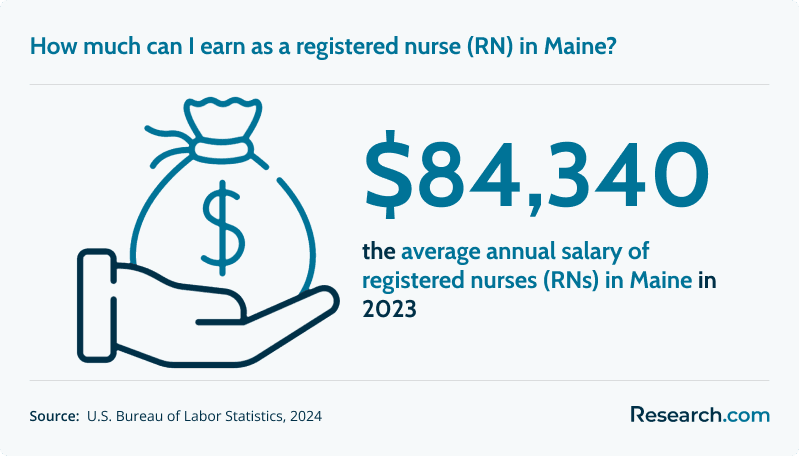
In 2023, registered nurses in Maine earned around $84,340 on average.
What are the licensing requirements for nurses in Maine?
Nursing licensure in Maine is handled by the Maine State Board of Nursing. The board verifies that applicants meet education, examination, background check, and professional standards before they are allowed to practice.
- Approved education: RN applicants generally complete an ADN or BSN program. LPN applicants complete a practical nursing program. Advanced practice nurses complete graduate-level nursing education and role-specific certification requirements.
- NCLEX exam: RN candidates must pass the NCLEX-RN, while LPN candidates must pass the NCLEX-PN.
- Application submission: Applicants submit required documentation to the Maine State Board of Nursing. The application fee is typically around $75.
- Criminal background check: Maine requires nursing candidates to complete a background check, including fingerprinting. Fingerprinting fees vary but are generally around $50.
- Board review: The Maine State Board of Nursing evaluates applications and determines whether the applicant meets the legal requirements for practice.
The most important step is to confirm your program is acceptable for Maine licensure before you enroll. This is especially important for students considering online, out-of-state, accelerated, or bridge programs.
What types of nursing licenses are available in Maine?
Maine’s nursing licenses correspond to different levels of training and clinical authority. The license you pursue should match the type of patient care you want to provide and the level of independence you want in your career.
| License or Credential | Typical Education | Primary Role |
| Licensed Practical Nurse (LPN) | Practical nursing program | Provides basic nursing care under supervision |
| Registered Nurse (RN) | ADN or BSN | Provides comprehensive nursing care, care coordination, and patient education |
| Certified Nurse Practitioner (CNP) | Master’s or doctoral nursing program | Diagnoses, treats, manages care, and may prescribe within role authority |
| Certified Nurse Midwife (CNM) | Graduate nursing and midwifery preparation | Provides pregnancy, birth, postpartum, and women’s health care |
| Certified Registered Nurse Anesthetist (CRNA) | Graduate-level anesthesia preparation | Provides anesthesia care before, during, and after procedures |
| Clinical Nurse Specialist (CNS) | Graduate nursing specialization | Improves care quality, supports evidence-based practice, and provides specialty expertise |
- Registered Nurse (RN): RNs complete an approved nursing program and pass the NCLEX-RN. Many begin with an associate degree, while others complete a BSN for broader employment and advancement options.
- Licensed Practical Nurse (LPN): LPNs complete a shorter training program and pass the NCLEX-PN. If you are comparing entry-level nursing routes, review how to become an LPN online while checking whether the program meets Maine requirements.
- Certified Nurse Practitioner (CNP): CNPs are advanced practice nurses with graduate education who may provide primary or specialty care.
- Certified Nurse Midwife (CNM): CNMs focus on pregnancy, childbirth, postpartum care, and women’s health.
- Certified Registered Nurse Anesthetist (CRNA): CRNAs administer anesthesia and manage anesthesia-related care.
- Clinical Nurse Specialist (CNS): CNSs apply advanced clinical expertise to improve patient outcomes, staff practice, and healthcare systems.
Advanced nursing roles can offer higher earnings, but they also require more education, clinical preparation, and certification. For salary context, compare average nurse practitioner salaries by state. In Maine, nurse practitioners earned around $122,940 in 2023. The chart below compares selected nursing salaries.
Can a Compact nurse practice in Maine?
Yes. Maine participates in the Nurse Licensure Compact, which allows eligible RNs and LPN/VNs with a multistate license to practice in Maine without obtaining a separate single-state Maine license. This is useful for travel nurses, telehealth nurses, military spouses, and nurses who work across state lines.
- Multistate practice: A nurse with a valid compact multistate license may practice in Maine and other compact jurisdictions.
- Residency rule: If a nurse moves to Maine and makes Maine their primary state of residence, they must apply for a new multistate license within 60 days.
- Public protection standards: Compact participation includes uniform eligibility standards and background check requirements.
The compact can reduce licensing friction, but it does not remove employer credentialing, specialty certification, facility onboarding, or scope-of-practice requirements. Nurses should confirm their license status before accepting a Maine assignment or telehealth role.
Can you practice as a nurse without a license in Maine?
No. You cannot legally practice as an RN or LPN in Maine without the required nursing license. Nursing licensure protects patients by confirming that a nurse has completed approved education, passed the relevant exam, and met state practice standards.
If you are not ready for RN or LPN licensure, consider legal healthcare entry points such as CNA training, medical assisting, patient care support, or volunteering in non-nursing roles. Some students also compare schools with accessible admissions standards, including the easiest nursing schools to get into, while remembering that admission difficulty is only one factor.
- Do not represent yourself as a nurse without a license. Titles such as RN and LPN are regulated.
- Complete the correct pathway. Graduation from an approved program and passing the NCLEX are central requirements.
- Know where LPNs work. The largest employers of licensed practical and vocational nurses include nursing and residential care facilities at 35%, hospitals at 15%, and home healthcare services at 13%.
-
: "
Before you begin clinical work, ask the school and the Maine State Board of Nursing whether your program leads to the license you want. This is especially important if the program is online or based outside Maine.
"
What is the state of nursing in Maine?
Nursing in Maine is shaped by an aging population, rural access issues, hospital and long-term care staffing needs, and growing use of home-based and community-based care. The Maine State Board of Nursing regulates nursing practice, while employers across the state rely on nurses in hospitals, clinics, nursing homes, public health agencies, and home healthcare settings.
The state offers meaningful opportunities, but it also requires realistic planning. Rural practice may involve broader responsibilities, longer travel distances, limited specialty access, and closer relationships with patients and families. Urban and regional medical centers may offer more specialized departments, but competition and credential expectations can vary.
- Healthcare services: Hospitals, clinics, outpatient centers, and long-term care facilities remain major employers for nurses.
- Home health care: Demand for care delivered in patients’ homes creates opportunities for nurses who prefer community-based work and flexible scheduling.
- Public health: Nurses contribute to prevention, education, community outreach, and population health initiatives.
Maine also offers support resources such as the Medical Professionals Health Program for clinicians facing substance use or mental health concerns. For nurses, maintaining personal wellness is part of long-term professional sustainability.
What is the job outlook for nursing in Maine?
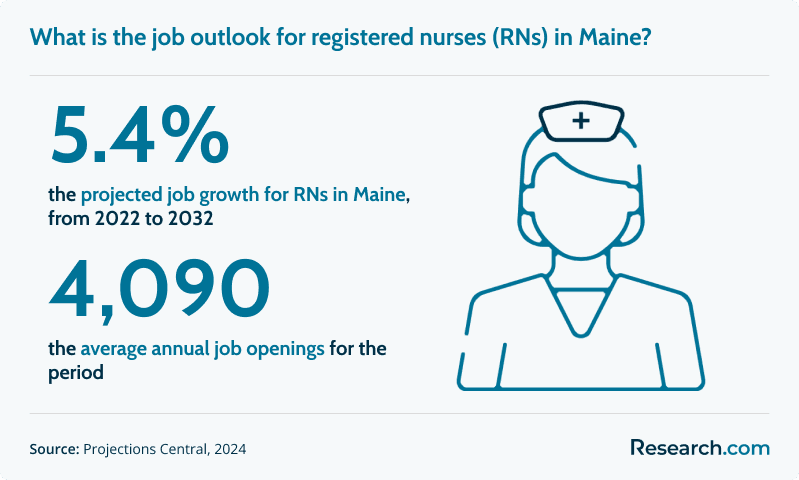
The job outlook for nurses in Maine is favorable, especially for applicants who are licensed, clinically prepared, flexible about work setting, and open to rural or high-need areas. According to long-term projections, registered nurse employment in Maine is expected to grow by 5.4% from 2022 to 2032, with an average of 4,090 annual openings during that period.
Pay varies by role, experience, employer, shift, specialty, and location. In 2023, registered nurses in Maine earned an average annual salary of about $84,340, compared with an average annual wage in the state of $60,000. Advanced practice roles may pay more, but they require additional education, certification, and responsibility.
- Higher-paying locations: Portland and Bangor are among the top-paying metropolitan areas for nurses in Maine, particularly for specialized or experienced nurses.
- Common higher-paying settings: Hospitals, outpatient care centers, and home healthcare services may offer strong opportunities, though pay depends on role and employer.
- Advanced practice earnings: Nurse anesthetists and nurse practitioners are among the higher-paid nursing roles, often earning around $120,000 to $225,000 annually.
- LPN earnings: Licensed practical nurses in Maine average around $71,430 per year.
Job growth does not mean every graduate will receive the same salary or job offer. Students should compare local employers, clinical placement quality, NCLEX preparation, specialty demand, and whether a program has relationships with healthcare facilities in Maine.
What other healthcare career opportunities complement a nursing career in Maine?
Nursing is not the only healthcare path in Maine. Some students begin in another healthcare role before nursing school, while others move from nursing into interdisciplinary careers. Pharmacy, laboratory services, medical billing, respiratory therapy, care coordination, and health informatics can all overlap with nursing work.
If medication therapy, patient counseling, and drug safety interest you, learning how to become a pharmacist in Maine can help you compare a pharmacy pathway with nursing. The right choice depends on whether you prefer direct bedside care, medication management, diagnostics, administration, or long-term patient relationships.
Are there financial aid options and scholarships available for nursing students in Maine?
Nursing school costs can include tuition, fees, books, uniforms, background checks, immunizations, transportation, testing fees, and lost work hours during clinical rotations. Students should compare the total cost of attendance, not tuition alone.
- Start with the FAFSA. Federal grants, loans, and work-study eligibility usually begin with the FAFSA.
- Ask schools about nursing-specific aid. Colleges may offer scholarships, emergency grants, tuition discounts, or payment plans.
- Check employer support. Some hospitals, long-term care facilities, and healthcare systems offer tuition assistance or reimbursement for employees.
- Look for service-based options. Loan repayment or scholarship programs may be tied to working in shortage areas or public service roles.
- Budget for credentials. Specialty credentials can support advancement, so compare costs and benefits of nursing certifications after you know your specialty goal.
What kind of nursing programs are available in Maine to support my career goals?
Maine nursing programs serve different starting points. A high school graduate, working CNA, LPN, career changer with a bachelor’s degree, and experienced RN will usually need different program types.
| Your Starting Point | Program to Consider | Possible Goal |
| No nursing license | LPN, ADN, or BSN program | Entry into licensed nursing practice |
| Current CNA or healthcare worker | LPN or RN program | Move into licensed nursing responsibilities |
| Current LPN | LPN-to-RN bridge | Expand scope of practice and career options |
| Current RN with ADN | RN-to-BSN program | Prepare for leadership, specialty, or graduate study |
| Bachelor’s degree in another field | Accelerated BSN or entry-level nursing pathway | Transition into nursing more efficiently |
| Current BSN-prepared RN | MSN, DNP, or certificate program | Specialize or move into advanced practice |
Students interested in practical nursing can compare online LPN programs in Maine, but they should verify whether clinical requirements can be completed locally and whether the program is approved for Maine licensure.
Can online programs help bridge my RN to BSN transition in Maine?
Yes, online RN-to-BSN programs can help licensed RNs earn a bachelor’s degree while continuing to work. These programs are often designed for nurses who already hold RN licensure and need flexibility because of shifts, family responsibilities, or geographic distance from campus.
Before enrolling, ask whether the program is accredited, whether it accepts your transfer credits, how clinical or practicum requirements are handled, and whether your employer recognizes the degree. If you are comparing workload and difficulty, review what to expect from an RN to BSN online pathway.
How can embracing technology and complementary skills boost your nursing career in Maine?
Technology is now part of everyday nursing practice. Nurses may use electronic health records, telehealth platforms, remote monitoring tools, medication administration systems, clinical decision support tools, and patient communication portals. Strong digital skills can help nurses work more efficiently and communicate more clearly with care teams.
Career flexibility can also improve when nurses understand adjacent healthcare functions. For example, learning how to become a medical biller and coder in Maine can be useful for nurses interested in documentation quality, utilization review, revenue cycle work, compliance, or administrative roles.
What is the pathway for becoming an LVN in Maine?
Maine commonly uses the term Licensed Practical Nurse, or LPN, rather than Licensed Vocational Nurse, or LVN. The practical nursing pathway generally includes completing a state-approved practical nursing program, meeting clinical requirements, passing the NCLEX-PN, and applying for licensure.
If you are researching the LVN title because you are moving from another state, compare the terminology carefully. A practical nursing license may have a similar function, but state rules and titles differ. For a focused explanation, review how to become an LVN in Maine and confirm details with the Maine State Board of Nursing.
Which online nursing programs offer both quality and flexibility in Maine?
The strongest online nursing programs combine legitimate accreditation, clear licensure alignment, accessible faculty, strong advising, transparent costs, and reliable clinical placement guidance. Flexibility should not come at the expense of program approval or graduate eligibility.
- Check accreditation and state approval. Do this before applying.
- Ask about clinical placements. Know whether the school arranges placements or expects you to find them.
- Compare total cost. Include fees, technology costs, travel, supplies, and exam preparation.
- Review student support. Online students still need advising, tutoring, library access, technical help, and career services.
- Look at outcomes. Ask about completion rates, NCLEX pass rates when relevant, and employment support.
For program comparisons, review the best online nursing programs in Maine.
How do I maintain your nursing license in Maine?
Maintaining a Maine nursing license requires timely renewal, continued competency, and compliance with professional standards. Nurses should track renewal dates carefully because working with an expired license can create legal and employment problems.
- Renew every two years. Maine nursing licenses renew on a two-year cycle tied to the nurse’s birthday.
- Budget for renewal. The renewal fee is $75.
- Keep records. Save documentation of continuing education, employer training, specialty certifications, and professional development.
- Watch for rule changes. Requirements can change, so check board guidance regularly.
For a detailed checklist, review the requirements for nursing licensure in Maine.
What are the unique challenges and opportunities for rural nursing in Maine?
Rural nursing in Maine can be deeply rewarding, but it is not the same as working in a large urban hospital. Nurses may manage broader patient needs, work with fewer specialty resources, travel farther between sites, and build long-term relationships with the communities they serve.
| Rural Nursing Challenge | Why It Matters | How to Prepare |
| Limited specialty access | Patients may need stabilization, referral, or telehealth-supported care. | Build strong assessment, triage, and communication skills. |
| Smaller care teams | Nurses may take on wider responsibilities. | Seek clinical experiences in community, emergency, long-term care, and primary care settings. |
| Transportation barriers | Patients may struggle to reach appointments or services. | Learn care coordination, patient education, and community resource navigation. |
| Close community relationships | Professional boundaries and confidentiality are especially important. | Practice ethical decision-making and privacy awareness. |
Students who want to practice in rural areas should compare clinical placement opportunities and community health preparation at the best nursing schools in Maine.
What useful tips and resources can help prepare me for a nursing career in Maine?
Preparing for nursing school and licensure is easier when you treat the process like a professional project. The goal is not just getting admitted; it is graduating, passing the exam, obtaining a license, and entering practice safely.
- Verify program approval before enrollment. Do not assume every online or out-of-state program meets Maine licensure standards.
- Shadow nurses in more than one setting. Compare hospitals, long-term care, home health, public health, and rural practice before choosing a path.
- Ask about NCLEX preparation. Strong programs should explain how they prepare students for the licensing exam.
- Plan around clinical schedules. Clinical placements may require travel, daytime availability, immunizations, background checks, and reliable transportation.
- Build academic readiness early. Anatomy, physiology, microbiology, pharmacology, writing, and test-taking skills matter.
- Find mentors. Experienced nurses can help you understand workplace realities, specialty choices, and career progression.
- Stay current with board requirements. The Maine State Board of Nursing should be your primary source for licensing updates.
What are the nurse practitioner education requirements in Maine?
Nurse practitioners in Maine need graduate-level nursing education, advanced clinical preparation, and certification aligned with their population focus or specialty. Most NP pathways require an active RN license, a strong academic record, and clinical experience or readiness for advanced practice coursework.
NP programs typically include advanced pathophysiology, pharmacology, assessment, diagnosis, treatment planning, evidence-based practice, and supervised clinical rotations. Students should confirm that the program’s clinical hours, specialty track, and certification preparation match their intended Maine practice role. For a detailed path, review the nurse practitioner education requirements in Maine.
How can advanced education shape your nursing career in Maine?
Advanced education can move a Maine nurse into roles with more autonomy, specialty expertise, leadership responsibility, teaching opportunities, or systems-level influence. It can also support practice in underserved areas where advanced clinicians help expand access to care.
For RNs interested in diagnosis, treatment, and primary or specialty care, nurse practitioner programs are a common next step. Comparing the best NP programs in Maine can help you evaluate format, specialty tracks, clinical support, cost, and alignment with your career goals.
- Choose advanced education when it fits your goal. Graduate school makes sense if you want advanced practice, leadership, education, policy, or research roles.
- Avoid enrolling only for salary reasons. Higher-paying roles usually require more responsibility, liability, education costs, and clinical demands.
- Compare specialty tracks carefully. Family practice, gerontology, psychiatric-mental health, women’s health, acute care, and anesthesia lead to different careers.
- Confirm certification eligibility. Your program should prepare you for the credential required for your role.
How can you become a nurse midwife in Maine?
To become a nurse midwife in Maine, you generally need RN preparation, graduate education in nurse midwifery, supervised clinical experience, national certification, and authorization to practice. Nurse midwives focus on pregnancy, childbirth, postpartum care, reproductive health, and patient-centered women’s health services.
Because midwifery practice involves both independent judgment and collaborative care, students should choose programs with strong clinical placements in maternal and newborn health. For a role-specific guide, review how to become a nurse midwife in Maine.
Common mistakes to avoid when becoming a nurse in Maine
- Choosing a school before checking licensure eligibility. Always confirm that the program supports Maine licensing requirements.
- Focusing only on tuition. Include fees, books, supplies, clinical travel, exam costs, lost wages, and housing if needed.
- Assuming online means easier. Online nursing programs can be rigorous and may still require in-person labs or clinical rotations.
- Ignoring clinical placement support. A program that leaves students to find placements alone can create delays.
- Using rankings as the only decision tool. Rankings can help, but accreditation, outcomes, cost, schedule, location, and licensure alignment matter more.
- Assuming salary outcomes are guaranteed. Pay depends on employer, location, experience, specialty, shift, credentials, and labor market conditions.
- Waiting until graduation to understand licensing. Learn the application, background check, and exam process early.
Questions to ask before choosing a Maine nursing program
- Is the program approved for the nursing license I want in Maine?
- What is the program’s NCLEX pass rate for the license track I am considering?
- Who arranges clinical placements, and where are they located?
- What are the total costs beyond tuition?
- Can I transfer previous credits?
- Does the schedule work with employment or family responsibilities?
- What student support is available for tutoring, advising, exam preparation, and career placement?
- Do local employers hire graduates from this program?
- If the program is online, what in-person requirements should I expect?
- Does the program align with my long-term goal, such as RN practice, nurse practitioner study, midwifery, anesthesia, leadership, or public health?
Key Insights
- Maine nursing requires formal education and licensure. You cannot practice as an RN or LPN without completing an approved pathway, passing the required exam, and receiving authorization from the Maine State Board of Nursing.
- The fastest route is not always the best route. LPN and ADN programs can move students into practice sooner, while BSN and graduate programs may support broader advancement.
- Demand is steady, but outcomes vary. Maine projects 5.4% RN employment growth from 2022 to 2032, but salary and hiring depend on specialty, setting, experience, and location.
- Online programs can work if they meet requirements. Flexibility is valuable, but accreditation, state approval, clinical placement support, and licensure eligibility are non-negotiable.
- Rural Maine offers both opportunity and complexity. Nurses may gain broad experience and strong community ties, but they must be ready for resource limits, travel barriers, and wider responsibilities.
- Advanced practice requires careful planning. NP, CNM, CRNA, CNS, DNP, and PhD pathways can expand career options, but they involve additional cost, time, certification, and accountability.
Related Articles for Nearby States
- 2027 How to Become a Nurse in New Hampshire
- 2027 How to Become a Nurse in Massachusetts
- 2027 How to Become a Nurse in Vermont
- 2027 How to Become a Nurse in Connecticut
- 2027 How to Become a Nurse in Rhode Island
- 2027 How to Become a Nurse in New York
- 2027 How to Become a Nurse in New Jersey
- 2027 How to Become a Nurse in Pennsylvania
- 2027 How to Become a Nurse in Delaware
- 2027 How to Become a Nurse in Maryland
References:
- nursinglicensemap.com (27 Jan 2020). Become a nurse in Maine – Licensure & requirements. nursinglicensemap.com
- maine.gov (n.d.). Welcome to the Maine State Board of Nursing website. maine.gov
- U.S. Bureau of Labor Statistics. (2023, September 6). Licensed practical and licensed vocational nurses. Retrieved February 16, 2024, from BLS.
Other Things You Need to Know About Nursing in Maine
To become a nurse in Maine in 2027, start by obtaining an Associate Degree in Nursing (ADN) or a Bachelor of Science in Nursing (BSN) from an accredited program. Graduates must then pass the NCLEX-RN exam to receive licensure from the Maine State Board of Nursing.
Yes, in order to work as a registered nurse in Maine, passing the NCLEX-RN exam is essential. It is a standardized exam that assesses if it is safe for you to begin practice as an entry-level nurse. After completing an accredited nursing program, you must register for and pass this exam to obtain licensure. Additionally, staying informed about Maine's continuing education requirements ensures ongoing competency in the nursing field.