
2027 Average Nurse Practitioner Salaries by State

Co-Founder and Chief Data Scientist
Choosing a nurse practitioner career path is not just a question of earning an advanced nursing degree. You also need to decide which patient population you want to serve, which certification fits your goals, whether an MSN or DNP makes more sense, and how state practice rules may affect your autonomy, salary, and job options. This guide is designed for registered nurses, nursing students, career changers, and healthcare professionals who want a practical roadmap to becoming a nurse practitioner in the United States.
You will learn what nurse practitioners do, how the education and licensure process works, which specialties are common, how salaries vary by state, what skills employers look for, and how to compare NP programs without relying only on rankings or tuition. The goal is to help you choose a nurse practitioner pathway that fits your clinical interests, schedule, budget, and long-term career plans.
Quick Answer: Is Becoming a Nurse Practitioner a Good Career Path?
For many registered nurses, becoming a nurse practitioner is a strong career move because it can expand clinical authority, increase responsibility, open specialty roles, and lead to higher earning potential. As of 2023, there were over 385,000 licensed NPs in the U.S., and over 39,000 NPs completed academic programs in AY 2021-2022. Most NPs are concentrated in primary care, with 88% certified in primary care and Family Nurse Practitioners making up over 70% of the profession.
The path requires RN licensure, graduate nursing education, national certification, and state licensure. Salaries vary widely by location and specialty, with California, New Jersey, and Washington reporting average salaries exceeding $141,000 in 2023. The best path depends on your current credentials, preferred patient population, state rules, and whether you want primary care, acute care, mental health, pediatrics, women’s health, or another specialty.
Key Things You Should Know About Becoming a Nurse Practitioner
- As of 2023, the U.S. had more than 385,000 licensed nurse practitioners.
- In 2023, BLS data showed California, New Jersey, and Washington with average NP salaries above $141,000.
- Nevada, Massachusetts, and New York each reported annual compensation above $137,000 in 2023.
- Oregon, Connecticut, and Alaska recorded average salaries above $133,000 in 2023.
- More than 39,000 NPs finished their academic programs in AY 2021-2022.
- Primary care remains the dominant NP focus, with 88% of NPs certified in primary care.
- Family Nurse Practitioners account for over 70% of all NPs.
- Adult-Gerontology Primary Care NPs represent 8.9% of the NP workforce, while Psychiatric/Mental Health NPs account for 6.5%.
- Adult-Gerontology Acute Care NPs, who often care for hospitalized adults and older adults, make up 6.1% of NPs.
- The ongoing shortage of healthcare professionals in the USA continues to make NP careers attractive for nurses seeking advanced clinical roles.
- Nurse practitioner salaries by state
- What nurse practitioners are and what they do
- Education, certification, and licensure requirements
- Nurse practitioner specialties in the USA
- How to choose the right NP specialty
- Skills and traits successful NPs need
- Where nurse practitioners work
- Career advancement strategies for NPs and work setting considerations
- Career growth options by healthcare setting
- Highest-compensated nurse practitioner specialties
- Current trends shaping NP practice
- Functional medicine opportunities and NP practice trends
- Top-ranked nurse practitioner degree programs to research
- How to evaluate online RN to BSN programs
- Using research to improve clinical practice
- Using public health expertise to expand NP careers
- Salary and benefits negotiation for nurse practitioners
- Nursing certifications that can strengthen an NP career
- Fast-track RN to BSN options for future NPs
- Benefits of accelerated RN to NP programs
- Accelerated NP pathways for career changers, including compensation planning, program research, salary comparison, and key decision points
Graduate Perspectives on Nurse Practitioner Careers
Mia describes the NP route as a meaningful professional shift because advanced training gave her more responsibility in patient care, more autonomy in clinical decision-making, and more room to grow within healthcare. - Mia
Liam values the ability to use advanced clinical judgment, earn trust from patients and colleagues, and build a career around a specialty that matches his interests. - Liam
Olivia highlights the expanded scope of practice available to many NPs, including ordering tests, prescribing medications, and serving as a primary provider, while also noting the income potential and work-life balance she has experienced. - Olivia
What are the average salaries of nurse practitioners across states in the USA?
Nurse practitioner pay depends on state, specialty, experience, employer type, shift structure, practice authority, and local demand. The table below uses U.S. Bureau of Labor Statistics 2023 median salary figures as provided in the original data set.
| State | Median salary (USD) - BLS, 2023 |
| Alabama | 103,830 |
| Alaska | 133,930 |
| Arizona | 130,960 |
| Arkansas | 109,330 |
| California | 164,050 |
| Colorado | 124,280 |
| Connecticut | 135,390 |
| Delaware | 130,260 |
| District of Columbia | 133,280 |
| Florida | 120,370 |
| Georgia | 119,490 |
| Guam | 82,150 |
| Hawaii | 129,160 |
| Idaho | 122,660 |
| Illinois | 126,950 |
| Indiana | 124,470 |
| Iowa | 126,620 |
| Kansas | 119,930 |
| Kentucky | 109,530 |
| Louisiana | 118,830 |
| Maine | 123,140 |
| Maryland | 127,990 |
| Massachusetts | 138,570 |
| Michigan | 122,040 |
| Minnesota | 131,000 |
| Mississippi | 110,540 |
| Missouri | 117,910 |
| Montana | 127,570 |
| Nebraska | 122,410 |
| Nevada | 138,780 |
| New Hampshire | 128,490 |
| New Jersey | 142,950 |
| New Mexico | 133,090 |
| New York | 137,630 |
| North Carolina | 121,450 |
| North Dakota | 124,040 |
| Ohio | 123,690 |
| Oklahoma | 124,070 |
| Oregon | 137,440 |
| Pennsylvania | 126,140 |
| Rhode Island | 128,720 |
| South Carolina | 112,510 |
| South Dakota | 119,410 |
| Tennessee | 105,420 |
| Texas | 126,580 |
| Utah | 123,200 |
| Vermont | 123,920 |
| Virginia | 123,950 |
| Washington | 141,040 |
| West Virginia | 108,830 |
| Wisconsin | 126,910 |
| Wyoming | 122,950 |
When compared with aesthetic or cosmetic nursing, nurse practitioners generally report higher average earnings. If you are comparing NP and cosmetic nursing roles, Research.com’s guide to how much aesthetic nurses make an hour notes an average of $43/hour for aesthetic nurses versus $60/hour for nurse practitioners, according to BLS data cited in the original article.
How to interpret NP salary data before choosing a path
| Factor | Why it matters | Question to ask |
| State | Pay can differ substantially across states because of cost of living, employer competition, and practice regulations. | Does the state where I plan to work pay enough to justify graduate school costs? |
| Specialty | High-acuity and hard-to-staff areas may offer stronger compensation than some routine clinic roles. | Am I willing to work in a higher-intensity specialty if it pays more? |
| Practice setting | Hospitals, clinics, telehealth companies, community health centers, and private practices may structure pay differently. | Do I prefer stability, autonomy, schedule flexibility, or maximum earning potential? |
| Benefits | Loan repayment, paid time off, CME funds, retirement contributions, and insurance can change the real value of an offer. | What is the total compensation package, not just the base salary? |
What are nurse practitioners, and what do they do?
Nurse practitioners are Advanced Practice Registered Nurses (APRNs) who complete graduate-level education and clinical training in a specific area of care. Depending on state law and specialty, NPs may evaluate patients, order and interpret tests, diagnose conditions, prescribe medications, manage chronic diseases, and create treatment plans. Some nurses reach this role after researching how to go from RN to nurse practitioner and completing the required education and licensure steps.
NPs are not physicians, but they often serve as primary or specialty care providers. Their exact authority depends on their certification area and the state where they practice.
Here is how the NP role is usually understood in practice:
Nurse Practitioner Definition and Background
- NPs begin as registered nurses and then complete advanced nursing education.
- They usually hold a master’s degree or higher in a focused healthcare area.
- The role requires advanced assessment, diagnostic, and clinical decision-making skills.
- Compared with many RN roles, NP practice involves broader responsibility for diagnosis, treatment, and care management.
Expanded Scope of Practice
- Depending on state rules, NPs may diagnose illnesses, prescribe medications, manage chronic conditions, and treat patients independently or in collaboration with physicians.
- They can work in primary care, specialty care, urgent care, hospital care, community health, and other settings.
- The NP profession emerged in the 1960s to help address primary care shortages, especially in rural communities.
Nurse Practitioner vs. Registered Nurse
| Category | Nurse Practitioner | Registered Nurse |
| Typical education | Master’s degree in nursing plus specialty-focused advanced practice preparation | Bachelor’s degree in nursing, as stated in the original comparison |
| Clinical authority | May diagnose, treat, order and interpret tests, prescribe medications, and manage chronic conditions | Provides direct care, monitors patients, administers medications, educates patients, and works under the applicable care model |
| Patient relationship | May serve as a primary or specialty provider | Often coordinates and delivers bedside or clinical nursing care |
| Career focus | Advanced practice, specialty care, leadership, and provider-level responsibility | Direct nursing care, care coordination, patient education, and clinical support |
Common Nurse Practitioner Responsibilities
- Assessment and diagnosis: Take health histories, perform physical exams, order diagnostic testing, and identify health conditions.
- Treatment planning: Create care plans, prescribe medications when allowed, recommend lifestyle changes, and manage follow-up care.
- Chronic disease management: Support patients with ongoing conditions through monitoring, medication management, education, and preventive care.
- Collaboration and referral: Work with physicians, nurses, specialists, pharmacists, therapists, and community resources when patient needs require a team-based approach.
- Patient education: Explain diagnoses, medications, prevention strategies, and self-care steps in language patients can understand.
The following graphic summarizes current NP workforce statistics in the USA.
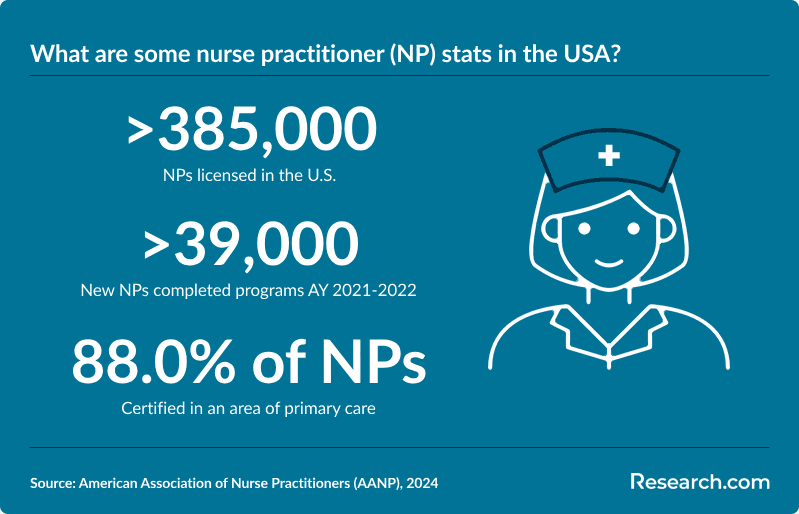
According to the original article’s cited 2023 and 2024 figures, the U.S. had more than 385,000 licensed NPs as of 2023. The profession also added more than 39,000 academic program completers in AY 2021-2022. A major share of the profession remains tied to primary care, with more than 88% of NPs certified in primary care.
What are the requirements to become a nurse practitioner?
The nurse practitioner pathway usually follows three major steps: become a licensed RN, complete graduate NP education, and earn national certification plus state authorization to practice. Requirements vary by state and specialty, so students should confirm rules before enrolling.
Step 1: Become a licensed registered nurse
- Complete a Bachelor of Science in Nursing (BSN) program from an accredited nursing program.
- Pass the National Council Licensure Examination for Registered Nurses, known as the NCLEX-RN.
- Apply for and maintain RN licensure in the state where you plan to work.
Step 2: Complete an MSN or DNP nurse practitioner program
- Enroll in a Master of Science in Nursing program with an NP specialty track or a Doctor of Nursing Practice program.
- MSN programs typically require 1-2 years, while DNP programs can take 3-6 years.
- Admissions requirements may include prerequisites, a minimum GPA, standardized test scores such as the GRE or MCAT, RN experience, or other program-specific criteria.
- Many accredited online MSN programs work with hospitals or healthcare centers to support required clinical rotation placement.
Step 3: Earn national certification and state NP licensure
- Pass the national certification exam that matches your NP specialty, such as an exam offered through organizations like the American Association of Nurse Practitioners.
- Apply for state licensure or authorization as an advanced practice nurse in the state where you intend to practice.
- Confirm whether the state requires additional exams, documentation, supervision, collaborative agreements, or practice hours.
MSN vs. DNP: Which route makes sense?
| Option | Best for | Typical timeline stated in the article | Decision point |
| MSN nurse practitioner program | RNs who want the most direct graduate route into NP practice | 1-2 years | Often the practical choice if your main goal is clinical NP eligibility as quickly as possible. |
| DNP nurse practitioner program | Nurses who want doctoral-level preparation, leadership training, systems improvement, or advanced clinical depth | 3-6 years | May be worth considering if you want executive, academic, or advanced leadership opportunities later. |
| Affordable or accelerated online options | Working nurses who need flexibility and cost control | Varies by program | Compare accreditation, clinical placement support, total cost, and certification pass preparation. |
Cost-conscious nurses often compare affordable online MSN programs before committing to graduate school. Nurses who want a shorter route may also research 1 year NP programs online, but fast timelines should be evaluated carefully for accreditation, clinical placement quality, and state eligibility.
The original article notes an average DNP salary of around $117,859 and a nurse practitioner median wage of $126,260, with some states reaching as high as $168,030. These figures should be used as reference points rather than guaranteed outcomes because compensation depends on geography, role, employer, and specialty.
Questions to ask before applying to an NP program
- Is the program accredited by a recognized nursing accreditor?
- Does the program’s specialty track match the certification exam I plan to take?
- Will the curriculum meet licensure requirements in the state where I want to practice?
- Who is responsible for finding clinical placements: the school, the student, or both?
- What are the total costs, including fees, travel, clinical requirements, books, and lost work time?
- Does the program publish certification pass rates, completion rates, and student support details?
- Can I transfer prior credits or receive credit for previous graduate coursework?
What are the different nurse practitioner specializations available in the USA?
Nurse practitioner specialties define the population you serve, the settings where you are most likely to work, and the certification exam you will pursue. Choosing a specialty is one of the most important decisions in the NP journey because switching later may require additional coursework, clinical hours, or certification.
| Specialty | Typical focus | Often a good fit for nurses who |
| Adult-Gerontology Primary Care NP | Primary care for adults across the lifespan, including chronic disease management, prevention, and health promotion | Prefer long-term patient relationships and adult primary care |
| Acute Care NP | Care for acutely ill patients in hospitals, emergency departments, intensive care units, and critical care units | Like high-acuity environments, fast decisions, and complex cases |
| Cardiac NP | Care for patients with heart disease, heart failure, cardiovascular risk, and related medication needs | Are interested in cardiology, chronic disease, and specialty procedures |
| Dermatology NP | Diagnosis and treatment of skin, hair, and nail conditions, including exams, biopsies, acne treatment, and some cosmetic procedures | Want a specialty clinic environment with procedural elements |
| Emergency NP | Assessment and stabilization of urgent and emergent conditions in emergency care settings | Thrive under pressure and enjoy unpredictable clinical work |
| Family Nurse Practitioner | Primary care for patients across the lifespan, from infants to older adults | Want broad primary care preparation and flexibility across age groups |
| Neonatal NP | Specialized care for newborns, including premature and critically ill infants in NICUs | Want to work with medically fragile newborns in hospital settings |
| Oncology NP | Care for patients with cancer, including symptom management, education, treatment support, and emotional support | Are drawn to cancer care and long-term patient support |
| Orthopedic NP | Musculoskeletal care, including fractures, joint injuries, sports injuries, arthritis, imaging, pain management, and surgical support | Like anatomy, mobility, procedures, and specialty practice |
| Pediatric NP | Primary care for infants, children, and adolescents, including prevention, immunizations, illnesses, and development | Enjoy working with children and families |
| Psychiatric-Mental Health NP | Assessment, diagnosis, medication management, and psychotherapy for mental health conditions across age groups | Want to focus on behavioral health, therapy, and psychiatric medication management |
| Women’s Health NP | Preventive care, well-woman visits, family planning, pregnancy-related care, and gynecologic concerns | Are interested in women’s health across the lifespan |
Family Nurse Practitioner programs remain especially common because they prepare graduates for broad primary care practice. Students comparing this path can review affordable online FNP programs as part of their research.
There are additional NP specialties beyond the ones listed here. Before choosing a track, confirm that the program prepares students for the certification exam and patient population you intend to serve.
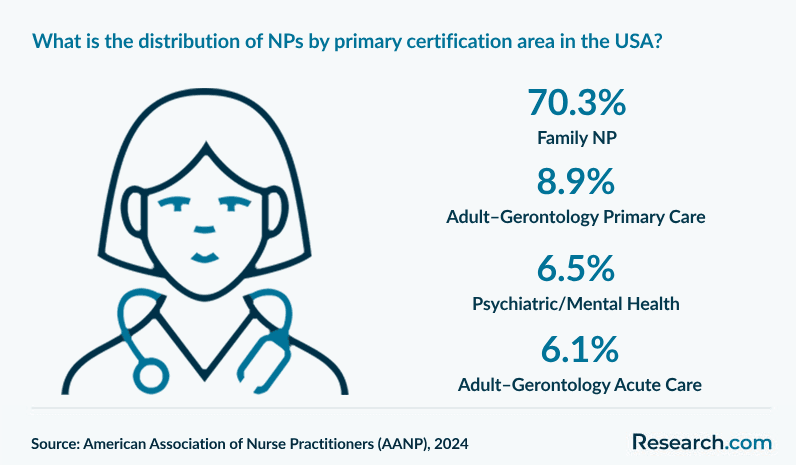
Based on 2024 data from the American Association of Nurse Practitioners cited in the original article, Family Nurse Practitioners are the largest group, representing over 70% of all NPs. Adult-Gerontology Primary Care NPs make up 8.9%, Psychiatric/Mental Health NPs account for 6.5%, and Adult-Gerontology Acute Care NPs represent 6.1% of the workforce.
The graphic below shows the distribution of major NP certification areas and underscores how central primary care remains to NP practice.
How do I choose the right nurse practitioner specialization for my interests and skills?
The best NP specialty is the one that fits your preferred patients, clinical environment, tolerance for stress, schedule expectations, and long-term goals. Do not choose a specialty only because it is popular or appears to pay well. A poor fit can make graduate school harder and limit satisfaction after licensure.
Start with a self-assessment
- Which age group do you most enjoy caring for: children, adults, older adults, newborns, or all ages?
- Do you prefer long-term primary care relationships or high-acuity episodic care?
- Are you interested in mental health, women’s health, cardiology, oncology, dermatology, emergency care, or another focused area?
- Do you enjoy procedures, diagnostic reasoning, counseling, medication management, or health education?
- Would you rather work predictable clinic hours, rotating hospital shifts, telehealth schedules, or urgent care hours?
Research the daily work, not just the title
- Read program descriptions and certification requirements for each NP track.
- Compare the typical patients, conditions, tasks, and practice settings in each specialty.
- Speak with experienced NPs who work in your areas of interest.
- Ask to shadow NPs in different settings when possible.
- Use volunteer or clinical experiences to test whether a specialty feels sustainable.
Match your strengths to the specialty
- If you enjoy communication, prevention, and continuity, family practice or adult-gerontology primary care may fit well.
- If you are comfortable with urgent decisions and complex cases, acute care or emergency practice may be a better match.
- If you are drawn to counseling, medication management, and behavioral health, psychiatric-mental health practice may be worth exploring.
- If you want a narrower specialty with procedures, dermatology, cardiology, orthopedics, or oncology may be appropriate depending on your interests and training opportunities.
Think about the future before enrolling
- Will the specialty support the type of employer you want: hospital, clinic, private practice, school, telehealth, or community health?
- Does your target state offer enough openings in that specialty?
- Could the specialty support leadership, research, teaching, or practice ownership later?
- Will the schedule work for your family, health, and long-term lifestyle?
For geographic planning, the following graph shows the top 10 states for nurse practitioner employment in 2023.
The original article identifies several areas with high concentrations of employed nurse practitioners in 2023. The District of Columbia leads with over 22,000 NPs, while Arkansas, Tennessee, and New Mexico each have a workforce exceeding 16,000 NPs. A high NP concentration can mean more peer networks, but it can also mean a more competitive job market depending on specialty and employer demand.
Specialty choice: practical comparison
| If you want... | Consider... | Be careful about... |
| Broad career flexibility | Family Nurse Practitioner | FNP roles vary widely, so confirm whether your desired setting accepts FNP preparation. |
| Hospital-based complex care | Acute Care NP or Emergency NP | Schedules may involve nights, weekends, high acuity, or stressful cases. |
| Mental health practice | Psychiatric-Mental Health NP | Demand can be strong, but the work requires comfort with psychiatric assessment and long-term therapeutic relationships. |
| Children and families | Pediatric NP | Make sure local employers hire PNPs for the roles you want. |
| Women’s health services | Women’s Health NP | Check whether the scope aligns with your desired work in primary care, reproductive health, or gynecology. |
What are the ethical considerations for nurse practitioners in their practice?
Ethics are part of daily NP decision-making. NPs often manage sensitive diagnoses, medication decisions, patient education, privacy issues, and care access barriers. Ethical practice requires more than following rules; it requires clear communication, sound judgment, and respect for patients.
- Patient autonomy: NPs should help patients understand their choices and respect informed decisions, even when the patient’s preference differs from the provider’s recommendation.
- Informed consent: Patients need clear explanations of risks, benefits, and alternatives before medications, procedures, or treatment plans are started.
- Confidentiality: NPs must protect health information under privacy rules such as HIPAA and disclose information only when legally and ethically appropriate.
- Cultural competence: Effective care requires awareness of how culture, language, beliefs, family systems, and lived experience influence health decisions.
- Professional integrity: NPs should avoid conflicts of interest, document honestly, practice within their competence, and follow professional standards.
- Advocacy: NPs often help patients overcome access problems, insurance barriers, social needs, and fragmented healthcare systems.
Strong ethical practice builds trust with patients and colleagues and helps NPs navigate complex clinical situations safely.
What are the essential skills and qualities for a successful nurse practitioner career?
A strong NP career requires advanced clinical ability, emotional intelligence, and disciplined professional habits. Employers look for providers who can assess patients accurately, communicate clearly, document thoroughly, and make safe decisions under pressure.
Core clinical skills
- Specialty knowledge: Understand the diseases, patient populations, assessments, and treatment standards in your NP focus area.
- Diagnostic reasoning: Use patient history, exams, labs, imaging, and clinical judgment to reach safe conclusions.
- Medication management: Know pharmacology, dosing, adverse effects, interactions, monitoring, and patient education requirements.
- Physical assessment: Perform complete and focused exams and recognize findings that require urgent action or referral.
- Procedural ability: Depending on specialty, develop skills such as suturing, injections, biopsies, or other clinical procedures.
- Technology fluency: Work efficiently with electronic health records, telehealth tools, patient portals, and healthcare data systems.
Professional qualities
- Compassion: Patients often seek care when they are anxious, vulnerable, or in pain, so empathy matters.
- Communication: NPs must explain complex health information in plain language and document clearly for care teams.
- Critical thinking: Safe practice depends on identifying patterns, recognizing red flags, and adjusting plans when new information appears.
- Cultural responsiveness: Patient-centered care requires respect for backgrounds, beliefs, and barriers that affect health behavior.
- Leadership: NPs frequently coordinate care, guide teams, educate patients, and influence workflow improvements.
- Lifelong learning: Certification, licensure, and quality care require ongoing education and staying current with evidence.
- Time management: NPs must balance visits, charting, results, messages, referrals, and follow-ups without compromising care.
- Advocacy: Strong NPs help patients access resources, understand options, and make informed choices.
What are the different types of healthcare settings where nurse practitioners can work?
Nurse practitioners work across a wide range of clinical and community settings. The right environment depends on your specialty, desired schedule, comfort with acuity, and interest in autonomy or team-based care.
| Setting | What NPs often do there | Who may prefer it |
| Community health centers | Provide primary care, prevention, chronic disease management, and care for underserved populations | NPs committed to access, equity, and community-based care |
| Home healthcare | Care for homebound patients, manage medications, monitor chronic conditions, and educate families | NPs who like independent visits and patient-centered home care |
| Hospitals | Work in emergency departments, ICUs, specialty units, and inpatient services caring for acute and complex patients | NPs who want high-acuity, team-based, fast-paced practice |
| Long-term care facilities | Manage chronic conditions, monitor medications, coordinate care, and support residents’ health needs | NPs interested in geriatrics and continuity with older adults |
| Outpatient clinics | Provide primary care, urgent care, specialty care, routine exams, immunizations, and minor injury care | NPs seeking structured clinical schedules and ongoing patient relationships |
| Private practice | Offer primary or specialty services and may manage business operations depending on state rules | Experienced NPs who want autonomy and entrepreneurial responsibility |
| Retail clinics | Treat minor illnesses and injuries in convenient care locations such as pharmacies or grocery stores | NPs who prefer focused, accessible, walk-in care |
| Schools | Provide student health services, manage common illnesses, support chronic conditions, and deliver health education | NPs who enjoy pediatrics, prevention, and school-based health |
| Telehealth | Deliver care through video, phone, or remote platforms for appropriate conditions and follow-ups | NPs interested in flexible access models and remote care delivery |
What are some strategies for advancing your nurse practitioner career?
Career advancement for NPs usually comes from deeper expertise, strong outcomes, leadership readiness, and strategic credential choices. The best approach depends on whether you want higher pay, more autonomy, a specialty role, academic work, management, or practice ownership.
- Add specialty certifications: Certifications in areas such as pediatric care, psychiatric-mental health, oncology, or other focused fields can help demonstrate expertise and qualify you for more targeted roles.
- Build leadership experience: Clinical supervisor, NP manager, director, preceptor, and quality improvement roles can expand influence and compensation opportunities.
- Consider practice ownership where allowed: In states with Full Practice Authority, some NPs pursue independent practice models, though business, billing, compliance, and liability issues must be evaluated carefully.
- Keep continuing education current: Continuing education protects certification status and helps NPs stay competitive. Nurses building toward advanced roles may also compare affordable online RN to BSN programs if they still need a BSN foundation.
- Network deliberately: Professional associations, conferences, clinical collaborations, research projects, and community health initiatives can create new opportunities.
- Track measurable achievements: Document quality improvement work, patient education initiatives, workflow changes, leadership roles, and outcomes you can discuss during interviews or negotiations.
What are the career advancement opportunities for nurse practitioners in various settings?
NP advancement looks different in each healthcare environment. Some settings reward clinical specialization, while others offer growth through administration, program design, quality improvement, teaching, or ownership.
Community Health Centers and Telehealth
- Clinical leadership: Experienced NPs can lead care teams, improve workflows, and support access initiatives.
- Program development: NPs may design services for prevention, chronic disease management, behavioral health, or population health.
- Telehealth expansion: NPs can help build remote care models that improve access for rural patients or those with mobility barriers.
Hospitals
- Advanced practice specialization: Some NPs pursue additional preparation for advanced roles such as nurse anesthetist or clinical nurse specialist pathways, where separate education and certification requirements apply.
- Administrative leadership: Experienced NPs may move into roles focused on quality, patient safety, staffing, clinical operations, or policy implementation.
- Specialty team leadership: NPs with deep expertise may supervise other advanced practice providers, mentor new clinicians, or lead specialty service lines.
Long-Term Care Facilities
- Staff education: NPs can train care teams on geriatric conditions, medication safety, pain control, and best practices.
- Quality improvement: NPs can lead projects to improve resident outcomes, reduce care gaps, and refine protocols.
- Transition-of-care leadership: NPs can develop systems that improve movement between hospitals, rehabilitation facilities, nursing homes, and home care.
Outpatient Clinics and Private Practice
- Expanded clinical scope: NPs may take on more complex patients, develop niche services, or increase panel size with appropriate support.
- Mentorship: Experienced NPs can precept students and guide new graduates during the transition to practice.
- Ownership: Some NPs open practices, manage billing and staffing, and build services around primary care or specialty expertise.
- Research and innovation: NPs can participate in research, evidence-based practice projects, or advanced degrees that support clinical improvement.
Schools
- Health curriculum support: NPs can collaborate with educators on student health programs and prevention initiatives.
- Policy advocacy: School-based NPs can advocate for policies related to mental health, chronic disease support, nutrition, and student wellness.
- School health leadership: Experienced NPs may manage school health staff and coordinate care delivery across campuses.
Which nurse practitioner specialties offer the highest compensation?
Higher-compensated NP specialties often involve complex care, advanced decision-making, urgent clinical needs, or hard-to-fill roles. Acute care, emergency medicine, and some psychiatric/mental health positions can offer stronger pay because they involve high-acuity patients, specialized assessment, medication management, and rapid clinical judgment. Compensation still depends on location, experience, employer, shift requirements, and certification.
If you want to compare compensation by specialty, review Research.com’s guide to the highest-paying nurse practitioner jobs and use it alongside state salary data, job postings, and total compensation offers.
What are the emerging trends in nurse practitioner practice?
Nurse practitioner practice continues to evolve as healthcare systems adapt to access gaps, chronic disease needs, technology, and changing expectations for team-based care. These trends should influence specialty choice, program selection, and career planning.
Population health and prevention
- NPs are increasingly involved in community health work and preventive care.
- Many roles require attention to social determinants of health that influence patient outcomes.
- Population-focused skills can help NPs contribute to outreach, screening, education, and care coordination.
Primary care and chronic disease management
- NPs continue to play a major role in managing chronic conditions.
- Primary care roles often involve prevention, medication management, follow-up, and patient coaching.
- As care needs become more complex, strong diagnostic and communication skills are increasingly important.
Full Practice Authority and demand for access
- Growing demand for care, an aging population, and physician shortages support continued need for NPs.
- More states have granted Full Practice Authority, allowing qualified NPs to practice independently under state law.
- Scope-of-practice rules affect autonomy, hiring options, and practice ownership opportunities.
Interprofessional collaboration
- NPs often work between nursing, medicine, pharmacy, behavioral health, and community support services.
- Effective collaboration improves care coordination and reduces fragmentation.
- Employers increasingly value NPs who can lead without working in isolation.
Specialization and innovation
- Primary care remains central, but demand for specialty NPs continues to grow in areas such as mental health, oncology, and women’s health.
- NPs may contribute to new care models, treatment protocols, patient education strategies, and clinical research.
Telehealth integration
- Telehealth has expanded remote access to care for appropriate services.
- NPs can use virtual care to support rural patients, patients with limited mobility, and follow-up visits.
- State rules, payer policies, patient safety, and documentation standards remain important considerations.
Healthcare technology adoption
- Electronic health records and healthcare IT tools are now central to NP workflow.
- Technology can improve documentation, communication, care coordination, and patient follow-up when used effectively.
For salary-focused planning, the original article identifies California, New Jersey, and Washington as states with average salaries exceeding $141,000 in 2023. Nevada, Massachusetts, and New York each reported compensation above $137,000, while Oregon, Connecticut, and Alaska reported average salaries surpassing $133,000.
The following graph shows the top 10 highest-paying states for nurse practitioners in 2023.
How can nurse practitioners integrate functional medicine into their practice?
Functional medicine may appeal to NPs who want to incorporate lifestyle, nutrition, environmental factors, and root-cause analysis into patient care. It is often used in chronic illness management and patient-centered care planning. NPs interested in this direction should pursue appropriate training, understand the evidence base, and stay within their legal scope of practice.
If this path interests you, Research.com’s guide to becoming a functional nurse practitioner explains how NPs can build this focus into their careers.
What are some top-ranked nurse practitioner degree programs that you can consider?
The programs below are examples of highly regarded nursing schools to include in your NP program research. They should not be treated as the only strong options. Students should also compare accreditation, specialty tracks, clinical placement support, cost, certification preparation, and whether a program meets state licensure requirements. If you are comparing doctoral options, you may also want to review online DNP programs.
1. The University of Pennsylvania
The University of Pennsylvania offers nursing programs at the Master's, Ph.D., and DNP levels, with MSN options that include several APRN tracks. Its NP preparation emphasizes advanced diagnosis, treatment planning, and specialty-focused clinical training. Students can pursue tracks such as pediatrics, women’s health, and acute care while learning from faculty involved in research and clinical practice.
2. Duke University
Duke University offers Master's, Ph.D., and DNP nursing degrees, and its MSN programs include multiple NP tracks. The curriculum emphasizes clinical experience, applied learning, simulation, and preparation for a range of advanced practice roles. Duke also supports community-building and global health experiences within its nursing education model.
3. Emory University
Emory University provides Master's, Ph.D., and DNP nursing programs. Its advanced practice options emphasize care across the lifespan and include a strong community-based primary care orientation. Students gain clinical experience in diverse settings, including underserved communities, while developing leadership and population health perspectives.
4. The University of Washington
The University of Washington offers Master's, Ph.D., and DNP nursing degrees, with the DNP including many available degree pathways. The school focuses on advanced practice preparation for complex healthcare settings and emphasizes evidence-based care, research-informed practice, and opportunities to participate in nursing science.
5. Columbia University
Columbia University offers primarily DNP nursing pathways with several tracks. Its programs prepare nurses for advanced professional practice in complex care environments. Students can access varied clinical placements and learning opportunities that expose them to different patient populations and healthcare delivery settings.
These schools are starting points, not a complete list. Many students also compare affordable online nurse practitioner programs to manage cost and flexibility. Students entering nursing from another field may also explore bridge pathways; for example, someone studying an affordable online public health degree may later consider nursing or MSN bridge options if they meet admissions requirements.
How to compare NP programs beyond rankings
| Selection factor | Why it matters | Red flag |
| Accreditation | Accreditation can affect licensure eligibility, certification eligibility, credit transfer, and employer acceptance. | The school cannot clearly explain its nursing accreditation status. |
| Specialty alignment | Your track must match the patient population and certification exam you need. | The program title is broad, but certification preparation is unclear. |
| Clinical placement support | Clinical hours are essential to NP preparation and can be difficult to arrange independently. | The school leaves placement entirely to students without strong guidance. |
| State authorization | Online programs may not meet requirements in every state. | The admissions advisor cannot confirm whether your state is eligible. |
| Total cost | Fees, travel, books, clinical compliance, and reduced work hours can raise the real cost. | The school advertises tuition only and avoids full cost estimates. |
What factors should nurse practitioners consider when selecting an online RN to BSN program?
An online RN to BSN program may be a stepping stone for nurses who want to become NPs but do not yet hold a BSN. When comparing programs, focus on accreditation, curriculum quality, flexibility, transfer credit policy, clinical or practice requirements, tuition, financial aid, and student support.
Do not choose only because a program looks easy or fast. Make sure it supports your next step into graduate nursing education. Research.com’s guide to the easiest RN to BSN program online can be used as one reference point while comparing accessibility, cost, and academic fit.
How can nurse practitioners harness research to enhance clinical practice?
Research literacy helps NPs deliver evidence-based care rather than relying only on habit or anecdote. NPs use research to evaluate treatment options, understand clinical guidelines, improve quality, and measure whether interventions are working for patients.
Ways to strengthen research use include reading peer-reviewed studies, participating in quality improvement projects, learning basic data interpretation, and applying current evidence to patient education and treatment planning. NPs who want a stronger science foundation may also consider related study options such as a biology online degree, depending on their broader academic and professional goals.
How can nurse practitioners leverage public health expertise to broaden career opportunities?
Public health knowledge can help NPs move beyond one-to-one clinical encounters into prevention, policy, community health, care access, and population-level program design. This background can be especially useful for NPs interested in underserved communities, chronic disease prevention, school health, occupational health, or leadership roles.
Nurses considering this direction can compare clinical and public health pathways and review Research.com’s guide to MSN in public health salary for additional context on career possibilities and financial benchmarks.
How can nurse practitioners effectively negotiate salaries and benefits?
Salary negotiation is an important professional skill for NPs because compensation should reflect specialty preparation, experience, local demand, productivity expectations, call requirements, and total value to the employer. The strongest negotiations are evidence-based and professional, not adversarial.
Prepare before the conversation
- Use reliable salary data for your state, specialty, and setting before naming a target number.
- Compare roles connected to high-demand training areas, including programs like the best acute care NP programs, when evaluating premium compensation expectations.
- Factor in cost of living, commuting, call responsibilities, patient volume, and documentation expectations.
Show your value clearly
- Highlight certifications, specialty training, bilingual skills, leadership experience, or hard-to-fill clinical expertise.
- Bring examples of quality improvement work, patient outcomes, precepting, program development, or workflow contributions.
Negotiate the full package
- Ask about bonuses, shift differentials, overtime, call pay, productivity models, and paid administrative time.
- Consider continuing education funds, certification reimbursement, malpractice coverage, paid time off, flexible scheduling, retirement contributions, and loan repayment support.
Use a collaborative tone
- Frame your request around retention, patient care, and the value you can bring to the organization.
- Stay open to trade-offs if the employer cannot raise base pay but can improve benefits or scheduling.
Compare offers carefully
- Multiple offers can help you understand market value, but use them professionally.
- Look beyond the headline salary and compare workload, support, benefits, autonomy, and burnout risk.
What nursing certifications can nurse practitioners pursue to enhance their career prospects?
Additional nursing certifications can help NPs deepen expertise, qualify for specialty roles, and demonstrate commitment to ongoing professional development. The best certification depends on your population focus and practice area, such as pediatrics, gerontology, psychiatric-mental health, oncology, acute care, or another specialty.
If you are exploring credential options, Research.com’s guide to nursing certifications online can help you review certification areas that may support career growth and clinical competence.
How can fast-track RN to BSN programs accelerate your nurse practitioner career?
Fast-track RN to BSN programs can help registered nurses complete the bachelor’s-level foundation often needed for graduate nursing admission. These programs may be especially useful for working RNs who want to move toward NP education without delaying for a traditional timeline.
Flexible online delivery can help nurses balance school and employment, but speed should not outweigh accreditation, faculty support, transfer policies, and graduate school readiness. Programs such as a 9 month RN to BSN online option may help some nurses move more quickly toward advanced practice preparation.
What are the benefits of accelerated RN to NP programs?
Accelerated RN to NP programs are designed for registered nurses who want a faster transition into advanced practice. These programs combine rigorous graduate coursework, clinical training, advanced pharmacology, assessment, and specialty preparation in a compressed format.
The main benefit is time efficiency, but the workload can be intense. Students should confirm accreditation, certification alignment, clinical placement quality, state eligibility, and whether they can realistically manage the pace while working. For more program comparisons, review Research.com’s guide to accelerated RN to NP programs.
What are the accelerated nurse practitioner pathways for career changers?
Career changers and working adults may have several accelerated routes into advanced nursing, depending on prior education, healthcare experience, RN status, and admissions eligibility. Some options are designed for RNs moving from ADN or BSN preparation into graduate nursing, while others are bridge pathways for students with a non-nursing background who must first become eligible for RN licensure.
Accelerated NP programs can be appealing because they reduce time to credential completion, but they are not shortcuts around clinical competence. Students still need rigorous coursework, supervised clinical training, certification preparation, and state licensure eligibility.
Common features of accelerated NP pathways
- Time efficiency: Some programs can be completed in as little as 12 to 18 months, helping qualified students move toward advanced practice more quickly.
- Flexible learning formats: Many accelerated options include online coursework that can help working adults manage school, employment, and family responsibilities.
- Comprehensive coursework: Shorter timelines still cover essential content such as advanced pharmacology, clinical assessment, and specialty care.
- Faster career progression: Qualified students may reach NP credentials sooner and enter advanced roles earlier.
- Specialty options: Some accelerated programs offer tracks in family practice, mental health, acute care, or other high-demand areas.
- Adult learner design: Condensed scheduling and flexible formats can support students balancing multiple obligations.
If you are comparing shorter NP options, review 1 year NP programs and verify that any program you consider meets certification and licensure requirements for your state.
Common Mistakes to Avoid When Planning an NP Career
| Mistake | Why it can hurt you | Better approach |
| Choosing a program without checking accreditation | Accreditation problems can affect certification, licensure, transfer credits, and employer acceptance. | Confirm accreditation directly before applying. |
| Looking only at tuition | Fees, travel, clinical compliance, books, and reduced work hours can change the true cost. | Calculate total cost of attendance and likely lost income. |
| Assuming every online NP program works in every state | State authorization and licensure rules vary. | Ask the school in writing whether your state is approved for your track. |
| Choosing a specialty only for salary | A high-paying specialty may involve stress, shifts, acuity, or patient needs that do not fit you. | Compare pay with daily work, schedule, and long-term fit. |
| Ignoring clinical placement responsibility | Students may struggle if they must find preceptors alone. | Ask how the school supports or guarantees clinical placements. |
| Relying only on rankings | A ranked program may not be the best match for your state, budget, specialty, or schedule. | Use rankings as one input, not the final decision. |
| Assuming salary outcomes are guaranteed | Actual pay depends on employer, geography, specialty, experience, and negotiation. | Use salary data as a benchmark and compare real job offers. |
Key Insights
- Becoming a nurse practitioner requires RN licensure, graduate nursing education, national certification, and state licensure or authorization.
- Specialty choice matters as much as school choice because it determines your certification exam, patient population, practice settings, and long-term career options.
- Family Nurse Practitioners represent over 70% of all NPs, while 88% of NPs are certified in primary care.
- NP salaries vary sharply by state, with California reporting $164,050 and Guam reporting $82,150 in the BLS 2023 salary table provided above.
- MSN programs typically take 1-2 years, while DNP programs can take 3-6 years, so students should weigh speed, cost, clinical goals, and leadership ambitions.
- Online and accelerated programs can be valuable, but only if they are accredited, state-approved, clinically rigorous, and aligned with certification requirements.
- Strong NP career planning includes salary research, specialty shadowing, clinical placement questions, total cost analysis, and a realistic view of workload.
- Do not choose an NP program based only on rankings, tuition, speed, or advertised salary. The right program must fit your state, specialty, budget, schedule, and licensure goals.
References:
- American Association of Nurse Practitioners. (2024). NP Fact Sheet. American Association of Nurse Practitioners.
- Bureau of Labor Statistics. (2024). Occupational Employment and Wage Statistics. Bureau of Labor Statistics.
Other Things You Should Know About the Average Nurse Practitioner Salaries by State
In 2027, states like California, Alaska, and Massachusetts typically offer the highest salaries for nurse practitioners. Factors contributing to these high salaries include the cost of living, demand for healthcare services, and state healthcare policies.
Mississippi, Alabama, and Arkansas are among the lowest-paying states for nurse practitioners in 2027, while higher pay is concentrated in California, New York, and Washington. State averages are usually reported by BLS employment and wage data, with local demand and cost of living affecting pay.


