2027 Best 12-Month FNP Programs (Online & Campus)

Co-Founder and Chief Data Scientist
As an RN wanting to move up the career ladder, you might wonder if pursuing an FNP degree is right for you. The rapidly aging population, with the number of Americans over age 85 expected to quadruple by 2040, increases the demand for healthcare providers, including FNPs.
Meanwhile, the U.S. could see a shortage of 46,000 to 121,900 physicians by 2032, particularly primary care physicians. This shortage creates a critical need for nurse practitioners to fill the gap and provide essential healthcare services.
Drawing on over ten years of expertise in career planning and thorough research from credible sources, I aim to guide you through the best 12-month FNP programs available. Reading this article will help you make an informed decision and advance your nursing career.
What are the benefits of getting a 12-month FNP program?
Enrolling in a 12-month FNP program can significantly enhance your career prospects and provide numerous advantages. Here are some key benefits:
- Job Opportunities: Opens doors to advanced roles in healthcare settings such as hospitals, clinics, and private practices.
- High Demand: The aging population and physician shortage increase the need for FNPs in primary care.
- Competitive Salary: FNPs typically earn between $95,000 and $120,000 annually, reflecting their advanced skills and responsibilities.
- Flexible Learning: Many programs offer online options, allowing you to balance work and study.
- Career Growth: Positions you for leadership roles and specialized fields within healthcare.
- Employer Preferences: Top companies and industries prefer hiring skilled nurse practitioners to meet their growing healthcare demands.
What can I expect from a 12-month FNP program?
A 12-month FNP program offers a comprehensive curriculum designed to equip you with advanced nursing skills. Core courses typically include advanced health assessment, pharmacology, and primary care management. You will also learn about healthcare policy and leadership.
Online classes are usually delivered through interactive platforms that include video lectures, discussion forums, and virtual simulations. This flexible format allows you to study at your own pace while balancing work and personal commitments.
As of 2022, there were more than 355,000 licensed nurse practitioners in the United States, with FNPs being one of the most common specialties. This program will prepare you to join this growing field and meet the increasing healthcare needs.
Where can I work with an FNP program?
The rapid growth in nurse practitioner employment, projected at 45% from 2021-2031, means a growing number of FNP program graduates entering the workforce.
- Offices of Physicians: FNPs often work in private practices, providing primary care services and earning an average salary of $122,780 annually.
- General Medical and Surgical Hospitals: FNPs in hospitals play a crucial role in patient care and earn an average salary of $135,610 per year.
- Outpatient Care Centers: These centers offer specialized services, and FNPs can earn around $139,860 annually.
- Offices of Other Health Practitioners: FNPs work in various healthcare settings, earning approximately $121,250 per year.
- Home Health Care Services: Providing in-home care, FNPs offer essential healthcare services to patients in their homes.
How much can I make with an FNP program?
According to the Bureau of Labor Statistics, nurse practitioners, including FNPs, earn a median salary of $128,490. This median salary reflects the advanced skills and responsibilities that FNPs bring to their roles, making them valuable assets in various healthcare settings.
The earning potential for FNPs varies widely based on experience, location, and workplace setting. The top 90% of nurse practitioners can earn up to $168,030 annually, while the bottom 10% earn around $94,530. These figures highlight the financial benefits of advancing your nursing career with an FNP program. Whether you work in hospitals, private practices, or clinics, becoming an FNP offers a significant increase in earning potential compared to an RN role.
- Best 12-Month FNP Programs for 2027 Best FNP Programs
- How does an online FNP program compare to an on-campus program? Online vs. On-Campus
- What is the average cost of a 12-month FNP program? Average Cost
- What are the financial aid options for students enrolling in a 12-month FNP program? Financial Aid Options
- What are the prerequisites for enrolling in 12-month FNP program? Admission Requirements
- What courses are typically in a 12-month FNP program? Courses
- What types of specializations are available in an FNP program? Specializations
- How to choose the best 12-month FNP programs? How to choose the best 12-month FNP programs?
- How to Maximize Success in Accelerated FNP Programs How to Maximize Success in Accelerated FNP Programs
- What challenges can I expect when completing a 12-month FNP program? What challenges can I expect when completing a 12-month FNP program?
- What career paths are available for graduates of an FNP program? What career paths are available for graduates of an FNP program?
- What is the job market for graduates with an FNP degree? Job Outlook
- Affordable Pathways to Becoming an FNP Affordable Pathways to Becoming an FNP
- What Are the Options for Pursuing an FNP Degree Online? What Are the Options for Pursuing an FNP Degree Online?
- How do nurse practitioner degrees online ensure hands-on clinical competency? How do nurse practitioner degrees online ensure hands-on clinical competency?
- How do 12-month FNP programs support certification exam preparation? How do 12-month FNP programs support certification exam preparation?
- How does an RN to MSN bridge program streamline the path to becoming an FNP? How does an RN to MSN bridge program streamline the path to becoming an FNP?
- What is the Return on Investment for a 12-month FNP Program? What is the Return on Investment for a 12-month FNP Program?
- What personal and professional growth can you expect from a 12-month FMP program? What personal and professional growth can you expect from a 12-month FMP program?
- How can I ensure that an FNP program is both high-quality and cost-effective? How can I ensure that an FNP program is both high-quality and cost-effective?
- How do 12-month FNP programs facilitate career placement and networking? How do 12-month FNP programs facilitate career placement and networking?
Best 12-Month FNP Programs for 2027
Choosing a 12-month Family Nurse Practitioner program is a high-stakes decision because the fastest option is not always the best option. A one-year FNP pathway can help experienced registered nurses move into advanced practice more quickly, but the compressed schedule also means heavier coursework, demanding clinical hours, and less room for delays in admissions, licensing, financial aid, or clinical placement.
This guide is for BSN-prepared registered nurses, RN-to-MSN applicants comparing bridge options, and working nurses who want an accelerated route into family primary care. You will learn which programs to compare, what admission requirements to expect, how online and campus formats differ, what costs to plan for, how clinical placement works, and which questions to ask before enrolling.
Quick Answer: Is a 12-Month FNP Program Worth Considering?
A 12-month FNP program can be a strong choice for nurses who already have solid RN experience, a current unencumbered license, strong study habits, and enough schedule flexibility to manage graduate coursework and clinical rotations at the same time. It is usually not the best fit for students who need a slower pace, are unsure about primary care, cannot reduce work hours if needed, or have not confirmed that the program meets state licensure and certification requirements.
Before applying, compare accreditation, total tuition, clinical placement support, certification exam preparation, program format, and whether graduates are eligible for FNP certification through the route you plan to pursue. If you are still comparing the two major FNP certification options, review the difference between FNP-BC and FNP-C certifications before choosing a program.
How Research.com Evaluated These FNP Programs
Research.com rankings are designed to help students compare education options using transparent factors rather than marketing claims. For this guide, school and program information is considered alongside publicly available higher education data from the IPEDS database, Peterson's database, the College Scorecard database, and The National Center for Education Statistics. These sources help provide context on institutions, costs, and student outcomes where available.
Because FNP program length, tuition, clinical requirements, and state authorization can change, applicants should verify current details directly with each nursing school before applying. You can also review the broader Research.com ranking process on our methodology page.
Best Accelerated and 12-Month FNP Programs to Compare
The programs below are useful starting points for nurses comparing intensive FNP pathways. Some are MSN-FNP options, while others are hybrid or DNP-based pathways with different credit loads and completion expectations. Always confirm the exact timeline, clinical hour requirements, state eligibility, and certification outcomes with the school.
| School | Format | Listed Cost | Total Credits | Best For |
| Vanderbilt University | Online with on-campus intensives | Approximately $61,000 | 40 credits | BSN graduates seeking a highly structured accelerated MSN-FNP option |
| University of Miami | Campus | $89,577 (for 2024) | 37 credits | Students who want face-to-face instruction and intensive clinical training |
| Mississippi University for Women | Campus | $30,000 | 39 credits | Experienced RNs looking for a lower-cost campus-based pathway |
| National University | Online | $30,960 | 45 credits | Working nurses who need online coursework with clinical practice requirements |
| University of California, San Francisco | Hybrid | $65,052 (estimated total for 2024) | 39 credits | Students seeking a hybrid program with strong primary care preparation |
| University of Pennsylvania | Hybrid | $59,088 (total tuition for 2024) | 44 credits | Nurses interested in primary care, prevention, and complex patient management |
| Rush University | Hybrid | $64,512 (estimated total for 2024) | 38 credits | Students comparing FNP pathways with population health and evidence-based practice emphasis |
| University of Florida | Hybrid | $33,675 (estimated total for 2024) | 75 credits | BSN-prepared nurses considering a BSN-to-DNP route with an FNP specialization |
1. Vanderbilt University - Nashville, TN (Online)
Vanderbilt University offers an MSN-FNP pathway for BSN-prepared nurses who want graduate-level preparation for family primary care. The program combines online learning with in-person intensives, which can be helpful for students who want flexibility without losing structured clinical skill development.
- Cost of Attendance: Approximately $61,000
- Admission Requirements: BSN degree, unencumbered RN license, minimum GPA of 3.0
- Total Credits: 40 credits
2. University of Miami - Coral Gables, FL (Campus)
The University of Miami offers an MSN-FNP program designed for students who prefer an on-campus experience with direct faculty interaction and in-person clinical preparation. This option may appeal to nurses who can commit to a full-time, campus-based schedule.
- Cost of Attendance: $89,577 (for 2024)
- Admission Requirements: BSN degree, minimum GPA of 3.0, completion of an introductory statistics course, three letters of recommendation, statement of purpose, current resume
- Total Credits: 37 credits
3. Mississippi University for Women - Columbus, MS (Campus)
Mississippi University for Women provides an accelerated MSN-FNP option with a focus on advanced nursing practice, evidence-based care, and collaboration across healthcare teams. Its admission criteria make it especially relevant for RNs who already have meaningful clinical experience.
- Cost of Attendance: $30,000
- Admission Requirements: BSN degree, unencumbered RN license, minimum GPA of 3.0, at least two years of RN experience, statistics course with a minimum grade of “C”, advanced pathophysiology course with a minimum grade of “B”
- Total Credits: 39 credits
4. National University - San Diego, CA (Online)
National University offers an online MSN-FNP program structured for working nurses who need remote coursework while completing required clinical components. Applicants should ask how clinical placements are arranged and whether placement support is available in their state.
- Cost of Attendance: $30,960
- Admission Requirements: BSN degree, unencumbered RN license, current employment as an RN, official transcripts, two professional recommendations, personal statement
- Total Credits: 45 credits
5. University of California, San Francisco - San Francisco, CA (Hybrid)
The University of California, San Francisco offers an FNP program focused on preparing nurses to provide primary care across the lifespan. Its hybrid structure can work well for students who want a blend of independent study, in-person learning, and supervised clinical practice.
- Cost of Attendance: $65,052 (estimated total for 2024)
- Admission Requirements: BSN degree, unencumbered RN license, minimum GPA of 3.0, letters of recommendation, personal statement
- Total Credits: 39 credits
6. University of Pennsylvania - Philadelphia, PA (Hybrid)
The University of Pennsylvania offers an FNP pathway that prepares nurses for family-centered primary care. The curriculum emphasizes health promotion, disease prevention, and care for patients with acute and chronic health concerns.
- Cost of Attendance: $59,088 (total tuition for 2024)
- Admission Requirements: BSN degree, unencumbered RN license, minimum GPA of 3.0, letters of recommendation, personal statement
- Total Credits: 44 credits
7. Rush University - Chicago, IL (Hybrid)
Rush University offers a Family Nurse Practitioner MSN to DNP pathway with attention to comprehensive primary care, evidence-based practice, and population health. Students comparing this option should confirm degree level, timeline, clinical expectations, and certification eligibility.
- Cost of Attendance: $64,512 (estimated total for 2024)
- Admission Requirements: BSN degree, unencumbered RN license, minimum GPA of 3.0, letters of recommendation, personal statement
- Total Credits: 38 credits
8. University of Florida - Gainesville, FL (Hybrid)
The University of Florida offers a BSN-to-DNP pathway with an FNP specialization. Because it lists 75 credits, applicants should examine the full completion plan carefully if their goal is the shortest possible route to advanced practice.
- Cost of Attendance: $33,675 (estimated total for 2024)
- Admission Requirements: BSN degree, unencumbered RN license, minimum GPA of 3.0, letters of recommendation, personal statement
- Total Credits: 75 credits
What Is a 12-Month FNP Program?
A 12-month FNP program is an accelerated graduate nursing pathway that prepares registered nurses to deliver family-focused primary care. FNP students study advanced assessment, diagnosis, pharmacology, disease management, health promotion, and care across the lifespan. Graduates typically pursue national FNP certification and state advanced practice licensure after completing program and clinical requirements.
The “12-month” label usually means the program is intensive. Students may take multiple graduate courses at once while completing clinical hours in approved healthcare settings. Some programs use online coursework, some require campus attendance, and others blend both formats.
How Does an Online FNP Program Compare to an On-Campus Program?
Online FNP programs are often more flexible than campus-based programs, but they are not less clinical. Students still need supervised hands-on experience, and many programs require in-person intensives, simulation, or local clinical rotations. This is similar to other online clinical or human-service graduate pathways, such as an online SLP master’s program or affordable online MSW programs, where remote coursework does not remove fieldwork requirements.
There were an estimated 1,035 online NP programs at the MSN, DNP, and post-master's certificate levels actively accepting students at the start of the 2023-2024 academic year. Nurses who already hold a graduate nursing degree may also compare online post-master’s nurse practitioner programs rather than starting a full MSN or DNP.
| Factor | Online FNP Program | On-Campus FNP Program | What to Ask Before Enrolling |
| Flexibility | Better for students who need remote lectures or asynchronous coursework | Better for students who want set class times and regular in-person contact | Can I keep working, or should I reduce my hours? |
| Clinical training | Usually completed in approved local or regional clinical sites | Often coordinated near the campus or through school-affiliated sites | Does the school find placements, or am I responsible? |
| Faculty access | Virtual office hours, discussion boards, video meetings, and learning platforms | Face-to-face advising, labs, and classroom interaction | How quickly do faculty respond when students need help? |
| Best fit | Self-directed learners with strong time-management skills | Students who learn best through structured, in-person instruction | Which format matches how I actually study under pressure? |
What Is the Average Cost of a 12-Month FNP Program?
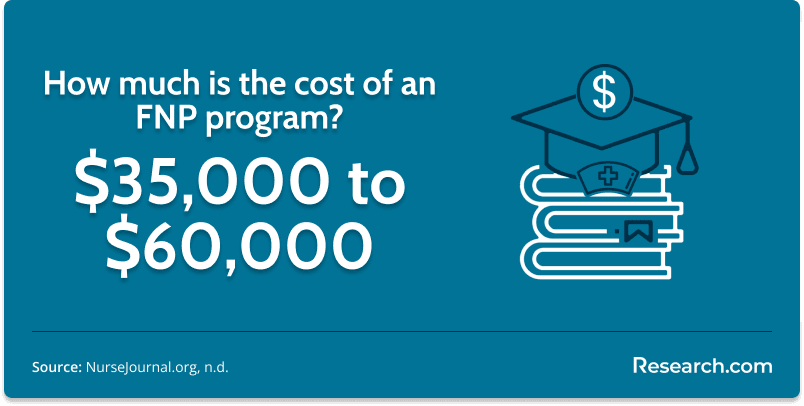
Many students should expect to budget between $35,000 and $60,000 for a 12-month FNP program, although actual costs vary widely by school, residency status, program length, technology fees, books, clinical expenses, and travel for intensives. The programs in this guide list costs ranging from $30,000 to $89,577 (for 2024), so the advertised tuition alone does not tell the full financial story.
For example, Sacred Heart University's online MSN-FNP program costs $1,250 per credit hour, with 42 credits required, making total tuition approximately $52,500. La Salle University's online MSN-FNP program consists of 45 credits. When comparing options, calculate total program cost rather than only the per-credit rate.
| Cost Item | Why It Matters | Question to Ask |
| Tuition | This is usually the largest direct cost, but it may not include fees. | Is the listed amount tuition only or total estimated cost? |
| Fees | Online, technology, lab, simulation, graduation, and clinical fees can add up. | Which mandatory fees are charged each term? |
| Clinical placement expenses | Students may need background checks, immunizations, drug screening, travel, or site onboarding. | Are clinical placement costs included in tuition? |
| Lost income | Accelerated programs may require reduced work hours. | Can I realistically maintain my current RN schedule? |
| Certification and licensure | Graduates must plan for exam, application, and state licensure expenses. | What post-graduation fees should I budget for? |
What Financial Aid Options Are Available for 12-Month FNP Students?
Financial aid can reduce the immediate burden of an accelerated FNP program, but students should compare repayment terms, service commitments, and eligibility rules before accepting any funding. Common options include federal student loans, scholarships, grants, employer support, work-study, and private loans.
- Federal Student Loans: Many graduate nursing students use federal loans for tuition and education-related expenses. About 70% of nursing students in MSN programs have federal student debt averaging $47,321.
- Scholarships: Nursing students may qualify for awards from groups such as the American Association of Nurse Practitioners (AANP), the Nurse Corps Scholarship Program, the National Health Service Corps (NHSC) Scholarship, and the Tylenol Future Care Scholarship.
- Grants: Federal and state grants do not need to be repaid and can lower out-of-pocket costs when students qualify.
- Employer Tuition Reimbursement: Hospitals, clinics, and health systems may help pay for graduate nursing education, sometimes in exchange for continued employment.
- Work-Study Programs: Work-study can provide part-time income, although accelerated FNP schedules may limit availability.
- Private Loans: Private lenders can cover remaining costs, but terms, rates, and borrower protections vary.
Apply early and speak with both the school’s financial aid office and your employer’s human resources team. A lower-tuition program is not automatically the cheapest if it provides limited clinical support, requires extra travel, or delays graduation because placements are unavailable.
What Are the Prerequisites for a 12-Month FNP Program?
Accelerated FNP programs usually expect applicants to arrive with a strong nursing foundation. Similar to admissions for some online DNP programs, requirements often combine academic preparation, professional experience, and evidence that the applicant can handle graduate-level clinical training.
| Requirement | What It Usually Means | Why It Matters in an Accelerated Program |
| Bachelor’s Degree | A BSN from an accredited institution | Confirms the applicant has completed upper-division nursing preparation |
| RN License | An active and unencumbered RN license | Required for clinical progression and advanced practice preparation |
| Clinical Experience | Usually one to two years of RN experience | Helps students apply advanced concepts more quickly |
| Prerequisite Courses | Courses such as advanced anatomy and physiology, pharmacology, and statistics | Reduces the risk of struggling with core graduate coursework |
| Recommendations | Professional or academic letters | Shows readiness, reliability, and clinical judgment |
| Resume or CV | A summary of nursing roles, certifications, and leadership experience | Helps admissions teams evaluate practical background |
| Personal Statement | An explanation of goals and motivation for becoming an FNP | Clarifies whether the applicant understands primary care responsibilities |
| GRE Scores | Required by some programs, but not all | May be used as an additional academic readiness measure |
| Interview | A conversation with faculty or admissions staff | Allows the program to assess fit for an intensive format |
What Courses Are Common in a 12-Month FNP Curriculum?
FNP coursework is designed to move nurses from bedside care into advanced assessment, diagnosis, treatment planning, prescribing responsibilities, patient education, and primary care decision-making. In a 12-month format, these subjects may be delivered at a fast pace with limited breaks between terms.
- Advanced Health Assessment: Builds skill in comprehensive physical exams, health histories, differential assessment, and patient evaluation.
- Advanced Pharmacology: Covers medication selection, drug therapy principles, prescribing considerations, and safety monitoring.
- Primary Care Management: Focuses on common acute and chronic conditions encountered in family practice.
- Health Promotion and Disease Prevention: Teaches prevention strategies, screening, counseling, and lifespan wellness planning.
- Family Nursing Theory: Examines family-centered care and how family systems affect health decisions.
- Evidence-Based Practice: Trains students to apply research findings to clinical decision-making.
- Healthcare Policy and Ethics: Explores legal, ethical, regulatory, and policy issues that affect advanced nursing practice.
Clinical practicum hours are a core part of the curriculum. Students apply classroom concepts in supervised healthcare settings and receive feedback from qualified preceptors and faculty.
What Types of Specializations Are Available in an FNP Program?
Family Nurse Practitioner programs are already broad because they prepare nurses to care for patients across the lifespan. Some schools, however, offer electives, clinical emphasis areas, or related tracks that let students build deeper experience with specific populations or settings. Availability varies by program, so students should not assume every FNP program includes each option.
- Pediatrics: Emphasizes care for infants, children, and adolescents, including growth, development, common pediatric conditions, and family education.
- Women’s Health: Focuses on reproductive health, gynecological care, prenatal and postnatal support, and preventive services.
- Gerontology: Centers on older adults, chronic disease management, aging-related changes, and end-of-life care considerations.
- Acute Care: Introduces care for higher-acuity environments such as emergency departments and intensive care units, although acute care NP practice may require a distinct certification path.
- Mental Health: Builds exposure to psychiatric assessment, mental health screening, counseling approaches, and treatment coordination.
If you want to work mainly in psychiatric care, acute care, or another specialized advanced practice role, ask whether FNP is the correct credential or whether a different nurse practitioner population focus would be more appropriate.
How to Choose the Best 12-Month FNP Program
The best 12-month FNP program is not simply the fastest or the cheapest. It is the program that matches your state, certification goal, schedule, finances, learning style, and clinical placement needs.
1. Confirm Accreditation First
Look for nursing program accreditation from recognized bodies such as the Commission on Collegiate Nursing Education (CCNE) or the Accreditation Commission for Education in Nursing (ACEN). Accreditation can affect certification eligibility, licensure, employer acceptance, transferability, and financial aid access.
2. Verify State Authorization and Licensure Alignment
Online programs may not be authorized in every state. Ask whether the program accepts students from your state and whether it meets your state board of nursing requirements for advanced practice licensure.
3. Evaluate Clinical Placement Support
Clinical placement is one of the biggest practical challenges in FNP education. Some schools place students directly, while others require students to identify preceptors. In a 12-month program, placement delays can affect graduation timing.
4. Compare Total Cost, Not Just Tuition
Calculate tuition, fees, books, travel, lost income, clinical onboarding costs, certification exam fees, and licensure expenses. If you are prioritizing affordability, compare accelerated options carefully, including affordable accelerated nursing programs and specialized online FNP programs.
5. Review Certification Exam Preparation
Ask whether the program includes board review, practice exams, faculty coaching, and current exam preparation resources. Strong certification support can help graduates move more efficiently from school to practice.
6. Assess Student Support Services
Accelerated programs leave little room for confusion. Look for academic advising, clinical coordination, tutoring, library access, technology support, and career services.
| Question | Why It Matters |
| Is the FNP program accredited? | Accreditation affects eligibility for certification, licensure, and employer recognition. |
| Will this program meet my state’s advanced practice requirements? | Licensure rules vary, especially for online students. |
| Who secures clinical placements? | Placement responsibility can make or break a 12-month timeline. |
| What is the total estimated cost? | Fees, travel, and lost work hours can change affordability. |
| What percentage of students complete on time? | On-time completion helps you evaluate whether the advertised timeline is realistic. |
| How does the program prepare students for FNP certification? | Certification is a key step before advanced practice employment. |
How to Succeed in an Accelerated FNP Program
A 12-month FNP program requires more than motivation. Students need a plan for time, money, clinical logistics, and emotional stamina before the first term begins.
- Map the full year before classes start. Add course deadlines, clinical days, exam windows, family responsibilities, work shifts, and travel requirements to one calendar.
- Talk to your employer early. If your program requires weekday clinical hours or intensives, confirm whether you can adjust your RN schedule.
- Prepare your support system. Family, supervisors, childcare providers, and peers should understand that a one-year program is not a standard part-time commitment.
- Use faculty and advising resources quickly. Do not wait until you are behind. Ask for help as soon as clinical paperwork, coursework, or exam preparation becomes unclear.
- Build clinical confidence deliberately. Request feedback from preceptors, track patient encounters, and connect coursework to real cases.
- Keep the career goal visible. Understanding the full route to practice can reduce uncertainty; Research.com’s guide on how to become a family nurse practitioner can help you plan each step.
What Challenges Should Students Expect in a 12-Month FNP Program?
Accelerated FNP programs can be rewarding, but they are intense. The main challenge is compression: students must master graduate-level content, complete clinical requirements, prepare for certification, and manage personal responsibilities in a short period.
- Time Management and Work-Life Balance: Students may need to juggle coursework, clinical rotations, employment, family responsibilities, and travel. A full-time RN schedule may not be realistic for everyone.
- Heavy Coursework: Advanced pharmacology, health assessment, and primary care management are complex subjects, and accelerated formats move quickly.
- Clinical Hour Demands: Clinical rotations require preparation, documentation, commute time, and professional accountability in real patient care environments.
- Stress and Burnout Risk: The pressure to perform academically and clinically can be high, especially when multiple deadlines overlap.
- Limited Flexibility: A missed placement, illness, family emergency, or work conflict can be harder to absorb in a 12-month timeline than in a longer program.
Common Mistakes to Avoid When Choosing a 12-Month FNP Program
| Mistake | Why It Can Hurt You | Better Approach |
| Choosing only by speed | The fastest program may not provide the support or clinical access you need. | Compare timeline, accreditation, placement support, and certification outcomes together. |
| Ignoring accreditation | Non-accredited or poorly aligned programs may create certification or licensure problems. | Confirm programmatic nursing accreditation before applying. |
| Looking only at tuition | Fees, travel, clinical costs, and reduced work hours can increase total cost. | Create a full one-year budget before accepting admission. |
| Assuming online means fully remote | FNP programs require in-person clinical training and may require campus visits. | Ask about intensives, simulation, and local clinical site requirements. |
| Waiting to think about clinical placements | Placement delays can postpone graduation or certification eligibility. | Ask in writing how placements are secured and what happens if a site falls through. |
| Assuming salary outcomes are guaranteed | Earnings vary by location, employer, experience, and role. | Use labor market data as context, not a promise. |
What Career Paths Are Available After an FNP Program?
FNP graduates commonly work in primary care and family-focused clinical settings. As of November 2022, there were over 355,000 licensed nurse practitioners in the United States, according to the American Association of Nurse Practitioners (AANP). Employment settings vary by region, scope-of-practice rules, and employer needs.
- Offices of Physicians: FNPs may provide primary care, preventive services, chronic disease management, and follow-up care. This sector employs the highest concentration of nurse practitioners, at 4.82%.
- Outpatient Care Centers: These settings provide ambulatory and specialty services and employ 2.39% of nurse practitioners.
- General Medical and Surgical Hospitals: Hospital-based FNPs may support patient care, discharge planning, specialty clinics, or transitional care. This setting employs 1.08% of nurse practitioners.
- Offices of Other Health Practitioners: These practices employ 1.0% of nurse practitioners and may include interdisciplinary care environments.
- Psychiatric and Substance Abuse Hospitals: Some FNPs work in behavioral health-related settings, where 0.96% of nurse practitioners are employed.
What Is the Job Market for FNP Graduates?
The labor market outlook for nurse practitioners is strong. About 29,200 openings for nurse anesthetists, nurse midwives, and nurse practitioners are projected each year, on average, over the decade. Employment for these roles is expected to grow by 38% from 2022 to 2032, compared to 3% for all occupations.
Demand is influenced by several factors, including the need for preventive care and the healthcare needs of an aging population. The number of Americans aged 65 and older is projected to increase from 58 million in 2022 to 82 million by 2050. In 2020, approximately 17% of the U.S. population, or over 1 in 6 individuals, were 65 or older.
These trends suggest that FNPs will remain important in primary care access, chronic disease management, preventive health, and community-based care. However, job availability and compensation still depend on state scope-of-practice laws, local employer demand, clinical experience, and specialty fit.
Affordable Pathways to Becoming an FNP
Students concerned about cost should compare more than sticker price. Affordable pathways may include public universities, employer-supported programs, scholarships, bridge programs, and accelerated formats that shorten the time before advanced practice employment. Some nurses also compare cost-conscious accelerated nursing programs when planning the broader route into advanced practice.
To reduce cost, start by applying for nursing-specific scholarships, federal and state aid, and employer tuition reimbursement. Ask whether accepting employer funding requires a work commitment after graduation. Also compare programs by clinical placement support because a low-tuition program may become more expensive if you must travel extensively or delay completion.
What Are the Options for Pursuing an FNP Degree Online?
Online FNP programs can be a practical choice for working nurses who need flexible coursework and cannot relocate. The best online options still include supervised clinical experiences and should clearly explain how students complete hands-on requirements. If online study is your priority, compare accredited online FNP programs by state authorization, clinical placement model, tuition, and certification exam support.
How Do Online Nurse Practitioner Programs Build Hands-On Clinical Competency?
Online nurse practitioner programs develop clinical competency through supervised rotations, simulation, skills assessments, faculty oversight, and approved preceptors. Coursework may be delivered online, but patient care training must occur in real clinical environments or approved in-person learning settings. Students comparing online nurse practitioner degrees should ask how the school evaluates clinical performance and what support is available if a preceptor site changes.
How Do 12-Month FNP Programs Support Certification Exam Preparation?
Many accelerated FNP programs include board review activities, practice exams, faculty feedback, and study resources aligned with national certification expectations. Because the timeline is short, exam preparation should begin during the program rather than after graduation. Students comparing 1-year nurse practitioner programs online should ask whether certification preparation is embedded in courses or offered separately.
How Does an RN to MSN Bridge Program Streamline the Path to FNP Practice?
An RN to MSN bridge program can help registered nurses without a BSN move toward graduate nursing preparation without completing a separate standalone bachelor’s degree first. This pathway may combine upper-level nursing coursework with graduate-level advanced practice preparation. If you hold an ADN or diploma in nursing, compare whether an RN to MSN bridge program is faster, more affordable, or more realistic than completing a BSN first and then applying to an FNP program.
What Is the Return on Investment for a 12-Month FNP Program?
The ROI of a 12-month FNP program depends on total cost, debt, lost income during school, time to certification, local job opportunities, and long-term career goals. The potential advantage of an accelerated program is that qualified graduates may reach advanced practice roles sooner than they would in a longer pathway. The risk is that a high-cost program or delayed clinical placement can reduce the financial benefit.
Before enrolling, compare tuition against expected borrowing, repayment obligations, and the job market in your state. If you are still evaluating accelerated nursing education more broadly, Research.com’s guide to the best accelerated nursing programs online can help you understand how shorter pathways affect planning and cost.
What Personal and Professional Growth Can You Expect From a 12-Month FNP Program?
A 12-month Family Nurse Practitioner program can accelerate more than academic progress. Students often strengthen clinical judgment, professional confidence, leadership ability, and resilience. It may also be one of the faster advanced practice routes for nurses who already meet prerequisites; if speed is your main concern, compare the shortest time to become a nurse practitioner with your personal and professional limits.
- Personal Growth: The pace can sharpen organization, discipline, stress tolerance, and decision-making under pressure.
- Professional Development: Students build advanced assessment, diagnostic reasoning, patient education, and primary care management skills.
- Networking Opportunities: Clinical preceptors, faculty, classmates, and alumni can become future references, mentors, or job leads.
How Can You Find an FNP Program That Is Both High-Quality and Cost-Effective?
To judge quality and cost together, look at accreditation, graduation outcomes, certification preparation, clinical placement support, faculty qualifications, student services, and total cost. A low-cost program with weak placement support may not be a good value, while a higher-cost program may be reasonable if it provides strong clinical coordination and helps students complete on time. Students comparing graduate nursing options may also find useful cost benchmarks in guides to the most affordable MSN in nursing education.
How Do 12-Month FNP Programs Support Career Placement and Networking?
Career support varies by school. Strong programs may offer resume help, interview preparation, alumni connections, clinical site networking, job fairs, faculty references, and career counseling. Because many FNP students meet potential employers during clinical rotations, placement quality can influence both learning and job-search momentum.
Ask whether the school tracks graduate employment outcomes, offers access to alumni working as nurse practitioners, and maintains employer relationships in your region. If you are still early in your nursing education search and want to understand admissions accessibility, Research.com also covers questions such as what college has the easiest nursing program?
Current Trends Affecting FNP Education and Practice
- Primary care demand remains a major factor. Growth projections for nurse practitioners, nurse midwives, and nurse anesthetists are much faster than the average for all occupations, and aging population trends continue to shape healthcare demand.
- Online and hybrid education is now common. With many online NP programs available, students have more choices but must verify state authorization, clinical placement support, and in-person requirements.
- Technology is changing day-to-day practice. FNPs increasingly work with electronic health records, telehealth platforms, remote monitoring tools, and clinical decision-support systems. These tools can improve access and workflow, but they do not replace clinical judgment.
- Employers still value hands-on readiness. Accelerated completion is helpful only if graduates can demonstrate safe assessment, diagnosis, prescribing judgment, documentation, and patient communication.
- Licensure and scope-of-practice rules matter. State regulations influence how independently FNPs can practice, prescribe, and bill for services.
Key Insights
- A 12-month FNP program is best for experienced, organized RNs who can handle a compressed graduate workload and clinical schedule.
- Accreditation, state authorization, clinical placement support, and certification eligibility should be verified before tuition cost or program length.
- Online FNP programs offer flexibility, but they still require supervised hands-on clinical training and may include campus intensives or simulation.
- Students should budget for tuition, fees, books, travel, clinical onboarding, certification, licensure, and possible lost income from reduced work hours.
- The job outlook for nurse practitioners is strong, with 29,200 projected annual openings for nurse anesthetists, nurse midwives, and nurse practitioners and 38% projected employment growth from 2022 to 2032.
- The strongest program choice is the one that fits your state, schedule, finances, learning style, and career goal—not simply the fastest advertised option.
References:
- Best Florida Nurse Practitioner Programs of 2024 | NurseJournal.org. (n.d.). https://nursejournal.org/state/florida/nurse-practitioner-programs/
- Khera, S. (2023, May 15). Nurse Scholarships: a strategic tool for Healthcare. Edcor. https://www.edcor.com/blog/nurse-scholarships-a-strategic-tool-for-healthcare/
- Nurse practitioners in high demand through 2031. (n.d.). Nurse.org. https://nurse.org/articles/nurse-practitioner-job-growth/
- Occupational Employment and Wage Statistics. (2023, May). U.S. Bureau of Labor Statistics. Retrieved May 30, 2024, from https://www.bls.gov/oes/current/oes291171.htm
- Occupational Outlook Handbook - Nurse Anesthetists, Nurse Midwives, and Nurse Practitioners. (2024, May). U.S. Bureau of Labor Statistics. Retrieved May 30, 2024, from https://www.bls.gov/ooh/healthcare/nurse-anesthetists-nurse-midwives-and-nurse-practitioners.htm#tab-6
- Statista. (2023, November 30). U.S. physician shortage predictions for 2032. https://www.statista.com/statistics/1095062/predicted-physician-shortage-2032/
- University of St. Augustine for Health Sciences. (2024, January 4). What is a Family Nurse Practitioner (FNP)? and how to become one. https://www.usa.edu/blog/what-is-an-fnp/
Other Things You Should Know About 12-Month FNP Programs
Most 12-month FNP programs require at least 500 supervised direct patient-care clinical hours, and many require 600 or more. These hours must include approved preceptors and advanced practice experiences in family primary care settings to satisfy national certification and graduate nursing standards.
In 2027, the best 12-month FNP programs are recognized by accrediting bodies like the Commission on Collegiate Nursing Education (CCNE) and the Accreditation Commission for Education in Nursing (ACEN). These organizations ensure the programs meet rigorous educational standards necessary for advanced nursing practice.