2027 Most Affordable Online Nursing Education MSN Programs

Co-Founder and Chief Data Scientist
Choosing an online MSN in Nursing Education is a career decision and a financial decision. Many registered nurses want to move into teaching, clinical training, staff development, or academic leadership, but graduate tuition, practicum requirements, accreditation, and work schedules can make the path difficult to compare.
The need for nurse educators also affects the larger healthcare workforce. When nursing schools lack enough qualified faculty, they cannot admit as many students, which limits the future supply of nurses. For working RNs, an affordable online MSN in nursing education can be a practical way to advance without leaving the workforce or taking on unnecessary debt.
This guide explains what online MSN nursing education programs include, how much selected programs cost, how long they take, what careers they can lead to, and how to compare programs before enrolling. It is designed for licensed nurses who want a clear, decision-focused way to evaluate affordable graduate nursing education options.
Quick answer: Is an online MSN in Nursing Education worth it?
An online MSN in Nursing Education can be worth it for licensed nurses who want to teach nursing students, train clinical staff, design curriculum, or move into professional development roles. The strongest candidates are RNs who already have clinical experience, want more schedule flexibility than a campus program provides, and choose an accredited program with transparent tuition, local practicum options, and strong faculty support.
It may not be the best fit for nurses whose main goal is advanced clinical diagnosis and prescribing. Those students may be better served by nurse practitioner tracks such as affordable online FNP programs or psychiatric-mental health options such as the cheapest PMHNP programs.
What are the main benefits of earning an online MSN in nursing education?
- Flexible study for working nurses: Many online MSN programs use asynchronous coursework, part-time plans, or competency-based formats so students can continue working while completing graduate classes.
- Preparation for teaching and training roles: Graduates may qualify for positions such as nurse educator, clinical instructor, nursing faculty member, staff development coordinator, or hospital-based educator.
- Strong salary potential: Nurse educators in the U.S. can expect an average salary of $102,263 per year, though actual pay depends on role, employer, credentials, location, and experience.
What can I expect from an online MSN nursing education?
An online MSN in Nursing Education blends graduate-level nursing knowledge with the methods used to teach adult learners in classrooms, labs, simulation environments, and clinical settings. Students typically study advanced nursing concepts, curriculum planning, instructional design, assessment, evaluation, leadership, and educational technology.
Most programs are built for licensed nurses who are already employed. That often means online lectures, discussion boards, virtual simulations, local practicum placements, and part-time enrollment options. However, “online” does not usually mean “no fieldwork.” Students should expect a teaching practicum, precepted experience, capstone, synthesis course, or other applied project where they demonstrate educator competencies in a real academic or healthcare training environment.
| Program component | What it usually involves | Why it matters |
| Core MSN coursework | Advanced nursing theory, research, evidence-based practice, leadership, and population or systems-focused content. | Builds the graduate nursing foundation expected of master’s-prepared nurses. |
| Education coursework | Teaching strategies, curriculum development, learner assessment, evaluation methods, and instructional technology. | Prepares nurses to teach students, orient staff, design courses, and evaluate learning outcomes. |
| Practicum or teaching experience | Supervised teaching, staff education, clinical instruction, simulation, or curriculum-related work arranged through an approved site. | Shows that the student can apply education theory in a real setting. |
| Capstone or synthesis project | A final project, teaching plan, curriculum evaluation, or evidence-based education initiative. | Allows students to connect research, teaching practice, and measurable educational outcomes. |
Where can I work with an online MSN nursing education?
Graduates can work in both academic and healthcare settings. Common employers include nursing schools, universities, community colleges, hospitals, health systems, vocational programs, continuing education departments, simulation centers, nonprofit organizations, government agencies, and online education providers.
The best work setting depends on the type of teaching you want to do. Academic roles usually involve preparing nursing students for licensure and professional practice. Clinical education roles usually focus on onboarding nurses, improving staff competencies, implementing new procedures, and supporting quality or safety initiatives inside healthcare organizations.
| Work setting | Common responsibilities | Best fit for nurses who want to... |
| Colleges and universities | Teach nursing courses, advise students, evaluate learning, participate in curriculum planning, and support academic programs. | Build a long-term academic career and teach future nurses. |
| Community colleges | Teach foundational nursing courses, supervise clinical learning, and support associate degree nursing students. | Work closely with entry-level nursing students and clinical skill development. |
| Hospitals and health systems | Train nursing staff, lead competency programs, support policy changes, and deliver continuing education. | Stay close to bedside practice while moving into education and leadership. |
| Simulation and skills labs | Design scenarios, evaluate clinical reasoning, and help students practice safely before patient care. | Use technology and hands-on learning to teach clinical judgment. |
| Government, nonprofit, or public health organizations | Create education materials, train community health workers, or support workforce development programs. | Apply nursing education skills to population health and community initiatives. |
How much can I make with an online MSN nursing education?
Earnings vary by title, workplace, region, experience, and whether the role is academic, clinical, administrative, or industry-based. According to the Bureau of Labor Statistics, postsecondary nursing instructors earn a median salary of around $80,780 per year, while higher-paying hospital and government settings may offer between $90,000 and $136,000 annually.
Specialized education roles can pay more. Clinical nurse educator and pharmaceutical nurse educator positions generally range from $90,000 to nearly $98,000. Faculty roles that combine academic responsibilities with clinical expertise can also vary widely: assistant professor salaries may span $91,000 to $108,000, while senior faculty positions average $105,000 to $202,000 depending on institution type.
Salary should not be evaluated in isolation. A lower-cost program with strong accreditation, a manageable practicum, and employer tuition support may produce a better return than a more expensive program with the same career outcome.
- Best online MSN nursing education programs
- How long online MSN nursing education programs take
- Online versus on-campus MSN nursing education programs
- Average cost of an online MSN in nursing education
- Financial aid for online MSN nursing education students
- Prerequisites for admission
- Typical courses in the curriculum
- Available specializations
- Options for nurses without a traditional BSN background
- Accreditation and quality standards
- How to choose the right program
- Career paths after graduation
- Job market for MSN nurse educators
- Mentorship and networking in online programs
- Support services for online nursing education students
List of the Best Online MSN Nursing Education Degree Programs
How do we rank schools?
Research.com evaluates online master’s programs using our methodology, which is designed to help prospective students compare schools with practical, decision-useful information. For school rankings and program research, we also review established education data sources, including:
- IPEDS database
- Peterson's database, including their Distance Learning Licensed Data Set
- College Scorecard database
- National Center for Education Statistics
Program comparison: affordable online MSN nursing education options
| School and program | Program length | Tracks or concentrations | Cost per credit or tuition | Accreditation |
| University of Texas at Arlington (UTA) — MSN in Nursing Education | 21 to 25 months | Nursing education, family nurse practitioner, and nursing administration. | $17,510 (total tuition) | Commission on Collegiate Nursing Education (CCNE) |
| Benedictine University — MSN Nurse Educator | 24 months | Nurse educator and nurse executive leader. | $670 (per credit) | CCNE |
| University of Cincinnati — MSN Nursing Education | One to two years | Nursing education | Tuition varies; prospective students are encouraged to use UC’s tuition calculator for an estimate. | CNNE |
| University of Alabama — MSN in Nurse Education | One to two years | Nurse education | $480 per credit | CCNE |
| Duke University School of Nursing — Nursing Education MSN | Flexible pacing | Nursing education | $15,750 per semester | CCNE |
| Western Governors University — Nursing Education (BSN to MSN) | 24 months | Nursing education | $5,035 per six months | CCNE |
| Arizona State University — MSN in Nursing Education | Two years | Nursing education | Tuition varies; prospective students are encouraged to use ASU’s tuition calculator for an estimate. | CCNE |
| Sacred Heart University — Nursing Education Specialization | Two years | Nursing education | $695 per credit | CCNE |
| Drexel University — Master’s in Nursing Education | Two to three years | Nursing education | $1,134 per credit hour | CCNE |
| Capella University — MSN in Nursing Education | Around 14 months | Nursing education | $29,850 in total (slower pace), $11,940 in total (accelerated) | CCNE |
1. University of Texas at Arlington - MSN in Nursing Education
The University of Texas at Arlington offers an online MSN with a nursing education specialization for registered nurses preparing to teach in academic or healthcare environments. The curriculum covers teaching methods, curriculum design, and the use of new technologies in nursing education. Students complete 135 precepted hours with licensed preceptors, giving them structured practice in educator responsibilities. UTA also offers MSN options in family nurse practitioner and nursing administration.
- Program Length: 21 to 25 months
- Tracks/concentrations: Nursing education, family nurse practitioner, and nursing administration.
- Cost per Credit/Tuition: $17,510 (total tuition)
- Accreditation: Commission on Collegiate Nursing Education (CCNE)
2. Benedictine University - MSN Nurse Educator
Benedictine University’s fully online MSN is designed for nurses moving toward education or leadership roles in healthcare. The program emphasizes evidence-based practice, healthcare technologies, collaboration across professions, and applied learning. Students choose either the Nurse Educator concentration, which focuses on curriculum and teaching, or the Nurse Executive Leader concentration, which centers on systems leadership, finance, and organizational decision-making. A practicum takes place in a clinical setting with an MSN-prepared nurse preceptor.
- Program Length: 24 months
- Tracks/concentrations: Nurse educator and nurse executive leader.
- Cost per Credit/Tuition: $670 (per credit)
- Accreditation: CCNE
3. University of Cincinnati - MSN Nursing Education
The University of Cincinnati offers a fully online MSN in Nursing Education for RNs who want to become educators in clinical or academic settings. Coursework addresses teaching strategies, curriculum planning, and technology-supported healthcare education. The asynchronous format can be useful for nurses with unpredictable work schedules. Eligible students may also explore the Nurse Faculty Loan Program, which provides loan forgiveness for graduates who teach in accredited nursing programs after completing the degree.
- Program Length: One to two years
- Tracks/concentrations: Nursing education
- Cost per Credit/Tuition: Tuition varies; prospective students are encouraged to use UC’s tuition calculator for an estimate.
- Accreditation: CNNE
4. University of Alabama - MSN in Nurse Education
The University of Alabama’s online MSN concentration in Nurse Education is structured around curriculum development, instructional methods, faculty roles, and technology in nursing education. The program requires 35 credit hours and 360 clinical hours. Students may enroll full-time or part-time, and the curriculum includes courses such as Clinical Foundations, Nursing Faculty Roles and Responsibilities, and Curriculum Theory & Practice. Applications are accepted for Fall, Spring, and Summer semesters, with deadlines on April 1, September 1, and January 1, respectively.
- Program Length: One to two years
- Tracks/concentrations: Nurse education
- Cost per Credit/Tuition: $480 per credit
- Accreditation: CCNE
5. Duke University School of Nursing - Nursing Education MSN
Duke University’s MSN specialization in Nursing Education prepares students for educator and leadership responsibilities in nursing. The program combines nursing science, evidence-based practice, educational technology, and teaching strategy. Online coursework is paired with applied learning, including a final-semester synthesis course where students plan, teach, and evaluate sessions with guidance from experienced educators.
- Program Length: Flexible pacing
- Tracks/concentrations: Nursing education
- Cost per Credit/Tuition: $15,750 per semester
- Accreditation: CCNE
6. Western Governors University - Nursing Education (BSN to MSN)
Western Governors University offers a fully online BSN-to-MSN Nursing Education program for registered nurses who want to teach in clinical or academic settings. The program develops skills in curriculum design, instructional approaches, and assessment. It also includes clinical practice experiences and allows students to earn the HQ Principles certificate from the National Association for Healthcare Quality (NAHQ). WGU’s competency-based format lets students move through courses as they demonstrate mastery, which may benefit disciplined students who want more control over pacing.
- Program Length: 24 months
- Tracks/concentrations: Nursing education
- Cost per Credit/Tuition: $5,035 per six months
- Accreditation: CCNE
7. Arizona State University - MSN in Nursing Education
Arizona State University’s online MSN concentration in Nursing Education is intended for RNs preparing for teaching roles in healthcare and academic environments. The program emphasizes curriculum design, instructional methods, and technology use in nursing education. Students complete 12 courses, each lasting 7.5 weeks, for a total of 33 credit hours. Practicum experiences help students apply educator skills in real-world settings. Graduates are eligible to sit for the National League for Nursing’s Certified Nurse Educator (CNE) examination.
- Program Length: Two years
- Tracks/concentrations: Nursing education
- Cost per Credit/Tuition: Tuition varies; prospective students are encouraged to use ASU’s tuition calculator for an estimate.
- Accreditation: CCNE
8. Sacred Heart University - Nursing Education Specialization
Sacred Heart University’s online MSN nursing education specialization prepares RNs to teach and train learners across healthcare settings. The curriculum addresses curriculum design, teaching methods, and educational technology. It is modeled using the American Association of Colleges of Nursing (AACN) Essentials for Master’s Education in Nursing and aligned with the National League for Nursing (NLN) competencies for Academic Nursing Educators.
- Program Length: Two years
- Tracks/concentrations: Nursing education
- Cost per Credit/Tuition: $695 per credit
- Accreditation: CCNE
9. Drexel University - Master’s in Nursing Education
Drexel University’s online master’s in nursing education prepares nurses for educator roles in academic and professional development settings. The curriculum includes graduate nursing topics such as patient safety, research, advocacy, and advanced clinical concepts. Students complete 45 quarter credits, equivalent to 30 semester credits, along with a virtual immersive simulation residency and a customizable clinical practicum.
- Program Length: Two to three years
- Tracks/concentrations: Nursing education
- Cost per Credit/Tuition: $1,134 per credit hour
- Accreditation: CCNE
10. Capella University - MSN in Nursing Education
Capella University offers an online MSN specialization in Nursing Education for registered nurses seeking educator roles in healthcare. The program focuses on instructional strategy, curriculum development, educational technology, and applied teaching experiences. Students can choose FlexPath, a self-paced competency-based option, or GuidedPath, which follows a more structured schedule. Practicum experiences allow students to apply course concepts in professional settings.
- Program Length: Around 14 months
- Tracks/concentrations: Nursing education
- Cost per Credit/Tuition: $29,850 in total (slower pace), $11,940 in total (accelerated)
- Accreditation: CCNE
How long does it take to complete an online MSN in nursing education program?
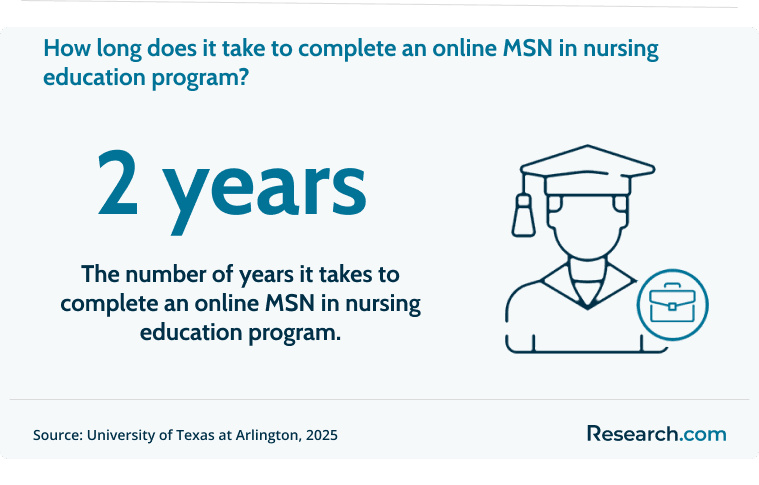
Many online MSN nursing education programs take about two years, although the specific timeline depends on the school, enrollment pace, practicum requirements, transfer credit policies, and whether the program uses traditional terms or a competency-based structure. One listed option can be completed in 21 to 25 months, while other programs range from around 14 months to two to three years.
Working nurses should look beyond the advertised completion time. A short program can be attractive, but accelerated formats may require heavier weekly study time and faster practicum planning. A part-time plan may cost more if tuition is charged by term or if fees repeat each semester, but it may be more realistic for nurses with full-time clinical schedules.
If your goal is education outside nursing, you may want to compare timelines with other teaching routes, such as learning how to become a substitute teacher. For RNs who want to teach in nursing schools or clinical training departments, however, an MSN in Nursing Education provides a more specialized graduate pathway.
| Timeline option | Who it may fit | Trade-off to consider |
| Around 14 months | Nurses who can manage an intensive schedule and want to finish quickly. | Less flexibility if work, family, or practicum placement issues arise. |
| 21 to 25 months | Working RNs seeking a common full-time or structured online pace. | Requires steady progress across coursework and practicum requirements. |
| 24 months | Students who want a predictable two-year plan. | May still include demanding clinical or teaching practice hours. |
| Two to three years | Students who need part-time pacing or more room for work obligations. | Total cost may increase depending on tuition model and fees. |
How does an online MSN in nursing education degree program compare to an on-campus program?
Online and campus-based MSN nursing education programs can lead to similar academic credentials when they are properly accredited. The real difference is how you learn, where you complete practicum requirements, how much schedule control you have, and what support systems are available.
| Factor | Online MSN in Nursing Education | On-campus MSN in Nursing Education |
| Schedule | Often offers asynchronous classes, part-time pacing, or self-paced formats. | Usually requires attendance at fixed times and locations. |
| Best for | Working nurses, rural students, military spouses, and learners who need geographic flexibility. | Students who prefer in-person interaction and direct access to campus resources. |
| Learning experience | Uses learning platforms, recorded lectures, discussion boards, virtual simulation, and online collaboration. | Relies more on classroom discussion, campus labs, and face-to-face faculty access. |
| Practicum | Often completed at an approved local site, but students may need to help identify a preceptor. | May use established university partnerships, though placement options can still be competitive. |
| Cost considerations | May reduce commuting, relocation, and campus-related expenses. | May involve transportation, housing, parking, or schedule-related opportunity costs. |
For many RNs, the online format is the practical choice because it allows them to remain employed while earning the degree. Still, students should confirm whether the school helps secure practicum placements, whether online students pay different fees, and whether the program meets employer or certification expectations.
Nurses considering long-term academic leadership may later compare doctoral pathways, including the cheapest higher education PhD programs online, especially if they want broader expertise in college teaching, administration, or research.
What is the average cost of an online MSN degree program in nursing education?
Online MSN nursing education tuition varies widely because schools use different pricing models. Some charge by credit, some charge by semester, and competency-based programs may charge a flat rate for a six-month term. The listed examples range from just under $12,000 to nearly $30,000, depending on program pace and structure.
Students comparing healthcare training options should also consider whether an MSN is necessary for their goal. If the goal is to enter allied health quickly rather than teach nursing, lower-cost alternatives such as the cheapest online phlebotomy technician certification programs may be more appropriate.
Cost examples from selected online MSN nursing education programs
- Western Governors University: WGU lists approximately $20,940 for its 2-year nursing education MSN program. Tuition is charged as a flat-rate amount per six-month term, which can reward students who complete more coursework within each term.
- Sacred Heart University: SHU’s MSN program costs about $27,105 for 39 credit hours. Because tuition is calculated per credit hour, the final amount is tied to required credits and enrollment choices.
- Capella University accelerated option: Capella lists an accelerated MSN nursing education path at roughly $11,940, designed for completion in 11 months. This route may fit students who can handle a condensed academic schedule.
- Capella University flexible pace: Capella also lists a slower option lasting about 28 months, with tuition around $29,850. The extended schedule may be easier to balance with work, but the total tuition is higher.
| Cost factor | Why it affects affordability | Question to ask before enrolling |
| Tuition model | Per-credit, per-semester, and flat-rate term pricing can produce very different totals. | What is the estimated total program cost, not just the cost per credit? |
| Program pace | Accelerated programs may cost less in some models but require more time each week. | Can I realistically complete courses at the pace needed to save money? |
| Fees | Technology, graduation, clinical, background check, and course fees can add to tuition. | Are all required fees included in the published estimate? |
| Practicum expenses | Students may need to pay for travel, documentation, immunizations, or site requirements. | Will I need to travel or pay extra to complete practicum hours? |
| Employer support | Tuition reimbursement can substantially reduce out-of-pocket cost. | Does my employer cover this program, and are there service commitments? |
The chart below shows the varying costs of an online MSN in nursing education from different schools:
What are the financial aid options for students enrolling in an online MSN in nursing education degree program?
Graduate nursing students may use several forms of aid to reduce upfront costs or spread payments over time. Availability depends on the school, enrollment status, employer policies, federal eligibility rules, and whether the student meets program-specific requirements.
- Federal Financial Aid: Eligible students can submit the Free Application for Federal Student Aid (FAFSA) to be considered for federal student aid, including federal student loans and, in some cases, grants.
- Scholarships: Universities, nursing associations, foundations, and professional organizations may offer scholarships for graduate nursing students, including those preparing for educator roles.
- Employer Tuition Reimbursement: Hospitals and healthcare organizations sometimes help pay for advanced nursing degrees, especially when the employee’s new skills support staff education, leadership, or workforce development needs.
- State and Federal Loan Forgiveness Programs: Graduates who teach in accredited nursing programs or work in qualifying public service or underserved settings may be able to explore options such as the Nurse Faculty Loan Program (NFLP) or Public Service Loan Forgiveness (PSLF).
- Payment Plans and Institutional Aid: Some schools offer monthly payment plans, internal awards, discounts, or online student grants that can reduce reliance on loans.
If your long-term plan includes leadership in care coordination, it may also be useful to review how to become a healthcare coordinator. Education, leadership, and systems-level training can overlap with roles that coordinate patient care, support quality improvement, and train healthcare teams.
What are the prerequisites for enrolling in an online MSN in nursing education degree program?
Admission requirements vary, but most online MSN nursing education programs expect applicants to show both nursing preparation and readiness for graduate-level academic work. Before applying, confirm the requirements with each school because bridge programs and traditional BSN-to-MSN pathways may differ.
- Bachelor of Science in Nursing (BSN): Many programs require a BSN from an accredited nursing program. Some schools offer RN-to-MSN bridge options for registered nurses with an associate degree or diploma who want to move into graduate study without completing a separate traditional BSN first.
- Active RN License: Applicants usually need a current, unrestricted registered nurse license. The license may need to be valid in the state where practicum hours are completed.
- Minimum GPA: Programs commonly expect an undergraduate GPA around 3.0 on a 4.0 scale. Some schools review applicants with lower GPAs if they have strong nursing experience, recommendations, or other evidence of graduate readiness.
- Work Experience: Some programs prefer or require one to two years of clinical nursing experience. This background helps future educators teach from real patient-care experience rather than theory alone.
- Application Materials: Common requirements include letters of recommendation, a resume or CV, a personal statement, and sometimes an interview or writing sample.
Admission requirements are one reason nurses should compare pathways early. A student who wants an education-focused MSN may need a different plan from someone pursuing advanced clinical practice through affordable online FNP programs or another practitioner track.
What courses are typically in an online MSN in nursing education degree program?
The curriculum in an online MSN in Nursing Education combines advanced nursing coursework with educator preparation. The goal is to help nurses teach safely, design meaningful learning experiences, evaluate competencies, and apply evidence-based education strategies in academic or clinical settings.
Students exploring online education in other fields may also compare programs such as affordable online religious studies degree programs, but nursing education programs have additional clinical, accreditation, and professional standards that make careful program review especially important.
Common courses in online MSN nursing education programs
- Advanced Health Assessment: Students strengthen assessment skills across the lifespan and develop the clinical reasoning needed to teach assessment concepts to nursing learners.
- Curriculum Development in Nursing Education: This course covers how nursing curricula are created, implemented, reviewed, and aligned with accreditation expectations and healthcare workforce needs.
- Teaching Strategies and Learning Theories: Students examine adult learning, active learning, clinical instruction, classroom engagement, and strategies that support critical thinking.
- Evaluation and Assessment in Nursing Education: This course focuses on measuring learning outcomes, building fair assessments, grading performance, and providing useful feedback.
- Educational Technology in Nursing: Students learn how to use learning management systems, simulation, multimedia tools, and online teaching methods to support nursing education.
- Research in Nursing Education: This course teaches students to evaluate education research and apply evidence-based practices to improve teaching and learning.
| Course area | Skill developed | How it applies after graduation |
| Curriculum design | Planning learning outcomes, course sequences, and teaching materials. | Useful for faculty, program coordinators, and staff education leaders. |
| Assessment and evaluation | Measuring student or staff competency fairly and consistently. | Essential for clinical instructors, simulation educators, and academic faculty. |
| Educational technology | Using online platforms, simulation tools, and multimedia instruction. | Important for hybrid programs, online teaching, and clinical training departments. |
| Leadership and evidence-based practice | Using research, policy, and systems thinking to improve education programs. | Helpful for educators who want to influence curriculum, staff development, or quality improvement. |
What types of specializations are available in an online MSN in nursing education degree program?
Some MSN nursing education programs offer a single education track, while others allow students to focus on a narrower area. A specialization can be useful if you already know where you want to teach or what type of educational work you want to do.
- Clinical Education: Focuses on teaching nursing skills, supervising learners in clinical settings, and evaluating hands-on competency.
- Curriculum Development and Instructional Design: Prepares students to build nursing courses, map outcomes, design assessments, and improve learning experiences.
- Health Informatics: Connects education with data, digital systems, and technology-supported nursing practice.
- Leadership in Nursing Education: Builds skills in academic administration, faculty development, policy, and program management.
- Simulation and Technology in Nursing Education: Emphasizes simulation design, scenario development, debriefing, and digital learning tools.
Students who are more interested in providing specialized mental health care than teaching may need a different MSN or post-graduate pathway. In that case, comparing the cheapest PMHNP programs can help nurses evaluate affordability in a clinical advanced practice track.
Can I Transition to an MSN in Nursing Education Without a Traditional BSN Background?
Yes, some registered nurses without a traditional BSN can still move toward an MSN in Nursing Education, but the route depends on the school. Nurses with an associate degree or diploma may need an RN-to-BSN, RN-to-MSN, or bridge pathway before entering the graduate education specialty.
For nurses who need the undergraduate credential first, online RN to BSN programs without clinicals may help complete the academic step more efficiently when additional clinical hours are not required by the program. Students should verify whether the bridge option is accepted by their intended MSN program and whether it meets employer expectations.
What accreditation and quality standards should I consider?
Accreditation is one of the most important filters when comparing online MSN nursing education programs. Students should confirm that the nursing program is accredited by a recognized nursing accreditor such as CCNE or ACEN and that the institution itself holds appropriate institutional accreditation.
Accreditation can affect financial aid eligibility, employer recognition, transfer credit, certification preparation, and future doctoral study. It is also a signal that the curriculum, faculty qualifications, student support, and outcomes are reviewed against external standards.
For broader comparisons across nursing education options, students may also review cheap online nursing programs. However, an MSN in Nursing Education should be evaluated specifically for graduate nursing accreditation, practicum expectations, faculty credentials, and alignment with educator competencies.
| Quality indicator | What to check | Why it matters |
| Nursing accreditation | Whether the program is accredited by CCNE or ACEN. | Supports credibility, employer acceptance, and certification readiness. |
| Institutional accreditation | Whether the university is properly accredited as an institution. | Can affect federal aid, transferability, and graduate school recognition. |
| Practicum support | How placements are approved and whether the school helps locate preceptors. | Delays in practicum placement can delay graduation. |
| Faculty experience | Whether faculty have nursing education, clinical, research, or leadership backgrounds. | Strong mentorship matters in educator preparation. |
| Graduate outcomes | Graduation rates, employment outcomes, certification preparation, and alumni feedback. | Outcomes help you judge whether the program delivers on its promises. |
How do I choose the best online MSN in nursing education degree program?
The best online MSN in Nursing Education is not automatically the cheapest or fastest option. The right program is the one that fits your license status, schedule, budget, practicum needs, career goal, and learning style while meeting recognized quality standards.
Step-by-step program selection checklist
- Confirm accreditation first. Search the Commission on Collegiate Nursing Education (CCNE) database or verify ACEN accreditation directly with the accreditor before applying.
- Calculate the full cost. Add tuition, fees, books, practicum expenses, travel, technology fees, and the cost of extending enrollment if you need more time.
- Review practicum requirements. Ask how many hours are required, where they can be completed, who approves the site, and what happens if you cannot find a preceptor.
- Match the curriculum to your goal. Choose clinical education, faculty preparation, simulation, leadership, or curriculum-focused options based on the role you want after graduation.
- Check schedule flexibility. Compare synchronous sessions, asynchronous work, deadlines, clinical hour requirements, and whether part-time enrollment is available.
- Ask about certification preparation. If you want to pursue Certified Nurse Educator (CNE) eligibility, confirm how the program supports that goal.
- Evaluate student support. Look for academic advising, library access, writing help, technology support, career services, and faculty mentorship.
- Compare outcomes. Ask for graduation rates, employment information, certification pass data if available, and examples of practicum sites.
Common mistakes to avoid
| Mistake | Why it can hurt you | Better approach |
| Choosing only by tuition | A low tuition rate may not include fees, practicum costs, or extra terms. | Compare total program cost and likely completion time. |
| Ignoring accreditation | Unaccredited programs may limit financial aid, employment, certification, or further education options. | Verify nursing and institutional accreditation before applying. |
| Assuming online means no fieldwork | Most MSN education programs still require practicum, teaching, or applied experiences. | Ask about all in-person, virtual, and site-based requirements. |
| Overlooking preceptor responsibilities | Some students must help secure their own practicum site or mentor. | Ask exactly how placement support works. |
| Relying only on rankings | A highly ranked program may not fit your schedule, budget, or state requirements. | Use rankings as one input, then compare fit and outcomes. |
| Assuming salary outcomes are guaranteed | Pay depends on employer type, geography, experience, credentials, and role. | Research local job postings and talk to employers before enrolling. |
What career paths are available for graduates of online MSN degree programs in nursing education?
An online MSN in Nursing Education can lead to roles that combine clinical knowledge with teaching, coaching, curriculum design, and workforce development. Some graduates work in colleges and universities, while others remain in healthcare organizations as clinical educators or staff development leaders.
If you are comparing healthcare education paths with a shorter timeline or lower entry cost, you may also review affordable respiratory care therapy associate programs online. Those programs prepare students for clinical roles, while an MSN in Nursing Education is a graduate route for licensed nurses moving into teaching and training.
Common roles and average salaries
- Nurse Educator ($102,263): Nurse educators teach nursing students or practicing nurses in colleges, universities, hospitals, or healthcare organizations. They may develop curriculum, evaluate learning, and support clinical preparation.
- Clinical Nurse Educator ($113,298): Clinical nurse educators train nursing staff in hospitals, clinics, and health systems. They help nurses stay current on procedures, technology, policies, and quality standards.
- Nursing Faculty ($80,622): Nursing faculty members teach theory and clinical content, advise students, contribute to curriculum work, and may participate in scholarship or academic service.
- Staff Development Coordinator ($89,699): Staff development coordinators design and deliver continuing education, onboarding, competency validation, and required training programs for healthcare staff.
- Healthcare Consultant ($74,081): Some MSN-prepared educators advise organizations on workforce development, nursing education, training systems, and quality improvement. Knowledge of public health nurse requirements can also support consulting work tied to community health and population-focused programs.
| Career path | Typical workplace | Good fit for nurses who enjoy... | Average salary listed |
| Nurse Educator | Nursing schools, hospitals, healthcare organizations | Teaching, mentoring, curriculum development, and learner assessment | $102,263 |
| Clinical Nurse Educator | Hospitals, clinics, health systems | Staff training, clinical practice improvement, and policy implementation | $113,298 |
| Nursing Faculty | Colleges and universities | Academic teaching, advising, and program development | $80,622 |
| Staff Development Coordinator | Healthcare employers and training departments | Continuing education, compliance training, and professional development | $89,699 |
| Healthcare Consultant | Consulting firms, nonprofits, healthcare organizations | Advising organizations, building education programs, and improving systems | $74,081 |
The chart below provides a clear overview of these career paths, including their typical responsibilities and average salary ranges, helping you better understand the opportunities available after earning an online MSN in nursing education.
What is the job market for graduates with an online MSN in nursing education degree?
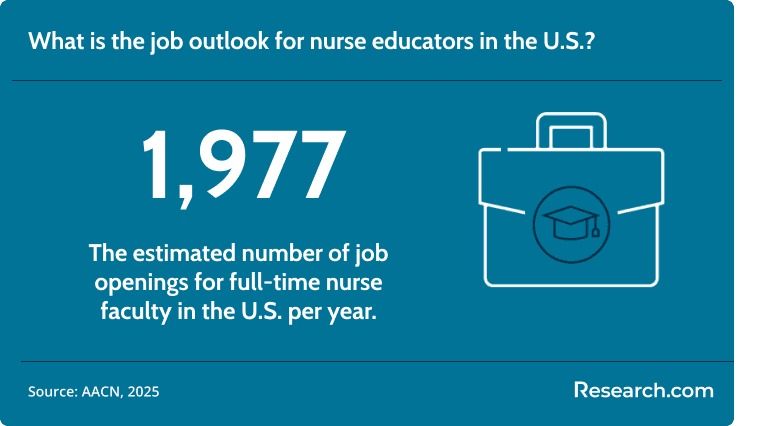
The job market for nurse educators is shaped by a persistent shortage of nursing faculty and clinical training capacity. According to AACN, nursing schools in 2023 turned away 65,766 qualified applicants from bachelor’s and graduate programs, largely because of limited faculty, preceptors, and training resources. In 2023, the national full-time nursing faculty vacancy rate was 7.8%, with around 1,977 job openings in one year, and nearly 80% of those requiring or preferring doctoral credentials.
Faculty retirements also continue to affect hiring needs. Up to one‑third of current faculty is expected to retire by 2025, increasing pressure on nursing schools and clinical education programs. While many full-time faculty positions prefer or require a PhD or DNP, MSN-prepared nurses can still pursue clinical instructor, hospital educator, staff development, simulation, and professional development roles where practical experience is highly valued.
Nurses who plan to move into doctoral-level academic or executive roles may want to understand DNP roles and responsibilities. For many MSN nursing education graduates, however, the most immediate opportunities are in clinical education, staff training, academic support, curriculum development, and preceptor-related roles.
Here’s what graduates have to say about their online MSN degrees in nursing education:
Completing my MSN in Nursing Education online made it possible to keep working, care for my family, and still move toward a new professional goal. The virtual courses were interactive, and the faculty support helped me feel prepared rather than isolated. The degree helped me step into a nurse educator career that feels meaningful. — Deborah
The online nursing education program let me study at a pace that fit my clinical schedule while using new ideas immediately at work. I did not have to pause my full-time job, and I now feel ready to teach and encourage future nurses. The experience gave me confidence and a clearer career direction. — Pearl
An online MSN made graduate school realistic for me when a campus program would not have worked. I valued learning with classmates from different regions and appreciated coursework that connected directly to real teaching situations. Becoming a nurse educator has been a major professional milestone. — Marissa
How can online MSN programs in nursing education foster effective mentorship and professional networking?
Strong online programs do more than deliver lectures. They create ways for students to connect with faculty, preceptors, classmates, alumni, and professional organizations. Mentorship may happen through faculty advising, practicum supervision, peer discussion groups, webinars, virtual office hours, and structured educator communities.
Networking is especially useful for students who want academic roles, because faculty hiring often values teaching experience, references, preceptor relationships, and professional visibility. Students should ask whether the program helps them connect with nurse educators, join professional events, identify practicum mentors, and prepare for teaching interviews.
Nurses comparing educator preparation with advanced practice routes may also review a direct entry nurse practitioner programs list. Direct-entry NP programs serve a different audience and goal, but comparing pathways can clarify whether teaching, clinical practice, or advanced practice authority is the better fit.
What additional support services are available to online MSN nursing education students?
Support services can strongly affect whether online students finish on time. Useful resources include academic advising, technical support, writing assistance, online library access, tutoring, career counseling, virtual orientation, faculty office hours, and help with practicum documentation.
Students should also look for community-building features such as cohort discussions, online study groups, simulation support, alumni panels, and professional development events. These resources can make online learning feel less isolated and can help students build confidence as they shift from clinical practice into teaching.
If you are not yet a nurse but are exploring graduate nursing pathways, compare the requirements carefully. Programs such as direct entry nurse practitioner online programs for non nurses are designed for a different starting point than MSN nursing education programs for licensed RNs.
Questions to ask before applying
- Is the nursing program accredited by CCNE or ACEN, and is the institution properly accredited?
- What is the full estimated program cost, including tuition, fees, books, and practicum-related expenses?
- How many practicum or teaching hours are required, and can they be completed near my home?
- Does the school find preceptors, or am I responsible for locating one?
- Are classes asynchronous, synchronous, self-paced, or cohort-based?
- Can I enroll part-time if my work schedule changes?
- Does the curriculum prepare students for the National League for Nursing’s Certified Nurse Educator (CNE) examination?
- What support is available for online students who need writing help, career coaching, or technical assistance?
- What roles do recent graduates hold, and what employment data can the program share?
- Will my employer recognize the degree for promotion, tuition reimbursement, or educator roles?
Key Insights
- An online MSN in Nursing Education is best suited for licensed nurses who want to teach, train staff, design curriculum, or move into academic or clinical education roles.
- Most listed programs can be completed in about two years, but options range from around 14 months to two to three years depending on pacing and structure.
- Affordability depends on total program cost, not just tuition per credit. Selected examples range from just under $12,000 to nearly $30,000.
- Accreditation should be a non-negotiable requirement. Verify CCNE or ACEN nursing accreditation before comparing cost, schedule, or rankings.
- Online programs can be highly practical for working nurses, but students still need to plan for practicum, teaching, or applied experience requirements.
- Graduates may pursue roles such as nurse educator, clinical nurse educator, nursing faculty member, staff development coordinator, or healthcare consultant, with listed average salaries from $74,081 to $113,298 depending on role.
- The nurse educator job market is supported by ongoing faculty shortages: AACN reported 65,766 qualified applicants turned away in 2023, a 7.8% full-time nursing faculty vacancy rate, and around 1,977 job openings in one year.
- Do not choose a program based only on speed or price. The stronger decision is to compare accreditation, total cost, practicum support, faculty experience, student services, and alignment with your target role.
- The demand for nurse educators is growing rapidly, with job growth projected between 8% and 22% over the next decade.
References:
- American Association of Colleges of Nursing. (2025). Fact Sheet: Nursing Faculty Shortage. AACN
- Capella University. (2025). MSN in Nursing Education. CU
- Glassdoor. (2025). Salary: Clinical Nurse Educator in the United States 2025. Glassdoor
- Sacred Heart University. (2025). MSN: Nursing Education Specialization. SHU
- University of Texas at Arlington. (2025). Master of Science in Nursing in Nursing Education. UTA
- Western Governors University. (2025). Nursing Education (BSN to MSN). WGU
- ZipRecruiter. (2025). Nurse Educator Salary. ZipRecruiter
Other things you should know about online MSN degree programs in nursing education
Most MSN Nursing Education programs require 180 to 270 supervised clinical hours, often completed in a local academic or healthcare setting. Students usually need a preceptor and site approval before clinicals begin, and the school may require clinical paperwork to be submitted several weeks in advance.
Admission requirements typically include a Bachelor of Science in Nursing (BSN), an active RN license, a minimum GPA of 3.0, and completion of prerequisite courses. Some programs may also require professional references, a resume, and a personal statement.
Enrolling in an affordable online MSN Nursing Education program for 2027 typically requires a reliable computer, high-speed internet, and updated software like Microsoft Office. Some programs may also require specific applications for virtual simulations or video conferencing platforms such as Zoom.