
2027 Most Affordable Online Phlebotomy Technician Certification Programs

Co-Founder and Chief Data Scientist
Choosing an online phlebotomy technician certificate is usually a cost, schedule, and clinical-training decision. The right program can help you enter allied health quickly, but the wrong one may leave you without the hands-on experience, certification eligibility, or state approval employers expect. Phlebotomists collect blood specimens, support diagnostic testing, protect sample quality, and help patients through a procedure that many people find stressful.
This guide is for students, career changers, and current healthcare workers comparing affordable online or hybrid phlebotomy programs. It explains what these certificates include, how much they cost, how long they take, where graduates work, what employers look for, and how to avoid common mistakes before enrolling. Demand remains strong: projections show that by 2037, phlebotomists in the U.S. will exceed 140,000 (National Center for Health Workforce Analysis, 2024).
Quick answer: Are affordable online phlebotomy technician programs worth it?
Affordable online phlebotomy technician certificate programs can be worth it if they prepare you for a recognized certification exam, include or help arrange hands-on practice, and meet the requirements in the state where you plan to work. Fully online coursework is useful for learning terminology, anatomy, safety, specimen handling, and exam concepts, but most students still need in-person practice or clinical experience to become job-ready.
Why choose an affordable online phlebotomy technician certificate?
- Online coursework can make phlebotomy training easier to fit around work, family responsibilities, or a changing schedule.
- Many programs pair online lessons with lab practice, externships, simulation tools, or clinical requirements because blood collection cannot be mastered through reading alone.
- Phlebotomists earn a median annual salary of $43,660, although earnings differ by employer, location, experience, and additional credentials.
What should I expect from an affordable online phlebotomy technician certification program?
An affordable online phlebotomy technician certificate should teach both the science behind blood collection and the patient-facing skills needed in clinics, hospitals, laboratories, and mobile settings. These programs are usually shorter than degree programs, but they still need to cover safety, specimen accuracy, infection control, communication, and certification exam preparation.
| Program feature | What it means for students | What to verify before enrolling |
| Online theory courses | You study topics such as medical terms, anatomy, blood collection procedures, and legal requirements through a learning platform. | Ask whether lessons are self-paced, instructor-led, or offered on fixed class dates. |
| Hands-on training | You practice venipuncture, capillary collection, labeling, equipment use, and safety procedures through labs, kits, or clinical sessions. | Confirm whether the school provides a clinical site or expects you to find one independently. |
| Certification preparation | The curriculum should align with a national phlebotomy certification exam and include review materials or practice assessments. | Check which exam the program prepares you for and whether an exam voucher is included. |
| Career support | Some programs offer resume help, externship guidance, employer connections, or job-search coaching. | Ask for specifics; “career services” can mean very different levels of support. |
- Flexible and short coursework: Many programs use asynchronous lessons that can be finished in weeks or months, which is helpful for students seeking a faster route into healthcare.
- Lower total cost than a degree: Certificate programs generally require fewer courses than associate or bachelor’s degrees, so tuition is often more manageable. Some schools also include certification exam vouchers.
- Practical skill development: Even when lectures are online, strong programs include lab kits, in-person labs, externships, or other supervised practice so students can build confidence with blood collection techniques.
Where can I work after earning a phlebotomy technician certificate?
A phlebotomy certificate can qualify graduates for entry-level roles wherever blood samples and other specimens are collected, labeled, processed, and transported. Employers value accuracy, patient communication, infection control, and the ability to follow protocols under time pressure.
- Hospitals: Around 43% of phlebotomy technicians work in private, local, and state hospitals. These roles may involve emergency departments, inpatient units, surgical areas, and high-volume specimen collection.
- Medical and diagnostic laboratories: Phlebotomists in laboratories help ensure specimens are correctly collected, labeled, and delivered so testing teams can produce reliable results.
- Ambulatory healthcare services: Urgent care centers, specialty clinics, and outpatient service providers often need phlebotomists who can support a steady flow of patients.
- Physician offices: In doctors’ offices, phlebotomy technicians often handle routine draws, prepare specimens, restock supplies, and support daily clinical operations.
- Outpatient care centers: These settings use phlebotomists for pre-procedure testing, follow-up lab work, and same-day patient services.
- Employment services: Staffing agencies may place phlebotomists in temporary, contract, or rotating assignments, which can help newer workers gain experience across multiple healthcare environments.
How much can I earn with a phlebotomy technician certificate?
Graduates of online phlebotomy technician certificate programs earn $44,390 annually on average, with wages ranging from $34,860 in the 10th percentile to $57,750 in the 90th percentile. Pay is shaped by geography, employer type, years of experience, shift schedules, certification status, and whether the worker has additional clinical skills.
The highest-paying industry listed for the profession is management of companies and enterprises, where phlebotomy technicians earn $62,640. In these environments, workers may support employee health screenings, corporate wellness services, on-site medical events, or specimen collection programs that require strong organization and professional communication.
By state, California reports the highest pay at $55,360, followed by Washington at $50,910, New York at $50,860, Massachusetts at $50,660, and Alaska at $49,720. Higher wages in these areas may reflect cost of living, demand, urban healthcare markets, and local labor conditions.
Additional credentials can improve mobility. A certified phlebotomist who also trains as a patient care technician or EKG technician may qualify for broader job duties. Licensed practical or vocational nurses with a phlebotomy certification may earn upwards of $60,000, while professionals who move into healthcare management earn an annual salary of around $100,000.
| Factor | How it can affect earnings | Decision tip |
| Location | States and metro areas with higher healthcare demand or cost of living may pay more. | Compare wages in the area where you actually plan to work, not only national averages. |
| Employer type | Hospitals, labs, corporate health programs, and staffing agencies may offer different pay structures. | Look at shift differentials, benefits, and schedule stability alongside hourly pay. |
| Certification | Employers may prefer or require national certification, especially for clinical roles. | Choose a program that clearly prepares you for the exam employers in your area recognize. |
| Additional training | Skills in EKG, patient care, nursing, lab work, or healthcare administration may open higher-paying paths. | Use phlebotomy as a first credential if you plan to stack healthcare qualifications over time. |
- Most Affordable Online Phlebotomy Technician Certification Programs for 2027
- How long does it take to complete an affordable online phlebotomy technician certification program?
- How does an online phlebotomy technician certification program compare to an on-campus program?
- What is the average cost of an affordable online phlebotomy technician certification program?
- What are the financial aid options for students enrolling in an online phlebotomy technician certification program?
- What are the prerequisites for enrolling in an online phlebotomy technician certification program?
- What courses are typically in an affordable online phlebotomy technician certification program?
- What types of specializations are available in online phlebotomy technician certification programs?
- Are these online phlebotomy technician certification programs accredited and recognized by employers?
- Can a phlebotomy technician certificate lead to lucrative leadership roles in healthcare?
- What are the opportunities for further education and career growth?
- How do online phlebotomy programs leverage innovative technology for clinical training?
- How can I maximize my success in an online phlebotomy technician certification program?
- How to choose the best affordable online phlebotomy technician certification programs?
- What career paths are available for graduates of online phlebotomy technician certification programs?
- What is the job market for graduates with a phlebotomy technician certificate?
Most Affordable Online Phlebotomy Technician Certification Programs for 2027
How do we rank schools?
Cost matters when you are choosing a short healthcare credential, but price alone does not make a program a good choice. Research.com reviewed affordable phlebotomy technician programs using a structured ranking methodology designed to help students compare options more clearly.
The ranking uses information from the Integrated Postsecondary Education Data System, Peterson’s database and its Distance Learning Licensed Data Set, College Scorecard, and the National Center for Education Statistics so readers can evaluate schools using transparent education data.
1. U.S. Career Institute
The online Phlebotomy Technician Certification Program from U.S. Career Institute teaches core concepts such as medical terminology, blood components, and cardiovascular system basics. Students receive an IV Practice Arm Kit and video demonstrations for simulated practice. The program is fully online, so students who need clinical experience for certification must arrange that experience separately. Students in California, Louisiana, Nevada, and Washington should note that this program does not meet licensure requirements in those states.
- Program Length: 3 to 4 months
- Tracks/Concentrations: N/A
- Cost: $979
- Required Credits to Graduate: 4 instruction packs
- Accreditation: Distance Education Accrediting Commission (DEAC)
2. Northeast Texas Community College
The Phlebotomy Technician certificate from Northeast Texas Community College includes 146 contact hours across classroom instruction, lab training, and clinical practice. Students who finish the program receive a certificate and may take the American Society of Phlebotomy Technicians national certification exam. The program is available in the fall and spring, and its lab and clinical requirements are completed in person. Course content includes Medical Terminology, phlebotomy technician preparation, and clinical experience.
- Program Length: 8 weeks
- Tracks/Concentrations: N/A
- Cost: $1,000
- Required Credits to Graduate: 146 contact hours
- Accreditation: Texas Higher Education Coordinating Board, Texas Education Agency
3. Heart to Heart Healthcare Training
Heart to Heart Healthcare Training offers a Michigan state-approved phlebotomy certification program that blends online lectures with on-site lab sessions. Students complete lecture content online and attend lab twice a week to practice specimen collection skills. The curriculum addresses technique, patient information handling, safety, and regulatory procedures. Eligible students who complete the course may pursue an externship for additional clinical exposure.
- Program Length: 7 to 8 weeks
- Tracks/Concentrations: N/A
- Cost: $1,195
- Required Credits to Graduate: N/A
- Accreditation: State of Michigan
4. CUNY Queensborough Community College
The hybrid Phlebotomy Technician program at CUNY Queensborough Community College prepares students to collect blood specimens safely for laboratory analysis. Students study medical terminology, anatomy and physiology, blood collection methods, and specimen types that fall within the phlebotomist’s scope. The format combines online learning with in-person skills instruction.
- Program Length: 2 months
- Tracks/Concentrations: N/A
- Cost: $1,200
- Required Credits to Graduate: 60 hours
- Accreditation: Middle States Commission on Higher Education (MSCHE)
5. Kennesaw State University
Kennesaw State University offers a Phlebotomy Technician Certificate that combines classroom concepts with hands-on lab practice. Students learn medical terminology, circulatory anatomy, infection control, and HIPAA privacy expectations. Training includes venipuncture, capillary sticks, heelsticks, and non-blood specimen collection. The program is designed for students entering healthcare or current workers adding clinical skills.
- Program Length: 2 months
- Tracks/Concentrations: N/A
- Cost: $1,699
- Required Credits to Graduate: 80 hours (8 CEUs)
- Accreditation: Southern Association of Colleges and Schools Commission on Colleges (SACSCOC)
6. SUNY Jefferson Community College
The self-paced online Phlebotomy Technician course from SUNY Jefferson Community College introduces students to blood collection, specimen preparation, point-of-care testing, and equipment procedures. A lab kit and instructional videos support simulated practice activities. Delivered in partnership with Condensed Curriculum International (CCI), the program includes a complimentary voucher for the NHA Certified Phlebotomy Technician (CPT) exam.
- Program Length: 6 to 12 months
- Tracks/Concentrations: N/A
- Cost: $1,799 (without voucher), $2,295 (with voucher)
- Required Credits to Graduate: 375 course hours + 40 externship hours
- Accreditation: MSCHE
7. American Institute of Medical Sciences and Education (AIMS)
AIMS Education provides a blended Phlebotomy Technician program for students preparing for entry-level positions in hospitals, laboratories, and medical offices. The format includes live online lectures plus campus-based lab sessions. Students learn to collect medical histories, draw and process specimens, and manage equipment and supplies while meeting professional and clinical expectations.
- Program Length: 1 month (day/evening classes) or 3 months (weekends)
- Tracks/Concentrations: N/A
- Cost: $1,875
- Required Credits to Graduate: 4
- Accreditation: Accrediting Bureau of Health Education Schools (ABHES)
8. Rogue Community College
The Phlebotomy Technician program at Rogue Community College is a one-term program that combines online coursework with lab instruction and clinical practice in a nearby clinic or hospital. Students attend classes two half-days each week and may study part-time. The curriculum emphasizes specimen collection, patient identification, safety protocols, communication, organization, and accuracy in busy healthcare settings.
- Program Length: 4 to 6 months
- Tracks/Concentrations: N/A
- Cost: $2,265
- Required Credits to Graduate: 12-13
- Accreditation: Northwest Commission on Colleges and Universities (NWCCU)
9. Boston Career Institute
Boston Career Institute offers day and evening options in blended and monthly formats. Students receive clinical training in phlebotomy skills, safe blood draws, vital signs, and EKGs. The program is designed to build technical ability and confidence through guided practice in a healthcare training environment.
- Program Length: 16 weeks
- Tracks/Concentrations: N/A
- Cost: $3,000
- Required Credits to Graduate: 116 class hours
- Accreditation: ABHES
10. Northwest Career College
Northwest Career College teaches foundational phlebotomy skills through morning and evening class options. Students complete three main courses: Introduction to Phlebotomy Practice, Special Procedures and Populations, and Specimen Collection and Processing. The school also offers flexible payment plans and scholarship opportunities to help students manage tuition.
- Program Length: 3 months
- Tracks/Concentrations: N/A
- Cost: $3,999
- Required Credits to Graduate: 3 courses
- Accreditation: ABHES
How long does it take to complete an affordable online phlebotomy technician certification program?
Many online phlebotomy technician certificate programs can be completed in four to 16 weeks. Programs with more clinical hours, externships, or broader healthcare coursework may take up to 12 months. The fastest options are usually best for students who already understand the healthcare environment or can quickly complete required hands-on practice.
Phlebotomy does not require a college degree in many settings, which helps explain why around 14% of phlebotomists enter the field with only a high school diploma (Zippia, 2025). At the same time, 22% hold associate degrees, and some workers use phlebotomy as a first step toward broader allied health or nursing roles.
Students planning a longer clinical career sometimes begin with phlebotomy, then later move into pathways such as a 6 month LPN to RN program online to build advanced nursing credentials.
The short training timeline is one of phlebotomy’s biggest advantages. It allows motivated students to enter healthcare faster, gain patient-care experience, and decide whether they want to pursue additional credentials later.
This chart shows the education levels reported among phlebotomists.
How does an online phlebotomy technician certification program compare to an on-campus program?
Online and campus-based phlebotomy programs share the same goal: preparing students for safe, accurate, entry-level specimen collection. The difference is how students learn. Online programs usually deliver lectures and assignments through a digital platform, while on-campus programs follow set class times and complete labs in person.
| Comparison point | Online or hybrid program | On-campus program |
| Schedule | Often more flexible, especially for theory courses. | Usually follows fixed class and lab times. |
| Hands-on practice | May use lab kits, scheduled labs, externships, or clinical sites. | Typically provides in-person practice with direct supervision. |
| Instructor access | Support may come through email, video meetings, chats, or online office hours. | Students can ask questions during class and receive immediate lab feedback. |
| Best for | Independent learners who need flexibility and can manage clinical requirements. | Students who want structure, in-person coaching, and regular peer interaction. |
- Hands-on training: Both formats need practical skill-building. Online students may complete simulations, use practice kits, or attend required in-person labs, while campus students usually complete these activities under direct supervision.
- Communication and support: Online learners often depend on discussion boards, email, scheduled virtual meetings, and uploaded demonstrations. Campus learners typically receive more immediate feedback during labs.
- Pace and flexibility: Online programs may let self-directed students move quickly, whereas campus programs usually keep students on a cohort schedule. Students comparing healthcare programs may see similar flexibility differences when researching the best accredited medical billing and coding schools online.
The better format depends on your learning style, schedule, transportation, and access to clinical training. If you are new to healthcare and nervous about blood draws, a hybrid or campus program with supervised labs may be safer than a lecture-only online option.
What is the average cost of an affordable online phlebotomy technician certification program?
An affordable online phlebotomy technician certificate usually costs between $800 and $6,500. Lower-cost programs may focus mainly on the essential knowledge needed for certification, while higher-cost options may include longer instruction, clinical support, exam vouchers, or additional healthcare skills.
Students should look beyond tuition. Extra expenses may include textbooks, digital materials, lab kits, uniforms, background checks, drug screening, immunization records, liability insurance, CPR or BLS certification, and certification exam fees. If the program includes an externship, ask whether all placement-related costs are included.
Some schools offer payment plans, upfront-payment discounts, scholarships, or partnerships with workforce development programs. Online coursework may also reduce commuting, parking, or relocation expenses, but that savings only helps if the program still meets certification and clinical requirements.
It can also help to compare nearby allied health options. For example, affordable online medical assistant programs may cost more or take longer because they cover a wider set of clinical and administrative duties.
What are the financial aid options for students enrolling in an online phlebotomy technician certification program?
Because many phlebotomy programs are short nondegree credentials, financial aid availability varies widely. Some programs may not qualify for federal aid, so students should ask each school what assistance is actually available before applying.
- American Society for Clinical Pathology Laboratory Student Scholarship: This scholarship awards $1,000 to high-achieving students in laboratory science programs, including phlebotomy.
- Garza & Becan-McBride Phlebotomy Student Scholarships: Phlebotomy students who have completed at least half of their training in an accredited program may receive a $1,000 scholarship.
- Employer tuition reimbursement: Hospitals, clinics, laboratories, and other healthcare employers may help pay for employees who pursue job-related credentials.
- School-based scholarships: Some colleges and training providers offer need-based, merit-based, or partner-funded assistance for phlebotomy students.
- State or local workforce grants: Workforce programs may help residents train for healthcare roles, depending on income, location, and program eligibility.
If you are comparing inexpensive online education outside clinical healthcare, you can also review low-cost online religious studies degree options, which support careers in ministry, education, and nonprofit settings.
Before you enroll, ask the admissions or financial aid office for a complete cost sheet and a written explanation of available aid. Do not assume that a certificate program qualifies for the same aid as a degree program.
What are the prerequisites for enrolling in an online phlebotomy technician certification program?
Most phlebotomy programs set basic entry requirements because students may interact with patients, handle specimens, and enter clinical sites. Requirements vary by school and state, so confirm them before paying an application or enrollment fee.
If you are considering a broader clinical training route, a low-cost online associate's degree in respiratory care therapy may provide a wider clinical foundation than a short phlebotomy certificate.
- Minimum age: Applicants are commonly expected to be at least 18 years old, especially when clinical placements or certification exams are involved.
- High school diploma or equivalent: A diploma, GED, or accepted equivalent is usually required. The National Healthcareer Association (NHA) reports that 39% of employers seek an applicant’s high school diploma during hiring.
- Government-issued identification: Programs may request a driver’s license, passport, Social Security number, or other approved ID.
- Immunization documentation: Clinical sites often require vaccination records to protect students, staff, and patients.
- Background check and drug screening: These requirements are common for students entering healthcare facilities.
- CPR or BLS certification: Some programs require basic life support or cardiopulmonary resuscitation certification before clinical training begins.
These requirements resemble many other allied health entry standards, including those outlined in guides on how to become a pharmacy technician. Completing prerequisite items early can prevent delays in clinical placement or certification eligibility.
This chart highlights the criteria employers consider when hiring phlebotomy technicians.
What courses are typically in an affordable online phlebotomy technician certification program?
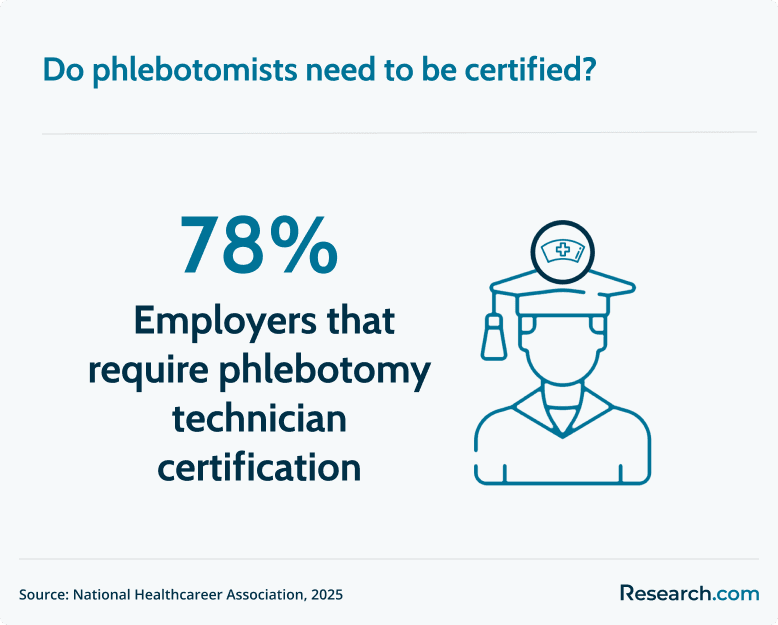
A strong online phlebotomy technician certificate should teach more than how to insert a needle. Students need to understand anatomy, infection control, specimen quality, patient communication, legal requirements, and workflow in laboratories and clinical settings. This matters because 78% of employers require phlebotomists to be certified.
- Medical Terminology and Anatomy: Students learn healthcare vocabulary and body systems, with particular attention to circulation and blood collection.
- Medical Equipment and Supplies: This course covers needles, syringes, tourniquets, collection tubes, labels, sharps containers, and safe handling procedures.
- Drawing Blood and Blood Testing: Students study venipuncture, capillary puncture, specimen handling, and methods for reducing patient discomfort while protecting sample integrity.
- Phlebotomy and Quality Assessment: This content focuses on standard procedures, quality assurance, correct labeling, and error prevention.
- Professional Ethics, Legal, and Regulatory Issues: Students review patient privacy, consent, HIPAA expectations, and the legal boundaries of the phlebotomy role.
- Infection Control and Safety: Training includes universal precautions, personal protective equipment, biohazard disposal, contamination prevention, and workplace safety.
The Centre for Medical Sciences & Research emphasizes that phlebotomists support patients during blood collection and help protect specimen integrity, which directly affects diagnostic accuracy and patient trust.
Good coursework should prepare students for both the certification exam and the realities of patient care: anxious patients, difficult veins, documentation requirements, time pressure, and strict safety rules.
What types of specializations are available in online phlebotomy technician certification programs?
Most phlebotomy certificate programs teach general blood collection skills rather than formal academic concentrations. After training, however, phlebotomists can build experience in specialized work settings that require different patient-care styles, documentation habits, and technical routines.
Specialized experience can also help address employer concerns. According to the NHA, 28% of employers say new phlebotomy technicians lack hands-on clinical experience, and 19% cite gaps in EHR proficiency and communication skills.
Students interested in specialized health and education roles outside phlebotomy may also compare affordable online school psychology programs, which prepare professionals to support student learning and mental health.
- Hospital and ER phlebotomy: Hospital technicians may rotate across departments, while emergency settings require speed, composure, and careful attention under pressure.
- Outpatient and inpatient clinics: Clinic-based phlebotomists often focus on scheduled testing, patient flow, EHR documentation, and routine specimen handling.
- Traveling phlebotomy: Mobile technicians collect specimens in homes, nursing facilities, rural clinics, or workplace settings, requiring independence and reliable documentation.
- Blood donation phlebotomy: Donation settings emphasize donor screening support, high-volume collections, post-donation monitoring, and strong interpersonal skills.
- Research and laboratory phlebotomy: These roles may involve clinical trials, study protocols, specimen processing, and stricter data or chain-of-custody procedures.
- Pediatric and geriatric phlebotomy: Working with children or older adults requires patience, communication, comfort techniques, and adaptations for fragile or difficult veins.
Some phlebotomists broaden their clinical options by adding another credential, such as training through an online ultrasound tech school, though requirements and hands-on training expectations vary by field.
The chart below summarizes skill gaps reported by the National Healthcareer Association and can help students decide what to practice during training.
Are these online phlebotomy technician certification programs accredited and recognized by employers?
Not every online phlebotomy program carries the same level of recognition. Students should verify institutional accreditation, program approval, certification exam alignment, and state requirements before enrolling. A low price is not a bargain if the program does not qualify you for the credential or job you want.
Ask three specific questions: Which accreditor or state agency recognizes the school? Which certification exam does the curriculum prepare students to take? Do local employers accept graduates from this program? Students considering broader population health careers can also compare options such as affordable online public health degree programs.
Can a phlebotomy technician certificate lead to lucrative leadership roles in healthcare?
A phlebotomy certificate alone usually leads to entry-level clinical work, not management. However, it can become the first credential in a longer healthcare career. Workers who gain clinical experience, earn additional credentials, and study supervision, operations, or healthcare administration may move into trainer, lead technician, laboratory operations, or administrative roles.
Students aiming for higher-level administration should plan for more education beyond phlebotomy. Researching high-paying healthcare administration careers can help you understand which roles require degrees, leadership experience, or specialized business training.
What are the opportunities for further education and career growth?
Phlebotomy can be a practical first step because it gives students patient contact, lab exposure, and familiarity with healthcare workflows. After gaining experience, graduates may pursue EKG training, patient care technician roles, medical assisting, nursing, clinical laboratory science, health information, or healthcare management.
Some students use the certificate to confirm that they enjoy healthcare before committing to a degree. Those interested in science-heavy pathways may later consider a fast track online biology degree to build academic preparation for laboratory, healthcare, or graduate study options.
How do online phlebotomy programs leverage innovative technology for clinical training?
Online phlebotomy programs may use video demonstrations, interactive modules, virtual simulations, digital quizzes, remote instructor feedback, and at-home practice kits to reinforce technique and decision-making. These tools can support learning, but they do not fully replace supervised practice with real patients or approved clinical experiences when those are required for certification or employment.
Students who want a deeper understanding of biological systems may also explore a biology degree online, especially if they plan to move into laboratory science, research, or advanced healthcare education.
How can I maximize my success in an online phlebotomy technician certification program?
Success in an online phlebotomy program depends on structure and practice. Set weekly study blocks, watch demonstrations more than once, quiz yourself on order of draw and safety rules, practice communication scripts, and ask instructors for feedback before clinical sessions. If your program requires you to find an externship, start that search early.
Students with long-term management goals can map out future credentials early, including options like an accelerated healthcare administration degree online after they gain clinical work experience.
How to choose the best affordable online phlebotomy technician certification programs?
The best affordable program is not always the cheapest. It is the one that fits your schedule, meets certification and state requirements, provides enough hands-on preparation, and gives you a realistic route to employment.
| Question to ask | Why it matters | Warning sign |
| Is the school accredited or state-approved? | Recognition affects employer trust and, in some cases, eligibility for certification or licensure. | The program cannot clearly explain its accreditation or approval status. |
| Does the program include clinical practice? | Employers often want proof that graduates can safely perform blood draws. | The program is lecture-only and gives no guidance on clinical experience. |
| Which certification exam does it prepare for? | Certification requirements vary by employer and location. | The school advertises “certification” but does not name the exam or credentialing body. |
| What is the total cost? | Fees, kits, screenings, uniforms, and exam costs can change the real price. | The school lists tuition but not required additional expenses. |
| Will it work in my state? | Some states have specific licensure or training rules. | The admissions office gives vague answers about state eligibility. |
- Accreditation and approval: Confirm that the school or program is recognized by an appropriate accrediting body, state agency, or employer-accepted training pathway.
- Curriculum and clinical components: Look for anatomy, safety, specimen handling, patient communication, venipuncture, capillary puncture, and documented practice opportunities.
- Certification exam preparation: Choose a program that clearly identifies the national exam it supports and provides review materials aligned with that exam.
- Student support: Advising, tutoring, instructor access, externship support, and career services can make a major difference, especially for online learners.
- Total price and aid: Compare tuition, fees, materials, exam vouchers, payment plans, and scholarship options. Students considering other affordable healthcare training routes may also review affordable surgical tech certification programs online.
Before enrolling, request written details about cost, clinical expectations, refund policies, certification eligibility, and state restrictions. Verbal promises are not enough when your job eligibility is at stake.
Common mistakes to avoid when choosing a phlebotomy program
- Choosing based only on tuition: A cheap program can become expensive if you must pay separately for labs, exams, screenings, and clinical placement.
- Ignoring hands-on requirements: Blood collection is a skill-based job. Employers may hesitate to hire graduates with no supervised practice.
- Assuming “online” means fully remote: Many legitimate programs still require in-person labs, externships, or clinical hours.
- Overlooking state rules: Some states have licensure or approval requirements that not every online program satisfies.
- Not checking employer preferences: Ask local hospitals, laboratories, and clinics which certifications they recognize before choosing a program.
- Relying only on rankings: Rankings can narrow your list, but your best choice depends on location, schedule, cost, clinical access, and certification goals.
What career paths are available for graduates of online phlebotomy technician certification programs?
The most direct career outcome is employment as a phlebotomist or phlebotomy technician. In this role, workers collect blood specimens, verify patient identity, label samples, follow infection-control procedures, maintain supplies, and communicate with patients who may be nervous or uncomfortable.
Phlebotomy can also support movement into related healthcare roles, especially for workers who add education, certification, or clinical experience. The certificate is often a starting point rather than a final career destination.
- Patient Care Technicians ($38,767): PCTs may combine phlebotomy with vital signs, mobility assistance, basic bedside care, and sometimes EKG-related duties.
- Research Lab Assistants ($42,113): These workers may collect, prepare, or process specimens in research, clinical trial, or academic laboratory settings.
- Phlebotomy Instructors ($44,989): Instructors train future technicians, lead skills labs, prepare course materials, and evaluate clinical competencies.
- Medical Records Specialists ($55,970): These professionals manage health data, privacy, accuracy, and accessibility. The role can also introduce workers to health informatics career and salary pathways.
- Licensed Practical/Vocational Nurses ($64,150): LPNs and LVNs provide basic nursing care under supervision, including medication administration, vital signs, and assistance with daily care needs.
- Clinical Laboratory Technologists and Technicians ($65,320): These professionals test blood, tissue, and other specimens to support diagnosis and treatment. Technologists commonly hold a bachelor's degree, while technicians often complete associate-level preparation.
- EKG Technicians ($72,890): EKG technicians operate electrocardiogram equipment and help physicians identify cardiac abnormalities through diagnostic testing.
- Registered Nurses ($98,430): RNs coordinate care, educate patients and families, administer treatments, perform diagnostic procedures, and supervise other healthcare staff.
The NHA reports that 35% of employers offer career ladder programs, which can help entry-level workers advance through structured training, additional credentials, and experience. A phlebotomy certificate can therefore be a practical first step toward broader clinical or administrative growth.
What is the job market for graduates with a phlebotomy technician certificate?
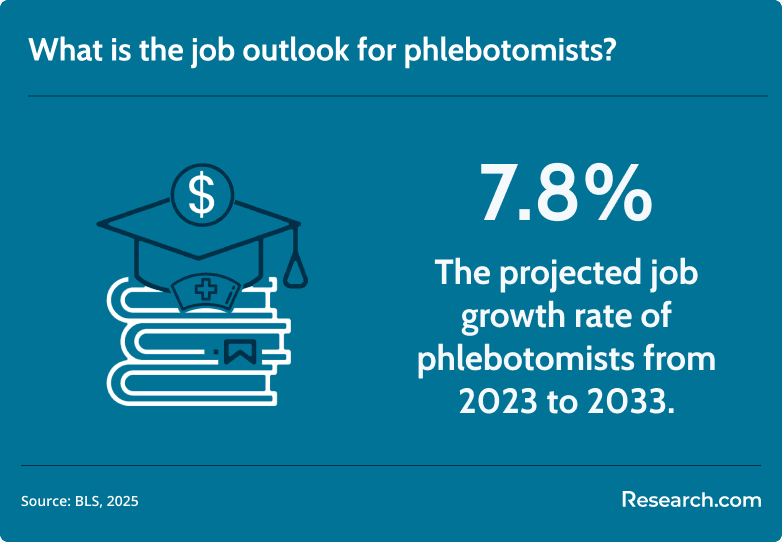
The labor market for phlebotomy certificate graduates remains favorable because blood testing is central to diagnosis, monitoring, preventive care, and treatment planning. According to the U.S. Bureau of Labor Statistics, employment of phlebotomists is projected to grow by 7.8% from 2023 to 2032, faster than the average for all occupations. That growth equals about 19,600 job openings each year. By 2037, the phlebotomy workforce is projected to reach 148,380, rising from its 2024 pool of 138,880.
Turnover also creates openings. Average tenure for phlebotomy technicians is just over three years, which means employers regularly need trained workers to replace those who move into other roles, leave the field, or continue their education.
The field is not expected to be heavily disrupted by retirement in the near term. The most recent American Society for Clinical Pathology Vacancy Survey (Garcia et al., 2022) found that only 8.7% of phlebotomists were expected to retire within five years. Combined with the continued reliance on blood testing, this suggests stable entry-level demand and room for upward movement for workers who continue developing skills.
Current trends affecting phlebotomy training and hiring
- Certification expectations are rising: With 78% of employers requiring certification, students should treat exam readiness as a core program requirement, not an optional benefit.
- Employers want stronger clinical readiness: The NHA finding that 28% of employers see hands-on experience gaps means students should prioritize programs with meaningful practice and externship support.
- Digital documentation matters: Since 19% of employers report gaps in EHR proficiency and communication skills, students should practice electronic charting, patient verification, and professional communication.
- Credential stacking is common: Phlebotomy can pair well with EKG, patient care, medical assisting, nursing, laboratory, or healthcare administration training.
- Hybrid learning is practical but limited: Online instruction can teach theory efficiently, but students still need in-person competence for a skill-based clinical job.
Questions to ask before enrolling in an online phlebotomy technician program
- Does this program meet the requirements for the state where I want to work?
- Which national certification exam does the curriculum prepare me to take?
- Are clinical hours, externships, or in-person labs included, required, or optional?
- Will the school place me at a clinical site, or must I find one myself?
- What is the full cost, including supplies, screenings, uniforms, insurance, and exam fees?
- What happens if I cannot complete the clinical portion on the original schedule?
- Do local hospitals, laboratories, clinics, and staffing agencies hire graduates from this program?
- Are payment plans, scholarships, employer reimbursement, or workforce grants available?
Key Insights
- An affordable online phlebotomy certificate is most valuable when it combines flexible coursework with hands-on practice and recognized certification preparation.
- Do not assume every online program qualifies you for employment or licensure in every state; verify requirements before enrolling.
- 39% of employers seek an applicant’s high school diploma during the hiring process, and 78% of employers require phlebotomists to be certified.
- Clinical readiness matters: 28% of employers say new phlebotomy technicians lack hands-on clinical experience, while 19% report gaps in EHR proficiency and communication.
- Phlebotomy can be a fast entry point into healthcare, but higher earnings usually require experience, additional credentials, or advancement into nursing, laboratory science, EKG, patient care, informatics, or administration.
- Phlebotomists who earn a bachelor’s degree in nursing and become registered nurses can earn as much as $98,430 annually.
- The employment of phlebotomists is projected to grow by 7.8% from 2023 to 2032, which supports continued opportunities for new certificate graduates.
References:
- National Center for Health Workforce Analysis. (2024, November). State of the U.S. Health Care Workforce, 2024. https://bhw.hrsa.gov/sites/default/files/bureau-health-workforce/state-of-the-health-workforce-report-2024.pdf
- National Healthcareer Association. (2025). 2025 Industry Outlook. https://info.nhanow.com/outlook
- Payscale. (2025, May 14). Average Patient Care Technician Hourly Pay. Retrieved May 28, 2025, from https://www.payscale.com/research/US/Job=Patient_Care_Technician/Hourly_Rate
- U.S. Bureau of Labor Statistics. (2024). Phlebotomists [Interactive data]. May 2024 OEWS Profiles, Occupational Employment and Wage Statistics (OEWS) Profiles. Retrieved May 28, 2025, from https://data.bls.gov/oesprofile
- U.S. Bureau of Labor Statistics. (2025a, April 18). Phlebotomists. Occupational Outlook Handbook. https://www.bls.gov/ooh/healthcare/phlebotomists.htm
- U.S. Bureau of Labor Statistics. (2025b, April 18). Occupational projections, 2023–33, and worker characteristics, 2023 (Numbers in thousands). Employment Projections. https://www.bls.gov/emp/tables/occupational-projections-and-characteristics.htm
- Zippia. (2025, January 8). Phlebotomist demographics and statistics in the US. Retrieved May 28, 2025, from https://www.zippia.com/phlebotomist-jobs/demographics
- ZipRecruiter. (2025, May 21). Phlebotomy Instructor Salary. Retrieved May 28, 2025, from https://www.ziprecruiter.com/Salaries/Phlebotomy-Instructor-Salary#Yearly
Other Things You Should Know About Affordable Online Phlebotomy Technician Certification Programs
In 2027, the National Accrediting Agency for Clinical Laboratory Sciences (NAACLS) and the American Society for Clinical Pathology (ASCP) are key accrediting bodies for phlebotomy technician programs. Accreditation from these organizations ensures that the program meets educational and professional standards essential for certification.
Yes. Most online phlebotomy technician certification programs require an in-person clinical externship of about 40 to 100 hours, completed at an approved healthcare site. Students usually must finish background checks, immunizations, and CPR training before starting the externship.


