
2027 Best Online Bachelor’s in Law Enforcement Degree Programs

Co-Founder and Chief Data Scientist
Choosing an online bachelor’s degree in law enforcement is not just a question of convenience. The bigger decision is whether a program will help you qualify for the roles you want, meet agency expectations, fit your schedule, and justify the cost. This guide is for working adults, current public safety professionals, military-affiliated students, transfer students, and first-time undergraduates comparing online law enforcement and criminal justice programs.
Below, you will find a practical breakdown of what online law enforcement programs teach, how long they take, what they cost, how online study compares with campus-based learning, and which career paths may follow. You will also see a ranked list of online programs, decision tables, questions to ask before enrolling, and common mistakes to avoid when evaluating accreditation, licensure, field training, transfer credits, and career outcomes.
Quick answer: Is an online law enforcement degree worth considering?
An online law enforcement degree can be a strong option if you need a flexible bachelor’s pathway for careers in policing, corrections, probation, investigations, public safety, homeland security, or related criminal justice roles. It is most useful when the program is properly accredited, offers relevant coursework, supports internships or agency-connected experience, and aligns with your state or agency’s hiring requirements.
- Common career outcomes include police officer, detective, probation officer, corrections professional, federal agent, public safety specialist, and private security investigator.
- Graduates in law enforcement can expect a median annual salary of approximately $67,290 for police and detectives, though pay varies by agency, location, rank, overtime, education, and experience.
- Online study is especially helpful for students who need to balance coursework with full-time employment, shift work, family responsibilities, or military service.
What can I expect from an online law enforcement degree program?
An online law enforcement degree usually combines criminal justice theory, legal foundations, policing strategy, ethics, and applied decision-making. At the bachelor’s level, students commonly complete general education courses, criminal justice core classes, electives, and a capstone, internship, or applied project. Some programs are built for first-time college students, while others are degree-completion programs for students who already have an associate degree or prior credits.
Course delivery is often asynchronous, meaning you can watch lectures, complete readings, and submit assignments on your own schedule within weekly deadlines. Some programs also include synchronous discussions, virtual simulations, writing-intensive assignments, case analysis, or supervised field experience with local agencies.
| Program feature | What it means for students | Why it matters |
| Accreditation | The college is reviewed by a recognized accrediting body. | Accreditation can affect financial aid eligibility, transfer credits, employer recognition, and graduate school admission. |
| Law enforcement-focused curriculum | Courses cover policing, criminal law, investigations, ethics, criminology, and public safety operations. | A focused curriculum is more useful for students targeting sworn or public safety roles. |
| Internship or capstone | Students apply classroom learning through research, fieldwork, simulations, or agency-based experience. | Practical experience helps connect academic work to hiring expectations and real-world duties. |
| Online student support | Advising, tutoring, library access, writing help, and career services are available remotely. | Support services can make a major difference for working adults and part-time students. |
| Transfer credit policy | The school evaluates prior college credits, military training, academy training, or professional experience. | Generous transfer policies may shorten the path to graduation and reduce total cost. |
Where can I work with an online law enforcement degree program?
Graduates may work in local, state, federal, nonprofit, and private-sector settings. Typical options include police departments, sheriff’s offices, correctional agencies, probation and parole departments, courts, emergency management offices, homeland security units, transportation security, private investigations, corporate security, and cybersecurity-adjacent public safety roles.
The degree itself does not automatically make someone a sworn officer or federal agent. Agencies may require separate academy training, physical fitness testing, background checks, psychological evaluations, drug screening, firearms qualification, citizenship requirements, age requirements, and state-specific licensing or certification. Before enrolling, students should compare the academic program with the requirements of the agencies where they hope to work.
How much can I make with an online law enforcement degree program?
Salary outcomes depend heavily on the role, agency, geographic area, union contracts, overtime, education level, specialized training, and years of service. Graduates typically see median salaries ranging from approximately $46,241 to $62,737, depending on the program and institution. Police officers generally have a median salary of roughly $75,000, with higher earnings possible in supervisory, specialized, or higher-cost regions.
A bachelor’s degree may support advancement into investigations, supervision, training, federal roles, emergency management, or administrative leadership, but it does not guarantee a specific salary or promotion. The strongest return usually comes from pairing the degree with agency experience, certifications, strong performance evaluations, and eligibility for advancement.
- Best online law enforcement degree programs for 2027
- How long does an online law enforcement degree take in 2027?
- Online vs. on-campus law enforcement degrees
- Average cost of an online law enforcement degree
- Financial aid for online law enforcement students
- Admission requirements and prerequisites
- Common courses in online law enforcement programs
- Available law enforcement specializations
- Using a law enforcement degree to move toward legal careers
- How to choose the right online law enforcement program
- Career paths after an online law enforcement degree
- Return on investment of an online law enforcement degree
- Practical training and career readiness in online programs
- Legal studies as a competitive advantage in law enforcement
- Job market for online law enforcement graduates
- Physical fitness standards in law enforcement
- Accelerated legal training for law enforcement students
- Certifications that can strengthen a law enforcement career
- Graduate education for law enforcement advancement
- How an online master’s in intelligence can support law enforcement careers
List of Best Online Law Enforcement Degree Programs for 2027
The best online law enforcement programs are not identical. Some focus directly on policing, while others use broader criminal justice, criminology, public safety, or security frameworks. When comparing the options below, pay close attention to tuition per credit, total credits, transfer credit rules, accreditation, degree title, concentrations, and whether the curriculum fits your target career.
How do we rank schools?
Programs are evaluated using education and institutional data sources, along with factors that matter to online law enforcement students: academic quality, cost, accreditation, curriculum relevance, flexibility, and student support. Rankings should be used as a starting point, not the only factor in your decision. A lower-cost program with strong transfer credit policies may be the better fit for one student, while another may need a program with a specific law enforcement, intelligence, or public safety concentration.
- Integrated Postsecondary Education Data System (IPEDS database)
- Peterson’s database, including their Distance Learning Licensed Data Set
- College Scorecard database
- National Center for Education Statistics
| Rank | School and program | Program length | Cost per credit | Credits | Accreditation |
| 1 | University of Wisconsin-Whitewater Criminology Degree | 4 years | $197 | 120 | The Higher Learning Commission |
| 2 | Eastern Kentucky University Bachelor of Science in Police Studies | 4 years | $443 | 120 | Southern Association of Colleges and Schools Commission on Colleges (SACSCOC) |
| 3 | Metropolitan State University Police Studies Undergraduate Certificate | 4 years | $285 | 120 | The Higher Learning Commission |
| 4 | Tiffin University Bachelor of Criminal Justice | 18 months | $525 | 121 | The Higher Learning Commission |
| 5 | Baker College Bachelor of Arts in Law Enforcement | 4 years | $450 | 120 | The Higher Learning Commission |
| 6 | Florida State University Bachelor of Science in Public Safety and Security | 4 years | $180 | 36 semester hours | Southern Association of Colleges and Schools Commission on Colleges (SACSCOC) |
| 7 | Sam Houston State University Bachelor of Science in Criminal Justice | 4 years | $636 | 120 | Southern Association of Colleges and Schools Commission on Colleges (SACSCOC) |
| 8 | Herzing University Bachelor of Science in Criminal Justice | 3 years | $515 | 120 | The Higher Learning Commission |
| 9 | Lindenwood University Bachelor of Arts in Criminology and Criminal Justice | 2-4 years | $495 | 120 | The Higher Learning Commission |
| 10 | Bemidji State University Bachelor of Science in Criminal Justice | 4 years | $313 | 49 | The Higher Learning Commission |
1. University of Wisconsin-Whitewater Criminology Degree
The University of Wisconsin-Whitewater program approaches law enforcement through criminology and sociology, helping students examine why crime occurs, how criminal justice institutions respond, and how social context shapes public safety. Students interested in policing, investigation, and related criminal justice work can build analytical, communication, and cultural competency skills through coursework and applied learning activities such as mock crime scenes, simulated court exercises, and death investigation case studies.
- Program Length: 4 years
- Tracks/concentrations: Law Enforcement
- Estimated Cost per Credit: $197
- Required Credits to Graduate: 120
- Accreditation: The Higher Learning Commission
2. Eastern Kentucky University Bachelor of Science in Police Studies
Eastern Kentucky University’s Bachelor of Science in Police Studies is designed for students who want a policing-centered curriculum rather than a general criminal justice degree. The program covers contemporary policing, ethics, crime analysis, technology, community engagement, and decision-making. Because it is available online and on campus, it can serve both traditional students and working adults who need more scheduling flexibility.
- Program Length: 4 years
- Tracks/concentrations: Law Enforcement
- Estimated Cost per Credit: $443
- Required Credits to Graduate: 120
- Accreditation: Southern Association of Colleges and Schools Commission on Colleges (SACSCOC)
3. Metropolitan State University Police Studies Undergraduate Certificate
Metropolitan State University offers police studies within a broader criminal justice academic pathway. Students should work closely with advisors to understand how the Police Studies Undergraduate Certificate fits into the Bachelor of Arts plan. A critical point for Minnesota students: academic completion does not automatically satisfy peace officer licensing requirements, so prospective students should verify the separate state-mandated steps before enrolling.
- Program Length: 4 years
- Tracks/concentrations: Law Enforcement
- Estimated Cost per Credit: $285
- Required Credits to Graduate: 120
- Accreditation: The Higher Learning Commission
4. Tiffin University Bachelor of Criminal Justice
Tiffin University’s Bachelor of Criminal Justice may be a fit for students who already have credits and want an accelerated online completion route. The program offers multiple start dates each year and includes tracks such as Contemporary Justice, Criminal Behavior, Criminalistics, and the Ohio Police Officer Training Academy (OPOTA) track. Students should confirm how each track affects graduation timing, transfer credit, and career preparation.
- Program Length: 18 months
- Tracks/concentrations: Law Enforcement
- Estimated Cost per Credit: $525
- Required Credits to Graduate: 121
- Accreditation: The Higher Learning Commission
5. Baker College Bachelor of Arts in Law Enforcement
Baker College’s Bachelor of Arts in Law Enforcement emphasizes the structure and function of the American criminal justice system, including law enforcement agencies, courts, and corrections. Students study criminal and constitutional law, investigation, evidence, ethics, and practical law enforcement concepts that can support entry-level public safety roles or advancement for current professionals.
- Program Length: 4 years
- Tracks/concentrations: Law Enforcement
- Estimated Cost per Credit: $450
- Required Credits to Graduate: 120
- Accreditation: The Higher Learning Commission
6. Florida State University Bachelor of Science in Public Safety and Security
Florida State University’s online Bachelor of Science in Public Safety and Security is broader than a traditional policing degree. It covers crime, terrorism, disaster management, intelligence, security management, and law enforcement operations. Students looking for a public safety degree with pathways beyond patrol work may find this structure useful, especially if they are interested in emergency management, security, intelligence, or technology-supported operations.
- Program Length: 4 years
- Tracks/concentrations: Law Enforcement
- Estimated Cost per Credit: $180
- Required Credits to Graduate: 36 semester hours
- Accreditation: Southern Association of Colleges and Schools Commission on Colleges (SACSCOC)
7. Sam Houston State University Bachelor of Science in Criminal Justice
Sam Houston State University’s Bachelor of Science in Criminal Justice provides a broad foundation in law enforcement, courts, corrections, criminological theory, criminal law, constitutional issues, research methods, and data interpretation. Specialized coursework may include criminal investigation, police administration, and cybercrime. Internship opportunities can help students connect academic learning with criminal justice agencies.
- Program Length: 4 years
- Tracks/concentrations: Law Enforcement
- Estimated Cost per Credit: $636
- Required Credits to Graduate: 120
- Accreditation: Southern Association of Colleges and Schools Commission on Colleges (SACSCOC)
8. Herzing University Bachelor of Science in Criminal Justice
Herzing University’s online Bachelor of Science in Criminal Justice is a 120-credit hour program for students preparing for careers in law enforcement, security, and corrections. The curriculum includes criminal law, criminology, investigation, and career-focused criminal justice skills. Online students may also use virtual support services and lifelong career coaching. Recent curriculum updates include interdisciplinary topics such as community health, mental health, diversity, equity, and inclusion.
- Program Length: 3 years
- Tracks/concentrations: Law Enforcement
- Estimated Cost per Credit: $515
- Required Credits to Graduate: 120
- Accreditation: The Higher Learning Commission
9. Lindenwood University Bachelor of Arts in Criminology and Criminal Justice
Lindenwood University’s online Bachelor of Arts in Criminology and Criminal Justice is built around crime, deviance, criminal justice institutions, policy, research, ethics, and legal procedure. It can support students who want to enter the workforce after graduation as well as those considering graduate study. Depending on course availability, students may pursue electives in areas such as law enforcement, corrections, and cybercrime.
- Program Length: 2-4 years
- Tracks/concentrations: Law Enforcement
- Estimated Cost per Credit: $495
- Required Credits to Graduate: 120
- Accreditation: The Higher Learning Commission
10. Bemidji State University Bachelor of Science in Criminal Justice
Bemidji State University’s Bachelor of Science in Criminal Justice covers criminal justice systems, criminological theory, criminal law, procedure, and research methods. The program also emphasizes diversity, ethics, and cultural awareness. Because the listed credit requirement may reflect a degree-completion structure, prospective students should ask how many credits they must bring in and how long completion will take based on their transcript.
- Program Length: 4 years
- Tracks/concentrations: Law Enforcement
- Estimated Cost per Credit: $313
- Required Credits to Graduate: 49
- Accreditation: The Higher Learning Commission
How long does it take to complete an online law enforcement degree program for 2027?
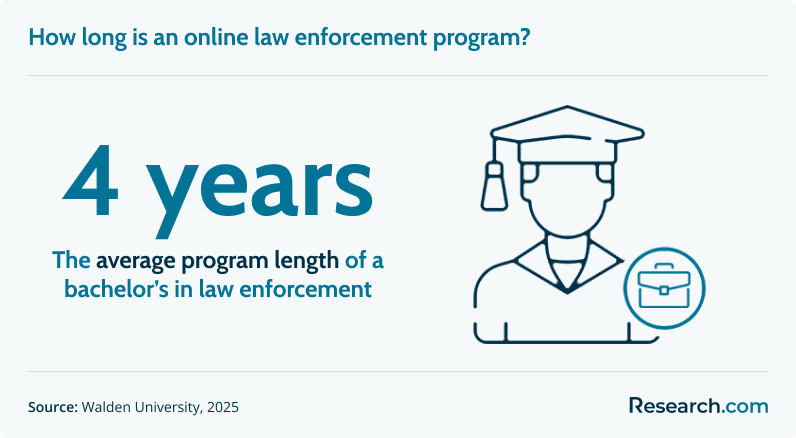
Most online bachelor’s programs in law enforcement or criminal justice take about four years for full-time students because many require between 120 and 128 credit hours. The actual timeline can be shorter or longer depending on transfer credits, enrollment intensity, course availability, term length, and whether the program is designed as a degree-completion pathway.
Students with prior college coursework, military training, police academy training, or an associate degree may be able to reduce the time to graduation. Part-time students often take longer, while accelerated programs may allow motivated students to finish faster by taking shorter terms or heavier course loads.
| Student situation | Likely timeline | What to check before enrolling |
| First-time full-time student | About four years | Total credits, course sequence, and whether summer courses are available |
| Part-time working adult | Longer than four years | Maximum time to completion, course rotation, and employer tuition assistance |
| Transfer student | Potentially shorter | Transfer credit evaluation, residency requirements, and upper-division credit rules |
| Accelerated degree-completion student | May finish faster | Prior credit requirements, workload intensity, and start dates |
How does an online law enforcement degree program compare to an on-campus program?
Online and on-campus law enforcement programs often teach similar academic content: criminal law, criminology, ethics, policing, investigations, corrections, and research. The main difference is not necessarily the curriculum but the way students learn, interact, and complete practical requirements.
Online programs are better suited for students who need scheduling flexibility, including working officers, military-affiliated students, parents, and adults with irregular shifts. Campus programs may be better for students who want face-to-face instruction, immediate access to labs or simulations, and a more structured weekly routine. Some online programs reduce the practical gap through local internships, agency partnerships, virtual simulations, and capstone projects.
| Factor | Online program | On-campus program |
| Schedule | More flexible, often asynchronous | Fixed class times and campus attendance |
| Best for | Working adults, transfer students, shift workers, military students | Students who prefer in-person learning and structured routines |
| Hands-on learning | May use local placements, simulations, or capstones | Often easier access to labs, campus facilities, and in-person exercises |
| Networking | Depends on virtual events, faculty access, and local internships | More informal networking with classmates, faculty, and campus recruiters |
| Cost considerations | May reduce commuting and relocation costs | May include housing, parking, commuting, or campus fees |
If you are comparing online learning in several fields, it can also help to review how other professional programs structure distance education, such as a construction project management degree online. The best format depends on whether the program’s delivery model fits the practical demands of the occupation.
What is the average cost of an online law enforcement degree program?
The cost of an online law enforcement degree varies by school type, residency status, credit requirements, fees, transfer credits, and whether students qualify for employer or military benefits. Tuition for these programs can range from approximately $285 to $460 per credit hour, with total program costs typically falling between $19,000 and $84,000 for a standard 120-credit hour degree. Some universities may charge as little as $160 per credit hour for in-state students, while out-of-state rates can be much higher and sometimes reach around $700 per credit hour.
On average, students can expect to pay about $43,900 for an online law enforcement degree, or roughly $12,300 annually in a four-year plan. Students should also budget for technology fees, textbooks, course materials, background checks for field placements, exam fees, and possible travel for any required in-person components.
Students considering graduate study should compare undergraduate costs with the price of a master’s program. A master’s in law enforcement degree program can cost around $24,000. Related graduate options may include criminal justice, legal studies, intelligence, or cybersecurity; students comparing public safety and technology pathways may also review the cheapest online master's in cyber security options as part of a broader cost comparison.
| Cost item | Why it matters | Question to ask |
| Tuition per credit | It drives most of the total program cost. | Is tuition the same for online, in-state, and out-of-state students? |
| Transfer credits | Accepted credits can reduce both time and cost. | How many prior credits can I apply toward the degree? |
| Fees | Online, technology, graduation, and course fees can add up. | What is the full cost of attendance, not just tuition? |
| Books and materials | Criminal justice courses may require textbooks, software, or digital resources. | Are course materials included or billed separately? |
| Field requirements | Internships or placements may require travel, background checks, or extra documentation. | Are there any in-person or agency-based costs? |
What are the financial aid options for students enrolling in an online law enforcement degree program?
Online law enforcement students may qualify for many of the same financial aid options as campus students, as long as they enroll in an eligible accredited institution and meet aid requirements. The most important step is usually completing the FAFSA early and asking the school’s financial aid office for a full aid estimate.
- FAFSA (Free Application for Federal Student Aid): The FAFSA determines eligibility for federal aid, including Federal Pell Grants, grants that do not need to be repaid, and Federal Student Loans such as direct subsidized loans.
- Law enforcement scholarships: Organizations such as the Fraternal Order of Police (FOP), Women in Federal Law Enforcement (WIFLE), and the American Correctional Association offer scholarships. Local police associations, sheriff’s offices, correctional associations, and regional public safety groups may also provide awards.
- Employer tuition reimbursement: Current public safety employees should ask their agency or employer whether tuition assistance is available and whether it requires continued service after graduation.
- Military benefits: Veterans, active-duty service members, and eligible dependents may be able to use GI Bill benefits or other military education benefits for tuition and related expenses.
What are the prerequisites for enrolling in an online law enforcement degree program?
Admission requirements vary, but most online bachelor’s programs require a high school diploma or GED. Degree-completion programs may require prior college credits or an associate degree before admission to upper-division coursework. Requirements are similar in structure to many other online undergraduate programs, including online writing degrees, although law enforcement programs may place more emphasis on career goals, background, or public service interest.
Schools may also request transcripts, a minimum GPA, letters of recommendation, a personal statement, or standardized test scores, although many online programs have become more flexible with test requirements. Students with military, academy, or professional training should ask whether the program awards credit for prior learning or work experience.
Admission to an academic program is separate from hiring or licensing as a law enforcement officer. Agencies may have additional requirements involving age, citizenship, physical fitness, medical screening, background checks, driving record, psychological evaluation, and criminal history review.
What courses are typically in an online law enforcement degree program?
Most online law enforcement programs teach students how criminal justice systems work, how laws are applied, how agencies operate, and how professionals make ethical decisions under pressure. Course titles vary by school, but the following subjects are common.
- Introduction to Criminal Justice: Provides a broad overview of law enforcement, courts, corrections, and the relationships among criminal justice institutions.
- Criminology: Examines theories of crime, criminal behavior, victimization, social factors, and patterns of offending.
- Criminal Law: Covers legal definitions of crimes, defenses, punishment, constitutional principles, and the limits of government authority.
- Criminal Procedure: Explains arrest, search and seizure, interrogation, prosecution, trial processes, evidence rules, and due process protections.
Other common topics may include policing strategies, ethics, investigation, corrections, juvenile justice, research methods, report writing, diversity in criminal justice, homeland security, emergency management, and cybercrime.
What types of specializations are available in an online law enforcement degree program?
Specializations help students align a broad criminal justice degree with a specific career goal. Not every school offers every track, so students should compare the course catalog rather than relying only on the program title.
- Criminal Investigation: Focuses on investigative procedures, evidence collection, crime scene documentation, interviewing, and case development.
- Police Administration: Covers leadership, supervision, agency policy, budgeting, organizational structure, and the operation of law enforcement agencies.
- Community Policing: Emphasizes public trust, community partnerships, problem-solving, de-escalation, and local public safety collaboration.
- Crime Analysis: Teaches students how to use data, mapping, statistical patterns, and trend analysis to support deployment and investigations.
Can an online law enforcement degree support a transition to legal careers?
Yes, but usually with additional preparation. A law enforcement degree can build useful legal, investigative, documentation, and analytical skills for legal support roles. Students who want to move toward paralegal work, court support, compliance, or legal administration should consider supplemental legal training. Accredited and cost-conscious options such as ABA-approved online paralegal programs can help law enforcement graduates add legal research, legal writing, case management, and document preparation skills.
How to choose the best online law enforcement degree program?
The best program is the one that fits your career goal, budget, schedule, transfer profile, and state or agency requirements. A highly ranked program may still be the wrong choice if it does not meet licensing expectations, lacks internship support, or requires more credits than you can afford.
- Confirm accreditation first: Make sure the institution is accredited by a recognized agency. Accreditation can affect financial aid, transferability, employer acceptance, and graduate school options.
- Match the curriculum to your target role: A policing-focused program may be better for patrol or agency leadership, while public safety, intelligence, cybercrime, or emergency management tracks may suit broader security careers.
- Ask about practical experience: Look for internships, field placements, capstones, simulations, ride-along support, agency partnerships, or career-connected projects.
- Calculate the full cost: Do not compare tuition alone. Include fees, textbooks, transfer credits, lost work time, travel requirements, and financial aid.
- Review online support services: Strong advising, tutoring, writing support, library access, and career services matter more in online programs because students have fewer informal campus touchpoints.
- Check outcomes carefully: Ask about graduation rates, transfer student outcomes, internship access, alumni roles, employer connections, and career support for online students.
| Common mistake | Why it can hurt you | Better approach |
| Choosing a program without checking accreditation | Credits may not transfer, aid may be limited, or employers may question the degree. | Verify institutional accreditation before applying. |
| Looking only at tuition per credit | Fees, required credits, and transfer policies can change the true cost. | Compare total estimated cost to graduation. |
| Assuming online means no practical requirements | Some programs require internships, background checks, or local placements. | Ask how field experience works for distance learners. |
| Ignoring state or agency requirements | The degree may not satisfy licensing or academy expectations. | Contact target agencies before enrolling. |
| Relying only on rankings | A ranked program may not fit your schedule, budget, or career path. | Use rankings as one factor, not the final decision. |
What career paths are available for graduates of an online law enforcement degree program?
Online law enforcement graduates can pursue a range of criminal justice and public safety roles. Some positions require additional academy training, certification, physical testing, or experience, so students should treat the degree as one part of a broader career preparation plan.
| Career path | Typical focus | Additional requirements to verify |
| Police officer or deputy sheriff | Patrol, public response, traffic enforcement, arrests, reports, and community safety | Academy training, physical testing, background check, state certification, agency hiring standards |
| Detective or investigator | Case investigation, interviews, evidence review, surveillance, reports, and court preparation | Prior law enforcement experience, specialized training, promotion or assignment process |
| Probation or parole officer | Supervision of individuals in the justice system, case planning, compliance monitoring, and reporting | State requirements, background checks, field training, communication skills |
| Corrections officer or corrections professional | Facility safety, inmate supervision, classification, documentation, and crisis response | Agency training, physical standards, shift availability, security clearance requirements |
| Federal agent or federal law enforcement role | Federal investigations, enforcement, intelligence support, or specialized operations | Federal hiring standards, citizenship, age limits, fitness standards, background investigation, experience |
| Private security or investigations | Asset protection, risk assessment, investigations, corporate security, or compliance support | State licensing, insurance, specialized credentials, industry experience |
Some skills developed in law enforcement programs, such as investigation, documentation, risk analysis, and operational planning, may transfer into adjacent fields. For example, students interested in supply chain security can explore how to get into logistics, while those considering information management or public-sector research roles can review careers in library science. These are not direct substitutes for law enforcement careers, but they show how analytical and compliance-oriented skills can apply outside traditional policing.
What is the return on investment of an online law enforcement degree?
The return on investment depends on how much you pay, how many credits transfer, whether the degree helps you qualify for promotion or higher-paying roles, and how long it takes to finish. A lower-cost accredited program with strong transfer credit policies may produce a better financial outcome than a more expensive program with similar career results.
Students should compare the total cost of the bachelor’s degree with salary potential, promotion requirements, public service benefits, pension eligibility, tuition reimbursement, and long-term career goals. Those who plan to move into supervisory or specialized criminal justice roles may eventually compare graduate options, including the cheapest online master's degree in criminal justice.
How do online law enforcement degree programs support practical training and career readiness?
Strong online programs connect coursework to practice through internships, scenario-based exercises, case studies, capstones, writing assignments, and career advising. Some schools help students find local placements with criminal justice agencies, while others use virtual simulations or applied research projects when in-person options are limited.
Career readiness also depends on communication skills, report writing, ethical judgment, cultural competence, de-escalation awareness, data literacy, and legal knowledge. Students who want broader legal or policy expertise may compare advanced options and career outcomes in What can you do with a masters in legal studies?.
Can an online legal studies degree offer a competitive edge in law enforcement?
An online legal studies degree can complement law enforcement education for students who want stronger grounding in legal procedure, documentation, court systems, statutory interpretation, and regulatory issues. This can be useful for professionals interested in investigations, compliance, court support, evidence handling, policy work, or interdisciplinary public safety roles.
What is the job market for graduates with an online law enforcement degree program?
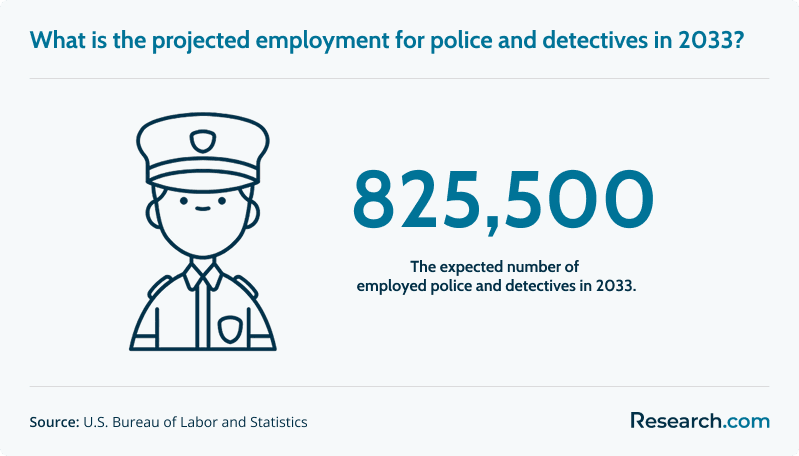
The job market for law enforcement and criminal justice graduates is shaped by public safety needs, agency budgets, retirements, local hiring cycles, and demand for specialized skills in areas such as cybersecurity, investigations, intelligence, and community policing. Legal occupations are projected to see steady growth, with approximately 796,800 job openings annually, many of which require only a bachelor's degree.
Graduates may find opportunities in policing, corrections, probation, homeland security, emergency management, private security, and federal agencies. Current professionals may use online study to qualify for advancement while staying employed. However, students should be realistic: hiring can be competitive, and agencies often evaluate the full candidate profile, including fitness, background, judgment, communication ability, work history, and interview performance. Candidates can also review professional guidance on career development and networking for professionals in the criminal justice field.
What Are the Essential Physical Fitness Standards in Law Enforcement?
Physical fitness is often a nonnegotiable part of law enforcement hiring and continued service. Agencies may test endurance, strength, agility, mobility, and overall stamina. Standards can differ by local police department, sheriff’s office, state agency, federal agency, and specialized unit.
Prospective students should not wait until graduation to prepare. Before applying to agencies, review official fitness standards, medical requirements, and academy expectations. Competitive federal or specialized roles may have stricter benchmarks; reviewing examples such as CIA physique requirements can help applicants understand how demanding some public safety pathways can be. A consistent training plan, injury prevention, and early preparation are essential.
Can accelerated legal training complement my online law enforcement degree?
Accelerated legal training can be useful for students who want to add court, documentation, and legal procedure skills without committing immediately to a full additional degree. Programs such as the quickest paralegal certificate programs online may help law enforcement students strengthen legal writing, evidence organization, ethics, and case support abilities.
What additional certifications can enhance my law enforcement career?
Certifications can strengthen a law enforcement career when they align with a specific role. Useful areas may include forensic technology, cybercrime, emergency management, crime analysis, investigations, fraud examination, leadership, or legal support. The best credential depends on whether you want to work in patrol, investigations, corrections, intelligence, private security, compliance, or administration.
Students interested in legal support skills may compare the best online school for paralegal options to determine whether a paralegal-oriented pathway would complement their law enforcement background.
Is pursuing graduate education a strategic step for advancing my law enforcement career?
Graduate education may be valuable for professionals targeting leadership, policy, intelligence, emergency management, legal studies, public administration, or specialized investigative roles. A master’s degree can help develop strategic decision-making, research, management, and analytical skills, but it should be weighed against cost, time, agency promotion rules, and expected career benefit.
Before enrolling, ask whether your agency rewards graduate education through promotion points, salary incentives, leadership eligibility, or tuition reimbursement. Students considering legal studies should also evaluate the master of legal studies cost before committing.
How can a master's in intelligence online support my law enforcement career?
An online intelligence graduate program can support law enforcement professionals who want to work with threat assessment, data analysis, strategic planning, interagency collaboration, and security operations. A master's in intelligence online may be especially relevant for students interested in federal agencies, homeland security, fusion centers, counterterrorism, cyber-enabled threats, or analytical leadership roles.
Key Insights
- An online law enforcement degree is most valuable when it is accredited, career-aligned, affordable, and compatible with agency hiring or licensing requirements.
- Most bachelor’s programs require between 120 and 128 credit hours of coursework and typically take about four years for full-time students, though transfer credits and accelerated formats can change the timeline.
- Tuition for law enforcement programs can range from approximately $285 to $460 per credit hour, and total program cost should include fees, books, transfer credit policies, and any field placement expenses.
- Graduates in law enforcement can expect a median annual salary of approximately $67,290 for police and detectives, but salaries are not guaranteed and depend on role, location, agency, rank, overtime, and experience.
- Online programs offer flexibility, but students should verify how practical training, internships, simulations, and career services work for distance learners.
- Legal occupations are projected to see steady growth, with approximately 796,800 job openings annually, but law enforcement hiring still depends on physical fitness, background checks, academy completion, and agency-specific standards.
- The strongest ROI usually comes from minimizing unnecessary credits, using financial aid or employer benefits, choosing a recognized program, and matching the degree to a clear career path.
References:
- BLS. (2024). Police and Detectives. Retrieved January 6, 2025, from BLS.
- BLS. (2024). Protective Service Occupations. Retrieved January 6, 2025, from BLS
- Bureau of Justice Statistics. (2024, December). Prisons Report Series: Preliminary Data Release, 2023. Retrieved January 6, 2025, from BJS.
- Santiago, E. (2024). 10 Criminal Justice Majors and Jobs You Can Pursue. Retrieved January 6, 2025, from Indeed.
Other Things You Should Know About the Best Online Law Enforcement Degree Programs
Yes. Many accredited online law enforcement bachelor’s programs require an internship, practicum, or field experience, often 120 to 240 hours, with placement approved by the program. These hours help students document real-world skills in policing, corrections, or public safety before graduation.
Yes, many online law enforcement degree programs in 2026 allow students to transfer credits from previous coursework. Each program has its own transfer policy, often requiring an evaluation of transcripts to determine which credits can be applied towards the degree requirements.


