2027 Best Online Military Science Degree Programs

Co-Founder and Chief Data Scientist
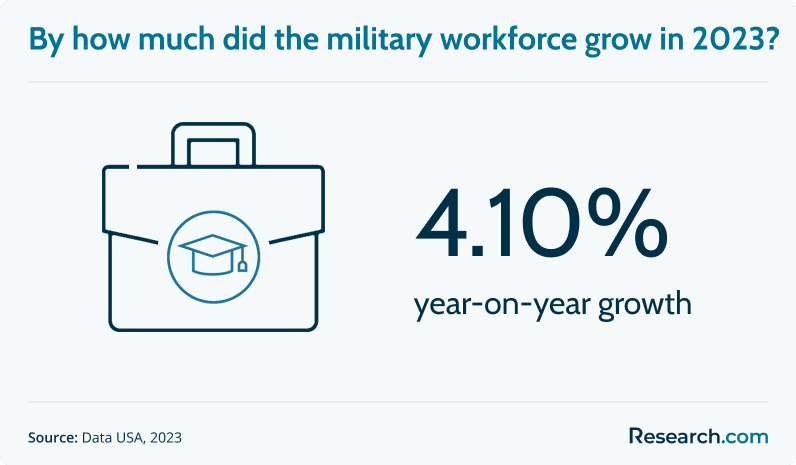
You want to serve, lead, or make a difference in national security—but figuring out where to start can feel overwhelming. Without a degree, turning that passion into a real career path isn’t always clear. With the military workforce expected to grow by 4.10% year-on-year in 2033, opportunities are expanding for those who combine ambition with the right education.
This guide was built to help you take that first step. Our team of career planning experts has put together the best online bachelor’s programs in military science, designed to help you move confidently toward your goals, whether that means military service, commissioning, or a civilian career.
What are the benefits of getting an online military science degree?
- It prepares you for advancement to officer ranks and leadership roles within the military or for a successful transition to high-demand civilian sectors like defense contracting and logistics.
- The degree significantly increases your earning potential, opening pathways to civilian project management roles that have an average salary of over $94,000.
- It offers the flexibility to earn your degree while deployed or balancing the demands of active service, turning your practical experience into a formal credential on your schedule.
What can I expect from an online military science degree?
An online military science degree emphasizes applied leadership, operational planning, and tactical decision-making. The goal is to prepare practitioners—leaders who can guide teams, make quick decisions under pressure, and execute complex missions. In short, it focuses on the “how” of military operations, equipping students with the skills needed to act effectively in the field.
This is very different from a military studies or history degree, which looks at the “why”—examining policies, theories, and the broader strategic impacts of military actions. To put it in perspective: a military science student studies the Battle of Gettysburg to draw tactical lessons about leadership and maneuver, while a military studies student analyzes its influence on national strategy and politics. Military science is the path for those who want to be on the ground, making the critical decisions.
Where can I work with an online military science degree?
This degree prepares you for leadership roles across all branches of the armed forces, but its value extends far beyond the military. Many people mistakenly believe this path narrows their options, but it actually prepares them for a direct transition into high-demand civilian sectors. Your skills in leadership, operational planning, and risk management are highly sought after in the corporate world.
Graduates are perfectly positioned for roles like Project Manager in the defense sector, Logistics Manager for a global shipping company, Emergency Management Director for a city or state, or Security Operations Chief for a major corporation. This degree acts as the translator for your military experience.
How much can I make with an online military science degree?
This degree is the credential that qualifies you for the promotion or the civilian job that carries a significant salary. In the military, it’s a key step toward becoming a commissioned officer. A mid-career officer, at the O-4 rank, earns over $8,000 per month in basic pay, not including housing and other allowances.
If you transition to the civilian sector, that same leadership experience, now validated by a degree, prepares you for roles like project manager, where salaries average over $94,000 annually.
- List of the Best Online Military Science Programs for 2027 List of Programs
- How long does it take to complete an online military science degree program? Completion Time
- How does an online military science degree program compare to an on-campus program? How does an online military science degree program compare to an on-campus program?
- What is the average cost of an online military science degree program? Program Cost
- What are the financial aid options for students enrolling in an online military science degree program? Financial Aid
- What are the prerequisites for enrolling in an online military science degree program? What are the prerequisites for enrolling in an online military science degree program?
- What courses are typically in an online military science degree program? What courses are typically in an online military science degree program?
- What types of specializations are available in an online military science degree program? What types of specializations are available in an online military science degree program?
- How to Choose the Best Online Military Science Program How to Choose the Best Online Military Science Program
- What career paths are available for graduates of an online military science degree program? Career Paths
- What is the job market for graduates of an online military science degree program? Job Market
- How Can I Enhance My Military Science Degree with Interdisciplinary Studies? How Can I Enhance My Military Science Degree with Interdisciplinary Studies?
- How Is Emerging Technology Transforming Military Science Education? How Is Emerging Technology Transforming Military Science Education?
Best Online Military Science Programs for 2027: What to Compare Before You Enroll
An online military science degree can help active-duty service members, veterans, reservists, and career changers turn leadership experience, military training, and operational knowledge into a recognized college credential. The right program can support commissioning goals, promotion requirements, defense-sector employment, or a smoother transition into civilian roles in logistics, security, emergency management, intelligence, and public service.
This guide explains how online military science programs differ, what they cost, how long they take, how military transfer credit works, and which factors matter most before you apply. It also compares program options, financial aid routes, career outcomes, and common mistakes that can cost students time or money.
Quick Answer: What Is the Best Online Military Science Program?
The best online military science program is the one that matches your service background, career goal, transfer credits, budget, and schedule. For many military-affiliated students, the strongest programs are regionally accredited, accept Joint Services Transcript credits, offer military-focused advising, and provide flexible online coursework that can fit deployment, duty schedules, family responsibilities, or reserve obligations.
Students seeking a direct military studies route may prefer programs with military, defense, intelligence, or homeland security coursework. Students who want broader civilian flexibility may benefit from interdisciplinary studies, liberal studies, political science, or homeland security programs that allow military-related electives or concentrations.
How We Ranked These Online Military Science Programs
Because a degree is a major investment, the ranking process prioritizes transparency, institutional data, affordability, accreditation, and student-relevant program features. Research.com evaluates programs using established education data sources, including the IPEDS database, Peterson's database, the College Scorecard database, and The National Center for Education Statistics.
These sources help compare schools using consistent data rather than marketing claims alone. To learn more about the ranking process, visit Research.com's methodology page.
Online Military Science Programs at a Glance
| School | Program | Best Fit | Credits | Published Cost | Accreditation |
| Fayetteville State University | Bachelor of Science in Integrated Studies | Students who want to combine prior military learning with career-focused concentrations | 120 | $183.83 in-state; $350.50 out-of-state per credit | SACSCOC |
| Texas A&M University-Central Texas | Bachelor of Science in Liberal Studies | Students who want a flexible online degree built around three minors, including Military Science | 120 | $255.07 in-state; $491.47 out-of-state per credit | SACSCOC |
| Norwich University | Bachelor of Science in Strategic Studies and Defense Analysis | Special Operations Forces professionals seeking an accelerated, transfer-friendly path | Up to 90 required transfer credits | $250 per credit | NECHE |
| University of South Alabama | Bachelor’s in Interdisciplinary Studies | Adult learners who want an advisor-designed degree with practical leadership and communication skills | 120 | $98.48 in-state; $181.88 out-of-state per credit | SACSCOC |
| Norfolk State University | Bachelor of Science in Interdisciplinary Studies | Active-duty and retired military students who want to maximize JST credit | 120 | $103.80 in-state; $300.30 out-of-state per credit | SACSCOC |
| Penn State World Campus | Bachelor of Arts in Political Science | Students interested in politics, government, public service, and Army ROTC integration | 120 | $638 per credit | MSCHE |
| Purdue Global | Master’s in Homeland Security and Emergency Management | Graduate students targeting security, emergency management, and public-private resilience roles | 45 | $420 per credit | HLC |
| US Naval Community College | Associate of Arts in Military Studies | Eligible active-duty enlisted Sailors, Marines, and Coast Guardsmen seeking a no-tuition pathway | 60 | Free for eligible service members | MSCHE |
1. Fayetteville State University - Bachelor of Science in Integrated Studies
Fayetteville State University offers an individualized online pathway for students who want to combine multiple academic areas into one career-aligned degree. The program is especially useful for service members who want previous college coursework and military training to count toward a bachelor’s credential.
- Program Length: 4 years
- Concentrations: Criminal Justice & Military Intelligence Operations; Criminal Justice & Military Leadership; Language & Intelligence Studies; and others
- Required Credits to Graduate: 120
- Cost per Credit: $183.83 in-state; $350.50 out-of-state
- Accreditation: Southern Association of Colleges and Schools Commission on Colleges (SACSCOC)
2. Texas A&M University-Central Texas - Bachelor of Science in Liberal Studies
Texas A&M University-Central Texas gives online students a customizable degree structure built around three minors. Students who choose the Military Science minor can pair it with other fields to strengthen communication, leadership, and analytical skills for military or civilian advancement.
- Program Length: 4 years
- Minor Option: Military Science
- Required Credits to Graduate: 120
- Cost per Credit: $255.07 in-state; $491.47 out-of-state
- Accreditation: Southern Association of Colleges and Schools Commission on Colleges (SACSCOC)
3. Norwich University - Bachelor of Science in Strategic Studies and Defense Analysis
Norwich University provides a specialized bachelor’s program for the Special Operations Forces community. The format is designed for students who may be completing coursework while serving and who want a degree that develops strategic analysis, research, and leadership preparation.
- Program Length: Approximately 18 months
- Required Transfer Credits: Up to 90
- Cost per Credit: $250
- Accreditation: New England Commission of Higher Education (NECHE)
4. University of South Alabama - Bachelor’s in Interdisciplinary Studies
The University of South Alabama offers a fully online interdisciplinary degree for adults who need flexibility and academic customization. Students work with an advisor to design a plan that can emphasize leadership, applied problem-solving, communication, and career development.
- Program Length: 4 years
- Concentrations: Administrative Sciences; Applied Arts; Applied Sciences; Community Services; Human Services; Liberal Studies; and Professional Development
- Required Credits to Graduate: 120
- Cost per Credit: $98.48 in-state; $181.88 out-of-state
- Accreditation: Southern Association of Colleges and Schools Commission on Colleges (SACSCOC)
5. Norfolk State University - Bachelor of Science in Interdisciplinary Studies
Norfolk State University structures its interdisciplinary studies degree with military students in mind. The program is built to make strong use of Joint Services Transcript credits while helping students strengthen research, writing, and professional communication skills.
- Program Length: 4 years
- Concentration: Military
- Required Credits to Graduate: 120
- Cost per Credit: $103.80 in-state; $300.30 out-of-state
- Accreditation: Southern Association of Colleges and Schools Commission on Colleges (SACSCOC)
6. Penn State World Campus - Bachelor of Arts in Political Science
Penn State World Campus offers a political science curriculum that focuses on government, policy, institutions, and evidence-based analysis. Students pursuing Army ROTC may be able to integrate ROTC coursework in place of elective requirements, which can make the program more relevant for commissioning-oriented students.
- Program Length: 4 years
- Required Credits to Graduate: 120
- Cost per Credit: $638
- Accreditation: Middle States Commission on Higher Education (MSCHE)
7. Purdue Global - Master’s in Homeland Security and Emergency Management
Purdue Global offers a graduate-level program focused on homeland security, emergency management, and resilience planning. Students examine how public agencies, private organizations, and communities prepare for and respond to complex threats.
- Program Length: 1 year
- Required Credits to Graduate: 45
- Cost per Credit: $420
- Accreditation: Higher Learning Commission (HLC)
8. US Naval Community College - Associate of Arts in Military Studies
The US Naval Community College, working with Arizona State University, offers an associate degree intended for enlisted leadership development. Eligible active-duty enlisted Sailors, Marines, and Coast Guardsmen can complete the program at no tuition cost while gaining a naval-relevant academic foundation.
- Program Length: Approximately 2 years
- Required Credits to Graduate: 60
- Total Tuition: Free for eligible service members
- Accreditation: Middle States Commission on Higher Education (MSCHE)
How Long Does an Online Military Science Degree Take?
Most online bachelor’s programs connected to military science, military studies, interdisciplinary studies, or political science require 120 credits and are commonly structured as 4-year degrees. Transfer-friendly programs can be much faster. Norwich University, for example, lists an approximately 18-month completion path for eligible students with up to 90 required transfer credits. Master’s programs are shorter; Purdue Global lists a 1-year timeline for its 45-credit master’s program.
For military-affiliated students, the real timeline depends less on the catalog estimate and more on transfer credit, deployment schedule, course load, funding limits, and whether the student enrolls full time or part time. Students comparing online study across fields, such as online MSN forensic nursing programs, will see a similar pattern: the advertised timeline is only a starting point.
How Military Training Can Shorten the Path
Military experience can reduce degree completion time when a school awards credit for prior learning. Many colleges review the Joint Services Transcript and use American Council on Education recommendations to determine whether military training, technical schools, leadership courses, or professional development can count toward college credits.
Before enrolling, ask for a written transfer evaluation. A generous credit for prior learning policy can reduce the number of courses you still need, lower your total tuition, and help you reach later goals sooner, including graduate study in fields such as fastest industrial organizational psychology master's programs online if your long-term plan includes leadership, organizational behavior, or workforce development.
Online vs. On-Campus Military Science Programs: Which Format Is Better?
For many service members and working adults, online delivery is the practical choice. It removes relocation barriers, allows coursework around duty schedules, and can make it easier to continue earning credits during transitions. Students can also explore federal aid through FAFSA, depending on eligibility and program participation.
An accredited online program should meet the same academic standards as the institution’s campus-based coursework. The important question is not whether the program is online, but whether it is accredited, transfer-friendly, well-supported, and aligned with your military or civilian goal.
| Factor | Online Program | On-Campus Program |
| Schedule flexibility | Usually stronger for active-duty, reserve, working, or relocating students | Better for students who can attend classes at set times |
| Access to military support | Can be strong if the school has dedicated military and veteran services | May offer in-person advising, ROTC offices, and campus veteran centers |
| Networking | Depends on online discussion, group projects, virtual events, and alumni access | Often easier through in-person events, campus organizations, and ROTC activities |
| Best for | Students who need mobility, asynchronous learning, or deployment-friendly scheduling | Students who want face-to-face instruction and can commit to a campus location |
How Employers and Military Leaders View Online Degrees
Online education is widely used by working professionals, including military students who cannot pause their careers to relocate. Completing an online degree while serving can show discipline, planning ability, and persistence. Still, reputation depends heavily on the institution. A regionally accredited online degree from a recognized school carries more weight than a poorly vetted program with weak student support.
How Much Does an Online Military Science Degree Cost?
The average total tuition for a bachelor's degree in military science is approximately $19,121 for in-state students and $30,829 for out-of-state students. Individual program prices vary widely, as shown by the listed per-credit rates in this guide. Residency status, transfer credits, military tuition benefits, fees, books, technology charges, and course load can all change the final cost.
Do not judge affordability by tuition alone. A program with a higher per-credit rate may cost less overall if it accepts more transfer credits, while a low-cost program may become more expensive if few credits apply to the degree. This same cost logic applies across online professional programs, including clinical nurse leader MSN programs online.
How to Estimate Your Real Cost
- Request a transfer credit review before committing. Ask how many JST, prior college, CLEP, DSST, or training credits will apply to the degree plan.
- Separate tuition from fees. Technology, graduation, online course, and transcript fees can affect total cost.
- Check annual benefit limits. Tuition Assistance, GI Bill rules, and school participation policies may shape how much you pay each term.
- Compare cost to timeline. A faster path, such as one modeled by some fastest online bachelor's degree in political science programs, may improve ROI if it helps you finish earlier without sacrificing program quality.
- Do not assume salary outcomes are guaranteed. The degree may support access to roles averaging over $94,000 a year, but actual earnings depend on rank, experience, employer, location, clearance, specialization, and career field.
Financial Aid and Military Education Benefits
Service members and veterans may be able to combine several funding sources, including the Post-9/11 G.I. Bill, branch-specific Tuition Assistance, military scholarships, employer tuition benefits, and institutional aid. Some students in other demanding online programs, such as an MSN family nurse practitioner program online, also rely on layered aid strategies to reduce out-of-pocket costs.
Military education funding can be substantial. The military has offered recruiting bonuses of up to $50,000 for certain roles, and education benefits are another way the services support recruitment, retention, and advancement.
| Funding Option | Who It May Help | Key Question to Ask |
| Tuition Assistance | Active-duty service members using branch education benefits while still serving | What is the annual cap, and does this program’s tuition fit within it? |
| Post-9/11 G.I. Bill | Eligible veterans, service members, and qualifying dependents | How much of tuition, fees, housing, or books will be covered for this school? |
| Yellow Ribbon Program | Students attending participating schools where costs exceed GI Bill limits | Does the school participate, and how much does it contribute? |
| Military scholarships | Veterans, spouses, dependents, reservists, and active-duty students | Can awards be combined with federal or military benefits? |
| Institutional aid | Students at schools offering military, veteran, transfer, or adult learner awards | Is the scholarship renewable, and does it require full-time enrollment? |
How to Stack Benefits Without Wasting Them
A smart funding plan starts with sequence. Some active-duty students use Tuition Assistance first and preserve GI Bill eligibility for graduate school or a dependent transfer strategy. Others use the GI Bill immediately because their career timeline requires faster completion. If private-school tuition exceeds benefit limits, the Yellow Ribbon Program can be especially important. Students can also review a list of military scholarships to identify additional aid.
Admission Requirements for Online Military Science Programs
Most bachelor’s programs require a high school diploma or GED, an application, and official transcripts from every college previously attended. Military experience can strengthen your application and may qualify you for transfer credit, but it usually does not replace the basic academic documents schools require.
Graduate programs typically require a completed bachelor’s degree and may ask for a statement of purpose, resume, recommendations, or evidence of professional experience. Requirements vary, so applicants should confirm admissions details directly with each school.
Commissioning Goals Require Earlier Planning
A bachelor’s degree is commonly required for commissioning routes, and age limits can make timing important. For example, the Army's cutoff is typically age 35. If your goal is to commission, do not wait until your final year to ask whether the program, ROTC coursework, transfer credits, and graduation timeline support that path.
Common Courses in an Online Military Science Degree
Military science coursework usually blends leadership, operations, ethics, history, policy, and management. Some programs are direct military studies degrees, while others use an interdisciplinary structure similar to the best interdisciplinary studies degree online programs and allow students to build a military-focused academic plan.
- Applied Military Leadership: Students examine decision-making, ethical leadership, motivation, team development, and accountability in high-pressure settings.
- Tactical Planning and Execution: Coursework may cover planning frameworks, mission analysis, operational coordination, and execution at different levels of command.
- Military History for Professionals: Students analyze campaigns, conflicts, and leadership decisions to identify lessons that apply to contemporary security environments.
- Defense Budgeting and Resource Management: This area focuses on personnel, funding, equipment, procurement, and resource allocation in defense-related organizations.
- Military Law and Ethics: Students study legal and ethical obligations, including topics related to the Uniform Code of Military Justice and the laws of armed conflict.
Military Science Specializations and When They Make Sense
Specializations help students align the degree with a specific military or civilian outcome. A student targeting command, intelligence, emergency management, logistics, or cyber operations should choose electives and concentrations carefully rather than taking the easiest available courses. The same specialization logic applies in other professional programs, such as an online MSN AGPCNP program, where course choices shape career direction.
| Specialization | Best For | Possible Career Direction |
| Defense Logistics and Supply Chain Management | Students with operations, maintenance, transportation, or supply experience | Logistics supervisor, defense project coordinator, operations manager |
| Intelligence and Security Operations | Students interested in threat assessment, security planning, and analytical work | Intelligence analyst, security operations specialist, risk analyst |
| Homeland Security and Emergency Management | Students who want roles in preparedness, response, resilience, or public safety | Emergency management coordinator, homeland security specialist |
| Cyber Operations and Warfare | Students with technical interests or cyber-related military experience | Cyber operations specialist, security analyst, cyber policy support roles |
| Strategic Communications | Students interested in public affairs, information operations, or organizational messaging | Communications specialist, public affairs coordinator, strategic messaging analyst |
Practitioner Track vs. Analyst Track
Before choosing a specialization, decide whether you want to perform operations or analyze policy and strategy. A cyber operations focus may emphasize technical defense, tactics, and procedures. A cyber policy or military studies focus may emphasize law, strategy, governance, and risk analysis. Students who prefer broader analysis over operational training may want to compare options such as the fastest military studies degree online.
How to Choose the Best Online Military Science Program
The strongest program for you is not automatically the most famous school or the cheapest tuition rate. It is the program that helps you finish efficiently, uses your existing credits well, supports your benefits, and leads toward your intended military or civilian outcome.
- Verify regional accreditation. Accreditation affects transferability, employer recognition, federal aid eligibility, and graduate school options.
- Ask for a JST review early. Do not enroll until you understand how your military training and prior college credits apply to the degree.
- Compare total cost, not only per-credit tuition. Include fees, books, benefit limits, transfer credit, and completion time.
- Check military student support. Look for advisors who understand Tuition Assistance, GI Bill rules, deployment interruptions, withdrawals, and benefit certification.
- Match the curriculum to your goal. A future officer, logistics manager, intelligence analyst, emergency manager, and policy analyst may need different electives.
- Confirm course delivery. Asynchronous courses may work better for shifting duty schedules, while synchronous courses may provide more structure but less flexibility.
- Evaluate faculty experience. Programs are stronger when instructors can connect leadership theory, military practice, public-sector needs, and civilian employer expectations.
| Question to Ask | Why It Matters |
| How many of my credits will apply to this exact degree? | A large transfer total is only useful if credits count toward requirements, not just electives. |
| Is the program fully online, or are there campus requirements? | Residency requirements can be difficult for deployed, active-duty, or relocating students. |
| Who certifies military education benefits? | A knowledgeable certifying official can prevent delays and benefit errors. |
| What happens if I deploy or receive new orders? | Military-friendly policies should address withdrawals, incompletes, pauses, and reentry. |
| Does the program support commissioning, promotion, or civilian transition goals? | A flexible degree is valuable only if it supports your specific next step. |
Career Paths With an Online Military Science Degree
An online military science-related degree can support two broad career directions. The first is continued military advancement, including officer pathways for students who meet commissioning requirements. The second is civilian employment in sectors that value leadership, operational planning, logistics, public safety, emergency response, security, intelligence, and defense contracting.
Graduates may pursue roles such as defense project manager, logistics supervisor, corporate security director, emergency management coordinator, public-sector analyst, or operations manager. Students interested in investigative or analytical public safety work may also compare related options, including the best crime analysis degree programs online.
| Career Direction | How the Degree Helps | What Else May Be Needed |
| Military officer pathway | Provides the bachelor’s credential commonly required for commissioning routes | Branch-specific eligibility, age requirements, physical standards, ROTC or officer training completion |
| Defense logistics | Connects military operations experience with supply chain, planning, and resource management concepts | Relevant experience, project management skills, clearance requirements for some roles |
| Homeland security and emergency management | Builds knowledge of preparedness, interagency coordination, and crisis response | Public-sector experience, emergency management training, local or federal hiring requirements |
| Intelligence and security | Strengthens analysis, risk assessment, and operational security knowledge | Clearance, analytical writing skills, technical or regional expertise |
| Corporate leadership | Translates military leadership into civilian management language | Resume translation, industry knowledge, networking, and business communication skills |
Using the Degree as a Launchpad
A bachelor’s degree can also open the door to advanced professional military education and graduate study. For students targeting senior command, strategic planning, or executive-level defense roles, the undergraduate degree is often a foundation rather than the final credential.
Job Market Outlook for Military Science Graduates
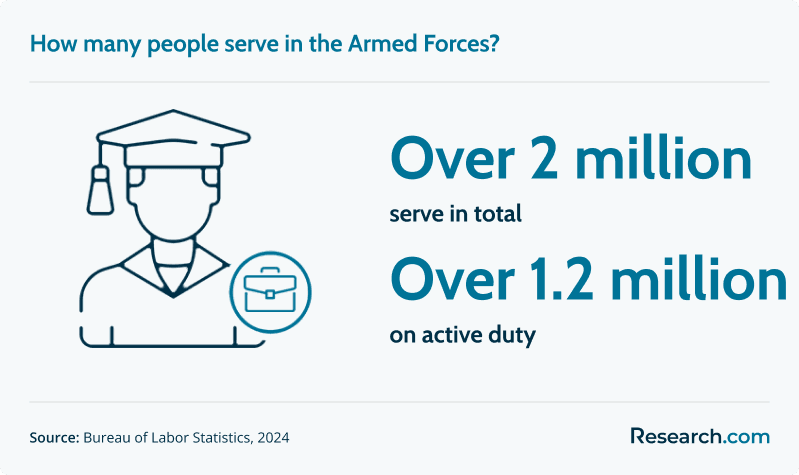
Graduates with military leadership, operational planning, and security-related skills can pursue opportunities across the armed forces, defense contractors, government agencies, emergency management organizations, and private-sector operations teams. The cited job market data notes a 4.1% year-over-year growth in the military workforce, suggesting continuing demand for qualified personnel.
Long-term demand is influenced by defense spending, geopolitical risk, recruitment trends, modernization, cybersecurity needs, and public-sector preparedness. The cited sources also note that U.S. defense allocation has reached nearly $850 billion and that military recruiting is up 12.5% in key areas. These figures point to ongoing need, but they should not be read as a guarantee of employment for every graduate.
Current Trends Affecting Military Science Education
- More online options for mobile students: Military learners need programs that can continue through relocation, reserve obligations, and changing duty schedules.
- Greater focus on transfer credit: Schools competing for military students increasingly highlight JST evaluation and credit for prior learning.
- Growing connection to civilian sectors: Programs often frame military leadership as preparation for logistics, emergency management, security, and operations careers.
- Technology-enabled instruction: Online programs may use simulations, scenario-based assignments, virtual collaboration, and data-informed learning tools.
- Employer demand for clear skills translation: Veterans and service members benefit when coursework helps convert military experience into civilian business, policy, or public safety language.
How Can Interdisciplinary Study Strengthen a Military Science Degree?
Military science becomes more career-flexible when paired with fields such as psychology, political science, cybersecurity, logistics, public administration, criminal justice, data analysis, or communications. These areas help students understand not only operations, but also people, organizations, policy, risk, and decision-making.
For example, psychology can support leadership, personnel management, conflict resolution, resilience, and human behavior analysis. Students considering advanced behavioral health or psychology pathways can compare options such as APA accredited online PsyD programs, while those seeking a faster undergraduate psychology foundation can review accelerated psychology programs.
How Technology Is Changing Online Military Science Education
Online military science education is increasingly shaped by digital collaboration, simulation, scenario-based learning, and adaptive instructional tools. These technologies can help students practice decision-making, analyze complex situations, and receive feedback without requiring a physical classroom.
Technology does not replace field experience, leadership practice, or professional judgment. Its value is strongest when programs use it to support realistic case studies, operational planning exercises, ethics discussions, team projects, and measurable skill development.
Common Mistakes to Avoid When Choosing an Online Military Science Program
| Mistake | Why It Can Hurt You | Better Approach |
| Choosing a school without checking accreditation | Unaccredited or poorly recognized degrees can create transfer, aid, employment, and graduate school problems. | Confirm regional accreditation before applying. |
| Focusing only on the lowest tuition | A cheaper per-credit rate may not save money if the school accepts fewer transfer credits. | Compare total remaining credits, fees, and completion time. |
| Assuming all military credits will count | Schools may accept credits differently, and some credits may apply only as electives. | Request a degree-specific transfer evaluation in writing. |
| Ignoring commissioning requirements | Degree completion alone may not satisfy age, physical, ROTC, branch, or officer training rules. | Talk with a commissioning advisor before enrolling. |
| Using GI Bill benefits without a long-term plan | You may use limited benefits on a degree that could have been funded another way. | Compare Tuition Assistance, GI Bill, Yellow Ribbon, scholarships, and employer aid. |
| Picking a broad degree with no career strategy | Flexibility can become unfocused if electives do not support a clear goal. | Choose concentrations and projects that match your intended role. |
What Graduates Say About Online Military Science Programs
- Ken: "Before I left active duty, I was not sure how civilian employers would read my background. The degree helped translate my leadership and operations experience into terms hiring managers understood. In a logistics interview, I could explain strategy, planning, and execution instead of only listing assignments."
- Brody: "A campus program was not realistic for me. I had family responsibilities, field time, and an unpredictable schedule. Online classes let me keep making progress in small blocks of time, even if that meant studying late at night or writing on weekends."
- Sally: "I needed a program that respected the realities of reserve service and full-time work. Being able to log in from different locations made the difference. The format also forced me to become more organized, which helped me professionally as much as academically."
Related Online Program Planning Resources
If you are still comparing online degrees by format, cost, workload, or career fit, it can help to look at how other professional programs are structured. Research.com also covers online healthcare and nursing pathways, including online MSN forensic nursing programs, clinical nurse leader MSN programs online, MSN family nurse practitioner programs online, and online MSN AGPCNP programs. These are not substitutes for military science programs, but they can help students compare online program design, admissions expectations, and professional specialization choices.
Key Insights
- The best program depends on your goal. Commissioning, promotion, civilian logistics, defense contracting, intelligence, emergency management, and public-sector leadership can require different courses and credentials.
- Transfer credit is one of the biggest ROI factors. A strong JST and credit for prior learning policy can shorten your degree and reduce total cost.
- Accreditation is non-negotiable. Regional accreditation protects transferability, aid eligibility, employer recognition, and graduate school options.
- Online delivery is often the most practical format for military students. It supports duty schedules, relocation, and family responsibilities, but students should still check course format and support services.
- Published tuition is not your final cost. Compare military benefits, GI Bill use, Tuition Assistance, Yellow Ribbon participation, scholarships, fees, and remaining credits.
- A broad degree needs a focused plan. Interdisciplinary and liberal studies programs can be valuable, but only if electives, projects, and concentrations support a clear career outcome.
- Do not assume outcomes are automatic. Salary, promotion, commissioning, and civilian employment depend on experience, eligibility, performance, location, clearance, and labor market conditions.
References:
- College Grad. (2022). Military careers: Career, salary and education information. Retrieved August 17, 2025, from https://collegegrad.com/careers/military-careers
- Data USA. (2023). Military specific occupations. Retrieved August 17, 2025, from https://datausa.io/profile/soc/military-specific-occupations
- Defense Finance and Accounting Service. (2025). 2025 basic pay: Officers. Retrieved August 17, 2025, from https://www.dfas.mil/MilitaryMembers/payentitlements/Pay-Tables/Basic-Pay/CO/
- Deloitte. (2025). 2025 aerospace and defense industry outlook. Retrieved August 17, 2025, from https://www.deloitte.com/us/en/insights/industry/aerospace-defense/aerospace-and-defense-industry-outlook.html
- PayScale. (2025). Average U.S. Army salary in 2025. Retrieved August 17, 2025, from https://www.payscale.com/research/US/Employer=U.S._Army/Salary
- University of Northern Iowa. (n.d.). Military science courses. Retrieved August 17, 2025, from https://csbs.uni.edu/military-science/minor-courses/military-science-courses
- U.S. Army Recruiting Command. (2024). U.S. Army Recruiting Command – Facts & figures. Retrieved August 17, 2025, from https://recruiting.army.mil/pao/facts_figures/
- U.S. Bureau of Labor Statistics. (2025). Military careers. In Occupational outlook handbook. Retrieved August 17, 2025, from https://www.bls.gov/ooh/military/military-careers.htm#tab-2
- U.S. Department of Defense News. (2024). Recruitment rises 12.5% despite ongoing challenges. Retrieved August 17, 2025, from https://www.defense.gov/News/News-Stories/Article/Article/3953052/recruitment-rises-125-despite-ongoing-challenges/
- Zippia. (2025). Military jobs education. Retrieved August 17, 2025, from https://www.zippia.com/military-jobs/education/
Other Things You Should Know About Online Military Science Degree Programs
Online military science degree programs typically require a reliable internet connection, a computer with an updated operating system, and specific software like video conferencing tools. Universities may provide a list of preferred hardware and software to ensure compatibility with their platforms.
Admission requirements for online military science degree programs in 2027 typically include a high school diploma or equivalent. Some programs may require SAT/ACT scores, letters of recommendation, or personal statements. Security clearance is generally not necessary for enrollment, but students interested in military careers may need it for advanced roles.


![2027 Best Advanced Standing Online MSW Programs [CSWE Accredited] thumbnail](/uploads/Online_Advanced_Standing_MSW_301dbd5368.jpg)