
2027 Best Online MSN in Forensic Nursing Programs

Co-Founder and Chief Data Scientist
Only about 25% of U.S. hospitals have a Sexual Assault Nurse Examiner, and many rural areas lack any local forensic nursing coverage, forcing victims to travel far for care. With roughly 660 forensic nurses nationwide, demand far outstrips supply.
This article ranks the best fully online U.S. MSN in Forensic Nursing programs, lays out salary and shortage context, and clarifies career paths so nurses can choose a program that fills gaps and advances their credentials. We lean on recent data about supply, compensation, and specialization to keep recommendations sharp.
What are the benefits of completing an online MSN in forensic nursing program?
- MSN-prepared nurse practitioners earn a median $129,210/year; forensic nurses average $72,659 annually, outperforming general RN wages.
- Demand for forensic nurses grows; jobs up 6% (2018–2028), and nurse practitioner roles project 45% growth through 2032.
- Career paths include Sexual Assault Nurse Examiner, forensic nurse examiner, legal nurse consultant, victim advocate, and death investigator.
What can I expect from an online MSN in forensic nursing program?
An online MSN in forensic nursing blends advanced clinical nursing with legal, investigative, and victim advocacy skills. Expect coursework in trauma-informed care, evidence collection/preservation, legal and ethical issues, and preparation for Sexual Assault Nurse Examiner (SANE) roles, plus interprofessional collaboration and clinical practicums to build real-case competency.
Graduates often complete capstones or applied projects and learn to testify, document chain-of-custody, and support justice-involved patients—filling gaps where forensic nurse examiners are in short supply in many U.S. communities (e.g., WHRO reporting on examiner shortages). Demand is reinforced by niche job outlook analysis showing steady need for forensic nursing expertise.
Where can I work with an online MSN in forensic nursing program?
Graduates can plug into both health care and justice systems, acting as bridges between victims, medical teams, and law enforcement. Top employing industries include:
- Hospitals and trauma centers (especially emergency departments and SANE programs)
- Medical examiner / coroner offices
- Law enforcement and corrections (prisons, jails, police departments)
- Victim advocacy / sexual assault response centers
- Public health agencies
- Forensic laboratories and legal nurse consulting
- Academic, research, or training institutions
Because forensic nursing often aligns with advanced practice (e.g., nurse practitioner) demand, the strongest state-level opportunities are clustered where practitioner employment and growth are high:
- California
- Texas
- Florida
- New York
- Tennessee
How much can I make with an online MSN in forensic nursing program?
The U.S. Bureau of Labor Statistics doesn’t track “forensic nurses” separately; comparable advanced-practice roles give a proxy baseline. Nurse practitioners (MSN-level) had median annual wages in the low $130,000s (May 2024), while registered nurses—often the foundation for forensic nursing—earned roughly $93,600.
Other sources report a wide range depending on role, specialization, and employer:
- Zippia: Average forensic nurse salary about $63,589 per year.
- Salary.com: Median annual forensic nurse salary $65,081
- ZipRecruiter: Average around $130,295 per year.
- Indeed: Reported forensic nurse salaries averages $102,056.
- Payscale: Reports $35.71 hourly averages; that’s about $61,042 per year.
- Glassdoor: Typical forensic nurse compensation ranges from $74K - $106K annually.
- Best Online MSN in Forensic Nursing Programs for 2027 List of Programs
- How long does it take to complete an online MSN in forensic nursing program? Program Duration
- How does an online MSN in forensic nursing compare to an on-campus program? How does an online MSN in forensic nursing compare to an on-campus program?
- What is the average cost of online MSN in forensic nursing programs? Program Cost
- What are the financial aid options for students enrolling in an online MSN in forensic nursing program? Financial Aid
- What are the prerequisites for enrolling in an online MSN in forensic nursing program? Requirements
- What courses are typically in an online MSN in forensic nursing program? What courses are typically in an online MSN in forensic nursing program?
- What types of specializations are available in an online MSN in forensic nursing programs? What types of specializations are available in an online MSN in forensic nursing programs?
- How do you choose the best online MSN in forensic nursing program? How do you choose the best online MSN in forensic nursing program?
- What career paths are available for graduates of online MSN in forensic nursing programs? Career Paths
- What is the job market like for graduates of online MSN in forensic nursing programs? Job Outlook
- How can you verify accreditation and quality assurance in online MSN forensic nursing programs? How can you verify accreditation and quality assurance in online MSN forensic nursing programs?
- What challenges do online MSN forensic nursing students face? What challenges do online MSN forensic nursing students face?
Best Online MSN in Forensic Nursing Programs for 2026
An online MSN in forensic nursing is designed for registered nurses who want to work where patient care, evidence handling, trauma response, public safety, and the legal system intersect. This graduate path can be especially relevant for nurses interested in sexual assault examination, death investigation, legal nurse consulting, correctional healthcare, victim advocacy, or forensic program leadership.
This guide is built for working RNs comparing online forensic nursing master’s programs and trying to answer practical questions: Which programs are fully online? How long will the degree take? What does it cost? What clinical requirements should you expect? How do you judge accreditation, quality, and career fit? You will also find decision-focused comparisons, common mistakes to avoid, and questions to ask before applying.
If you are still exploring the field, start with Research.com’s overview of what forensic nurses do, then use this ranking to compare accredited MSN-level options.
Quick Answer: What Is the Best Online MSN in Forensic Nursing?
The best online MSN in forensic nursing depends on your budget, state eligibility, clinical placement needs, schedule, and career goal. Duquesne University, Xavier University, Cleveland State University, DeSales University, Fitchburg State University, Aspen University, Oakland University, Stevenson University, Monmouth University, and Pittsburg State University all offer online pathways with forensic nursing coursework or concentrations. Before choosing, confirm CCNE or ACEN accreditation, clinical placement support, state authorization, and whether the curriculum aligns with roles such as SANE, forensic nurse examiner, death investigator, legal nurse consultant, or forensic nursing leader.
How We Ranked Online MSN in Forensic Nursing Programs
Our ranking process uses a combination of institutional data, program features, and student-centered decision factors. Research.com’s ranking methodology considers authoritative data sources such as the IPEDS database, Peterson's database, and the College Scorecard database. We also evaluate online delivery, accreditation, institutional reputation, whether the program has an established campus-based counterpart, and student support services such as financial aid guidance, advising, and career assistance.
Because forensic nursing is a specialized MSN pathway, we also looked for programs that clearly connect nursing practice with forensic science, legal processes, trauma-informed care, evidence documentation, and supervised clinical or practicum experiences.
Online MSN in Forensic Nursing Program Comparison
| Rank | School and Program | Program Cost | Program Length | Credits | Accreditation |
| 1 | Duquesne University – Master of Science in Nursing, Forensic Nursing Track | $1,840/credit | 2.5 years | 36 credits | CCNE |
| 2 | Xavier University – MSN – Forensic Nursing Track | $722/credit | 2 years (full-time) or 3 years (part-time) | 37 credits | CCNE |
| 3 | Cleveland State University – MSN in Forensic Nursing | $618/credit (in-state); $619/credit (out-of-state) | 2 years (part-time) | 38 credits | CCNE |
| 4 | DeSales University – MSN in Forensic Nursing with Certificate in Investigative Forensics | $1,005/credit (2025–26 academic year; reviewed annually) | As little as two years | 29–39 credits | CCNE |
| 5 | Fitchburg State University – MS in Forensic Nursing | $347/credit | ~3 years (part-time; as few as 3 years, up to 6 years allowed) | 39 credits | CCNE |
| 6 | Aspen University – MSN: Forensic Nursing Specialization | $650/credit (estimated; tuition varies slightly by year) | 16–17 months (accelerated full-time) | 36 credits | CCNE and approved by the Iowa Board of Nursing |
| 7 | Oakland University – MSN: Forensic Nursing | ~$951.50/credit (Michigan resident); ~$1,078/credit (out-of-state) | 28 months (approximately 2⅓ years) | 39 credits | CCNE |
| 8 | Stevenson University – Online MSN, Forensic Nursing Concentration | $641/credit | ~2 years (accelerated schedule) | 36 credits | CCNE |
| 9 | Monmouth University – MSN: Forensic Nursing | ~$918/credit (tuition for 2024–25) | ~2 years | 39 credits | CCNE |
| 10 | Pittsburg State University – MSN, Forensic Nursing Leadership Emphasis | ~$409/credit (standard online graduate tuition) | ~2 years (full-time) | 33 credits | CCNE |
1. Duquesne University – Master of Science in Nursing, Forensic Nursing Track
Duquesne University is a private Catholic institution in Pittsburgh, PA, founded in 1878. Its forensic nursing track stands out because it was developed with the Cyril H. Wecht Institute of Forensic Science and Law, giving students access to an interdisciplinary foundation in nursing, forensic science, ethics, and legal systems. The program is a strong fit for nurses who want a long-established forensic nursing pathway connected to both clinical and legal expertise.
- Program cost: $1,840/credit
- Program duration: 2.5 years
- Total credits: 36 credits
- Program Accreditation: CCNE (Commission on Collegiate Nursing Education)
2. Xavier University – MSN – Forensic Nursing Track
Xavier University is a private Jesuit university in Cincinnati, OH, founded in 1831. Its MSN Forensic Nursing track reflects the school’s emphasis on critical thinking, whole-person care, and social justice. The program may appeal to nurses who want a forensic nursing curriculum with a strong ethical and interdisciplinary orientation. Xavier also offers a dual-degree option with criminal justice, which can be useful for nurses who expect to work closely with law enforcement, courts, advocacy organizations, or correctional systems.
- Program cost: $722/credit
- Program duration: 2 years (full-time) or 3 years (part-time)
- Total credits: 37 credits
- Program Accreditation: CCNE
3. Cleveland State University – MSN in Forensic Nursing
Cleveland State University is a public research university in Cleveland, Ohio, founded in 1964. Its MSN in Forensic Nursing is designed for working nurses who need a fully online structure without campus residencies. The program has been ranked #2 nationally by Nurse.org and OnlineSchoolsGuide and includes full clinical placement support. CSU’s combination of public-university pricing, online accessibility, and forensic nursing focus makes it a practical option for nurses seeking affordability and structured support.
- Program cost: $618/credit (in-state); $619/credit (out-of-state)
- Program duration: 2 years (part-time)
- Total credits: 38 credits
- Program Accreditation: CCNE
4. DeSales University – MSN in Forensic Nursing with Certificate in Investigative Forensics
DeSales University offers forensic nursing education through both an MSN route and a post-master’s certification option. The MSN includes a forensic nursing concentration and Certification in Forensic Nursing and Investigative Forensics, while nurses who already hold a graduate nursing degree can pursue the Post-Master’s Certification in Forensic Nursing with Certification in Investigative Forensics. The post-master’s route is fully online, requires 9–12 courses (29–39 credits), includes 375 clinical hours, and can be completed in as little as two years.
- Program cost: $1,005/credit (2025–26 academic year; reviewed annually).
- Program duration: As little as two years.
- Total credits: 29–39 credits.
- Program Accreditation: CCNE.
5. Fitchburg State University – MS in Forensic Nursing
Fitchburg State University is a public Massachusetts institution founded in 1894. Its fully online Master of Science in Forensic Nursing is built for nurses who need flexibility and may prefer a public-university price point. The 39-credit program can be completed in as few as 3 years, and students may take up to 6 years if they need a slower pace. Coursework emphasizes trauma assessment, victim advocacy, legal collaboration, evidence-based practice, and forensic nursing roles in justice-related settings.
- Program cost: $347/credit
- Program duration: ~3 years (part-time; as few as 3 years, up to 6 years allowed)
- Total credits: 39 credits
- Program Accreditation: CCNE
6. Aspen University – MSN: Forensic Nursing Specialization
Aspen University is a private online university headquartered in Denver, Colorado. Its MSN with a Forensic Nursing specialization is structured for registered nurses who want online coursework that fits around employment. The curriculum focuses on the practical overlap between patient care and legal processes, including evidence collection, forensic documentation, victim advocacy, and the responsibilities nurses may hold when healthcare information becomes part of an investigation.
- Program cost: $650/credit (estimated; tuition varies slightly by year)
- Program duration: 16–17 months (accelerated full-time)
- Total credits: 36 credits
- Program Accreditation: CCNE (and approved by the Iowa Board of Nursing)
7. Oakland University – MSN: Forensic Nursing
Oakland University is a public research university in Rochester, Michigan, founded in 1957. Its 39-credit MSN in Forensic Nursing is the state’s only fully online MSN in Forensic Nursing and has been endorsed by Virginia Lynch. The 28-month curriculum prepares nurses for roles that may include SANE work, forensic examination, and death investigation. Although coursework is online, the university’s simulation resources and healthcare connections support applied learning and professional credibility.
- Program cost: ~$951.50/credit (Michigan resident); ~$1,078/credit (out-of-state)
- Program duration: 28 months (approximately 2⅓ years)
- Total credits: 39 credits
- Program Accreditation: CCNE
8. Stevenson University – Online MSN, Forensic Nursing Concentration
Stevenson University is a private Maryland institution with a career-focused approach to graduate education. Its online MSN with a Forensic Nursing concentration blends advanced nursing concepts with forensic science, legal knowledge, evidence collection, and clinical reasoning. Courses are delivered in six 8-week terms annually, which may benefit nurses who want an accelerated rhythm and frequent start points. The program is especially relevant for students seeking mentorship, smaller classes, and practice-oriented preparation.
- Program cost: $641/credit
- Program duration: ~2 years (accelerated schedule)
- Total credits: 36 credits
- Program Accreditation: CCNE
9. Monmouth University – MSN: Forensic Nursing
Monmouth University is a private university in West Long Branch, New Jersey. Its online MSN in Forensic Nursing offers multiple entry points, including an RN-to-MSN bridge. The curriculum connects advanced nursing practice with legal response, interpersonal violence, forensic care, and crime scene investigation concepts. Faculty support and a nationally recognized simulation lab strengthen the applied learning experience, making the program a useful option for nurses who want both online flexibility and experiential training.
- Program cost: ~$918/credit (tuition for 2024–25)
- Program duration: ~2 years
- Total credits: 39 credits
- Program Accreditation: CCNE
10. Pittsburg State University – MSN, Forensic Nursing Leadership Emphasis
Pittsburg State University, founded in 1903 in Kansas, emphasizes applied learning and career preparation. Its Irene Ransom Bradley School of Nursing offers a fully online 33-credit MSN with a Forensic Nursing Leadership emphasis. The curriculum combines clinical forensic knowledge with leadership, policy, program development, and interagency coordination. The “Gorilla Advantage” program provides in-state tuition to residents of 32 states, which can make this option attractive for students prioritizing affordability.
- Program cost: ~$409/credit (standard online graduate tuition)
- Program duration: ~2 years (full-time)
- Total credits: 33 credits
- Program Accreditation: CCNE (Commission on Collegiate Nursing Education)
How Long Does an Online MSN in Forensic Nursing Take?
Most online MSN in forensic nursing programs take about two to three years for nurses who already hold a BSN. Many programs fall between 36 and 39 credits, although some leadership or certificate-integrated options vary. Full-time students may finish in about 24 to 28 months, while part-time students often need closer to three years.
RNs entering without a BSN may need a bridge pathway before or during graduate study. If you are comparing bridge timelines, Research.com’s guide to the shortest RN to MSN online program options can help you understand how RN-to-MSN structures differ from standard BSN-to-MSN admission.
Clinical placement timing can affect completion. Even when classes are online, students usually need supervised practice experiences in approved settings. Some schools coordinate placements for students; others expect students to help identify local sites. Delays in securing a qualified preceptor or clinical site can extend the timeline. Some programs allow transfer or prior graduate credits, which may shorten the degree modestly for eligible students. For a broader look at online forensic nursing program structures, see this overview of online MSN in forensic nursing programs.
| Enrollment Path | Typical Timeline | Best For | Watch For |
| Full-time MSN | About 24 to 28 months in some programs | Nurses who can manage heavier coursework while working fewer hours or using flexible scheduling | Higher weekly workload and less room for clinical placement delays |
| Part-time MSN | Usually about three years | Working nurses balancing shifts, family responsibilities, and graduate study | Longer time before graduation and possible tuition or fee changes over time |
| Extended pace | Some programs allow up to 6 years | Students who need maximum flexibility due to employment or personal obligations | Maintaining momentum and meeting program progression rules |
| RN-to-MSN bridge | Varies by prior education and required bridge coursework | RNs without a BSN who want a graduate-level pathway | Additional prerequisites, bridge courses, and admission conditions |
Online vs. On-Campus MSN in Forensic Nursing: Which Format Is Better?
Online and campus-based MSN forensic nursing programs can lead to comparable academic outcomes when they are properly accredited and include appropriate clinical supervision. The better format depends on how you learn, where you live, how much schedule flexibility you need, and whether you want regular in-person access to labs, faculty, and peers.
Online programs are usually the better fit for working nurses who need asynchronous coursework, reduced commuting, and the ability to complete clinical hours near home. Many online nursing programs use virtual simulation, structured discussion, digital case review, and supervised local practicum experiences. Arizona State University’s online learning resource explains broader differences between online and in-person degrees, and similar trade-offs apply to graduate nursing education.
Campus-based programs may work better for students who value face-to-face interaction, frequent lab access, spontaneous faculty contact, and in-person simulation. A comparison of online versus on-campus nursing degree formats can help students think through learning preferences, support needs, and schedule constraints.
Employer acceptance of online education has also improved when the credential comes from a reputable institution. The National Association of Colleges and Employers has reported that employers often view online degrees as comparable to in-person degrees, especially when program quality and institutional credibility are clear.
Students comparing online graduate formats outside nursing may notice similar quality markers in other fields, such as structured outcomes, faculty interaction, and applied projects in an online instructional design master’s program. The same principle applies here: the delivery format matters less than accreditation, curriculum rigor, clinical quality, and support.
| Factor | Online MSN in Forensic Nursing | On-Campus MSN in Forensic Nursing |
| Schedule flexibility | Usually stronger, especially with asynchronous coursework | More fixed class, lab, and commuting requirements |
| Clinical experience | Often completed locally with approved supervision | May be connected to campus-affiliated sites |
| Peer and faculty interaction | Structured through discussion boards, video meetings, and online advising | More immediate in-person interaction |
| Costs beyond tuition | May reduce commuting, relocation, and housing expenses | May involve travel, parking, housing, or relocation |
| Best fit | Working nurses who need flexibility | Students who prefer in-person labs, networking, and real-time feedback |
The following chart shows 2023 RN credentials, with bachelor’s and associate degrees representing larger shares than master’s degrees. Forensic nursing MSN programs, whether online or campus-based, build on these varied nursing backgrounds while maintaining graduate-level competency expectations.
What Is the Average Cost of an Online MSN in Forensic Nursing?
Online MSN in forensic nursing programs typically charge tuition by the credit. Because most programs require roughly the same credit load as other MSN tracks, total cost depends mainly on per-credit tuition, required credits, fees, residency pricing, transfer credit policies, and whether clinical placement costs are included. Research.com’s broader MSN degree guide can help you compare forensic nursing with other master’s-level nursing pathways.
Among broader online MSN options, the most affordable fully online programs can total $10,000–$30,000 in tuition, with per-credit rates commonly $400–$800, according to an overview of affordable online MSN programs. Forensic nursing programs may fall above or below that range depending on the school and fee structure.
Do not compare tuition alone. Students should ask about technology fees, clinical compliance fees, background checks, drug screening, malpractice coverage, textbooks, simulation tools, travel to clinical sites, and graduation fees. Broader pressure from the average cost of college makes detailed cost comparison especially important for graduate students who may already carry undergraduate debt.
| Cost Item | Why It Matters | Question to Ask |
| Per-credit tuition | This is usually the largest direct expense | Is tuition the same for online, in-state, and out-of-state students? |
| Total required credits | A lower per-credit rate may not mean a lower total cost if the program requires more credits | How many credits are required for my entry pathway? |
| Clinical and compliance costs | Background checks, immunizations, drug screens, and site documentation can add expenses | Which clinical-related costs are included, and which are paid separately? |
| Transfer credit policy | Approved prior graduate credits may reduce total tuition | How many credits can I transfer, and which courses are eligible? |
| Financial aid and employer support | Scholarships, loans, and tuition assistance can change the real price | What aid do online MSN students actually receive? |
Financial Aid Options for Online MSN in Forensic Nursing Students
Most graduate nursing students use more than one funding source. According to NCES data released in 2023, about 74% of graduate students receive aid. Students can review the federal summary through the NCES press release and then compare school-specific aid packages before enrolling.
- Federal student loans: Graduate students commonly use Direct Unsubsidized Loans and Grad PLUS Loans. The FAFSA is required, and Grad PLUS borrowing includes a credit review.
- Nursing scholarships and grants: Organizations such as AACN and specialty nursing associations may offer awards that do not require repayment. Review AACN’s list of scholarships for nursing students.
- Public service and repayment programs: Nurses working for qualifying employers may explore Public Service Loan Forgiveness and other repayment options. Nurse.org provides a guide to student loan forgiveness for nurses.
- Employer tuition assistance: Some health systems provide tuition reimbursement or education benefits. Under IRC Section 127, employer educational assistance can provide up to $5,250 tax-free annually for tuition or qualified loan payments. Groom’s summary of IRS FAQs on educational assistance programs explains the tax treatment.
- Institutional aid: Ask each school about graduate nursing scholarships, payment plans, alumni discounts, military benefits, and partner health-system rates.
- Lower-cost school selection: Comparing the cheapest MSN programs can reduce borrowing before you even apply.
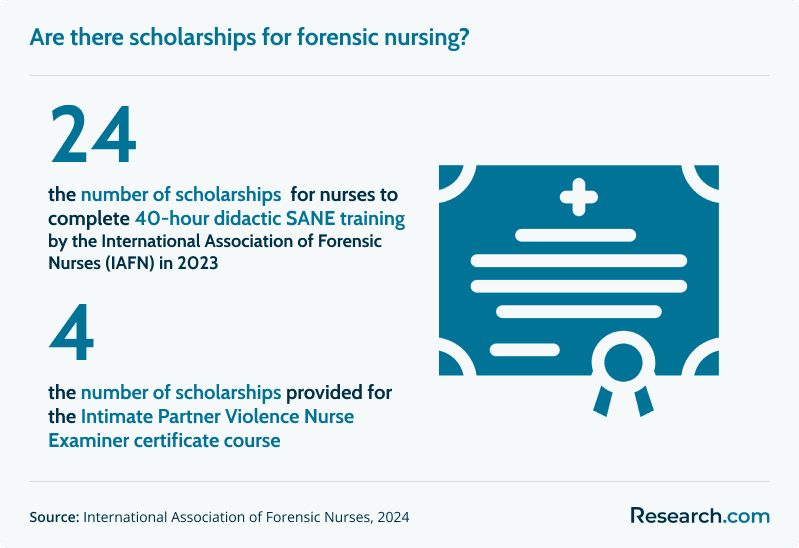
The image below notes that in 2023 the IAFN awarded 24 scholarships for the 40-hour SANE didactic training and four for the Intimate Partner Violence Nurse Examiner certificate. That example shows how forensic nursing funding can be targeted but limited, so students should apply early and combine multiple aid sources.
Admission Requirements for Online MSN in Forensic Nursing Programs
Admissions requirements vary by school, but most forensic nursing MSN programs expect applicants to show both nursing readiness and the maturity needed for legally sensitive work. Because forensic nurses may document injuries, collect evidence, interact with vulnerable patients, and participate in legal proceedings, programs often review clinical background, professional judgment, and communication skills carefully.
- Active, unencumbered RN license in the U.S. or its territories.
- Bachelor’s degree, usually a BSN, although some schools may consider applicants with a non-nursing bachelor’s degree if bridge or leveling coursework is completed.
- Minimum undergraduate GPA around 3.0, sometimes based on the full record or recent coursework.
- Prior coursework in statistics or research methods to support evidence-based practice.
- At least one year of RN clinical experience, either required or strongly preferred.
- Professional statement explaining career goals, forensic nursing interest, and readiness for graduate study.
- Two letters of recommendation from academic, clinical, or professional references.
- Resume or CV and official transcripts.
- Interview, if required by the program.
- Background check, drug screening, immunization documentation, and current BLS/CPR certification before clinical placement.
Other credential-based fields also rely on verified readiness before advanced training. For example, professionals evaluating online CGRC certification ISC2 options will see a similar emphasis on documented competencies, prerequisites, and applied experience, although the subject matter is very different.
The field’s growth makes careful admissions screening important: the referenced data show 49% more applicants, 38% more new certificants, and a 74% rise in total certificants over five years. Programs use prerequisites such as RN licensure, clinical experience, and background checks to help ensure students are prepared for sensitive forensic responsibilities.
SANE-A (adolescent) and SANE-P (pediatric) Forensic Nursing Certificates Are Becoming Popular

Common Courses in an Online MSN in Forensic Nursing
Forensic nursing MSN curricula combine advanced nursing science with legal, investigative, ethical, and trauma-informed practice. Students should expect both graduate nursing core courses and specialty courses that address violence, evidence, documentation, testimony, systems response, and patient advocacy.
- Foundations of Forensic Nursing Science: Introduces forensic nursing roles, trauma-informed care, victim and offender dynamics, and the nurse’s responsibilities in justice-related cases.
- Advanced Pathophysiology Across the Lifespan: Builds understanding of disease, injury, trauma, and physiological responses across age groups.
- Advanced Health Assessment Across the Lifespan: Develops advanced assessment techniques used in complex clinical and forensic situations.
- Pharmacology for Advanced Practice: Covers medication effects, therapeutic management, and pharmacologic considerations relevant to advanced nursing care.
- Evidence-Based Practice and Translational Research: Teaches students how to evaluate research and apply findings to clinical and forensic nursing practice.
- Forensic Methodologies and The Legal System: Covers evidence handling, documentation, legal processes, and preparation for expert testimony.
- Interpersonal Violence and Maltreatment: Focuses on assessment, intervention, advocacy, and practicum experiences related to abuse, assault, neglect, and violence.
- Forensic Nursing Quality, Safety, Risk, and Death: Examines death investigation, risk management, quality improvement, and systems-level accountability.
- Advanced Forensic Nursing Seminar and Clinical: Integrates specialty knowledge through supervised applied practice.
- Capstone, practicum, or scholarly project: Requires students to synthesize forensic nursing knowledge through a culminating project or supervised experience.
Most programs include several hundred supervised practicum hours. Oakland University’s published forensic nursing plan of study is one example of how specialty coursework and clinical requirements may be sequenced.
Graduate programs in other fields also combine theory, research, and applied work. For example, students comparing a master’s in higher education online will see a similar structure of conceptual study plus practical application, though the professional outcomes differ.
The chart below identifies top forensic nursing skills listed in 2025, including patient care, evidence collection, mental health, and child abuse. The courses above are designed to build those capabilities through assessment, legal knowledge, forensic methodology, and clinical practice.
Forensic Nursing Specializations and Career Focus Areas
Some online MSN forensic nursing programs allow students to concentrate on specific populations, settings, or legal responsibilities. Choosing a specialization can help you align coursework and clinical experiences with the role you want after graduation.
- Sexual Assault Nurse Examiner (SANE): Focuses on caring for sexual assault survivors, performing specialized examinations, documenting findings, and collecting evidence.
- Forensic Nurse Death Investigator: Applies nursing knowledge to death investigation, scene assessment, medical history review, and collaboration with medicolegal authorities.
- Legal Nurse Consultant: Uses nursing expertise to help attorneys, insurers, or healthcare organizations interpret medical records and clinical issues.
- Forensic Psychiatric Nursing: Connects mental health assessment and care with forensic settings, criminal justice populations, or trauma-related cases.
- Correctional or Forensic Correctional Nursing: Provides healthcare to incarcerated individuals while addressing safety, documentation, and institutional policies.
- Geriatric and Pediatric/Child Abuse Forensic Nursing: Focuses on abuse, neglect, exploitation, and injury assessment among children or older adults.
- Emergency Room Forensic Nursing: Integrates acute care, crisis response, evidence preservation, and rapid documentation in emergency settings.
- Clinical Forensic Nursing, Human Rights Abuse Investigations, and Forensic Nurse Education: Prepares nurses for broader advocacy, training, systems development, and investigative support roles.
If you are more interested in managing people, budgets, and service lines than direct forensic examination, compare forensic nursing leadership pathways with a master’s in nursing executive leadership online.
How to Choose the Best Online MSN in Forensic Nursing Program
The best program is not automatically the highest-ranked or the fastest. It is the program that fits your license, location, career target, learning style, clinical placement needs, and financial limits. Use the following checklist before applying.
- Confirm accreditation. Look for programmatic accreditation from CCNE or ACEN and institutional accreditation from a recognized accreditor.
- Verify state authorization. Make sure the school can enroll students in your state and that clinical placement rules work where you live.
- Match the curriculum to your goal. A nurse aiming for SANE work needs different preparation than someone targeting death investigation, legal consulting, or program leadership.
- Ask who finds clinical placements. Placement support can determine whether you graduate on time.
- Review faculty expertise. Look for instructors with forensic nursing, SANE, medicolegal, legal, trauma, or investigative backgrounds.
- Compare total cost, not just tuition. Include fees, clinical expenses, transfer credit, financial aid, and employer reimbursement.
- Check scheduling expectations. Asynchronous courses may still include live sessions, group projects, deadlines, or practicum commitments.
- Evaluate student support. Strong online programs should offer advising, library access, writing support, technology help, and career services.
- Ask about outcomes. Request information about completion rates, graduate roles, certification preparation, and employer partnerships when available.
- Consider your entry pathway. If you do not have a BSN, review bridge options or compare an accelerated online BSN program before selecting an MSN route.
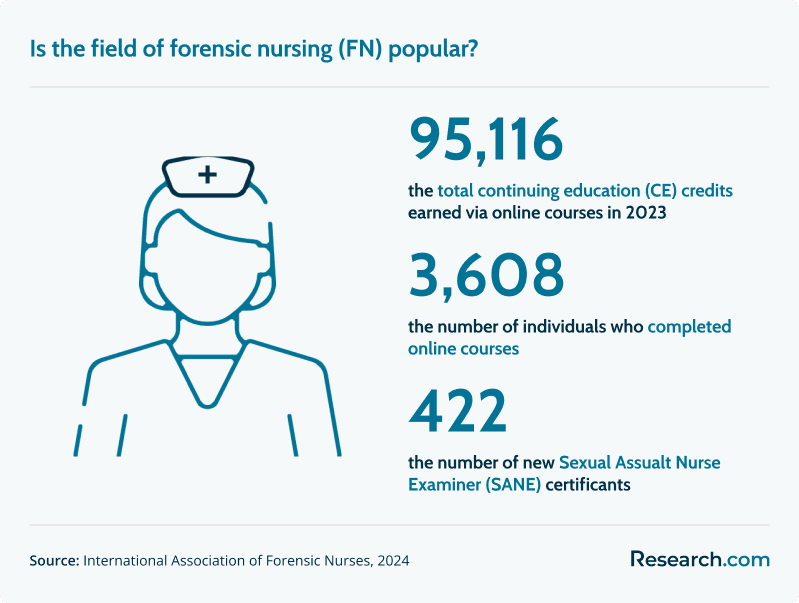
The image’s data—95,116 online CE credits, 3,608 course completers, and 422 new SANE certificants in 2023—shows strong continuing education activity in forensic nursing. Use that momentum wisely by choosing a program with verified accreditation, strong clinical oversight, and a curriculum that matches your intended role.
Common Mistakes to Avoid When Choosing an Online Forensic Nursing MSN
| Mistake | Why It Can Hurt You | Better Approach |
| Choosing only by tuition | A low per-credit rate may be offset by more credits, extra fees, or weak placement support | Calculate the full program cost and ask for a written fee breakdown |
| Ignoring accreditation | Unaccredited programs may limit financial aid eligibility, employer recognition, or future education options | Verify institutional and nursing program accreditation before applying |
| Assuming online means self-paced | Many online MSN programs have weekly deadlines, cohort pacing, live sessions, or practicum timelines | Ask for a sample course schedule and expected weekly workload |
| Overlooking clinical placement rules | Failure to secure a site or preceptor can delay graduation | Ask whether the school arranges placements or expects students to find them |
| Assuming every program prepares for every forensic role | SANE, death investigation, legal consulting, and leadership require different experiences | Match electives, practicums, and faculty expertise to your career goal |
| Relying only on rankings | A highly ranked school may not be authorized in your state or affordable for your situation | Use rankings as a starting point, then verify fit, cost, and eligibility |
Career Paths for Online MSN in Forensic Nursing Graduates
An MSN in forensic nursing can support advancement from bedside or emergency care into specialized clinical, investigative, consulting, educational, and leadership roles. Actual job titles vary by state, employer, certification, and clinical background.
- Sexual Assault Nurse Examiner (SANE) or Forensic Nurse Examiner: Provides trauma-informed examinations, documents injuries, collects evidence, and supports survivors during medical and legal processes.
- Forensic Nurse Investigator or Medicolegal Death Investigator: Applies clinical knowledge to death investigations, case review, scene information, and collaboration with medical examiners or coroners.
- Legal Nurse Consultant or Forensic Clinical Nurse Specialist: Helps legal teams, healthcare organizations, or insurers interpret medical facts, records, standards of care, and injury patterns.
- Forensic Nursing Educator or Program Coordinator: Trains nurses, develops protocols, coordinates forensic services, and supports quality improvement.
- Program Director or Policy Advisor in Forensic Nursing: Leads forensic nursing programs, strengthens interagency collaboration, and contributes to policy and service design.
- Executive Leadership: Nurses who want broader administrative authority may pair clinical specialization with business training through an online MSN MBA dual degree.
Job Market Outlook for Forensic Nursing Graduates
The job market for forensic nursing is specialized rather than broad, but demand can be meaningful in communities that lack trained forensic examiners. Rural and underserved regions may have difficulty providing timely access to Sexual Assault Nurse Examiners and forensic nurse examiners. WHRO has documented forensic nurse examiner shortages in some communities, and MPB has reported on whether TeleSANE can help address SANE access gaps in the Gulf South.
Forensic nursing roles are not always counted as a single occupational category in federal labor data, so students should be cautious with salary and employment claims. However, the broader advanced-practice nursing labor market remains strong. The Bureau of Labor Statistics projects nurse anesthetists, nurse midwives, and nurse practitioners to grow by roughly 40% from 2023 to 2033. MSN-prepared forensic nurses may benefit from this broader demand when they combine advanced nursing education with specialized forensic competencies.
For additional labor-market context, students can review sources such as Barton Associates’ 2024 Nurse Practitioner job outlook, Becker’s Hospital Review’s summary of nurse practitioner employment by state, and BLS May 2022 Occupational Employment Statistics for Nurse Anesthetists, Nurse Midwives, and Nurse Practitioners. For forensic-specific salary snapshots, compare multiple sources rather than relying on one figure, including Glassdoor forensic nurse salary data, Indeed forensic nurse salary guidance, Indeed salary information for Registered Nurses at Forensic Nurse Specialists, Inc, Payscale forensic nurse hourly rate data, salary.com forensic nurse salary research, Zippia forensic nurse job information, and ZipRecruiter forensic nurse salary estimates.
Telehealth is also affecting forensic nursing access. TeleSANE models can connect less-resourced facilities with experienced forensic examiners, but students should ask programs how technology, remote consultation, documentation standards, and legal admissibility are addressed in coursework.
What Graduates Say About Online MSN in Forensic Nursing Programs
- Saskia: "The online MSN in Forensic Nursing allowed me to stay on night shift while completing graduate coursework. The asynchronous lessons and online discussions worked with my schedule, and I was able to use evidence documentation strategies in my clinical role within months. I feel better prepared to support survivors and explain my work with confidence."
- Ronan: "I expected online study to feel disconnected, but my forensic nursing cohort became an important professional network. Case-based simulations, faculty feedback, and focused assignments helped me turn a general interest in forensic care into a clear career plan. I now communicate with law enforcement and legal partners using stronger clinical reasoning."
- Eulalia: "Earning the online MSN in Forensic Nursing helped me move into a more visible leadership role. The forensic coursework and virtual mentorship strengthened my credibility in multidisciplinary case meetings, especially when patient care overlapped with legal questions. I now lead case reviews with more structure and confidence."
How to Verify Accreditation and Program Quality
Accreditation should be your first quality check. Confirm that the nursing program is accredited by the Commission on Collegiate Nursing Education (CCNE) or the Accreditation Commission for Education in Nursing (ACEN), and verify that the institution itself holds recognized accreditation. Do not rely only on marketing language; check the accreditor’s database and the school’s official accreditation page.
Quality assurance should also include clinical oversight, faculty qualifications, outcome reporting, and student support. Ask whether forensic practicum sites are approved in advance, whether preceptors receive guidance, and how the program evaluates student competence in documentation, evidence handling, patient advocacy, and legal communication. Program pages from schools such as Cleveland State University, DeSales University, Fitchburg State University, Monmouth University, Oakland University, Stevenson University, and Xavier University can help you compare how schools present curriculum, delivery format, and requirements.
Challenges Online MSN Forensic Nursing Students Should Expect
Online forensic nursing students often balance shift work, graduate writing, practicum planning, emotionally difficult subject matter, and technology-based learning. The content can be demanding because students study trauma, assault, abuse, death, legal documentation, and systems response. Strong time management and access to support are essential.
Common challenges include limited face-to-face interaction, difficulty finding local clinical placements, delayed preceptor approvals, heavy reading loads, and the need to practice sensitive communication skills online. Students who are returning to school after a long break may benefit from strengthening academic writing, statistics, and evidence-based practice skills before beginning. If you are still completing undergraduate nursing requirements, comparing the easiest RN BSN online program options may help you identify a bridge path before applying to an MSN.
| Challenge | How to Prepare |
| Working while studying | Choose part-time pacing if your shifts are unpredictable, and review weekly workload expectations before enrolling |
| Clinical placement delays | Ask early who secures placements and what happens if a site falls through |
| Emotionally difficult content | Use faculty support, peer discussion, and professional wellness resources |
| Online learning isolation | Participate actively in discussion boards, live sessions, and professional organizations |
| Legal and documentation expectations | Practice precise writing, objective charting, and evidence-based communication throughout the program |
Questions to Ask Before Applying
- Is the nursing program accredited by CCNE or ACEN?
- Can the school enroll students from my state?
- Does the program meet my state’s requirements for the forensic role I want?
- Who is responsible for finding clinical placements?
- How many practicum hours are required?
- Are any campus visits, synchronous sessions, or live simulations required?
- What forensic specialties are included: SANE, death investigation, legal consulting, correctional nursing, child abuse, elder abuse, or leadership?
- What is the total estimated cost, including fees and clinical compliance expenses?
- Can I transfer prior graduate credits?
- What support is available for online students, including advising, technology help, writing assistance, and career services?
References
- American Association of Colleges of Nursing. Scholarships for nursing students.
- Barton Associates. 2024 Nurse Practitioner (NP) job outlook.
- Becker’s Hospital Review. Nurse Practitioner employment by state.
- Bureau of Labor Statistics. Nurse Anesthetists, Nurse Midwives, and Nurse Practitioners - Occupational Outlook Handbook.
- Bureau of Labor Statistics. May 2022 Occupational Employment Statistics for Nurse Anesthetists, Nurse Midwives, and Nurse Practitioners.
- Cleveland State University. Online MSN in Forensic Nursing program page.
- DeSales University. MSN and Post-MSN Forensic Nursing with Investigative Forensics overview.
- EducationData.org. Average cost of college.
- Fitchburg State University. Online Master of Science in Forensic Nursing program page.
- Glassdoor. Forensic nurse salary.
- Groom. IRS issues FAQs on educational assistance programs.
- HigherEdU. Online vs. on-campus nursing degree: which is better.
- Indeed. Forensic nurse salary advice.
- Indeed. Registered nurse salaries at Forensic Nurse Specialists, Inc.
- Monmouth University. MSN Forensic Nursing program PDF.
- MPB Online. The Gulf South needs more Sexual Assault Nurse Examiners—is TeleSANE the answer?
- NBC Chicago. Chicago nurse aims to highlight shortage of Sexual Assault Nurse Examiners.
- Oakland University. Online MSN in Forensic Nursing program page.
- Payscale. Forensic nurse hourly rate.
- salary.com. Forensic nurse salary research.
- Stevenson University. Online MSN Forensic Nursing concentration program page.
- WHRO. Forensic nurse examiners are in short supply in some communities.
- Xavier University. Online MSN in Forensic Nursing program page.
- Zippia. Forensic nurse jobs.
- ZipRecruiter. Forensic nurse salary.
Key Insights
- An online MSN in forensic nursing is best for licensed RNs who want advanced roles involving trauma-informed care, evidence documentation, legal collaboration, victim advocacy, death investigation, or forensic program leadership.
- Most BSN-to-MSN forensic nursing programs take about two to three years and require roughly 36 to 39 credits, although some programs offer accelerated, part-time, extended, or bridge pathways.
- Accreditation matters more than delivery format. Online and on-campus programs can be comparable when they are properly accredited, clinically supervised, and supported by qualified faculty.
- Total cost varies widely. Compare per-credit tuition, required credits, fees, clinical costs, transfer policies, and employer or institutional aid before choosing a program.
- Clinical placement support can make or break the experience. Ask whether the school finds placements, approves preceptors, and supports students in your state.
- Do not assume every forensic nursing MSN prepares for every role. Match the curriculum to your target area, such as SANE, legal nurse consulting, death investigation, correctional nursing, child abuse or elder abuse response, or leadership.
- The job market is specialized but important, particularly in communities with shortages of trained forensic examiners. Graduates who combine advanced nursing education with practical forensic experience and relevant certification may be better positioned for competitive roles.
Other Things You Should Know About the Best Online MSN in Forensic Nursing Programs
When selecting the best online MSN in Forensic Nursing program in 2027, consider accreditation, faculty expertise, curriculum comprehensiveness, and practicum opportunities. Ensure the program has a strong alumni network and partnerships with healthcare facilities to enhance hands-on experience and future career prospects.
In 2027, top online MSN in Forensic Nursing programs include offerings from institutions like Duquesne University, Fitchburg State University, and Aspen University. These programs provide robust curricula designed for flexibility, allowing nurses to advance their careers without sacrificing their current job responsibilities.
In 2027, top online MSN in Forensic Nursing programs offer specialized courses like forensic science, legal aspects of forensic nursing, evidence collection, and victimology. These courses equip nurses with skills to handle medical-legal issues, engage in criminal investigations, and support victims effectively.





