
2027 Best Online Nurse Executive Leadership MSN Programs

Co-Founder and Chief Data Scientist
As healthcare systems become increasingly complex, nurse leaders are taking center stage in shaping strategic decisions—81% now help define their organization’s mission. This growing influence highlights the importance of online nurse executive leadership programs, which equip nurses with the skills to lead decisively and inspire change.
In this guide, I will discuss the best online nurse executive leadership programs. I will also offer guidance on selecting a program that supports professional advancement into roles that influence policy, operations, and patient outcomes.
What are the benefits of getting into an online nurse executive leadership MSN degree?
- Online nurse executive leadership MSN programs offer the flexibility to pursue graduate education while balancing work and family responsibilities.
- These programs prepare nurses to take on high-level leadership roles in healthcare, focusing on strategic planning, team management, and organizational development.
- Nurse executives’ average salary is $93,552 per year, and top earners make up to $148,500, opening doors to career growth and financial advancement.
What can I expect from an online nurse executive leadership MSN degree?
Online nurse executive leadership programs equip nurses with the skills to lead healthcare organizations and drive quality improvements. It is designed for current registered nurses aiming to transition into executive roles.
Students can expect the following:
- Core Curriculum: Courses in healthcare leadership, strategic management, financial oversight, ethics, and human resource management.
- Practical Application: Programs often include capstone or practicum experiences that apply learned strategies in real-world healthcare environments.
- Flexible Learning: Online platforms provide a blend of asynchronous content, live sessions, and interactive forums to promote peer collaboration and instructor feedback.
- Specialization Options: Some schools offer additional certificates or dual pathways in nursing education, informatics, or public health.
Where can I work with an online nurse executive leadership MSN degree?
Graduates of online nurse executive leadership programs are equipped to lead healthcare teams, shape policies, and improve system-wide outcomes. The common workplaces for online nurse executive leadership MSN program graduates include:
- Hospitals and Health Systems: Leading nursing departments, managing operations, or serving as Chief Nursing Officers (CNOs).
- Long-Term Care and Rehabilitation Facilities: Overseeing patient care standards and staff development.
- Government and Public Health Agencies: Influencing health policy and community-based care initiatives.
- Health Insurance and Managed Care Organizations: Directing quality improvement, compliance, and care coordination strategies.
- Academic Institutions: Teaching or developing future nurse leaders in higher education settings.
- Nonprofit or Advocacy Organizations: Leading programs focused on access, equity, or care delivery reform.
How much can I make with an online nurse executive leadership MSN degree?
Nurse executive salaries in the U.S. vary based on job title, experience, and location. The average annual salary is $93,552, or $44.98 per hour. Weekly earnings are about $1,799, and monthly income averages $7,796. Most earn between $58,000 and $120,500 a year.
Top earners can make up to $148,500 annually, with some roles reaching $184,000. The wide nurse executive salary range shows strong potential for growth. An MSN in nurse executive leadership can lead to higher pay and prepare nurses for top leadership roles in healthcare.
- Best Online Nurse Executive Leadership MSN Programs for 2027 List of Programs
- How long does it take to complete an online nurse executive leadership MSN program? Completion Time
- How does an online nurse executive leadership MSN compare to an on-campus program? How does an online nurse executive leadership MSN compare to an on-campus program?
- What is the average cost of an online nurse executive leadership MSN program? Program Cost
- What are the financial aid options for students enrolling in an online nurse executive leadership MSN program? Financial Aid
- What are the prerequisites for enrolling in an online nurse executive leadership MSN program? Prerequisites
- What courses are typically in an online nurse executive leadership MSN program? What courses are typically in an online nurse executive leadership MSN program?
- What types of specializations are available in online nurse executive leadership MSN programs? What types of specializations are available in online nurse executive leadership MSN programs?
- How to choose the best online nurse executive leadership MSN program? How to choose the best online nurse executive leadership MSN program?
- What career paths are available for graduates of online nurse executive leadership MSN programs? Career Paths
- What is the job market for graduates with an online nurse executive leadership MSN? Job Market
- How can mentorship and networking opportunities enhance success in online nurse executive leadership MSN programs? How can mentorship and networking opportunities enhance success in online nurse executive leadership MSN programs?
- Is an Online Nurse Executive Leadership MSN a Worthy Investment? Is an Online Nurse Executive Leadership MSN a Worthy Investment?
Best Online Nurse Executive Leadership MSN Programs for 2027
An online MSN in nurse executive leadership is designed for registered nurses who want to move from bedside or unit-level work into management, administration, operations, quality improvement, or senior nursing leadership. The decision is not only about finding a convenient online program. You also need to compare accreditation, total tuition, practicum expectations, leadership coursework, employer recognition, and whether the degree fits your long-term career goals.
This guide ranks online nurse executive leadership MSN programs and explains how to evaluate them. You will find program details, cost and length comparisons, admissions requirements, common courses, specialization options, career paths, job outlook, financial aid options, and practical questions to ask before enrolling.
Quick answer: What should you look for in an online nurse executive leadership MSN?
The best online nurse executive leadership MSN program is accredited, affordable for your budget, flexible enough for your work schedule, and aligned with the type of leadership role you want. For many working RNs, the strongest programs combine asynchronous coursework, applied leadership practicums, healthcare finance, policy, quality improvement, and faculty with real nursing administration experience.
| Decision factor | What to check before applying |
| Accreditation | Look for recognized nursing accreditation such as CCNE or ACEN, especially if you plan to pursue certification or future doctoral study. |
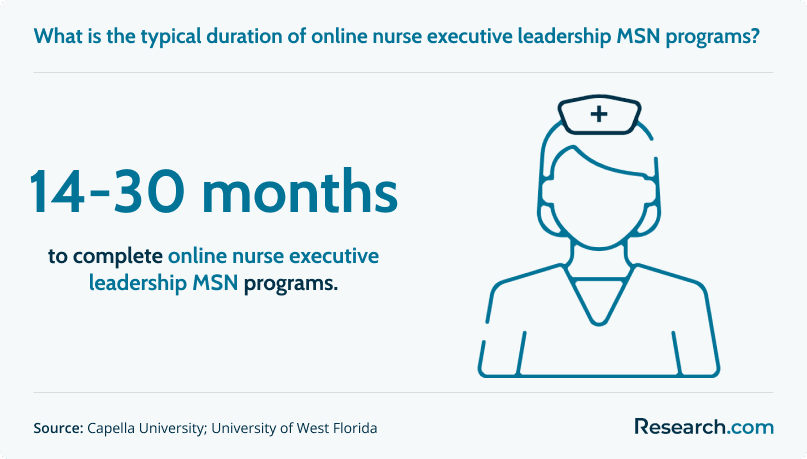
| Program length | Programs in this guide range from 14 months to nearly three years depending on format, credit load, and pace. |
| Cost | Listed tuition ranges from $350 to $777 per credit hour, but total cost depends on required credits and fees. |
| Career fit | Choose nurse executive, nursing leadership, management, quality, informatics, or population health tracks based on your target role. |
| Practicum support | Ask whether the school helps secure local leadership practicum placements and approved preceptors. |
How do we rank schools?
Research.com evaluates schools using a structured ranking methodology built around data quality, academic relevance, affordability, online learning access, and student decision-making needs. Because graduate nursing education requires a meaningful investment of time and money, the ranking emphasizes factors that help applicants compare programs realistically rather than relying on reputation alone.
Our research draws from established higher education data sources, including the Integrated Postsecondary Education Data System, Peterson's database and its distance learning data, College Scorecard, and the National Center for Education Statistics (NCES). These sources help students review programs with more confidence and compare schools using consistent information.
Online nurse executive leadership MSN programs at a glance
| Rank | School | Program focus | Length | Cost per credit | Credits | Accreditation |
| 1 | Walden University | Nurse Executive | 18 months | $350 | 53 to 63 | Commission on Collegiate Nursing Education (CCNE) |
| 2 | University of West Florida | Nursing Leadership | 24 months | $450 | 36 | CCNE |
| 3 | Sacred Heart University | Nursing Management and Executive Leadership | 20 months | $600 | 42 | CCNE |
| 4 | University of Alabama | Nurse Executive | 18 months | $400 | 30 | CCNE |
| 5 | Benedictine University | Nursing Leadership | 24 months | $550 | 36 | CCNE |
| 6 | Chamberlain University | Nurse Executive | 18 months | $650 | 30 | CCNE |
| 7 | Western Governors University | Nursing Leadership and Management | 23 months | $350 | 36 | CCNE |
| 8 | Simmons University | Nursing Leadership | 24 months | $600 | 40 | CCNE |
| 9 | Capella University | Nursing Leadership and Administration | 14 months | $777 | 54 | CCNE |
| 10 | Missouri Baptist University | Executive Leadership | 24 months | $777 | 36 | CCNE |
1. Walden University
The online MSN-Nurse Executive program at Walden University is built for nurses preparing for administrative, operational, and strategic leadership roles. The curriculum emphasizes leadership in complex healthcare organizations, policy awareness, and management decision-making. Courses such as Strategic Leadership in Healthcare and Healthcare Policy and Advocacy help students connect nursing practice with organizational change and healthcare policy.
- Program Length: 18 months
- Tracks/Concentrations: Nurse Executive
- Cost per Credit Hour: $350
- Required Credits to Graduate: 53 to 63
- Accreditation: Commission on Collegiate Nursing Education (CCNE)
2. University of West Florida
The online nursing leadership master’s program at the University of West Florida focuses on preparing nurses to guide teams, support evidence-based practice, and participate in organizational improvement. Students study healthcare policy, leadership theory, and systems-based practice, making the program a practical option for RNs who want to move into nurse manager, director, or administrative roles.
- Program Length: 24 months
- Tracks/Concentrations: Nursing Leadership
- Cost per Credit Hour: $450
- Required Credits to Graduate: 36
- Accreditation: CCNE
3. Sacred Heart University
Sacred Heart University offers an online MSN in Nursing Management and Executive Leadership for nurses who want to develop management, finance, quality improvement, and team leadership skills. The program is especially relevant for students who want to understand how clinical decisions connect to budgets, staffing, patient outcomes, and healthcare administration.
- Program Length: 20 months
- Tracks/Concentrations: Nursing Management and Executive Leadership
- Cost per Credit Hour: $600
- Required Credits to Graduate: 42
- Accreditation: CCNE
4. University of Alabama
The University of Alabama offers an online MSN Nurse Executive program that combines leadership development, healthcare policy, strategic management, and applied nursing administration. Its 30-credit structure may appeal to students looking for a focused graduate pathway into executive nursing leadership.
- Program Length: 18 months
- Tracks/Concentrations: Nurse Executive
- Cost per Credit Hour: $400
- Required Credits to Graduate: 30
- Accreditation: CCNE
5. Benedictine University
The online Master of Science in Nursing at Benedictine University emphasizes nursing leadership, healthcare administration, informatics, population health, and ethical decision-making. The program is designed for RNs who want to lead teams, influence practice standards, and contribute to system-level improvement in patient care.
- Program Length: 24 months
- Tracks/Concentrations: Nursing Leadership
- Cost per Credit Hour: $550
- Required Credits to Graduate: 36
- Accreditation: CCNE
6. Chamberlain University
Chamberlain University offers an online MSN Nurse Executive program centered on healthcare finance, policy, quality improvement, and leadership strategy. It is designed for nurses preparing to supervise teams, manage resources, and contribute to organizational performance in healthcare settings.
- Program Length: 18 months
- Tracks/Concentrations: Nurse Executive
- Cost per Credit Hour: $650
- Required Credits to Graduate: 30
- Accreditation: CCNE
7. Western Governors University
The online BSN-to-MSN Nursing Leadership and Management program at Western Governors University uses a competency-based model that lets students progress by demonstrating mastery. This format can be useful for self-directed nurses who already have strong professional experience and want a flexible path into leadership and management roles.
- Program Length: 23 months
- Tracks/Concentrations: Nursing Leadership and Management
- Cost per Credit Hour: $350
- Required Credits to Graduate: 36
- Accreditation: CCNE
8. Simmons University
The online Master of Science in Nursing Leadership Program at Simmons University prepares nurses to lead with attention to healthcare economics, quality improvement, strategic planning, and ethical decision-making. The program’s leadership focus may be a strong match for nurses seeking advancement into formal management or administrative positions.
- Program Length: 24 months
- Tracks/Concentrations: Nursing Leadership
- Cost per Credit Hour: $600
- Required Credits to Graduate: 40
- Accreditation: CCNE
9. Capella University
The online MSN in Nursing Leadership and Administration at Capella University focuses on leadership, healthcare policy, evidence-based practice, and organizational improvement. The program is intended for nurses who want to strengthen administrative decision-making and prepare for leadership responsibilities across healthcare settings.
- Program Length: 14 months
- Tracks/Concentrations: Nursing Leadership and Administration
- Cost per Credit Hour: $777
- Required Credits to Graduate: 54
- Accreditation: CCNE
10. Missouri Baptist University
The online nursing executive leadership program at Missouri Baptist University is structured for working nurses who want to develop leadership skills while studying in a flexible format. The program includes an executive leadership focus and incorporates faith-informed perspectives on nursing practice, service, and organizational leadership.
- Program Length: 24 months
- Tracks/Concentrations: Executive Leadership
- Cost per Credit Hour: $777
- Required Credits to Graduate: 36
- Accreditation: CCNE
How long does it take to complete an online nurse executive leadership MSN program?
Most online nurse executive leadership MSN programs can be completed in 14 months to nearly three years. The exact timeline depends on the number of credits, whether the student enrolls full time or part time, and how the school structures practicums, capstones, or leadership projects.
Full-time study is usually best for nurses who can manage a heavier academic workload and want to qualify for leadership roles sooner. Part-time study is often a better fit for RNs balancing rotating shifts, family responsibilities, or employer tuition reimbursement rules.
Some students also compare MSN timelines with accelerated nursing programs, especially if they are planning a longer education pathway or helping evaluate nursing education options at earlier degree levels. When comparing programs, ask whether the school offers multiple start dates, rolling admissions, or competency-based pacing.
| Timeline option | Best for | Trade-off |
| Accelerated or intensive format | Students who can prioritize school and complete assignments quickly | Less schedule flexibility and a heavier weekly workload |
| Full-time online format | RNs who want a predictable path and can manage several courses at once | May be challenging while working full time |
| Part-time online format | Working nurses, parents, and students using employer reimbursement | Longer time to graduation and possibly a longer wait for career advancement |
How does an online nurse executive leadership MSN compare to an on-campus program?
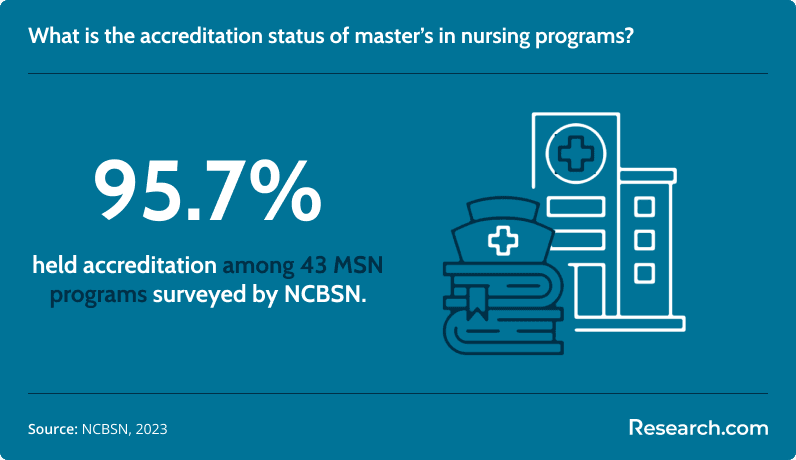
An online nurse executive leadership MSN can be academically credible when it is offered by an accredited institution and includes the same graduate-level expectations as a campus program. For students asking, whether an online nursing degree is credible, the better question is whether the specific program is accredited, well supported, and accepted by employers or certification bodies relevant to your goals.
Online programs are usually designed for licensed RNs who need flexibility. On-campus programs may offer more face-to-face interaction, easier access to faculty, and built-in networking, but they can be harder to manage with full-time nursing schedules.
| Feature | Online MSN nurse executive program | On-campus MSN nurse executive program |
| Course delivery | Mostly remote, often asynchronous or hybrid | In-person classes on a fixed campus schedule |
| Flexibility | Stronger fit for working RNs and students outside commuting range | Better for students who prefer scheduled class meetings |
| Curriculum | Can match campus rigor when accredited and properly designed | Often similar or identical to the school’s online curriculum |
| Practicum | Often completed locally with approved mentors | May use local healthcare partners near campus |
| Networking | Depends on virtual events, cohort design, alumni access, and faculty engagement | More natural in-person interaction with peers, faculty, and local employers |
What is the average cost of an online nurse executive leadership MSN program?
Among the programs listed in this guide, tuition ranges from $350 to $777 per credit hour. However, the lowest per-credit price is not always the lowest total cost. A program requiring more credits can cost more overall than a higher-priced program with fewer required credits.
Students should also budget for expenses beyond tuition. Common additional costs include books, technology fees, online course fees, background checks, clinical or practicum documentation, graduation fees, and possible travel for required intensives. If you are comparing graduate nursing programs and wondering how much nursing school costs, calculate the full program price rather than relying on the advertised cost per credit.
| Cost item | Why it matters |
| Tuition per credit | This is the easiest number to compare, but it does not show total cost by itself. |
| Required credits | Total tuition depends heavily on whether the program requires 30, 36, 42, 54, or 53 to 63 credits. |
| Fees | Online learning, technology, clinical compliance, and graduation fees can change affordability. |
| Practicum costs | Students may need to pay for documentation, background checks, travel, or placement-related requirements. |
| Work schedule impact | A heavier course load may reduce overtime or shift availability, creating an opportunity cost. |
What financial aid options are available for online nurse executive leadership MSN students?
Graduate nursing students may be able to combine federal aid, employer benefits, scholarships, payment plans, military benefits, and private financing. The best strategy is to compare net cost after aid, not just listed tuition. Start early because some scholarships, employer reimbursement plans, and assistantships have separate deadlines.
- FAFSA and federal aid: Graduate students should complete the Free Application for Federal Student Aid each year to determine eligibility for federal loans and other aid options.
- University scholarships: Schools may offer awards based on academic achievement, professional background, leadership potential, or financial need.
- Nursing association scholarships: Professional organizations and nonprofit groups may support nurses pursuing leadership, administration, or advanced practice education.
- State grants and loan forgiveness: Some states support nurses who serve in high-need or underserved communities.
- Graduate assistantships: A limited number of schools may offer tuition support or stipends in exchange for teaching, research, or administrative work.
- Employer tuition reimbursement: Hospitals and healthcare systems may help pay for an MSN if the degree supports workforce development or leadership succession planning.
- Private loans: Private lenders can fill funding gaps, but students should compare interest rates, repayment terms, and borrower protections carefully.
- Military and VA education benefits: Eligible service members, veterans, and family members may use GI Bill, Yellow Ribbon Program, or other VA benefits. The Air Force Financial Assistance Program offers over $45,000 per year during residency, plus a $2,000+ monthly stipend, in exchange for a service commitment.
- Fellowships and stipends: Some foundations and professional groups offer funding for leadership training, clinical development, or graduate nursing education.
How to reduce the cost of an online nurse executive MSN
- Ask whether your employer reimburses graduate nursing tuition and whether you must stay employed for a certain period after receiving funds.
- Compare total tuition by multiplying cost per credit by required credits.
- Review whether transfer credits are accepted.
- Look for programs with transparent fees and no required travel if travel would add major expenses.
- Apply for scholarships before admission deadlines when possible.
- Consider part-time enrollment if it allows you to keep income and employer benefits stable.
What are the prerequisites for enrolling in an online nurse executive leadership MSN program?
Admission requirements vary by school, but online nurse executive leadership MSN programs generally expect applicants to have a nursing background, an active RN license, and evidence that they are ready for graduate-level leadership coursework. These programs are not usually intended for students who are new to nursing; they are designed for licensed RNs preparing to lead teams, departments, systems, or improvement initiatives.
Some nurses researching future leadership or academic pathways also compare MSN leadership programs with online MSN to EdD bridge programs. The right choice depends on whether your next goal is organizational leadership, education leadership, research, or executive administration.
- BSN degree: Most applicants need a Bachelor of Science in Nursing from an accredited institution.
- Active RN license: Programs typically require a current, unencumbered RN license, often in the state where practicum activities will occur.
- Minimum GPA: Many schools look for an undergraduate cumulative GPA of 3.0 or higher.
- Professional nursing experience: Programs commonly prefer one to two years of clinical or leadership experience so students can connect coursework to real staffing, quality, and operations challenges.
- Letters of recommendation: Applicants may need two to three professional or academic references who can speak to readiness for graduate study and leadership potential.
- Personal statement or essay: Schools often ask applicants to explain career goals, leadership experience, and reasons for pursuing an MSN in executive leadership.
- Resume or CV: A current resume should show nursing roles, certifications, leadership responsibilities, committee work, and professional achievements.
- Interview: Some programs use interviews to assess communication skills, career fit, and readiness for advanced leadership training.
- Clinical compliance documents: Practicum requirements may include a background check, immunization records, drug screening, and proof of professional liability coverage.
What courses are typically included in an online nurse executive leadership MSN program?
An online MSN in nurse executive leadership blends advanced nursing practice knowledge with management, finance, policy, quality improvement, and organizational strategy. The goal is to help nurses make decisions that affect staffing, patient safety, budgets, compliance, care delivery, and workforce development.
Students who want to continue beyond the MSN sometimes compare leadership degrees with online MSN to PhD programs, especially if they are interested in research, academic leadership, or evidence generation. For most nurse executive students, however, the MSN curriculum is focused on applying evidence to real organizational problems.
- Health systems leadership: Covers leadership frameworks, systems thinking, change management, and clinical operations.
- Healthcare finance and budgeting: Teaches nurses to interpret budgets, manage resources, and understand the financial impact of staffing and care delivery decisions.
- Organizational behavior: Explores team dynamics, workplace culture, communication, conflict, and leadership in complex healthcare environments.
- Strategic planning: Focuses on long-range goals, performance metrics, organizational priorities, and improvement planning.
- Legal and ethical issues: Reviews compliance, professional accountability, healthcare law, patient rights, and ethical decision-making.
- Informatics and healthcare technology: Examines electronic health records, data systems, digital workflows, and technology-supported decision-making.
- Human resource and talent management: Addresses recruitment, retention, evaluations, workforce planning, staffing concerns, and professional development.
- Quality and safety in healthcare: Prepares students to lead patient safety initiatives, monitor outcomes, and use quality improvement methods.
- Population health and policy: Connects leadership decisions to community health, equity, access, and healthcare policy.
- Evidence-based practice: Builds the ability to evaluate research and apply evidence to clinical and administrative decisions.
- Capstone or practicum: Allows students to apply leadership skills in a real healthcare setting under faculty or mentor guidance.
For RNs looking for less stressful nursing jobs with less physical bedside demand, leadership coursework can support a transition into administrative, quality, education, or operations roles. These jobs can still be demanding, but the stress profile is often different from direct patient care.
What specializations are available in online nurse executive leadership MSN programs?
Many online nurse executive leadership MSN programs offer a general leadership curriculum, while others allow students to focus on a specific administrative or systems-level area. Applicants comparing schools, including those reviewing nursing schools with more accessible admissions pathways, should make sure the specialization matches the roles they actually want after graduation.
| Specialization | Best fit for students who want to... |
| Nurse Executive or Nurse Leader | Manage clinical teams, lead departments, support strategic decisions, and prepare for formal leadership roles. |
| Healthcare Informatics | Use data, digital systems, and clinical technology to improve workflows and decision-making. |
| Quality and Patient Safety | Lead performance improvement, reduce errors, monitor outcomes, and support safer care delivery. |
| Population Health Leadership | Work on community health, access, prevention, equity, and care coordination across populations. |
| Strategic Planning and Organizational Development | Guide long-term planning, organizational redesign, compliance alignment, and performance measurement. |
| Healthcare Finance and Budgeting | Develop stronger skills in budgeting, resource allocation, cost management, and financial planning. |
| Legal and Ethical Leadership in Healthcare | Navigate compliance, risk, professional ethics, and legal concerns in administrative decision-making. |
Professional certification can also strengthen a nurse leader’s profile. The American Nurses Credentialing Center offers the Nurse Executive (NE-BC) credential, which requires 2,000 hours of management experience and 30 hours of clinical leadership training within the past three years. Nurses in broader system-level roles may also consider the Advanced Nurse Executive (NEA-BC) certification.
How should you choose the best online nurse executive leadership MSN program?
Choosing a nurse executive leadership MSN should be a career decision, not just a convenience decision. The right program should help you build the leadership skills, credentials, network, and practical experience needed for your next role. If you are comparing leadership tracks with clinical tracks such as online MSN women’s health nurse practitioner programs, be clear about whether you want to lead systems or provide specialized direct patient care.
- Confirm accreditation: Look for CCNE or ACEN accreditation and verify it directly with the accreditor or school.
- Compare total cost: Multiply tuition by required credits and add fees, travel, books, and practicum-related expenses.
- Review faculty experience: Prioritize programs taught by faculty with backgrounds in nursing administration, executive leadership, quality, informatics, or healthcare operations.
- Match the curriculum to your goals: Nurse manager candidates may need staffing and HR coursework, while future executives may need finance, policy, and strategic planning.
- Ask about practicum placement: Find out whether the school places students, approves student-selected sites, or expects students to locate their own mentors.
- Check schedule flexibility: Determine whether courses are asynchronous, synchronous, part time, full time, or competency-based.
- Evaluate student support: Strong programs provide advising, technical help, writing support, career services, and practicum guidance.
- Look at graduate outcomes: Ask about completion rates, alumni roles, certification preparation, and employer partnerships when available.
- Consider future education: If you may pursue a DNP, EdD, or PhD later, ask how the MSN credits and curriculum support that pathway.
Questions to ask admissions before enrolling
| Question | Why it matters |
| Is the program accredited by CCNE or ACEN? | Accreditation can affect employer recognition, certification eligibility, and future education options. |
| How are leadership practicums arranged? | Students need to know whether they must find their own preceptor or site. |
| Are classes asynchronous, live, or hybrid? | The delivery format determines whether the program fits your work schedule. |
| What fees are not included in tuition? | Hidden costs can change the affordability of a program. |
| Can I study part time? | Part-time enrollment may be essential for nurses working full time. |
| Does the curriculum align with NE-BC or NEA-BC preparation? | Certification alignment may matter for nurse leadership advancement. |
| What career support do online students receive? | Online learners should have access to advising, networking, and career resources. |
What career paths are available after an online nurse executive leadership MSN?
Graduates of online nurse executive leadership MSN programs often pursue roles that combine clinical judgment, personnel management, budget awareness, quality improvement, and strategic planning. These positions may be found in hospitals, health systems, long-term care organizations, public health agencies, academic settings, consulting firms, and healthcare technology environments.
Some leadership and advanced nursing roles are included among the highest-paying nursing career paths, but individual salaries vary by employer, region, experience, title, and scope of responsibility.
| Career path | Typical responsibilities |
| Chief Nursing Officer (CNO) | Sets nursing strategy, oversees nursing departments, aligns care standards with organizational priorities, and participates in executive decision-making. |
| Nurse Manager or Nurse Administrator | Supervises unit operations, staffing, scheduling, performance, compliance, and team communication. |
| Clinical Director | Leads a department or service line, monitors outcomes, manages staff, and supports quality initiatives. |
| Healthcare Consultant | Advises organizations on operations, compliance, leadership structures, performance improvement, or care delivery redesign. |
| Director of Nursing Education | Oversees staff development, continuing education, onboarding, competency training, or academic nursing programs. |
| Quality Improvement Director | Designs and monitors programs aimed at patient safety, regulatory readiness, process improvement, and outcome measurement. |
| Population Health Manager | Coordinates initiatives related to prevention, community outcomes, resource use, and care access. |
What is the job market for graduates with an online nurse executive leadership MSN?
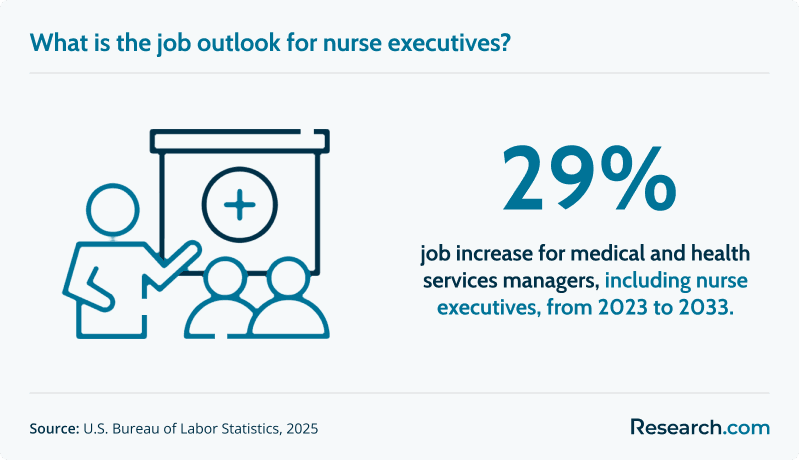
The U.S. Bureau of Labor Statistics does not report nurse executives as a separate occupational category. Instead, many nurse leadership roles fall within the broader medical and health services managers category. Employment in that category is projected to grow by 29% from 2023 to 2033, which is much faster than the average for all occupations.
The BLS also projects an average of 61,400 openings per year for medical and health services managers throughout the decade. Demand is influenced by healthcare system growth, administrative complexity, regulatory requirements, patient safety priorities, technology adoption, and the need for experienced leaders who understand clinical care.
Nurses who combine leadership education with specialized clinical experience may have broader options. For example, some RNs compare executive MSN programs with a pediatric acute care nurse practitioner post-master’s certificate online when deciding whether to expand into clinical specialization, leadership, or both.
Is an online nurse executive leadership MSN worth it?
An online nurse executive leadership MSN can be worth it for experienced RNs who want to move into management, administration, quality improvement, healthcare operations, or executive nursing roles. It may be less useful for nurses who prefer direct patient care, want a nurse practitioner role, or are not ready to take on budget, staffing, compliance, and organizational responsibilities.
| This degree may be worth it if... | You may want another path if... |
| You already have RN experience and want formal leadership responsibility. | You want to diagnose and treat patients as an advanced practice provider. |
| Your employer values MSN-level leadership credentials for promotion. | You are not interested in staffing, finance, conflict resolution, or administration. |
| You want roles in quality, operations, education, population health, or executive leadership. | You need the shortest or least expensive route to a different nursing role. |
| You can complete the program without taking on unmanageable debt. | The program lacks recognized accreditation or practicum support. |
Return on investment depends on tuition, employer support, time to completion, local leadership opportunities, your current salary, and whether the degree helps you qualify for roles you could not otherwise access. Some students compare graduate leadership programs with earlier-entry options such as online accelerated BSN programs, but those pathways serve different audiences. Accelerated BSN programs are generally for entering nursing, while nurse executive MSN programs are for licensed nurses moving into leadership.
What current trends affect nurse executive leadership MSN programs?
Nurse leadership education is changing because healthcare organizations are under pressure to improve patient safety, manage labor shortages, control costs, adopt technology, and respond to shifting care models. Graduate leadership programs increasingly emphasize data literacy, informatics, workforce strategy, virtual collaboration, quality improvement, and interprofessional communication.
- AI and healthcare analytics: Nurse leaders are expected to understand how data tools support staffing, quality monitoring, patient flow, and operational decisions. The goal is not to replace nursing judgment, but to use information more effectively.
- Workforce and staffing challenges: Leadership programs now place more emphasis on retention, burnout prevention, team culture, and staffing models.
- Quality and safety accountability: Healthcare organizations need leaders who can measure outcomes, respond to regulatory standards, and lead improvement initiatives.
- Virtual leadership: Online MSN students often practice digital communication and remote collaboration, skills that are increasingly relevant in multi-site health systems.
- Credential-based advancement: Employers may look for graduate education, leadership experience, and certifications when filling administrative roles.
How can mentorship and networking improve success in an online nurse executive leadership MSN?
Mentorship and networking matter because leadership roles are built on relationships, visibility, and applied judgment. Strong online programs help students connect with faculty, alumni, practicum mentors, and peers who work in different healthcare settings. These connections can lead to project ideas, career advice, references, and exposure to leadership problems beyond a student’s current workplace.
Students who are still building their nursing foundation may benefit from earlier pathway options such as the easiest RN to BSN nursing program before moving toward MSN-level leadership study. For MSN students, the most valuable networking opportunities are usually tied to practicums, professional associations, alumni communities, and faculty-led leadership projects.
Common mistakes to avoid when choosing an online nurse executive leadership MSN
- Choosing a program without verifying accreditation: Do not rely only on marketing pages. Confirm accreditation through the school or accreditor.
- Comparing only cost per credit: A lower credit price may not mean a lower total cost if the program requires more credits.
- Ignoring practicum logistics: Ask whether you must find your own mentor, whether your workplace qualifies, and how approvals work.
- Assuming online means easier: Online graduate nursing programs still require research, writing, group work, leadership projects, and time management.
- Selecting a specialization too quickly: Match the concentration to your target role rather than choosing the title that sounds most impressive.
- Overlooking employer expectations: Talk with nurse leaders in your organization about which degrees, certifications, and experiences are valued for promotion.
- Assuming salary outcomes are guaranteed: A degree can improve qualifications, but pay depends on role, employer, location, experience, and leadership scope.
- Relying only on rankings: Rankings are useful starting points, but your best program depends on cost, fit, accreditation, support, and career goals.
Here’s what graduates say about online nurse executive leadership MSN programs
- : "Balancing work, family responsibilities, and graduate school felt unrealistic until I found an online leadership program with enough flexibility. I was able to keep working while building the confidence to manage a team of 30 nurses. — Jessica"
- : "The online format gave me access to faculty with executive experience even though I worked in a rural hospital. The budgeting and strategic planning coursework helped me prepare for a promotion within six months of graduating. — Derrick"
- : "Online study strengthened my time management, virtual leadership, and data-based decision-making skills. Learning with nurses from different regions also expanded my professional network and changed how I approach leadership problems. — Amirah"
Key Insights
- An online nurse executive leadership MSN is best for licensed RNs who want management, administration, quality, operations, population health, or executive nursing roles.
- Programs in this guide range from 14 months to nearly three years and list tuition from $350 to $777 per credit hour.
- Accreditation matters. CCNE or ACEN accreditation can affect employer trust, certification eligibility, and future graduate study.
- Total cost depends on more than tuition. Required credits, fees, practicum expenses, travel, and lost work time can significantly affect affordability.
- Online programs can be credible when they are accredited, academically rigorous, and supported with strong advising, faculty access, and practicum guidance.
- The strongest applicants usually have a BSN, an active RN license, professional nursing experience, a solid GPA, leadership potential, and clear career goals.
- Career outcomes are strongest when the program aligns with a specific goal, such as nurse manager, clinical director, quality improvement leader, healthcare consultant, or chief nursing officer.
- The U.S. Bureau of Labor Statistics projects 29% growth for medical and health services managers from 2023 to 2033, with an average of 61,400 openings per year across the decade.
- Do not choose based on ranking or convenience alone. Ask about accreditation, practicum placement, faculty experience, student support, total cost, and graduate outcomes before enrolling.
References:
- American Organization for Nursing Leadership (2025). Nursing Leadership Insight Study. Retrieved from https://www.aonl.org/resources/nursing-leadership-survey
- AMN Healthcare (2024). 2024 Survey of Hospital Nurse Leaders. Retrieved from https://www.amnhealthcare.com/amn-insights/nursing/surveys/2024-survey-of-hospital-nurse-leaders/
- NCBSN (2023). 2023 U.S. Nursing Education: Program Overview. Retrieved from https://app.powerbi.com/view?r=eyJrIjoiMTQ1MzcyNmItMjdhYS00YzNjLWIwOWQtYjE3NzZmMDg5NTlmIiwidCI6IjUxNzVkYTNiLWUwNDctNDliNS1hZDJmLWNhMzU1YTZiMzdhMyIsImMiOjN9
- US BLS (2025). Medical and Health Services Managers. Retrieved from https://www.bls.gov/ooh/management/medical-and-health-services-managers.htm#tab-6
- ZipRecruiter (2025). Nurse Executive Salary. Retrieved from https://www.ziprecruiter.com/Salaries/Nurse-Executive-Salary
Other Things You Should Know About the Online Nurse Executive Leadership MSN Programs
Yes. Many programs require a practicum, internship, or leadership residency of about 120 to 240 clinical or administrative hours. Students usually complete these in healthcare management settings under a qualified preceptor, with a final project or capstone tied to executive nursing practice.
Typical admission requirements for 2027 online MSN Nurse Executive Leadership programs include a BSN degree, an active RN license, and at least one year of clinical experience. Additionally, a minimum GPA of 3.0 and professional references may be required.
Yes, many online MSN programs for Nurse Executive Leadership in 2027 are designed to meet the eligibility requirements for nurse executive certification exams. Accreditation and curriculum alignment with the certification criteria are crucial to ensure that graduates can sit for these exams.
The typical program length for an online MSN in Nurse Executive Leadership is about 18–24 months in 2027. This timeframe can vary depending on part-time or full-time enrollment and any prior academic credits transferred into the program.


