
2027 How to Become a Radiology Technician in Maryland

Co-Founder and Chief Data Scientist
Becoming a radiology technician in Maryland usually means completing an accredited radiologic technology program, passing the American Registry of Radiologic Technologists exam, and applying for licensure through the Maryland Board of Physicians. The decision is worth taking seriously: radiologic technologists help physicians diagnose injuries and illnesses using X-rays and other imaging tools, and the work requires technical accuracy, patient care skills, and strict safety judgment.
This guide is for Maryland students, career changers, military-connected learners, and healthcare workers considering radiologic technology as a practical path into medical imaging. It explains the education route, licensing steps, expected skills, salary ranges, job settings, career growth options, common challenges, and financial aid considerations so you can decide whether this career fits your goals, schedule, and budget.
Quick answer: How do you become a radiology technician in Maryland?
- Complete an accredited postsecondary radiologic technology program, commonly an associate degree that combines classroom instruction with supervised clinical training.
- Graduate from a program that supports eligibility for the ARRT certification exam, since ARRT certification is essential for Maryland licensure.
- Apply to the Maryland Board of Physicians with proof of certification or an equivalent credential, required forms, fees, and a criminal background check.
- Expect a Maryland labor market described as steadily growing, with a projected 7% increase in employment through 2030.
- Use salary figures carefully: the article’s cited Maryland pay estimates include an average annual salary around $62,000, a median annual wage around $68,000, and hospital-sector salaries often around or above the state median of $70,000 annually.
- Consider accredited training options at institutions such as the Community College of Baltimore County and Anne Arundel Community College when comparing programs.
- Education needed for Maryland radiology technicians
- Skills employers expect
- Maryland licensing and ARRT certification
- Salary expectations in Maryland
- Job outlook and hiring demand
- Best work settings for radiology technicians
- Technology trends in radiology
- Teamwork with other healthcare professionals
- Work-life balance in Maryland imaging jobs
- Challenges to plan for
- Interview and job-search strategy
- Legal and ethical responsibilities
- Career advancement and continuing education
- Ways to fund radiology technician training
- Ultrasound specialization and related imaging pathsFinancial support checklistProfessional development optionsQuestions to ask before enrollingCareer growth routesHow to learn from working technologistsFAQ: fastest timelineFAQ: highest-paying rolesFAQ: quickest routeFAQ: best majorReferences
What level of education is required to become a radiology technician in Maryland?
Maryland candidates should plan on completing an accredited postsecondary radiologic technology program. The standard route is an associate degree, although the most important factor is not the label of the credential alone; it is whether the program meets the education and clinical preparation requirements needed for certification and state licensure.
A strong radiologic technology program teaches the science behind diagnostic imaging and gives students repeated clinical practice under supervision. Typical coursework includes anatomy, radiographic procedures, radiation physics, image evaluation, patient positioning, patient care, and radiation protection. Clinical rotations are essential because they show whether you can produce diagnostic-quality images while communicating clearly with patients who may be injured, anxious, or in pain.
For licensure planning, accreditation matters. Graduating from a Joint Review Committee on Education in Radiologic Technology-accredited program is commonly treated as the safest route because it supports eligibility for the ARRT certification exam. Before enrolling, verify the program’s accreditation status, clinical placement process, graduation requirements, and whether the curriculum aligns with Maryland Board of Physicians expectations.
| Education decision | Why it matters | What to verify before enrolling |
| Associate degree radiologic technology program | This is the typical education path for entry into radiologic technology practice in Maryland. | Confirm accreditation, clinical rotation sites, ARRT exam preparation, and licensure support. |
| Accelerated program | May shorten the time to workforce entry compared with a traditional schedule. | Check whether the shorter format still meets certification and Maryland licensing requirements. |
| Related healthcare program | May help students explore patient-care work before committing to radiologic technology. | Ask whether credits transfer into a radiologic technology program and whether the pathway leads to licensure. |
What essential skills do you need to be a radiology technician in Maryland?
Radiology technicians need more than the ability to operate imaging equipment. The role combines medical knowledge, patient interaction, safety discipline, and calm decision-making. In Maryland, employers typically look for candidates who can follow protocols precisely while adapting to real clinical conditions.
The most important skills include:
- Imaging equipment competence: You must know how to use X-ray systems and, depending on the role, work with modalities such as CT scanners and MRI machines while producing clear images for interpretation.
- Radiation safety judgment: Safe practice requires shielding, correct exposure settings, patient verification, and careful adherence to radiation protection standards.
- Patient communication: Good technologists explain the exam, give positioning instructions, reduce anxiety, and maintain dignity during uncomfortable procedures.
- Precision and attention to detail: Small errors in positioning, identification, or exposure can lead to poor images, repeat exams, delays, or safety risks.
- Medical documentation: Accurate records support continuity of care, billing, regulatory compliance, and privacy obligations.
- Problem-solving under pressure: Equipment issues, patient movement, emergency orders, and high-volume schedules require quick but careful choices.
- Physical stamina: The job often involves standing, helping position patients, moving equipment, and working variable shifts.
What are the licensing or certification requirements for radiology technicians in Maryland?
The Maryland pathway generally has three parts: approved education, certification, and state licensure. Most candidates begin by completing an accredited radiologic technology program that takes around two years and includes both didactic coursework and clinical practice.
After graduation, candidates pursue ARRT certification. The ARRT exam tests areas such as patient care, image production, radiographic procedures, and radiation safety. Passing this exam is a major step because certification is a prerequisite for Maryland licensure.
The state licensing step is handled through the Maryland Board of Physicians. Applicants submit proof of ARRT certification or an equivalent credential, complete the state application, pay required fees, and undergo a criminal background check. This review is intended to confirm both professional competence and suitability for patient-care work.
Once licensed, you can apply for Maryland imaging roles and compare different radiology career options, including hospital, outpatient, government, and specialty imaging positions.
If your priority is speed, review the fastest way to become a radiology technician, but do not choose a shorter program unless it still supports certification, licensure, and clinical readiness.
Nationally, associate degrees are common among radiology technicians, as shown in the visual below.
How much can radiology technicians earn in Maryland?
Radiology technician pay in Maryland depends on experience, modality, employer type, shift schedule, location, and credentials. Entry-level radiologic technologists in Maryland often begin with annual salaries ranging from $50,000 to $55,000, especially in smaller clinics, outpatient care settings, or nonprofit organizations. These roles can be valuable because they help new graduates build speed, confidence, and exam-room judgment.
With experience and advanced credentials in areas such as CT or MRI, compensation can rise. Advanced positions in large public hospitals or government healthcare facilities can pay between $75,000 and $85,000. These jobs may also include overtime, shift differentials, stronger benefits, and more specialized procedures.
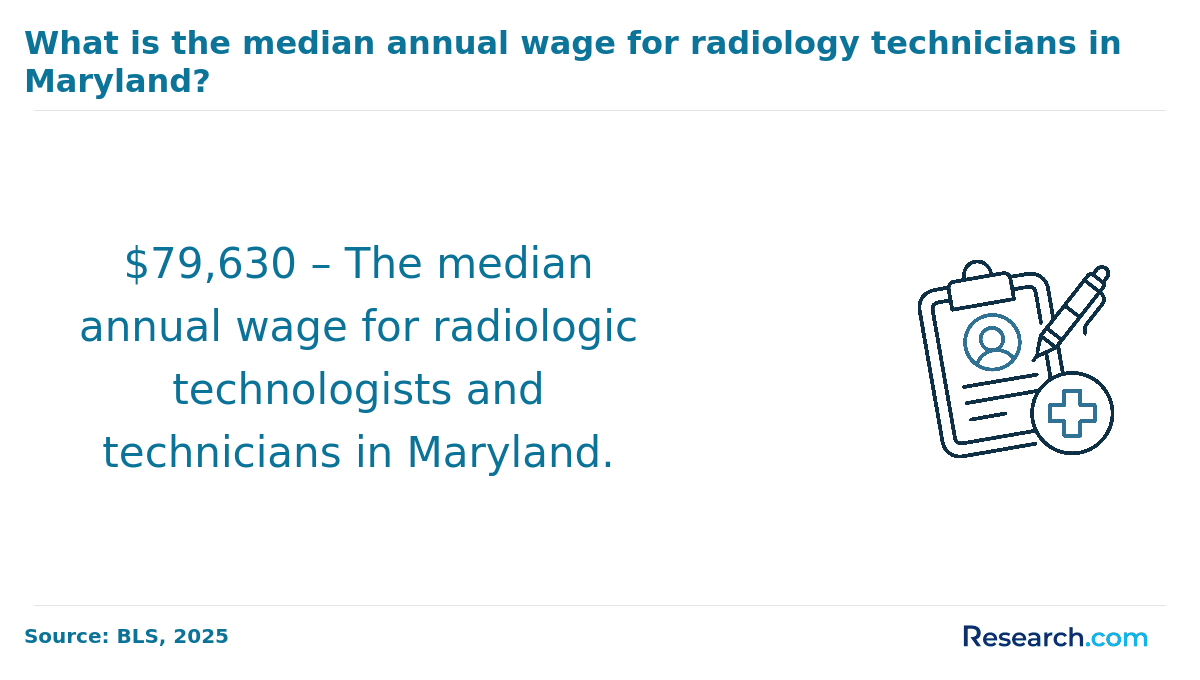
Several Maryland pay figures are commonly cited in career discussions. The article’s data points include an average annual salary around $62,000, a median annual wage around $68,000, and hospital-sector salaries often around or above the state median of $70,000 annually. Treat these as planning estimates rather than guaranteed outcomes, because an individual offer can vary widely.
| Career stage or setting | Salary information cited | What may influence pay |
| Entry-level Maryland radiologic technologist | $50,000 to $55,000 annually | First job, smaller clinic, nonprofit employer, outpatient setting, limited modality experience. |
| Average Maryland radiology technician figure | Around $62,000 annually | Statewide variation, employer type, location, credentials, and experience. |
| Maryland median annual wage figure | Around $68,000 | Broader labor market mix across hospitals, outpatient centers, and other employers. |
| Hospital-sector estimate | Around or above the state median of $70,000 annually | Urban hospital systems, shift differentials, overtime, benefits, and specialized workflow. |
| Advanced hospital or government role | $75,000 to $85,000 | Experience, CT or MRI credentials, high-acuity environment, and larger healthcare systems. |
If you are comparing radiologic technology with other patient-care careers, review related healthcare career college degrees so you understand the education, licensing, and salary trade-offs.
What is the job outlook for radiology technicians in Maryland?
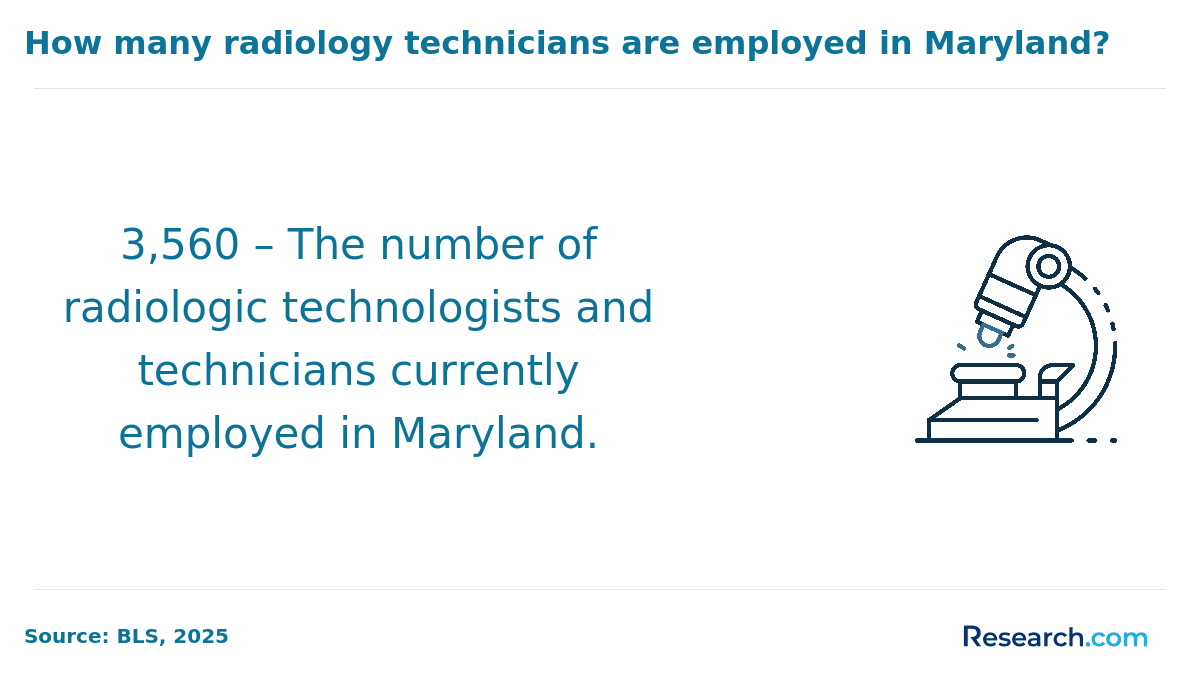
The Maryland outlook is generally positive because diagnostic imaging remains a core part of modern healthcare. The state’s job market is described as growing steadily, with a projected 7% increase in employment through 2030. Demand is supported by hospitals, outpatient imaging centers, aging-patient needs, and continued use of imaging in diagnosis and treatment planning.
Maryland also benefits from its proximity to Baltimore and Washington, D.C., which broadens the range of possible employers. Candidates may find openings in large hospital systems, specialty clinics, outpatient centers, government facilities, and Veterans Affairs medical centers.
Competition still exists, especially for accredited program admission and preferred clinical placements. If you are concerned about admissions strength, compare the easiest radiology programs with a careful eye toward accreditation, licensure outcomes, and clinical training quality.
Which industries provide the best opportunities for radiology technicians?
The best work setting depends on what you value most: pay, stability, schedule predictability, patient mix, specialization, or advancement. Hospitals often provide the broadest clinical exposure and stronger benefits, while outpatient centers may offer more predictable schedules and focused imaging work.
| Work setting | Potential advantages | Possible trade-offs |
| Hospitals and large urban systems | Often around or above the state median of $70,000 annually, broad case variety, benefits, shift differentials, and overtime potential. | May involve nights, weekends, holidays, emergency cases, and physically demanding shifts. |
| Outpatient imaging centers | Exposure to advanced imaging such as MRI and CT, competitive compensation, and often more predictable schedules. | May require faster patient throughput and modality-specific credentials. |
| Government and Veterans Affairs facilities | Strong job stability, benefits, pension plans, loan forgiveness programs, and structured promotion pathways. | Hiring processes may be slower and documentation requirements may be extensive. |
| Nonprofit community health centers | Meaningful community-based care and experience with diverse patient needs. | Base salaries may be lower than those in large hospitals or corporate settings. |
| Corporate healthcare, clinical trials, and product testing | Potential for higher pay, bonuses, stock options, and exposure to innovation. | These positions are less common and may require specialized experience. |
| Mobile imaging and telemedicine-supported services | More flexibility and access to rural or underserved patient populations. | May involve travel, independent workflow, and added responsibility for secure image transfer. |
What are the latest trends and emerging technologies in radiology?
Radiology is becoming more digital, more connected, and more dependent on advanced workflow tools. Maryland technologists entering the field should expect to work with digital imaging systems, electronic medical records, image archiving platforms, and increasingly sophisticated CT and MRI equipment.
Artificial intelligence is also changing the workflow. AI tools may help flag abnormalities, prioritize cases, improve image quality, or support efficiency, but they do not remove the need for skilled technologists. Technicians still need to position patients correctly, follow safety standards, understand when an image is inadequate, and communicate concerns to the care team.
Telemedicine and remote image review are also affecting the profession, especially for rural or underserved areas. Radiology technicians may need stronger digital communication skills, familiarity with secure image-sharing systems, and awareness of privacy obligations under HIPAA. Cybersecurity awareness is becoming part of everyday professionalism because patient images and records are sensitive medical information.
How can collaboration with other healthcare professionals boost your radiology career?
Radiology technicians rarely work in isolation. They coordinate with radiologists, physicians, nurses, medical assistants, emergency department teams, surgeons, and administrative staff. Strong collaboration improves patient flow, reduces repeat imaging, supports safety, and helps technologists become trusted members of the clinical team.
One practical way to grow is to learn how other healthcare roles think about patient care. For example, understanding the responsibilities described in how to become a nurse in Maryland can help radiology technicians communicate more effectively with nursing teams during urgent or complex imaging procedures.
How can radiology technicians maintain a healthy work-life balance in Maryland?
Work-life balance depends heavily on employer type and shift structure. Hospital jobs may provide strong clinical experience and overtime opportunities, but they can also involve nights, weekends, and urgent cases. Outpatient centers may offer more predictable hours, but higher patient volume can still create pressure.
To protect long-term health, radiology technicians should ask about shift rotations, call requirements, staffing levels, ergonomic support, meal breaks, and employee assistance programs before accepting a job. Clear boundaries matter, especially in settings where overtime is common.
It also helps to understand credentialing and renewal expectations early. Reviewing related licensing processes, such as how to get a nursing license in Maryland, can give students a broader view of how healthcare regulation, documentation, and renewal obligations affect professional life.
What challenges should you expect as a radiology technician in Maryland?
The first challenge often appears before the first job: getting into and completing an accredited program. Seats can be limited, and students must manage science coursework, imaging labs, clinical schedules, transportation, and exam preparation.
The second challenge is licensure. Maryland candidates need ARRT certification and state approval, and licensed professionals must keep up with continuing education. These obligations take time and may add costs, so they should be part of your budget from the beginning.
The job itself can also be demanding. Radiology technicians may stand for long periods, assist patients with limited mobility, handle urgent imaging requests, and work with patients who are frightened or in pain. Radiation safety is an ongoing responsibility, not a one-time topic from school.
The labor market is promising, but not every opening pays the same or offers the same schedule. Entry-level roles may pay less than median estimates, and rural positions may differ from urban hospital jobs. If you are comparing radiologic technology with other healthcare pathways, ask, What are some medical degrees I can get online, and then verify whether any online coursework still leads to required clinical training and licensure.
| Common mistake | Why it can hurt you | Better approach |
| Choosing a program without checking accreditation | You may complete coursework that does not support certification or licensure. | Verify accreditation and ARRT exam eligibility before applying. |
| Looking only at tuition | Fees, uniforms, transportation, background checks, immunizations, and exam costs can change the real price. | Ask for the full cost of attendance and clinical requirements. |
| Assuming online coursework is enough | Radiologic technology requires supervised clinical training. | Confirm how labs and clinical rotations are arranged. |
| Ignoring schedule demands | Clinical rotations can conflict with work or family responsibilities. | Ask about day, evening, weekend, and travel expectations. |
| Expecting the highest salary immediately | Higher pay often requires experience, modality credentials, or specific employers. | Build a staged plan: first licensure, then experience, then specialization. |
How can radiology technicians excel in job interviews and secure rewarding positions in Maryland?
A strong interview should show both technical competence and patient-care maturity. Employers want to know that you can follow protocols, communicate with patients, protect safety, document accurately, and stay calm when the schedule changes.
Prepare examples from clinical rotations that show how you handled positioning, patient anxiety, equipment limitations, infection-control expectations, or teamwork with nurses and physicians. Bring attention to your ARRT progress, Maryland licensure status, modality exposure, and comfort with electronic documentation.
Networking can also help. Clinical sites, instructors, professional associations, and healthcare job fairs often lead to early opportunities. If you want a broader healthcare entry point while exploring imaging, compare this path with how to become a medical assistant in Maryland.
What legal and ethical best practices should radiology technicians follow in Maryland?
Maryland radiology technicians must treat licensure, privacy, radiation protection, and informed patient communication as core professional duties. Licensure through the Maryland Board of Physicians is not just an administrative step; it is the state’s way of confirming that technologists meet education, examination, and competency standards.
Patient privacy is also central. HIPAA applies to medical images, patient identifiers, exam notes, and electronic records. Technologists should avoid casual disclosure, secure workstations, verify patient identity, and follow facility policy when sharing images.
Radiation safety is both legal and ethical. The Maryland Department of the Environment enforces radiation control standards that align with the ALARA principle, meaning exposure should be kept “as low as reasonably achievable.” In practice, this means correct positioning, shielding when appropriate, calibrated equipment, and avoiding unnecessary repeat exams.
Ethical practice also includes clear communication. Patients should understand what will happen during the exam, how to cooperate, and when to ask questions. Compassion matters because many imaging patients are worried about a diagnosis, injury, or procedure.
Continuing education supports safe practice as technology changes. Maryland’s biennial license renewal process requires documented credits, and ARRT certification reinforces professional standards and ethical conduct.
The chart below compares salaries across radiology-related roles, including radiology technicians.
What career and professional development opportunities exist for radiology technicians in Maryland?
Radiology technicians can advance by gaining experience, adding modality credentials, moving into higher-acuity settings, or shifting into leadership and education. Common specialization areas include computed tomography, magnetic resonance imaging, mammography, and interventional radiology.
Continuing education is required for license maintenance and is also a smart career strategy. New imaging protocols, safety updates, digital systems, and AI-supported workflows reward technologists who keep learning.
Professional organizations and local colleges can support growth. The MSRT offers resources such as annual conferences, certification review courses, and networking events. Community colleges such as Montgomery College and Anne Arundel Community College may offer advanced coursework or certificate options in radiologic sciences.
Some technologists eventually move into quality assurance, department supervision, clinical education, equipment applications, healthcare administration, or specialized imaging teams. Advancement is rarely automatic, so create a plan that connects your next credential to a specific role or employer need.
| Advancement path | Best for | Decision point |
| CT or MRI certification | Technologists who want higher-level imaging responsibility. | Ask employers which modalities are in demand and whether they support training. |
| Mammography or interventional radiology | Technologists interested in specialized patient populations or procedure-based imaging. | Confirm supervision, credentialing, and clinical volume requirements. |
| Lead technologist or supervisor | Experienced professionals who enjoy workflow management and mentoring. | Develop communication, scheduling, compliance, and conflict-resolution skills. |
| Clinical education | Technologists who like teaching students or training staff. | Build a strong record of safe practice and consider education-focused development. |
| Healthcare administration | Professionals who want broader operational responsibility. | Evaluate whether additional coursework or a degree is needed. |
What financial support options can help fund radiology technician education in Maryland?
Radiology technology students should build a complete funding plan before enrolling. Maryland students may be able to use scholarships, institutional aid, federal and state grants, low-interest student loans, and health science funds offered through community colleges or technical schools.
Apply early because some scholarships and institutional funds have priority deadlines. Also ask each program for a full cost estimate that includes tuition, fees, books, uniforms, health screenings, immunizations, background checks, transportation to clinical sites, certification exam costs, and licensing fees.
If you are still comparing allied health options, review the best medical assistant programs in Maryland to understand how costs, timelines, and patient-care roles differ from radiologic technology training.
How can specializing in ultrasound technology enhance your radiology career in Maryland?
Ultrasound can be a valuable specialization for imaging professionals who want to broaden their diagnostic skill set. Unlike X-ray-based imaging, ultrasound uses real-time sound-wave imaging, which can expand the types of patients and procedures a technologist can support.
Specializing may improve career mobility, especially for professionals who want to work across multiple imaging services. However, ultrasound has its own training expectations, scanning techniques, anatomy focus, and credentialing considerations. Before committing, compare program requirements and clinical demands by reviewing how to become an ultrasound technician in Maryland.
What should you ask working radiology technicians before choosing this career?
Before enrolling, talk with current radiologic technologists, recent graduates, clinical instructors, and hiring managers in Maryland. Firsthand conversations can reveal details that program brochures may not cover, including workload, schedule strain, clinical-site expectations, patient volume, and the difference between hospital and outpatient practice.
Useful questions include:
- What surprised you most during clinical rotations?
- Which skills mattered most in your first year on the job?
- How difficult was the ARRT exam preparation process?
- What schedule should new graduates expect in hospitals, clinics, and outpatient centers?
- Which modality credentials are most valued by Maryland employers?
- What would you ask a program director before enrolling?
Questions to ask before enrolling in a Maryland radiologic technology program
- Is the program accredited and does it support ARRT exam eligibility?
- What percentage of students complete the program and obtain licensure?
- Where are clinical rotations located, and can students be assigned far from home?
- Are evening, weekend, or summer clinical hours required?
- What costs are not included in advertised tuition?
- Does the program offer help with exam preparation, job placement, and resume development?
- Can credits transfer if you later pursue a bachelor’s degree or another healthcare credential?
Frequently asked questions about becoming a radiology technician in Maryland
How fast can you become a radiology technician in Maryland?
The common pathway takes around two years because most candidates complete an accredited associate-level radiologic technology program before taking the ARRT exam and applying for Maryland licensure. Accelerated options may be shorter, but only consider them if they meet certification and licensing requirements.
Which radiology technician roles tend to pay more?
Higher earnings are often associated with experience, advanced imaging credentials, large hospital systems, government healthcare facilities, and modalities such as CT or MRI. In Maryland, advanced roles in large public hospitals or government healthcare facilities can command salaries between $75,000 and $85,000.
What is the fastest path to becoming a radiology technician?
The fastest practical path is usually an accredited program designed to prepare students efficiently for ARRT certification and state licensure. Speed should not outweigh accreditation, clinical training quality, or licensure eligibility.
What major is best for a future radiology technician?
Radiologic technology is the most direct major or program of study for this career. Students who begin in another health science field should confirm whether credits transfer and whether the new path still meets ARRT and Maryland licensure expectations.
Related Articles for Nearby States
- 2027 How to Become a Radiology Technician in Virginia
- 2027 How to Become a Radiology Technician in West Virginia
- 2027 How to Become a Radiology Technician in Pennsylvania
- 2027 How to Become a Radiology Technician in Delaware
- 2027 How to Become a Radiology Technician in New Jersey
- 2027 How to Become a Radiology Technician in New York
- 2027 How to Become a Radiology Technician in Ohio
- 2027 How to Become a Radiology Technician in North Carolina
- 2027 How to Become a Radiology Technician in Kentucky
- 2027 How to Become a Radiology Technician in Connecticut
References:
- How Much Do Radiology Technologists Make? | All Allied Health Schools https://www.allalliedhealthschools.com/radiology-technician/salary/
- How Much Money Radiology Techs Make In Every State Of 2024 https://www.forbes.com/sites/andrewdepietro/2024/09/17/how-much-money-radiology-techs-make-in-every-state-of-2024/
- Occupational Employment and Wage Statistics (OEWS) Tables : U.S. Bureau of Labor Statistics https://www.bls.gov/oes/current/oes292034.htmForbes salary reference
- Rad Tech salary range in the US by state and modality https://www.medical-professionals.com/en/rad-tech-salary-range-in-the-us-by-state/
- Radiologic Technologists: Highest Salaries by State https://www.hctravelnursing.com/blog/highest-paying-states-for-radiologic-technologists
- Radiology Tech Salary by State | 2025 https://nurse.org/education/radiology-tech-salary/
- Nurse.org radiology tech salary reference The Highest-Paying Careers in the Medical Imaging Industry | Regis College https://www.regiscollege.edu/blog/medical-imaging/highest-paying-careers-in-medical-imaging
- Top 10 radiology tech jobs and who’s hiring | Handshake https://joinhandshake.com/blog/students/radiology-tech-jobs/
- Handshake radiology tech jobs reference Top States for Medical Imaging Professionals: Where Salaries Shine https://rademploy.com/blog/details/Top-States-for-Medical-Imaging-Professionals-Where-Salaries-Shine
- Top-5 Highest Paying States for Radiologic Technologist | AMN Healthcare https://www.amnhealthcare.com/blog/allied/travel/the-top-5-highest-paying-states-for-radiologic-technologists/
Key Insights
- The safest Maryland pathway is accredited radiologic technology education, ARRT certification, and licensure through the Maryland Board of Physicians.
- Program choice matters. Verify accreditation, clinical placements, ARRT eligibility, total costs, and schedule requirements before enrolling.
- Maryland salary estimates vary by source and setting, with cited figures including around $62,000, around $68,000, around or above $70,000 in hospital settings, and $75,000 to $85,000 for some advanced hospital or government roles.
- The job market is described as steadily growing, with a projected 7% increase in employment through 2030, but preferred roles can still be competitive.
- Hospitals, outpatient imaging centers, government facilities, and specialized modalities offer different trade-offs in pay, stability, schedule, and advancement.
- Technology is changing the job, but AI and digital imaging tools increase the need for well-trained technologists rather than replacing the need for patient positioning, safety judgment, and clinical communication.
- The biggest avoidable mistake is choosing the fastest or cheapest program without confirming that it leads to certification, licensure, and real clinical readiness.
Other Things You Should Know About Becoming a Radiology Technician in Maryland
In Maryland, radiology technicians who perform radiography must hold a state license from the Maryland Board of Physicians and ARRT certification in radiography. Applicants complete an approved education program, pass the ARRT exam, and meet Maryland’s application and background requirements before practicing.
In 2026, becoming a radiology technician in Maryland typically takes about two years to complete an accredited associate degree program. Following education, candidates must pass the American Registry of Radiologic Technologists (ARRT) certification exam and meet state licensing requirements, which may take additional weeks to months.


