
2027 How to Become a Radiology Technician in Florida

Co-Founder and Chief Data Scientist
Becoming a radiology technician in Florida is a practical route into healthcare for people who want patient-facing work, technical responsibility, and a shorter training path than medical school. Florida’s healthcare system uses radiologic technologists in hospitals, outpatient imaging centers, specialty practices, and government facilities, and the state has a large credentialed workforce: nearly 27,000 imaging professionals hold American Registry of Radiologic Technologists (ARRT) certifications across specialties.
A Florida radiology technician, often called a radiologic technologist or radiographer, performs diagnostic imaging exams, positions patients, operates imaging equipment, follows radiation safety rules, and works with physicians and radiologists who interpret the images. The role requires formal education, state licensure, clinical training, and strong judgment because image quality and patient safety both depend on the technologist’s accuracy.
This guide explains how to become a radiology technician in Florida in 2026, including education options, licensing steps, ARRT certification, salary expectations, job outlook, work settings, technology trends, and common mistakes to avoid before enrolling in a program.
Quick Answer: How to Become a Radiology Technician in Florida
- Complete an accredited radiologic technology or radiography program, commonly an Associate of Applied Science degree that takes about two years.
- Apply for licensure through the Florida Department of Health and meet state requirements, including age, moral character, and background standards.
- Pass the American Registry of Radiologic Technologists (ARRT) certification exam if required for your pathway.
- Maintain your license and credentials through continuing education, including Florida-required coursework and ARRT continuing education requirements.
- Consider advanced credentials in CT, MRI, mammography, nuclear medicine, or ultrasound if you want more specialized roles or broader employment options.
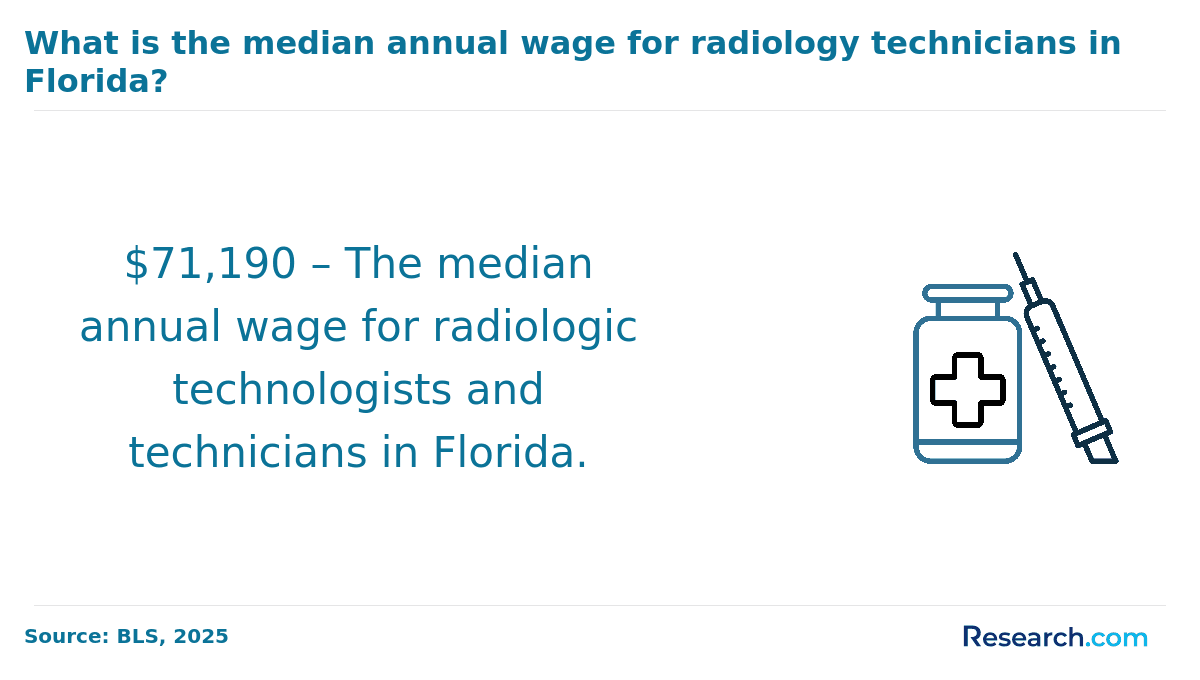
Florida’s radiology technician labor market is steady rather than explosive. Florida Commerce projects 4% job growth from 2024 to 2032, with many openings tied to replacement needs as workers leave or transfer occupations. Salaries vary by employer, city, specialty, and experience, but the average annual salary in Florida is around $71,000.
- What education do you need to become a radiology technician in Florida?
- What skills do Florida radiology technicians need?
- What licensing and certification requirements apply in Florida?
- How much do radiology technicians earn in Florida?
- What is the job outlook for radiology technicians in Florida?
- Where do radiology technicians find the best opportunities?
- How should you choose a radiologic technology program?
- Can radiology technicians transition into nursing in Florida?
- What technology trends are changing radiology careers?
- What challenges should Florida radiology technicians expect?
- What related allied health paths can strengthen a radiology career?
- What legal and ethical practices matter most in Florida?
- How can radiology technicians advance professionally?
- How can radiology technicians protect work-life balance and reduce burnout?
- Is ultrasound specialization a good option for Florida radiology technicians?
What education do you need to become a radiology technician in Florida?
Florida radiology technicians must complete a formal radiologic technology or radiography education program before they can pursue licensure. The usual entry-level credential is an Associate of Applied Science degree, which generally takes two years and combines classroom learning with supervised clinical rotations.
Students study anatomy, patient positioning, radiation physics, image production, radiation protection, pathology, medical terminology, and patient care. Clinical rotations are especially important because they teach students how to perform exams safely with real patients under professional supervision.
Some students choose a bachelor’s degree in radiologic sciences instead of, or after, an associate degree. A bachelor’s path may make sense for technologists who want broader training, leadership roles, teaching opportunities, advanced imaging specialization, or long-term mobility within healthcare administration.
Program accreditation matters. Students should confirm that a radiography program is accredited by the Joint Review Committee on Education in Radiologic Technology (JRCERT), because accreditation signals that the curriculum, clinical experience, faculty qualifications, and student outcomes meet recognized educational standards.
| Education option | Best for | Typical value | Important caution |
| Associate of Applied Science in Radiography | Students who want the standard entry route into radiologic technology | Usually the fastest practical pathway to eligibility for licensure and entry-level imaging roles | Confirm accreditation, clinical placements, ARRT exam preparation, and Florida licensure alignment before enrolling |
| Bachelor’s degree in Radiologic Sciences | Students seeking broader career options, leadership potential, or advanced specialization | Can support advancement into supervision, education, administration, or specialized imaging | May cost more and take longer than necessary for a first radiography job |
| Post-primary or advanced imaging certificate | Licensed technologists who want to add CT, MRI, mammography, nuclear medicine, or another modality | Helps experienced technologists qualify for more specialized roles | Requirements vary by modality, employer, and credentialing body |
Radiology technician training is very different from the physician pathway. Becoming a radiologist requires medical school, residency, and physician licensure. Radiologists interpret imaging studies and diagnose disease, while radiology technicians perform the imaging exams and ensure that images are captured safely and correctly.
For students who want a healthcare career without the long physician training timeline, radiologic technology can be a more accessible option. However, it is still a regulated clinical profession, not a quick certificate job.
What skills do Florida radiology technicians need?
Radiology technicians need a blend of technical, clinical, communication, and safety skills. The job is not limited to pressing buttons on imaging equipment. Technologists must evaluate patient condition, choose correct positioning, reduce unnecessary radiation exposure, document procedures accurately, and respond calmly when patients are anxious, injured, or in pain.
Technical skill is the foundation. Florida radiologic technologists must understand imaging equipment, anatomy, exposure factors, image quality, radiation physics, and digital imaging systems. As imaging departments use more advanced platforms, technologists also need comfort with electronic health records, image archiving systems, and AI-supported workflow tools.
Patient communication is just as important. Many patients arrive frightened, uncomfortable, or unable to move easily. A strong technologist explains the procedure clearly, protects patient dignity, verifies identity, checks pregnancy or safety concerns when relevant, and helps the patient cooperate without feeling rushed.
Attention to detail affects both image quality and safety. Poor positioning or documentation can lead to repeat imaging, delayed diagnosis, or unnecessary radiation exposure. The best technologists develop repeatable routines while staying alert to each patient’s unique needs.
| Skill area | Why it matters in radiology | How to build it |
| Patient positioning | Accurate positioning helps produce diagnostic-quality images and reduces repeat exams | Practice during clinical rotations and ask supervisors for feedback on technique |
| Radiation safety | Technologists must protect patients, coworkers, and themselves from unnecessary exposure | Master ALARA principles, shielding practices, exposure settings, and facility protocols |
| Communication | Clear explanations improve patient cooperation and reduce anxiety | Use plain language, confirm understanding, and adapt communication to age, culture, and condition |
| Digital imaging workflow | Modern departments rely on digital records, image storage, and secure communication | Learn equipment software, electronic health record workflows, and image quality review processes |
| Critical thinking | Unexpected patient conditions, trauma cases, or equipment issues require fast judgment | Reflect on clinical cases, study protocols, and learn when to escalate concerns |
Adaptability will become more valuable as radiology departments adopt AI-assisted image review, 3D imaging, remote consultation tools, and integrated digital records. These technologies do not remove the need for technologists; they change the workflow and raise expectations for digital competence.
This chart displays the terminal degrees earned by radiologic technologists and technicians.
What licensing and certification requirements apply in Florida?
Florida regulates radiologic technology, so graduates must meet state licensing requirements before practicing. The typical route begins with completing a JRCERT-accredited educational program, applying to the Florida Department of Health, meeting eligibility standards, and passing the American Registry of Radiologic Technologists (ARRT) certification exam.
Applicants must be at least 18 years old, demonstrate good moral character, and have a clean criminal record. Because healthcare licensing rules can affect eligibility, students with prior legal or disciplinary issues should contact the appropriate licensing authority before investing in a program.
Florida also offers an endorsement route for qualified radiologic technologists from other states. Out-of-state applicants may be able to work in Florida if their active license or certification is verified by the Department and they meet the state’s requirements.
As of May 2025, Florida has 24,172 technicians with a radiography certification. That large credentialed workforce means licensure and certification are not optional extras; they are baseline expectations for legal practice and competitive employment.
| Step | What to do | Why it matters |
| 1. Choose an accredited program | Verify JRCERT accreditation and Florida licensure preparation | Accreditation supports eligibility for certification, licensure, and employer acceptance |
| 2. Complete classroom and clinical training | Finish required courses and supervised clinical competencies | Clinical experience proves you can perform imaging procedures safely |
| 3. Apply through the Florida Department of Health | Submit the required application and documentation | Florida licensure is required for legal practice |
| 4. Pass the ARRT exam | Prepare for and complete the certification exam | ARRT certification is widely expected by employers and supports state licensing |
| 5. Maintain credentials | Complete continuing education and renewal requirements | Ongoing compliance keeps your license and professional standing active |
Students interested in becoming an x ray technician should understand that X-ray training, radiography certification, and state licensing are closely connected. Before enrolling, ask the program exactly which Florida license or certification pathway it prepares graduates to pursue.
How much do radiology technicians earn in Florida?
Radiology technician pay in Florida depends on location, employer, shift, experience, modality, and credentials. The average annual salary is around $71,000, which is below the national average for the profession of $79,760. The typical Florida salary range for the profession is $50,080 to $92,910.
Entry-level radiology technician salaries in Florida typically range from $45,000 to $52,000 annually. New graduates often begin in hospitals, outpatient centers, physician practices, or smaller clinics, where they build speed, confidence, and clinical judgment.
Experienced technologists with advanced certifications can earn more. Advanced radiology technicians in Florida may earn between $80,000 and $90,000, especially in private corporations, specialized diagnostic imaging centers, or roles requiring high-demand modalities.
Government healthcare facilities, including state and federal agencies, offer salaries ranging from $55,000 to $75,000 and may also provide strong benefits or pension plans. Public hospitals and nonprofit organizations may offer stable work and training opportunities, though starting pay can be lower than in some private-sector settings.
| Career stage or setting | Florida salary information stated | What can affect pay |
| Average Florida radiology technician | Around $71,000 yearly | Region, employer type, shift schedule, and modality |
| National average for the profession | $79,760 | State labor market, cost of living, and specialty mix |
| Typical Florida range | $50,080 to $92,910 | Experience, credentials, and workplace setting |
| Entry-level roles | $45,000 to $52,000 annually | Clinical readiness, shift availability, and local demand |
| Advanced radiology technicians | $80,000 to $90,000 | Specialization, employer, and advanced certification |
| Government healthcare facilities | $55,000 to $75,000 | Agency, seniority, benefits, and role requirements |
Radiologic technology is one of several hands-on healthcare and technical paths. If you are comparing this route with other skilled occupations, reviewing broader trade careers can help you weigh training length, physical demands, licensing, and long-term advancement.
What is the job outlook for radiology technicians in Florida?
Florida’s radiologic technologist employment outlook is steady, with openings driven more by workforce replacement than rapid expansion. Florida Commerce projects 4% job growth from 2024 to 2032 for radiologic technologists and technicians. That projection equals about 7,342 total openings over the decade.
The details matter. Of those openings, 3,970 are tied to exits and 2,810 are tied to transfers, while 562 are attributed to occupational growth. In practical terms, most opportunities will come from retirements, career changes, and workers moving into other roles, not from a sudden surge in newly created positions.
Florida’s aging population and continued use of diagnostic imaging support long-term demand in hospitals, outpatient imaging centers, physician groups, and specialty clinics. However, students should not assume that simply graduating will guarantee a preferred job. Clinical performance, ARRT preparation, flexibility with shifts, and willingness to work in high-need locations can all affect employability.
For students who need flexibility, accredited radiology tech programs online may be worth exploring, but radiography is not fully online in the same way as some academic degrees. Any legitimate program must include in-person clinical training, and students should verify that online coursework still leads to Florida licensure eligibility.
Where do radiology technicians find the best opportunities?
Radiology technicians in Florida work across several healthcare and healthcare-adjacent settings. The best fit depends on whether you value pay, schedule stability, specialization, benefits, patient variety, or advancement.
Corporate and enterprise employers may offer some of the strongest compensation and structured advancement opportunities, especially when they operate specialized diagnostic imaging services. Hospitals remain one of the most reliable employment settings because they provide broad case exposure, full-time roles, continuing education access, and pathways into CT, MRI, emergency imaging, and supervisory work.
Outpatient imaging centers and diagnostic laboratories can appeal to technologists who want more predictable hours. Government and military medical facilities may provide competitive pay, job security, and benefits. Academic institutions can be attractive for technologists interested in teaching, research support, or long-term stability.
| Work setting | Best fit for | Trade-offs to consider |
| Hospitals | Technologists who want varied cases, emergency experience, and specialization pathways | May require nights, weekends, holidays, or high-pressure trauma work |
| Outpatient imaging centers | Professionals who prefer more predictable schedules and focused imaging workflows | May offer less emergency experience or narrower case variety |
| Corporate or enterprise imaging providers | Technologists seeking competitive pay and structured advancement | Productivity expectations can be high |
| Government or military medical facilities | Workers who value benefits, stability, and public-sector employment | Hiring processes may take longer and requirements may be strict |
| Academic institutions | Technologists interested in instruction, research environments, or student supervision | Pay may vary depending on location and institution |
| Nonprofit organizations | Professionals motivated by community health and service to underserved populations | Compensation may be lower than some private-sector roles |
The right industry is not always the one with the highest starting salary. A new graduate may benefit more from a strong hospital training environment, while an experienced technologist may prioritize outpatient hours, advanced modality pay, or leadership opportunities.
How should you choose a radiologic technology program?
Choosing a program is one of the most important decisions in this career path because it affects licensure eligibility, clinical experience, exam preparation, cost, and employability. Top Florida institutions offering radiologic technology programs include Gulf Coast State College, Keiser University, and Rasmussen University, which are known for accredited curricula. Still, students should evaluate each program directly instead of relying only on name recognition.
Start with accreditation and licensing alignment. Then compare clinical placement quality, ARRT exam preparation, faculty experience, graduation support, schedule flexibility, and total cost. Tuition alone does not show the full price; students may also need to budget for fees, uniforms, background checks, immunizations, transportation to clinical sites, books, and exam-related costs.
| Question to ask before enrolling | Why it matters |
| Is the radiography program JRCERT-accredited? | Accreditation can affect certification eligibility, licensure, and employer confidence |
| Does the program prepare graduates for Florida licensure? | Not every program automatically meets every state requirement |
| Where are clinical rotations located? | Clinical sites affect commute time, schedule feasibility, and hands-on experience |
| What support is provided for ARRT exam preparation? | Strong exam preparation can reduce delays between graduation and employment |
| What is the full cost beyond tuition? | Fees, supplies, transportation, and clinical requirements can change affordability |
| Can credits transfer into a bachelor’s degree later? | Transfer options matter if you plan to pursue leadership or advanced roles |
Students comparing allied health options can also review the best medical assistant programs in Florida to understand how program length, patient care duties, cost, and career outcomes differ across healthcare training paths.
Can radiology technicians transition into nursing in Florida?
Yes, transitioning from radiologic technology to nursing can be viable, but it is not an automatic lateral move. Nursing has different legal responsibilities, clinical scope, coursework, and licensure requirements. Radiology technicians may bring useful experience in patient communication, hospital workflow, infection control, and clinical documentation, but they still need nursing-specific education and must meet Florida nursing requirements.
This path may make sense for radiology technicians who want broader patient care responsibility, more bedside involvement, or long-term advancement into nursing leadership, advanced practice, or specialty care. It may not be ideal for technologists who prefer equipment-based diagnostic work, shorter patient interactions, or imaging specialization.
Before changing paths, compare time in school, tuition, clinical requirements, work schedule, licensure exams, and salary goals. For a full overview of the nursing route, see the guide on how to become a nurse in Florida.
What technology trends are changing radiology careers?
Radiologic technology is becoming more digital, data-driven, and integrated with broader healthcare systems. Florida technologists entering the field should expect to work with digital imaging platforms, electronic health records, secure image-sharing tools, and increasingly sophisticated equipment.
Artificial intelligence is one of the major developments affecting imaging departments. AI-supported tools may help prioritize urgent cases, flag possible abnormalities, assist quality control, and streamline workflow. These tools do not eliminate the need for technologists, but they do require professionals who understand equipment operation, image quality, patient positioning, and how AI fits into clinical protocols.
Telehealth and remote radiology workflows are also important, especially for rural or underserved areas. Images may be captured in one location and interpreted elsewhere, which makes accurate documentation, secure transmission, and protocol compliance essential.
Educational programs are gradually incorporating more digital workflow content, but students should also take responsibility for lifelong learning. Technologists who stay current with AI-assisted imaging, 3D imaging, digital records, and advanced modalities may be better positioned for specialized roles.
This chart shows the top states employing radiologic technologists and technicians.
What challenges should Florida radiology technicians expect?
Radiologic technology can be rewarding, but students should understand the hard parts before committing. The first challenge is the regulated entry process. Florida licensing standards protect patients, but they also require time, documentation, examination preparation, and ongoing compliance.
Hiring can also be selective. According to a Florida Hospital Association survey, many employers report difficulty filling radiologic technologist positions, often taking more than 60 days to hire a candidate. That suggests demand for qualified workers, but it also shows that employers may be looking for candidates with the right credentials, clinical readiness, and experience.
The work can be physically demanding. Technologists stand for long periods, move equipment, assist patients with limited mobility, and position people who may be injured or in pain. Over time, poor ergonomics can contribute to fatigue or musculoskeletal strain.
Radiation safety adds another layer of responsibility. Technologists must follow procedures carefully, document correctly, and reduce avoidable exposure. Mistakes can affect patients, coworkers, and the technologist’s professional standing.
| Common challenge | What it looks like | How to prepare |
| Licensure pressure | Applications, exams, background requirements, and renewal obligations | Choose an accredited program and track deadlines early |
| Physical strain | Standing, lifting, patient transfers, and repetitive positioning | Use proper body mechanics and ask for help when needed |
| Patient anxiety or pain | Patients may be frightened, confused, injured, or unable to cooperate | Practice calm explanations and patient-centered communication |
| Shift demands | Hospitals may require evenings, weekends, holidays, or emergency coverage | Ask employers about scheduling expectations before accepting a role |
| Technology changes | New software, AI tools, and imaging systems can alter workflows | Stay engaged in continuing education and modality training |
If you are comparing imaging careers, it helps to understand the difference between radiographer vs radiologist degree programs. The technologist route is shorter than the physician route, but it still carries serious clinical responsibility.
What related allied health paths can strengthen a radiology career?
Radiology technicians can improve their career flexibility by building adjacent allied health skills. Patient care, scheduling, medical office workflow, electronic records, and care coordination can all support better performance in imaging departments, especially in outpatient and multidisciplinary settings.
Medical assisting is one related path that can help students understand front-office and back-office clinical operations, although it leads to a different role than radiologic technology. Learning more about how to become a medical assistant in Florida can help prospective students compare scope of practice, training length, and patient care responsibilities before choosing a healthcare program.
Other useful complementary areas include phlebotomy, patient navigation, healthcare administration, informatics, and advanced imaging modalities. The best option depends on whether your goal is higher pay, better schedule control, leadership, or broader clinical responsibility.
What legal and ethical practices matter most in Florida?
Florida radiology technicians must follow state licensing rules, facility policies, federal privacy laws, and professional ethics. Compliance is not just paperwork; it protects patients and helps preserve trust in diagnostic imaging.
Continuing education is part of professional responsibility. Florida requires radiology technicians to complete 12 hours of general continuing education and a one-hour HIV-AIDS course approved by the Florida Department of Health. Technologists must also complete the CE requirements mandated by the ARRT.
Privacy is another core obligation. Radiology technicians handle sensitive medical information and must comply with HIPAA when accessing, documenting, transmitting, or discussing patient data. Digital imaging systems make privacy practices especially important because images and records can be shared quickly across departments and facilities.
Radiation ethics center on the ALARA principle, meaning exposure should be kept As Low As Reasonably Achievable. Technologists should use appropriate protocols, avoid unnecessary repeats, verify orders, and communicate concerns if an exam seems inconsistent with patient safety or facility policy.
Ethical communication also matters. Patients deserve clear explanations, respectful treatment, privacy during positioning, and honest answers within the technologist’s scope. Technologists should not interpret images or provide diagnoses unless authorized to do so; that responsibility belongs to qualified physicians such as radiologists.
How can radiology technicians advance professionally?
Florida radiology technicians can advance by gaining experience, earning additional credentials, moving into advanced modalities, pursuing a bachelor’s degree, or stepping into supervision, education, or administration. Common specialization areas include magnetic resonance imaging (MRI), computed tomography (CT), mammography, and nuclear medicine.
Advanced certifications can make a technologist more competitive, especially in facilities that need multi-skilled imaging staff. However, specialization should be strategic. Choose a modality based on local employer demand, clinical interest, schedule preferences, and the credential requirements for that field.
Professional organizations such as the Florida Society of Radiologic Technologists (FSRT) can support networking, workshops, seminars, advocacy, and continuing education. Large healthcare employers in Miami, Tampa, Orlando, and other urban areas may also offer internal training, mentorship, and leadership development.
| Advancement path | Who it fits | Potential benefit |
| CT or MRI specialization | Technologists who want advanced imaging work and stronger modality expertise | Can improve competitiveness for specialized imaging roles |
| Mammography | Technologists interested in breast imaging and preventive care | Supports work in women’s health and dedicated imaging centers |
| Nuclear medicine | Professionals interested in functional imaging and specialized diagnostic procedures | Can expand practice into a more specialized area of imaging |
| Bachelor’s degree completion | Technologists aiming for leadership, teaching, or administrative roles | Can support long-term advancement beyond staff technologist positions |
| Supervision or management | Experienced technologists with communication and workflow skills | Moves the career toward staffing, quality, operations, and department leadership |
| Education or clinical instruction | Technologists who enjoy mentoring students | Creates opportunities in academic programs or clinical training roles |
Career growth is usually gradual. New graduates should first focus on strong clinical habits, patient care, safety, and exam quality. Once those foundations are solid, advanced credentials and leadership pathways become more realistic.
How can radiology technicians protect work-life balance and reduce burnout?
Radiology technicians in Florida often work in fast-moving environments where patient volume, physical demands, and shift schedules can create stress. Burnout prevention starts with choosing a setting that matches your tolerance for nights, weekends, trauma cases, and productivity expectations.
Practical habits matter. Use proper body mechanics, take scheduled breaks when possible, document accurately, ask for help with difficult transfers, and speak up when workload or safety conditions become unsustainable. Peer support and employee wellness programs can also help, especially in hospital departments with high patient volume.
Work-life balance may look different by employer. Hospitals may offer strong training and benefits but more variable shifts. Outpatient centers may provide more predictable hours but can have tight scheduling and high exam volume. Government and academic settings may appeal to workers who value stability, though hiring requirements can be more complex.
Some professionals eventually move into adjacent healthcare roles for different schedules or broader clinical responsibilities. If nursing is one option you are considering, review how to get a nursing license in Florida before making a career change.
Is ultrasound specialization a good option for Florida radiology technicians?
Ultrasound can be a strong specialization for radiology technicians who want to expand into another diagnostic imaging area. Sonography is used in obstetric, cardiovascular, emergency, abdominal, and specialty care settings, and it relies on a different imaging method than X-ray-based radiography.
This path may appeal to technologists who enjoy patient interaction, real-time imaging, and anatomy-focused scanning. It can also broaden employment options beyond traditional radiography roles. However, ultrasound requires dedicated training and certification preparation; it should not be treated as a simple add-on skill.
Before choosing this route, compare program requirements, clinical hours, certification expectations, and local job postings. For a Florida-specific overview, see this guide on how to become an ultrasound technician in Florida.
What do radiology technicians say about their careers in Florida?
- "My radiography training at the College of Central Florida gave me the technical base I needed, but the hospital environment taught me how much judgment the job requires. Every patient is different, and in Florida you work with people from many backgrounds and age groups. The work can be busy, but it feels meaningful because imaging often plays a major role in diagnosis and treatment." - Matthew
- "Keiser University helped me understand both the science and the patient care side of radiography. Once I started working in a local healthcare facility, I realized how important teamwork is. A good image depends on communication, positioning, equipment knowledge, and attention to detail. Florida’s healthcare market has given me room to keep learning and think about future specialization." - Irvin
- "St. Petersburg College prepared me well for the transition into a community hospital. The job challenges you physically and mentally, especially when patients are in pain or the department is busy. At the same time, I have become more confident, more compassionate, and more aware of how important imaging is to patient care." - Dominic
Common mistakes to avoid before becoming a radiology technician in Florida
| Mistake | Why it can hurt you | Better approach |
| Choosing a program without checking accreditation | You may face problems with certification, licensure, or employer acceptance | Verify JRCERT accreditation and Florida licensure alignment before applying |
| Looking only at tuition | Clinical travel, fees, supplies, and exam costs can change the real price | Ask for a full cost breakdown and compare total program cost |
| Assuming online means fully remote | Radiography requires hands-on clinical training | Confirm where clinical rotations occur and whether the schedule fits your life |
| Ignoring state licensure rules | Graduating does not automatically authorize practice | Review Florida Department of Health requirements early |
| Assuming salary outcomes are guaranteed | Pay varies by city, employer, credentials, and experience | Check local job postings and compare requirements for your target area |
| Waiting too long to plan specialization | Advanced roles may require additional credentials and experience | Ask clinical supervisors which modalities are in demand locally |
Key Insights
- The standard Florida pathway is an accredited radiography program, state licensure through the Florida Department of Health, and ARRT certification.
- An associate degree is the common entry route, while a bachelor’s degree or advanced modality credentials can support leadership, teaching, or specialization.
- Florida radiology technicians earn around $71,000 on average, with a stated range of $50,080 to $92,910 and higher potential for experienced or specialized technologists.
- Florida Commerce projects 4% job growth from 2024 to 2032, with most openings coming from exits and transfers rather than new job creation.
- Hospitals offer broad experience and advancement potential, while outpatient centers may provide more predictable schedules. The best setting depends on your goals, not only salary.
- AI-assisted imaging, digital records, remote radiology workflows, and advanced modalities are reshaping the profession, making technology fluency increasingly important.
- Before enrolling, verify accreditation, clinical placements, licensure preparation, ARRT exam support, total cost, and transfer options.
- Radiologic technology is a strong healthcare path for students who want hands-on patient care and diagnostic work, but it requires physical stamina, precision, ethical judgment, and lifelong learning.
Related Articles for Nearby States
- 2027 How to Become a Radiology Technician in Georgia
- 2027 How to Become a Radiology Technician in Alabama
- 2027 How to Become a Radiology Technician in South Carolina
- 2027 How to Become a Radiology Technician in Mississippi
- 2027 How to Become a Radiology Technician in Tennessee
- 2027 How to Become a Radiology Technician in North Carolina
- 2027 How to Become a Radiology Technician in Louisiana
- 2027 How to Become a Radiology Technician in Kentucky
- 2027 How to Become a Radiology Technician in Arkansas
- 2027 How to Become a Radiology Technician in Virginia
References:
- American Registry of Radiologic Technologists. (n.d.). Learn About the Profession. Retrieved May 16, 2025, from https://www.arrt.org/pages/about-the-profession/learn-about-the-profession
- American Registry of Radiologic Technologists. (2025, May). Credential Statistics by Location and Discipline. Retrieved May 16, 2025, from https://www.arrt.org/pages/credential-statistics-census
- American Society of Radiologic Technologists. (2024). Radiologic Technologist Wage and Salary Survey 2024. https://www.asrt.org/main/news-publications/research/wage-and-salary-surveys
- American Society of Radiologic Technologists. (2024). White Paper From the 2024 Consensus Committee on the Future of Medical Imaging and Radiation Therapy. https://www.asrt.org/docs/default-source/research/whitepapers/2024-consensus-committee-on-the-future-of-medical-imaging-and-radiation-therapy.pdf
- Florida Commerce. (2024). Employment Projections Data. Retrieved May 16, 2025, from https://floridajobs.org/economic-data/employment-projections
- Florida Department of Health. (n.d.). Radiologic Technology: Licensing. Retrieved May 16, 2025, from https://www.floridahealth.gov/licensing-and-regulation/radiologic-technology/licensing/index.html
- Florida Hospital Association. (2024). 2024 Allied Health Vacancy And Turnover Rate. https://fha.org/common/Uploaded%20files/FHA/Workforce/2024%20Allied%20Health%20-%20Vacancy%20and%20Turnover%20Infographic.pdf
- U.S. Bureau of Labor Statistics. (2025, May 15). Occupational Employment and Wage Statistics - Florida, May 2024. Occupational Employment and Wage Statistics Query System. Retrieved May 16, 2025, from https://data.bls.gov/oes/#/area/1200000
- ZipRecruiter. (2025, May 9). Cardiovascular Technologist Salary in Florida. Retrieved May 16, 2025, from https://www.ziprecruiter.com/Salaries/Cardiovascular-Technologist-Salary--in-Florida#Yearly
Other Things You Should Know About Becoming a Radiology Technician in Florida
The Florida Department of Health, through the Florida Radiologic Technologists Program, licenses radiologic technologists. Applicants must meet state education standards, pass an approved exam such as the ARRT registry exam, and submit the required application and fee before practicing.
In 2027, Florida radiology technicians must complete 12 hours of continuing education every two years to maintain certification. These hours must include courses in radiological safety and ethics, fulfilling requirements set by the Florida Department of Health's licensing standards.
In 2027, aspiring radiology technicians in Florida must complete an accredited associate degree in radiologic technology. This program typically includes classroom instruction in anatomy and imaging, as well as clinical experience. Accreditation by the Joint Review Committee on Education in Radiologic Technology (JRCERT) is essential for certification eligibility.


