2027 ABA Certification Explained: RBT, BCaBA, BCBA, BCBA-D

Co-Founder and Chief Data Scientist
Choosing an ABA certification is not just a credential decision; it determines what services you can provide, how much independence you may have, who you can supervise, and which jobs you can realistically pursue. Applied Behavior Analysis (ABA) is used in education, healthcare, autism services, behavioral health, developmental disability support, and other settings where behavior change is measured and guided by evidence-based methods.
This guide is for students, career changers, RBTs planning their next step, educators, counselors, and psychology graduates who want to understand the ABA certification ladder. You will learn what each Behavior Analyst Certification Board (BACB) credential means, how long each path can take, what education and supervised experience are required, how exam and renewal costs compare, and how to decide which certification fits your career goals.
Quick Answer: Which ABA Certification Should You Choose?
If you want the fastest entry into ABA work, the Registered Behavior Technician (RBT) credential is the most direct starting point. If you have or are earning a bachelor’s degree and want more responsibility while still working under supervision, the BCaBA may fit. If you want to assess clients, design behavior plans, supervise others, and qualify for many independent or leadership roles, the BCBA is the core professional credential. The BCBA-D is not a separate scope of practice beyond the BCBA, but it signals doctoral-level training for professionals interested in research, teaching, clinical leadership, or advanced interdisciplinary work.
Key Things You Should Know About ABA Certification
- The BACB certification ladder has four main credentials: RBT for entry-level direct service, BCaBA for bachelor’s-level assistant behavior analysts, BCBA for master’s-level behavior analysts, and BCBA-D for doctoral-level BCBAs.
- Requirements increase with independence: RBTs complete 40 hours of training, BCaBAs need a bachelor’s degree plus supervised fieldwork, BCBAs need a qualifying graduate degree plus supervised fieldwork, and BCBA-Ds must hold BCBA certification and a qualifying doctorate.
- Every credential involves an exam or formal BACB review: Exam fees range from $45 for the RBT exam to $125 for the BCaBA and BCBA exams, with separate application fees.
- Renewal is part of the commitment: BCaBAs complete 20 CEUs every 2 years, while BCBAs and BCBA-Ds complete 32 CEUs every 2 years, including required ethics training.
- Demand is tied to real service needs: ABA professionals are especially visible in autism therapy, schools, behavioral health, and developmental disability services. BCBAs commonly report salaries in the $70,000 – $100,000 range depending on role, employer, experience, and location.
- What is ABA certification?
- Is ABA certification required to work in applied behavior analysis?
- How do you become an RBT?
- How do you become a BCaBA?
- How do you become a BCBA?
- How do you become a BCBA-D?
- How can ABA certification improve career mobility?
- Which complementary credentials pair well with ABA?
- How does ABA certification affect salary and advancement?
- How should you choose an ABA certification training program?
- Can ABA certification help you move toward counseling?
- Can ABA certification support Christian counseling work?
- How much do ABA certification exams cost?
- Can APA-accredited PsyD training strengthen ABA practice?
- Can an online master’s degree speed up an ABA career path?
- What CEU requirements apply to BCBA and BCaBA renewal?
- How can an accelerated psychology degree complement ABA certification?
What Is Applied Behavior Analysis (ABA) Certification?
ABA certification is a professional credential showing that a person has met defined standards in behavior analysis education, supervised practice, ethics, and examination. In most U.S. settings, these credentials are issued by the Behavior Analyst Certification Board (BACB), the organization that sets certification requirements for behavior technicians, assistant behavior analysts, behavior analysts, and doctoral-level designees.
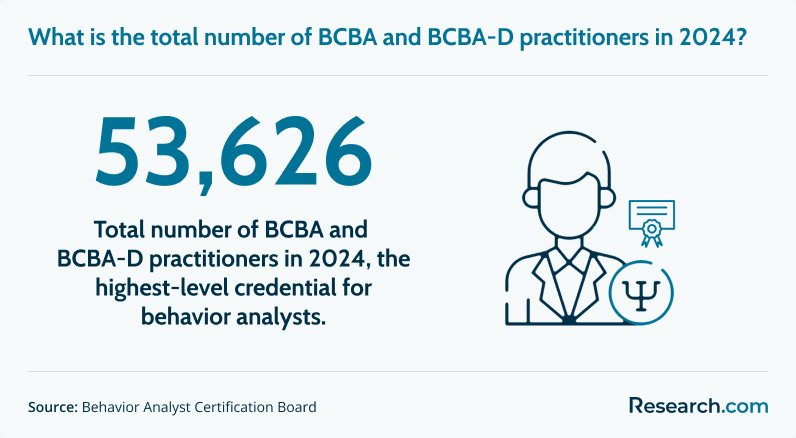
As of 2024, there were 53,626 BCBA and BCBA-D practitioners, representing the highest-level ABA credential category. Between 2020 and 2024, the total number of new BCBA certifications alone increased by 59%, showing how quickly the credential has expanded across clinical, educational, and behavioral health settings.
The BACB offers four major ABA credentials:
- Registered Behavior Technician (RBT): An entry-level paraprofessional who delivers ABA services directly to clients while supervised by a BCBA, BCBA-D, or qualified supervisor.
- Board Certified Assistant Behavior Analyst (BCaBA): A bachelor’s-level credential for professionals who support assessment, data review, treatment implementation, and staff oversight under BCBA supervision.
- Board Certified Behavior Analyst (BCBA): A graduate-level credential for professionals who assess behavior, create intervention plans, supervise RBTs and BCaBAs, and often qualify for higher-responsibility ABA roles. Students exploring graduate preparation may also compare options related to a masters in behavioral psychology.
- Board Certified Behavior Analyst-Doctoral (BCBA-D): A doctoral designation for active BCBAs with qualifying doctoral training. It reflects advanced education but does not expand the BCBA scope of practice by itself.
ABA Certification Levels Compared
| Credential | Best For | Minimum Education or Training | Typical Level of Independence |
| RBT | People entering ABA quickly and gaining direct client experience | High school diploma or equivalent plus 40 hours of training | Works under ongoing supervision |
| BCaBA | Bachelor’s-level professionals who want more ABA responsibility | Bachelor’s degree plus BACB-aligned coursework and supervised fieldwork | Works under BCBA or BCBA-D supervision |
| BCBA | Professionals who want to design programs, supervise staff, and lead ABA services | Master’s degree or higher plus graduate ABA coursework and supervised fieldwork | Can practice with significantly more professional autonomy, subject to state law and employer rules |
| BCBA-D | BCBAs pursuing research, teaching, advanced clinical leadership, or doctoral-level specialization | Doctorate plus active BCBA certification | Same certification scope as BCBA, with doctoral designation |
Why ABA Certification Matters
- It supports consistent standards of care: Certification requires education, supervision, assessment, and ethics training, which helps protect clients receiving ABA services.
- It improves professional credibility: Employers, clients, schools, agencies, and insurers often use certification as evidence that a practitioner has met recognized standards.
- It creates clearer career pathways: Each credential corresponds to different job responsibilities, from direct implementation to supervision, assessment, and program design.
- It encourages ongoing learning: BCaBAs, BCBAs, and BCBA-Ds must complete continuing education to keep their knowledge current.
- It may affect billing and legal practice: In many states and employer settings, certification is connected to licensure, insurance reimbursement, or job eligibility.
Is ABA Certification Required to Work in the Field of Applied Behavior Analysis?
ABA certification is not required for every job that uses behavior principles, but it is often required for roles involving direct ABA service delivery, supervision, independent behavior analysis, insurance billing, or use of the title “behavior analyst.” The exact requirement depends on the state, employer, funding source, and job duties.
For example, 38 states require providers to be certified in order to bill insurance for ABA services. Schools, autism therapy providers, behavioral health clinics, and developmental disability agencies may also require BACB credentials even when state law does not explicitly require certification for every position.
Certification is less likely to be mandatory in some research roles, entry-level support positions, administrative jobs, or adjacent fields where ABA concepts are used but the person is not delivering ABA services as a behavior analyst. Even then, certification can make a candidate more competitive because it demonstrates formal training, ethical accountability, and supervised experience.
When ABA Certification Is Usually Important
| Work Situation | Certification Importance | Why It Matters |
| Providing direct ABA therapy to clients | High | Employers often require RBT certification or supervised ABA training. |
| Designing behavior intervention plans | Very high | BCBA-level training is commonly expected for assessment and program design. |
| Billing insurance for ABA services | Very high | Certification may be connected to reimbursement rules, including in 38 states. |
| Working in research or policy | Variable | Certification may help, but role requirements depend on the employer and research setting. |
| Using ABA-informed strategies in teaching or counseling | Helpful but not always required | ABA training can strengthen practice, but other licenses or credentials may be more central. |
Before enrolling in any program, check three things: the BACB requirements for your target credential, your state’s licensure rules, and the hiring standards used by employers in your area.
How Do You Become a Registered Behavior Technician (RBT)?
The Registered Behavior Technician credential is the most accessible route into ABA. RBTs work directly with clients, collect data, implement skill-building programs, and follow behavior intervention plans written by qualified supervisors. They do not independently assess clients or design treatment plans.
As of 2024, there were 196,579 RBTs in the ABA workforce. For many people, the RBT role is a practical way to test whether ABA work fits their interests before committing to a bachelor’s, master’s, or doctoral pathway.
Step 1: Meet the Basic Eligibility Rules
You must be at least 18 years old, have a high school diploma or equivalent, and complete a criminal background check. Employers and states may have additional onboarding or clearance requirements.
Step 2: Complete the Required 40-Hour RBT Training
The RBT training requirement covers core ABA concepts, measurement, documentation, skill acquisition, behavior reduction, ethics, and professional conduct. Training may be offered online or in person and usually takes one to two months depending on schedule and provider format.
Step 3: Complete the RBT Initial Competency Assessment
After training, a qualified supervisor evaluates whether you can perform key RBT tasks correctly. Some employers include this assessment during onboarding, while others expect applicants to arrange it separately.
Step 4: Apply to the BACB and Schedule the Exam
After completing training and competency assessment requirements, you submit an RBT application to the BACB. The application fee is $50, and the RBT exam fee is $45 through Pearson VUE.
Step 5: Pass the RBT Exam
The RBT exam includes 85 multiple-choice questions and is administered by computer. It covers topics from the RBT Task List, including measurement, assessment support, skill acquisition, behavior reduction, documentation, and professional conduct.
Step 6: Maintain the Credential
RBTs must receive ongoing supervision. At least 5% of monthly hours working with clients must be supervised by a qualified supervisor. RBT certification is renewed annually and includes a competency assessment and renewal fee.
How Long Does It Take to Become an RBT?
Most candidates can complete the RBT process in one to three months. The timeline depends on training availability, how quickly you can complete the competency assessment, and exam scheduling.
How Do You Become a Board Certified Assistant Behavior Analyst (BCaBA)?
The BCaBA is a bachelor’s-level ABA credential for professionals who want more responsibility than an RBT but are not yet pursuing or ready for BCBA certification. BCaBAs help implement and monitor behavior programs, analyze client data, support treatment planning, and may oversee RBTs under BCBA supervision.
Among certified behavior analysts, 82.8% of BCaBAs focused on autism spectrum disorder therapy in 2024, making autism services one of the most visible employment settings for this credential.
Step 1: Earn a Bachelor’s Degree
You need a bachelor’s degree or higher from an accredited institution. The major does not always have to be ABA-specific, but coursework in psychology, education, human development, behavioral science, or related fields can make the transition smoother. If your long-term goal is behavioral health practice, you may also want to review career routes such as how to become a behavioral health therapist.
Step 2: Complete BACB-Aligned ABA Coursework
BCaBA candidates must complete coursework that meets BACB requirements. Relevant topics include behavior assessment, ethical practice, intervention design, measurement, behavior-change procedures, and supervision-related concepts. Some students complete this coursework inside a bachelor’s degree, while others use a standalone certificate sequence.
Step 3: Complete Supervised Fieldwork
The fieldwork requirement can be met through at least 1,000 hours of supervised ABA experience or 670 hours of concentrated supervised fieldwork. Concentrated fieldwork includes more intensive supervision. Supervision must be provided by a qualified BCBA or BCBA-D.
Step 4: Apply for the BCaBA Exam
After completing education and fieldwork requirements, you submit your application to the BACB and pay the required application and exam fees.
Step 5: Pass the BCaBA Certification Exam
The BCaBA exam is a computer-based multiple-choice test administered through Pearson VUE. It includes 160 questions and allows four hours for completion. The exam measures knowledge of behavior analysis concepts, ethics, assessment, data-based decision-making, and intervention planning.
Step 6: Keep the Credential Active
BCaBAs must complete 20 CEUs every two years, including ethics requirements, and must continue to receive supervision from a BCBA or BCBA-D. They must also follow the BACB’s professional and ethical standards.
How Long Does It Take to Become a BCaBA?
The full timeline can range from one to five years. A bachelor’s degree typically takes four years, but candidates who already have a degree may only need the ABA coursework, fieldwork, and exam process. Coursework may take six months to a year if completed separately, fieldwork may take another six months to a year, and exam preparation plus application processing can take one to three months.
How Do You Become a Board Certified Behavior Analyst (BCBA)?
The BCBA is the central professional credential for behavior analysts who want to conduct assessments, design behavior intervention plans, supervise ABA staff, and lead client programming. BCBAs often work with individuals with autism, developmental disabilities, behavioral challenges, school-based needs, and mental health-related concerns. The Association for Science in Autism Treatment has identified interventions based on ABA principles beneficial in autism treatment.
Compared with RBTs and BCaBAs, BCBAs generally have more responsibility for clinical decisions, documentation, supervision, family consultation, staff training, and outcome monitoring.
Step 1: Earn a Qualifying Master’s Degree or Higher
BCBA candidates must hold a graduate degree from an accredited institution. Many students pursue graduate study in behavior analysis, psychology, education, special education, or a related field. If you are mapping out your academic plan, review behavior analyst education requirements before choosing a program.
Step 2: Complete Graduate ABA Coursework
BCBA coursework must align with BACB standards and generally covers behavior assessment, experimental design, ethics, behavior-change procedures, measurement, supervision, and research methods. Some graduate programs include the required course sequence; others require students to add a verified course sequence separately.
Step 3: Complete Supervised Fieldwork
BCBA candidates complete supervised ABA experience under a qualified BCBA or BCBA-D. The two pathways described here are 2,000 hours of supervised fieldwork or 1,500 hours of concentrated supervised fieldwork. Concentrated supervised fieldwork requires more frequent supervision.
Step 4: Apply for BCBA Certification
Once your degree, coursework, and fieldwork are complete, you submit documentation to the BACB and pay the applicable fees.
Step 5: Pass the BCBA Exam
The BCBA exam is a computer-based multiple-choice exam administered through Pearson VUE. It contains 175 questions and allows four hours for completion. Exam content includes behavior assessment, intervention planning, ethics, supervision, measurement, and research methods.
Step 6: Renew the Credential Every Two Years
BCBAs renew certification every two years by completing 32 CEUs, including 4 hours in ethics. BCBAs who supervise others must also meet supervision-related continuing education requirements.
How Long Does It Take to Become a BCBA?
The BCBA path commonly takes two to five years depending on prior education, program format, fieldwork access, and whether coursework is built into the graduate degree. A master’s program, including a BCBA degree online, often takes two to three years. Supervised fieldwork may be completed during the degree or afterward and often adds one to two years. Application and exam preparation may take one to three months.
How Do You Become a Board Certified Behavior Analyst-Doctoral (BCBA-D)?
The BCBA-D is a doctoral designation for professionals who already meet BCBA requirements and also hold a qualifying doctoral degree. It is most useful for behavior analysts who want to teach at the university level, conduct research, supervise advanced clinical programs, lead organizations, or contribute to policy and interdisciplinary practice.
Importantly, the BCBA-D does not grant a broader practice scope than the BCBA credential. It identifies doctoral-level education and expertise within the BCBA credential structure.
Step 1: Earn a Doctoral Degree
BCBA-D candidates typically complete a Ph.D., Psy.D., or Ed.D. in behavior analysis, psychology, education, or a related field. If your goal is a research-intensive route, compare ABA PhD programs carefully for ABA coursework, research mentorship, dissertation support, and faculty expertise.
Step 2: Meet the BCBA Requirements First
The BCBA-D designation requires active BCBA certification. That means completing a master’s degree, BACB-aligned coursework, supervised fieldwork of 1,500–2,000 hours, and the BCBA certification exam.
Step 3: Build Doctoral-Level Expertise
Doctoral-level behavior analysts often conduct applied research, publish scholarship, teach, mentor supervisees, or lead complex clinical and organizational programs. This step is especially important for candidates who want faculty, research, or executive roles.
Step 4: Apply for the BCBA-D Designation
After earning the doctorate and maintaining BCBA certification, candidates submit the required documentation to the BACB and pay applicable fees.
Step 5: Maintain the BCBA-D
BCBA-D renewal follows the BCBA renewal cycle. Certificants complete 32 CEUs every two years, including four hours in ethics, and must follow the BACB ethics code.
How Long Does It Take to Become a BCBA-D?
The total timeline commonly ranges from six to ten years. A master’s degree may take two to three years, BCBA fieldwork and examination may take one to two years, and a doctoral program—such as a doctorate in behavioral health—may add three to five years.
How Does ABA Certification Enhance Career Advancement and Interdisciplinary Opportunities?
ABA certification can help professionals move from task-based service delivery into roles involving assessment, supervision, clinical decision-making, training, consultation, and program leadership. The higher the credential, the more likely the professional is to qualify for jobs that involve designing interventions, supervising teams, managing service quality, and coordinating with families, schools, clinicians, and agencies.
Interdisciplinary preparation can also broaden career options. For example, ABA professionals who later pursue family systems or counseling-related training may compare online MFT programs if they want to work with family dynamics, relationship patterns, and broader therapeutic contexts. ABA certification alone does not replace counseling licensure, but it can strengthen a professional’s behavioral assessment and intervention skill set.
What Complementary Certifications Can Enhance My ABA Career?
Complementary credentials are most useful when they match the population you serve. An ABA professional working with co-occurring behavioral health and addiction concerns, for instance, may benefit from training related to a substance abuse counselor pathway. Educators may benefit from special education credentials. Supervisors may benefit from organizational leadership, trauma-informed care, or clinical documentation training.
Useful Add-Ons by Career Goal
| Career Goal | Helpful Complement | Why It May Help |
| Autism services | Developmental disabilities, speech-language collaboration, or special education training | Improves coordination with families, schools, and multidisciplinary teams. |
| Behavioral health settings | Counseling, addiction, crisis intervention, or trauma-informed care training | Supports work with clients who have complex emotional or behavioral needs. |
| School consultation | Special education law, IEP processes, classroom management, or assessment training | Helps behavior analysts communicate effectively with teachers and school teams. |
| Leadership or supervision | Organizational behavior management, supervision, compliance, or quality assurance training | Builds skills needed to manage staff, systems, outcomes, and service quality. |
| Research or teaching | Doctoral study, research design, statistics, and publication experience | Prepares professionals for academic, policy, and advanced evidence-building roles. |
How Does ABA Certification Impact Career Growth and Salary Prospects?
ABA certification can improve career growth because it gives employers a clearer signal of training, supervision, ethics preparation, and competency. RBT certification can help a new worker qualify for direct service roles. BCaBA certification can support advancement into assistant analyst and supervision-adjacent work. BCBA certification is often the credential tied to higher-responsibility clinical, supervisory, and program leadership positions.
Salary outcomes are not guaranteed. Compensation varies by state, employer, setting, caseload, experience, licensure rules, and whether the role involves supervision or leadership. BCBAs may earn $70,000 – $100,000 per year depending on experience and location, but candidates should compare local job postings rather than relying on national salary claims alone.
Professionals who want to combine ABA with licensed counseling should understand that counseling licensure has separate accreditation, internship, practicum, and state exam requirements. If affordability is a priority, compare options such as the cheapest CACREP-accredited programs online only after confirming they meet the licensing rules in your state.
How Can I Choose the Best ABA Certification Training Program?
The best ABA program is the one that matches your target credential, meets BACB requirements, provides access to qualified supervision, fits your schedule, and has transparent costs. Do not choose a program based only on speed or tuition. A low-cost course can become expensive if credits do not apply, supervision is not available, or the coursework does not meet certification requirements.
Questions to Ask Before Enrolling
- Does the coursework meet the BACB requirements for the credential I want?
- Is the institution properly accredited?
- Does the program include supervised fieldwork, help students find supervision, or leave students to arrange it independently?
- What are the total costs, including tuition, fees, textbooks, supervision, background checks, applications, and exam fees?
- Can I complete the program while working full time?
- Are online courses asynchronous, live, or hybrid?
- Does the program publish exam pass rates, completion outcomes, or graduate employment information?
- Will the program meet requirements in the state where I plan to work?
Students who are comparing affordability across related helping professions may also review the most affordable online counseling degrees, but counseling and ABA have different credentialing rules. Always evaluate the specific license or certification you intend to pursue.
Common Mistakes to Avoid
| Mistake | Why It Creates Problems | Better Approach |
| Choosing the cheapest program without checking BACB alignment | Coursework may not satisfy certification requirements. | Verify requirements with the BACB and the program before enrolling. |
| Ignoring supervised fieldwork access | You may finish classes but be unable to complete certification hours on schedule. | Ask exactly how fieldwork and supervision are arranged. |
| Assuming online means easier | Online ABA programs still require rigorous coursework, documentation, and fieldwork. | Choose the format that fits your learning style and time commitments. |
| Overlooking state licensure rules | Certification may not be the only requirement for practice or billing. | Check your state board, employer standards, and insurance rules. |
| Relying only on salary averages | Pay differs widely by setting, region, and responsibility level. | Compare current local job postings and required credentials. |
Can ABA Certification Accelerate My Transition to a Counseling Career?
ABA certification can support a counseling transition by giving professionals strong skills in behavioral observation, data collection, intervention planning, goal tracking, and ethical decision-making. These skills are valuable in mental health, social services, school support, and developmental disability settings.
However, ABA certification does not automatically qualify someone to become a licensed counselor or therapist. Counseling careers usually require a specific graduate degree, supervised clinical hours, state licensure exams, and sometimes programmatic accreditation. If you want to compare the shortest legitimate routes, use a licensure-focused guide such as the quickest way to become a therapist.
Can ABA Certification Support a Career in Christian Counseling?
ABA training can complement Christian counseling when a professional wants to combine evidence-based behavior-change strategies with values-informed care. For example, ABA methods may help with measurable goals, skill development, parent training, or behavior support plans, while counseling training addresses emotional, relational, spiritual, and mental health concerns.
The important distinction is scope of practice. ABA certification does not replace pastoral counseling preparation, mental health licensure, or theological training. Professionals who want a formal faith-based counseling path may consider a masters in Christian counseling while confirming whether the program supports their intended counseling role and state requirements.
What Is the Cost of the ABA Certification Exams?
ABA certification costs include more than the exam. Candidates should budget for application fees, exam fees, coursework or training, supervised fieldwork, background checks, textbooks, renewal fees, and continuing education. The table below lists the BACB application and Pearson VUE exam fees stated for each credential.
| Credential | Application Fee (BACB) | Exam Fee (Pearson VUE) |
| Registered Behavior Technician (RBT) | $50 | $45 |
| Board Certified Assistant Behavior Analyst (BCaBA) | $175 | $125 |
| Board Certified Behavior Analyst (BCBA) | $245 | $125 |
| Board Certified Behavior Analyst-Doctoral (BCBA-D) | $245 | $125 |
RBT candidates should also account for the required 40-hour training program, which may cost $29 to $539 depending on provider and included materials. A background check typically costs $50 to $100, depending on location and provider.
The BCBA-D is a designation for professionals who already hold qualifying doctoral education and active BCBA certification. There is no separate application fee for the BCBA-D designation beyond the standard BCBA fees.
How to Reduce ABA Certification Costs
- Ask employers whether they reimburse RBT training, exam fees, supervision, or CEUs.
- Compare total program cost, not only tuition.
- Choose coursework that clearly aligns with your target credential so you do not have to retake classes.
- Look for fieldwork opportunities connected to paid employment when possible.
- Budget for renewal and continuing education before certification deadlines arrive.
Can APA Accredited PsyD Programs Online Strengthen ABA Practice?
Doctoral clinical psychology training can strengthen an ABA professional’s ability to understand assessment, diagnosis, research methods, ethics, and interdisciplinary treatment. Programs such as APA accredited PsyD programs online may be relevant for professionals who want broader clinical psychology preparation, although PsyD training and ABA certification serve different purposes.
Before choosing a PsyD program, confirm accreditation status, in-person training requirements, internship expectations, state licensure rules, and whether the program actually supports your intended clinical role. Doctoral study can expand professional options, but it is a major time and financial commitment.
Can an Online Master's Degree Accelerate Your ABA Career?
An online master’s degree can help working adults move toward BCBA eligibility when the program includes or pairs with BACB-aligned coursework and allows students to complete supervised fieldwork. The main advantage is flexibility: students may be able to continue working while completing graduate coursework.
Speed should not be the only consideration. A shorter program is only useful if it meets certification requirements, supports fieldwork planning, and prepares students for the BCBA exam. Professionals comparing accelerated psychology options may review a 1 year psychology masters online, but they should verify whether the specific degree satisfies BACB requirements before enrolling.
What Are the Continuing Education Unit (CEU) Requirements for BCBA and BCaBA?
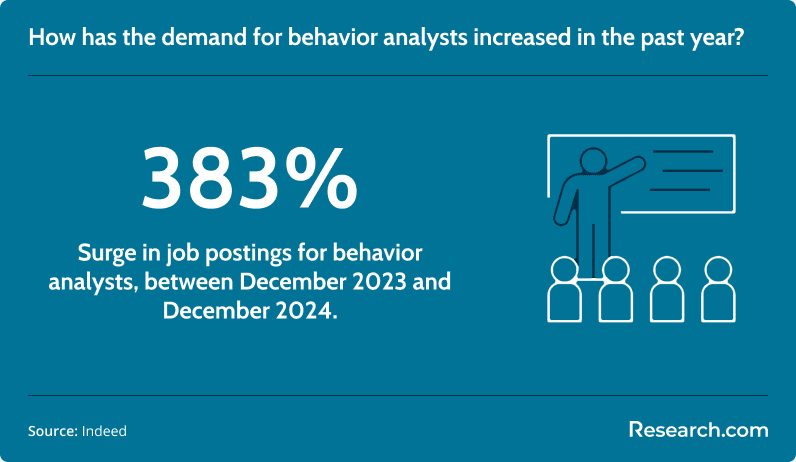
The demand for behavior analysts increased by more than 300% in 2024, but certification does not end after passing the exam. BCaBAs, BCBAs, and BCBA-Ds must complete continuing education and renewal requirements to keep their credentials active.
BCBAs must complete 32 CEUs every two years, including 4 hours in ethics. BCaBAs must complete 20 CEUs every two years, including four hours in ethics. BCBAs who supervise RBTs or BCaBAs must also complete 3 CEUs in supervision.
CEUs must come from approved BACB sources or qualifying activities. Common options include professional conferences, workshops, webinars, online courses, university coursework, research, and scholarly activities.
Ways to Earn CEUs
- Attend ABA conferences such as ABAI and APBA.
- Complete online courses from approved CEU providers.
- Participate in webinars, workshops, and professional development events.
- Engage in qualifying research, publication, or scholarly activities.
What Happens If You Miss the CEU Deadline?
If you do not complete the required CEUs and renewal steps, your certification can expire. Regaining certification may require retaking the BCBA or BCaBA exam, so it is safer to track CEUs throughout the renewal cycle instead of waiting until the final months.
How Can an Accelerated Psychology Degree Complement ABA Certification?
An accelerated psychology degree can give ABA professionals a broader foundation in human development, cognition, mental health, research methods, and behavioral science. This can be useful for RBTs planning graduate study, BCaBAs preparing for BCBA eligibility, or professionals who want a stronger academic base before specializing.
Acceleration should not come at the expense of credential fit. Before enrolling, confirm whether the curriculum supports your next ABA step, whether credits transfer into graduate study, and whether the program is properly accredited. If speed is a priority, compare options carefully using a guide to an accelerated psychology degree.
Current Trends Affecting ABA Certification in 2026
- Employer expectations are becoming more credential-specific: Many ABA job postings now distinguish clearly between RBT, BCaBA, BCBA, and BCBA-D responsibilities.
- Insurance and state rules continue to matter: Certification may interact with licensure, billing, and supervision rules, so candidates should verify requirements where they plan to work.
- Online and hybrid education are common: Flexible programs can help working adults complete coursework, but fieldwork and supervision still require careful planning.
- Interdisciplinary work is expanding: ABA practitioners often collaborate with teachers, speech-language professionals, occupational therapists, physicians, counselors, and family support teams.
- Data and technology skills are increasingly valuable: Employers value professionals who can collect, interpret, document, and use behavioral data responsibly while protecting client privacy.
Key Insights
- Start with the role you want, not the credential name: Choose RBT for entry-level direct service, BCaBA for bachelor’s-level supervised responsibility, BCBA for independent assessment and supervision roles, and BCBA-D for doctoral-level research, teaching, or leadership goals.
- BCBA is the main career-advancing ABA credential: It is the credential most often connected with designing treatment plans, supervising staff, and qualifying for higher-responsibility behavior analyst roles.
- Certification requirements are only part of the picture: State licensure, employer rules, insurance billing requirements, and supervision access can affect your timeline and job eligibility.
- Do not underestimate fieldwork: Many candidates finish coursework faster than they complete supervised experience, so ask programs how supervision is arranged before enrolling.
- Costs go beyond the exam: Budget for training, tuition, supervision, application fees, exam fees, background checks, CEUs, and renewal requirements.
- ABA can complement counseling, education, psychology, and healthcare careers: It does not replace separate licensure, but it can strengthen measurable goal-setting, behavior intervention, data-based decision-making, and interdisciplinary collaboration.
- Verify current requirements before committing: BACB standards, state rules, and employer expectations can change, so use official sources and program documentation before making a final decision.
References:
- Association of Professional Behavior Analysts. (2024). News and professional updates.
- Behavior Analyst Certification Board. (2024). BACB fact sheet.
- Behavior Analyst Certification Board. (2024). U.S. licensure of behavior analysts.
- Behavior Analyst Certification Board. (2025). Lightcast report.
- Behavior Analyst Certification Board. (2024). BACB certificant data.
Other Things You Need to Know About ABA Certifications
BCaBA applicants need 1,000 hours of supervised fieldwork, while BCBA applicants need 2,000 hours of supervised fieldwork, or 1,500 hours through concentrated fieldwork. The fieldwork must meet BACB monthly supervision and documentation rules before the application is accepted.
In 2027, to obtain a BCaBA certification, candidates must have at least a bachelor's degree, complete approved coursework, gain supervised field experience, and pass the certification exam. Additional requirements may include maintaining ongoing supervision and adhering to the BACB's ethical guidelines.