
2027 Fastest Way to Become a Licensed Counselor or Therapist

Co-Founder and Chief Data Scientist
Becoming a licensed counselor or therapist in the United States can be a rewarding journey, but it is also one fraught with complexities. With a vast array of licensing boards, educational requirements, and certification processes, it's easy to feel overwhelmed.
The landscape of counseling licensure has evolved significantly, making it even more crucial to have accurate and up-to-date information. As an expert in career planning, I wrote this guide to cut through the confusion, providing a clear roadmap to help you achieve your licensing goals efficiently and effectively.
Key Things You Should Know About Becoming a Licensed Counselor or Therapist
- Counselors or therapists can expect to earn an average salary of around $50,000 to $80,000 per year or more depending on qualifications, location, and experience.
- Online degrees in counseling, therapy, and related fields help you save money on physical costs such as board and lodging, and accelerated online programs help you finish quicker than traditional programs.
- State requirements and continuing education vary and change over time, so make sure to stay on to of these for license renewal and to keep abreast with your field.
- What is the fastest way to become a licensed counselor or therapist in the USA? Fastest Licensure Path
- What are the common coursework requirements for counseling and therapy programs? What are the common coursework requirements for counseling and therapy programs?
- What should I know about licensing exams? Licensing Exam Basics
- What should I know about internships and supervised experience? Internship Requirements
- What should I know about continuing education requirements? Continuing Education Requirements
- What are specializations and certifications in counseling and therapy? What are specializations and certifications in counseling and therapy?
- What should I know about state-specific requirements in counseling and therapy? State-Specific Requirements
- What are alternative career paths for those with a counseling or therapy education? What are alternative career paths for those with a counseling or therapy education?
- What is the career outlook for counseling and therapy? Career Outlook
- How can you choose the right specialization in counseling or therapy? How can you choose the right specialization in counseling or therapy?
- How to Become a Christian Counselor: A Faith-Based Path to Counseling How to Become a Christian Counselor: A Faith-Based Path to Counseling
- What are some common mistakes to avoid in counseling and therapy licensing? What are some common mistakes to avoid in counseling and therapy licensing?
- What are some common myths and misconceptions about counseling and therapy? What are some common myths and misconceptions about counseling and therapy?
- What is the financial investment for specializing in addiction counseling? What is the financial investment for specializing in addiction counseling?
- What are the best strategies for balancing work and study while becoming a licensed counselor or therapist? What are the best strategies for balancing work and study while becoming a licensed counselor or therapist?
- Are online counseling programs as credible as traditional programs? Are online counseling programs as credible as traditional programs?
- How can I evaluate online counseling programs for quality and affordability? How can I evaluate online counseling programs for quality and affordability?
- Can an online MS in psychology applied behavior analysis enhance my counseling career? Can an online MS in psychology applied behavior analysis enhance my counseling career?
- What financial aid options are available for counseling students? What financial aid options are available for counseling students?
- What are the emerging trends in counseling and therapy? What are the emerging trends in counseling and therapy?
- How can I reconcile affordability with quality in online counseling programs? How can I reconcile affordability with quality in online counseling programs?
- How does a counseling degree compare to other mental health degrees? How does a counseling degree compare to other mental health degrees?
- Can fast track programs accelerate my journey to licensure? Can fast track programs accelerate my journey to licensure?
- Can an online associate degree accelerate my initial steps toward a counseling career? Can an online associate degree accelerate my initial steps toward a counseling career?
- Can an affordable online master's degree in psychology further enhance my counseling career? Can an affordable online master's degree in psychology further enhance my counseling career?
- Should I Pursue a Doctoral Degree for Advanced Counseling Practice? Should I Pursue a Doctoral Degree for Advanced Counseling Practice?
- Is an accelerated bachelor's degree online an effective fast-track option to launch my counseling career? Is an accelerated bachelor's degree online an effective fast-track option to launch my counseling career?
- How can integrating organizational psychology enhance counseling leadership? How can integrating organizational psychology enhance counseling leadership?
- Is a 6-month master's degree online a strategic move for rapid counseling career growth? Is a 6-month master's degree online a strategic move for rapid counseling career growth?
- What are the admission requirements for online counseling and social work programs? What are the admission requirements for online counseling and social work programs?
What is the fastest way to become a licensed counselor or therapist in the USA?
The quickest legitimate route to becoming a licensed counselor or therapist in the United States is to choose a graduate program that already matches your state’s licensure rules, complete required clinical training without delays, prepare early for the licensing exam, and submit complete documentation as soon as you qualify. There is no shortcut around accreditation, supervised hours, exams, or state board approval. However, careful planning can prevent avoidable setbacks that add months or even years to the process.
This guide is for students, career changers, and working professionals who want to understand the fastest practical path into counseling or therapy without choosing a program that later fails to meet licensing requirements. You will learn how education, internships, supervised experience, exams, specialization, online programs, affordability, and state rules fit together so you can make a better decision before enrolling.
Quick answer: the fastest realistic path
The fastest path is usually a licensure-aligned master’s degree in counseling, marriage and family therapy, school counseling, clinical mental health counseling, or a closely related field, followed by supervised post-graduate experience and the required licensing exam in your state. Students who want speed should compare CACREP-accredited online counseling master’s programs, confirm state eligibility before applying, and begin exam preparation and supervised hour planning early.
| Step | How to move faster without risking licensure | What can slow you down |
| Choose a program | Select an accredited master’s program that meets the licensing rules in the state where you plan to practice. | Enrolling in a cheaper or faster program that lacks required coursework, practicum, internship, or accreditation alignment. |
| Complete coursework | Map every required course to your state board’s education checklist before your first term. | Discovering near graduation that you are missing ethics, assessment, diagnosis, group counseling, or human development coursework. |
| Gain clinical experience | Use practicum and internship placements strategically, and confirm which hours count toward state requirements. | Poor documentation, unapproved supervisors, or placements that do not satisfy direct client contact requirements. |
| Prepare for exams | Start studying before graduation and use official exam outlines, practice questions, and peer study groups. | Waiting until after all hours are finished, then needing multiple exam attempts. |
| Apply for licensure | Submit transcripts, supervision forms, exam results, fees, and background check materials as soon as you are eligible. | Incomplete forms, mismatched names, missing signatures, or unclear hour totals. |
Market demand is one reason many students are trying to enter the field quickly. According to a recent report by Precedence Research, the US behavioral health market was valued at $83.47 billion in 2022 and is projected to reach $136.6 billion by 2032 at a CAGR of 5.10% (2023 to 2032), as shown in the graphic below.
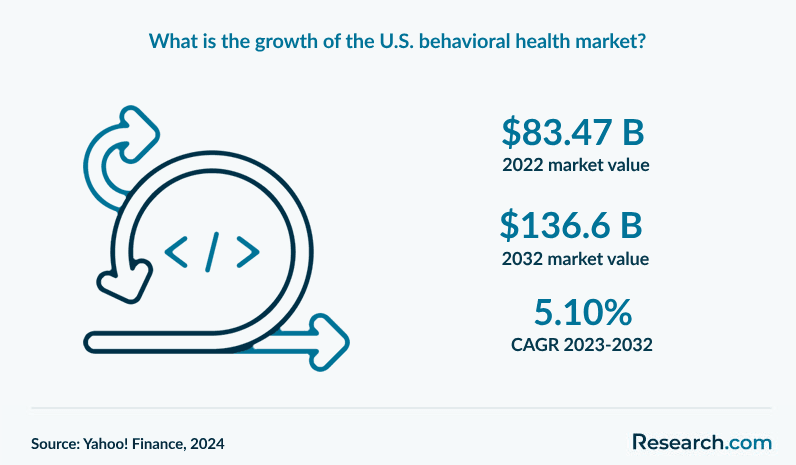
This expansion is tied to rising mental health needs, broader public awareness, new product introductions, and substantial investment. For students, that growth makes program choice more important: demand may be strong, but licensure remains state-controlled and non-negotiable.
What coursework do counseling and therapy programs usually require?
Most counseling and therapy programs combine foundational clinical courses, ethics training, assessment instruction, multicultural practice, research literacy, and supervised fieldwork. Even students comparing the most affordable online school counseling programs should verify that lower tuition does not come at the expense of required licensure content.
Course titles vary by school, but state boards and accrediting bodies commonly expect coverage in the areas below.
Core courses
- Introduction to Counseling: Explains the profession’s history, common work settings, counselor roles, and the boundaries of practice.
- Ethics and Professional Issues: Covers confidentiality, informed consent, mandated reporting, dual relationships, documentation, and professional responsibility.
- Human Development: Examines emotional, cognitive, social, and psychological development across the lifespan. Students interested in deeper developmental research may later consider a doctorate in developmental psychology.
- Psychopathology: Introduces mental health disorders, symptom patterns, causes, treatment approaches, and diagnostic frameworks such as the DSM-5.
- Counseling Techniques: Builds practical helping skills such as rapport building, active listening, empathy, questioning, reflection, and treatment planning.
- Assessment and Diagnosis: Teaches students how to use assessment tools, diagnostic criteria, and client information to form treatment plans.
- Group Counseling: Covers group dynamics, facilitation, screening, confidentiality, group stages, and interventions in different settings.
- Cultural Competence: Focuses on culturally responsive care, identity, bias, systemic factors, and ethical practice with diverse clients.
- Research Methods: Helps future counselors understand evidence, evaluate studies, and apply research-informed interventions.
- Practicum/Internship: Places students in supervised clinical settings where they begin applying classroom learning with real clients.
Specialized or elective courses
Electives help students build expertise for specific populations, diagnoses, or work settings. They can also help clarify whether a specialization is worth additional certification, supervised experience, or graduate study.
- Addiction Counseling: Focuses on substance use disorders, relapse prevention, motivational interviewing, co-occurring conditions, and family-based interventions. Students who want earlier preparation in this area can compare online substance abuse counseling degree options.
- Marriage and Family Therapy: Teaches systemic approaches, relationship dynamics, couple communication, family conflict, and treatment planning for relational problems. Students exploring this route should review what it takes to become a marriage and family therapist.
- Trauma-Informed Counseling: Covers trauma assessment, PTSD, crisis response, safety planning, stabilization, and evidence-based trauma interventions.
- Child and Adolescent Counseling: Prepares students to work with younger clients using developmentally appropriate strategies and family-aware approaches.
- Crisis Intervention: Addresses suicide prevention, emergency mental health response, disaster support, and short-term stabilization.
- Career Counseling: Explores career development theory, career assessment, job transitions, and vocational decision-making.
- Couples Counseling: Focuses on intimacy, communication patterns, conflict repair, trust, and relational assessment.
- Mindfulness and Meditation in Counseling: Introduces mindfulness-based strategies for stress management, emotional regulation, and anxiety support.
- Expressive Arts Therapy: Uses music, art, drama, or other creative processes as therapeutic tools for expression and healing.
- Forensic Counseling: Examines counseling work connected to courts, offenders, victims, evaluations, and legal systems.
The best curriculum is not simply the fastest one. It is the one that satisfies your state board, gives you enough supervised practice, and prepares you for the population you want to serve.
Some students also add education outside counseling to widen their career options. For example, the most affordable online master’s degrees in healthcare administration may support leadership goals in healthcare organizations, while affordable ABA-approved paralegal certificate programs may help students interested in mental health law, advocacy, compliance, or court-adjacent work.
Workforce data also shows why education planning matters. In 2024, a decade after its inaugural survey in 2014, the American Counseling Association (ACA) revisited the counseling workforce landscape, and the number of employed counselors has grown by roughly 36% since then. Counselor educators continue to earn more than professional counselors, with an average salary of $77,000 compared to $71,000. Experience affects earnings as well: those with over 20 years of experience earn nearly $80,000 annually, while those with less than three years of experience earn around $57,000. These differences are shown in the graph below.
In 2022, the most common counseling occupations were substance use, behavioral disorder and mental health counselor, and educational, guidance, school and vocational counselors.
Full-time respondents reported an average salary of $71,000, while part-time respondents earned an average of $51,000. The average professional counselor salary rose from $49,589 in 2014 to $70,956 in 2024, a 43% increase. Counselor educators also saw salary growth, with average pay increasing from $66,405 in 2014 to $77,171 in 2024, a 16% increase.
These figures suggest that the profession has grown substantially over the past decade, but compensation still varies by role, setting, experience, and level of responsibility.
What should you know about counseling and therapy licensing exams?
Licensing exams are designed to confirm that new counselors and therapists understand clinical practice, ethics, diagnosis, case conceptualization, and safe client care. The exam you take depends on your profession and state board.
Common licensing exams
- National Counselor Examination (NCE): Administered by the National Board for Certified Counselors (NBCC) and commonly used for Licensed Professional Counselor (LPC) licensure.
- National Clinical Mental Health Counseling Examination (NCMHCE): Also administered by NBCC and required by some states for clinical mental health counseling licensure.
- Examination for Professional Practice in Psychology (EPPP): Required for psychologist licensure and focused on broad foundational psychology knowledge.
- State-specific exams: Some jurisdictions require additional testing on state law, ethics, reporting duties, regulations, and scope of practice.
How hard are the exams?
Difficulty depends on the exam, your academic preparation, your clinical experience, and how consistently you study. The exams are built to uphold professional standards, so memorizing definitions is rarely enough. You need to apply concepts to client situations, ethical dilemmas, and treatment decisions.
How to prepare efficiently
- Use official materials first: Start with the exam provider’s content outline, candidate handbook, and sample questions.
- Review high-yield coursework: Pay particular attention to ethics, diagnosis, assessment, theory, human development, and treatment planning.
- Practice under timed conditions: Simulated exams can reveal whether your issue is content knowledge, pacing, or test anxiety.
- Study with peers: Group review can help you explain concepts out loud and learn how other candidates reason through cases.
- Consider workshops selectively: Exam prep workshops can help if they are current, exam-specific, and aligned with your weak areas.
Pass rates and retakes
Pass rates vary by exam and state. The NCE generally has a pass rate of around 80%, while other exams may vary. Candidates who do not pass are typically allowed to retake exams, but state rules may limit timing or the number of attempts within a defined period.
| Exam planning question | Why it matters |
| Which exam does my state require? | Taking the wrong exam can delay licensure even if you pass. |
| Can I take the exam before finishing all supervised hours? | Some states allow earlier testing, which can shorten the overall timeline. |
| How long are scores valid? | Expired scores may require retesting if your application is delayed. |
| What retake rules apply? | Waiting periods and attempt limits can affect your licensure date. |
What should you know about internships and supervised experience?
Supervised experience is where counseling students and graduates learn how to translate theory into ethical, competent practice. It is also one of the most common sources of licensing delays because rules vary by state and documentation must be precise.
Required supervised experience
- State rules differ: Most states require between 2,000 to 4,000 hours of supervised experience, typically over a period of two years.
- Hours may come from more than one phase: Some hours may be earned during graduate practicum and internship, while others must be completed after graduation.
Types of experience that may count
- Direct client contact: Individual, group, couple, and family counseling sessions conducted with clients.
- Clinical supervision: Scheduled supervision with a licensed professional who reviews cases, ethics, documentation, and intervention choices.
- Administrative and case management work: Documentation, care coordination, treatment planning, referrals, and related clinical support duties.
How to avoid losing hours
- Confirm that your supervisor meets your state’s credential and experience rules before you begin.
- Track direct and indirect hours separately if your state requires separate totals.
- Keep copies of supervision logs, evaluations, signed forms, and placement agreements.
- Ask your program whether practicum and internship hours count toward licensure or only toward graduation.
- Do not assume an employer’s job title automatically satisfies licensing requirements.
Finding a qualified supervisor
- University placement offices: Graduate programs often maintain approved practicum and internship sites.
- Professional organizations: Groups such as the American Counseling Association (ACA) may help students locate state board resources and professional networks.
- Local networking: Conferences, workshops, alumni groups, and community agencies can lead to supervision opportunities.
What continuing education requirements apply after licensure?
Licensure is not the end of professional regulation. Counselors and therapists usually need continuing education (CE) to renew licenses, stay current with ethical standards, and maintain competence as treatment methods and laws change.
How many CE credits are required?
- State requirements vary: Most states require 20 to 40 CE credits every two years.
- Some topics may be mandatory: Ethics, cultural competence, suicide prevention, telehealth, or state law may be required depending on the jurisdiction.
What activities usually qualify?
- Workshops and seminars: Approved professional trainings, conferences, and in-person seminars.
- Online courses: Accredited webinars or self-paced courses accepted by your licensing board.
- Professional development: Research, teaching, publishing, or presenting may count in some states.
When are CE credits due?
- At license renewal: Renewal is commonly annual or biennial, depending on the state.
- Documentation is essential: Licensees must keep proof of completion and submit it when required or during an audit.
Can unused CE credits carry over?
- It depends on state policy: Some states allow limited carryover into the next renewal cycle.
- Restrictions may apply: Carryover credits may not satisfy required ethics or other designated topics.
What happens if CE requirements are not met?
- Licensure consequences: Failure to complete CE can lead to suspension, nonrenewal, or revocation.
- Reinstatement may cost more: Licensees may need extra credits, fees, or board approval to restore active status.
What specializations and certifications are available in counseling and therapy?
Specializations help counselors focus on specific client needs, clinical issues, or work settings. They can also support career mobility, but they do not replace state licensure. Before investing in a certification, check whether it is recognized by employers, required for your target role, or mainly useful for professional development.
| Specialization or certification | Best fit for students who want to work with | Typical added preparation |
| Certified Clinical Mental Health Counselor (CCMHC) | Clients with diagnosable mental health conditions in clinical settings. | Advanced clinical training, relevant experience, and passing the CCMHC exam. |
| Marriage and Family Therapist (MFT) | Couples, families, and relational systems. | A master’s degree in marriage and family therapy and the national MFT exam. Students may also compare online MFT certificate programs. |
| Certified Addiction Counselor (CAC) | Clients with substance use disorders or addictive behaviors. | Addiction-focused coursework, ethics training, and supervised experience. |
| Certified Trauma Professional (CTP) | Clients affected by PTSD, abuse, violence, disasters, or complex trauma. | Training in trauma-informed care, crisis response, and evidence-based trauma interventions. |
| Child and adolescent counseling | Children, teens, parents, and school-linked support systems. | Coursework in child psychology, family dynamics, and developmentally appropriate interventions. |
| Grief counseling | Clients navigating bereavement, life transitions, or traumatic loss. | Training in grief theory, narrative approaches, and emotional processing strategies. |
| Certified Rehabilitation Counselor (CRC) | Individuals with disabilities pursuing personal, career, and independent living goals. | Specialized disability, vocational, and rehabilitation counseling preparation. |
| School counseling certification | K-12 students needing academic, career, and social-emotional support. | School counseling coursework, field experience, and state education requirements. |
| Clinical supervision certification | New counselors who need supervision and mentorship. | Advanced training in supervision models, ethics, documentation, and feedback. |
| Mindfulness-Based Stress Reduction (MBSR) | Clients managing stress, anxiety, emotional regulation, or chronic stress patterns. | Mindfulness practice training and supervised application in therapeutic contexts. |
| Career counseling | Students, job seekers, career changers, and workers facing transition. | Career assessment, vocational psychology, and job-search strategy training. |
| Art therapy | Clients who benefit from creative expression in psychotherapy. | Specific art therapy theories, techniques, and supervised training. |
| Certified Eating Disorder Specialist (CEDS) | Clients with anorexia, bulimia, binge eating disorder, or related conditions. | Advanced eating disorder treatment training and supervised clinical experience. |
| Sex therapy | Clients addressing sexual dysfunction, intimacy issues, or sexual health concerns. | Additional education in human sexuality, sexual health, and specialized therapeutic methods. |
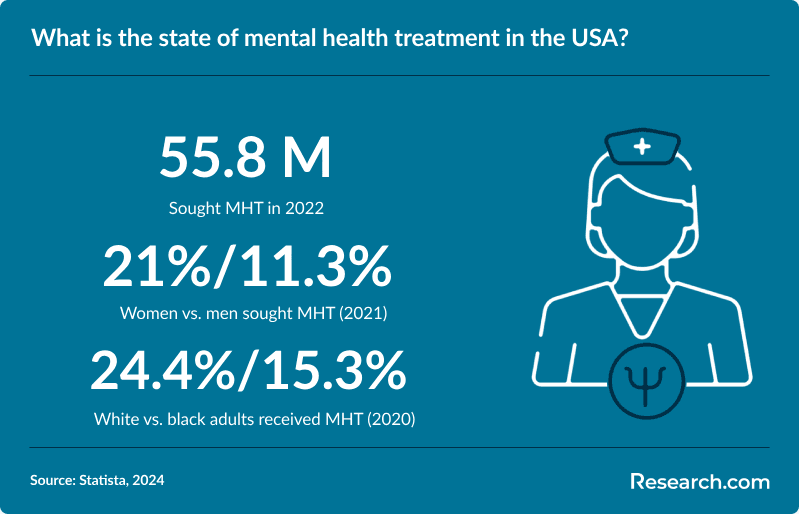
The need for specialized care is broad. Approximately 55.8 million adults in the United States sought mental health treatment in 2022. Women were nearly twice as likely as men to receive such treatment, with 21% of adult women compared to 11.3% of adult men reporting some form of mental health care in 2021. Younger adults aged 18-44 are more likely to choose counseling or therapy, while older adults often prefer medication for mental health issues. Older adults are more likely to use medication overall. Racial disparities also appear in treatment access, with white adults (24.4%) more likely to receive mental health treatment than black adults (15.3%) or Hispanics (12.6%) in 2020, as shown below.
What should you know about state-specific licensing requirements?
Counseling and therapy licensure is controlled by individual states, so the right program in one state may not satisfy requirements in another. Before enrolling, identify the state where you plan to practice and compare its education, supervised experience, exam, and application rules against the program’s curriculum.
Where to verify requirements
- State licensing board or state government websites: These are the primary sources for application forms, statutes, regulations, and education requirements.
- Professional associations: The American Counseling Association provides professional resources and links that can help students locate state licensing information.
- Program licensure disclosures: Accredited schools should disclose whether their program meets educational requirements in specific states.
Common state application components
- Completed licensure application and fee.
- Official transcripts showing required degree and coursework.
- Verification of supervised experience.
- Passing score on the required national or state exam.
- Background check, if required.
- Supervisor forms, affidavits, or employment verification documents.
Reciprocity and moving between states
- Rules vary: Some states have reciprocity or endorsement pathways, but they are not universal.
- Verification is still required: A license in one state does not automatically authorize practice in another state.
- Plan before relocating: If you expect to move, choose a program with broad licensure alignment and keep detailed documentation.
Location and job prospects
- Demand differs by region: Local needs, reimbursement systems, school staffing, agency funding, and population size affect openings.
- Urban and rural trade-offs: Major cities may have more employers and more competition, while rural areas may face provider shortages but offer fewer workplace options.
What alternative career paths are available with counseling or therapy education?
A counseling education can support more than traditional therapy practice. Some roles still require licensure, while others use counseling skills in wellness, education, human services, business, or policy settings.
- Health coach or wellness consultant: Uses behavior change, stress management, and motivational support to help clients pursue wellness goals.
- Human resources or employee assistance programs: Applies communication, conflict resolution, wellness, and mental health awareness skills in workplace settings.
- Social services: Helps individuals and families navigate community resources, case management, and support systems.
- Academic advisor or career counselor: Supports students with educational planning, career exploration, and decision-making.
- Research and policy advocacy: Uses knowledge of mental health systems to contribute to program evaluation, public health, education policy, or advocacy.
- Private practice or consulting: Offers autonomy after the required licensure, experience, and business preparation are in place.
- Advanced education: Students who want faster graduate study may compare one-year master’s programs online, but should confirm whether a shorter format fits licensing goals.
The best alternative path depends on whether you want direct clinical work, leadership, prevention, education, or systems-level impact.
What is the career outlook for counseling and therapy?
The counseling and therapy field is supported by continuing demand for mental health, school-based, addiction, rehabilitation, and community services. Still, salary and advancement vary widely by license type, specialization, geography, employer, and whether you work full time, part time, or in private practice.
Job outlook and pay considerations
- Growth outlook: The Bureau of Labor Statistics projects faster-than-average growth for counseling jobs.
- Salary range: Salaries vary widely, typically ranging from $40,000 to $70,000 annually, depending on location, specialization, and experience.
Common work settings
- Private practice: Often pursued after licensure and additional experience.
- Community agencies: Includes nonprofits, behavioral health centers, addiction treatment programs, and social service organizations.
- Hospitals and integrated care: May involve care coordination with physicians, psychiatrists, nurses, and social workers.
- Schools and colleges: Includes academic, career, social-emotional, and crisis support.
- Corporate settings: Includes employee assistance programs and workplace wellness roles.
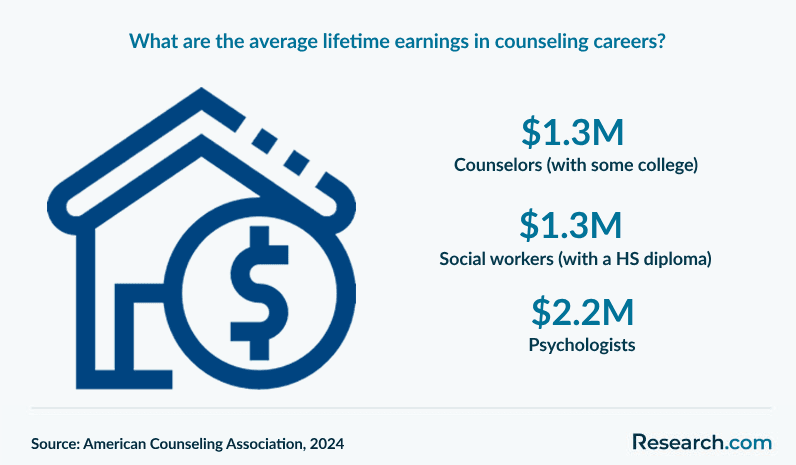
Lifetime earnings also differ by occupation and education level. Counselors with some college education can expect to earn an average of $1.3 million over their lifetimes. Social workers, even with only a high school diploma, can also anticipate earning around $1.3 million, with higher earnings possible with MS degrees; students considering social work may review accelerated MSW program options.
Psychologists, who typically complete advanced degrees, have an estimated lifetime income of $2.2 million. These figures, shown in the infographic below, illustrate why education level and professional path can meaningfully affect long-term earning potential.
Challenges and rewards
- Challenges: Emotional strain, crisis situations, documentation demands, difficult cases, ethical boundaries, and burnout risk.
- Rewards: Helping clients improve functioning, supporting families and communities, building specialized expertise, and working in flexible settings.
Networking and professional growth
- Professional associations: Membership in organizations such as the ACA or the American Association for Marriage and Family Therapy (AAMFT) can support continuing education, networking, and advocacy.
- Conferences and workshops: Events can help new professionals meet supervisors, employers, and peers in specialized practice areas.
Where opportunities may be concentrated
- Major cities: New York, Los Angeles, and Chicago often have high demand for mental health professionals but can also be competitive.
- Large states: California, Texas, and Florida offer numerous opportunities because of large populations and diverse service needs.
How can you choose the right counseling or therapy specialization?
Your specialization affects your coursework, internship choices, supervisors, certifications, work settings, and long-term professional identity. Choose based on fit, not only on salary claims or what appears popular online.
- Start with the population you want to serve: Consider whether you are most drawn to children, families, couples, students, trauma survivors, clients with addiction, people with disabilities, or workers navigating career change.
- Study labor demand carefully: Look at job postings in your target region and compare preferred credentials. For behavioral and educational settings, some students also explore how to become a board certified behavior analyst.
- Check added credential requirements: Some specialties require additional coursework, supervision, exams, or certification fees.
- Use fieldwork to test fit: Practicum, internship, shadowing, and volunteer experience can show you the daily reality of a specialty.
- Compare income and advancement realistically: Marriage and family therapy, substance abuse counseling, school counseling, and clinical mental health counseling can differ in pay structures, reimbursement, and workplace options.
- Ask mentors direct questions: Supervisors and faculty can explain caseloads, burnout risks, employer expectations, and career progression in each specialty.
How do you become a Christian counselor?
Christian counseling combines professional helping skills with faith-informed support. The appropriate path depends on whether you want to provide pastoral counseling, faith-based coaching, or state-licensed mental health counseling. Students who want to practice as licensed counselors usually need a bachelor’s degree in psychology, counseling, or a related field, followed by a master’s degree that meets state licensure standards. A faith-based program can be appropriate if it is accredited and includes the required clinical coursework and supervised training.
Supervised clinical hours remain important for developing ethical and effective practice. State licensure helps confirm that the counselor meets professional standards, while additional credentials from organizations such as the National Christian Counselors Association (NCCA) may strengthen credibility in faith-based settings. Students who want this route should review how to become a Christian counselor while also checking state scope-of-practice rules.
What common mistakes should you avoid during counseling and therapy licensing?
Licensure problems are often preventable. The most damaging mistakes usually involve choosing the wrong program, misunderstanding state rules, or failing to document supervised experience correctly.
| Common mistake | Why it creates problems | Better approach |
| Submitting an incomplete application | Missing fees, forms, transcripts, signatures, or exam scores can delay board review. | Use the board checklist and confirm every document before submission. |
| Misreading state requirements | State rules differ in coursework, hours, exams, titles, and supervisor qualifications. | Review your state board’s current rules before enrolling and again before applying. |
| Choosing speed over licensure alignment | A fast program may not meet the state’s education or field placement requirements. | Ask the school for written licensure disclosure for your target state. |
| Poor supervision records | Unclear logs can lead to rejected hours or requests for additional documentation. | Track dates, direct hours, indirect hours, supervisor credentials, and signatures consistently. |
| Waiting too long to prepare for exams | Failed attempts can add months to the timeline. | Create an exam plan during the final year of graduate study. |
| Assuming online programs are automatically accepted | Online format is not the issue; accreditation, curriculum, and field placement approval are. | Verify accreditation, practicum support, and state eligibility before enrolling. |
If you discover an error, contact the licensing board quickly, ask what corrective action is allowed, and submit missing documentation promptly. Some states may offer extensions or allow resubmission of documents, but relying on exceptions is risky.
What myths and misconceptions about counseling and therapy should you ignore?
Misunderstandings about counseling can lead students to choose the wrong path or underestimate the preparation required. These are the most common myths to correct before making career decisions.
- Myth: Only people with severe mental illness need counseling. Reality: Counseling can also support stress management, grief, relationship concerns, personal growth, and life transitions.
- Myth: Counselors only listen and give advice. Reality: Effective counselors use evidence-based methods, assessment, ethical decision-making, and collaborative treatment planning.
- Myth: Counseling is a quick fix. Reality: Meaningful change often requires multiple sessions, client effort, and ongoing practice outside sessions.
- Myth: All counselors can prescribe medication. Reality: Medication prescribing is limited to psychiatrists and certain other qualified medical professionals.
- Myth: Counseling does not work. Reality: Research supports counseling for many mental health concerns, although outcomes vary by condition, client engagement, treatment fit, and provider skill.
- Myth: Counselors have no advancement options. Reality: Counselors can move into supervision, administration, private practice, specialization, teaching, consulting, or policy work.
- Myth: You can practice independently immediately after graduation. Reality: Licensure requires supervised experience, exams, and board approval.
- Myth: All counselors use the same approach. Reality: Counselors use different modalities and adapt treatment to the client’s needs, culture, goals, and diagnosis.
- Myth: Counseling is always unaffordable. Reality: Insurance coverage, community clinics, employee assistance programs, and sliding scale fees may reduce costs for clients.
- Myth: Only extroverts become good counselors. Reality: Empathy, listening, self-awareness, clinical reasoning, and ethical judgment matter more than personality type.
Compensation also varies more than many students expect. According to BLS May 2024 data, Clinical and Counseling Psychologists, with total employment of 71,730, hold the highest median annual salary at $96,100. Counselors, Social Workers, and Other Community and Social Service Specialists, numbering over 2.3 million, have a median annual salary of $51,970. Counselors, used as a general category across specialties, have a median salary of $56,470. Rehabilitation Counselors, with 84,750 professionals, earn $44,040 annually. Substance Abuse, Behavioral Disorder, and Mental Health Counselors, totaling 397,880, earn $53,710. Marriage and Family Therapists, numbering 63,340, earn $58,510. Therapists, a broader category, have a median salary of $90,400. The graph below shows how earnings differ by specialization and role.
What is the financial investment for specializing in addiction counseling?
Addiction counseling may require additional coursework, supervised experience, certification fees, exam fees, and continuing education beyond a general counseling curriculum. Costs differ by school, state, and credentialing body, so students should compare total program price rather than tuition alone. For a deeper cost breakdown, review this guide to how much it costs to become an addiction counselor.
How can you balance work and study while becoming a licensed counselor or therapist?
Many counseling students work while completing graduate courses, internships, and exam preparation. The challenge is not only time management; it is avoiding overload during a program that also requires emotional presence and clinical growth.
- Build a weekly schedule before the term starts: Reserve time for classes, readings, assignments, clinical hours, supervision, commuting, and exam review.
- Use short-term milestones: Break licensure into smaller targets such as finishing a course, securing a placement, logging hours, or completing practice exams.
- Choose online learning carefully: Online programs can add flexibility, but students must still complete fieldwork and supervision on schedule.
- Connect work to coursework: If you already work in human services, use relevant experiences to deepen case conceptualization and ethical analysis.
- Communicate with employers: Ask early about flexible scheduling, practicum accommodations, or professional development support.
- Protect your health: Sleep, exercise, social connection, and boundaries are not optional in a helping profession.
- Use peer support: Study groups and cohort relationships can improve accountability and reduce isolation.
These strategies are especially important for students pursuing demanding clinical specialties, including those researching marriage and family therapist requirements.
Are online counseling programs as credible as traditional programs?
Online counseling programs can be credible when they are properly accredited, include required clinical training, provide qualified faculty, and support supervised field placements. Employers and licensing boards generally focus on accreditation, curriculum, practicum quality, and state eligibility rather than whether lectures are delivered online or on campus.
Students should be cautious with labels such as “easy” or “fast.” A flexible program can still be rigorous, but a program that avoids clinical requirements may not support licensure. If flexibility is the main goal, compare options such as the easiest online master’s degree while confirming that the counseling-related pathway meets professional standards.
How can you evaluate online counseling programs for quality and affordability?
To compare online counseling programs, look beyond advertised tuition. A lower-cost program may be a strong option if it is accredited, licensure-aligned, transparent about outcomes, and helpful with practicum placement. It may be a poor choice if students must find their own placements without support or if the curriculum does not satisfy state rules.
| Evaluation factor | What to ask |
| Accreditation | Is the institution accredited, and does the counseling program hold relevant programmatic accreditation where applicable? |
| State licensure alignment | Does the program meet educational requirements in the state where you plan to practice? |
| Field placement support | Will the school help secure approved practicum and internship sites near you? |
| Total cost | What are tuition, fees, books, residency costs, technology fees, and supervision-related expenses? |
| Student support | Are advising, exam preparation, career services, and faculty access available to online students? |
| Specialization fit | Does the curriculum match your intended field, such as clinical mental health, school counseling, or MFT? |
Students interested in relational therapy can compare online MFT master’s programs that balance affordability with focused training.
Can an online MS in psychology applied behavior analysis enhance a counseling career?
Applied behavior analysis can complement counseling by strengthening skills in behavior assessment, intervention planning, data tracking, and outcome measurement. An online MS in psychology applied behavior analysis may be useful for counselors working in behavioral health, education, developmental services, or intervention-focused roles. Students should still verify whether the program supports their intended license or credential because ABA preparation and counseling licensure are not identical pathways.
What trends are shaping counseling and therapy?
Counseling and therapy are being reshaped by telehealth, digital client management tools, mobile mental health applications, culturally responsive practice, integrated wellness models, and growing attention to access gaps. Technology can improve reach and convenience, but it also raises questions about privacy, clinical appropriateness, crisis response, and licensing across state lines.
AI-driven tools may assist with documentation, triage, analytics, or administrative workflows, but they do not replace licensed clinical judgment. Students should expect employers to value both technology comfort and strong ethical reasoning. Online education is also expanding access to training; students comparing cost-conscious options can review affordable online counseling degree programs.
How can you balance affordability with quality in online counseling programs?
The most affordable program is not always the best value. A good-value counseling program should combine reasonable cost with accreditation, state licensure alignment, strong field placement support, qualified faculty, and transparent student services. If a program is inexpensive but leaves you ineligible for licensure, the savings can disappear quickly.
Students focused on cost should compare tuition and fees alongside accreditation and outcomes. A useful starting point is this list of affordable CACREP-accredited online counseling master’s programs.
How does a counseling degree compare with other mental health degrees?
Counseling, social work, psychology, marriage and family therapy, and applied behavior analysis can all lead to mental health or human services work, but they differ in training focus, scope of practice, licensure, and career outcomes.
| Path | Typical focus | Best fit |
| Counseling | Therapeutic techniques, client-centered intervention, diagnosis, ethics, and supervised clinical practice. | Students who want to provide counseling services in clinical, school, agency, or private practice settings. |
| Social work | Client support within broader social, community, policy, and resource systems. | Students interested in therapy, case management, advocacy, public systems, or community services. |
| Psychology | Human behavior, research, assessment, and, at advanced levels, clinical practice. | Students interested in assessment, research, doctoral study, or psychologist licensure. |
| Marriage and family therapy | Couples, families, relationships, and systemic treatment approaches. | Students focused on relational and family systems work. |
For a deeper comparison of two common mental health pathways, review this explanation of social work versus psychology.
Can fast-track programs accelerate the journey to licensure?
Fast-track degree programs can shorten classroom time, but they cannot remove required clinical hours, exams, or state board approval. They work best for students who have transfer credits, strong time management, and a clear state licensure plan. Before enrolling, confirm that the accelerated curriculum includes the same required coursework, practicum, internship, and supervision standards as a traditional program.
Can an online associate degree help you start a counseling career faster?
An online associate degree can be a useful first step for students who are new to college, need an affordable starting point, or want to test interest in psychology, human services, or behavioral science. It will not qualify you for independent counseling licensure, but it can help you move toward a bachelor’s degree and then a required graduate program. Students who want an accelerated foundation can explore fast online associate degree programs.
Can an online bachelor's degree build a strong foundation for counseling?
A bachelor’s degree can prepare students for graduate admission by covering psychology, human development, research basics, ethics, communication, and social science methods. It usually does not qualify graduates to become licensed therapists, but it can support entry-level human services roles and graduate school readiness. Cost-conscious students may compare affordable online bachelor’s degree programs while checking transfer policies and prerequisite alignment.
What financial aid options are available for counseling students?
Counseling education can be expensive, especially at the graduate level. Students should begin with the Free Application for Federal Student Aid (FAFSA) to determine eligibility for federal grants, loans, and work-study programs. Grants such as the Pell Grant and FSEOG offer need-based assistance for undergraduate students, while graduate students may use Direct PLUS Loans or state-funded scholarships.
Professional organizations, including the National Board for Certified Counselors (NBCC) and the American Counseling Association (ACA), may offer scholarships for counseling students. Loan forgiveness or repayment programs such as Public Service Loan Forgiveness (PSLF) and the National Health Service Corps (NHSC) may help graduates who work in qualifying public service or underserved settings.
Before borrowing, students should understand what degree is needed to become a therapist, because financial aid value depends on choosing an accredited program that supports the intended license. Graduate assistantships may also reduce tuition in exchange for teaching or research support.
Can an affordable online master's degree in psychology strengthen a counseling career?
An accredited online master’s in psychology can deepen knowledge of human behavior, assessment, research, and intervention theory. However, psychology master’s programs do not always lead to counseling licensure, so students must compare curriculum and state rules carefully. For professionals seeking cost-conscious graduate study, affordable online psychology master’s programs may be worth reviewing alongside counseling licensure requirements.
Should you pursue a doctoral degree for advanced counseling practice?
A doctoral degree may be worthwhile for professionals who want advanced clinical training, leadership roles, research opportunities, teaching positions, program administration, or psychologist-level practice. It is not always necessary for counseling licensure, and it requires a major investment of time and money. Students considering advanced clinical psychology training can compare online PsyD clinical psychology programs and review licensure requirements carefully before applying.
Is an accelerated online bachelor's degree a useful fast-track option?
An accelerated bachelor’s degree can help students reach graduate school sooner, especially if they bring transfer credits or can study full time. It may support entry-level work in human services, behavioral health support, or case management, but independent counseling practice still requires graduate education and licensure. Students comparing speed and flexibility can review accelerated online bachelor’s degree programs.
How can organizational psychology support counseling leadership?
Organizational psychology can help counselors who move into supervision, program management, employee wellness, group practice leadership, or healthcare administration. It adds knowledge of workplace behavior, team dynamics, conflict resolution, performance systems, and leadership development. Counselors who want to strengthen management skills may consider an affordable online master’s in organizational psychology.
Is a 6-month master's degree online a good option for rapid counseling career growth?
A very short master’s program may be useful for some professional development goals, but students pursuing counseling licensure should be cautious. Licensure-focused master’s programs must include required coursework, supervised clinical training, and field placements that usually cannot be compressed without limits. If you are exploring a 6-month master’s degree online, verify accreditation, clinical requirements, state board acceptance, and whether the degree actually supports your intended counseling credential.
What are the admission requirements for online counseling and social work programs?
Admission requirements vary, but online counseling and social work programs commonly require a bachelor’s degree, minimum GPA, prerequisite coursework in psychology or human services, letters of recommendation, a personal statement, and sometimes an interview. Relevant volunteer or work experience can strengthen an application because these fields depend heavily on communication, judgment, ethics, and service orientation.
Applicants should compare each program’s requirements and build an application that clearly explains their readiness for graduate-level clinical or human services training. Students considering social work as a related route can review online MSW programs and compare admission expectations.
Key Insights
- The fastest legitimate path to becoming a licensed counselor or therapist is not about bypassing requirements; it is about choosing the right accredited program, documenting supervised hours correctly, passing exams efficiently, and applying without errors.
- State rules control licensure. Always verify coursework, exams, practicum, internship, supervised hours, and supervisor qualifications with the licensing board in the state where you plan to practice.
- Online programs can be credible if they are accredited, licensure-aligned, and strong in field placement support. Format matters less than accreditation, curriculum, supervision, and state eligibility.
- Specializations such as addiction counseling, marriage and family therapy, trauma counseling, school counseling, rehabilitation counseling, and child and adolescent counseling can shape your career, but they may require added training or certification.
- Salary varies substantially by role, experience, setting, geography, and credential. Avoid assuming that any degree or certification guarantees a specific income.
- Common licensing delays come from incomplete applications, missing coursework, rejected supervised hours, poor documentation, and choosing programs without checking state requirements first.
- Affordability should be measured by total value, not tuition alone. A lower-cost program is only a good investment if it supports licensure, offers adequate supervision pathways, and fits your career goal.
References:
- American Counseling Association. (2024). Licensure requirements for professional counselors. American Counseling Association.
- American Counseling Association. (2024). Counseling workforce report. American Counseling Association.
- Statista. (2023, April 18). Share of U.S. adults who received mental health treatment or counseling in the past year from 2002 to 2021. Statista.
- U.S. Bureau of Labor Statistics. (2023, March 31). Occupational employment and wage statistics. U.S. Bureau of Labor Statistics.
- Yahoo Finance. (2022, March 31). U.S. behavioral health market size to reach $240.2 billion by 2028, growing at a CAGR of 4.5% from 2021. Yahoo Finance.
Other Things You Should Know About Becoming a Licensed Counselor or Therapist
Most states require 2,000 to 4,000 supervised clinical hours after graduation, completed under an approved supervisor and documented for the licensing board. The board, often the state counseling or social work board, also requires a passing score on an exam such as the NCE or NCMHCE.
In 2027, organizations like TEACH and NBCC offer fast-tracked licensure options for therapists, allowing eligible candidates to complete requirements more swiftly. They often involve intensive coursework and examinations, with a processing time shorter than traditional routes.


