2027 How to Become a Nurse in Kansas

Co-Founder and Chief Data Scientist
Becoming a nurse in Kansas starts with one practical question: which license and education path will get you into the role you want without wasting time or money? Kansas offers several nursing routes, from practical nursing programs that can lead to LPN practice to BSN, RN-to-BSN, nurse practitioner, nurse midwifery, and other advanced practice pathways. The right choice depends on your current education, timeline, budget, desired scope of practice, and whether you want flexibility to work across state lines through the Nurse Licensure Compact.
This guide explains how to become a nurse in Kansas in 2026, including education options, licensing steps, renewal rules, job outlook, Compact license considerations, online program choices, and career paths beyond bedside nursing. It is designed for high school students, career changers, current LPNs or RNs, international nurses, and Kansas nurses considering advanced practice or specialization.
Quick answer: How do you become a nurse in Kansas?
To become a nurse in Kansas, you generally need to complete a state-approved nursing program, pass the correct NCLEX exam, submit an application to the Kansas State Board of Nursing, complete fingerprinting and a background check, and maintain your license through renewal and continuing education. LPN candidates take the NCLEX-PN, while RN candidates take the NCLEX-RN. Nurses who want advanced practice authority must complete graduate-level nursing education, hold national certification, and meet Kansas APRN licensure requirements.
| Goal | Typical education route | Licensing exam or credential | Best fit |
| Licensed Practical Nurse | Practical nursing program lasting nine to twelve months | NCLEX-PN | Students who want a faster entry into direct patient care |
| Registered Nurse | ADN, hospital diploma program, or BSN | NCLEX-RN | Students who want broader clinical responsibilities and more job options |
| Advanced Practice Registered Nurse | MSN or DNP after RN preparation | National certification in specialty area | RNs seeking advanced clinical practice, leadership, or specialization |
| Certified Nursing Assistant | State-approved training program | Competency exam | Students testing healthcare work before committing to nursing school |
Key Things You Should Know About Becoming a Nurse in Kansas
- Kansas is projected to face a nursing shortfall of over 20,000 nurses by 2030, which may create opportunities for new graduates, career changers, and nurses willing to work in high-need settings.
- The average salary for registered nurses in Kansas is approximately $66,000 per year, although pay can differ by location, employer, specialty, shift, and experience level.
- The Bureau of Labor Statistics projects a 7% growth rate for registered nursing positions through 2029, with demand influenced by an aging population and continued need for healthcare services.
- Kansas students can choose from several nursing education paths, including ADN programs, BSN degrees, accelerated nursing options, practical nursing programs, and online or hybrid programs.
- Professional organizations, nursing schools, and healthcare employers in Kansas can help students and licensed nurses find mentors, continuing education, clinical opportunities, and career guidance.
- What are the steps to becoming a nurse in Kansas?
- What are the educational requirements for becoming a nurse in Kansas?
- What types of nurses can legally practice in Kansas?
- What are the licensing requirements for nurses in Kansas?
- What types of nursing licenses are available in Kansas?
- Can a Compact nurse practice in Kansas?
- Can you practice as a nurse without a license in Kansas?
- What is the state of nursing in Kansas?
- What is the job outlook for nursing in Kansas?
- What options are available for LPN aspirants in Kansas?
- What are the licensure renewal and continuing education requirements for Kansas nurses?
- Why should nurses consider medical billing and coding in Kansas?
- How can I transition from a BSN to NP in Kansas?
- How is technology reshaping nursing practice in Kansas?
- Can international nurses obtain licensure in Kansas?
- How can mentorship and professional networks accelerate your nursing career in Kansas?
- Does specializing as a nurse midwife amplify your career prospects in Kansas?
- What resources and educational programs can enhance your nursing career in Kansas?
- Is it beneficial to explore allied healthcare careers alongside nursing in Kansas?
- What are the nurse practitioner education requirements in Kansas?
- How does pursuing an LVN pathway enhance your nursing career in Kansas?
What are the steps to becoming a nurse in Kansas?
The process depends on whether you want to become an LPN, RN, or APRN, but the core sequence is similar: prepare academically, choose the right program, graduate from an approved nursing program, pass the licensing exam, and complete Kansas licensure requirements.
- Finish high school or earn a GED. Nursing programs typically expect preparation in English, math, science, and social studies. Strong biology, chemistry, anatomy, and algebra skills can make nursing prerequisites easier.
- Choose the license level that matches your career goal. A practical nursing program lasting nine to twelve months can prepare you for LPN licensure. RN candidates may choose a hospital diploma program that takes two to three years, a two-year associate degree in nursing, or a four-year baccalaureate degree in nursing.
- Confirm that the program is approved and properly accredited. Before enrolling, verify program status through the Kansas State Board of Nursing. This matters because graduation from an approved program is tied to eligibility for licensure.
- Complete required classroom and clinical training. Nursing education combines science coursework, patient-care skills, simulations, supervised clinical rotations, and preparation for safe practice.
- Pass the national licensing exam. RN candidates take the NCLEX-RN. LPN candidates take the NCLEX-PN. Passing the appropriate exam is required before you can practice as a licensed nurse.
- Apply for licensure in Kansas. Submit your application, education verification, exam results, fingerprinting, background check information, and required fees to the Kansas State Board of Nursing.
- Maintain your license. Kansas nurses must renew their licenses and complete continuing education to remain eligible to practice.
Kansas has previously been described as facing a projected shortfall of nearly 18,000 nurses by 2020, and current discussions continue to emphasize workforce demand. For students, that means nursing can offer several entry points, but it does not remove the need to compare programs carefully and meet every licensure requirement. If you are comparing specialties, such as cosmetic or aesthetic nursing, it may also help to review how compensation differs by role, including how much do aesthetic nurses make an hour.
| Step | What to check before moving forward | Why it matters |
| Program selection | Board approval, accreditation, clinical sites, NCLEX preparation | Program quality affects licensure eligibility and job readiness |
| Admissions | Prerequisites, GPA expectations, entrance exams, waitlists | Some nursing programs are competitive and may require planning |
| Clinical placement | Location, schedule, travel expectations, simulation requirements | Clinical logistics can affect working students and parents |
| Licensure | Application, fingerprinting, background check, NCLEX results | You cannot legally practice until licensing requirements are met |
Nationally, government is the highest-paying industry for registered nurses, with an annual salary of $99,840. Hospitals, including state, local, and private hospitals, follow with an annual salary of $88,430. Ambulatory healthcare services, nursing and residential care facilities, and educational services, including state, local, and private employers, also report competitive RN salaries ranging from $71,550 to $81,230 per year. The graph below summarizes these figures.
What are the educational requirements for becoming a nurse in Kansas?
Kansas nursing education requirements vary by license type. The shortest route is usually practical nursing, while advanced practice roles require graduate education. The best program is not always the fastest one; it is the one that supports your licensure goal, budget, clinical access, and long-term career plan.
- Licensed Practical Nurse (LPN): A one-year diploma program can prepare students for LPN licensure. This path may appeal to students who want to enter nursing quickly, though job scope and pay are generally more limited than RN roles. Medical assistants considering practical nursing can explore medical assistant to LPN online programs.
- Associate Degree in Nursing (ADN): The ADN is commonly a two-year route to RN eligibility. It can be a practical option for students who want to enter the workforce sooner and later complete a BSN.
- Bachelor of Science in Nursing (BSN): The BSN is a four-year nursing degree that includes broader preparation in leadership, community health, evidence-based practice, and clinical care. It may be preferred by some employers and can support future graduate study.
- Prerequisite coursework: Nursing programs typically require a high school diploma or GED. ADN and BSN programs may also require undergraduate courses such as statistics and English, which can take three to six months to complete.
- Advanced Practice Registered Nurse (APRN): Nurses pursuing nurse practitioner, nurse anesthetist, nurse midwife, or clinical nurse specialist roles typically need an MSN or DNP. If you are comparing advanced practice returns, review how DNP salary ranges compare by state and role.
| Education option | Typical time stated | Possible outcome | Decision guidance |
| Practical nursing diploma | One year or nine to twelve months | LPN eligibility | Consider if you want a faster start and are comfortable working under RN or physician supervision |
| Hospital diploma program | Two to three years | RN eligibility | Consider if available locally and approved for Kansas licensure |
| Associate Degree in Nursing | Two years | RN eligibility | Consider if cost and speed are priorities and you may complete a BSN later |
| Bachelor of Science in Nursing | Four years | RN eligibility and stronger foundation for advancement | Consider if you want leadership, specialty, public health, or graduate-school options |
| MSN or DNP | Graduate study after RN preparation | Advanced practice, leadership, or specialized roles | Consider if you want APRN practice, greater autonomy, or advanced clinical responsibility |
Before committing, confirm accreditation and board approval. Accreditation can influence licensure eligibility, employer acceptance, transfer credits, graduate school admission, and financial aid options. As of 2023, the median annual salary for nurses in Kansas was $71,990, but individual outcomes depend on license, employer, specialty, location, experience, and shift differentials.
What types of nurses can legally practice in Kansas?
Kansas recognizes multiple nursing and nursing-support roles. Each has a different legal scope of practice, education requirement, and level of supervision. Understanding these distinctions helps you avoid enrolling in the wrong program for your career goal.
- Registered Nurses (RNs): RNs assess patients, administer medications, coordinate care, educate patients and families, monitor changes in condition, and collaborate with physicians and other healthcare professionals. RN candidates complete an accredited nursing program, commonly an ADN or BSN, and pass the NCLEX-RN. Programs accredited by the Commission on Collegiate Nursing Education or the Accreditation Commission for Education in Nursing are recognized.
- Licensed Practical Nurses (LPNs): LPNs provide basic nursing care, often under RN or physician supervision. They complete a practical nursing program, usually about a year, and pass the NCLEX-PN. Kansas recognizes LPN programs accredited by ACEN or approved by the state.
- Advanced Practice Registered Nurses (APRNs): APRNs include Nurse Practitioners, Clinical Nurse Specialists, Nurse Anesthetists, and Nurse Midwives. These nurses complete advanced education, typically at the master's or doctoral level, and hold national certification in their specialty. Their responsibilities may include diagnosis, treatment, prescribing, and advanced patient management, depending on role and state rules.
- Certified Nursing Assistants (CNAs): CNAs are not licensed nurses, but they are important members of the care team. They assist with daily care tasks after completing a state-approved training program and passing a competency exam.
Some nurses also pursue mobile or temporary assignments. If travel nursing interests you, compare the role, pay structure, and licensing implications by reviewing how much does a traveling nurse make.
National wage data show that nurse anesthetists earn the highest median annual wage among nurses in the USA, with $195,610. Nurse practitioners report $120,680, nurse midwives report $112,830, registered nurses report $77,600, and licensed practical and licensed vocational nurses report $48,070. The national average for all occupations is $45,760. The graph below presents these comparisons.
What are the licensing requirements for nurses in Kansas?
Kansas nursing licensure is handled by the Kansas State Board of Nursing. The process is designed to confirm that applicants have completed required education, passed the appropriate licensing exam, and met background-screening requirements before practicing with patients.
- Complete an approved nursing program. Depending on your goal, this may be a diploma, associate degree, bachelor's degree, or graduate nursing program.
- Pass the NCLEX. RN applicants take the NCLEX-RN. Practical nurse applicants take the NCLEX-PN.
- Submit the Kansas licensure application. The application requires documentation of nursing education and exam results.
- Complete fingerprinting. Kansas requires fingerprinting as part of the background check process.
- Clear the required background check. Certain criminal convictions may affect eligibility, so applicants with concerns should review board guidance before applying.
- Pay required fees. The application fee for a registered nurse license is approximately $150, while the practical nurse license fee is around $100. Fingerprinting may create additional costs.
Licensure is not just a formality. It is the legal permission to practice within a defined scope. Students should also understand that finishing school and passing the NCLEX are not the same as being authorized to work; the license must be issued before independent nursing practice begins.
What types of nursing licenses are available in Kansas?
Kansas nursing licenses correspond to different levels of education, responsibility, and patient-care authority. Choosing the right license should be based on the work you want to do now and the advancement path you may want later.
| Kansas nursing license | Minimum preparation described | General scope | When this path makes sense |
| Registered Nurse | Accredited nursing program, often an associate's or bachelor's degree | Broad patient assessment, care coordination, medication administration, education, and clinical judgment | You want a flexible nursing career with stronger mobility across settings |
| Licensed Practical Nurse | Practical nursing program and NCLEX-PN | Basic nursing care under supervision of RNs or physicians | You want a shorter entry route into direct care |
| Advanced Practice Registered Nurse | Master's degree in nursing and national certification exam | Advanced clinical practice, including diagnosis, treatment, prescribing, and patient management depending on role | You want specialty practice, leadership, or greater clinical autonomy |
Students comparing healthcare-administration options alongside nursing may also want to understand related credentials. For example, what to know about free online medical billing and coding courses can help nurses evaluate non-clinical skills that support care coordination, documentation, or revenue-cycle knowledge.
Can a Compact nurse practice in Kansas?
Yes. Kansas is a member of the Nurse Licensure Compact (NLC). Nurses who hold a valid multistate license from another Compact state can practice in Kansas without obtaining a separate Kansas single-state license, as long as they meet Compact rules.
- Multistate practice: Compact licensure can help nurses accept assignments across participating states, which is useful for travel nurses, border-region nurses, telehealth roles, and professionals who relocate.
- Conversion from single-state to multistate status: Kansas RNs and LPNs with a single-state license may apply for conversion if they meet uniform license requirements, including background-check expectations.
- Initial licensure after July 1, 2019: Applicants who have never been licensed may apply for a multistate license in Kansas if they submit their application after July 1, 2019 and meet eligibility requirements.
- Expired Kansas license: Nurses with an expired Kansas license can pursue reinstatement. Reinstatement initially results in a single-state license, and conversion is a separate step if multistate privileges are desired.
- Continuing education: Kansas requires 30 hours of approved continuing education for license renewal, whether the nurse holds a single-state or multistate license.
Compact licensure is valuable, but it does not replace the need to understand state scope-of-practice rules, employer requirements, and renewal obligations. If you are still choosing a school, compare admission pathways and program fit through resources such as the easiest nursing schools to get into.
Can you practice as a nurse without a license in Kansas?
No. You cannot legally practice as a nurse in Kansas without a valid nursing license. Completing a nursing program or passing the NCLEX does not authorize practice by itself; the Kansas State Board of Nursing must issue the appropriate license.
To practice legally as an RN or LPN in Kansas, you must complete the required education, pass the correct NCLEX exam, submit the licensing application, and satisfy background-check and fingerprinting requirements. Practicing without a license can put patients at risk and may lead to legal and professional consequences.
- For RN practice: Complete an ADN, BSN, hospital diploma pathway, or other approved RN-preparation route, pass the NCLEX-RN, and obtain licensure.
- For LPN practice: Complete an approved practical nursing program, pass the NCLEX-PN, and obtain licensure.
- For APRN practice: Complete advanced nursing education, meet certification requirements, and obtain the required Kansas APRN authorization.
RN jobs have been projected to grow by 6% from 2022 to 2032, which can make nursing attractive. Still, job demand does not waive licensure rules. New graduates should wait for official authorization before accepting work that requires a nursing license.
A Kansas nurse described the waiting period this way: “After I finished school and passed the NCLEX, I still felt like I was in limbo until my license arrived. When it finally did, I understood both the freedom and responsibility that came with it.”
What is the state of nursing in Kansas?
Nursing in Kansas is shaped by three realities: steady need for healthcare workers, workforce pressure in rural and underserved areas, and a cost environment that can be more manageable than some higher-cost states. For students, this means opportunity exists, but location and specialty matter.
- Employment demand: Kansas healthcare employers continue to need RNs, LPNs, APRNs, and support staff across hospitals, outpatient centers, long-term care facilities, clinics, and community health settings.
- Rural workforce needs: Rural regions may have more difficulty recruiting and retaining nurses. Nurses open to rural practice may find meaningful roles serving communities with fewer local providers.
- Work settings: Nurses in Kansas work in hospitals, outpatient care centers, nursing homes, government healthcare facilities, schools, home health, mental health, and specialty practice settings.
- Cost of living: Kansas may appeal to nurses seeking a balance between income and everyday expenses, although costs vary by city and household situation.
- Career mobility: Because Kansas participates in the Nurse Licensure Compact, eligible nurses may have more flexibility to work in other Compact states or accept certain multistate roles.
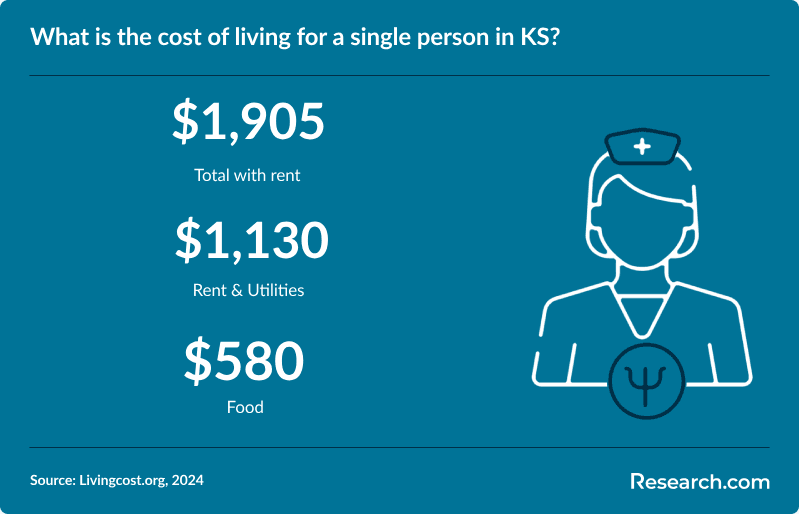
Kansas State offers a relatively affordable cost of living. For a single person, the total monthly cost, including rent and utilities, is $1,905, which is 1.15 times less expensive than the national average. Rent and utilities account for $1,130, while food costs $580, as shown in the graphic below. Kansas State has been ranked 43rd most expensive and 32nd best state to live in the United States.
Students should not evaluate Kansas nursing only by statewide averages. A new RN in a rural long-term care facility may have a different experience from an ICU nurse in Kansas City, an LPN in a clinic, or a nurse practitioner in a specialty practice. Compare employers, commute, shift expectations, benefits, overtime culture, and orientation support before accepting a role.
What is the job outlook for nursing in Kansas?
The nursing job outlook in Kansas is generally positive, but outcomes depend on license level, specialty, geography, and employer type. Demand is supported by aging patients, ongoing healthcare access needs, and turnover in some care settings.
According to the U.S. Bureau of Labor Statistics, employment for registered nurses is projected to grow by 6% from 2021 to 2031. The average annual salary for registered nurses in Kansas is approximately $66,000, or about $31.73 per hour. Pay may be higher or lower based on experience, specialty, shift, location, and benefits.
- Kansas City: RNs in this metro area can earn upwards of $70,000 annually, supported by major healthcare facilities and a larger labor market.
- Topeka: RNs average around $65,000, with opportunities connected to the capital city’s healthcare systems and public-sector employers.
- Specialty hospitals: These settings may offer higher wages because of the complexity of patient care.
- Government healthcare facilities: These employers may pair competitive wages with strong benefits.
- Advanced practice roles: Nurse anesthetists and nurse practitioners tend to be among the highest-paid nursing professionals, often exceeding $100,000 annually.
- LPN roles: Licensed practical nurses typically earn lower salaries, averaging around $45,000 per year.
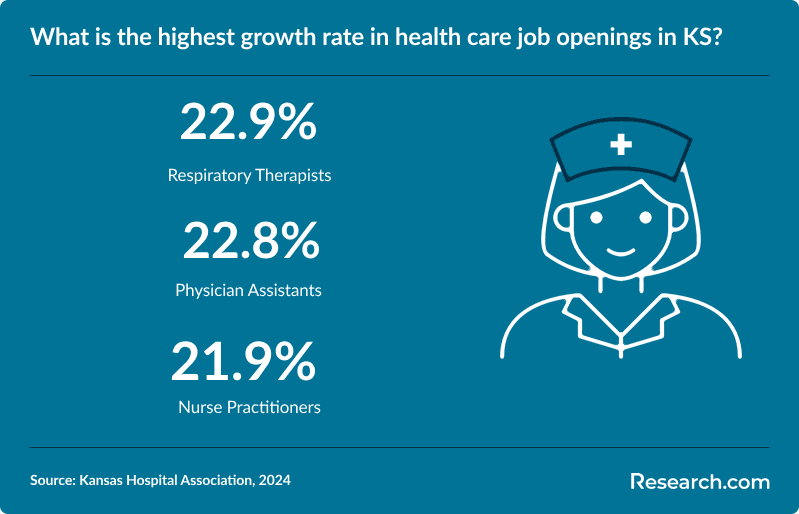
According to the Kansas Hospital Association's 2024 data, three healthcare professions are projected to experience significant job growth in the state. Respiratory Therapists have the highest projected growth rate in healthcare job openings in Kansas from 2020 to 2030, at 22.9%. Physician Assistants follow at 22.8%, and Nurse Practitioners follow at 21.9%, as shown in the graphic below.
Nurses who want administrative advancement can also consider healthcare management education. For example, 1 year MHA programs online may be relevant for nurses interested in operations, leadership, policy, or healthcare administration roles.
What options are available for LPN aspirants in Kansas?
LPN programs can be a good fit for Kansas students who want to enter nursing faster than a traditional RN pathway. LPNs provide essential bedside and basic nursing care under the supervision of RNs and physicians, often in long-term care, clinics, hospitals, rehabilitation facilities, and community care settings.
To become an LPN in Kansas, you must complete an accredited or state-approved practical nursing program and pass the NCLEX-PN. Programs typically include classroom instruction, lab practice, and supervised clinical training. If schedule flexibility matters, compare online LPN programs in Kansas, but verify whether clinical requirements can be completed near you.
| LPN path consideration | What to ask before enrolling |
| Program approval | Is the program approved for Kansas practical nursing licensure? |
| Clinical placement | Where are clinicals located, and are evening or weekend options available? |
| NCLEX-PN preparation | How does the program prepare students for the licensing exam? |
| Bridge options | Does the school offer or accept credits toward an LPN-to-RN pathway? |
| Total cost | What are the full costs beyond tuition, including fees, uniforms, books, testing, and transportation? |
What are the licensure renewal and continuing education requirements for Kansas nurses?
Kansas nurses must meet state renewal rules to keep their licenses active. The most important requirement stated here is that Kansas requires 30 hours of approved continuing education for license renewal. Nurses should confirm current renewal timelines, acceptable course types, and documentation rules directly with the Kansas State Board of Nursing before the renewal deadline.
Continuing education can do more than satisfy compliance. It can also support specialty development, leadership growth, and academic advancement. For working RNs, online RN to BSN programs may help combine degree completion with ongoing professional development, depending on course approval and employer expectations.
Why should nurses consider medical billing and coding in Kansas?
Medical billing and coding can be useful for Kansas nurses who want to understand the administrative side of healthcare, move into non-clinical roles, support documentation accuracy, or prepare for case management, utilization review, compliance, or revenue-cycle positions. It is not a replacement for nursing licensure, but it can add flexibility to a nursing career.
Nurses who want less physically demanding work, remote-friendly options, or part-time administrative opportunities may find coding and billing knowledge valuable. To compare the training path, credential options, and Kansas-specific considerations, review how to become a medical biller and coder in Kansas.
How can I transition from a BSN to NP in Kansas?
A BSN-to-NP pathway is designed for registered nurses who want advanced clinical responsibilities, expanded assessment and diagnostic skills, and potential specialization. In Kansas, the strongest programs are those that align coursework, supervised clinical experiences, national certification preparation, and state APRN requirements.
When comparing BSN to NP programs, look beyond convenience. Ask whether the program helps students secure clinical placements, prepares graduates for the intended national certification exam, offers faculty support, and has experience serving Kansas-based students.
| BSN-to-NP factor | Why it matters |
| Accreditation | Supports certification, licensure, employer recognition, and academic quality |
| Clinical placement support | NP students often need approved preceptors and specialty-specific clinical hours |
| Population focus | Family, adult-gerontology, psychiatric-mental health, women’s health, and other tracks lead to different roles |
| State alignment | Programs should prepare students for Kansas APRN expectations and national certification |
| Schedule format | Online coursework may still require in-person clinicals, intensives, or local placements |
How is technology reshaping nursing practice in Kansas?
Technology is changing how Kansas nurses document care, communicate with teams, monitor patients, and deliver services. Telehealth, electronic health records, mobile health tools, clinical decision-support systems, and remote patient monitoring all require nurses to be comfortable with digital workflows.
For nursing students, this means program quality should include more than anatomy, pharmacology, and clinical skills. Strong programs also teach informatics, data privacy, documentation standards, virtual care communication, and safe use of technology. Students comparing flexible formats can review the best online nursing programs in Kansas while confirming clinical requirements and board approval.
Can international nurses obtain licensure in Kansas?
International nurses may be able to obtain Kansas licensure, but they must show that their education, clinical preparation, and credentials meet state expectations. This commonly involves credential evaluation from recognized agencies, documentation of nursing education, and proof of English language proficiency when required.
Some internationally educated nurses may also need additional coursework, bridging preparation, or clinical assessment depending on their background. Because requirements can be documentation-heavy, applicants should begin early, keep certified records organized, and review the requirements for nursing licensure in Kansas before submitting an application.
How can mentorship and professional networks accelerate your nursing career in Kansas?
Mentorship can shorten the learning curve for new nurses and help experienced nurses move into leadership, specialty care, graduate school, or advanced practice. In Kansas, networking can be especially useful for finding clinical placements, understanding rural practice needs, learning employer reputations, and identifying preceptors.
- Ask nursing programs whether they provide faculty advising, alumni mentoring, and clinical-placement support.
- Join local or state nursing organizations to stay aware of continuing education, policy changes, and job openings.
- Seek mentors in the specialty you want, not only in the job you currently have.
- Use clinical rotations to build professional references and learn which settings fit your strengths.
Prospective students can compare schools with these support factors in mind by reviewing the best nursing schools in Kansas.
Does specializing as a nurse midwife amplify your career prospects in Kansas?
Nurse midwifery can be a strong path for RNs who want advanced practice in maternal, reproductive, and newborn care. Certified nurse midwives often work in hospitals, birth centers, clinics, and community health settings, depending on state rules and employer structure.
This specialty requires focused graduate-level preparation, hands-on clinical training, national certification, and compliance with Kansas APRN licensure requirements. If maternal health is your goal, review how to become a nurse midwife in Kansas before choosing an NP, CNM, or other APRN track.
What resources and educational programs can enhance your nursing career in Kansas?
Kansas nurses can strengthen their careers through advanced education, continuing education, professional associations, employer training, specialty certification, and mentorship. The right resource depends on your stage: pre-nursing student, new graduate, working RN, LPN bridge student, or advanced practice candidate.
- Pre-nursing students: Focus on board-approved programs, prerequisite planning, admission requirements, financial aid, and clinical access.
- LPNs: Compare LPN-to-RN or LPN-to-BSN pathways if you want broader responsibility and long-term advancement.
- RNs: Consider BSN completion, specialty certification, charge nurse training, or graduate education.
- Advanced practice candidates: Compare certification pass preparation, clinical placement support, faculty expertise, and APRN licensure alignment.
- Working nurses: Use continuing education strategically so renewal requirements also build marketable skills.
RNs who want advanced clinical practice can compare the best NP programs in Kansas. Kansas nurses should also monitor resources from the Kansas State Nurses Association and the Kansas State Board of Nursing for renewal updates, practice guidance, and professional development.
Is it beneficial to explore allied healthcare careers alongside nursing in Kansas?
Exploring allied healthcare careers can help nurses understand the broader care team and identify alternative career options. This is especially useful for nurses interested in care coordination, medication safety, public health, case management, health informatics, or administration.
Pharmacy is one example of a related clinical field with significant overlap in medication management and patient education. If you are considering a broader healthcare trajectory, review how to become a pharmacist in Kansas to compare the education and licensure path with nursing.
What are the nurse practitioner education requirements in Kansas?
Kansas nurse practitioner candidates must build on RN preparation with advanced nursing education and clinical training. Accredited NP programs typically require a BSN, supervised clinical practice hours, and advanced coursework such as pathophysiology, pharmacology, and evidence-based practice.
Students should choose an NP track that matches the population they want to serve. Family practice, adult-gerontology, psychiatric-mental health, pediatrics, women’s health, and acute care tracks can lead to different certification exams and job settings. For a fuller explanation of prerequisites, education, and licensure steps, review the nurse practitioner education requirements in Kansas.
How does pursuing an LVN pathway enhance your nursing career in Kansas?
The term LVN is commonly used in some states, while Kansas generally uses the LPN title for practical nurses. If you see LVN resources while researching Kansas, make sure you understand whether the information applies to Kansas licensure or to another state’s terminology.
A practical nursing route can still be a strategic first step for students who want faster entry into healthcare, direct patient-care experience, and a possible bridge to RN education later. Practical nurses may work in long-term care, outpatient clinics, community health services, rehabilitation settings, and other supervised care environments. To compare terminology and pathway details, review how to become an LVN in Kansas.
Common mistakes to avoid when becoming a nurse in Kansas
| Mistake | Why it can hurt you | Better approach |
| Choosing a program without checking board approval | You may risk licensure delays or ineligibility | Verify program status with the Kansas State Board of Nursing before enrolling |
| Looking only at tuition | Fees, books, uniforms, exams, background checks, commuting, and lost work hours can change the true cost | Calculate total cost of attendance and compare financial aid options |
| Assuming online means fully remote | Nursing programs require clinical training, and some may require campus visits | Ask where clinicals occur and whether placements are guaranteed or student-arranged |
| Ignoring transfer-credit rules | Prior coursework may not apply, delaying graduation | Request a written transfer evaluation before committing |
| Assuming salary averages are guaranteed | Pay varies by role, city, shift, employer, and experience | Compare local job postings and ask employers about base pay, differentials, and benefits |
| Waiting until graduation to understand licensure | Background checks, fingerprinting, and documentation can take time | Review licensing steps early and keep records organized |
Questions to ask before choosing a Kansas nursing program
- Is the program approved by the Kansas State Board of Nursing?
- Is the program accredited by a recognized nursing accreditor?
- What are the NCLEX-RN or NCLEX-PN preparation supports?
- Where do students complete clinical rotations?
- Does the school help arrange clinical placements, or must students find their own?
- What is the total estimated cost, including fees, supplies, uniforms, testing, and transportation?
- Can prior college credits transfer into the program?
- Are there evening, weekend, part-time, accelerated, or online options?
- What support is available for working adults, parents, and first-generation college students?
- Does the program offer bridge pathways, such as LPN-to-RN, RN-to-BSN, or BSN-to-NP?
What do nurses say about becoming a nurse in Kansas?
- “I wanted a nursing career that let me serve the community where I live. In Kansas, I found experienced nurses who were willing to teach, guide, and answer questions. Smaller hospitals gave me close patient relationships and helped me understand the impact of consistent bedside care.” Noemi
- “Nursing appealed to me because it is demanding and meaningful. Kansas needs nurses, especially in rural areas, and that opened opportunities I did not expect. I have worked in long-term care and community health, and the variety has helped me discover which specialties fit me best.” Richard
- “Every shift in Kansas nursing has taught me something new. The work can be challenging, but the learning never stops. I also appreciate that the cost of living lets me build a life outside of work while still pursuing a healthcare career.” Nelly
Key Insights
- Kansas nursing starts with choosing the correct license path: LPN for faster entry, RN for broader practice, and APRN for advanced clinical roles.
- You cannot practice as a nurse in Kansas without a valid license, even if you have completed school and passed the NCLEX.
- Program approval and accreditation should be checked before enrollment because they affect licensure, employment, transfer credit, and graduate study options.
- Kansas is a Nurse Licensure Compact state, which can benefit eligible nurses who want multistate practice flexibility.
- Salary and job outlook are promising but not guaranteed; compare local employers, specialties, shifts, benefits, and advancement pathways.
- Online nursing programs can be convenient, but students must still verify clinical placement requirements and Kansas licensure alignment.
- Continuing education is part of long-term nursing practice in Kansas, with 30 hours of approved continuing education required for license renewal.
- The smartest nursing path is the one that balances speed, cost, licensure eligibility, clinical support, and your long-term career goal.
Related Articles for Nearby States
- 2027 How to Become a Nurse in Nebraska
- 2027 How to Become a Nurse in Oklahoma
- 2027 How to Become a Nurse in Missouri
- 2027 How to Become a Nurse in Colorado
- 2027 How to Become a Nurse in Iowa
- 2027 How to Become a Nurse in Arkansas
- 2027 How to Become a Nurse in Texas
- 2027 How to Become a Nurse in South Dakota
- 2027 How to Become a Nurse in Wyoming
- 2027 How to Become a Nurse in Minnesota
References:
- Bureau of Labor Statistics. (2024). Registered nurses. Bureau of Labor Statistics.
- Kansas Hospital Association. (2024). Data public. Kansas Hospital Association.
- Kansas Hospital Association. (2024). Nursing in Kansas. Kansas Hospital Association.
- Kansas Hospital Association. (2024). Vacancy and turnover rates. Kansas Hospital Association.
- Kansas Hospital Association. (2024). Workforce-related surveys. Kansas Hospital Association.
- Kansas State Board of Nursing. (2024). Nurse licensure compact. Kansas State Board of Nursing.
- Kansas State Nurses Association. (2024). Becoming a nurse. Kansas State Nurses Association.
- LivingCost. (2024). Cost of living in Kansas. LivingCost.
- NurseJournal. (2024). Nurse licensing requirements in Kansas. NurseJournal.
Other Things You Should Know About Becoming a Nurse in Kansas
To become a nurse in Kansas in 2027, start by earning an approved nursing degree such as an ADN or BSN from an accredited program. Then, pass the NCLEX-RN exam. Lastly, apply for licensure through the Kansas State Board of Nursing and complete any state-specific requirements.
Becoming a nurse in Kansas requires not only a solid educational foundation but also effective preparation for the NCLEX-RN exam, which is essential for licensure. Here are some useful tips and resources to help you succeed in your nursing career in the Sunflower State.
- NCLEX Preparation Courses: Enrolling in NCLEX preparation courses can significantly enhance your chances of passing the exam. Many institutions in Kansas offer these courses, which provide structured study plans, expert instruction, and access to valuable resources. For instance, Kaplan and Hurst Review Services are popular options that offer comprehensive review materials tailored to the NCLEX format.
- Study Groups: Collaborating with peers can be an effective way to reinforce your knowledge. Forming or joining a study group allows you to share resources, quiz each other, and discuss challenging topics. Many nursing programs in Kansas encourage this collaborative approach, fostering a supportive learning environment.
- Practice Tests: Regularly taking practice tests is crucial for familiarizing yourself with the exam format and identifying areas that need improvement. Resources like UWorld and ATI provide extensive question banks and detailed rationales, helping you to build confidence and competence before the actual exam.
- Time Management: Balancing study time with personal commitments is vital. Creating a study schedule that allocates specific times for review, practice tests, and relaxation can help you stay organized and reduce stress. The Kansas State Board of Nursing recommends dedicating consistent hours each week to NCLEX preparation.
- Professional Organizations: Joining professional organizations such as the Kansas State Nurses Association (KSNA) can provide networking opportunities, access to continuing education, and resources tailored to Kansas nurses. Membership often includes newsletters, conferences, and advocacy efforts that keep you informed about the nursing landscape in the state.
By utilizing these resources and strategies, aspiring nurses in Kansas can enhance their preparation and increase their chances of a successful nursing career.