
2027 How to Become a Nurse in Montana

Co-Founder and Chief Data Scientist
Becoming a nurse in Montana requires more than choosing a school and passing an exam. You need to understand which nursing role fits your goals, what education is required, how Montana licensure works, whether a compact license applies, and how job opportunities differ between urban hospitals, rural clinics, long-term care, telehealth, and advanced practice settings. This guide is for prospective nursing students, licensed nurses moving to Montana, LPNs planning to advance, foreign-trained nurses, and career changers comparing nursing with related healthcare paths.
Montana’s healthcare system depends heavily on nurses, especially in rural and underserved communities where access to care can be limited. The state is also facing workforce pressure from an aging population, retiring clinicians, and growing demand for primary care, behavioral health, long-term care, and home health services. Below, you will learn the practical steps to become licensed, the education options available, the types of nursing licenses Montana recognizes, salary and employment considerations, renewal rules, financial aid options, and common mistakes to avoid before investing in a program.
Quick answer: How do you become a nurse in Montana?
To become a nurse in Montana, you must complete a state-approved or accredited nursing program, pass the appropriate national licensing exam, submit an application to the Montana Board of Nursing, complete required background checks and fingerprinting, and maintain your license through renewal and continuing education. RNs take the NCLEX-RN, LPNs take the NCLEX-PN, and advanced practice nurses need graduate education, national certification, and additional APRN licensure requirements.
Key things you should know about becoming a nurse in Montana
- Nursing shortage: Montana is projected to need over 2,000 additional registered nurses by 2025, driven by an aging population, retirements, and continued demand for healthcare access across the state.
- Average salary: Registered nurses in Montana earn around $70,000 annually on average, though pay can change based on experience, employer type, location, shift, and specialty. Billings and Missoula generally offer stronger wage potential than many rural areas.
- Employment outlook: The Bureau of Labor Statistics projects 7% growth for registered nursing positions through 2029, reflecting steady national demand for nursing care and the continued importance of nurses in hospitals, clinics, home health, and community settings.
- Education choices: Prospective nurses can enter through an LPN program, Associate Degree in Nursing, Bachelor of Science in Nursing, bridge program, or graduate nursing pathway depending on the license and role they want.
- Community impact: Nursing in Montana often involves close patient relationships, broad clinical responsibility, and service to communities where one nurse may be essential to access, continuity of care, and patient education.
- What are the steps to becoming a nurse in Montana?
- What education do you need to become a nurse in Montana?
- Which nursing roles can legally practice in Montana?
- What are Montana’s nursing licensure requirements?
- What nursing license types does Montana offer?
- Can a compact nurse work in Montana?
- Can you work as a nurse in Montana without a license?
- Can pharmacy knowledge expand nursing career options in Montana?
- What is the current state of nursing in Montana?
- What is the job outlook for nurses in Montana?
- What LPN education options are available in Montana?
- What alternative healthcare careers can you consider in Montana?
- How can LVNs move into advanced nursing roles in Montana?
- Can professional development improve a Montana nurse’s career growth?
- What are Montana’s nursing license renewal and continuing education rules?
- What mentorship and networking options help Montana nurses advance?
- What are the opportunities for nurse midwives in Montana?
- What are the best education pathways for nurse practitioners in Montana?
- What education requirements apply to Montana nurse practitioners?
- Why consider online psychiatric nurse practitioner programs in Montana?
- What financial aid options are available for nursing students in Montana? NP pathway details job outlook factors other decision factors
What are the steps to becoming a nurse in Montana?
The process depends on whether you want to become an LPN, RN, APRN, or nursing assistant, but the general sequence is similar: choose the right role, complete approved education, pass the required exam, apply for licensure, and keep your credential active. Planning the steps early matters because program length, clinical requirements, cost, and career options can differ significantly.
- Choose the nursing role you want. If you want the fastest clinical entry point, an LPN program may be the better starting option. If you want broader patient care responsibility, an RN pathway through an ADN or BSN is usually the standard route. If your goal is diagnosis, prescribing, advanced clinical decision-making, or independent specialty practice, you will eventually need graduate-level preparation.
- Complete an approved nursing program. RNs generally complete an approved RN program, while LPNs complete an approved practical nursing program. Nurse practitioners, nurse midwives, nurse anesthetists, and clinical nurse specialists need a master’s degree in nursing or another qualifying graduate-level nursing credential.
- Pass the correct national exam. RN candidates take the NCLEX-RN. LPN candidates take the NCLEX-PN. These exams evaluate whether a candidate can practice safely as an entry-level nurse.
- Apply to the Montana Board of Nursing. After meeting education and exam requirements, applicants submit licensure materials to the Montana Board of Nursing. The application fee is $100 for RNs and LPNs, and endorsement applicants may face additional fees if they are moving a license from another state.
- Complete background checks and fingerprinting. Montana requires nursing applicants to meet public-safety screening requirements, including criminal background review.
- Renew the license on time. RNs and LPNs renew every two years and must complete 24 contact hours of continuing education. The renewal fee is $100. APRNs have additional continuing education expectations, including pharmacology-focused education.
- Start applying strategically. New nurses should compare hospitals, outpatient clinics, long-term care facilities, rural health centers, home health employers, and specialty settings. RNs in Montana earn an average annual salary of $67,450, but compensation depends on employer, experience, region, and role.
| Goal | Typical education route | Required exam or credential | Best fit for |
| Become an LPN | Approved practical nursing program | NCLEX-PN | Students who want a faster route into hands-on patient care under RN or provider supervision |
| Become an RN | ADN or BSN from an approved nursing program | NCLEX-RN | Students who want broader clinical responsibilities, hospital roles, and long-term advancement options |
| Become an APRN | Master’s degree in nursing or higher graduate preparation | National certification plus Montana APRN licensure requirements | RNs aiming for advanced clinical practice, prescribing authority, leadership, or specialty care |
| Enter healthcare before nursing school | State-approved CNA training or related allied health training | Competency exam or role-specific credential | Students who want patient-care exposure before committing to nursing school |
A good first decision is not “Which program is fastest?” but “Which license matches the work I actually want to do?” A faster route can be useful, but it may also limit your job options or require additional schooling later.
What are the educational requirements for becoming a nurse in Montana?
Montana nursing education requirements are tied to license level. An LPN needs practical nursing education, an RN needs an approved RN program, and an APRN needs graduate nursing preparation. Students should confirm that any program they consider is approved for Montana licensure, provides required clinical training, and prepares graduates for the appropriate licensing exam.
- Associate Degree in Nursing: An ADN is commonly completed in about two years through a community college or similar institution. Graduates may qualify to take the NCLEX-RN and pursue RN licensure. Students comparing cost and early-career earnings can review associate degree nursing salary information before choosing this route.
- Bachelor of Science in Nursing: A BSN is a four-year nursing degree that prepares students for the NCLEX-RN while also building stronger foundations in leadership, research, public health, and evidence-based practice. RNs who already hold a license may later consider RN to BSN programs with no clinicals if they want degree completion options that fit around work.
- Master of Science in Nursing: An MSN is usually required for advanced practice and many specialty, education, and leadership roles. It typically takes two years to complete, depending on entry point, enrollment status, and specialty. RNs seeking a faster graduate pathway can compare short online RN to MSN programs.
- Doctor of Nursing Practice: A DNP is a terminal clinical practice degree for nurses who want advanced practice, systems leadership, quality improvement, or high-level clinical roles. Programs may require a BSN or MSN for admission and can take an additional three to four years depending on the pathway.
- Accelerated nursing programs: Students who already have a bachelor’s degree in another field may be able to enter accelerated BSN or direct-entry graduate options. These programs are intensive and often take 12 to 18 months, so applicants should assess whether they can manage the academic and clinical workload.
- Online and hybrid programs: Online coursework can help working adults and rural students access nursing education, but clinical requirements still matter. Before enrolling, verify how local placements are arranged, whether the program is accepted by the Montana Board of Nursing, and whether out-of-state online programs meet Montana licensure rules.
| Education option | Typical purpose | Main advantage | Important caution |
| ADN | Entry-level RN preparation | Often shorter and more affordable than a four-year degree | Some employers may prefer or later require BSN completion |
| BSN | RN preparation with broader academic training | Supports leadership, public health, and graduate school preparation | Usually takes longer and may cost more upfront |
| MSN | Advanced practice, education, leadership, or specialization | Required for many APRN and advanced roles | Requires graduate-level clinical and academic commitment |
| DNP | Highest level of clinical practice preparation | Useful for advanced practice leadership and complex systems work | Not necessary for every nursing career goal |
| Accelerated program | Career changers entering nursing | Can shorten the transition for students with prior degrees | Fast pace can be difficult for students who must work full time |
The 2022 National Nursing Workforce Survey published in the Journal of Nursing Regulation reported that Registered Nurse licenses were held by 94.9% of nurses, while Advanced Practice Registered Nurse licenses accounted for 9.8%. Licensed Practical Nurse and Licensed Vocational Nurse licenses represented 0.8% of the nursing workforce. The graph below illustrates those license categories.
When comparing schools, look beyond the degree title. Ask about NCLEX preparation, clinical placement support, faculty access, student completion patterns, transfer credit policies, and whether the curriculum meets Montana licensing expectations.
What types of nurses can legally practice in Montana?
Montana recognizes several levels of nursing and nursing-support roles. Each role has a different scope of practice, education requirement, and level of responsibility. Understanding these differences can help students avoid overpaying for the wrong credential or choosing a program that does not match their long-term goals.
- Registered Nurses: RNs provide assessment, care planning, medication administration, patient education, coordination of care, and clinical monitoring. Montana RN candidates generally complete an ADN or BSN program and pass the NCLEX-RN before licensure.
- Licensed Practical Nurses: LPNs provide basic nursing care, monitor patients, administer certain medications, document patient status, and work under the supervision of RNs or authorized providers. Practical nursing students must complete a state-approved program and pass the NCLEX-PN. Students comparing lower-cost training options can review affordable online LPN programs.
- Advanced Practice Registered Nurses: APRNs include nurse practitioners, clinical nurse specialists, certified registered nurse anesthetists, and certified nurse midwives. These nurses complete graduate education and advanced clinical training. APRNs may diagnose, treat, prescribe, and manage care within the limits of Montana law and their specialty certification.
- Certified Nursing Assistants: CNAs are not licensed nurses, but they are important members of the care team. They help patients with daily activities, mobility, hygiene, and basic support under nursing supervision. Students considering this entry point can compare CNA salary information before deciding whether to use CNA work as a bridge into nursing school.
| Role | Primary work | Education level | Career value |
| CNA | Daily living support and basic patient assistance | State-approved training and competency exam | Good exposure to healthcare before nursing school |
| LPN | Basic nursing care under supervision | Approved practical nursing program | Faster clinical entry than RN preparation |
| RN | Patient assessment, care coordination, medication administration, education, and monitoring | ADN or BSN | Broadest standard nursing pathway and strong base for advancement |
| APRN | Advanced diagnosis, treatment, prescribing, specialty care, and leadership | Graduate nursing degree | Best fit for nurses seeking advanced clinical autonomy or specialization |
Montana State University, the University of Montana, and other institutions help prepare students for different levels of practice. The best program choice depends on your timeline, budget, location, academic background, and desired scope of practice.
What are the licensing requirements for nurses in Montana?
Montana nursing licensure is designed to confirm that applicants have the education, exam performance, background clearance, and professional readiness needed to provide safe care. Requirements vary by license type, but most applicants should expect the following components.
- Approved education: Applicants must graduate from an accredited or approved nursing program appropriate to the license they are seeking. RN candidates commonly complete an ADN or BSN. Montana institutions such as Montana State University and the University of Providence offer nursing education options.
- National licensing exam: RN applicants must pass the NCLEX-RN. LPN applicants must pass the NCLEX-PN. APRNs must meet certification and graduate education requirements tied to their specialty.
- Montana Board of Nursing application: Candidates submit application materials and fees to the Montana Board of Nursing. Depending on license type, fees typically range from $100 to $200.
- Criminal background check and fingerprints: Applicants must complete background screening through the Montana Department of Justice process, including fingerprint submission.
- Correct license category: Montana issues credentials for RNs, LPNs, and APRNs. Applicants should apply for the credential that matches their education and legal scope of practice.
- Continuing education after approval: Licensure does not end with the first application. Nurses must meet ongoing education and renewal rules to keep practicing legally.
| Licensure step | Why it matters | Common mistake | Better approach |
| Program approval | Determines whether your education can support licensure | Choosing an online program without confirming Montana acceptance | Check approval before paying deposits or enrolling |
| Exam readiness | NCLEX passage is required for RN or LPN licensure | Assuming graduation alone is enough | Ask programs about NCLEX preparation and support |
| Background screening | Protects patients and meets state requirements | Waiting until the end to ask about past legal issues | Contact the board or school early if you have concerns |
| Renewal planning | Keeps the license active and valid | Missing continuing education documentation | Track hours throughout the renewal cycle |
Students should treat licensure as part of program selection, not something to figure out after graduation. The wrong program choice can delay employment or require additional coursework.
What types of nursing licenses are available in Montana?
Montana offers nursing licenses that reflect different training levels and scopes of practice. Choosing the correct license type helps you understand what you can legally do, what education you need, and what career options may be available later.
1. Registered Nurse: The RN license allows nurses to deliver a wide range of patient-care services, including assessment, care planning, patient education, medication administration, and coordination with providers and other healthcare professionals.
2. Licensed Practical Nurse: The LPN license allows practical nurses to provide basic nursing care, usually under the direction of an RN, physician, or other authorized clinician.
3. Advanced Practice Registered Nurse: APRNs are nurses with graduate-level clinical preparation and advanced specialty training. Montana recognizes the following APRN categories:
- Certified Nurse Practitioner
- Certified Nurse Midwife
- Certified Registered Nurse Anesthetist
- Clinical Nurse Specialist
To qualify for a Montana nursing license, applicants must meet the relevant education requirements, pass the NCLEX-RN or NCLEX-PN when applicable, and complete required background checks. APRN applicants must also meet advanced practice and certification requirements.
Psychiatric nurse practitioners are one advanced practice option for nurses interested in mental health assessment, diagnosis, therapy support, and medication management. To compare compensation for this specialty, review psychiatric nurse practitioner earnings.
The best license depends on your desired responsibility level. LPN training may get you into clinical work faster, RN licensure usually offers broader employment options, and APRN licensure is designed for nurses who want advanced clinical authority and specialty practice.
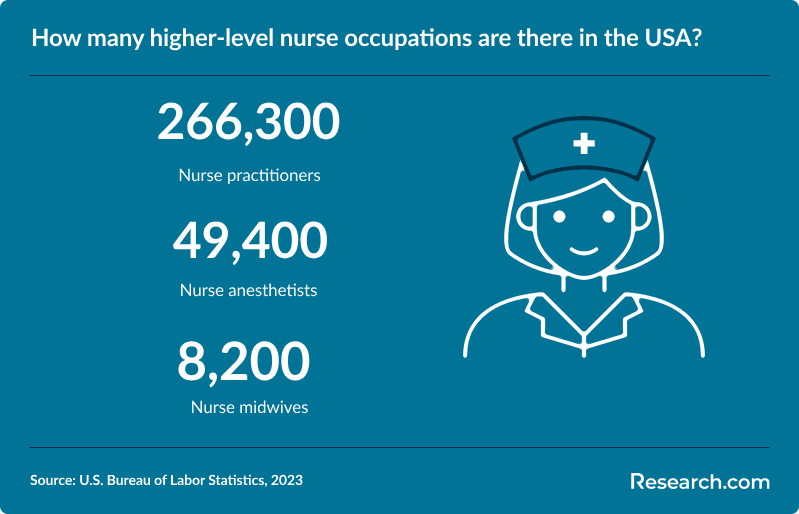
According to 2022 data from the U.S. Bureau of Labor Statistics, there were approximately 266,300 nurse practitioners, 49,400 nurse practitioners, and 8,200 nurse anesthetists as part of higher-level nurse occupations in the United States. The graphic below presents these higher-level nursing occupation figures and shows the scale of advanced nursing roles nationally.
Can a Compact nurse practice in Montana?
Yes. Montana participates in the Nurse Licensure Compact, so eligible nurses who hold a multistate compact license from another compact state can practice in Montana without applying for a separate single-state Montana license. This is especially important for travel nurses, telehealth nurses, military spouses, and clinicians serving rural or temporary staffing needs.
- Multistate practice access: A compact license allows eligible nurses to work across compact states, including Montana, without repeating the full licensure process in each state.
- More job flexibility: Compact privileges can help nurses respond to staffing needs in hospitals, clinics, home health, long-term care, and rural facilities.
- Residency still matters: Nurses must maintain legal residency in a compact state to keep a multistate license. Moving to a non-compact state can affect compact privileges and may require notification to the appropriate board.
- Enhanced safety standards: Montana operates under the Enhanced Nursing Licensure Compact, which includes requirements such as comprehensive background checks.
- Useful for rural access: Compact mobility can help employers fill urgent needs in remote regions where recruiting permanent staff is more difficult.
Compact practice does not mean “no rules.” Nurses working in Montana under compact privileges must follow Montana’s nurse practice laws and any employer-specific requirements. If you plan to move permanently to Montana, check whether you need to update your primary state of residence and license status.
Can you practice as a nurse without a license in Montana?
No. You cannot legally practice as a nurse in Montana without the proper nursing license or legal practice privilege. The Montana Nurse Practice Act limits nursing practice to individuals who hold the appropriate credential or compact privilege. Working outside those rules can place patients at risk and expose the individual to disciplinary, employment, and legal consequences.
- Licensure defines legal authority: A nursing title and scope of practice are protected. You must hold the correct credential before performing nursing functions.
- Patient safety is the priority: Licensing verifies that a nurse has completed required education, passed the necessary exam, and met public-safety screening requirements.
- Professional credibility depends on compliance: A nursing license represents accountability to state standards, ethical conduct, and continuing competence.
Foreign-trained nurses, including members of the 15% of the U.S. RN workforce from diverse international backgrounds, may need additional documentation, evaluation, examinations, or board review before practicing. The process can take time, so internationally educated nurses should start early and communicate directly with the Montana Board of Nursing.
-
: "
“When I came to Montana from the Philippines, I wanted to begin caring for patients right away, but I quickly learned that licensure had to come first. The paperwork, exams, and board requirements were demanding, yet they also clarified why the process exists. Practicing without a license was never an acceptable shortcut because patient safety and professional integrity were at stake.”
"
Can integrating pharmacy expertise expand career opportunities for nurses in Montana?
Pharmacy knowledge can strengthen a nurse’s work in medication reconciliation, patient teaching, chronic disease management, care coordination, and safety monitoring. Nurses who understand pharmacology deeply may be better positioned for roles in outpatient care, case management, quality improvement, behavioral health, long-term care, or interdisciplinary medication-management programs.
This does not mean every nurse should become a pharmacist. It means nurses who enjoy medication safety, patient counseling, and collaborative clinical decision-making may benefit from additional pharmacy-related education or a dual healthcare career plan. If you are considering that direction, review the steps for becoming a pharmacist in Montana.
What is the state of nursing in Montana?
Nursing in Montana is shaped by geography, workforce shortages, rural access challenges, an aging population, and the need for flexible care delivery. Nurses may find opportunities in urban hospitals, critical access hospitals, community clinics, tribal health organizations, long-term care facilities, public health, home health, school nursing, mental health services, and telehealth.
- Workforce demand: Montana is expected to need more RNs and LPNs as healthcare demand grows and experienced nurses retire. Rural communities often face the hardest recruitment and retention issues.
- Current workforce: Montana has approximately 20,000 licensed nurses, including RNs and LPNs serving communities across the state.
- Rural challenges: Smaller facilities may require nurses to work with broad clinical responsibility, limited specialty backup, and heavier staffing pressure. For some nurses, this means faster skill development; for others, it can increase burnout risk.
- Cost of living considerations: Living costs vary widely. Billings and Missoula may offer more employment options and higher wages, while rural areas may have lower housing costs but fewer employers.
- Industries hiring nurses: Hospitals, outpatient clinics, long-term care facilities, home health agencies, mental health settings, and telehealth services all rely on nurses in Montana.
The cost of living in Montana is relatively affordable compared with the national average. As shown in the graphic below, a single person can expect monthly spending of around $1,961, with housing and utilities representing the largest share at $1,203 and food costs around $562 per month.
What is the job outlook for nursing in Montana?
The job outlook for nurses in Montana is strong, especially for clinicians willing to work in rural communities, long-term care, home health, behavioral health, outpatient care, and advanced practice. According to the Montana Department of Labor and Industry, registered nurse demand is projected to grow by 12% from 2020 to 2030.
Registered nurses in Montana earn around $70,000 per year on average, but pay varies by region, setting, shift, and specialty. The article’s cited salary examples include the following top-paying metropolitan areas:
- Billings, where nurses can earn upwards of $75,000.
- Missoula, where salaries are around $72,000.
- Great Falls, where the average salary is approximately $68,000.
Higher-paying employment settings in Montana may include:
- Outpatient care centers, with salaries exceeding $80,000.
- Specialty hospitals, where earnings are around $78,000.
- Home health care services, where wages are typically around $70,000.
Advanced roles often pay more than entry-level roles. Nurse practitioners and clinical nurse specialists may earn over $90,000, while licensed practical nurses average around $50,000. These figures are not guarantees; individual offers depend on education, credentials, schedule, employer, experience, and local labor conditions.
National wage data also show large differences by nursing role. In 2022, the Bureau of Labor Statistics reported median annual pay of $195,610 for nurse anesthetists, $120,680 for nurse practitioners, $112,830 for nurse midwives, $77,600 for registered nurses, and $48,070 for licensed practical and vocational nurses. The median wage across all occupations was $45,760. The graph below compares those wage levels.
| Factor | Why it affects Montana nursing jobs | Question to ask before accepting a role |
| Location | Urban centers may offer more specialty roles, while rural areas may have greater staffing need | Will this location support my cost of living, commute, and lifestyle? |
| Setting | Hospitals, outpatient centers, home health, and long-term care can differ in workload and pay | What is the nurse-to-patient expectation and typical shift structure? |
| Specialty | Critical care, mental health, advanced practice, and specialty services may require added training | Does the employer provide orientation, precepting, or certification support? |
| Career ladder | Some employers support RN-to-BSN, MSN, certification, and leadership development | Will this job help me reach my next nursing credential or role? |
What options are available for LPN education in Montana?
LPN education can be a practical starting point for students who want to enter nursing sooner than a traditional RN pathway may allow. Montana LPN programs generally combine classroom learning, lab practice, and supervised clinical training. Before enrolling, verify state approval, NCLEX-PN preparation, clinical placement quality, program cost, schedule, and whether credits may transfer into an LPN-to-RN bridge program later.
Students comparing practical nursing pathways can review online LPN programs in Montana and evaluate whether each option provides the clinical training and licensing preparation required for practical nursing work.
What are alternative healthcare career options in Montana?
Nursing is not the only way to build a healthcare career in Montana. Some students prefer administrative, technical, or support roles that involve healthcare knowledge without direct bedside nursing responsibilities. Medical billing and coding is one option for people who are detail-oriented and interested in insurance claims, documentation, patient records, coding systems, compliance, and revenue cycle operations.
If you want healthcare work but are unsure about clinical nursing, compare responsibilities, training time, remote-work potential, and advancement options. A helpful starting point is this guide on becoming a medical biller and coder in Montana.
How Can LVNs Transition to Advanced Nursing Roles in Montana?
Licensed Vocational Nurses who want broader practice authority in Montana usually need to move toward RN preparation and then, if desired, graduate nursing education. Bridge programs can help experienced vocational or practical nurses build on prior clinical knowledge while completing the coursework and clinical requirements needed for RN licensure.
When comparing bridge options, confirm admission requirements, credit for prior nursing education, clinical placement locations, NCLEX-RN preparation, online versus campus expectations, and whether the program is accepted for Montana licensure. For early pathway planning, review how to become an LVN in Montana.
Can continuous professional development boost nurses' career growth in Montana?
Yes. Continuing professional development can help Montana nurses move into specialty care, charge nurse roles, precepting, quality improvement, public health, case management, leadership, informatics, education, or advanced practice. Professional growth is especially important in rural settings, where nurses may need broad competency and confidence across many patient needs.
Useful development options include specialty certifications, employer-sponsored training, workshops, conferences, graduate coursework, leadership programs, and online nursing programs that allow working nurses to keep earning while studying. Nurses exploring flexible degree options can compare the best online nursing programs in Montana.
What are the licensure renewal and continuing education requirements for nurses in Montana?
Montana nurses must renew their licenses periodically and complete required continuing education to maintain active practice authority. RNs and LPNs must renew every two years, complete 24 contact hours of continuing education, and pay a $100 renewal fee. APRNs have additional requirements, including specialized continuing education in pharmacology.
Do not wait until the renewal deadline to gather documentation. Keep records of completed courses, confirm that the education meets Montana requirements, and review current board instructions before submitting renewal materials. For a detailed breakdown, see the Montana nursing licensure requirements.
What mentorship and networking opportunities can enhance career advancement in Montana?
Mentorship can be especially valuable for new nurses, rural nurses, nurses changing specialties, and RNs planning graduate school. A strong mentor can help with clinical judgment, workplace communication, certification planning, leadership readiness, and decisions about specialty pathways.
Montana nurses can seek mentorship through employers, nursing faculty, professional associations, specialty conferences, alumni networks, clinical preceptors, and advanced practice groups. Students can also compare the best nursing schools in Montana to identify programs that emphasize advising, clinical support, and career development.
What are the prospects for nurse midwifery in Montana?
Nurse midwifery can be a meaningful pathway for nurses interested in pregnancy, childbirth, postpartum care, reproductive health, primary care, patient education, and community-based care. In a state with rural access challenges, nurse midwives may play an important role in improving continuity of maternal and reproductive healthcare.
This pathway requires advanced education, specialized clinical preparation, certification, and compliance with Montana licensure expectations. Students should look for programs with strong clinical placement support and mentorship in women’s health, birth settings, and rural or community care. For a focused career guide, review how to become a nurse midwife in Montana.
What are the best educational pathways for aspiring nurse practitioners in Montana?
Nurse practitioners are advanced practice nurses who can help expand access to primary care, mental health care, women’s health, acute care, and specialty services. In Montana, NP pathways are especially relevant for nurses who want to serve rural communities, practice with greater clinical responsibility, or move beyond bedside RN roles.
The right NP pathway depends on your current credential and specialty goal. An RN with a BSN may enter an MSN or DNP nurse practitioner program. An RN without a BSN may consider an RN-to-MSN route if eligible. A nurse interested in family practice, psychiatric-mental health, women’s health, acute care, or another population focus should choose a program aligned with the certification exam and patient population they intend to serve.
Program quality matters. Look for accreditation, clinical placement support, Montana licensure compatibility, faculty expertise, board certification preparation, and flexible scheduling if you plan to keep working. To compare state options, review the best NP programs in Montana.
| NP pathway | Best for | Decision factor |
| BSN-to-MSN NP | RNs with a BSN who want advanced practice preparation | Often a direct graduate route into NP certification preparation |
| RN-to-MSN NP | RNs without a BSN who want a bridge to graduate practice | Admissions rules and bridge coursework vary by school |
| DNP NP pathway | Nurses seeking doctoral-level clinical preparation | May be valuable for leadership, systems work, and advanced clinical practice goals |
| Post-master’s certificate | MSN-prepared nurses changing or adding specialties | Useful when the nurse already has graduate nursing preparation |
What are the nurse practitioner education requirements in Montana?
Montana nurse practitioner candidates must complete an accredited advanced nursing program that includes graduate-level coursework and supervised clinical training. Programs generally require a BSN or active RN license for admission and include advanced pathophysiology, pharmacology, assessment, evidence-based practice, and population-specific clinical preparation.
NP students must also complete documented clinical hours under qualified supervision and pass the relevant national certification examination for their specialty. For step-by-step requirements, review nurse practitioner education requirements in Montana.
What makes online psychiatric nurse practitioner programs a viable option in Montana?
Online psychiatric-mental health nurse practitioner programs can be useful for Montana nurses who need graduate education but cannot easily relocate or attend campus full time. This flexibility is especially relevant in rural areas where commuting to a university may be difficult. However, students must still complete clinical training, so placement support is one of the most important factors to verify.
Before choosing an online PMHNP program, confirm accreditation, Montana licensure compatibility, faculty support, psychiatric clinical placement requirements, board certification preparation, tuition, fees, and in-person intensive expectations. Cost-conscious students can compare the most affordable online PMHNP programs.
What financial aid opportunities are available for aspiring nurses in Montana?
Nursing students in Montana may be able to use federal financial aid, institutional scholarships, grants, employer tuition assistance, loan repayment programs, workforce scholarships, and aid connected to rural or underserved service commitments. Eligibility, deadlines, and award amounts vary, so students should contact school financial aid offices early and compare total program cost rather than tuition alone.
Career changers should ask whether prerequisites are covered by aid, whether accelerated programs qualify for federal aid, and whether online options support clinical placement near where they live. Students entering nursing from another field can also compare online RN programs for non-nurses as part of their financial and academic planning.
Common mistakes to avoid when becoming a nurse in Montana
| Mistake | Why it can hurt you | What to do instead |
| Choosing a program before checking approval or accreditation | You may finish coursework that does not support Montana licensure | Confirm approval with the Montana Board of Nursing and verify accreditation before enrolling |
| Focusing only on tuition | Fees, books, uniforms, background checks, commuting, and lost work hours can change the real cost | Build a full cost estimate for the entire program |
| Assuming online means fully remote | Nursing programs require clinical experiences, labs, or in-person components | Ask exactly where and how clinical placements are completed |
| Ignoring NCLEX outcomes and support | A low-support program can make licensure harder after graduation | Ask about exam preparation, tutoring, remediation, and faculty access |
| Assuming salary estimates are guaranteed | Pay varies by region, employer, specialty, shift, and experience | Compare local job postings and ask employers about wage scales |
| Waiting to plan advancement | You may need additional prerequisites or degrees for RN, BSN, MSN, or APRN goals | Choose a pathway that keeps future bridge or graduate options open |
What should you ask before choosing a Montana nursing program?
- Is the program approved for the Montana nursing license I want?
- Is the school institutionally accredited, and is the nursing program properly accredited or approved?
- What are the graduation, retention, and NCLEX support practices?
- Where are clinical placements located, and who arranges them?
- Can I complete the program while working, or is full-time study expected?
- What is the total cost, including fees, supplies, travel, background checks, uniforms, and exam costs?
- Does the school accept transfer credits or prior healthcare experience?
- Will this credential help me move into the next role I want, such as RN, BSN, MSN, NP, or nurse midwife?
- Does the program meet requirements if I later move to another state?
- What academic support, advising, mentorship, and career services are available?
What do nurses say about becoming a nurse in Montana?
- “Nursing in Montana changed how I think about community care. Patients often feel like neighbors, not anonymous cases, and that makes the work personal. I have cared for multiple generations in the same family, which gives the job a deeper sense of responsibility. The landscape is beautiful, but the relationships are what keep me committed.” Janette
- “I came to Montana because I wanted variety, and I found it. One day may involve caring for a rancher, the next a visitor passing through, and the next a long-time local patient with complex needs. Smaller facilities gave me hands-on experience quickly, and the teamwork among staff has been one of the strongest parts of the job.” Eugene
- “For me, Montana offers both professional opportunity and personal balance. Rural areas need healthcare workers, so motivated nurses can find ways to grow, specialize, and take on responsibility. Being able to build my career while still enjoying the outdoors has made the path worthwhile.” Monique
Related Articles for Nearby States
- 2027 How to Become a Nurse in Idaho
- 2027 How to Become a Nurse in Wyoming
- 2027 How to Become a Nurse in North Dakota
- 2027 How to Become a Nurse in South Dakota
- 2027 How to Become a Nurse in Washington
- 2027 How to Become a Nurse in Oregon
- 2027 How to Become a Nurse in Utah
- 2027 How to Become a Nurse in Nebraska
- 2027 How to Become a Nurse in Minnesota
- 2027 How to Become a Nurse in Colorado
Key Insights
- Montana nurses must complete approved education, pass the correct licensing exam, apply through the Montana Board of Nursing, and maintain continuing education for renewal.
- The best pathway depends on your goal: LPN for faster entry, ADN or BSN for RN practice, and MSN or DNP preparation for nurse practitioner, nurse midwife, nurse anesthetist, or clinical nurse specialist roles.
- Montana participates in the Nurse Licensure Compact, so eligible multistate license holders can practice in Montana, but they must still follow Montana nursing laws.
- You cannot legally practice nursing in Montana without the proper license or compact privilege.
- Rural healthcare demand creates opportunity, but students should compare workload, support, pay, cost of living, and advancement options before accepting a position.
- Online nursing programs can be useful, but clinical placement, state approval, accreditation, and licensure compatibility must be verified before enrollment.
- Do not choose a nursing school based only on speed or tuition. The stronger decision is the program that supports licensure, NCLEX preparation, clinical readiness, affordability, and your next career step.
Resources:
- Bureau of Labor Statistics. (2023, September 6). Occupational outlook handbook - Nurse anesthetists, nurse midwives, and nurse practitioners. Bureau of Labor Statistics.
- Journal of Nursing Regulation. (2023). The 2022 National Nursing Workforce Survey. Journal of Nursing Regulation.
- LivingCost.org. (2024). Cost of living & prices in Montana: 34 cities compared. LivingCost.org.
- Montana Board of Nursing. (2024). Nursing licensure in Montana. Montana Board of Nursing.
- Nurse.org. (2024). Enhanced nurse licensure compact (eNLC). Nurse.org.
- Wiley Online Library. (2021). From imperialism to inpatient care: Work differences of Filipino and White registered nurses in the United States and implications for COVID‐19 through an intersectional lens. Wiley Online Library.
Other Things You Should Know About Becoming a Nurse in Montana
To start a nursing program in Montana in 2027, you typically need a high school diploma or GED, completion of prerequisite courses like anatomy and physiology, and sometimes, a background check. Requirements can vary by institution, so check specific program details.
To become a nurse in Montana in 2027, first, complete an accredited nursing program for an ADN or BSN. Pass the NCLEX-RN exam, obtain state licensure from the Montana Board of Nursing, and pursue any necessary specialty certifications. Continuous education is important for maintaining licensure.


