
2027 Georgia Nursing License Requirements

Co-Founder and Chief Data Scientist
Getting a Georgia nursing license is the step that turns nursing school into legal nursing practice. Whether you are applying for your first RN or LPN license, moving to Georgia from another state, renewing an existing license, or planning an advanced practice role, the key decisions are the same: choose the right education pathway, meet Georgia Board of Nursing requirements, pass the required exam, submit a complete application, and keep your license active after approval.
This guide explains how Georgia nursing licensure works, what credentials are available, how much time and money to budget, how renewal works, what out-of-state nurses should know, and how to compare programs before enrolling. It is written for nursing students, career changers, current nurses relocating to Georgia, and licensed nurses planning career advancement.
Quick answer: How do you become licensed as a nurse in Georgia?
To become licensed as a nurse in Georgia, you generally need to graduate from an approved nursing program, complete the required clinical training, pass the appropriate NCLEX exam, submit an application to the Georgia Board of Nursing through the Georgia Secretary of State’s system, complete fingerprinting and a criminal background check, and provide required documents such as official transcripts and proof of citizenship or legal residency.
| Licensure topic | What Georgia applicants should know |
| Licensing exam | RN candidates must pass the NCLEX-RN. The first-time test-taker pass rate in 2022 was approximately 87%. |
| Licensing authority | The Georgia Board of Nursing regulates nursing licensure and practice standards in the state. |
| Core requirements | Applicants need an accredited nursing degree, a criminal background check, and proof of citizenship or legal residency. |
| Application | The online application is submitted through the Georgia Secretary of State’s website and requires a fee of $40 plus official transcripts. |
| Georgia workforce context | As of May 2023, Georgia had 93,730 registered nurses, with an annual mean wage of $US 90,000. |
- What is a Georgia nursing license and why is it required?
- What nursing license types are available in Georgia?
- What are the requirements for a Georgia nursing license?
- How do you apply for a nursing license in Georgia?
- How often do Georgia nurses renew their licenses?
- How much does it cost to become a nurse in Georgia?
- Can a compact nurse practice in Georgia?
- What advanced practice opportunities can improve a nursing career in Georgia?
- Can accelerated pathways help you become a nurse practitioner faster?
- What job market trends affect nurses in Georgia?
- Is an accelerated RN program a practical option in Georgia?
- What alternative healthcare licenses can strengthen your career options?
- What careers can an LPN license lead to in Georgia?
- Can complementary healthcare certifications expand nursing career options?
- Which online nursing programs in Georgia support career advancement?
- What are the requirements to become a nurse midwife in Georgia?
- How can you become an LVN in Georgia?
- How can nurses licensed in other states obtain a Georgia license?
- What tips and resources help with the Georgia nursing licensing exam?
- How long does it take to become an RN in Georgia?
- What nursing schools in Georgia can help you reach your goals?
- What financial aid options are available for Georgia nursing students?
What is a Georgia nursing license and why is it required?
A Georgia nursing license is the legal authorization to practice nursing in the state. It confirms that a nurse has completed the required education, met state eligibility standards, passed the appropriate licensing exam, and is accountable to the Georgia Board of Nursing.
The license matters because nursing is a regulated profession. Nurses make clinical judgments, administer medications, monitor patient conditions, document care, and communicate with physicians, patients, and families. Georgia uses licensure to protect patients and ensure that only qualified individuals provide nursing care.
| Why licensure matters | How it affects nurses and patients |
| Patient safety | Licensure sets minimum education, examination, and conduct standards for nurses providing care. |
| Professional accountability | The Georgia Board of Nursing can review complaints, enforce regulations, and require nurses to follow professional standards. |
| Employment eligibility | Hospitals, clinics, long-term care facilities, home health agencies, and other employers typically require an active nursing license. |
| Career mobility | Licensure is the foundation for advanced roles, endorsement from another state, and compact practice privileges when eligible. |
Georgia recognizes multiple nursing roles, including licensed practical nurses, registered nurses, and advanced practice registered nurses. Each role has a different scope of practice, education expectation, and career ceiling. If you are comparing nursing specialties, salary potential can also vary by role and state; for example, Research.com explains how much does a neonatal nurse make for readers exploring neonatal nursing pathways.
What nursing license types are available in Georgia?
Georgia offers several nursing licensure pathways. The right choice depends on how quickly you want to enter the workforce, how much responsibility you want, whether you plan to pursue graduate education, and what kind of clinical setting you want to work in.
| License type | Typical education | General role | Best fit for |
| Licensed Practical Nurse (LPN) | State-approved practical nursing program, typically about one year | Provides basic nursing care, supports daily living activities, administers certain medications, and works under RN or physician supervision | Students who want a faster route into direct patient care and may later bridge to RN study |
| Registered Nurse (RN) | Associate Degree in Nursing (ADN) or Bachelor of Science in Nursing (BSN) | Assesses patients, develops care plans, coordinates care, educates patients, and performs broader clinical responsibilities | Students seeking more responsibility, wider job options, and stronger long-term advancement potential |
| Advanced Practice Registered Nurse (APRN) | Graduate nursing education and advanced clinical preparation | Includes nurse practitioners, clinical nurse specialists, nurse anesthetists, and nurse midwives | Experienced nurses who want advanced clinical authority, specialization, and leadership opportunities |
The LPN route can be a practical entry point, but it has a narrower scope than RN practice. The RN route takes longer but opens more clinical settings and advancement options. APRN roles require additional education beyond RN licensure and are designed for nurses who want advanced diagnosis, treatment, prescribing, specialty care, or leadership responsibilities. Nurses interested in family practice may compare accelerated graduate routes such as a 12-month FNP program online, but they should verify accreditation, clinical placement support, and state authorization before enrolling.
NNPs with less than five years’ experience earn a mean salary of $119,000 per year, while more experienced NNPs with more than 30 years of experience earn a mean salary of $134,000 per year, as shown in the following graphic.

Not every healthcare role requires the same education or carries the same pay level. In 2022, the median annual wage for orderlies, who often assist nurses and other care staff, was $34,520. This illustrates why many students choose licensure-based nursing roles when they want a clearer clinical scope and stronger earning potential.
What are the requirements for a Georgia nursing license?
Georgia nursing license requirements depend on the license type, but most applicants must meet education, clinical training, examination, identity, and background-check standards. For RN licensure, candidates usually complete an approved nursing program and then pass the NCLEX-RN. For practical nursing, candidates complete an approved practical nursing program and pass the NCLEX-PN.
Core requirements for RN applicants
- Graduate from an accredited or approved nursing program.
- Complete a qualifying nursing education pathway, such as an Associate Degree in Nursing, Bachelor of Science in Nursing, or approved diploma program.
- Complete required clinical training, including a minimum of 500 clinical hours in settings such as hospitals, clinics, and long-term care facilities.
- Apply to the Georgia Board of Nursing.
- Submit official transcripts and required identity documentation.
- Complete fingerprinting and a criminal background check.
- Pass the NCLEX-RN before licensure is issued.
Education is the first major checkpoint. An ADN can prepare students for RN licensure in a shorter timeline, while a BSN may be preferred by some employers and can support future graduate study. Diploma programs from approved nursing schools may also qualify when they meet state requirements.
The licensing exam is the next major checkpoint. The NCLEX-RN tests whether a graduate can make safe entry-level nursing decisions. It is not simply a memory test; candidates are evaluated on clinical judgment, prioritization, safety, and patient-centered care.
Career demand for advanced nursing roles has grown as well. Nurse practitioners in the U.S. doubled from approximately 91,000 to 190,000 between 2010 and 2017. RNs who plan to move into advanced practice later may want to compare graduate options early, including the best shortest online MSN programs, while confirming that any program matches their licensure and certification goals.
How do you apply for a nursing license in Georgia?
The Georgia nursing license application process is straightforward when your documents are ready, but delays can happen if transcripts, fingerprints, background checks, or exam registration are incomplete. Applicants should treat licensure as a checklist-driven process rather than a single form.
Georgia nursing license application steps
- Complete an approved nursing education program that matches the license you are seeking.
- Create or access your account through the Georgia Secretary of State’s online licensing system.
- Submit the Georgia Board of Nursing application with your personal, education, and eligibility information.
- Pay the required application fee. The application fee listed for a Georgia nursing license is approximately $40.
- Request official transcripts from your nursing program.
- Complete fingerprinting and the required criminal background check.
- Register for the NCLEX-RN or NCLEX-PN, depending on the license type.
- Wait for authorization and Board review before scheduling or completing final exam steps.
| Application item | Why it matters | Common delay to avoid |
| Online application | Starts Board review and creates your official licensing record | Submitting with missing or inconsistent information |
| Official transcript | Confirms completion of an approved nursing program | Uploading unofficial documents when official records are required |
| Fingerprinting | Supports the criminal background check requirement | Waiting until the last minute to schedule fingerprinting |
| NCLEX registration | Connects your exam eligibility to the licensing process | Assuming the school application and exam registration are the same process |
| Fees | Application and third-party processing fees must be paid before review can move forward | Budgeting only for tuition and forgetting licensure costs |
Applicants who are already thinking beyond RN licensure may also compare graduate nursing costs and program formats. Research.com’s guide to the cheapest online nurse practitioner programs can help nurses evaluate affordability when planning a future NP pathway.
How often do Georgia nurses renew their licenses?
Georgia nursing licenses must be renewed every two years. Renewal is different from initial licensure: instead of proving basic eligibility for the first time, licensed nurses must show that they remain in good professional standing and have completed required continuing education.
Georgia nursing license renewal requirements
- Renewal cycle: Nursing licenses in Georgia are renewed every two years.
- Continuing education: Nurses must complete at least 30 hours of continuing education during each renewal period.
- Online renewal: Renewal is completed through the Georgia Secretary of State’s website with the required fee.
- Background review: A background check may be required, especially if the nurse’s legal or disciplinary status has changed.
Missing renewal can create serious career problems. A nurse without an active license may be unable to practice legally, continue employment, or move smoothly into a new job. Renewal should be tracked well before the deadline, especially for nurses working rotating shifts or managing multiple credentials.
| Renewal task | Best practice |
| Continuing education | Complete credits throughout the two-year cycle instead of rushing near the deadline. |
| Documentation | Keep certificates and records in case you need to verify completion. |
| Online renewal | Confirm your login information early and check that your contact information is current. |
| Career planning | Use continuing education strategically by choosing topics related to your specialty or advancement goals. |
Some nurses use renewal periods as a planning point for career growth. If you want to move into higher-level roles quickly, an accelerated BSN program online may be worth comparing, especially if you already have college credit and want a faster route to a BSN.
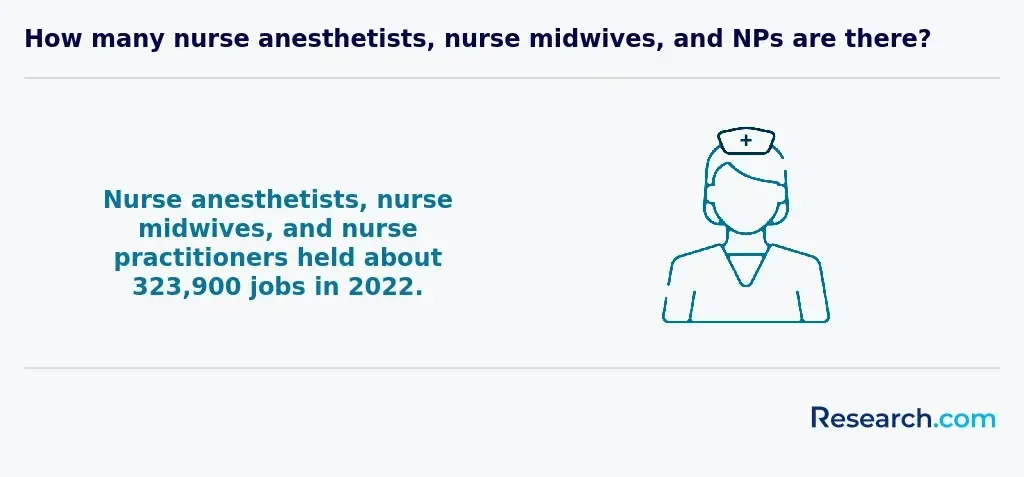
For broader workforce context, there were 339,000 jobs held by nurse anesthetists, nurse midwives, and NPs in 2022, as shown in the following graphic.
How much does it cost to become a nurse in Georgia?
The cost of becoming a nurse in Georgia depends mostly on the credential you pursue, the school you attend, whether you qualify for in-state tuition, and how many credits you can transfer. Students should also budget for licensing, testing, uniforms, textbooks, clinical supplies, transportation, and background checks.
| Cost category | Typical amount stated | Planning note |
| Associate Degree in Nursing | $6,000 to $20,000 | Often a lower-cost RN pathway, especially at public or community colleges. |
| Bachelor of Science in Nursing | $20,000 to $70,000 | Usually takes longer but may support broader hiring and graduate-school options. |
| Licensure application fee | Approximately $75 | Applicants should verify current fees before applying because licensing costs can change. |
| NCLEX-RN exam fee | $200 | This is separate from school tuition and state application costs. |
| Fingerprinting and background checks | $50 to $100 | Costs vary by provider and processing requirements. |
| Books, uniforms, and clinical supplies | $1,000 to $3,000 | These are common out-of-pocket expenses that students often underestimate. |
Students comparing costs should look beyond tuition. A lower-tuition program may still be expensive if it has weak transfer policies, limited clinical placements, long commute requirements, or poor exam support. On the other hand, a higher-cost BSN may be more practical if it offers strong clinical partnerships and better alignment with your long-term goals.
If your goal is advanced practice, graduate nursing expenses can add substantially to the total investment. For a more focused cost discussion, see Research.com’s guide to how much does it cost to become a nurse practitioner in Georgia.
Can a compact nurse practice in Georgia?
Yes. Georgia participates in the Nurse Licensure Compact, which allows eligible RNs and LPNs/VNs with a compact license from another participating state to practice in Georgia without obtaining a separate Georgia-only license. The NLC was enacted in 2000 and currently includes 39 states.
Georgia joined the NLC on July 1, 2020. To use compact privileges, a nurse must hold an active, unencumbered license in the nurse’s primary state of residence and meet compact eligibility requirements, including passing the NCLEX-RN or NCLEX-PN exam.
| Situation | What to consider |
| You live in another compact state and want to work in Georgia | You may be able to practice under your multistate compact license if you meet NLC rules. |
| You move your primary residence to Georgia | You may need to apply for Georgia licensure because compact privileges are tied to primary state of residence. |
| You have a single-state license | You cannot assume compact privileges apply; verify whether you need Georgia licensure by endorsement. |
| You work telehealth across state lines | Confirm the patient’s location, compact rules, employer policy, and state practice requirements. |
What advanced practice opportunities can improve a nursing career in Georgia?
Advanced practice nursing can lead to greater clinical autonomy, specialized patient care, leadership opportunities, and stronger earning potential. In Georgia, common APRN pathways include nurse practitioner, clinical nurse specialist, nurse anesthetist, and nurse midwife roles. These paths require graduate-level preparation, advanced clinical training, and role-specific certification.
Advanced practice is best suited for nurses who want deeper responsibility rather than only a higher title. APRNs often evaluate patients, manage complex conditions, prescribe or support medication management within their legal scope, and collaborate with physicians and healthcare teams. If this direction fits your goals, compare accredited nurse practitioner programs in Georgia based on clinical placement support, specialization options, certification pass preparation, and state authorization.
Can accelerated pathways help you become a nurse practitioner faster?
Accelerated nurse practitioner pathways can be useful for experienced RNs who are ready for intensive graduate study and already have the academic foundation to move quickly. These programs compress coursework and clinical preparation into a shorter period, which can reduce time away from advancement but may increase weekly workload.
| Accelerated NP pathway may fit if... | It may not fit if... |
| You can manage demanding coursework while completing clinical requirements. | You need a slower pace because of work, caregiving, or financial limits. |
| You already know which NP population focus you want. | You are unsure whether advanced practice is the right long-term goal. |
| Your employer supports schedule flexibility for school and clinical rotations. | You cannot reliably attend clinical placements or required in-person experiences. |
| You have verified accreditation and certification alignment. | You are choosing mainly because the program sounds fast. |
Online options such as 1-year nurse practitioner programs online can be attractive, but speed should not be the only factor. Before enrolling, confirm clinical placement expectations, required campus visits, certification eligibility, and whether the program is authorized for students in Georgia.
What job market trends affect nurses in Georgia?
Georgia’s nursing job market is shaped by patient demand, workforce shortages in some communities, growth in outpatient and home-based care, and the need for specialized nurses in both urban and rural settings. For nurses, this means opportunity—but not automatic job security in every specialty, schedule, or location.
As of May 2023, Georgia had 93,730 registered nurses, and the annual mean wage was $US 90,000. Actual pay varies by employer, shift, specialty, experience level, region, and education. Nurses who want to improve mobility should build marketable skills in areas such as acute care, care coordination, informatics, patient education, chronic disease management, and specialty certification.
If you are still mapping your entry path, Research.com’s step-by-step career guide on how to become a nurse in Georgia can help you connect education choices with licensing and employment goals.
Is an accelerated RN program a practical option in Georgia?
An accelerated RN program can be a smart option for motivated students who already have college experience or a bachelor’s degree in another field and want to enter nursing faster. These programs are usually intensive and combine science coursework, nursing theory, skills labs, and clinical rotations in a compressed format.
The trade-off is workload. Accelerated programs can shorten the calendar, but they do not remove the need to master patient safety, pharmacology, assessment, clinical judgment, and hands-on care. Before choosing this route, ask whether you can reduce work hours, commute to clinical sites, afford a faster-paced program, and maintain enough study time for the NCLEX.
Students comparing fast options can review an easy 1 year accelerated RN nursing degree online, while remembering that licensure depends on program approval, clinical completion, and exam success—not just program speed.
What alternative healthcare licenses can strengthen your career options?
Some nurses expand their careers by adding credentials outside traditional nursing. This can make sense when the added license supports a clear goal, such as medication expertise, healthcare operations, compliance, administration, or interdisciplinary care. It is less useful when pursued only to collect credentials without a career plan.
For example, pharmacy licensure is a separate and demanding pathway, but it may interest professionals who want deeper involvement in medication management and treatment planning. Nurses considering a major career pivot can review how to become a licensed pharmacist in Georgia to understand the requirements before committing time and money.
What careers can an LPN license lead to in Georgia?
An LPN license can lead to direct patient care roles in long-term care, outpatient clinics, home health, rehabilitation, and similar settings. It is often a faster entry point than RN licensure because practical nursing programs are shorter, typically about one year.
The LPN path is especially practical for students who want to start working sooner, gain bedside experience, and later decide whether to bridge to RN education. However, LPNs usually have a more limited scope of practice than RNs and may face fewer advancement options without additional schooling.
If you are comparing LPN eligibility, training, and licensing steps, see What are the requirements to become a LPN in Georgia? for a more focused pathway guide.
Can complementary healthcare certifications expand nursing career options?
Complementary healthcare certifications can help nurses move into hybrid roles that combine clinical knowledge with documentation, compliance, billing, operations, or administrative support. These credentials are most valuable when they match a job target, such as utilization review, coding support, care coordination, clinic management, or revenue cycle work.
For nurses interested in documentation and reimbursement systems, a medical billing and coding certification in in Georgia may add useful knowledge of coding, claims, compliance, and healthcare data. It should be viewed as a career supplement, not a replacement for maintaining nursing competence and licensure.
Which online nursing programs in Georgia support career advancement?
Online nursing programs can be helpful for working nurses who need flexibility, but students should evaluate them carefully. Nursing is not fully online when clinical training or skills practice is required. Many programs use hybrid formats that combine online coursework with in-person labs, practicums, or local clinical placements.
| What to check before enrolling | Why it matters |
| Accreditation and state approval | Licensure, financial aid, employer acceptance, and graduate-school eligibility may depend on it. |
| Clinical placement support | Students may struggle if they are expected to find clinical sites alone. |
| Georgia authorization | Online programs must be allowed to serve students in your state and support your licensure goal. |
| NCLEX or certification preparation | Strong exam support can affect readiness for licensure or advanced certification. |
| Schedule format | Asynchronous classes may fit shift workers better than fixed live sessions. |
To compare flexible options, review the top online nursing programs in Georgia and focus on fit, approval, clinical requirements, and student support rather than rankings alone.
What are the requirements to become a nurse midwife in Georgia?
To become a nurse midwife in Georgia, you first need an active RN license. After that, candidates complete a graduate-level nurse midwifery program with advanced didactic and clinical preparation, pass the required national certification examination for nurse midwives, and meet Georgia’s applicable regulatory and background-check requirements.
This pathway is best for nurses who want to care for patients through reproductive health, pregnancy, birth, postpartum care, and related services. Because nurse midwifery has specific certification and practice requirements, applicants should verify program accreditation and state eligibility before enrolling. Research.com’s guide to the educational requirements for a nurse midwife in Georgia provides more detail for this specialty route.
How can you become an LVN in Georgia?
Georgia commonly uses the term Licensed Practical Nurse, while Licensed Vocational Nurse is a term used in some other states. If you are searching for LVN information in Georgia, you are generally looking for the practical nursing pathway.
To qualify, applicants complete a state-approved practical or vocational nursing program that meets Georgia Board of Nursing standards, finish required clinical training, and pass the NCLEX-PN. The most important step is verifying that the program is properly approved for Georgia licensure before you enroll. For a focused explanation, see how to become an LVN in Georgia.
How can nurses licensed in other states obtain a Georgia license?
Nurses who already hold a license in another state may be able to obtain Georgia licensure by endorsement. This route allows qualified nurses to seek a Georgia license without retaking the NCLEX, as long as they meet Georgia’s requirements and submit proper verification.
Endorsement requirements for U.S.-licensed nurses
- Hold a valid nursing license from another U.S. state or territory.
- Submit the Georgia Board of Nursing endorsement application and required fee.
- Provide license verification from the state that issued the current license.
- Complete the required criminal background check and fingerprinting.
Additional steps for foreign-educated nurses
- Have nursing education evaluated by a recognized credentialing agency to determine whether it meets Georgia standards.
- Pass the NCLEX-RN if it has not already been completed.
- Show English proficiency, commonly through a standardized exam such as the TOEFL.
Endorsement applicants should not resign from a current job or begin work in Georgia until they understand their authorization status. Compact privileges may apply for some nurses, but endorsement may still be needed when Georgia becomes the nurse’s primary state of residence.
What tips and resources help with the Georgia nursing licensing exam?
The NCLEX is one of the most important steps in the Georgia nursing licensure process. Passing requires more than rereading textbooks. Candidates need a structured plan that builds clinical judgment, prioritization skills, and comfort with exam-style questions.
Practical NCLEX preparation tips
- Start with the test plan: Use official NCLEX guidance to understand what content areas and decision-making skills are tested.
- Build a study calendar: Assign review blocks for pharmacology, safety, management of care, health promotion, and clinical judgment.
- Practice questions daily: Review rationales for both correct and incorrect answers so you learn how the exam expects you to think.
- Simulate test conditions: Timed practice helps reduce anxiety and improves stamina.
- Use your school’s support: Faculty, review courses, tutoring, and predictor exams can help identify weak areas before test day.
- Join peer support carefully: Study groups can help, but they should stay focused and evidence-based.
Professional organizations such as the Georgia Nurses Association can also help nurses stay connected to continuing education, mentorship, networking, and policy updates. The National Council of State Boards of Nursing offers NCLEX-related information and exam resources for candidates.
| Common NCLEX mistake | Better approach |
| Memorizing facts without practicing clinical judgment | Use case-style questions and focus on why one action is safest or highest priority. |
| Studying only favorite topics | Use practice results to target weak areas, even when they are uncomfortable. |
| Waiting too long after graduation | Keep momentum while nursing content and clinical routines are still fresh. |
| Ignoring test anxiety | Practice timed exams, sleep routines, breathing strategies, and realistic test-day planning. |
Registered nurse pay also varies by employment sector. According to the U.S. Bureau of Labor Statistics, the highest-paying industries for RNs in the U.S. include government at $99,840 annually, followed by hospitals, including state, local, and private hospitals, at $88,430. Ambulatory healthcare services average $81,230 per year, nursing and residential care facilities average $79,280, and educational services, including state, local, and private employers, average $71,550. These differences are shown in the graph below.
How long does it take to become an RN in Georgia?
Becoming a registered nurse in Georgia usually takes two to four years, depending on the education pathway. An Associate Degree in Nursing generally takes two years, while a Bachelor of Science in Nursing generally takes four years. After graduation, candidates must pass the NCLEX-RN and complete the Georgia licensing process before practicing as an RN.
| Pathway | Typical time | What to consider |
| ADN to RN | Two years | Often faster and less expensive, but some employers may prefer or require a BSN. |
| BSN to RN | Four years | Longer and often more expensive, but may support broader hiring and graduate education. |
| Accelerated RN pathway | Varies by program | Can be faster for qualified students but usually requires a heavy academic and clinical workload. |
| LPN-to-RN bridge | Varies by transfer credit and program design | May help working LPNs advance while building on prior nursing education. |
NCLEX outcomes vary by candidate group and education background. According to the National Council of State Boards of Nursing, 2022 NCLEX pass rates were 79.9% for U.S.-educated graduates, 43.74% for repeat test-takers, and 43.18% for international test-takers. U.S. bachelor’s degree graduates had a 90.3% pass rate, compared with 82.8% for U.S. associate degree graduates. These results are shown in the following chart.
What nursing schools in Georgia can help you reach your goals?
The best nursing school in Georgia is not automatically the one with the biggest name. It is the program that is approved for your licensure goal, fits your budget and schedule, offers strong clinical experiences, prepares students for the NCLEX, and supports the type of nursing career you want.
Questions to ask before choosing a Georgia nursing program
- Is the program approved for Georgia nursing licensure?
- Is the program properly accredited?
- What degree or credential will I earn?
- How many clinical hours are required, and where are clinical placements located?
- What support is available for NCLEX preparation?
- What are the total costs, including fees, supplies, transportation, and testing?
- Can I transfer prior credits?
- Does the schedule fit my work and family responsibilities?
- Do graduates commonly work in the settings or specialties I am targeting?
Students comparing options can start with Research.com’s list of the best nursing schools in Georgia, then verify program details directly with each school and the Georgia Board of Nursing before making a final decision.
What financial aid options are available for Georgia nursing students?
Nursing school can be expensive, but financial aid can reduce out-of-pocket costs if students apply early and compare all available sources. The best strategy is to combine federal aid, state programs, institutional scholarships, employer support, and nursing-specific awards when eligible.
| Financial aid option | How it can help nursing students |
| HOPE Scholarship and Grant Program | Georgia’s HOPE Scholarship and HOPE Grant provide support for eligible students attending in-state colleges and universities, including students in associate and bachelor’s nursing programs. |
| Nursing Student Loan Repayment Program | The NSLRP offers loan repayment assistance to qualified nursing professionals who commit to working in underserved or rural areas of Georgia. |
| Federal financial aid | FAFSA completion can open access to federal grants, loans, and work-study. The Pell Grant is need-based aid that does not require repayment. |
| Nursing scholarships | Organizations such as the Georgia Nurses Association and local healthcare foundations may offer scholarships for nursing students with specific academic, service, or career commitments. |
Common mistakes to avoid when pursuing a Georgia nursing license
- Choosing a program without checking approval: Always verify that the nursing program supports Georgia licensure.
- Looking only at tuition: Include books, uniforms, supplies, testing, transportation, application fees, and background-check costs.
- Assuming online means fully remote: Nursing programs often require clinical placements, labs, or in-person assessments.
- Waiting to plan for the NCLEX: Exam preparation should begin during school, not after graduation.
- Ignoring renewal requirements: Track continuing education and renewal deadlines before your license is close to expiring.
- Assuming compact rules apply automatically: Compact eligibility depends on your license status and primary state of residence.
- Relying only on rankings: Rankings can help you start research, but program approval, clinical quality, affordability, and fit matter more.
Key Insights
- A Georgia nursing license is required to practice legally and is regulated by the Georgia Board of Nursing.
- RN candidates typically complete an ADN, BSN, or approved diploma program, satisfy clinical requirements, pass the NCLEX-RN, and complete background-check requirements.
- Georgia nursing licenses renew every two years, and nurses must complete at least 30 hours of continuing education during each renewal period.
- Georgia participates in the Nurse Licensure Compact, but nurses should confirm whether compact privileges or endorsement applies to their situation.
- Program choice matters. Before enrolling, verify approval, accreditation, clinical placement support, total cost, transfer policies, and exam preparation resources.
- Accelerated and online programs can be useful, but only when they meet licensure requirements and fit your schedule, finances, and clinical obligations.
- Financial aid, scholarships, employer support, and loan repayment options can reduce nursing education costs, especially for students willing to serve high-need communities.
Related Articles for Nearby States
- 2027 South Carolina Nursing License Requirements
- 2027 Florida Nursing License Requirements
- 2027 Alabama Nursing License Requirements
- 2027 Tennessee Nursing License Requirements
- 2027 North Carolina Nursing License Requirements
- 2027 Mississippi Nursing License Requirements
- 2027 Kentucky Nursing License Requirements
- 2027 Virginia Nursing License Requirements
- 2027 Louisiana Nursing License Requirements
- 2027 West Virginia Nursing License Requirements
References:
- Snapp, B., Moore, T., Wallman, C., & Staebler, S. (2021). 2020 Neonatal Nurse Practitioner Workforce Survey. Advances in Neonatal Care, 21, 242 - 246. Advances in Neonatal Care.
- U.S. Bureau of Labor Statistics. (2023, September 6). Occupational outlook handbook - Nursing assistants and orderlies. U.S. Bureau of Labor Statistics.
Other Things You Should Know About Nursing Licenses in Georgia
The Georgia Board of Nursing does not publish a fixed processing time for every application. Most licenses are issued after the application, fee, fingerprints, and verification documents are received and reviewed by the Board. Delays are common when transcripts, test results, or background check results are incomplete.
To apply for a Georgia nursing license in 2027, you must graduate from an accredited nursing program, pass the NCLEX-RN exam, and submit a completed application to the Georgia Board of Nursing. You are also required to undergo a criminal background check before receiving your license.
In 2027, Georgia nurses must complete 30 hours of continuing education every two years for license renewal. These hours must be approved and cover relevant nursing topics. The Georgia Board of Nursing provides guidelines on eligible courses and approved providers.


