
2027 Fastest Online MBA Programs in Sustainability

Co-Founder and Chief Data Scientist
As a career and education expert, I recognize your ambition to enter the sustainability-focused business world quickly through an accelerated online MBA. However, the path to finding the right program is often cluttered with misleading information. You'll encounter a mix of specialized master's programs and traditional MBAs, with vague claims about completion times that can be difficult to verify.
Distinguishing between programs that offer a genuine, deep dive into sustainability principles and those that simply offer a superficial overview presents another significant hurdle. My purpose is to provide you with the essential insights to cut through this confusion and identify a genuinely fast, high-quality program that serves your professional goals.
What are the benefits of getting a fast online MBA in Sustainability?
- Career Advancement: An MBA in Sustainability opens doors to leadership roles in corporate social responsibility (CSR), sustainable finance, and environmental, social, and governance (ESG) strategy, fields with growing demand and significant impact.
- Peak Earning Potential: ESG Analyst and Sustainability Manager have median salaries between $85,000 and $125,000, with top earners in senior corporate or experienced consulting positions commanding well over $175,000 annually.
- Flexible & Accelerated Path: Online programs offer the ability to earn your degree quickly, often through accelerated 8-week courses, while managing current work and family commitments.
What can I expect from the fastest online MBA in Sustainability programs?
- Concentrated Business Core: Expect foundational courses in finance, accounting, business law, and marketing, all viewed through the lens of sustainability.
- Specialized Sustainability Topics: In-depth study of key areas such as sustainable supply chain management, ESG reporting, impact investing, and renewable energy finance.
- Real-World Application: The curriculum often includes case studies on corporate sustainability initiatives, market analysis projects for green technologies, and simulations of ESG integration into business strategy.
- Condensed Program Timeline: Accelerated formats are designed to help you complete a master's degree in a shorter timeframe than traditional programs.
- Industry-Expert Instructors: Learn from faculty who are often experienced sustainability consultants, CSR executives, and ESG analysts, bringing practical, current market knowledge to the virtual classroom.
Where can I work with a fast online MBA in Sustainability?
- Corporate Sustainability Departments: Manage the sustainability initiatives of large corporations, handling everything from carbon footprint reduction to ethical sourcing and stakeholder engagement.
- Consulting Firms: Work for specialized sustainability consulting firms or the sustainability practices of major consulting companies, advising clients on ESG strategy and implementation.
- Investment Firms and Financial Institutions: Pursue roles in impact investing, sustainable finance, or as an ESG analyst for asset management firms and investment banks.
- Non-Profit and Government Agencies: Lead sustainability-focused initiatives in the public and non-profit sectors, working on policy, advocacy, and community development.
- Clean Energy and Technology Companies: Join the fast-growing clean-tech sector in roles ranging from project management and finance to marketing and business development.
How much can I make with a fast online MBA in Sustainability?
- Sustainability Manager: Expect median salaries around $95,000 to $125,000, with top earners in senior corporate roles exceeding $175,000.
- ESG Analyst: A specialized career path where professionals can earn an average of $85,000 to over $115,000 annually, depending on the firm and level of experience.
- Sustainability Consultant: This role offers significant earning potential, with experienced consultants commanding salaries well over $150,000.
- Fastest Online MBA Programs in Sustainability for 2027 List of Programs
- What is the average cost of an online MBA in Sustainability program? Cost
- What are the financial aid options for an online MBA in Sustainability? Financial Aid
- What are the prerequisites for enrolling in an online MBA in Sustainability? What are the prerequisites for enrolling in an online MBA in Sustainability?
- What courses are typically in an online MBA in Sustainability? What courses are typically in an online MBA in Sustainability?
- What types of specializations are available for online MBA in Sustainability graduates? Specializations
- How do you choose the best among the fastest online MBA in Sustainability programs? How do you choose the best among the fastest online MBA in Sustainability programs?
- What career paths are available for graduates of online MBA in Sustainability programs? Career Paths
- How much can I earn with an online MBA in Sustainability? Salaries
- What is the job market like for graduates of an online MBA in Sustainability? Job Market
- What are some current and future trends in sustainability? What are some current and future trends in sustainability?
- How can emerging technologies enhance sustainability leadership? How can emerging technologies enhance sustainability leadership?
- Are online MBA in Sustainability degrees recognized and valued by employers? Are online MBA in Sustainability degrees recognized and valued by employers?
- How Can Technical Engineering Skills Boost Sustainability Leadership? How Can Technical Engineering Skills Boost Sustainability Leadership?
Fastest Online MBA Programs in Sustainability for 2027
Choosing an online MBA in Sustainability is not just about finding the shortest program. It is about finding a business degree that fits your schedule, budget, professional background, and target role in sustainability strategy, ESG reporting, renewable energy, sustainable finance, consulting, or responsible operations. Accelerated programs can help working professionals move faster, but speed should never outweigh accreditation, curriculum depth, employer recognition, and career support.
This guide is designed for professionals comparing online or hybrid MBA programs with sustainability-focused coursework, concentrations, or pathways. You will find a ranked program list, cost and financial aid guidance, admissions expectations, common courses, specialization options, career paths, salary information, labor market data, and practical advice for choosing the right program.
Quick Answer: What Is the Fastest Online MBA in Sustainability?
Among the programs reviewed here, the shortest listed option is the Sustainability Management School (SUMAS) online MBA in Sustainability Management, which can be completed in 12 months. Southern Oregon University also offers an accelerated online MBA concentration in Corporate Sustainability that can be completed in 16 months. Other programs typically range from 18 months to 3 years, depending on full-time or part-time enrollment, executive format, and course load.
The fastest program is not automatically the best choice. Students should compare total tuition, accreditation, required credits, sustainability coursework, experiential learning, employer connections, and whether the format is realistic alongside full-time work.
How We Selected and Ranked These Programs
Because graduate business school requires a major investment of time and money, our ranking process emphasizes transparency and decision-ready information. Our ranking methodology draws on established education data sources, including:
- IPEDS database
- Peterson's database, including its Distance Learning Licensed Data Set
- College Scorecard database
- National Center for Education Statistics
For this guide, we focused on MBA programs that offer sustainability-related concentrations, pathways, tracks, or integrated coursework and that support online, hybrid, low-residency, or distance-based study. Students should use this list as a starting point and confirm current tuition, delivery format, admissions rules, and course availability directly with each school.
Online MBA in Sustainability Programs at a Glance
| School | Program Format or Focus | Program Length | Tuition Cost | Accreditation |
| Bard College | MBA in Sustainability with low-residency hybrid study | 2 years full-time; 3 years part-time | Approximately Fulltime: $91,525 total; Part-time: $92,505 total | Middle States Commission on Higher Education (MSCHE) |
| Boston University | Social Impact MBA | 2 years | $25,000 total tuition | Association to Advance Collegiate Schools of Business (AACSB) |
| Northwestern University | Online MBA with Social Impact pathway | 2 years | $86,370 for 2 years | Association to Advance Collegiate Schools of Business (AACSB) |
| Southern Oregon University | Online MBA with Corporate Sustainability concentration | 16 months | $19,350 total | Accreditation Council for Business Schools and Programs (ACBSP) |
| Sustainability Management School (SUMAS) | Online MBA in Sustainability Management | 12 months | Online: CHF 18,600; On Campus: EUR 27,800; Livestreaming: EUR 27,800 | Accreditation Council for Business Schools and Programs (ACBSP) |
| Duke University | Global Executive MBA with Energy and Environment concentration | 21 months | $170,700 total cost | American Assembly of Collegiate Schools of Business (AACSB) and Southern Association of Colleges and Schools Commission on Colleges (SACSCOC) |
| Northeastern University | Online MBA with Sustainability concentration | 18+ Months | $900 per credit | Association to Advance Collegiate Schools of Business (AACSB) |
| Presidio Graduate School | MBA in Sustainable Solutions | As few as 24 months | $1,430 per credit for the 2024-2025 academic year | Western Association of Schools and Colleges (WASC) Senior College and University Commission (WSCUC) |
| University of Denver | Online MBA with customized Sustainability concentration | Flexible, 2 years average | $98,880 for two years | Association to Advance Collegiate Schools of Business (AACSB) |
| University of North Carolina at Chapel Hill | Online MBA with Sustainable Enterprise concentration | 18-36 months | North Carolina Residents: $55,416; Non-North Carolina Residents: $74,138 per academic year | Association to Advance Collegiate Schools of Business (AACSB) |
1. Bard College
Bard College offers an MBA in Sustainability built around the idea that business decisions should account for financial performance, environmental impact, and social outcomes. Its hybrid low-residency structure combines weekend residencies with online evening courses, which can appeal to working professionals who want regular interaction without relocating.
The program blends core business training with sustainability-focused management practices. Students study how organizations can pursue economic value while addressing environmental and equity concerns, making the degree relevant for careers in consulting, corporate strategy, impact finance, and nonprofit leadership.
Students may shape their studies through tracks such as Impact Finance, Circular Value Chain Management, and Sustainability Consulting. Completed focus areas are recorded on transcripts. A key feature is NYCLab, a yearlong consulting course where students work with real clients across sectors.
Career support includes one-on-one planning each semester, internships, case competitions, and networking opportunities such as a student-hosted podcast featuring global sustainability leaders.
- Program Length: 2 years full-time; 3 years part-time
- Tracks/Concentrations: Impact Finance, Circular Value Chain Management, Sustainability Consulting, Non-Profit Management, Entrepreneurship
- Tuition Cost: Approximately Fulltime: $91,525 total; Part-time: $92,505 total; fellowship opportunities available
- Required Credits to Graduate: Depends on track
- Accreditation: Middle States Commission on Higher Education (MSCHE)
2. Boston University
Boston University offers a Social Impact MBA through the Questrom School of Business. The program integrates social and environmental issues into the broader MBA experience and is designed for students who want to address challenges such as climate change, public health, social entrepreneurship, and sustainable finance.
Students build core business skills that can be applied in nonprofit, public, and private-sector settings. The curriculum includes four key courses, including “Business, Society and the Natural Environment,” along with electives that allow students to customize their academic path.
Experiential learning is a major part of the program. Students may participate in global field seminars, consulting projects, case competitions, and collaborations with experts and industry leaders. The program also gives students access to the broader MBA curriculum, helping them combine social impact interests with functional areas such as finance, marketing, operations, or strategy.
- Program Length: 2 years
- Tracks/Concentrations: Social Impact & Sustainability; various tracks, 100+ electives
- Tuition Cost: $25,000 total tuition
- Required Credits to Graduate: 64, varies by track
- Accreditation: Association to Advance Collegiate Schools of Business (AACSB)
3. Northwestern University
The Kellogg School of Management at Northwestern University offers an online MBA with a Social Impact pathway for professionals who want to apply business leadership to sustainability, public action, nonprofit management, and impact finance.
The curriculum begins with leadership and analytical foundations and includes topics such as ethics, social change strategies, and bias reduction. Students then choose specialized toolkits based on their career goals.
Options include Impact Driven Organizations, Corporate Sustainability & Impact, Sustainable & Impact Finance, and Policy & Public Action. Students interested in nonprofit leadership can study board governance and strategic leadership and complete a Social Innovation Practicum. Those focused on corporate sustainability can take courses on sustainable business decisions, value creation, and applied learning through the Sustainability Lab. The sustainable finance toolkit covers ESG reporting, impact investing, and labs involving venture and private equity.
- Program Length: 2 years
- Tracks/Concentrations: Impact Driven Organizations, Corporate Sustainability & Impact, Sustainable & Impact Finance, Policy & Public Action
- Tuition Cost: $86,370 for 2 years
- Required Credits to Graduate: Varies depending on track
- Accreditation: Association to Advance Collegiate Schools of Business (AACSB)
4. Southern Oregon University
Southern Oregon University offers an online MBA with a Corporate Sustainability concentration for students who want a faster, fully online route into sustainability-focused business leadership. The program is designed for working professionals and emphasizes practical sustainability frameworks, environmental risk management, and organizational responsibility.
Students complete online coursework while learning how to connect accounting, reporting, and business strategy with sustainability performance. Case studies help students analyze how companies manage environmental and social obligations in real-world contexts.
The university’s Institute for Applied Sustainability supports research and applied learning, while partnerships with outside organizations create opportunities to connect classroom concepts with sustainability initiatives. Graduates may pursue roles such as Director of ESG Reporting, Sustainability Innovation Manager, sustainability consultant, or environmental impact analyst.
- Program Length: 16 months
- Tracks/Concentrations: Sustainability
- Tuition Cost: $19,350 total
- Required Credits to Graduate: 45
- Accreditation: Accreditation Council for Business Schools and Programs (ACBSP)
5. Sustainability Management School (SUMAS)
The Sustainability Management School (SUMAS) offers an online MBA in Sustainability Management for students who want a highly flexible program with no required campus attendance. The instructor-led online format allows students to continue working while completing weekly assignments, participating in discussion forums, and engaging with professors and corporate faculty.
Students can access livestreamed or recorded sessions with guest speakers and may also combine online, on-campus, and livestreaming formats depending on their study preferences. The program includes a global business simulation in which students practice executive decision-making as a CEO.
Graduates often pursue roles such as Sustainability Consultant or Project Manager, helping organizations design, implement, and assess sustainability strategies.
- Program Length: 12 months
- Tracks/Concentrations: Sustainability
- Tuition Cost: Online: CHF 18,600, On Campus: EUR 27,800, Livestreaming: EUR 27,800
- Required Credits to Graduate: 43 US CTS (86 ECTS)
- Accreditation: Accreditation Council for Business Schools and Programs (ACBSP)
6. Duke University
Duke University offers a Global Executive MBA through the Fuqua School of Business with a concentration in Energy & Environment. This option is best suited for experienced professionals and executives who want to evaluate sustainability, climate, and energy issues through a senior leadership lens.
The concentration can support career movement into the energy or sustainability sectors, but it can also benefit executives who need to understand climate-related business risks, regulatory pressure, infrastructure transitions, and long-term strategic opportunities.
Students complete a relevant independent project through distance learning. They identify the project topic and timeline, while a faculty advisor provides guidance. Executive MBA students may also connect with the Center for Energy, Development, and the Global Environment (EDGE) and participate in virtual or on-campus extracurricular programming.
- Program Length: 21 months
- Tracks/Concentrations: Energy and Environment
- Tuition Cost: $170,700 total cost
- Required Credits to Graduate: Information not available
- Accreditation: American Assembly of Collegiate Schools of Business (AACSB) and Southern Association of Colleges and Schools Commission on Colleges (SACSCOC)
7. Northeastern University
Northeastern University offers an online MBA through the D'Amore-McKim School of Business with a Sustainability concentration and experience-based learning. The program is fully online and structured around weekly deadlines, allowing students to manage coursework around professional and personal obligations.
The program uses a seven-week course schedule, with students typically focusing on one or two courses at a time. Each student works with a success manager for program support and a career advisor who helps with job search planning, employer connections, and alumni networking.
A distinctive feature is the EXPO model, in which project-based electives make up twenty percent of the curriculum. Students work through executive-level business challenges, including sustainability and diversity topics, while building decision-making skills. The core also includes global strategy and stakeholder value coursework.
- Program Length: 18+ Months
- Tracks/Concentrations: Sustainability
- Tuition Cost: $900 per credit
- Required Credits to Graduate: 50
- Accreditation: Association to Advance Collegiate Schools of Business (AACSB)
8. Presidio Graduate School
Presidio Graduate School offers an MBA in Sustainable Solutions that places sustainability and social justice at the center of the business curriculum. The program is structured for students who want flexible part-time and online study while focusing deeply on sustainability-oriented leadership.
Students complete required courses and electives connected to sustainability, ESG, climate, energy systems, supply chains, and social justice. Semester-long experiential projects help students apply theory to real organizational challenges.
Students can also gain practical exposure through job shadowing at PGS Consults and projects with public and private organizations working to improve environmental and social governance practices. The curriculum includes data analytics applications for social justice and sustainability-related decision-making.
- Program Length: As few as 24 months
- Tracks/Concentrations: Sustainable Solutions
- Tuition Cost: $1,430 per credit for the 2024-2025 academic year
- Required Credits to Graduate: 53
- Accreditation: Western Association of Schools and Colleges (WASC) Senior College and University Commission (WSCUC)
9. University of Denver
The University of Denver offers an online MBA through the Daniels College of Business with a customized Sustainability concentration. The program combines real-time class interaction with online flexibility and allows students to personalize their coursework around career goals.
Students may complete the degree at a flexible pace of up to five years, with a 2 years average timeline. They also have the option to take any course in person on the DU campus. Small class sizes are intended to support stronger relationships with classmates and faculty.
Support includes a dedicated advisor and lifelong one-on-one career coaching through Daniels Career Services. The curriculum includes core business courses, electives, real-world business challenges, and a capstone project. Students may also add online concentrations such as Executive Leadership or Marketing, with additional in-person concentration options available.
- Program Length: Flexible, 2 years average
- Tracks/Concentrations: Sustainability
- Tuition Cost: $98,880 for two years
- Required Credits to Graduate: 60
- Accreditation: Association to Advance Collegiate Schools of Business (AACSB)
10. University of North Carolina at Chapel Hill
The University of North Carolina offers an online MBA through the Kenan-Flagler Business School with a Sustainable Enterprise concentration. The concentration focuses on business opportunities that support a triple bottom line: profit, society, and the environment.
Students learn to identify market-based strategies that address sustainability challenges while strengthening competitive positioning. The concentration is flexible enough to complement other MBA career concentrations and can be applied across industries and functional areas.
Students may take courses outside the Business School in fields such as public policy, social work, and environmental studies. Course options include topics such as the energy value chain, renewable energy project development, corporate reputation management, and sustainable finance.
- Program Length: 18-36 months
- Tracks/Concentrations: Sustainable Enterprise
- Tuition Cost: North Carolina Residents: $55,416, Non-North Carolina Residents: $74,138 per academic year
- Required Credits to Graduate: Not specified
- Accreditation: Association to Advance Collegiate Schools of Business (AACSB)
If cost is your top concern and you are open to a broader sustainability graduate degree rather than an MBA, compare this list with our guide to the cheapest online Master's in Sustainability programs.
What Is the Average Cost of an Online MBA in Sustainability Program?
The cost of an online MBA in Sustainability can vary widely depending on school type, residency status, credit requirements, program length, and whether the institution charges flat-rate tuition or per-credit tuition. Students should compare the full cost of attendance, not only the advertised tuition rate.
For professionals who want to move into engineering-intensive sustainability work, a technical graduate pathway such as the shortest online industrial engineering master's degree may be worth comparing with an MBA because it can build advanced operational, systems, and process-improvement skills.
- Public universities for in-state students: These programs are often the lowest-cost option, with tuition often ranging from $800 to $1,500 per credit hour.
- Public universities for out-of-state students: Nonresident students may pay substantially more than in-state students unless the school offers a special online tuition rate.
- Private universities: Private institutions commonly charge higher tuition, and rates can exceed $2,000 per credit hour.
| Cost Factor | Why It Matters | What to Ask Before Enrolling |
| Per-credit tuition vs. total program tuition | A low per-credit price can still become expensive if the program requires many credits. | What is the total tuition for all required credits? |
| Fees | Technology, residency, graduation, and student service fees can increase the final bill. | Are there mandatory fees beyond tuition? |
| Residency requirements | Hybrid or low-residency programs may involve travel and lodging costs. | How many campus visits or residencies are required? |
| Time to completion | Faster programs may reduce opportunity cost, but they may also require heavier course loads. | Can I realistically manage the pace while working? |
| Employer reimbursement | Tuition assistance can significantly reduce out-of-pocket cost. | Does my employer cover MBA coursework related to sustainability? |
Based on 2025 data from the U.S. Bureau of Labor Statistics, environmental scientists and specialists held about 84,600 jobs in 2023. The public sector was the largest employment base: state governments employed 28% of these professionals, local governments accounted for 14%, and the federal government employed 7%.
Private-sector demand was also meaningful. Management, scientific, and technical consulting services employed 19% of environmental scientists and specialists, while engineering services accounted for 11% of roles, as shown below.
This employment pattern shows that sustainability-related work is not limited to corporations. Government agencies, consulting firms, and engineering organizations all play major roles, which is why students should align their MBA electives with the sector they want to enter.
What Financial Aid Options Are Available for an Online MBA in Sustainability?
Online MBA students may qualify for many of the same financial aid options as campus-based students, provided they attend an eligible accredited institution. Financial aid policies vary by school, so applicants should speak with the financial aid office before committing to a program.
If you are comparing accelerated graduate options across different professional fields, specialized programs such as an accelerated graduate certificate program in nurse midwifery online may have different employer reimbursement rules, scholarship pools, and professional funding sources than business programs.
- Federal student aid: Completing the Free Application for Federal Student Aid (FAFSA) is usually the starting point for federal loan eligibility.
- Employer tuition assistance: Many employers offer tuition reimbursement when the degree supports an employee’s current responsibilities or advancement path.
- State grants: Some states provide grants or scholarships to residents enrolled at in-state institutions, including certain online programs.
- Institutional scholarships and fellowships: Some business schools offer merit awards, mission-driven fellowships, or sustainability-focused funding.
- Military and veteran benefits: Eligible students should ask whether the institution participates in applicable military education benefit programs.
What Are the Admission Requirements for an Online MBA in Sustainability?
Admission requirements vary by school, but most online MBA in Sustainability programs expect applicants to show academic readiness, professional maturity, and a clear reason for pursuing sustainability-focused business training.
- Bachelor's degree: Applicants generally need a bachelor’s degree from an accredited institution. Students who have not yet completed an undergraduate degree can begin by comparing the cheapest online bachelor's degree in sustainability programs.
- Minimum GPA: Many universities set a minimum undergraduate GPA, often around a 3.0 or higher, while competitive programs may expect a 3.5 or above.
- GMAT or GRE scores: Many universities have become test-optional, but some still require or recommend standardized test scores.
- Professional experience: Many top MBA programs prefer or require at least two to three years of professional work experience.
- Application documents: Typical materials include an application form, official transcripts, letters of recommendation, a resume, and a personal essay or statement of purpose.
What Courses Are Typically Included in an Online MBA in Sustainability?
An online MBA in Sustainability usually combines traditional MBA foundations with courses that focus on environmental, social, and governance issues. The goal is to prepare graduates to make business decisions that account for financial performance, stakeholder expectations, regulatory risk, and long-term resource constraints.
- Sustainable Business Strategies: Introduces ways to connect sustainability priorities with competitive strategy, operations, risk management, and growth.
- Sustainable Finance and Investment: Covers impact investing, ESG metrics, green bonds, sustainable capital allocation, and financial decision-making.
- Circular Economy and Supply Chain Management: Examines resource efficiency, product lifecycle thinking, waste reduction, sourcing, and sustainable logistics.
- Corporate Social Responsibility and Ethics: Explores ethical leadership, stakeholder engagement, social impact, transparency, and corporate accountability.
- Sustainability Reporting and Marketing: Focuses on measuring, reporting, and communicating sustainability performance without overstating claims.
- Business Core Courses: Includes MBA fundamentals such as accounting, economics, finance, marketing, leadership, analytics, and operations, often taught through a sustainability lens.
The United Nations Environment Programme (UNEP) reports that over 430 million tons of plastic are produced annually, with two-thirds designed for short-term use. This results in more than 280 million tons of waste each year. Nearly half of this waste goes to landfills, while about 22% becomes litter. Packaging represents 36% of all plastic production, and around 60% of clothing materials are made from plastic.
Plastic pollution also affects oceans and climate. Industrial fishing releases over 100 million pounds of gear, laundry releases roughly 500,000 tons of microfibers, and plastic production contributed 1.8 billion metric tons of greenhouse gas emissions in 2019, or roughly 3.4% of the global total. Selected indicators are shown below.
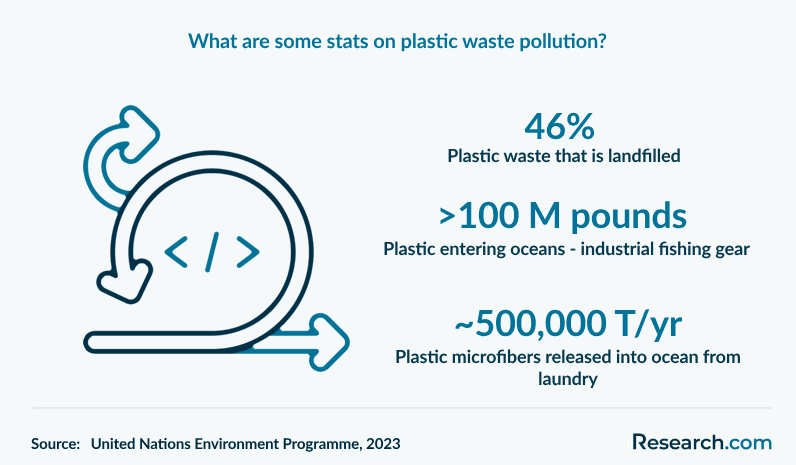
In 2022, UN member states committed to developing a legally binding treaty to reduce plastic pollution, with the aim of finalization by the end of 2024. For MBA students, this illustrates why sustainability leaders need skills in regulation, circular economy strategy, supply chain management, finance, and stakeholder communication.
What Specializations Are Available in Online MBA in Sustainability Programs?
Specializations help students move from broad sustainability awareness to targeted expertise. The right specialization depends on whether you want to work in finance, operations, consulting, energy, policy, entrepreneurship, or corporate strategy.
Students who want deeper scientific and ecological preparation may also compare business programs with the shortest online degree in environmental science, especially if their target roles involve environmental assessment, conservation, or technical sustainability analysis.
- Sustainable Finance and ESG Strategy: Focuses on ESG data, investment analysis, reporting, risk, and sustainable capital markets.
- Corporate Social Responsibility: Prepares students to manage social impact, community engagement, corporate ethics, and stakeholder relationships.
- Sustainable Supply Chain Management: Covers responsible sourcing, supplier accountability, logistics, circular systems, and emissions reduction across value chains.
- Renewable Energy Management: Fits students interested in the business, policy, and financing side of solar, wind, and other clean energy projects.
- Green Technology and Innovation: Emphasizes sustainable product development, circular design, eco-friendly technologies, and commercialization.
- Climate Risk and Policy Analysis: Trains students to assess climate-related business risk, resilience planning, policy changes, and regulatory exposure.
- Social Entrepreneurship: Supports students who want to build mission-driven ventures that address environmental or social problems through market-based models.
According to the 2025 Sustainable Development Report, the United States ranked 44th out of 167 countries in overall Sustainable Development Goals performance. Climate and consumption indicators show why business-focused sustainability training remains important.
The U.S. had high CO2 emissions from fossil fuel combustion and cement production at 14.5 tons per capita in 2023. Greenhouse gas emissions embodied in imports reached 5.5 tons per capita in 2024, and the nation’s carbon pricing score was 22.6% in 2021.
Energy and waste indicators also reveal ongoing challenges. The population had 100% access to electricity in 2022, but renewable energy represented 10.9% of total final consumption in 2021. Non-recycled municipal solid waste was 1.5 kg per capita per day in 2018, while electronic waste that was not recollected reached 9.3 kg per capita in 2022.
These data points suggest that sustainability leaders need more than environmental awareness. They need business skills to reduce emissions, redesign consumption systems, improve reporting, finance cleaner technologies, and manage organizational change.
Professionals interested in science-driven innovation may also explore the shortest online biotechnology master's programs, especially if they want to work on sustainable biotech solutions, climate mitigation technologies, or energy-related innovation.
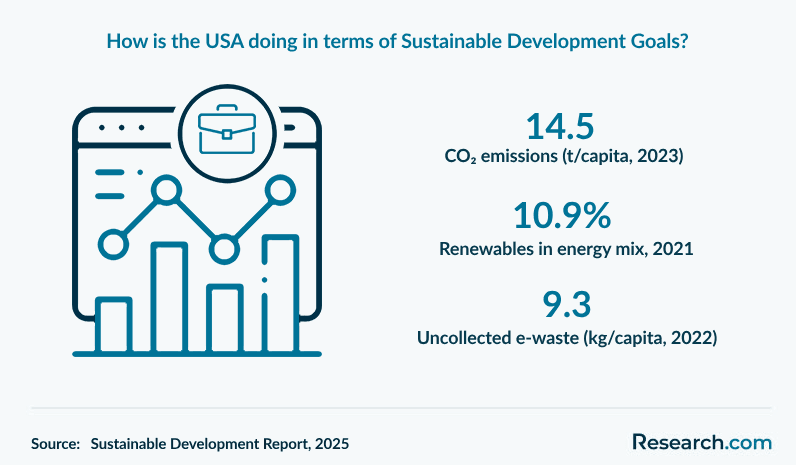
A strong specialization can make an MBA more relevant to specific employers. Before choosing a program, review the actual elective list, not just the concentration title, and confirm how often key courses are offered.
How Do You Choose the Best Fast Online MBA in Sustainability Program?
The best program is the one that fits your career target, financial situation, schedule, and learning preferences. A 12-month program may be ideal for one student and unrealistic for another. A more expensive program may be worthwhile if it offers stronger employer access, executive networking, or a specialized sustainability pathway that matches your goals.
- Confirm accreditation: Look for institutional accreditation first. Business-specific accreditation from organizations such as AACSB or ACBSP can also signal quality.
- Review the sustainability curriculum: Do not rely only on the program title. Check whether the school offers courses in ESG reporting, sustainable finance, climate risk, circular economy, supply chains, renewable energy, or social impact.
- Assess faculty and industry connections: Programs with instructors who have sustainability leadership, consulting, policy, finance, or operations experience may offer more practical insight.
- Compare learning formats: Asynchronous courses offer maximum flexibility, while synchronous classes provide real-time discussion and networking. Hybrid or low-residency formats add travel requirements.
- Calculate total cost: Include tuition, fees, books, residencies, travel, and the opportunity cost of reducing work hours.
- Check career support: Ask whether online students receive the same access to coaching, alumni networks, recruiting events, internships, and employer partnerships as campus students.
| If Your Goal Is... | Prioritize Programs With... | Be Careful About... |
| Moving into ESG reporting | Courses in ESG metrics, sustainability reporting, accounting, and compliance | Programs that discuss sustainability broadly but lack reporting-focused coursework |
| Working in sustainable finance | Impact investing, sustainable finance, ESG analysis, and capital markets electives | Degrees with limited finance depth |
| Entering consulting | Client projects, case competitions, practicum courses, and strong networking | Programs with little applied project work |
| Advancing as an executive | Executive MBA formats, leadership coaching, and peer networks | Programs designed mainly for early-career students |
| Changing careers quickly | Accelerated formats, career advising, portfolio projects, and employer connections | Overloading your schedule without time for networking or job search |
Online vs. Hybrid MBA in Sustainability: Which Format Is Better?
Online and hybrid sustainability MBA programs can both be valuable, but they serve different types of students. Fully online programs are often best for students who need geographic flexibility, while hybrid or low-residency programs may offer stronger in-person networking and applied learning experiences.
| Format | Best For | Trade-Offs |
| Fully online | Working professionals who need maximum schedule and location flexibility | Networking may require more intentional effort |
| Hybrid or low-residency | Students who want online coursework plus periodic in-person collaboration | Travel, lodging, and time away from work can increase costs |
| Executive format | Experienced managers and senior professionals | Tuition may be higher, and admissions may expect stronger work experience |
| Accelerated format | Students who can handle intensive coursework and want a faster credential | Less time for internships, networking, and gradual career exploration |
What Career Paths Are Available With an Online MBA in Sustainability?
An MBA in Sustainability can support roles across corporate strategy, ESG reporting, finance, operations, consulting, energy, government, and nonprofit leadership. The degree is most useful when paired with relevant experience, technical skills, industry knowledge, or a clear specialization.
- Chief Sustainability Officer: A senior executive responsible for enterprise-wide environmental and social strategy. Some professionals pursue this route through online executive MBA programs.
- ESG Investment Manager: A finance professional who evaluates investments using environmental, social, and governance data.
- Corporate Social Responsibility Director: A leader who manages community engagement, philanthropy, employee volunteerism, and broader social impact initiatives.
- Sustainable Supply Chain Manager: A specialist who improves sourcing, production, logistics, and distribution through environmental and ethical standards.
- Renewable Energy Project Manager: A manager who leads clean energy projects such as wind or solar developments.
- Sustainability Consultant: An advisor who helps organizations improve sustainability performance, meet regulations, manage risk, and implement green initiatives.
- Environmental Policy Advisor: A professional who supports sustainability-related policy development for government agencies, nonprofits, or advocacy organizations.
- Social Entrepreneur: A founder or operator who builds a venture designed to address a social or environmental challenge.
Students exploring broader options can review related careers in sustainability to compare job duties, education pathways, and advancement opportunities.
How Much Can You Earn With an Online MBA in Sustainability?
Salaries for sustainability professionals vary by role, employer, location, experience, and technical specialization. An MBA can improve access to management and strategy roles, but it does not guarantee a specific salary. Career outcomes depend heavily on prior experience, networking, portfolio quality, and the type of organization hiring.
- Sustainability Manager: The national average salary for a sustainability manager is around $110,000, with those in senior roles at large corporations often earning over $175,000 annually.
- ESG Analyst: This role typically offers a starting salary in the range of $90,000 to $120,000, with experienced analysts earning well over six figures.
- Director of Sustainability: This senior-level position commands an average salary between $150,000 and $200,000, with top earners exceeding $250,000.
According to 2025 PayScale.com data, sustainability-related careers show a clear salary ladder. Entry-level and analyst roles such as environmental consultant and sustainability analyst average about $62,000 to $70,000, while sustainability consultant averages around $73,000.
Management roles tend to pay more. A corporate social responsibility manager averages $81,709, a sustainability manager earns approximately $87,000, and an environmental health and safety manager earns about $90,000. Specialized roles can command higher pay: a sustainable supply chain manager averages $95,000, and a risk manager earns $98,000.
Senior and director-level positions usually offer the highest pay. A sustainability officer averages $100,000, a renewable energy project manager earns $102,000, a sustainability director earns $113,000, and a senior sustainability manager earns around $120,000 annually. Students aiming for senior leadership can also read our guide on how to become a director of sustainability.
The overall pattern is straightforward: earnings generally rise as professionals move from analysis and coordination into management, specialized strategy, and executive responsibility.
What Is the Job Market Like for Online MBA in Sustainability Graduates?
The sustainability job market is expanding across public, private, and nonprofit sectors as organizations respond to climate risk, stakeholder expectations, ESG reporting requirements, resource constraints, and investment in cleaner technologies. However, job titles and requirements vary widely, so students should match their program to the roles they want rather than assuming one sustainability degree fits every path.
- Demand spans many sectors: Sustainability skills are used in corporations, consulting firms, government agencies, nonprofits, finance, manufacturing, retail, healthcare, technology, real estate, and energy.
- Reporting and accountability are increasingly important: Employers often need professionals who can manage ESG data, sustainability reports, compliance obligations, and stakeholder communications.
- Operations and supply chains matter: Companies need leaders who can reduce waste, improve sourcing, lower emissions, and manage supplier risk.
- Finance and investment roles are growing more specialized: Sustainable finance and ESG analysis require both business fluency and comfort with data.
- Senior roles require experience: An MBA can support advancement, but C-suite positions such as Chief Sustainability Officer typically require significant leadership experience. For more detail, see our related guide answering, what do you need to be a chief sustainability officer?
According to 2025 data from the U.S. Bureau of Labor Statistics, environmental scientists and specialists earned median pay of $80,060 per year, or $38.49 per hour, in 2024. The occupation included 84,600 jobs in 2023 and is projected to grow by 7% from 2023 to 2033, which is faster than the average for all occupations.
This projected growth represents an employment change of approximately 6,100 new jobs over that period. Entry into the field typically requires a bachelor's degree, with no prior work experience or on-the-job training generally required.
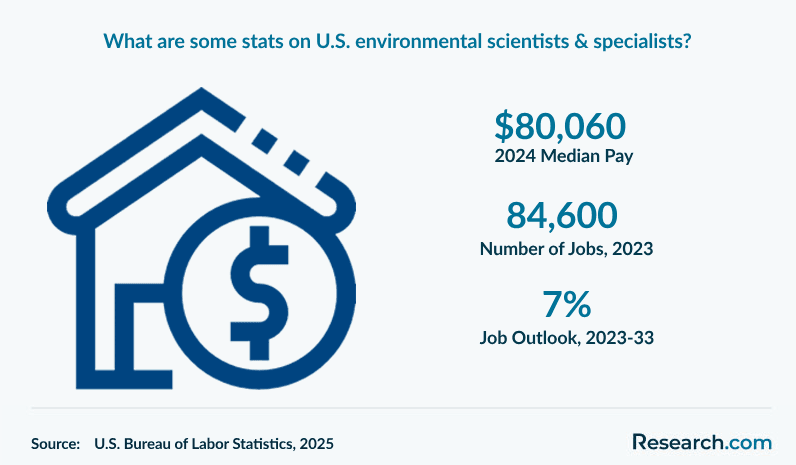
For MBA students, this labor market data is useful but should be interpreted carefully. Environmental scientist roles are not the same as sustainability MBA roles, but the figures show continued demand for environmental expertise that can complement business, consulting, policy, and operations careers.
What Current Trends Are Shaping Sustainability Careers?
Sustainability leadership is becoming more data-driven, regulated, and connected to core business strategy. Employers increasingly need professionals who can move beyond broad commitments and help implement measurable plans.
- AI and sustainability analytics: Artificial intelligence can help automate ESG data collection, forecasting, reporting, and risk analysis, but organizations must also consider the energy and water demands of AI systems.
- Circular economy models: Companies are exploring ways to reuse, recycle, repair, remanufacture, and redesign products instead of relying on linear “take-make-dispose” systems.
- Cross-sector partnerships: Sustainability challenges often require collaboration among businesses, governments, nonprofits, suppliers, investors, and communities.
- Green talent gap: Demand for green skills is growing, which increases the value of professionals who combine business training with sustainability, data, finance, engineering, or policy expertise.
- Broader risk assessment: Organizations are looking beyond carbon alone to consider biodiversity loss, water scarcity, supply chain disruption, and regulatory exposure.
- Impact investing: Investors are increasingly interested in measurable social and environmental outcomes alongside financial performance.
- Mandatory ESG reporting and accountability: Some organizations are moving from voluntary sustainability claims toward more formal reporting, verification, and transition planning.
How Can Emerging Technologies Strengthen Sustainability Leadership?
Emerging technologies can help sustainability leaders measure impact, improve transparency, and make better decisions. Data analytics can identify emissions hotspots. Blockchain tools may support supply chain traceability. Renewable energy technologies can change project economics. AI can accelerate reporting and scenario analysis when used responsibly.
Professionals who combine business strategy with technical fluency may have an advantage. For example, someone pursuing a biotechnology career can connect scientific innovation with sustainable product development, climate mitigation, or circular bioeconomy strategies.
Are Online MBA in Sustainability Degrees Respected by Employers?
Employers generally care less about whether the MBA was completed online and more about the reputation, accreditation, curriculum quality, faculty expertise, career support, and evidence of applied skills. An accredited online MBA in Sustainability can be credible when it comes from a recognized institution and includes rigorous business training, sustainability coursework, and real-world projects.
Before enrolling, confirm that the institution is accredited, ask whether online students receive equal career services, and review employment outcomes if available. Students who want stronger environmental science foundations may also compare MBA options with the cheapest environmental science online degrees.
Common Mistakes to Avoid When Choosing an Online MBA in Sustainability
| Mistake | Why It Can Hurt You | Better Approach |
| Choosing only the fastest program | A compressed schedule may limit networking, internships, and deeper skill-building. | Balance speed with curriculum fit, career support, and workload realism. |
| Ignoring accreditation | Unrecognized credentials may create problems with employers, transfer credits, or future study. | Verify institutional accreditation and consider business accreditation such as AACSB or ACBSP. |
| Looking only at tuition | Fees, residencies, travel, and books can raise the actual cost. | Ask for the full cost of attendance before applying. |
| Assuming all sustainability concentrations are the same | One program may focus on ESG finance while another emphasizes social impact or operations. | Compare course lists, electives, projects, and faculty backgrounds. |
| Relying only on rankings | A highly ranked program may not match your career target, schedule, or budget. | Use rankings as a shortlist, then evaluate fit. |
| Waiting until graduation to network | Career changes often depend on relationships and applied experience. | Start building connections, projects, and industry knowledge during the first term. |
How Can Technical Engineering Skills Boost Sustainability Leadership?
Sustainability leaders often need to understand systems, infrastructure, energy use, resource efficiency, and operational trade-offs. Engineering knowledge can help managers evaluate technical proposals, improve resource utilization, reduce environmental impacts, and communicate more effectively with product, operations, facilities, and energy teams.
Professionals who want a stronger technical foundation may compare MBA coursework with options such as affordable online electrical engineering degrees, particularly if they plan to work in energy systems, clean technology, manufacturing, or infrastructure-related sustainability roles.
Questions to Ask Before Applying
- Is the institution accredited, and does the business school hold programmatic accreditation?
- How many sustainability-specific courses are required, and how many are electives?
- Are courses asynchronous, synchronous, hybrid, or low-residency?
- What is the total program cost, including fees and required travel?
- Can working professionals realistically complete the program at the advertised pace?
- Do online students receive full access to career coaching, alumni networks, and employer events?
- Are there consulting projects, capstones, internships, labs, or client-based assignments?
- Which industries and employers commonly hire graduates?
- Can students specialize in ESG, sustainable finance, supply chains, energy, climate risk, or social impact?
- What data does the school provide on graduation rates, career outcomes, and student satisfaction?
What Graduates Say About Online MBA in Sustainability Programs
- Dion: "The accelerated online MBA in Sustainability helped me change direction into work that matches my values. Studying circular economy concepts and then using them in my sustainability manager role made the degree feel immediately relevant."
- Alberta: "Balancing work and family was difficult, but the flexible online structure made graduate school manageable. I was able to use ideas from sustainable finance courses at work right away, which helped me contribute to new ESG projects."
- Neema: "The strongest part of the program was the network. Learning with faculty and classmates already working in sustainability reporting, impact investing, and corporate change gave me both confidence and long-term professional connections."
References
- PayScale. (2025). Environmental Consultant Salary. PayScale.
- PayScale. (2025). Environmental Health & Safety (EHS) Manager Salary. PayScale.
- PayScale. (2025). Environmental Manager Salary. PayScale.
- PayScale. (2025). Facilities Manager Salary. PayScale.
- PayScale. (2025). Energy Analyst Salary. PayScale.
- PayScale. (2025). Energy Manager Salary. PayScale.
- PayScale. (2025). Operations Manager Salary. PayScale.
- PayScale. (2025). Policy Analyst Salary. PayScale.
- PayScale. (2025). Project Manager, Environmental Salary. PayScale.
- PayScale. (2025). Risk Manager Salary. PayScale.
- PayScale. (2025). Risk Manager Salary. PayScale.
- PayScale. (2025). Senior Sustainability Manager Salary. PayScale.
- PayScale. (2025). Social Impact Manager Salary. PayScale.
- PayScale. (2025). Supply Chain Manager Salary. PayScale.
- PayScale. (2025). Sustainability Analyst Salary. PayScale.
- PayScale. (2025). Sustainability Consultant Salary. PayScale.
- PayScale. (2025). Sustainability Director Salary. PayScale.
- PayScale. (2025). Sustainability Manager Salary. PayScale.
- PayScale. (2025). Sustainability Officer Salary. PayScale.
- PayScale. (2025). Sustainable Finance Manager Salary. PayScale.
- Sachs, J. D., Lafortune, G., Fuller, G., & Iablonovski, G. (2025). United States: Fact sheet. Sustainable Development Report 2025. Sustainable Development Report, formerly SDG Index & Dashboards. Paris: SDSN; Dublin: Dublin University Press.
- United Nations Environment Programme. (2023, April 25). Everything you need to know about plastic pollution. UNEP.
- U.S. Bureau of Labor Statistics. (2025, April). Environmental scientists and specialists. In Occupational Outlook Handbook. U.S. Department of Labor. U.S. Bureau of Labor Statistics.
- Yahoo Finance. (2025, May). Sustainable Finance Market Research and Growth Forecast 2025. Yahoo Finance. Yahoo Finance.
Key Insights
- The fastest listed online MBA in Sustainability option is SUMAS at 12 months, followed by Southern Oregon University at 16 months.
- Speed should be weighed against accreditation, course depth, workload, networking, applied projects, and career services.
- Common sustainability MBA focus areas include ESG strategy, sustainable finance, circular economy, supply chains, renewable energy, social impact, and climate risk.
- Costs vary widely. Students should compare total program cost, not just tuition per credit.
- Accreditation matters. Verify institutional accreditation first, then consider business accreditors such as AACSB or ACBSP.
- Career outcomes are strongest when students pair the MBA with relevant experience, technical skills, data fluency, or a clear industry specialization.
- Sustainability leadership is becoming more data-driven, regulated, and strategic, making applied projects and reporting skills especially valuable.
Other Things You Should Know About the Fastest Online MBA in Sustainability Programs
Many accelerated online MBA programs in sustainability waive GMAT or GRE scores for applicants with strong GPAs, relevant work experience, or prior graduate coursework. Programs that still require a test usually accept either exam, and some set minimum score cutoffs or offer test waivers by petition.
Applicants for 2027's fastest online MBA programs in sustainability should expect a bachelor’s degree, relevant work experience, a strong resume, and possibly GMAT or GRE scores. Programs may also require letters of recommendation and a statement of purpose outlining career goals in sustainability.


