
2027 Fastest Online Graduate Certificate Nurse Midwifery Programs

Co-Founder and Chief Data Scientist
The demand for nurse midwives is on the rise, with employment projected to grow 7% from 2023 to 2033, according to the U.S. Bureau of Labor Statistics (BLS). For registered nurses looking to expand their expertise quickly, a fast online graduate certificate in nurse midwifery offers a convenient and accelerated path into this growing field. This article explores the benefits, expectations, and outcomes of completing such a program entirely online.
What are the benefits of getting a fast online graduate certificate in nurse midwifery?
- This credential qualifies professionals to work as certified nurse midwives, supporting reproductive and prenatal care, labor and delivery, and postnatal support in clinics, hospitals, and birthing centers.
- Nurse midwives earned a median annual wage of $128,790 as of May 2024, making it a highly rewarding specialty for those seeking both financial and professional advancement.
- Online certificate programs are ideal for working nurses who want to upskill without pausing their careers, offering faster completion timelines and remote learning flexibility.
What can I expect from a fast online graduate certificate program in nurse midwifery?
A fast-track online graduate certificate in nurse midwifery typically focuses on advanced concepts in women’s health, prenatal and postnatal care, and clinical decision-making. These programs are designed for registered nurses or nurse practitioners who already hold a graduate degree and want to specialize in midwifery without committing to a full-length master’s program.
Most accelerated online certificates can be completed in 12 to 24 months, depending on prior coursework and clinical hour requirements. While the didactic portion is offered online, students are often required to complete hands-on clinical hours in approved healthcare settings to meet certification standards.
The curriculum aligns with the standards set by the Accreditation Commission for Midwifery Education (ACME), preparing graduates to sit for the national certification exam through the American Midwifery Certification Board (AMCB).
Where can I work with a graduate certificate in nurse midwifery?
Graduates of an online graduate certificate in nurse midwifery are qualified to work in a range of healthcare settings. These include hospitals, community health centers, private OB-GYN practices, birthing centers, and women’s health clinics. Many also find employment in federally qualified health centers (FQHCs), nonprofit clinics, or rural and underserved communities where access to maternal care is limited.
In addition to clinical care, nurse midwives may also work in roles involving health education, advocacy, and policy development. Some may collaborate with interdisciplinary teams in academic medical centers or teaching hospitals, mentoring future nurses or midwives. Others may choose to open independent practices in states where midwives have full practice authority.
How much can I make with a graduate certificate in nurse midwifery?
Nurse midwives enjoy strong earning potential thanks to their advanced clinical expertise. According to BLS, the median annual wage for nurse midwives was $128,790 in May 2024, with the top 10% earning more than $180,000 annually. Those working in outpatient care centers or specialty hospitals tend to earn higher salaries compared to those in public health or nonprofit settings.
Salary can also vary by location and experience. Urban areas with high demand for maternity and reproductive care, such as New York, California, and Massachusetts, often offer the most competitive compensation. Additionally, professionals who supplement clinical practice with teaching or leadership roles may see increased earning potential over time.
- List of the Fastest Online Graduate Certificate Nurse Midwifery Programs for 2027 List of Programs
- How long does it take to complete a fast online graduate certificate in nurse midwifery? Completion Times
- How does a fast online graduate certificate in nurse midwifery compare to an on-campus program? Online vs. Traditional
- What is the average cost of a fast online graduate certificate in nurse midwifery? Average Cost
- What are the financial aid options for students enrolling in a fast online graduate certificate program in nurse midwifery? Financial Aid
- What are the prerequisites for enrolling in a fast online graduate certificate program in nurse midwifery? Prerequisites
- What courses are typically in a fast online graduate certificate program in nurse midwifery? What courses are typically in a fast online graduate certificate program in nurse midwifery?
- What types of specializations are available in a fast online graduate certificate program in nurse midwifery? What types of specializations are available in a fast online graduate certificate program in nurse midwifery?
- How do you choose the best among the fastest online graduate certificate programs in nurse midwifery? How do you choose the best among the fastest online graduate certificate programs in nurse midwifery?
- What career paths are available for graduates of fast online graduate certificate programs in nurse midwifery? What career paths are available for graduates of fast online graduate certificate programs in nurse midwifery?
- What is the job market like for graduates of a fast online graduate certificate program in nurse midwifery? What is the job market like for graduates of a fast online graduate certificate program in nurse midwifery?
- How do fast online nurse midwifery certificate programs foster professional networking and mentorship? How do fast online nurse midwifery certificate programs foster professional networking and mentorship?
- Should I pursue advanced degrees after my nurse midwifery certificate? Should I pursue advanced degrees after my nurse midwifery certificate?
- What are the licensure and regulatory considerations after certification? What are the licensure and regulatory considerations after certification?
Fastest Online Graduate Certificate Nurse Midwifery Programs for 2027
Choosing a fast online graduate certificate in nurse midwifery is not just a scheduling decision. For licensed nurses, it can affect certification eligibility, clinical placement access, tuition cost, state licensure, and the type of maternal and reproductive healthcare roles available after graduation. The right program can help an MSN- or DNP-prepared nurse move toward nurse-midwifery practice without starting a full degree from the beginning, but the wrong program can create delays if accreditation, clinical requirements, or state authorization do not match the student’s goals.
This guide is built for nurses comparing accelerated online and hybrid certificate options in nurse midwifery. It explains which programs are among the fastest, what they cost, how long they take, what prerequisites are common, how online programs handle clinical training, and what to check before enrolling.
Quick answer: What is the fastest online graduate certificate in nurse midwifery?
The fastest online graduate certificate nurse midwifery programs in this list can be completed in as little as 12 months, depending on the school, prior graduate coursework, clinical placement availability, and whether the student studies full time or part time. Frontier Nursing University, the University of Cincinnati, Midwives College of Utah, Texas Tech University Health Sciences Center, and Thomas Jefferson University all list minimum timelines beginning at 12 months. However, students should not choose by speed alone. Accreditation, certification eligibility, clinical placement support, state licensure alignment, and total cost matter just as much as completion time.
How this ranking was developed
A graduate certificate in nurse midwifery requires a serious investment of money, clinical time, and professional energy. This ranking is designed to help prospective students identify online or hybrid certificate programs that combine shorter completion timelines with recognized accreditation, flexible delivery, and accessible program structures.
Research.com evaluated programs using a transparent methodology that considers affordability, length, flexibility, and accreditation. You can review the full ranking process here.
The ranking draws on publicly available information from trusted education and workforce sources, including the IPEDS database, Peterson’s Distance Learning Licensed Data Set, the College Scorecard, and the National Center for Education Statistics. Each school below offers an online or hybrid graduate certificate pathway connected to nurse midwifery, maternal care, reproductive health, or midwifery practice.
| Rank | School | Program length | Credits | Cost per credit | Accreditation listed |
| 1 | Frontier Nursing University | 12 to 24 months | 33 | $646 | ACME, SACSCOC |
| 2 | Georgetown University | 16 to 24 months | 30 | $2,278 | ACME, CCNE |
| 3 | University of Cincinnati | 12 to 18 months | 27 | $746 | ACME, CCNE, HLC |
| 4 | Bethel University – Minnesota | 18 to 24 months | 30 | $830 | ACME, HLC |
| 5 | Midwives College of Utah | 12 to 30 months | Varies; typically 30 to 35 | $390 | MEAC |
| 6 | Texas Tech University Health Sciences Center | 12 to 24 months | 32 | $495 in-state; $880 out-of-state | ACME, SACSCOC |
| 7 | University of Utah | 18 to 24 months | 32 | $807 | ACME, NWCCU |
| 8 | Thomas Jefferson University | 12 to 24 months | 36 | $1,065 | ACME, MSCHE |
| 9 | University of New Mexico | 16 to 24 months | 30 | $442 | ACME, HLC |
| 10 | East Carolina University | 24 months | 26 | $303 in-state; $948 out-of-state | ACME, SACSCOC |
1. Frontier Nursing University
Frontier Nursing University offers a graduate certificate pathway in nurse midwifery for registered nurses who already hold an MSN or DNP. The program combines online coursework with clinical experiences arranged near the student when possible. Frontier’s model is especially relevant for nurses who want advanced preparation in maternal, reproductive, and community-based care while remaining in their current region.
- Program length: 12 to 24 months
- Track or concentration: Nurse Midwifery
- Cost per credit: $646
- Required credits to graduate: 33
- Accreditation: ACME, SACSCOC
2. Georgetown University
Georgetown University provides a graduate certificate in nurse midwifery through its School of Nursing. The program is designed for APRNs seeking preparation for nurse-midwifery certification and includes online instruction, live virtual engagement, and clinical rotations completed in approved settings. Georgetown’s format may appeal to nurses who want a structured online experience with regular faculty and peer interaction.
- Program length: 16 to 24 months
- Track or concentration: Nurse Midwifery
- Cost per credit: $2,278
- Required credits to graduate: 30
- Accreditation: ACME, CCNE
3. University of Cincinnati
The University of Cincinnati offers an online post-master’s certificate in nurse midwifery through its College of Nursing. The program uses flexible online coursework and local preceptorships to prepare nurses for AMCB certification. Its shorter 12 to 18 month timeline may be useful for working nurses who already meet several graduate-level prerequisites.
- Program length: 12 to 18 months
- Track or concentration: Nurse Midwifery
- Cost per credit: $746
- Required credits to graduate: 27
- Accreditation: ACME, CCNE, HLC
4. Bethel University – Minnesota
Bethel University offers a hybrid graduate certificate in nurse midwifery that blends online coursework with required campus-based intensives. The program is intended for master’s-prepared nurses who want to expand their scope into midwifery practice. Its smaller cohort structure and faith-informed approach may fit students looking for close faculty engagement and a Christian-centered care perspective.
- Program length: 18 to 24 months
- Track or concentration: Nurse Midwifery
- Cost per credit: $830
- Required credits to graduate: 30
- Accreditation: ACME, HLC
5. Midwives College of Utah
The Midwives College of Utah offers an online graduate certificate option connected to midwifery education, with a flexible structure that can support working students. The program emphasizes community-based midwifery and out-of-hospital birth settings. Because its listed accreditation is MEAC rather than ACME, prospective nurse-midwifery students should confirm which credential, certification route, and state practice pathway the program supports before enrolling.
- Program length: 12 to 30 months
- Tracks or concentrations: Nurse Midwifery, Direct Entry Midwifery
- Cost per credit: $390
- Required credits to graduate: Varies; typically 30 to 35
- Accreditation: MEAC
6. Texas Tech University Health Sciences Center
Texas Tech offers a post-master’s nurse midwifery certificate through its School of Nursing. The program combines online coursework with clinical training arranged through approved placements. It is built for APRNs who want to pursue national certification and deepen their preparation for maternal care across diverse and underserved communities.
- Program length: 12 to 24 months
- Track or concentration: Nurse Midwifery
- Cost per credit: $495 in-state, $880 out-of-state
- Required credits to graduate: 32
- Accreditation: ACME, SACSCOC
7. University of Utah
The University of Utah provides a nurse midwifery certificate through its College of Nursing for licensed APRNs. Students complete online coursework and fulfill clinical requirements in local or regional healthcare environments. The program may fit nurses who want a structured 18 to 24 month pathway with a university-based nursing infrastructure.
- Program length: 18 to 24 months
- Track or concentration: Nurse Midwifery
- Cost per credit: $807
- Required credits to graduate: 32
- Accreditation: ACME, NWCCU
8. Thomas Jefferson University
Thomas Jefferson University offers an advanced practice certificate in nurse midwifery for nurses who already hold a master’s degree. The program uses both synchronous and asynchronous online learning, with clinical hours completed in approved healthcare settings. Students who prefer a mix of scheduled online meetings and independent coursework may find this format helpful.
- Program length: 12 to 24 months
- Track or concentration: Nurse Midwifery
- Cost per credit: $1,065
- Required credits to graduate: 36
- Accreditation: ACME, MSCHE
9. University of New Mexico
The University of New Mexico offers a hybrid post-master’s certificate in nurse midwifery. The program serves nurses across the Southwest and emphasizes community-based maternal care, including rural and Native health contexts. Most academic content is delivered online, while clinical training occurs in approved community settings.
- Program length: 16 to 24 months
- Track or concentration: Nurse Midwifery
- Cost per credit: $442
- Required credits to graduate: 30
- Accreditation: ACME, HLC
10. East Carolina University
East Carolina University offers a part-time online nurse midwifery certificate through its College of Nursing. The program is structured for working nurses and includes virtual instruction with clinical experiences arranged in students’ local communities. Its 24 month format may be a better fit for students who need predictable pacing rather than the shortest possible timeline.
- Program length: 24 months
- Track or concentration: Nurse Midwifery
- Cost per credit: $303 in-state, $948 out-of-state
- Required credits to graduate: 26
- Accreditation: ACME, SACSCOC
How long does a fast online graduate certificate in nurse midwifery take?
Most fast online graduate certificate programs in nurse midwifery take 12 to 24 months. The actual timeline depends on the student’s prior graduate coursework, whether the program is full time or part time, how quickly clinical placements are approved, and whether the student needs to repeat or complete advanced practice core courses.
Students usually complete a mix of asynchronous coursework, scheduled virtual sessions, and in-person clinical hours. Online delivery can be especially useful for nurses already working in labor and delivery, postpartum care, women’s health, or related roles. Nurses comparing related maternal care paths may also find it helpful to review how to become a postpartum nurse through this guide on how to become a postpartum nurse.
The biggest timeline risk is usually clinical placement, not online coursework. Before enrolling, ask whether the school secures placements, helps identify preceptors, or requires students to find their own sites. A delayed preceptor match can extend graduation even in an accelerated program.
| Timeline factor | How it can speed up completion | How it can delay completion |
| Prior graduate coursework | Previously completed advanced pathophysiology, pharmacology, or health assessment courses may reduce course load if accepted. | Expired or non-equivalent coursework may need to be repeated. |
| Enrollment pace | Full-time study can make a 12 to 18 month timeline more realistic. | Part-time study may be necessary for working nurses but often lengthens completion. |
| Clinical placement process | Strong school placement support can keep students on schedule. | Limited local preceptors or site approval delays can postpone practicum hours. |
| State authorization | Programs approved to enroll students in your state can reduce administrative delays. | State restrictions may prevent enrollment or limit clinical options. |
Online vs. on-campus nurse midwifery certificate programs: Which format fits you?
Online and campus-based nurse midwifery certificate programs can both prepare students for advanced midwifery practice when they meet the right accreditation, clinical, and certification requirements. The main differences are not usually the clinical expectations but the way academic content, faculty interaction, and scheduling are delivered.
| Comparison point | Fast online or hybrid certificate | Campus-based certificate |
| Best for | Working nurses, students who cannot relocate, and APRNs balancing employment with school. | Students who want frequent in-person instruction and access to campus-based clinical networks. |
| Course delivery | Online lectures, discussion boards, virtual simulations, live sessions, and occasional intensives depending on the school. | In-person classes, labs, seminars, and campus-based learning activities. |
| Clinical training | Completed in person at approved local or regional sites. | Often completed through facilities affiliated with the school or nearby health systems. |
| Flexibility | Usually stronger for nurses who need to keep working or manage family responsibilities. | More fixed schedules and location requirements. |
| Potential challenge | Students may need to be proactive about communication, technology, and clinical site coordination. | Relocation, commuting, and less scheduling flexibility can increase time and cost. |
Flexibility
Online programs let students complete much of the didactic work from home or another approved location. This can make the certificate more manageable for nurses who work shifts, care for family members, or are comparing other advanced nursing paths such as how to become a CVOR nurse.
Pacing
Accelerated online certificates often compress coursework into shorter terms or allow students to move through didactic requirements quickly. That speed is useful only if clinical hours can be completed on schedule.
Clinical experience
Every credible nurse midwifery pathway requires in-person clinical training. Online students should confirm how placements are approved, what types of sites qualify, whether birth numbers or case requirements apply, and whether travel is expected.
Faculty and peer interaction
Campus students typically get face-to-face contact. Online students rely on virtual office hours, synchronous sessions, messaging platforms, discussion boards, and clinical faculty check-ins. Students who need immediate in-person access may prefer a campus or hybrid-heavy option.
How much does a fast online graduate certificate in nurse midwifery cost?
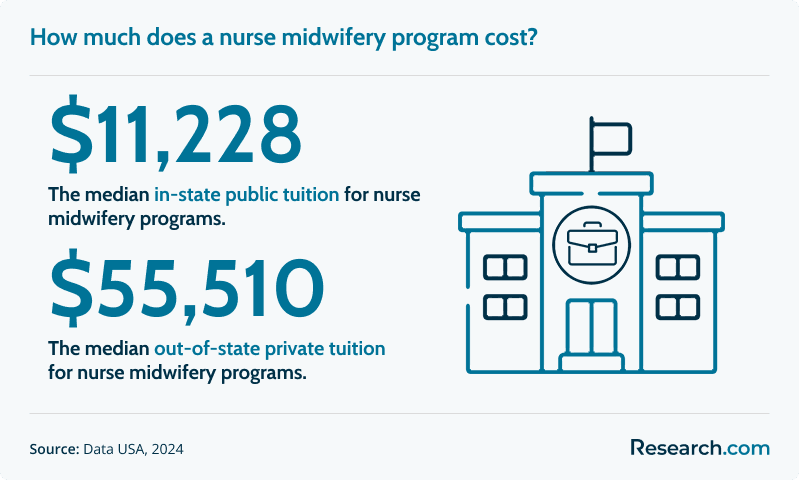
Costs vary widely by institution, public or private status, residency classification, required credits, fees, and clinical travel. According to Data USA, median in-state public tuition is around $11,228, while median out-of-state private tuition is approximately $55,510.
At the program level, the listed cost per credit in this ranking ranges from $303 in-state at East Carolina University to $2,278 at Georgetown University. Because required credits range from 26 to 36, students should calculate total tuition rather than comparing only the per-credit rate.
Students should also budget for textbooks, clinical supplies, background checks, immunizations, liability insurance, technology fees, travel to intensives, certification-related expenses, and possible lost work hours during clinical rotations. Those exploring broader maternal and child health roles may also want context on related healthcare careers, such as what a pediatric medical assistant does.
| Cost item | Why it matters | Question to ask before enrolling |
| Tuition per credit | A low per-credit rate can still add up if the program requires more credits. | What is the total tuition for the entire certificate? |
| Program fees | Online, technology, simulation, clinical, and graduation fees can raise the actual price. | Can the school provide a full fee schedule? |
| Clinical travel | Local placements reduce travel costs; distant placements may require lodging and time off work. | How far do students typically travel for clinical rotations? |
| Residency status | Public universities may charge different rates for in-state and out-of-state students. | Am I eligible for in-state or reduced online tuition? |
| Certification and licensure | Exam, application, and state licensure costs are usually separate from tuition. | Which certification and state licensure expenses should I expect? |
Financial aid options for online nurse midwifery certificate students
Students considering an accredited graduate certificate should start by submitting the Free Application for Federal Student Aid. FAFSA results help determine eligibility for federal student aid, and many schools use the form to evaluate institutional aid as well.
Common funding options include:
- Federal student loans: Eligible graduate students may qualify for federal loan options, depending on the school, program status, enrollment level, and federal aid rules.
- School-based scholarships: Nursing schools may offer awards based on academic merit, financial need, service goals, or commitment to underserved communities.
- Professional and state scholarships: Nursing associations, state workforce programs, and maternal health organizations may provide targeted funding for advanced nursing students.
- Employer tuition assistance: Hospitals and health systems may reimburse part of the cost for nurses pursuing advanced practice credentials.
- Loan repayment programs: Service-based programs, including options such as the NURSE Corps Loan Repayment Program, may help reduce debt for clinicians who work in qualifying underserved settings.
How to reduce the cost before you enroll
- Request a total program cost estimate. Ask for tuition, fees, clinical expenses, and expected certification costs in writing.
- Confirm transfer or waiver policies. If you already completed graduate-level advanced practice core courses, ask whether they can reduce your required credits.
- Compare residency rules. In-state and out-of-state pricing can change the value of a public university program.
- Ask your employer early. Tuition reimbursement often requires preapproval before the term starts.
- Plan for clinical work hours. Even online students may need to reduce paid work during intensive clinical terms.
Admission requirements for fast online graduate certificate nurse midwifery programs
Most nurse midwifery graduate certificate programs are intended for nurses who already have graduate-level nursing education. These certificates are not usually entry-level nursing programs. They are typically designed for MSN- or DNP-prepared nurses who want to add nurse-midwifery preparation to an existing advanced nursing background.
Common prerequisites include:
- A master’s or doctoral degree in nursing, such as an MSN or DNP
- An active, unencumbered RN or APRN license
- Graduate coursework in advanced pathophysiology, advanced pharmacology, and advanced health assessment
- Clinical experience in women’s health, labor and delivery, reproductive health, primary care, or a related field
- Professional references, a resume or CV, transcripts, and a statement of goals
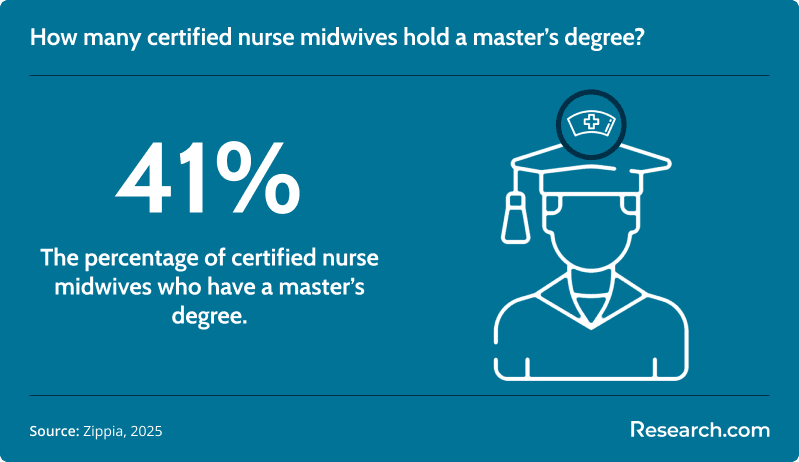
According to Zippia, 41% of certified nurse midwives hold a master’s degree, 38% hold a bachelor’s degree, and 11% hold an associate degree. Certificate programs, however, commonly expect applicants to already have graduate preparation. Nurses still building their academic foundation may need to complete a nursing degree first, just as students in other accelerated fields must meet prerequisites before entering specialized programs such as an accelerated bachelor’s in natural sciences online.
Applicants interested in management as well as direct practice may also compare leadership pathways and review charge nurse qualifications.
Typical courses in an online graduate certificate in nurse midwifery
Fast nurse midwifery certificate curricula focus on advanced maternal care, reproductive healthcare, newborn assessment, professional ethics, and supervised clinical practice. Course names differ by school, but most programs combine didactic instruction with hands-on practicum hours.
This balance of theory and applied learning is similar to other advanced nursing pathways, including an accelerated online MSN nursing education program, though nurse midwifery is clinically focused rather than teaching-focused.
| Course area | What students learn | Why it matters in practice |
| Advanced midwifery care | Prenatal, intrapartum, postpartum, and newborn care management. | Builds the clinical foundation for supporting patients through pregnancy, birth, and recovery. |
| Women’s health across the lifespan | Preventive care, gynecologic assessment, family planning, and reproductive health. | Prepares students for care beyond pregnancy and birth settings. |
| Pharmacology for midwifery practice | Medication safety, prescribing considerations, interactions, and patient education. | Supports safe medication decisions within the midwifery scope of practice. |
| Professional role, ethics, and policy | Legal responsibilities, cultural humility, advocacy, documentation, and collaborative care. | Helps students understand the responsibilities and limits of advanced practice. |
| Clinical practicum | Supervised experience in labor and delivery, outpatient clinics, newborn care, and related settings. | Connects classroom learning to direct patient care and certification readiness. |
Maternal health also intersects with behavioral health, trauma-informed care, and perinatal mental health. Nurses interested in that broader scope may benefit from learning what a psychiatric nurse practitioner does.
Specializations and practice settings in nurse midwifery certificate programs
Most graduate certificates in nurse midwifery focus on core preparation rather than numerous formal concentrations. Still, students can often shape their experience through electives, clinical sites, faculty interests, and capstone or practicum work. A certificate may be narrower than a full MSN, so nurses who want broader graduate training may compare it with a fastest nurse midwifery MSN degree online.
Common focus areas include:
- Primary care for women: Preventive visits, gynecologic care, contraceptive counseling, reproductive health, and wellness services.
- Community or rural health: Care for underserved populations, access barriers, and maternal health disparities.
- High-risk obstetrics: Recognition and management of complications during pregnancy, labor, and postpartum care in collaboration with other clinicians.
- Outpatient and ambulatory care: Practice in clinics, group practices, and reproductive health centers.
According to BLS, nurse midwives most commonly work in the following settings:
- Offices of Physicians
- General Medical and Surgical Hospitals
- Outpatient Care Centers
- Offices of Other Health Practitioners
- Specialty Hospitals, excluding psychiatric and substance abuse
Practice setting can influence the skills students should prioritize. A nurse planning to work in a hospital-based environment, for example, may also want to understand adjacent perioperative roles and compensation patterns through resources on operating room nurse salary.
How to choose the best fast online graduate certificate in nurse midwifery
The best program is not automatically the shortest or cheapest. A strong choice is one that fits your licensure state, clinical placement needs, budget, learning style, and certification goal. Use the criteria below before applying.
| Selection factor | What to verify | Why it affects your decision |
| Accreditation | Confirm whether the program’s accreditation supports your intended certification and licensure route. | Accreditation can affect exam eligibility, employer recognition, and state approval. |
| Certification eligibility | Ask whether graduates are eligible for the AMCB exam, if your goal is certified nurse-midwife practice. | Not every midwifery-related credential leads to the same professional pathway. |
| Clinical placement support | Find out whether the school finds sites, approves student-found preceptors, or offers regional placement networks. | Clinical delays are one of the most common reasons accelerated students finish later than planned. |
| State authorization | Confirm that the school can enroll students in your state and that clinicals can be completed there. | Online availability does not always mean the program is approved for every state. |
| Total cost | Compare tuition, required credits, fees, travel, and certification costs. | The lowest per-credit rate is not always the lowest total price. |
| Schedule fit | Review synchronous class times, intensives, clinical hour expectations, and part-time options. | A fast program can become unrealistic if it conflicts with shift work or family responsibilities. |
| Student outcomes | Ask about graduation rates, certification exam pass rates, and employment outcomes when available. | Outcomes help you judge whether the program supports students through completion and certification. |
Questions to ask admissions before you apply
- Does this certificate meet the education requirements for nurse-midwifery certification in my state?
- Are students in my state eligible to enroll and complete clinical hours locally?
- Who is responsible for finding clinical preceptors?
- How many campus visits, intensives, or travel days are required?
- What happens if I cannot secure a clinical placement on time?
- Can any of my prior graduate nursing credits reduce the certificate length?
- What are the most recent certification exam pass rates?
- What is the total estimated program cost, including fees and clinical expenses?
Common mistakes to avoid
- Choosing only by speed: A 12 month timeline is useful only if the program meets your certification, licensure, and clinical needs.
- Ignoring accreditation differences: ACME, CCNE, MEAC, and institutional accreditors serve different purposes. Know which one matters for your intended credential.
- Assuming online means no travel: Some programs require intensives, campus visits, or travel for clinicals.
- Comparing only tuition per credit: Required credits, fees, supplies, and travel can change the true cost.
- Waiting to think about clinicals: Start asking about preceptors before admission, not after coursework begins.
- Assuming salary outcomes are guaranteed: Pay varies by location, employer, experience, credentials, and setting.
Career paths after an online graduate certificate in nurse midwifery
The most direct outcome of a nurse midwifery graduate certificate is preparation for certified nurse-midwife practice, assuming the program meets the required certification and licensure standards. Graduates may work in hospitals, birthing centers, outpatient clinics, physician offices, community health centers, academic settings, or public health organizations.
| Career path | Typical focus | Good fit for |
| Certified nurse midwife | Pregnancy, birth, postpartum, newborn, gynecologic, and reproductive healthcare. | Nurses who want direct advanced practice in maternal and reproductive health. |
| Maternal health educator | Prenatal classes, childbirth education, lactation education, and parenting support. | Clinicians who enjoy teaching patients and families. |
| Reproductive health consultant | Program design, access improvement, public health education, and nonprofit work. | Nurses interested in systems-level maternal and reproductive health work. |
| Clinical faculty or preceptor | Teaching, supervision, simulation, and mentoring future nurses or midwives. | Experienced clinicians who want to support nursing education. |
Graduates interested in research, senior leadership, or full-time faculty roles may eventually consider doctoral pathways. For nurses comparing academic advancement options, fast track BSN to PhD online programs can provide context on longer-term routes into research and higher education.
According to BLS, the industries with the highest median annual wages for nurse midwives are:
- Outpatient Care Centers
- General Medical and Surgical Hospitals
- Offices of Physicians
- Colleges and Universities
- Local Government, non-education
These categories show that nurse midwifery career opportunities can extend across clinical care, academic work, and public-sector health services.
Job outlook for nurse midwifery certificate graduates
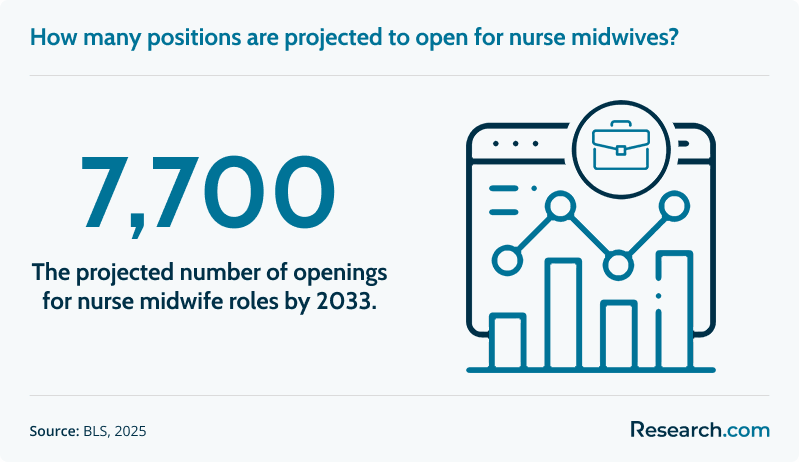
The labor market for nurse midwives is shaped by demand for maternal care, reproductive health services, preventive care, and access in underserved communities. Approximately 7,700 new job openings for nurse midwives are projected by 2033.
Fast online certificate graduates may be able to move into the workforce sooner than students in longer degree pathways, but job prospects still depend on certification, state licensure, clinical experience, local demand, and employer requirements. Nurses in rural or underserved regions may find that clinical relationships built during the certificate program are especially important for employment opportunities.
Technology is also changing advanced nursing practice. Telehealth, remote monitoring, electronic documentation, clinical decision-support tools, and AI-supported administrative workflows are increasingly relevant in maternal care. These tools do not replace clinical judgment, hands-on assessment, or birth care skills, but they can change how nurse midwives communicate with patients, coordinate teams, and manage follow-up care.
Networking and mentorship in fast online nurse midwifery certificate programs
Online students should not assume they will be professionally isolated. Strong programs build community through live class sessions, faculty advising, clinical supervision, alumni connections, peer discussion groups, webinars, and professional association engagement. These relationships can help students find preceptors, understand state practice rules, prepare for certification, and identify job leads.
Mentorship is especially valuable in nurse midwifery because students must integrate advanced clinical skills with patient advocacy, interprofessional collaboration, and culturally responsive care. When comparing programs, ask whether each student is assigned a faculty advisor, how clinical performance is evaluated, and whether alumni remain involved after graduation.
Nurses comparing cost-conscious pathways in nursing education can also review the most affordable online RN-BSN programs to understand how affordability varies across nursing credentials.
Should you pursue another degree after a nurse midwifery certificate?
A graduate certificate may be enough for nurses who already hold the required graduate degree and want to add nurse-midwifery preparation. However, some graduates later pursue a doctoral degree for advanced clinical leadership, administration, policy, quality improvement, or academic roles.
A Doctor of Nursing Practice can be a logical next step for nurse midwives who want deeper preparation in systems leadership and evidence-based practice. Nurses comparing shorter doctoral options can review the fastest online DNP programs.
Before pursuing another degree, weigh the added cost and time against your career goal. A DNP may be valuable for leadership and advanced practice influence, but it is not automatically necessary for every clinical nurse-midwifery role.
Licensure and regulatory issues after completing a nurse midwifery certificate
Licensure rules for nurse midwives vary by state. Before enrolling, confirm that the program meets the education, accreditation, clinical hour, and certification requirements for the state where you plan to practice. This is especially important for online students because state authorization and clinical approval rules can differ from state to state.
Students should verify:
- Whether the program meets Accreditation Commission for Midwifery Education expectations for the intended credential
- Whether graduates can pursue the relevant national certification exam
- Whether the school is authorized to enroll students from their state
- Whether clinical placements can be completed in their state or region
- Whether the state requires additional applications, supervised practice, collaborative agreements, or prescriptive authority steps
- Whether the program publishes first-time certification or licensure exam pass rates
Credentialing can also be complex in other advanced healthcare roles. Students comparing advanced practice routes may find it useful to review this guide to direct nurse practitioner programs.
What graduates say about fast online graduate certificate programs in nurse midwifery
- Mandy: "Earning my nurse midwifery certificate online changed what was possible for me. I kept working as an RN while completing accelerated coursework, and I finished in just under 18 months. The virtual classes were more engaging than I expected, and the faculty and classmates helped me stay connected throughout the program. By the end, I felt ready for community-based clinical training and more confident in the care I wanted to provide."
- Lauren: "I needed a program that would not require me to move, and the online format made that possible. As a parent of two, I studied during evenings and weekends and completed the program in 14 months. The discussions were thoughtful, the instructors responded quickly, and each term made my goal of CNM certification feel more realistic. The experience was demanding, but it was also deeply motivating."
- Jenna: "The accelerated certificate helped me shift my career direction without putting my life on hold. In 16 months, I moved from labor-and-delivery nursing toward nurse-midwifery preparation through a structured curriculum and clinical placement support. The pace kept me focused, and the online format gave me room to manage work and family. I finished with stronger skills and a clearer sense of purpose."
Key Insights
- The fastest programs can start at 12 months, but speed should not be the only priority. Clinical placement access, certification eligibility, and state licensure fit can matter more than the advertised timeline.
- Most nurse midwifery certificates are built for MSN- or DNP-prepared nurses. Applicants usually need an active RN or APRN license and graduate coursework in advanced pathophysiology, pharmacology, and health assessment.
- Accreditation must match your credential goal. If your goal is certified nurse-midwife practice, ask specifically whether the program supports AMCB exam eligibility and licensure in your state.
- Online does not mean fully remote. Coursework may be virtual, but clinical training is in person, and some programs require campus intensives or travel.
- Total cost is more than tuition per credit. Fees, travel, supplies, certification expenses, and reduced work hours during clinical terms can significantly affect affordability.
- Clinical placement support is a major decision factor. A program with strong preceptor coordination may be more valuable than a cheaper or faster option that leaves students to manage placements alone.
- Career outcomes vary by state, setting, and credential. Nurse midwives work in physician offices, hospitals, outpatient care centers, academic settings, and public-sector roles, but salary and hiring depend on local market conditions and employer requirements.
References:
- BLS. (2025, August 28). Nurse anesthetists, nurse midwives, and nurse practitioners. bls.gov.
- BLS. (2025). Occupational Employment and wage Statistics Profiles. data.bls.gov.
- Data USA. (2024). Nurse Midwife. datausa.io.
- Zippia. (2025, January 8). Best Colleges and Degrees for Certified Nurse Midwives. zippia.com.
Other Things You Should Know About the Fastest Online Graduate Certificate Nurse Midwifery Programs
They should hold national nursing or midwifery accreditation from a recognized agency such as the Accreditation Commission for Midwifery Education or a comparable nursing accreditor. Accreditation matters because it affects eligibility for advanced practice licensure and state approval.
To enroll in a 2027 online graduate certificate nurse midwifery program, you typically need a Bachelor of Science in Nursing (BSN), a current RN license, and clinical experience. Some programs may require GRE scores or specific coursework such as anatomy and physiology.


