2027 Fastest Online MSN Adult-Gerontology Primary Care NP Programs

Co-Founder and Chief Data Scientist
Career growth can stall quickly for BSN-prepared nurses—especially as the degree becomes standard across the workforce, with over 71% of RNs now holding one. For those aiming to expand their scope of practice and step into more autonomous roles, advanced training is no longer optional, it’s essential.
The fastest online MSN Adult Gerontology Primary Care NP programs offer a streamlined path to becoming a high-demand primary care provider. This guide, prepared by career counselors, serves as a strategic resource, detailing program formats, costs, and job outlooks to support a confident, future-focused career move.
What are the benefits of getting an online MSN Adult-Gerontology Primary Care NP degree?
- Transition into a highly autonomous role as a primary care provider, building lasting relationships with adult and elderly patients while helping fill a critical gap in healthcare.
- Substantially increase your earning potential, with Primary Care Nurse Practitioners earning an average salary of $126,034 per year.
- The flexibility of an online format allows you to advance your career without pausing your work, fitting your education around your professional and personal commitments.
What can I expect from a fast online MSN Adult-Gerontology Primary Care NP program?
Understanding what "online" means in the context of MSN Adult Gerontology Primary Care Nurse Practitioner programs is essential, as these are not fully remote offerings. Most follow a hybrid structure that combines flexible online coursework—covering subjects like advanced pathophysiology and pharmacology—with required, in-person clinical practicums. This format allows working nurses to engage with rigorous academic content while maintaining employment.
Equally critical to the program is the hands-on clinical training, which takes place in real healthcare environments and is central to developing practical skills. Many programs require students to take the initiative in securing their own clinical placements, making early planning a key factor in staying on track for graduation.
Where can I work with a degree from fast online MSN Adult-Gerontology Primary Care NP programs?
Graduates with an AG-PCNP degree are prepared for roles in a diverse range of outpatient and community-based settings. Career paths open up in private practices, community health clinics, and long-term care facilities, where these practitioners manage the ongoing health needs of adult and elderly patients.
Beyond these settings, opportunities are growing in more specialized areas. Many NPs build careers in clinics focused on cardiology or endocrinology, while others work in university student health centers or corporate wellness programs. Furthermore, the expansion of telehealth has created a strong demand for practitioners who can provide expert care remotely, adding another layer of flexibility to this career path.
How much can I make with an online MSN Adult-Gerontology Primary Care NP degree?
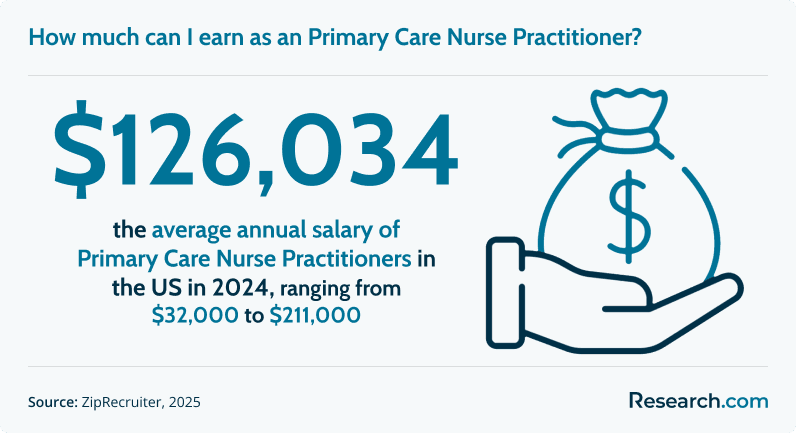
The average annual salary for a Primary Care Nurse Practitioner is approximately $126,034. It's helpful to know that this figure sits within a wide range, which can go from about $32,000 to over $211,000 a year.
This variation depends on key factors like geographic location, years of experience, and the specific type of healthcare setting. The strong earning potential for these roles is largely driven by the nationwide shortage of primary care providers. This high demand gives qualified AG-PCNPs excellent negotiating power and job security upon entering the field.
- List of the Best Fastest Online MSN Adult-Gerontology Primary Care NP Programs for 2027 List of Programs
- How long does it take to complete a fast online MSN Adult-Gerontology Primary Care NP program? Completion Time
- How does an online MSN Adult-Gerontology Primary Care NP program compare to an on-campus program? How does an online MSN Adult-Gerontology Primary Care NP program compare to an on-campus program?
- What is the average cost of a fast online MSN Adult-Gerontology Primary Care NP program? Program Cost
- What are the financial aid options for students enrolling in a fast online MSN Adult-Gerontology Primary Care NP program? Financial Aid
- What are the prerequisites for enrolling in an online MSN Adult-Gerontology Primary Care NP program? Prerequisites
- What courses are typically in an online MSN Adult-Gerontology Primary Care NP program? What courses are typically in an online MSN Adult-Gerontology Primary Care NP program?
- What types of specializations are available in a fast online MSN Adult-Gerontology Primary Care NP program? What types of specializations are available in a fast online MSN Adult-Gerontology Primary Care NP program?
- How to Choose the Best Fast Online MSN Adult-Gerontology Primary Care NP Program How to Choose the Best Fast Online MSN Adult-Gerontology Primary Care NP Program
- What career paths are available for graduates of a fast online MSN Adult-Gerontology Primary Care NP program? What career paths are available for graduates of a fast online MSN Adult-Gerontology Primary Care NP program?
- What is the job market for graduates of fast online MSN Adult-Gerontology Primary Care NP programs? Job Market
- What are the potential challenges of fast online MSN Adult-Gerontology Primary Care NP programs? What are the potential challenges of fast online MSN Adult-Gerontology Primary Care NP programs?
- Is the Direct Entry Pathway a Suitable Alternative for Aspiring Nurse Practitioners? Is the Direct Entry Pathway a Suitable Alternative for Aspiring Nurse Practitioners?
- How Do Technological Innovations Enhance Learning in Online MSN AG-PCNP Programs? How Do Technological Innovations Enhance Learning in Online MSN AG-PCNP Programs?
- Is Advancing to a DNP a Valuable Next Step for MSN AG-PCNP Graduates? Is Advancing to a DNP a Valuable Next Step for MSN AG-PCNP Graduates?
Fastest Online MSN Adult-Gerontology Primary Care NP Programs for 2026
Choosing a fast online MSN Adult-Gerontology Primary Care Nurse Practitioner program is a high-stakes decision for registered nurses who want to move into advanced practice without stepping away from work for several years. The right program can help you qualify for national certification, complete required clinical training, and transition into adult and older-adult primary care. The wrong program can create delays, unexpected costs, clinical placement problems, or licensure complications.
This guide is written for RNs comparing accelerated online MSN AG-PCNP programs and trying to answer practical questions: Which programs are fastest? What will they cost? How much clinical support should you expect? How do online programs compare with campus-based options? And how do you know whether adult-gerontology primary care is the right nurse practitioner specialty for your career goals?
Quick Answer: What Is the Fastest Online MSN AG-PCNP Program?
Among the programs listed here, St. Thomas University reports the shortest completion time at 18 months, followed by West Coast University and Herzing University at 20 months. However, the fastest advertised timeline is not always the best choice. Before enrolling, confirm accreditation, clinical placement expectations, state authorization, certification exam eligibility, total cost, and whether the program pace is realistic with your work schedule.
How Research.com Evaluates These Programs
Because an MSN nurse practitioner degree can involve a major financial and time commitment, our rankings are built to help readers compare programs using clear, decision-relevant information. Research.com evaluates schools through a structured ranking methodology that considers institutional quality, online program availability, cost indicators, and student outcome data where available.
For this ranking, we reviewed institutional and program information using sources such as the IPEDS database from the National Center for Education Statistics, Peterson’s database and its Distance Learning Licensed Data Set, the College Scorecard, and the National Center for Education Statistics. Students should still verify program details directly with each school because tuition, clinical policies, admissions requirements, and state authorization can change.
Fast Program Comparison
| Rank | School | Reported Program Length | Credits | Cost per Credit | Accreditation |
| 1 | North Park University | 32 months | 48 | $925 | CCNE |
| 2 | Walden University | 24 months | 38.67 quarter credits | $775 per quarter credit hour | CCNE |
| 3 | West Coast University | 20 months | 49 | $783.60 | CCNE |
| 4 | Florida Agricultural and Mechanical University | As little as 5 semesters full-time | 42 | $732 | ACEN |
| 5 | Franklin University | 27 months | 49 | $670 | CCNE |
| 6 | The University of Texas at Arlington | 29-33 months | 41 | $654 | CCNE |
| 7 | University of Cincinnati | 2 years | 44 | $892 in-state; $907 out-of-state | CCNE |
| 8 | Felician University | 2.3 years | 47 | $766 | CCNE |
| 9 | Herzing University | 20 months | 48 | $770 | CCNE |
| 10 | St. Thomas University | 18 months | 47 | $605 | CCNE |
1. North Park University - Online MSN Adult-Gerontology Primary Care Nurse Practitioner Program
North Park University offers an online AG-PCNP pathway for registered nurses who want to care for adults and older adults with complex health needs. The program combines advanced online coursework with supervised clinical experiences, and it includes clinical placement support to help students move from classroom learning into practice. Graduates were prepared for national certification, and the school reported a 100% graduate pass rate in 2023.
- Program length: 32 months
- Required credits to graduate: 48
- Cost per credit: $925
- Accreditation: Commission on Collegiate Nursing Education (CCNE)
2. Walden University - Online MSN Adult-Gerontology Primary Care Nurse Practitioner Program
Walden University structures its AG-PCNP program for nurses preparing to deliver primary care to patients aged 13 and older. The curriculum is intended to build advanced assessment, diagnostic, and patient management skills while preparing graduates to pursue national certification.
- Program length: 24 months
- Required quarter credits to graduate: 38.67
- Cost per quarter credit hour: $775
- Accreditation: Commission on Collegiate Nursing Education (CCNE)
3. West Coast University - Online MSN Adult-Gerontology Primary Care Nurse Practitioner Program
West Coast University is designed for nurses who want an accelerated route into adult and older-adult primary care. Students complete online coursework along with clinical experiences focused on preventing, diagnosing, and managing health issues before they escalate into acute-care needs.
- Program length: 20 months
- Required credits to graduate: 49
- Cost per credit: $783.60
- Accreditation: Commission on Collegiate Nursing Education (CCNE)
4. Florida Agricultural and Mechanical University - Online MSN Adult-Gerontology Primary Care Nurse Practitioner Program
Florida Agricultural and Mechanical University provides an AGPCNP option for BSN-prepared nurses who want to manage acute, chronic, and end-of-life concerns across the adult lifespan. Coursework emphasizes advanced pathophysiology, pharmacology, and health assessment for practice in primary care and related settings.
- Program length: As little as 5 semesters (full-time)
- Required credits to graduate: 42
- Cost per credit: $732
- Accreditation: Accreditation Commission for Education in Nursing (ACEN)
5. Franklin University - Online MSN Adult-Gerontology Primary Care Nurse Practitioner Program
Franklin University designs its AG-PCNP program for working RNs who want to focus on gerontology and adult primary care. Graduates may use the degree to pursue advanced clinical roles or leadership-oriented positions in long-term care, private practice, community health, and similar settings.
- Program length: 27 months
- Required credits to graduate: 49
- Cost per credit: $670
- Accreditation: Commission on Collegiate Nursing Education (CCNE)
6. The University of Texas at Arlington - Online MSN Adult-Gerontology Primary Care Nurse Practitioner Program
The University of Texas at Arlington offers an online AG-PCNP program for nurses who want to support adult and older-adult patients in maintaining health, function, and independence. The curriculum develops skills in assessment, diagnosis, treatment planning, and chronic disease management for settings such as clinics, long-term care facilities, and ambulatory care.
- Program length: 29-33 months
- Required credits to graduate: 41
- Cost per credit: $654
- Accreditation: Commission on Collegiate Nursing Education (CCNE)
7. University of Cincinnati - Online MSN Adult-Gerontology Primary Care Nurse Practitioner Program
The University of Cincinnati serves nurses interested in primary care and outpatient specialty areas such as dermatology, cardiology, and orthopedics. Students complete advanced coursework in areas including biostatistics, pathophysiology, and healthcare policy while building the clinical reasoning needed for adult and geriatric care.
- Program length: 2 years
- Required credits to graduate: 44
- Cost per credit: $892 (in-state); $907 (out-of-state)
- Accreditation: Commission on Collegiate Nursing Education (CCNE)
8. Felician University - Online MSN Adult-Gerontology Primary Care Nurse Practitioner Program
Felician University offers an online MSN AG-PCNP program for nurses who want to strengthen advanced clinical practice and prepare for more autonomous roles. The program focuses on caring for patients from adolescence through older adulthood and emphasizes both independent judgment and collaborative care.
- Program length: 2.3 years
- Required credits to graduate: 47
- Cost per credit: $766
- Accreditation: Commission on Collegiate Nursing Education (CCNE)
9. Herzing University - Online MSN Adult-Gerontology Primary Care Nurse Practitioner Program
Herzing University builds its MSN-AGPCNP pathway around flexibility for non-traditional and working students. The program includes online coursework, career support, and a 540-hour clinical component with an immersion experience intended to support the transition into a first nurse practitioner role.
- Program length: 20 months
- Required credits to graduate: 48
- Cost per credit: $770
- Accreditation: Commission on Collegiate Nursing Education (CCNE)
10. St. Thomas University - Online MSN Adult-Gerontology Primary Care Nurse Practitioner Program
St. Thomas University offers an accelerated AG-PCNP program for nurses seeking more clinical independence in diagnosing and managing common adult health concerns. The curriculum emphasizes evidence-based practice, advanced judgment, and primary care across community and outpatient settings.
- Program length: 18 months
- Required credits to graduate: 47
- Cost per credit: $605
- Accreditation: Commission on Collegiate Nursing Education (CCNE)
How Long Does It Take to Finish a Fast Online MSN Adult-Gerontology Primary Care NP Program?
Fast online MSN AG-PCNP programs commonly take 18 to 24 months for full-time BSN-prepared nurses, while part-time students often need closer to 36 months. The actual timeline depends on your entry pathway, transfer credits, course sequencing, clinical hour requirements, preceptor availability, and whether the school allows continuous enrollment.
| Student Background | Typical Path | Common Timeline | Main Factor That Can Delay Graduation |
| BSN-prepared RN | Direct MSN AG-PCNP coursework | 18 to 24 months full-time | Clinical placement timing and course load intensity |
| ADN or ASN-prepared RN | RN-to-MSN bridge with additional bachelor’s-level content | 24 to 36 months full-time | Bridge coursework, prerequisites, and clinical scheduling |
| Working RN studying part-time | Reduced course load each term | Around 36 months | Balancing shifts, coursework, and clinical rotations |
For BSN-Prepared Nurses
A BSN-prepared RN usually has the most direct route into an MSN AG-PCNP program. You typically begin graduate-level nursing coursework right away and may be able to finish in the 18-to-24-month range if you enroll full-time. The biggest challenges are managing an accelerated graduate workload and completing clinical hours on schedule.
If you are still comparing adult-gerontology specialties, review how primary care differs from acute care. Nurses who prefer hospital-based, high-acuity practice may want to compare this route with the shortest MSN AGACNP online programs before committing to a primary care track.
For ADN or ASN-Prepared Nurses
RNs with an associate degree may use an RN-to-MSN bridge program to move into graduate nursing without first completing a separate traditional BSN. These programs usually add bridge coursework before the MSN specialty sequence, which extends the total timeline. This option can be efficient for experienced nurses, but it requires careful review of admissions rules, transfer credit policies, and whether the program leads to the same certification eligibility as the BSN-to-MSN route.
Online vs. Campus MSN AG-PCNP Programs: Which Format Is Better?
An online MSN AG-PCNP and an on-campus MSN AG-PCNP can lead to the same degree outcome when both programs meet the same academic, clinical, accreditation, and certification-preparation standards. Employers typically evaluate the school, accreditation, clinical preparation, certification, license status, and experience rather than focusing only on whether the didactic coursework was delivered online.
The key quality check is accreditation. Many nurse practitioner programs hold accreditation from the Commission on Collegiate Nursing Education (CCNE), while others may hold ACEN accreditation. Students should confirm that the program’s accreditation is recognized for certification, licensure, and financial aid purposes in their intended state of practice.
| Factor | Online MSN AG-PCNP | On-Campus MSN AG-PCNP |
| Best for | Working nurses who need schedule flexibility | Students who want a structured campus routine |
| Course delivery | Mostly online didactic coursework, often with clinicals completed locally | In-person classes with local or school-arranged clinical experiences |
| Main advantage | Can reduce commuting and relocation barriers | More immediate face-to-face access to faculty and peers |
| Main challenge | Requires strong self-management and proactive communication | Less flexible for full-time working nurses |
| What to verify | Clinical placement support, state authorization, and campus visit requirements | Class schedule, commute time, clinical site availability, and attendance rules |
When an Online Program Makes Sense
An online format is often the better fit if you plan to keep working, cannot relocate, or need to complete coursework around family and clinical obligations. It works best for students who are comfortable with digital learning platforms, independent reading, asynchronous assignments, and virtual communication with faculty.
The trade-off is accountability. Online students must stay ahead of deadlines, document clinical requirements carefully, and ask early questions about preceptors, state approvals, and required campus intensives.
When an On-Campus Program Makes Sense
A campus-based program may be better if you learn best through in-person discussion, want frequent face-to-face faculty access, or prefer a fixed weekly schedule. It can also be useful for students who live near a university with strong clinical partnerships.
However, campus study can be harder to combine with full-time employment. If your long-term goal combines clinical leadership and business operations, you may also compare NP programs with options such as an accelerated online MSN MBA dual degree, especially if you are interested in management, administration, or healthcare strategy.
How Much Does a Fast Online MSN Adult-Gerontology Primary Care NP Program Cost?
The average total tuition for this type of program is approximately $37,650. That figure should be treated as a starting point, not the full cost of attendance. Most students also need to budget for university fees, books, technology, background checks, immunization documentation, clinical compliance costs, travel to clinical sites, and certification exam expenses.
Cost comparisons should focus on total program price rather than only the per-credit rate. A lower per-credit cost may not mean a lower final bill if the program requires more credits or additional fees. Students evaluating broader clinical or behavioral health interests may also compare related options, such as accelerated online counseling psychology programs, but should remember that those degrees prepare for different roles and licensure pathways.
How to Evaluate Return on Investment
A fast MSN AG-PCNP program may offer strong career value for nurses who want to move into advanced practice, but ROI depends on more than tuition. Consider your current RN earnings, expected NP compensation in your state, loan amount, interest rate, employer tuition support, certification costs, and whether you can keep working while enrolled.
| Cost or ROI Factor | Why It Matters | Question to Ask |
| Total tuition | Shows the base academic cost before extras | What is the total tuition at my expected enrollment pace? |
| Fees and supplies | Can raise the real cost of attendance | Which fees are mandatory each term? |
| Clinical travel | May increase costs if placements are far from home | How far do students usually travel for clinicals? |
| Lost income | Accelerated study may require fewer work hours | Can I maintain my current schedule during clinical rotations? |
| Employer assistance | Can reduce borrowing | Does my employer reimburse graduate nursing tuition? |
| Certification and licensure | Required after graduation for practice | Which post-graduation expenses should I budget for? |
Financial Aid Options for Fast Online MSN AG-PCNP Students
Graduate nursing students may use several funding sources, including federal loans, institutional scholarships, employer tuition assistance, private loans, and service-based repayment programs. The first step for most students is completing the FAFSA, which determines eligibility for federal student aid options.
Funding strategy matters because an accelerated program can compress tuition payments into a shorter period. Before enrolling, ask the school for a term-by-term cost estimate and confirm how financial aid is disbursed for online and accelerated formats.
Funding Sources to Review Before You Borrow
- Federal student aid: Completing the FAFSA can open access to federal graduate loan options, including Direct Unsubsidized Loans and Grad PLUS Loans.
- Institutional scholarships: Many nursing schools offer graduate scholarships, but deadlines may fall well before the start term.
- Employer tuition reimbursement: Hospitals and health systems may help pay for advanced nursing education, especially when the degree supports workforce needs.
- Nursing-specific scholarships: Service-based awards such as the federal NURSE Corps Scholarship Program can help eligible students cover costs in exchange for a work commitment after graduation.
- Loan repayment programs: After graduation, programs such as the NURSE Corps Loan Repayment Program may help reduce debt for qualifying nurses who serve in eligible shortage areas.
- Private loans: These may fill funding gaps, but students should compare rates, repayment terms, and borrower protections carefully.
If you are comparing advanced practice specializations, also consider how specialization affects your goals. For example, nurses interested in reproductive and women’s health may compare AG-PCNP options with the fastest online women’s health nurse practitioner DNP programs, but the patient population, certification route, and long-term practice focus differ.
Admissions Requirements for Online MSN Adult-Gerontology Primary Care NP Programs
Requirements vary by school, but most online MSN AG-PCNP programs require an active, unencumbered RN license. Schools also commonly review prior nursing education, GPA, professional experience, references, and a statement of purpose. Because nurse practitioner education leads to certification and licensure-related outcomes, applicants should confirm that their state is authorized for enrollment before applying.
Common Requirements for BSN-Prepared Nurses
- BSN degree: Usually from a nursing program accredited by CCNE or ACEN.
- RN license: A current, unencumbered registered nurse license is typically required.
- Minimum GPA: A 3.0 cumulative GPA on a 4.0 scale is a common benchmark.
- Clinical experience: Many programs prefer or require one to two years of full-time RN experience.
- Recommendations: Schools often request two to three professional or academic references.
- Personal statement: Applicants usually explain their goals, specialty interest, and readiness for graduate-level study.
Common Requirements for ADN or ASN-Prepared Nurses
- ADN or ASN degree: The associate nursing degree usually must come from an accredited program.
- RN license: Active RN licensure is expected for bridge applicants.
- Minimum GPA: Many programs use a 3.0 GPA expectation, though policies vary.
- Bridge coursework: Students may need undergraduate-level nursing courses before starting the MSN specialty sequence.
- Clinical background: RN-to-MSN programs often value substantial bedside or clinical experience.
- Professional references and essay: These help the admissions committee assess readiness for accelerated graduate study.
What Will You Study in an Online MSN AG-PCNP Program?
MSN AG-PCNP coursework is designed to shift an RN from bedside task execution into advanced clinical reasoning, diagnosis, treatment planning, prevention, and long-term management of adult and older-adult health. Most programs center on the advanced practice “three P’s”: pathophysiology, pharmacology, and physical or health assessment.
| Course Area | What It Builds | Why It Matters for AG-PCNP Practice |
| Advanced Pathophysiology | Understanding disease mechanisms and progression | Supports diagnosis and management of complex adult and geriatric conditions |
| Advanced Pharmacology | Medication selection, safety, interactions, and monitoring | Essential for patients with chronic conditions and multiple prescriptions |
| Advanced Health Assessment | Comprehensive examination and diagnostic reasoning | Helps identify subtle changes in adult and older-adult health status |
| Primary Care Management | Prevention, diagnosis, follow-up, and chronic disease care | Aligns with outpatient clinics, community care, and long-term care settings |
| Clinical Practicum | Supervised application of NP competencies | Connects online learning with patient care under approved preceptors |
How Coursework Connects to Practice
The clinical focus is deeper than a BSN curriculum. For example, advanced assessment teaches students to connect symptoms, exam findings, lab results, and patient history into a working differential diagnosis. This foundation can also support later specialty development, such as wound and ostomy expertise. Nurses interested in that path can review requirements for WOCN certification.
Does an MSN AG-PCNP Program Offer Specializations?
The AG-PCNP track is already a specialization within nurse practitioner education. Instead of choosing a separate concentration such as cardiology or oncology during the MSN, students are trained for primary care across the adult lifespan, including older adults with chronic and complex needs.
The most common comparison is AG-PCNP versus Family Nurse Practitioner. An FNP prepares nurses to care for patients across the full lifespan, including children. An AG-PCNP focuses on adolescent, adult, and geriatric populations, making it a stronger fit for nurses who do not want pediatric primary care as part of their scope.
| Path | Best Fit | Typical Patient Focus |
| AG-PCNP | Nurses who want adult and older-adult primary care | Adolescents, adults, and geriatric patients |
| FNP | Nurses who want broad family primary care | Patients across the lifespan, including children |
| AG-ACNP | Nurses who prefer acute and hospital-based care | Adults and older adults with complex acute conditions |
| Nursing informatics | Nurses interested in systems, data, technology, and workflow improvement | Healthcare teams, organizations, and patient data systems |
How to Build a More Focused Specialty After Graduation
After becoming certified and licensed, many AG-PCNPs develop expertise through the setting where they practice. Common directions include cardiology, dermatology, palliative care, long-term care, occupational health, and chronic disease management. Some nurses pursue post-master’s certificates or additional credentials, while others move into technology-focused roles after learning how to get into nursing informatics.
How to Choose the Best Fast Online MSN Adult-Gerontology Primary Care NP Program
The best program is not always the shortest or cheapest. For an NP degree, the most important question is whether the program can get you to graduation, certification eligibility, and state practice requirements without avoidable delays. Use the checklist below before committing.
Program Selection Checklist
| What to Check | Why It Matters | What to Ask the School |
| Accreditation | Can affect certification eligibility, financial aid, and employer acceptance | Is the program CCNE- or ACEN-accredited? |
| State authorization | Online nursing programs may not accept students from every state | Can I enroll from my state and complete clinicals where I live? |
| Clinical placement support | Weak preceptor support can delay graduation | Does the school place students, assist students, or require students to find sites independently? |
| Certification preparation | Graduates need to qualify for national certification exams | Which certification exams are graduates prepared to take? |
| Total cost | Tuition alone does not show the full financial commitment | What is the complete cost estimate, including fees and clinical expenses? |
| Program pace | Accelerated formats can be difficult while working full-time | How many hours per week do successful students typically study? |
| Clinical hour logistics | Clinical scheduling can conflict with work obligations | When do clinical rotations begin, and how flexible are placement schedules? |
Primary Care vs. Acute Care: Know the Difference
The AG-PCNP role is built for prevention, continuity, chronic disease management, patient education, and long-term care relationships. It is a strong match for nurses who like follow-up visits, medication management, wellness planning, and working with patients over time.
That differs from the Adult-Gerontology Acute Care NP role, which is more aligned with high-acuity hospital environments and unstable or complex acute conditions. An ACNP's average salary is around $117,423, but salary alone should not drive your specialty choice. Nurses more interested in behavioral health should compare the AG-PCNP track with psychiatric nurse requirements before choosing a program.
Common Mistakes to Avoid
- Choosing only by speed: An 18-month program is not helpful if you cannot complete clinical hours on time.
- Ignoring accreditation: Always verify CCNE or ACEN accreditation before applying.
- Assuming online means easier: Online graduate nursing programs can be demanding, especially during clinical terms.
- Overlooking state rules: A program may be online but still restricted by state authorization or clinical placement rules.
- Comparing only per-credit tuition: Total cost, fees, and required credits matter more than the credit rate alone.
- Waiting too long to plan clinicals: Ask about preceptors early, especially if you live in a competitive area.
- Relying only on rankings: Rankings are useful starting points, but your best program depends on your state, schedule, specialty goals, and budget.
Career Paths After a Fast Online MSN AG-PCNP Program
Most graduates pursue certification and practice as Adult-Gerontology Primary Care Nurse Practitioners in settings that serve adults and older adults. Common workplaces include primary care practices, internal medicine offices, community health centers, long-term care facilities, outpatient specialty clinics, and ambulatory care environments.
| Career Direction | Typical Work | When It Makes Sense |
| Adult-gerontology primary care NP | Assessing, diagnosing, treating, prescribing where permitted, and managing adult patient care | Best for nurses who want direct advanced clinical practice |
| Long-term care or geriatric care NP | Managing chronic conditions, functional decline, medication complexity, and care coordination | Best for nurses committed to aging-related care |
| Outpatient specialty NP | Working in areas such as cardiology, dermatology, orthopedics, or endocrinology | Best after gaining targeted specialty experience |
| Nursing leadership | Supervising teams, improving quality, managing clinical operations, and developing staff | Best for experienced NPs who want broader organizational influence |
| Nursing education | Teaching students, mentoring clinicians, or supporting clinical education programs | Best for nurses interested in instruction and workforce development |
| Health policy or quality improvement | Using clinical expertise to improve systems, guidelines, outcomes, or access to care | Best for NPs interested in population-level impact |
Moving Into Leadership or Education
An MSN can also support career growth beyond direct patient care. With experience, some NPs move into management roles, clinical program leadership, quality improvement, or staff development. Nurses who want to understand that transition can explore the nursing administrator career path.
Other graduates may teach, precept future NPs, contribute to policy discussions, or work with healthcare organizations on practice standards and care delivery. The degree creates flexibility, but advancement depends on experience, certification, state practice authority, employer needs, and continued professional development.
Job Market Outlook for MSN AG-PCNP Graduates
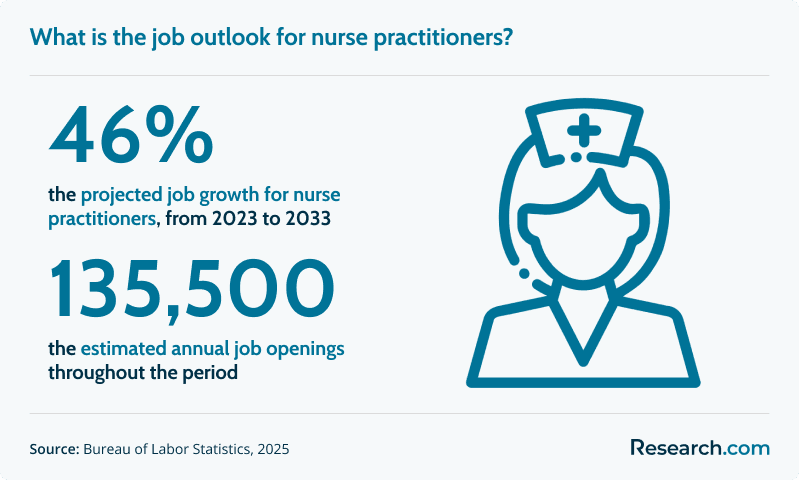
The nurse practitioner job market remains strong. The U.S. Bureau of Labor Statistics projects 46% growth for nurse practitioners from 2023 to 2033, representing an estimated 135,500 additional NP jobs. That outlook makes advanced practice nursing one of the more resilient healthcare career paths for RNs prepared to complete graduate education and certification.
Demand is influenced by several forces: an aging population, chronic disease management needs, primary care access gaps, and workforce turnover. One cited workforce concern is that 40% of RNs plan to leave in the next five years, which increases pressure on healthcare organizations to recruit, retain, and develop advanced nursing talent.
Where AG-PCNPs Fit in the Healthcare Workforce
AG-PCNPs are part of a broad list of healthcare professions working to expand access to care, manage chronic illness, and support aging populations. Job availability can still vary by region, employer type, practice authority, and local competition, so students should research the market in the state where they plan to work.
Challenges of Fast Online MSN Adult-Gerontology Primary Care NP Programs
Accelerated online MSN AG-PCNP programs can be rewarding, but they are demanding. Students often juggle graduate coursework, clinical documentation, preceptor schedules, paid work, and family responsibilities at the same time. The faster the program, the less room there is for falling behind.
| Challenge | Why It Happens | How to Reduce the Risk |
| Clinical placement delays | Preceptors may be limited in some regions | Ask whether the school provides placement support before enrolling |
| Heavy weekly workload | Accelerated terms compress assignments and exams | Review sample schedules and reduce work hours during clinical-heavy terms if possible |
| Online isolation | Students may have less informal access to peers and faculty | Use office hours, discussion boards, study groups, and advising early |
| Unexpected expenses | Fees, travel, books, and compliance costs can add up | Request a full cost breakdown, not just tuition |
| Licensure assumptions | Online programs may not meet requirements in every state | Confirm state authorization and certification eligibility in writing |
Students focused on lowering costs should compare NP options with broader affordability resources, including the cheapest online nursing program listings, while still prioritizing accreditation and clinical readiness.
What Graduates Say About Fast Online MSN AG-PCNP Programs
-
: "I knew I wanted to work more closely with older adults, but I needed a program that would give me practical tools, not just theory. The gerontology focus helped me understand chronic disease patterns, medication complexity, and the everyday decisions that affect quality of life for aging patients.
— Ben"
-
: "Online study was the only realistic option for me as a single parent. I completed most assignments after my children went to bed, and the flexibility made the degree possible. The work was intense, but the career shift changed my family’s financial outlook.
— Jessica"
-
: "I was exhausted by bedside nursing but did not want to leave healthcare. The program gave me a new direction and pushed me to think diagnostically. I moved into a role that is less physically draining and more focused on clinical judgment.
— Liam"
Is a Direct Entry Pathway a Good Alternative for Future Nurse Practitioners?
Direct entry pathways may be worth exploring for students who already hold a non-nursing bachelor’s degree and want a faster route into nursing and advanced practice. These programs are not shortcuts around licensure. Students still need to confirm how the program handles foundational nursing preparation, RN licensure eligibility, graduate progression, clinical training, and eventual NP certification requirements.
Because direct entry formats vary widely, compare outcomes, clinical support, admissions standards, and state eligibility before applying. A useful starting point is Research.com’s overview of online direct entry nurse practitioner programs. Non-nurses comparing accelerated routes can also review an online direct entry NP program for non nurses guide to understand how these pathways differ from traditional RN-to-MSN tracks.
How Technology Is Changing Online MSN AG-PCNP Programs
Online nurse practitioner education increasingly uses digital tools to strengthen clinical reasoning and student support. Programs may incorporate virtual simulations, interactive case studies, remote proctoring, video-based skills review, digital patient scenarios, and synchronous sessions with faculty or clinical experts. These tools do not replace required clinical practice, but they can help students prepare for patient encounters before entering supervised settings.
When comparing programs, ask how technology is used for assessment, faculty feedback, exam security, simulation, and clinical documentation. Strong online design should make learning more structured and interactive, not simply move lectures onto a screen.
Is a DNP Worth Considering After an MSN AG-PCNP?
A Doctor of Nursing Practice can be a logical next step for AG-PCNPs who want deeper preparation in evidence-based practice, quality improvement, clinical leadership, systems change, or policy influence. It may be especially valuable for nurses who plan to lead programs, teach, conduct practice improvement projects, or compete for senior clinical roles.
The decision should be based on career goals, cost, time, employer expectations, and whether a doctoral credential is necessary for the roles you want. MSN-prepared NPs comparing doctoral options can start with Research.com’s guide to DNP programs online.
Key Insights
- The fastest listed option is not automatically the best option. St. Thomas University reports an 18-month timeline, but accreditation, clinical placement support, cost, and state eligibility are more important than speed alone.
- Most fast BSN-to-MSN AG-PCNP programs take 18 to 24 months full-time. RN-to-MSN bridge students often need 24 to 36 months because they must complete additional bridge coursework.
- Accreditation is non-negotiable. Confirm CCNE or ACEN accreditation before applying, and verify that the program supports certification and licensure in your intended state.
- Clinical placement support can determine whether you graduate on time. Ask whether the school finds placements, assists with placements, or leaves preceptor searches mainly to students.
- The average total tuition is approximately $37,650, but real costs may be higher. Include fees, books, compliance costs, clinical travel, certification exams, and potential lost income in your ROI calculation.
- AG-PCNP is best for nurses who want adult and older-adult primary care. If you prefer pediatrics, acute care, psychiatric care, or systems technology, compare other NP or nursing career paths before enrolling.
- The job outlook for nurse practitioners is strong. BLS projects 46% growth from 2023 to 2033, with an estimated 135,500 additional NP jobs, but local opportunities still depend on region, employer demand, and scope-of-practice rules.
References
- Data USA. (2025). Nursing Practice. Retrieved October 26, 2023, from https://datausa.io/profile/cip/nursing-practice
- Data USA. (2025). Registered Nursing. Retrieved October 26, 2023, from https://datausa.io/profile/cip/registered-nursing
- National Council of State Boards of Nursing. (2025). 2024 Study Highlights. Retrieved October 26, 2023, from https://www.ncsbn.org/research/recent-research/workforce/2024-workforce-pn.page
- National Council of State Boards of Nursing. (2025). Active RN licenses. Retrieved October 26, 2023, from https://www.ncsbn.org/nursing-regulation/national-nursing-database/licensure-statistics/active-rn-licenses.page
- Payscale. (2025). Master of Science in Nursing (MSN) Degree. Retrieved October 26, 2023, from https://www.payscale.com/research/US/Degree=Master_of_Science_in_Nursing_(MSN)/Salary
- University of St. Augustine for Health Sciences. (2024). Nursing shortage: A 2024 data study reveals key insights. Retrieved October 26, 2023, from https://www.usa.edu/blog/nursing-shortage/
- U.S. Bureau of Labor Statistics. (2025). Occupational Employment and Wage Statistics (OEWS) Profiles. Retrieved October 26, 2023, from https://data.bls.gov/oesprofile/
- U.S. Bureau of Labor Statistics. (2025). Registered nurses. Occupational Outlook Handbook. Retrieved October 26, 2023, from https://www.bls.gov/ooh/healthcare/registered-nurses.htm
- U.S. Census Bureau. (2021, April 5). Who are our health care workers? Retrieved October 26, 2023, from https://www.census.gov/library/stories/2021/04/who-are-our-health-care-workers.html
Other Things You Need To Know About Online MSN Adult-Gerontology Primary Care NP Programs
Online MSN Adult-Gerontology Primary Care NP programs typically take 2-3 years to complete. Accelerated options may shorten this timeline, allowing students to graduate in just under two years, depending on prior coursework and full-time enrollment status.
Yes. Most MSN Adult-Gerontology Primary Care NP programs require at least 500 supervised clinical hours, and many require 600 to 720 hours before graduation. These hours must be completed with approved preceptors in primary care or gerontological settings and are verified by the program.
To enroll in an online MSN Adult-Gerontology Primary Care NP program in 2027, candidates generally need a Bachelor of Science in Nursing (BSN), a valid RN license, and relevant clinical experience. Some programs may also require specific courses such as statistics or health assessment.