
2027 Best Accelerated Online MSN/MBA Dual Degree Programs

Co-Founder and Chief Data Scientist
Did you know the healthcare industry is rapidly expanding? With employment of medical and health services managers projected to grow 29% from 2023 to 2033, advanced credentials are in high demand. Completing an accelerated online MSN/MBA dual degree equips professionals with clinical expertise and business acumen, fast‐tracking leadership roles in hospitals, clinics, and health systems.
This article explores how such programs boost earning potential, offer exceptional job security, and open doors to diverse executive positions in healthcare administration. Read on to see how you can accelerate your career trajectory.
What are the benefits of completing an accelerated online MSN/MBA dual degree programs?
- Graduates can earn a median annual salary of $100,947 as medical and health services managers in 2023.
- Employment for healthcare managers is projected to increase 29% from 2023 to 2033, far outpacing average occupational growth.
- Career paths include Chief Nursing Officer, Healthcare Administrator, Nurse Executive, and other executive leadership roles.
What can I expect from accelerated online MSN/MBA dual degree program?
An accelerated online MSN/MBA dual degree blends advanced nursing and business coursework into a streamlined curriculum, typically completed in under three years. You’ll engage in “100% online” lectures, virtual simulations, and collaborative projects that sharpen clinical leadership and strategic management skills.
Expect rigorous modules covering healthcare policy, finance, and administration alongside MSN courses in evidence-based practice and population health. Time management is crucial—you’ll balance asynchronous learning with live sessions, capstone projects, and practicums coordinated at your workplace. Graduates emerge ready to “plan, direct, or coordinate medical and health services” at executive levels.
Where can I work with accelerated online MSN/MBA dual degree program?
Graduates of an accelerated online MSN/MBA dual degree are well‐positioned for leadership roles across diverse healthcare settings. You might serve as a nurse executive, healthcare consultant, or director of operations in organizations ranging from hospitals to insurance firms. Top-employing industries include:
- General medical and surgical hospitals (147,250 managers; $145,390 mean annual wage)
- Offices of physicians (68,370 managers; $134,330 mean annual wage)
- Outpatient care centers (38,150 managers; $129,500 mean annual wage)
- Home health care services (25,750 managers; $109,300 mean annual wage)
- Nursing care facilities (28,100 managers; $106,520 mean annual wage)
Healthcare leadership roles also abound regionally. States with the highest employment levels for medical and health services managers are:
- California (57,310 managers; $156,140 mean annual wage)
- Texas (51,030 managers; $120,200 mean annual wage)
- Florida (35,950 managers; $124,070 mean annual wage)
- New York (25,910 managers; $179,160 mean annual wage)
- Pennsylvania (20,800 managers; $125,860 mean annual wage)
How much can I make with accelerated online MSN/MBA dual degree program?
According to the U.S. Bureau of Labor Statistics, the mean annual wage for Medical and Health Services Managers was $134,440 in May 2023. Below are salary figures from popular job platforms:
- Zippia: Average salary of $84,568/year
- Salary.com: $96,665/year
- ZipRecruiter: $95,625/year
- Indeed: Median $110,680/year
- PayScale: $82,299/year
- Glassdoor: (typically ranges reported around $114,000; link example)
- Best Accelerated Online MSN/MBA Dual Degree Programs for 2027 List of Programs
- How long does it take to complete an accelerated online MSN/MBA dual degree program? Program Duration
- How does an online MSN/MBA dual degree compare to an on-campus program? Online vs Campus Program
- What is the average cost of an accelerated online MSN/MBA dual degree program? Program Cost
- What are the financial aid options for students enrolling in an accelerated online MSN/MBA dual degree program? Financial Aid
- What are the prerequisites for enrolling in an accelerated online MSN/MBA dual degree program? Admission Requirements
- What courses are typically in an accelerated online MSN/MBA dual degree program? Curriculum
- What types of specializations are available in accelerated online MSN/MBA dual degree programs? Specializations
- How do you choose the best accelerated online MSN/MBA dual degree program? How do you choose the best accelerated online MSN/MBA dual degree program?
- What career paths are available for graduates of accelerated online MSN/MBA dual degree programs? What career paths are available for graduates of accelerated online MSN/MBA dual degree programs?
- What is the job market like for graduates with an accelerated online MSN/MBA dual degree? What is the job market like for graduates with an accelerated online MSN/MBA dual degree?
- What accreditation and support services should I expect from an accelerated online MSN/MBA dual degree program? What accreditation and support services should I expect from an accelerated online MSN/MBA dual degree program?
- How do accelerated online MSN/MBA dual degree programs compare to nurse practitioner direct entry programs? How do accelerated online MSN/MBA dual degree programs compare to nurse practitioner direct entry programs?
- How will emerging healthcare trends impact the value of an accelerated online MSN/MBA dual degree? How will emerging healthcare trends impact the value of an accelerated online MSN/MBA dual degree?
- Can an accelerated online MSN/MBA dual degree pave the way for additional advanced clinical qualifications? Can an accelerated online MSN/MBA dual degree pave the way for additional advanced clinical qualifications?
Best Accelerated Online MSN/MBA Dual Degree Programs for 2027
Choosing an accelerated online MSN/MBA dual degree is usually a career decision, not just an academic one. Registered nurses who are moving toward nurse manager, director, administrator, chief nursing officer, or healthcare executive roles often need more than clinical expertise; they also need budgeting, operations, strategy, staffing, quality improvement, and organizational leadership skills.
This guide is designed for working nurses comparing online MSN/MBA dual degree programs and trying to decide whether the time, cost, and workload make sense. It explains how accelerated dual programs work, how long they take, what they cost, what accreditation to check, which schools stand out, and what career outcomes may be realistic after graduation.
You will also find practical comparison tables, program-selection advice, common mistakes to avoid, and questions to ask admissions teams before enrolling.
Quick answer: What is the best accelerated online MSN/MBA dual degree?
The best accelerated online MSN/MBA dual degree is the one that matches your career goal, budget, schedule, state requirements, and accreditation needs. Strong programs usually combine a CCNE- or ACEN-accredited nursing curriculum with an AACSB-, ACBSP-, or IACBE-accredited business school, allow shared credits between the MSN and MBA, and provide online advising, practicum support, and career services for working nurses.
Among the programs reviewed below, Southern Utah University offers one of the shortest stated timelines at 18 months, while several other universities offer completion windows of about 2.5 to 3 years. Program costs, credit requirements, and business-school accreditation vary substantially, so comparing total program cost is more useful than comparing tuition per credit alone.
Best accelerated online MSN/MBA dual degree programs at a glance
| School | Program | Published cost | Estimated duration | Credits | Accreditation listed |
| Kent State University | MSN/MBA Dual Degree Program | $572/credit | ~3 years | ~60 credits | CCNE, AACSB |
| Texas Tech University Health Sciences Center | MSN Administration/MBA Dual Degree | $589/credit | ~3 years | 57 credits | CCNE, AACSB |
| University of Texas at Tyler | Coordinated MSN in Nursing Administration/MBA | ~$802/credit | ~2.5 years | 63 credits | CCNE, AACSB |
| Indiana Wesleyan University | MSN/MBA Healthcare Systems Leadership | $595/credit | ~3 years | 61 credits | CCNE, ACBSP |
| Southern Utah University | MSN in Leadership & Administration/MBA Dual Degree | $504/credit | 18 months | 51 credits | CCNE, AACSB |
| Union University | MSN Administration/MBA Dual Degree Option | $750/credit | ~18 months | ~60 credits | CCNE, AACSB |
| University of Mary | MSN/MBA Dual Degree in Healthcare Administration | $495/credit | < 2.5 years | ~60 credits | CCNE, IACBE |
| Benedictine University | Online Dual MSN/MBA Program | $800/credit | ~2.5 years | 69 credits | CCNE, ACBSP |
| Spring Arbor University | MSN/MBA Dual Degree Program | $767/credit | ~30 months | ~60 credits | CCNE, IACBE |
| Purdue University Global | Online MSN/MBA Dual Degree | $420–$485/credit | ~2.5 years | 88 credits | CCNE, ACBSP |
How do we rank schools?
Research.com evaluates accelerated online MSN/MBA dual degree programs using a research-based ranking methodology that reviews institutional data, program features, affordability, reputation, and student-value indicators.
Our analysis draws on the IPEDS database from the National Center for Education Statistics for institutional information; Peterson's database, including distance-learning data, for program availability and delivery details; and the U.S. Department of Education’s College Scorecard database for cost and outcomes measures.
The ranking prioritizes programs that combine recognized academic quality, relevant nursing and business accreditation, online accessibility, reasonable cost considerations, and evidence that the online program is connected to a credible institution with established academic operations.
1. Kent State University – MSN/MBA Dual Degree Program
Kent State University, founded in 1910 in Kent, Ohio, is a public research university with a broad academic footprint across Northeast Ohio. Its dual MSN/MBA option is built for nurses who want leadership preparation that reaches beyond bedside care and into management, finance, and organizational decision-making.
This program is a strong fit for nurses who want a university with established nursing and business education and who prefer a roughly three-year path with business-school accreditation from AACSB.
- Program cost: $572/credit
- Program duration: ~3 years
- Total credits needed to graduate: ~60 credits
- Program/School Accreditation: CCNE, AACSB
2. Texas Tech University Health Sciences Center – MSN Administration/MBA Dual Degree
Texas Tech University Health Sciences Center, located in Lubbock, Texas, was established in 1969 and focuses on healthcare education, clinical training, and health sciences research. Its dual program pairs nursing administration coursework with MBA study through Texas Tech’s Rawls College of Business.
This option may appeal to nurses who want a public university system, a nursing-administration focus, and a 57-credit structure that integrates healthcare leadership with business fundamentals.
- Program cost: $589/credit
- Program duration: ~3 years
- Total credits needed to graduate: 57 credits
- Program/School Accreditation: CCNE, AACSB
3. University of Texas at Tyler – Coordinated MSN in Nursing Administration/MBA
The University of Texas at Tyler, founded in 1971, is part of the University of Texas System and serves students across East Texas and beyond. Its coordinated MSN/MBA pathway is designed for nurses who want to move into administrative, financial, and operational roles within healthcare organizations.
Because this program lists 63 credits and an estimated completion time of about 2.5 years, it may suit students who can manage a demanding schedule and want a public university option with both CCNE and AACSB accreditation listed.
- Program cost: ~$802/credit
- Program duration: ~2.5 years
- Total credits needed to graduate: 63 credits
- Program/School Accreditation: CCNE, AACSB
4. Indiana Wesleyan University – MSN/MBA Healthcare Systems Leadership
Indiana Wesleyan University is a private Christian university in Marion, Indiana, founded in 1920. Its National & Global campus serves adult and online learners, making the MSN/MBA pathway relevant for working nurses who need flexibility while continuing employment.
The healthcare systems leadership focus is useful for nurses who want to combine faith-informed leadership, advanced nursing preparation, and business administration training in one coordinated graduate plan.
- Program cost: $595/credit
- Program duration: ~3 years
- Total credits needed to graduate: 61 credits
- Program/School Accreditation: CCNE, ACBSP
5. Southern Utah University – MSN in Leadership & Administration/MBA Dual Degree
Southern Utah University, a public university in Cedar City, Utah, was founded in 1897. Its online MSN/MBA dual degree emphasizes leadership, administration, finance, marketing, and operations for nurses preparing to manage teams or service lines.
With a listed 18-month duration and 51-credit structure, this is one of the shortest programs in this ranking. Prospective students should still confirm the actual course load, start dates, practicum expectations, and whether the pace is realistic alongside full-time nursing work.
- Program cost: $504/credit
- Program duration: 18 months
- Total credits needed to graduate: 51 credits
- Program/School Accreditation: CCNE, AACSB
6. Union University – MSN Administration/MBA Dual Degree Option
Union University is a private Christian university in Jackson, Tennessee, with roots dating to 1823. Its MSN administration students can pursue an MBA through the university’s business school, creating a dual path for nurses interested in ethics-centered leadership and organizational management.
This program is worth considering for students who prefer a private Christian university setting, value smaller academic communities, and want a program that lists both CCNE and AACSB accreditation.
- Program cost: $750/credit
- Program duration: ~18 months
- Total credits needed to graduate: ~60 credits
- Program/School Accreditation: CCNE, AACSB
7. University of Mary – MSN/MBA Dual Degree in Healthcare Administration
The University of Mary is a private Catholic university in Bismarck, North Dakota, founded in 1959 by the Benedictine Sisters. Its MSN/MBA dual degree in healthcare administration blends graduate nursing content with business courses intended for nurses moving into management and executive responsibilities.
The listed tuition of $495/credit and completion timeline of less than 2.5 years make this program a notable option for cost-conscious students, though applicants should compare total fees, practicum requirements, and scholarship eligibility before deciding.
- Program cost: $495/credit
- Program duration: < 2.5 years
- Total credits needed to graduate: ~60 credits
- Program/School Accreditation: CCNE, IACBE
8. Benedictine University – Online Dual MSN/MBA Program
Benedictine University is a private Catholic university in Lisle, Illinois, with institutional history dating to 1887. Its online dual MSN/MBA program serves working nurses who want both graduate nursing preparation and business management training without relocating.
The program lists 69 credits and an estimated timeline of about 2.5 years, making it a more credit-intensive choice than some alternatives. It may be a fit for students who value a values-based education and can manage the tuition and course load.
- Program cost: $800/credit
- Program duration: ~2.5 years
- Total credits needed to graduate: 69 credits
- Program/School Accreditation: CCNE, ACBSP
9. Spring Arbor University – MSN/MBA Dual Degree Program
Spring Arbor University is a private Free Methodist university in Spring Arbor, Michigan, founded in 1873. Its online MSN/MBA program uses an asynchronous format and is structured around one concentrated seven-week course at a time.
This format may work well for nurses who prefer focused course sequencing instead of juggling multiple classes. Students interested in organizational consulting or human resources development should review how concentration options align with their leadership goals.
- Program cost: $767/credit
- Program duration: ~30 months
- Total credits needed to graduate: ~60 credits
- Program/School Accreditation: CCNE, IACBE
10. Purdue University Global – Online MSN/MBA Dual Degree
Purdue University Global, established in 2018 as Purdue University’s online branch, focuses on flexible programs for working adults. Its MSN/MBA dual degree allows students to earn both credentials by sharing credits rather than completing two entirely separate graduate programs.
This program lists the lowest per-credit range in the ranking at $420–$485/credit, but it also lists 88 credits, so students should calculate the full tuition estimate before assuming it is the least expensive overall. The curriculum includes experiential learning arranged at students’ workplaces and preparation connected to nurse executive certification goals.
- Program cost: $420–$485/credit
- Program duration: ~2.5 years
- Total credits needed to graduate: 88 credits
- Program/School Accreditation: CCNE, ACBSP
How long does it take to complete an accelerated online MSN/MBA dual degree program?
Most accelerated online MSN/MBA dual degree programs take about 2 to 3 years of full-time study, though the exact timeline depends on transfer credits, shared credits, course load, term length, and whether the student studies year-round.
Some programs advertise shorter completion periods, including options listed at 18 months or less than 2.5 years. Others may take up to 4 years for students who enroll part time while balancing rotating shifts, family responsibilities, and practicum requirements.
The acceleration usually comes from shared coursework between the MSN and MBA, compressed terms, multiple start dates, and online delivery. If you are still asking, what is an MSN degree, the key point is that the MSN portion develops advanced nursing leadership and evidence-based practice skills, while the MBA portion adds business, finance, strategy, and management training.
| Student situation | Likely timeline | What to consider before enrolling |
| Full-time student with employer flexibility | About 2 to 3 years | Confirm weekly workload, practicum timing, and whether compressed terms are sustainable. |
| Working nurse studying part time | Up to 4 years | Ask whether the school allows stop-outs, reduced course loads, and flexible sequencing. |
| Student choosing an intensive accelerated track | As little as 18 months in some programs | Make sure the pace does not compromise work performance, practicum quality, or exam preparation. |
How does an online MSN/MBA dual degree compare to an on-campus program?
An online MSN/MBA dual degree can carry the same academic value as an on-campus program when the institution is properly accredited and the online curriculum is equivalent to the campus-based version. The main difference is delivery: online students typically complete lectures, discussions, team projects, and assignments through a learning platform, while practicum or applied leadership experiences may be arranged locally or through the student’s workplace.
For nurses who want business training with a stronger data focus, an online master of business administration in analytics may be a useful comparison point, especially for roles involving reporting, performance improvement, quality metrics, and operational decision-making.
| Factor | Online MSN/MBA | On-campus MSN/MBA |
| Best for | Working nurses who need schedule flexibility and cannot relocate | Students who prefer in-person instruction and campus networking |
| Course delivery | Asynchronous or synchronous online classes, virtual collaboration, digital simulations, and remote advising | Scheduled classroom meetings, in-person group work, campus resources, and local networking |
| Practicum or applied work | Often completed through approved local sites or current workplace settings | Often tied to campus partnerships, local healthcare systems, or faculty-arranged experiences |
| Cost considerations | May reduce relocation, commuting, and housing expenses | May involve campus fees, commuting, housing, or relocation costs |
| Networking | Requires intentional participation in virtual events, projects, and alumni groups | More natural access to face-to-face faculty, classmates, and local employers |
Online programs are not automatically easier. In accelerated formats, the time-management demands can be higher because students must keep pace without the structure of weekly campus meetings. Nurses comparing formats should ask whether the program is asynchronous, whether live sessions are required, and how practicum placement support works in their state.
What is the average cost of an accelerated online MSN/MBA dual degree program?
Accelerated online MSN/MBA dual degree programs usually charge by the credit. That means the real price depends on the tuition rate, total required credits, university fees, technology charges, books, clinical or practicum expenses, and whether the student qualifies for in-state tuition or employer reimbursement.
The average cost of attendance for graduate students in 2023–24 was $37,540, including tuition, fees, supplies, and living costs. Published graduate tuition and required fees averaged $10,269 for in-state students and $19,469 for out-of-state students per academic year.
Recent analyses show that total graduate program costs can range from $30,000 at smaller institutions to more than $120,000 at top-tier private universities. Among the U.S. Top 100 colleges, average graduate tuition and fees were $16,323 for in-state students and $39,757 for out-of-state students in 2023–24.
Because the programs in this guide list 51 to 88 credits, per-credit tuition can be misleading. A lower per-credit rate may still produce a higher total bill if the program requires substantially more credits. Students should request a full cost sheet before applying.
| Cost item | Why it matters | Question to ask |
| Tuition per credit | This is the base cost, but not the full cost. | Is the quoted tuition locked for the entire program or subject to annual increases? |
| Total credits | Dual degrees can require significantly different credit totals. | How many credits are required after shared MSN/MBA coursework is applied? |
| Mandatory fees | Technology, distance-learning, graduation, and course fees can add up. | What fees are required each term and at graduation? |
| Practicum expenses | Students may need background checks, immunizations, travel, or site-related documentation. | Will the school help secure practicum placements near my home or workplace? |
| Indirect costs | Lost work hours, childcare, and reduced overtime can affect affordability. | How many hours per week should I expect to spend on coursework? |
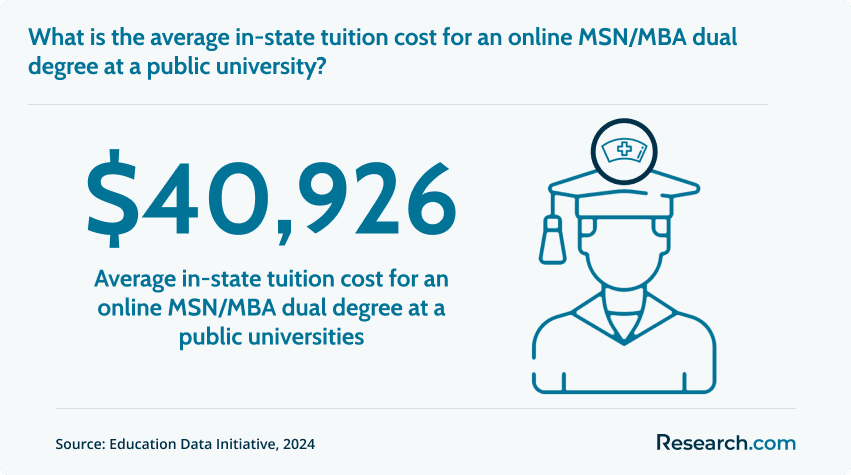
The average of $40,926 in-state tuition shown in the image below is a useful reminder that public-university options may be more cost-effective for some students, but the best comparison is always total program cost after aid, employer support, and required fees.
What are the financial aid options for students enrolling in an accelerated online MSN/MBA dual degree program?
Graduate nursing and business students may be able to combine federal loans, school-based aid, employer benefits, scholarships, and military education benefits. The most important step is to compare net cost, not just advertised tuition.
- Federal Direct Unsubsidized Loans: Graduate students can borrow up to $20,500 per year, and interest begins accruing immediately.
- Graduate PLUS Loans: These loans may cover costs that remain after unsubsidized loan eligibility is used, but credit approval is required.
- Institutional Scholarships & Grants: Some universities offer merit-based or need-based support for graduate nursing, business, or dual-degree students.
- Graduate Assistantships & Fellowships: Teaching, research, or administrative roles may reduce tuition costs and may include stipends, depending on the school.
- Employer Tuition Reimbursement: Hospitals, health systems, clinics, and insurers may help fund graduate education for employees who meet service or grade requirements.
- State Grant Programs: Some states provide graduate-level support for residents entering high-need fields such as nursing.
- Veterans’ Education Benefits: Eligible veterans and service members may use Post-9/11 GI Bill and other VA education programs.
Students trying to limit borrowing should also compare affordable online MSN programs and ask whether a single MSN, MBA, certificate, or employer-sponsored leadership program could meet their immediate goals at a lower cost.
What are the prerequisites for enrolling in an accelerated online MSN/MBA dual degree program?
Admission requirements vary, but applicants typically must satisfy both graduate nursing and graduate business expectations. Most programs look for evidence that the applicant can handle advanced nursing coursework, business analytics, leadership projects, and applied healthcare management assignments.
If you have not yet completed a BSN, fast track online LPN to BSN programs may be relevant if they match your licensure status, state requirements, and career timeline.
- Bachelor of Science in Nursing: Many programs require a BSN from an accredited nursing program.
- Active RN License: Applicants generally need an unencumbered U.S. registered nurse license in good standing.
- Minimum GPA: A cumulative GPA of 3.0 or higher on a 4.0 scale is commonly expected.
- Professional Experience: 1–2 years of clinical nursing experience is often preferred.
- Official Transcripts: Schools usually require transcripts from all undergraduate and graduate institutions attended.
- Résumé or CV: Applicants should document clinical roles, leadership duties, committees, quality projects, and management experience.
- Personal Statement: A strong statement should explain why the applicant wants both the MSN and MBA and how the degree supports specific leadership goals.
- Letters of Recommendation: Programs often request two to three professional or academic references.
- Prerequisite Coursework: Statistics or research methods may be required before or during the program.
- Background Check & Health Clearance: Some schools require criminal background checks, immunization records, drug screening, or site-specific documentation.
Applicants should also ask whether business prerequisites are required. Some MBA courses assume comfort with accounting, economics, statistics, or quantitative analysis, even when the program does not require a business undergraduate degree.
What courses are typically in an accelerated online MSN/MBA dual degree program?
Accelerated online MSN/MBA programs combine nursing leadership, evidence-based practice, health systems, finance, management, strategy, and organizational behavior. The goal is to prepare nurses to make decisions that are clinically sound, financially responsible, and operationally realistic.
Students who are earlier in the nursing pathway may need to complete RN preparation before considering a graduate dual degree. For example, accelerated LVN to RN online programs may help some licensed vocational or practical nurses move toward RN eligibility before later pursuing BSN and graduate study.
Programs generally require around 60–90 credits. Course titles differ by school, but the curriculum often includes the following areas.
| Course area | Typical focus | Why it matters for healthcare leadership |
| Evidence-Based Practice | Research interpretation, statistics, quality improvement, and clinical decision-making | Leaders must justify policy and process changes with data, not assumptions. |
| Advanced Health Assessment | Comprehensive patient evaluation across populations | Clinical credibility remains important when leading care teams. |
| Healthcare Informatics | Clinical systems, electronic records, workflow data, and technology-enabled care | Managers increasingly rely on dashboards, documentation systems, and digital care tools. |
| Organizational Leadership in Nursing | Team leadership, change management, staffing, ethics, and professional practice | Nurse leaders need to manage people, conflict, safety culture, and performance. |
| Healthcare Finance & Economics | Budgeting, reimbursement, resource allocation, and financial analysis | Directors and executives must connect care quality with financial sustainability. |
| Strategic Management | Competitive positioning, planning, growth, and organizational execution | Healthcare leaders must align department goals with system-wide priorities. |
| Marketing for Healthcare Organizations | Market analysis, patient engagement, communication, and service-line positioning | Healthcare organizations compete for patients, talent, payer relationships, and community trust. |
| Human Resource Management | Recruitment, retention, performance evaluation, labor issues, and team development | Staffing challenges directly affect quality, cost, morale, and patient experience. |
| Capstone or Integrative Project | Applied leadership project addressing a real healthcare problem | Students demonstrate that they can connect clinical evidence with business execution. |
The chart below highlights in-demand skills such as Social Work at 27.9%, Behavioral Health at 10.3%, and Care Management at 3.9%. These skill areas connect closely to MSN coursework in evidence-based practice, leadership, population health, and care coordination.
What types of specializations are available in accelerated online MSN/MBA dual degree programs?
Specializations allow students to shape the dual degree around their target role. Some programs emphasize nursing administration, while others offer options connected to informatics, education, healthcare administration, organizational consulting, human resources, or executive leadership.
Students entering nursing from another healthcare role should map each step carefully. For example, a person with medical assistant experience may first compare the shortest medical assistant to RN program online before moving on to BSN and graduate-level options.
- Nurse Leadership: Builds skills in staff supervision, clinical operations, quality improvement, and change management.
- Healthcare Informatics: Focuses on information systems, workflow optimization, electronic health records, and data-supported decision-making.
- Nurse Education: Prepares nurses to support staff development, clinical education, curriculum design, and learner assessment.
- Population Health: Emphasizes prevention, community assessment, health promotion, and care strategies for groups rather than individual patients only.
- Healthcare Finance & Economics: Covers budgets, reimbursement models, cost analysis, and financial planning in healthcare organizations.
- Strategic Management: Develops planning, operations, market analysis, and organizational strategy skills for health systems.
- Entrepreneurship in Healthcare: Supports nurses interested in consulting, startups, service-line development, or independent healthcare ventures.
- Executive Leadership: Combines advanced nursing leadership with high-level management preparation for senior administrative roles.
The chart below shows that 52% of health care managers hold a bachelor’s degree, 17% hold an associate degree, and 22% hold master’s-level qualifications. That master’s-level share illustrates why graduate credentials can matter for nurses pursuing competitive leadership roles.
How do you choose the best accelerated online MSN/MBA dual degree program?
The best program is not always the fastest or cheapest one. A strong choice should align with your target role, state requirements, work schedule, financial situation, and preferred learning format. Use the following process before applying.
- Clarify the job you want next: Decide whether you are aiming for nurse manager, department director, informatics leader, educator, healthcare consultant, chief nursing officer, or another role.
- Verify institutional accreditation: Confirm that the university is recognized by an appropriate institutional accreditor.
- Check nursing accreditation: Look for CCNE or ACEN recognition, especially if you may pursue certification, further graduate study, or employer reimbursement.
- Check business accreditation: Review whether the business school lists AACSB, ACBSP, or IACBE accreditation and whether that matters to your employer or career goals.
- Compare total cost, not tuition per credit only: Multiply tuition by total credits, then add fees, books, technology charges, travel, and practicum expenses.
- Study the pace carefully: Ask how many courses students typically take per term and how many hours per week are expected.
- Confirm practicum support: Do not assume you can complete applied requirements anywhere. Ask who finds sites, approves preceptors, and handles affiliation agreements.
- Review student services: Look for online advising, library access, writing support, technical help, career coaching, and alumni networking.
- Ask about outcomes: Request graduation rates, retention rates, career-support data, and alumni role examples, while remembering that salary and promotion are never guaranteed.
Questions to ask before enrolling
| Question | Why it matters |
| Is the online program identical to or substantially aligned with the campus curriculum? | This helps you judge academic consistency and employer recognition. |
| How many credits are shared between the MSN and MBA? | Shared credits are what usually make a dual degree faster than two separate degrees. |
| Are there required live sessions? | Live attendance may be difficult for nurses working nights, weekends, or rotating shifts. |
| Can I complete practicum or applied projects at my current workplace? | This can reduce travel and make assignments more relevant to your job. |
| What happens if I need to slow down or pause enrollment? | Flexible pacing can be critical for working nurses with unpredictable schedules. |
| Does the program prepare students for nurse executive certifications? | Certification alignment may matter if you are targeting formal leadership credentials after graduation. |
What career paths are available for graduates of accelerated online MSN/MBA dual degree programs?
MSN/MBA graduates typically pursue leadership and administration roles rather than direct advanced clinical practice roles. The dual degree is especially relevant for nurses who want to manage people, budgets, service lines, quality initiatives, and organizational strategy.
- Nurse Manager: Supervises unit operations, staffing, scheduling, performance, budgets, quality metrics, and patient-care processes.
- Department Director or Practice Manager: Oversees multiple teams, departments, clinics, or service lines while coordinating operations and strategic goals.
- Medical and Health Services Manager: Plans, directs, and coordinates the business activities of healthcare facilities, departments, or practices.
- Director of Clinical Services: Leads clinical program development, quality improvement, compliance, and service delivery initiatives.
- Chief Nursing Officer: Serves as a senior nursing executive responsible for nursing strategy, workforce planning, standards of care, and organizational policy.
- Vice President of Healthcare Services: Manages broad operations across service lines, regions, or business units and helps drive financial and strategic performance.
- Chief Executive Officer or C-suite Executive: Leads organizational vision, stakeholder relationships, operational sustainability, and long-term strategy.
Because an online MBA is embedded in the degree plan, graduates can speak both the clinical and business languages of healthcare. That combination can be valuable in roles where patient outcomes, staffing pressures, reimbursement, and financial performance intersect.
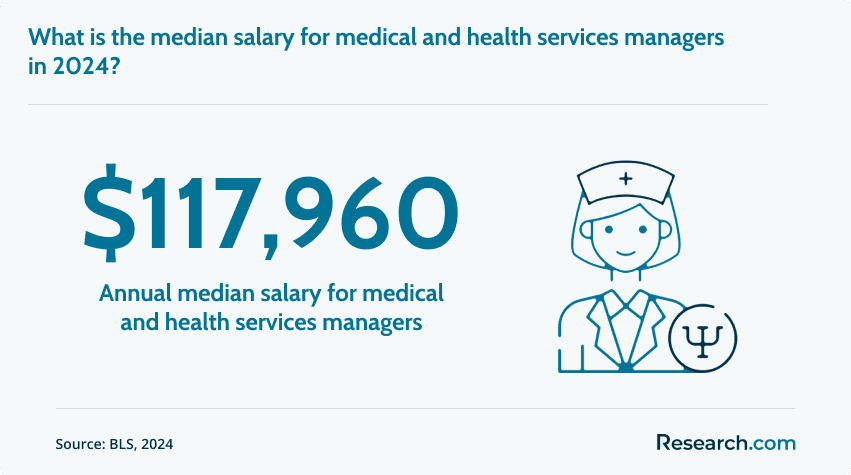
The infographic below lists a $117,960 median salary for medical and health services managers. This figure can help benchmark the leadership market, but individual earnings depend on employer, region, role level, experience, organization size, and prior management background.
What is the job market like for graduates with an accelerated online MSN/MBA dual degree?
The labor market for healthcare managers is strong. The Bureau of Labor Statistics projects 29% growth for medical and health services managers from 2023 to 2033, which is much faster than average occupational growth.
In 2023, there were 562,700 medical and health services manager positions nationwide, with 160,600 new openings expected over the decade. Hospitals remain major employers, while physician offices, outpatient care centers, and home health services also employ healthcare managers.
The median annual wage for medical and health services managers was $117,960 in May 2024. States with high employment levels and wages for healthcare management roles include California, Texas, Florida, New York, and Pennsylvania.
An MSN/MBA can help nurses compete for leadership roles, but it does not guarantee promotion. Employers may also look for supervisory experience, quality-improvement results, communication skills, budget ownership, project leadership, and knowledge of healthcare regulations.
What accreditation and support services should I expect from an accelerated online MSN/MBA dual degree program?
Accreditation should be one of the first checks, not an afterthought. A credible accelerated online MSN/MBA program should be offered by an institution with recognized institutional accreditation and should clearly identify nursing and business program accreditation where applicable.
For the nursing component, look for recognized nursing accreditation such as CCNE or ACEN. For the business component, common business-school accreditors include AACSB, ACBSP, and IACBE. Accreditation can affect employer acceptance, certification eligibility, transfer options, and future doctoral study, so applicants should verify current status directly with the school and accreditor.
Support services matter because accelerated online dual degrees are demanding. Look for academic advising, practicum coordination, library access, writing support, technical help, career development, faculty availability, mentorship, and alumni networking. Students who are still comparing nursing pathways and cost should also review affordable options such as low-cost online nursing programs before committing to a dual graduate degree.
What graduates say about accelerated online MSN/MBA dual degree programs
- Marisol: "Completing two graduate degrees while working full time required discipline, but the online schedule made it possible. I could study after shifts, and the leadership projects connected directly to problems I was seeing in the hospital. The biggest benefit was learning how to discuss staffing, quality, and finance in the same conversation."
- Kian: "The program changed how I approached management. I already understood patient care, but the MBA courses helped me read budgets, evaluate strategy, and participate more confidently in executive-level discussions. I started applying the coursework to department efficiency almost immediately."
- Tova: "Online study let me keep my job and stay present for my family. The coursework was challenging, but the virtual discussions and group projects helped me build a network with nurses in other states and health systems. I finished with a clearer plan for moving into senior leadership."
How do accelerated online MSN/MBA dual degree programs compare to nurse practitioner direct entry programs?
An accelerated online MSN/MBA and a nurse practitioner direct entry pathway serve different career goals. The MSN/MBA is mainly for nurses who want leadership, administration, operations, finance, strategy, or executive roles. Nurse practitioner direct entry programs are designed for students pursuing advanced clinical practice and patient-care provider roles.
| Factor | Accelerated online MSN/MBA | Nurse practitioner direct entry program |
| Primary career direction | Healthcare leadership, administration, operations, finance, and executive management | Advanced clinical practice and direct patient care |
| Core curriculum emphasis | Nursing leadership plus MBA topics such as finance, strategy, marketing, and management | Clinical diagnosis, treatment, pharmacology, assessment, and specialty practice |
| Typical outcome | Manager, director, administrator, chief nursing officer, healthcare executive, consultant | Nurse practitioner roles in a clinical specialty area |
| Certification considerations | May support nurse executive or leadership certifications depending on program design | Usually tied to NP certification and state licensure requirements |
| Best fit | Experienced nurses who want to influence systems, staffing, quality, and business decisions | Students who want to diagnose, treat, and manage patient care as advanced practice providers |
If your goal is to lead departments or health systems, the MSN/MBA is usually the more aligned option. If your goal is to become an advanced clinical provider, an NP pathway is more appropriate.
How will emerging healthcare trends impact the value of an accelerated online MSN/MBA dual degree?
Healthcare leadership is being reshaped by digital health tools, telemedicine, data analytics, workforce shortages, value-based care models, cost pressures, and increased scrutiny of quality and patient outcomes. These changes make cross-functional leadership more important because managers must understand clinical realities, financial limits, technology adoption, compliance, and patient experience at the same time.
An MSN/MBA can be valuable when the curriculum teaches students to use data, manage change, evaluate operational risk, communicate across departments, and make financially responsible decisions without losing sight of patient care. However, students should review each program’s courses carefully. A program that does not address informatics, analytics, quality improvement, or healthcare finance may be less useful for modern leadership roles.
Candidates comparing leadership and clinical pathways may also want to review a nurse practitioner direct entry program for non nurses to understand how clinical provider preparation differs from health administration preparation.
Can an accelerated online MSN/MBA dual degree lead to additional advanced clinical qualifications?
An MSN/MBA can support future graduate study, but it is not the same as an advanced clinical practice degree. Nurses who later want higher-level clinical, systems, or evidence-based practice preparation may consider doctoral options, depending on their goals and eligibility.
For example, some graduates may pursue online DNP programs to deepen practice leadership, quality improvement, clinical scholarship, or systems-level expertise. Before choosing this route, students should confirm whether their MSN/MBA coursework satisfies admission expectations and whether additional clinical prerequisites are required.
Common mistakes to avoid when choosing an accelerated online MSN/MBA dual degree
- Choosing only by speed: A very short timeline can be attractive, but it may require an intense workload that is difficult to manage with full-time nursing shifts.
- Comparing tuition per credit without checking total credits: A lower per-credit rate may not mean a lower total cost if the program requires more credits.
- Ignoring accreditation: Always verify institutional, nursing, and business accreditation directly before enrolling.
- Assuming online means self-paced: Many online programs have fixed deadlines, group projects, live sessions, or required term sequences.
- Overlooking practicum logistics: Ask who secures sites, approves preceptors, and handles contracts before you commit.
- Relying only on rankings: Rankings can narrow your list, but your final choice should depend on cost, fit, accreditation, schedule, support, and career alignment.
- Assuming a degree guarantees an executive role: Leadership advancement also depends on experience, performance, networking, employer needs, and demonstrated management results.
Is an accelerated online MSN/MBA dual degree worth it?
An accelerated online MSN/MBA can be worth it for experienced registered nurses who want to move from clinical practice into management, administration, consulting, or executive leadership. It is especially relevant for nurses who already lead projects, supervise staff, manage budgets, serve on committees, or want to compete for director-level roles.
It may not be the best choice for nurses who primarily want direct advanced clinical practice, such as becoming a nurse practitioner. It may also be too expensive or time-intensive if a shorter certificate, standalone MSN, standalone MBA, employer leadership academy, or targeted management training would meet the same near-term goal.
Who should choose this path?
- Registered nurses with a BSN who want healthcare leadership rather than advanced clinical provider practice
- Nurses aiming for nurse manager, director, administrator, chief nursing officer, or healthcare executive roles
- Professionals who want formal business training in finance, operations, strategy, and management
- Working nurses who need online flexibility but can handle accelerated graduate coursework
- Students whose employers value or reimburse dual graduate credentials
Who should consider another option?
- Nurses whose main goal is to diagnose and treat patients as advanced practice providers
- Students who need the lowest-cost path and do not require two master’s degrees
- Applicants without enough clinical experience to benefit from leadership coursework
- Students who need a fully self-paced program with no fixed deadlines
- Professionals who want a business career outside healthcare and may be better served by a standalone MBA
Key Insights
- Accelerated online MSN/MBA programs are built for healthcare leadership. They combine advanced nursing preparation with MBA-level business training for nurses targeting management, administration, and executive roles.
- Program length varies widely. Options in this guide list timelines from 18 months to about 3 years, while part-time students may need up to 4 years.
- Total cost depends on both tuition and credits. The listed programs range from 51 to 88 credits, so students should calculate full tuition and fees instead of comparing per-credit rates alone.
- Accreditation is essential. Look for recognized institutional accreditation, nursing accreditation such as CCNE or ACEN, and business accreditation such as AACSB, ACBSP, or IACBE.
- The degree is not an NP substitute. An MSN/MBA is best for leadership and administration; nurse practitioner pathways are better for students who want advanced direct patient-care roles.
- Career demand is favorable, but outcomes are not automatic. The Bureau of Labor Statistics projects 29% growth for medical and health services managers from 2023 to 2033, and the May 2024 median annual wage was $117,960, but promotions depend on experience, employer needs, and leadership performance.
- The best program is the one that fits your actual life. Before enrolling, confirm workload, practicum support, total cost, accreditation, employer reimbursement, and whether the curriculum aligns with your next career move.
References:
- Applied Nursing Research. Online MSN/MBA Dual Degree Programs.
- Benedictine University. MBA & MSN Dual Degree Program.
- Bureau of Labor Statistics, U.S. Department of Labor. Medical and Health Services Managers.
- Data USA. Medical-Health Services Managers Profile.
- Earnest. How Much Does College Cost?
- Glassdoor. Medical and Health Services Manager Salaries.
- Indiana Wesleyan University. MSN/MBA Dual Degree Program.
- Kent State University. MSN/MBA Dual Degree Program.
- LSIB. Answers.
- National Center for Education Statistics. IPEDS Survey Components.
- National Center for Education Statistics. National Postsecondary Student Aid Study.
- NursingProcess.org. Online MSN/MBA Dual Degree Programs.
- Purdue University Global. MSN/MBA Online Program.
- Salary.com. Medical and Health Services Manager Salary Research.
- Spring Arbor University Online. Master of Science in Nursing/MBA Dual Degree.
- Southern Utah University Online. MSN Administration & Leadership/MBA Dual Program.
- Texas Tech University Health Sciences Center. MSN Administration/MBA Dual Degree.
- Union University. MSN Administration/MBA Dual Degree Option.
- University of Mary Online. MSN/MBA Dual Degree in Healthcare Administration.
- U.S. News & World Report Money. Medical and Health Services Manager Salary.
- University of Texas at Tyler. Coordinated MSN in Nursing Administration/MBA.
- University Statistics. Cost of Attendance Core Stats.
- ZipRecruiter. Medical and Health Services Manager Salary.
- Zippia. Health Services Manager Salaries.
Other Things You Should Know About Accelerated Online MSN/MBA Dual Degree Programs
Most accelerated online MSN/MBA dual degree programs require at least 500 supervised clinical practicum hours for the MSN portion, plus separate MBA coursework. Some nursing tracks require 1,000 post-baccalaureate practice hours to meet advanced practice standards and state licensing requirements.
Admission requirements typically include a bachelor's degree in nursing, a valid RN license, and relevant work experience. Programs may require a minimum GPA and GMAT or GRE scores, with deadlines in early 2027 for potential applicants.





