2027 Best Online Early Childhood Development Degree Programs

Co-Founder and Chief Data Scientist
Early childhood is among the most important stages of human development, and trained professionals are needed now more than ever. Whether working as preschool teachers, special education providers, or childcare workers, these professionals play a key role in helping young children thrive. Current projections estimate between 2,000 and 163,000 job openings each year throughout the decade.
Earning an online early childhood development degree equips students with the skills to support young children’s growth and learning. These flexible programs offer a strong foundation in child development, educational theory, and age-appropriate teaching strategies.
This guide highlights the best online early childhood development degree programs. It also covers academic requirements, job prospects, salaries, and career paths, so you can make an informed decision about your future in this rewarding field.
What are the benefits of getting into online early childhood development degree programs?
- Studying an online early childhood development degree offers the flexibility to balance coursework with other responsibilities.
- This degree can serve as a stepping stone toward advanced education or licensure in related fields like elementary teaching, special education, or child psychology.
- Graduates can earn an income between $33,000 to $72,000 annually, with variations based on experience level, employer type, or location.
What can I expect from an online early childhood development degree program?
An early childhood development degree focuses on the education, growth, and well-being of children from birth through age eight. This program prepares students to understand developmental milestones, create age-appropriate learning environments, and support children’s social, emotional, and cognitive needs.
Students enrolled in an online early childhood development degree can expect a flexible learning experience that fits around work and personal commitments. Courses are typically delivered through interactive platforms that include video lectures, discussion boards, and digital assignments.
Many programs also require field experiences or practicums. These hands-on components allow students to apply what they’ve learned in real-world settings.
Overall, graduates will be well-equipped to create inclusive, developmentally appropriate environments that support growth and early learning success.
Where can I work with an online early childhood development degree?
Graduates of an online early childhood development degree are prepared to work in a variety of early learning environments that support young children and their families. These settings offer opportunities to apply developmental knowledge, lead age-appropriate activities, and create nurturing educational spaces.
- Preschools: Graduates plan and implement developmentally appropriate lessons for children ages three to five. They work in a structured environment and follow specific schedules.
- Childcare Centers: Professionals in these settings provide daily care and structured play-based learning for infants and toddlers. They create safe, engaging environments that promote healthy development.
- Head Start and Early Head Start Programs: Graduates work with underserved families and young children in federally funded programs. They focus on school readiness, health, and family support.
- Home-Based Childcare: Professionals design personalized learning plans and routines. They typically manage small groups and maintain communication with parents.
- Nonprofits and Community Organizations: Here, graduates support child development programs and initiatives. They may also provide education services, parent training, or community workshops.
How much can I make with an online early childhood development degree?
Students who complete an online early childhood development degree and enter the workforce as childcare workers or preschool teachers typically earn $33,140 and $41,450, respectively.
Overall earnings range from $23,000 to $60,000, depending on experience, responsibilities, and work setting. Entry-level roles usually fall on the lower end, while more experienced professionals or those in advanced positions earn more.
Specialized or related roles often offer higher pay. For example, preschool special education teachers earn an average of $72,610 annually, and kindergarten teachers make about $67,020. Leadership positions—such as preschool or childcare center administrators—may offer around $62,640.
Salaries also vary by location. For instance, preschool teachers in Washington, D.C., New Jersey, and Nebraska tend to earn more due to stronger funding and higher living costs. Professionals with a master’s degree, teaching license, or specialized credentials may also qualify for better-paying roles.
Additionally, educators in public schools often receive more competitive pay and benefits. In contrast, private schools may offer lower salaries but more flexible schedules or smaller class sizes.
While early childhood education isn’t among the highest-paying fields, it provides meaningful work, job stability, and opportunities for advancement. With additional training, credentials, or graduate education, professionals can expand both their career options and earning potential.
- List of the Best Online Early Childhood Development Degree Programs for 2027 List of Programs
- How long does it take to complete an online early childhood development degree program? Completion Time
- How does an online early childhood development degree program compare to an on-campus program? How does an online early childhood development degree program compare to an on-campus program?
- What is the average cost of an online early childhood development degree program? Program Cost
- What are the financial aid options for students enrolling in an online early childhood development degree program? Financial Aid
- What are the prerequisites for enrolling in an online early childhood development degree program? Requirements
- What courses are typically in an online early childhood development degree program? What courses are typically in an online early childhood development degree program?
- What types of specializations are available in online early childhood development degree programs? Specializations
- How to choose the best online early childhood development degree program? How to choose the best online early childhood development degree program?
- Is Accreditation Important for Evaluating Online Early Childhood Development Degrees? Is Accreditation Important for Evaluating Online Early Childhood Development Degrees?
- What career paths are available for graduates of online early childhood development degree programs? Career Paths
- What is the job market for graduates with an online early childhood development degree program? Job Outlook
- How Can Interdisciplinary Learning Enhance Online Early Childhood Development Outcomes? How Can Interdisciplinary Learning Enhance Online Early Childhood Development Outcomes?
- How Do Digital Tools Enhance Practical Classroom Skills in Online Early Childhood Programs? online
Best Online Early Childhood Development Degree Programs for 2026
Choosing an online early childhood development degree is not just a question of convenience. It affects how quickly you can enter the field, whether your credits will transfer, whether the program supports licensure or non-licensure goals, and whether the cost makes sense for the wages common in early childhood careers. This guide is designed for students comparing associate and bachelor’s programs, childcare workers seeking advancement, career changers interested in young children’s development, and parents or working adults who need a flexible path into education-related roles.
Below, you will find Research.com’s ranked program list, a practical comparison of online and campus learning, cost and financial aid considerations, admissions requirements, common courses, specialization options, career outcomes, job market data, and questions to ask before enrolling.
Quick Answer: Is an Online Early Childhood Development Degree Worth It?
An online early childhood development degree can be worth it if you want to work with children from birth through age eight and need a flexible program that fits around work or family responsibilities. Associate degrees are often best for entry-level childcare and preschool support roles, while bachelor’s degrees may open more options in teaching, administration, family services, early intervention, or graduate study. However, wages in the field can be modest, so students should compare tuition, transfer credits, financial aid, licensure alignment, and local job requirements before committing.
| Best fit | Consider this path | Watch out for |
| Students who want a faster, lower-cost entry into childcare or preschool settings | Online associate degree or stackable certificate pathway | Some lead teacher or public school roles may require a bachelor’s degree or state certification |
| Students aiming for broader advancement, leadership, or graduate school | Online bachelor’s degree in early childhood development, child development, or early care and education | Not every bachelor’s program leads to teacher licensure |
| Current childcare workers with a CDA or prior college credits | Programs with transfer credit, CDA credit, or accelerated formats | Credit acceptance varies by institution |
| Students who need state teacher certification | Licensure-track program approved for the state where you plan to work | Online format does not guarantee licensure eligibility in every state |
How Research.com Ranked These Programs
Research.com understands that a degree requires a major commitment of time, money, and personal energy. To support a clearer comparison, our team built this ranking using a consistent ranking methodology that considers academic quality, affordability, online learning options, student support, and program relevance.
Program information was evaluated using sources such as the Integrated Postsecondary Education Data System, Peterson’s database and its Distance Learning Licensed Data Set, College Scorecard, and the National Center for Education Statistics. These sources help provide a more transparent, data-informed view of online early childhood development programs.
At-a-Glance Comparison of Ranked Programs
| Rank | School | Credential | Program Length | Credits | Cost per Credit | Accreditation |
| 1 | Ohio State University Online | Associate of Arts | 24 months | 60 | $400–$600 | Higher Learning Commission (HLC) |
| 2 | Ivy Tech Community College | Associate of Applied Science pathway | 24 months | 60 | $178.38 (in-state), $348.97 (out-of-state) | HLC, National Association for the Education of Young Children (NAEYC) |
| 3 | Purdue University Global | Associate Degree | 24 months | 90 quarter credits | $371 | HLC |
| 4 | Pima Community College | Associate of Applied Science | 15 months | 60 | $100.50–$183 (in-state), $232.00–$314.50 (out-of-state) | NAEYC |
| 5 | Liberty University | Associate of Arts | 24 months | 60 | $390–$455 | Southern Association of Colleges and Schools Commission on Colleges (SACSCOC) |
| 6 | Florida International University | BS | 4 years | 120 | $235.57 (in-state), $648.87 (out-of-state) | SACSCOC |
| 7 | University of Washington | BA | 2–3 years | 87 | $231 | Northwest Commission on Colleges and Universities (NWCCU) |
| 8 | Appalachian State University | BS | 4 years | 120 | $204.79 (in-state), $966.87 (out-of-state) | SACSCOC |
| 9 | Central Michigan University | BS, BA, or BAA | 4 years | 41 | $499–$552 | HLC, NAEYC |
| 10 | West Virginia University | BS | 4 years | 120 | $503 | HLC |
1. Ohio State University Online
Ohio State University Online offers an Associate of Arts in Early Childhood Development and Education for students preparing to work with young children, families, and early learning programs. The degree is useful for new students entering the field as well as current early childhood workers who want a stronger academic foundation.
A notable advantage is the opportunity for students with an active Child Development Associate credential to receive up to 13 credits. For eligible learners, that can reduce both the time and total tuition required. The fully online structure also supports students who need to balance coursework with employment or caregiving responsibilities.
- Program Length: 24 months
- Tracks/Concentrations: Early Childhood Education
- Cost per Credit: $400–$600
- Required Credits to Graduate: 60
- Accreditation: Higher Learning Commission (HLC)
2. Ivy Tech Community College
Ivy Tech Community College provides an Early Childhood Education program built around applied learning. Students study child development, relationships between children and caregivers, and the design of learning environments that support growth across developmental areas.
The program is especially practical for students who want stackable credentials. Learners may begin with a certificate or technical certificate and then apply those credits toward the Associate of Applied Science degree. This structure can help students enter the workforce sooner while continuing toward a longer credential.
- Program Length: 24 months
- Tracks/Concentrations: Early Childhood Education
- Cost per Credit: $178.38 (in-state), $348.97 (out-of-state)
- Required Credits to Graduate: 60
- Accreditation: HLC, National Association for the Education of Young Children (NAEYC)
3. Purdue University Global
Purdue University Global offers an online Associate Degree in Early Childhood Development focused on children from birth to age eight. Coursework introduces students to early learning environments, inclusive practices, child development, health, and nutrition.
The program also emphasizes workplace-ready communication and critical thinking skills. Students who want to continue their education can apply earned credits toward a Bachelor’s in Early Childhood Administration.
- Program Length: 24 months
- Tracks/Concentrations: Early Childhood Education
- Cost per Credit: $371
- Required Credits to Graduate: 90 quarter credits
- Accreditation: HLC
4. Pima Community College
Pima Community College offers an Associate of Applied Science in Early Childhood Studies for students interested in roles such as preschool teacher, teacher aide, center director, or home childcare provider. The program is aligned with Arizona’s Career Lattice Level E and focuses on children from birth to age eight.
Students develop skills in observation, assessment, curriculum planning, family partnerships, and developmentally appropriate teaching. The program also highlights professional growth and advocacy within the early childhood field.
- Program Length: 15 months
- Tracks/Concentrations: Early Childhood Education
- Cost per Credit: $100.50–$183 (in-state), $232.00–$314.50 (out-of-state)
- Required Credits to Graduate: 60
- Accreditation: NAEYC
5. Liberty University
Liberty University provides a fully online Associate of Arts in Early Childhood Education. Courses are delivered in eight-week terms, with no required campus visits or fixed login times, making the format suitable for working adults and students with changing schedules.
The curriculum introduces child development, learning behavior, and core early education practices. Because the program is non-licensure, it is best for students who want early childhood knowledge for childcare, ministry, family services, or support roles rather than state teacher certification.
- Program Length: 24 months
- Tracks/Concentrations: Early Childhood Education
- Cost per Credit: $390–$455
- Required Credits to Graduate: 60
- Accreditation: Southern Association of Colleges and Schools Commission on Colleges (SACSCOC)
6. Florida International University
Florida International University offers an online BS in Early Childhood Development that examines young children’s growth through a whole-child lens. Students study cognitive, language, and social-emotional development while also considering the role of families, communities, and early learning environments.
The degree covers early education theory, curriculum planning, and developmentally appropriate practice. It does not lead to teaching certification, so students who need licensure should verify whether another program is a better match.
- Program Length: 4 years
- Tracks/Concentrations: Early Childhood Development
- Cost per Credit: $235.57 (in-state), $648.87 (out-of-state)
- Required Credits to Graduate: 120
- Accreditation: SACSCOC
7. University of Washington
The University of Washington offers an online BA in Early Care and Education with an interdisciplinary curriculum and a strong emphasis on equity, diversity, and inclusion. Through Community-Based Learning, students connect academic concepts to local communities, cultures, and early learning settings.
This program can support students who want to work in education, healthcare, psychology, social work, or other child-centered fields. It is also a flexible option for students planning to continue into graduate or professional study.
- Program Length: 2–3 years
- Tracks/Concentrations: Early Childhood Development
- Cost per Credit: $231
- Required Credits to Graduate: 87
- Accreditation: Northwest Commission on Colleges and Universities (NWCCU)
8. Appalachian State University
Appalachian State University offers an online BS in Child Development – Birth through Kindergarten. The program combines online flexibility with advising and faculty mentorship, which can be valuable for students completing field-based requirements or preparing for licensure.
Graduates earn an “A” licensure with dual certification in regular and special education. Students must be admitted to the Teacher Education program by the end of the first year, so applicants should review admission checkpoints early.
- Program Length: 4 years
- Tracks/Concentrations: Early Childhood Development
- Cost per Credit: $204.79 (in-state), $966.87 (out-of-state)
- Required Credits to Graduate: 120
- Accreditation: SACSCOC
9. Central Michigan University
Central Michigan University offers BS, BA, and BAA options in Early Childhood Development and Learning. The curriculum focuses on how children from birth to age eight grow and learn in educational and community settings.
The program meets Michigan Department of Education requirements and is suited for students who want to support diverse children and families, including those in Head Start programs. Course examples include Early Childhood Mental Health, Early Childhood Development, and Quantitative Methods in Childhood Assessment.
- Program Length: 4 years
- Tracks/Concentrations: Early Childhood Development
- Cost per Credit: $499–$552
- Required Credits to Graduate: 41
- Accreditation: HLC, NAEYC
10. West Virginia University
West Virginia University offers a BS in Child Development and Family Studies for students preparing to serve children from birth to age eight. The program combines academic coursework, guided fieldwork, family engagement, and evidence-based strategies for early learning environments.
The curriculum aligns with West Virginia’s Core Knowledge and Early Standards Framework and is designed for students who want to lead, advocate, and work effectively with young children and families.
- Program Length: 4 years
- Tracks/Concentrations: Early Childhood Development
- Cost per Credit: $503
- Required Credits to Graduate: 120
- Accreditation: HLC
How Long Does It Take to Complete an Online Early Childhood Development Degree?
Completion time depends on the credential level, transfer credits, enrollment intensity, term format, and whether the program includes fieldwork or licensure requirements. Most associate degrees take 24 months of full-time study, while bachelor’s programs commonly take 4 years. Some programs are shorter or designed for students who already have prior college credits.
Students who want a compressed bachelor’s pathway can compare options such as a fast-track early childhood education bachelor’s degree online. These programs may use shorter terms, multiple annual start dates, or generous transfer policies to help students move faster.
| Credential | Typical timeline | Best for | What can change the timeline |
| Certificate or technical certificate | Varies by school | Students seeking entry-level childcare preparation or a stackable pathway | Course availability, part-time study, and whether credits apply to an associate degree |
| Associate degree | About 24 months | Students entering childcare, preschool support, or assistant roles | CDA credit, transfer credit, summer terms, and course load |
| Bachelor’s degree | About 4 years | Students seeking broader career options, licensure-track study, leadership roles, or graduate school | Prior credits, fieldwork requirements, teacher education admission, and part-time enrollment |
| Post-bachelor’s or graduate certificate | Varies by program | Educators adding specialization or professional development | Prerequisites, practicum requirements, and accelerated formats |
NCES reported that 18,498 associate degrees and 89,410 bachelor’s degrees in education were awarded in 2021–22. These numbers show continued student interest in education-related fields, but the right credential should still be chosen based on your career target, state requirements, and budget.
Online vs. On-Campus Early Childhood Development Degrees: Which Format Fits You?
The main difference between online and campus-based early childhood development programs is how the coursework is delivered. On-campus students attend scheduled classes in person and may benefit from face-to-face routines, campus childcare labs, and direct peer interaction. Online students complete lectures, assignments, discussions, and advising remotely, which can be a better fit for working adults, caregivers, and students who live far from campus.
Flexibility does not remove the need for practice-based learning. Online students may still need to complete observations, practicum hours, student teaching, or field placements at approved sites near where they live. Before enrolling, ask how the school approves local placements and whether fieldwork can be completed in your state.
Online learning is common across many professional fields, but every discipline has different hands-on requirements. For example, students comparing the scheduling demands of education programs may notice similar flexibility questions in unrelated healthcare pathways such as online AGACNP DNP programs; the key lesson is the same: online coursework can be flexible, but clinical, field, or practicum requirements still need careful planning.
| Factor | Online program | On-campus program | Decision tip |
| Schedule | Often more flexible, especially asynchronous programs | Usually requires set class times | Choose online if work or caregiving limits your availability |
| Fieldwork | Usually completed locally at approved sites | Often coordinated near campus or through school partnerships | Ask who finds the placement and whether your location is approved |
| Peer interaction | Discussion boards, video meetings, group projects, messaging tools | In-person classes, campus events, study groups | Choose the environment where you are more likely to stay engaged |
| Support services | Virtual advising, online tutoring, digital library access, technical support | In-person advising, campus labs, offices, and library access | Confirm support hours, especially if you study evenings or weekends |
| Licensure planning | Requires extra attention to state authorization and placement rules | May be more directly aligned with the state where the campus is located | Never assume an online program meets licensure rules in your state |
What Is the Average Cost of an Online Early Childhood Development Degree?
Tuition depends on school type, residency status, credential level, transfer credits, fees, and whether the institution charges online students the same rate as campus students. Public two-year colleges averaged around $4,050 in tuition for most programs, according to Ma et al. (2024). Public four-year universities averaged $11,610 for in-state students and about $30,780 for out-of-state students, while private four-year colleges averaged $43,350 in tuition and fees.
Online students may reduce some expenses, especially campus housing and transportation. However, they may still pay technology fees, distance learning fees, background check costs, books, field placement expenses, and licensure-related costs. Students with prior credits or a CDA credential should ask for a written transfer evaluation before comparing total price.
Some students who already have a degree or early childhood experience may find that a shorter credential is more cost-effective than another full degree. For example, an accelerated graduate certificate in early childhood education online may provide focused preparation in less time than a full degree, depending on career goals and employer expectations.
| Cost factor | Why it matters | Question to ask |
| Tuition rate | The published per-credit price is only the starting point | Is tuition different for online, in-state, and out-of-state students? |
| Transfer credits | Accepted credits can reduce both time and cost | How many credits will you accept from my prior coursework or CDA credential? |
| Fees | Online, technology, assessment, and fieldwork fees can increase total cost | What is the full cost of attendance, not just tuition? |
| Field placement costs | Students may need background checks, transportation, immunization records, or supplies | What expenses should I expect for practicum or student teaching? |
| Career wages | Early childhood roles may not always produce high earnings | What roles do graduates enter, and what are typical wages in my area? |
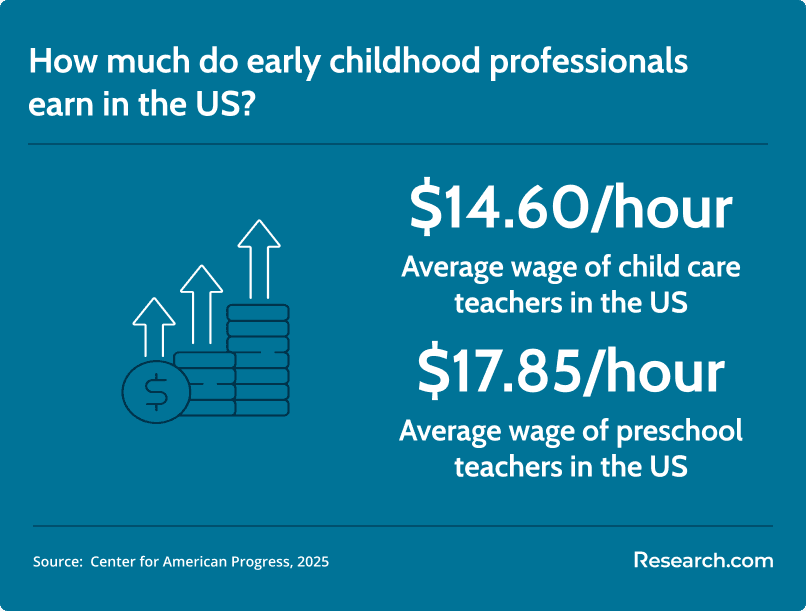
The financial return should be evaluated carefully. Schneider (2025) reported that median hourly wages in 2023 were $14.60 for child care workers and $17.85 for preschool teachers. These wage levels make it especially important to avoid unnecessary debt, maximize grants and scholarships, and choose the lowest-cost accredited program that still supports your career goal.
Financial Aid Options for Online Early Childhood Development Students
Online early childhood development students may qualify for many of the same aid options as campus-based students, provided the school and program meet eligibility rules. The most important first step is usually completing the FAFSA and confirming that the program participates in federal financial aid.
Financial aid rules can apply across many online fields, though aid eligibility depends heavily on the institution and credential type. Students researching other online training options, such as online cloud engineering bootcamps, should make the same distinction: degree-granting programs and short-term bootcamps may not have identical aid options.
- Federal Pell Grants: These need-based grants do not have to be repaid. Award amounts depend on financial need, enrollment status, and cost of attendance.
- Federal Student Loans: Eligible students may use subsidized or unsubsidized loans through the U.S. Department of Education. Borrow only what you need, especially if you plan to work in lower-wage early childhood roles.
- State Grants and Scholarships: Many states provide need-based or merit-based aid to residents attending approved institutions. Online eligibility may depend on your residency and the school’s authorization status.
- Institutional Scholarships: Colleges may offer scholarships based on grades, leadership, financial need, transfer status, or major. Ask whether online students are considered automatically or must submit a separate application.
- Employer Tuition Assistance: Childcare centers, school districts, Head Start programs, and related employers may reimburse tuition or partner with specific colleges.
- Childcare and Education-Specific Scholarships: Professional associations, nonprofits, and workforce development programs may support students already employed in early learning settings.
How to Reduce the Cost Before You Enroll
- Submit the FAFSA as early as possible.
- Request a transfer credit review before accepting admission.
- Ask whether your CDA credential, military training, or prior work-based learning can count for credit.
- Compare the total program cost, including fees and field placement expenses.
- Prioritize grants, scholarships, and employer assistance before loans.
- Check whether your state has early childhood workforce grants or scholarship programs.
Admission Requirements for Online Early Childhood Development Degrees
Most undergraduate early childhood development programs require the same core materials used for other college admissions. Requirements vary by school and credential level, but applicants should be ready to show academic preparation and a clear interest in working with young children and families.
Experience in childcare is often not required for entry-level undergraduate programs, but it can strengthen an application or help students succeed in field-based courses. As with structured online training in other disciplines, including online ethical hacking training, students usually need to meet baseline requirements before advancing into specialized coursework.
- High School Diploma or GED: Applicants generally need proof of high school completion or an equivalent credential, usually through official transcripts.
- Minimum GPA: Some programs set a minimum GPA such as 2.5 or 2.75, while others offer conditional admission for students who do not meet the preferred threshold.
- Standardized Test Scores: SAT or ACT scores may be optional at many online programs, but some schools still request them for admission or placement.
- Letters of Recommendation: Programs may ask for two to three letters from teachers, supervisors, mentors, or community leaders who can discuss your reliability and readiness.
- Personal Statement: A short essay may be required to explain your interest in early childhood development, your career goals, and your preparation for online learning.
- Background Check: Programs with fieldwork may require background checks, fingerprinting, or health documentation before students can enter child-serving settings.
Students comparing teaching pathways should also understand the difference between elementary and secondary education degrees. Early childhood development typically focuses on children from birth through age eight, while elementary and secondary programs prepare teachers for older age groups and different instructional methods.
NCES reported that 61% of kids aged three to five were enrolled in school in 2023. That level of participation makes preparation for early learning environments important, but students should still verify whether their chosen program matches the age range, setting, and certification requirements they want.
Common Courses in an Online Early Childhood Development Degree
Early childhood development programs combine child development theory, teaching methods, family systems, communication, observation, and applied practice. The strongest programs help students understand how young children grow while also preparing them to design safe, inclusive, and developmentally appropriate learning environments.
Like broader service-oriented graduate pathways such as an online doctorate in human services, early childhood programs often connect theory with practical decision-making for real people and communities.
| Course area | What students learn | Why it matters in early childhood settings |
| Introduction to Psychology | Basic concepts in behavior, cognition, emotion, and development | Helps future educators understand how children think, feel, and learn |
| Young Children with Exceptionalities | Developmental delays, disabilities, inclusion, and early intervention strategies | Prepares students to support diverse learners and collaborate with specialists |
| Family Development | Family structures, parenting, stress, culture, and community influences | Supports stronger partnerships with parents and caregivers |
| Interpersonal Communication | Active listening, verbal and nonverbal communication, conflict resolution, and cultural awareness | Improves collaboration with children, families, colleagues, and administrators |
| Health, Safety, and Nutrition | Illness prevention, first aid concepts, nutrition, safe environments, and wellness routines | Addresses essential responsibilities in childcare and preschool settings |
| Positive Child Guidance | Behavior support, emotional regulation, classroom routines, and relationship-based guidance | Helps educators create calm, respectful, and supportive learning environments |
| Content and Methods of Teaching a Subject | Age-appropriate methods for literacy, math, science, arts, or other content areas | Connects developmental knowledge to practical lesson planning |
Students who want advanced preparation after the bachelor’s level may compare options such as the fastest online master’s in early childhood education. A graduate degree can support deeper specialization, leadership, or advanced teaching preparation, depending on state and employer requirements.
According to Statista data, 32% of four-year-olds are enrolled in state pre-kindergarten programs, 6% in Head Start, and 3% in special education. These figures show why early childhood programs need to prepare graduates for multiple settings, not just one type of classroom.
Specializations in Online Early Childhood Development Programs
Some online early childhood development degrees offer concentrations, electives, or field experiences that let students focus on a specific age group, service model, or professional goal. The right specialization depends on whether you want to teach, support families, work with infants and toddlers, serve children with disabilities, or move into program leadership.
| Specialization | Focus | Good fit for students who want to |
| Special Education | Developmental delays, learning differences, behavioral supports, early intervention, and IEP-related concepts | Support children with disabilities or continue into advanced training such as one of the shortest online special education master’s programs |
| Infant and Toddler Development | Birth to age three, brain development, attachment, caregiving routines, and early relationships | Work in infant-toddler classrooms, home visiting, or early care programs |
| Preschool Teaching | Ages three to five, play-based learning, early literacy, language development, assessment, and classroom routines | Teach or assist in preschool, pre-K, childcare, or Head Start settings |
| Child and Family Studies | Family systems, parent partnerships, community support, and social context | Work in family services, parent education, advocacy, or community-based programs |
| Curriculum and Instruction | Lesson design, assessment, instructional improvement, program planning, and learning standards | Develop curriculum, mentor educators, or prepare for center leadership roles |
Specialization matters because early childhood work is not one-size-fits-all. A student interested in infants will need different preparation than a student aiming for preschool special education or program administration.
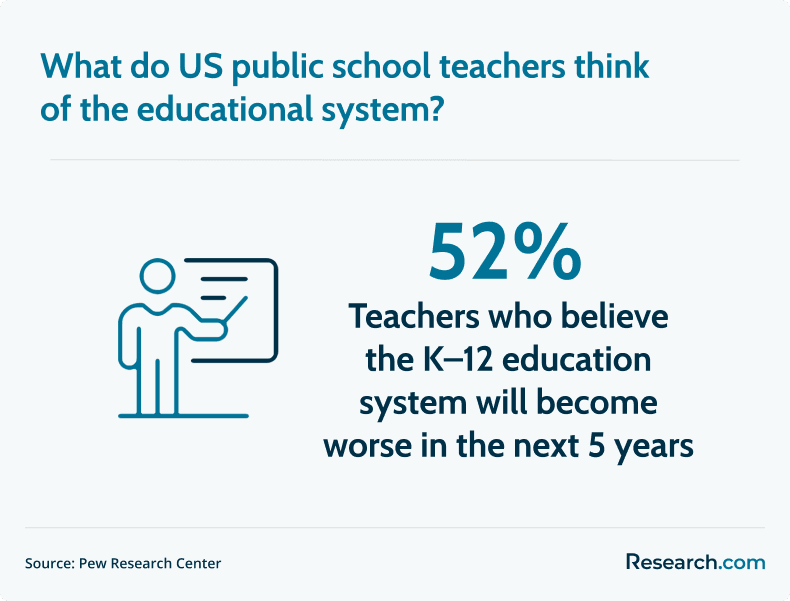
Broader concerns about the K–12 system also reinforce the value of strong early childhood preparation. Pew Research Center reported that 52% of teachers believe conditions will worsen (Lin et al., 2024), which highlights why high-quality early support, family engagement, and stable learning environments remain important.
How to Choose the Best Online Early Childhood Development Degree Program
The best online early childhood development degree is the one that matches your career goal, state requirements, budget, learning style, and timeline. A highly ranked program is not automatically the best fit if it does not support licensure in your state, accept your transfer credits, or offer field placements where you live.
Key Factors to Compare
- Accreditation: Confirm institutional accreditation and, where relevant, programmatic recognition such as NAEYC. Accreditation affects financial aid, credit transfer, employer recognition, and graduate school options.
- Licensure alignment: If you want to become a certified teacher, verify that the program leads to the correct credential in the state where you plan to work.
- Curriculum quality: Look for balanced coursework in child development, inclusion, family engagement, health and safety, assessment, curriculum, and field practice.
- Faculty experience: Instructors should have relevant early childhood expertise, not only general education credentials.
- Fieldwork support: Ask whether the school helps identify approved placements and whether your local area is eligible.
- Total cost: Compare tuition, fees, books, background checks, transportation for fieldwork, and lost work time.
- Transfer policy: Students with prior credits, a CDA credential, or an associate degree should get a formal transfer review.
- Online student support: Advising, tutoring, library access, career services, technology support, and writing help are especially important in remote programs.
Questions to Ask Before Enrolling
- Is this program licensure-track or non-licensure?
- Will it meet requirements in the state where I plan to work?
- How are field placements arranged for online students?
- How many of my prior credits will transfer?
- What is the total cost of attendance after fees?
- What scholarships or workforce grants are available for early childhood students?
- What roles do graduates commonly enter?
- Can I speak with an advisor who understands early childhood requirements?
- Are courses asynchronous, synchronous, or a mix of both?
- What happens if I need to pause enrollment or study part time?
Why Accreditation Matters for Online Early Childhood Development Degrees
Accreditation is one of the most important safeguards when evaluating an online early childhood development degree. It signals that a college or program has been reviewed for academic quality, faculty qualifications, student support, and institutional stability. It also matters for federal financial aid, transfer credits, employer trust, and admission to graduate programs.
Students planning long-term advancement should pay special attention to accreditation because advanced education pathways may require a recognized undergraduate degree. For example, students who eventually want doctoral-level education leadership preparation may compare options such as the fastest Ed D programs, where prior accredited study can be important for admission.
Accreditation does not automatically guarantee state licensure eligibility. Always check both the school’s accreditation and the program’s approval status for the role and state you are targeting.
Career Paths With an Online Early Childhood Development Degree
Graduates can pursue roles in childcare centers, preschools, Head Start programs, early intervention services, family support organizations, school systems, and program administration. The right role depends on degree level, state requirements, field experience, and whether the program leads to licensure.
| Career path | Average wage listed | Typical responsibilities | Common preparation |
| Childcare Workers | $33,140 | Care for infants, toddlers, and preschool children; supervise play; assist with routines; support social and emotional development | Certificate, associate degree, CDA, or employer-required training |
| Teaching Assistants | $35,960 | Support teachers, prepare classroom materials, supervise students, and assist with individual or group activities | Associate degree or school-specific requirements |
| Preschool Teachers | $41,450 | Lead learning activities for children ages 3 to 5 and build early skills in language, math, motor development, and social interaction | Associate or bachelor’s degree depending on setting and state rules |
| Early Intervention Specialists | $48,360 | Work with infants and toddlers with developmental delays, coordinate support plans, and collaborate with families and providers | Bachelor’s degree, specialized training, and role-specific requirements |
| Head Start Program Coordinators | $55,240 | Coordinate federally funded early learning services, support compliance, supervise staff, and monitor child and family outcomes | Bachelor’s degree and experience in early childhood or family services |
| Childcare Center Directors | $62,640 | Manage staffing, operations, budgets, curriculum, licensing compliance, and parent communication | Bachelor’s degree, management experience, and state director requirements |
| Kindergarten Special Education Teachers | $70,150 | Teach children with developmental delays or disabilities, develop individualized education plans, and provide specialized support | Licensure-track bachelor’s degree and special education certification |
| Preschool Special Education Teachers | $72,610 | Adapt instruction for preschool-aged children with disabilities and support early developmental milestones | Special education preparation and state certification |
These roles can be meaningful and community-centered, but students should compare wages with total education cost. A lower-cost accredited program, transfer credits, and employer aid can improve return on investment.
The chart below summarizes the average wages of selected early childhood development careers.
Job Market Outlook for Online Early Childhood Development Graduates
The early childhood job market offers many openings, but conditions vary by role. Demand is shaped by family childcare needs, preschool enrollment, state pre-K policies, special education services, turnover, wages, and local funding.
- The BLS projects that preschool teacher employment will grow by 4.4% from 2023 to 2033, with about 61,400 annual job openings.
- Preschool special education teachers are projected to grow by 1.6%, with about 1,800 openings each year.
- Speech-language pathologists, who often collaborate with early childhood teams, are projected to see SLP demand increase by 18.4%, with 13,700 annual openings.
- Some related teaching roles are projected to decline slightly. Kindergarten teachers and K–Elementary SpEd teachers are each projected at -0.7%, though these roles will still generate more than 13,000 openings.
- Childcare workers are projected at -1.3%, but the occupation is still expected to produce around 162,500 annual openings.
- Preschool and daycare administrator roles are projected at -2.1%, with about 5,000 annual openings.
These figures show a field with both opportunity and strain. Openings may remain high because of turnover and ongoing childcare needs, but low pay, burnout, and uneven licensing standards can make retention difficult. Students entering the field should choose programs that build practical skills in inclusive teaching, family communication, child assessment, trauma-informed support, and professional resilience.
The chart below presents job outlook data for selected careers connected to early childhood development.
How Interdisciplinary Learning Strengthens Early Childhood Practice
Early childhood professionals do more than supervise children. They observe development, interpret behavior, communicate with families, document progress, adapt activities, and collaborate with specialists. Interdisciplinary learning can strengthen those responsibilities by adding knowledge from psychology, health, family studies, communication, social work, data literacy, and special education.
Quantitative and analytical skills are also useful. Educators who understand basic data can track child progress, evaluate classroom interventions, and use assessment results more responsibly. Students interested in strengthening mathematical reasoning for education, assessment, or curriculum planning may find useful comparisons in programs such as the fastest online bachelors degree mathematics options, although early childhood students should prioritize child development and licensure alignment first.
Digital Tools in Online Early Childhood Development Programs
Online early childhood programs increasingly use digital tools to help students connect theory to practice. These may include video-based classroom observations, virtual simulations, interactive lesson planning platforms, digital portfolios, online assessment tools, and real-time collaboration systems.
Digital tools are most useful when they support practice rather than replace it. Watching classroom videos can help students analyze teacher-child interactions. Simulations can prepare students to respond to behavior challenges. Online portfolios can organize lesson plans, reflections, and fieldwork evidence. Collaborative platforms can also expose students to classmates working in different communities and early learning settings.
Research skills matter as well. Early childhood students should learn how to find credible sources on child development, inclusion, curriculum, and family engagement. Students who want to understand digital information systems more broadly may compare related academic pathways such as the cheapest MLIS degree online, but early childhood learners should focus first on tools that improve observation, planning, communication, and child-centered practice.
Common Mistakes to Avoid When Choosing an Online Early Childhood Development Degree
| Mistake | Why it can hurt you | Better approach |
| Assuming every online program leads to teacher licensure | Many programs are non-licensure and may not qualify graduates for public school teaching roles | Ask directly whether the program leads to certification in your state |
| Choosing based only on tuition per credit | Fees, transfer limits, fieldwork costs, and extra terms can raise the final cost | Compare total cost of attendance and time to completion |
| Ignoring accreditation | Unaccredited or poorly recognized programs may limit aid, transfer, employment, or graduate school options | Verify institutional accreditation and any relevant programmatic recognition |
| Not checking field placement rules | You may be unable to complete practicum or student teaching where you live | Confirm placement support and state authorization before enrolling |
| Overborrowing for a modest-wage field | Loan payments can become difficult after graduation | Use grants, scholarships, employer aid, and lower-cost accredited options first |
| Relying only on rankings | A high-ranked program may not fit your schedule, budget, state, or career goal | Use rankings as a starting point, then compare licensure, cost, support, and outcomes |
What Graduates Say About Online Early Childhood Development Programs
- Jess: "Completing my early childhood development degree online made it possible to keep working full time in a daycare while studying. I could use new ideas from class right away with the children I cared for, which helped the material feel practical instead of abstract. The program gave me stronger confidence in child development and helped me see myself as ready for more responsibility in early education."
- Ally: "My online coursework helped me understand how important the earliest years are for learning, relationships, and long-term growth. Studying from home allowed me to stay in my Head Start role while completing assignments around my schedule. The instructors connected research to real classroom situations, and I finished the program feeling more prepared professionally and personally."
- Sienna: "What I valued most was learning with classmates from different communities. Their experiences helped me see how culture, family life, and local resources shape early childhood education. I left with stronger observation, communication, and planning skills, and the online format gave me time to reflect before applying what I learned in practice."
Key Insights
- An online early childhood development degree is most useful when it matches your career target, state requirements, budget, and need for flexibility.
- Associate degrees typically support entry-level childcare, preschool, and assistant roles, while bachelor’s degrees can provide broader options in teaching, administration, early intervention, family services, or graduate study.
- Licensure is the most important detail to verify. Some programs are explicitly non-licensure, and online delivery does not guarantee eligibility for certification in every state.
- Cost should be weighed carefully because early childhood wages can be modest. Compare total cost, transfer credits, CDA credit, scholarships, grants, and employer tuition support before borrowing.
- Fieldwork still matters in online programs. Ask how local placements are approved, who arranges them, and whether your state or community is eligible.
- Accreditation affects financial aid, transferability, employer recognition, and future graduate study. It should be checked before any application decision.
- The job market includes many annual openings, especially for childcare workers and preschool teachers, but the field also faces challenges related to pay, burnout, and retention.
- The strongest programs prepare students for real early childhood settings through child development theory, family engagement, inclusion, health and safety, assessment, digital tools, and supervised practice.
References:
- Ma, J., Pender, M., & Oster, M. (2024). Trends in College Pricing and Student Aid 2024. College Board. https://research.collegeboard.org/trends/college-pricing
- National Center for Education Statistics. (2023, September). Bachelor's degrees conferred by postsecondary institutions, by field of study: Selected academic years, 1970-71 through 2021-22. Digest of Education Statistics. https://nces.ed.gov/programs/digest/d23/tables/dt23_322.10.asp?current=yes
- National Center for Education Statistics. (2024, September). Percentage of 3- to 5-year-old children enrolled in school, by age and selected child and family characteristics: Selected years, 2013 through 2023. Digest of Education Statistics. https://nces.ed.gov/programs/digest/d24/tables/dt24_202.20.asp?current=yes
- PayScale. (2025, June 26). Average Early Intervention Specialist Hourly Pay. Retrieved August 3, 2025, from https://www.payscale.com/research/US/Job=Early_Intervention_Specialist/Salary
- Schneider, A. (2025, January 30). A 2024 Review of Child Care and Early Learning in the United States. Center for American Progress. https://www.americanprogress.org/article/a-2024-review-of-child-care-and-early-learning-in-the-united-states
- U.S. Bureau of Labor Statistics. (2024). Preschool Teachers [Interactive data]. Occupational Employment and Wage Statistics (OEWS) Profiles. Retrieved August 3, from https://data.bls.gov/oesprofile
- U.S. Bureau of Labor Statistics. (2025, April 18). Occupational projections, 2023–33, and worker characteristics, 2023 (Numbers in thousands). Employment Projections. https://www.bls.gov/emp/tables/occupational-projections-and-characteristics.htm
- ZipRecruiter. (2025, July 28). Head Start Coordinator Salary. Retrieved August 3, 2025, from https://www.ziprecruiter.com/Salaries/Head-Start-Coordinator-Salary#Yearly
Other Things You Should Know About Online Early Childhood Development Degree Programs
In 2027, completing an online early childhood development degree typically requires 120 credit hours. This may include courses in child psychology, curriculum design, and educational ethics, ensuring comprehensive training for future early childhood educators.
Admission requirements for the top online early childhood development degree programs in 2027 typically include a high school diploma or equivalent, transcripts, and a statement of purpose. Some programs may also require letters of recommendation or evidence of prior experience in a related field.
Check for institutional accreditation from a U.S. Department of Education-recognized agency, such as the Higher Learning Commission or regional accreditors, and program approval when the degree leads to licensure. For teacher preparation, many employers also value CAEP-aligned programs and state education department approval.