
2027 Elementary vs. Secondary Education Degree: Explaining the Difference

Co-Founder and Chief Data Scientist
Choosing between an elementary education degree and a secondary education degree is really a choice about the students you want to teach, the subjects you want to focus on, and the kind of classroom work you want to do every day. For the 2024–25 school year, an estimated 49,000 teaching positions remain vacant across the United States, while more than 400,000 positions are held by people who are not fully certified for their assignments (Teacher Shortages, 2024). That shortage makes teacher preparation an important decision not only for future educators, but also for schools that need qualified, well-prepared teachers.
This guide is for prospective teachers, career changers, education majors, and graduate students comparing elementary and secondary teaching pathways. You will learn how the degrees differ, what each career involves, what licensure usually requires, how salaries compare, where demand remains strongest, and what questions to ask before choosing a program.
The goal is not to push one path over the other. Elementary and secondary teaching can both be meaningful careers. The better choice depends on your strengths, preferred age group, subject interests, classroom style, and long-term career goals.
- Quick answer: elementary vs. secondary education degree
- What does an elementary school teacher do?
- What does a secondary school teacher do?
- What courses are included in elementary and secondary education programs?
- Elementary vs. secondary education degree: key differences
- Certification and licensure requirements for teachers
- Job demand for elementary and secondary education degrees in 2027
- Skills teachers need to succeed
- Trends shaping teaching careers
- Financial aid and the value of advanced qualifications
- Accelerated teaching degree options
- Elementary teacher salary vs. secondary teacher salary
- How to choose the right education degree
- Additional certifications for career growth
- Long-term career outcomes for education graduates
Quick answer: elementary vs. secondary education degree
An elementary education degree prepares you to teach several core subjects to younger children, usually in kindergarten through fifth or sixth grade. A secondary education degree prepares you to teach one subject area, such as English, math, history, biology, or chemistry, to middle or high school students.
| Best fit | Choose elementary education if... | Choose secondary education if... |
| Student age group | You enjoy working with younger children who need structure, encouragement, and help building foundational academic and social skills. | You prefer working with adolescents who are developing independence, subject interests, and post-graduation plans. |
| Subject focus | You want to teach reading, writing, math, science, and social studies across the school day. | You want to specialize deeply in one subject or a closely related content area. |
| Classroom style | You like routines, whole-child development, hands-on activities, and frequent communication with families. | You are comfortable managing multiple class periods, grading subject-specific work, and preparing students for college, careers, or graduation requirements. |
| Preparation path | You will usually complete broad elementary methods courses and student teaching in a self-contained classroom. | You will usually combine education courses with advanced coursework and exams in your teaching subject. |
The strongest choice is the one that matches both your teaching personality and your certification goals. Because licensure rules vary by state, confirm that any program you consider leads to the grade level and endorsement you want.
What does an elementary school teacher do?
Elementary teachers help children build the academic, social, and behavioral foundation they will use for the rest of their schooling. They usually teach multiple subjects to the same group of students and spend much of the day balancing instruction, classroom routines, student support, and family communication.
- Teach core academic skills. Elementary teachers introduce and reinforce reading, writing, mathematics, science, and social studies. They focus on basic literacy, numeracy, vocabulary, comprehension, problem-solving, and curiosity across subjects.
- Create a safe and predictable classroom. Younger students need clear routines, emotional support, and consistent expectations. Teachers help students learn how to participate, cooperate, resolve conflict, and treat others respectfully.
- Plan age-appropriate lessons. Lessons often include read-alouds, guided practice, small-group activities, learning centers, manipulatives, and visual supports. Plans must align with district or state standards while remaining developmentally appropriate.
- Track learning and behavior. Teachers use observations, quizzes, classwork, reading checks, projects, and formal assessments to understand student progress. They adjust instruction when students need remediation, enrichment, or a different approach.
- Work closely with families. Family communication is central in elementary grades. Teachers share updates about academic growth, behavior, attendance, and concerns, while also helping families support learning at home.
- Support students with varied needs. Elementary teachers often collaborate with reading specialists, special education teachers, counselors, multilingual learner specialists, and school psychologists to help students access instruction.
Elementary teaching is broad and demanding because the teacher is responsible for both academic growth and early social-emotional development. The work can be especially rewarding for people who enjoy nurturing students over time and watching children gain confidence in basic skills.
Public trust also remains an important part of the profession’s value. The chart below shows elementary school teachers ranked 2nd among the most respected professions, with a trust rating of 61%, behind nurses at 76%. That level of trust reflects how much families and communities rely on teachers during a child’s formative years.
What does a secondary school teacher do?
Secondary teachers usually work with students in grades 6–12 and teach a specific subject area. Their role combines content instruction, academic coaching, classroom management, assessment, and mentoring as students prepare for graduation, college, careers, or technical training.
- Teach specialized courses. Secondary teachers typically focus on one or two subjects, such as English, mathematics, biology, chemistry, history, or a world language. They teach concepts in greater depth than elementary teachers.
- Prepare students for next steps. Middle and high school teachers help students meet course requirements, build study habits, strengthen critical thinking, and connect schoolwork to college, employment, or career and technical pathways.
- Design standards-based lessons. Instruction may include lectures, labs, seminars, writing workshops, problem sets, discussions, projects, or independent research. Teachers revise lessons based on student performance and engagement.
- Assess subject mastery. Secondary teachers grade essays, tests, lab reports, presentations, projects, homework, and class participation. Feedback is often more content-specific and may affect course grades, credits, or graduation progress.
- Manage adolescent classroom dynamics. Older students need structure, but they also need autonomy and respect. Effective secondary teachers balance authority with relationship-building and clear academic expectations.
- Advise and mentor students. Teachers may help students through academic challenges, write recommendation letters, discuss career interests, or support students navigating personal and social pressures.
The work can be demanding, especially when teachers manage several classes and many students each day. Still, many educators find the role meaningful. According to the Pew Research Center (2024), 67% of teachers with less than six years of experience say they feel fulfilled in their work extremely often or often. That finding suggests that early-career teachers can find strong purpose in the profession, even when the workload is substantial.
What courses are included in elementary and secondary education programs?
Course names differ by college, state, and certification track, but most teacher preparation programs combine education theory, teaching methods, field experience, assessment, classroom management, and supervised student teaching. The biggest difference is breadth versus specialization: elementary programs prepare generalists, while secondary programs prepare subject-area teachers.
Common courses in an elementary education degree
- Child Development and Learning. Students study how children grow cognitively, socially, emotionally, and physically, and how those stages affect classroom behavior and learning readiness.
- Foundations of Education. This course examines the history, philosophy, policy, and social context of schooling.
- Literacy Instruction. Future teachers learn methods for teaching phonics, vocabulary, fluency, comprehension, writing, and early reading intervention.
- Mathematics for Elementary Teachers. The course focuses on how children understand mathematical ideas and how teachers can explain number sense, operations, measurement, geometry, and problem-solving.
- Science and Social Studies Methods. Students learn how to design inquiry-based and standards-aligned lessons in science, civics, geography, history, and related content.
- Classroom Management. Coursework covers routines, behavior supports, positive reinforcement, classroom culture, and inclusive learning environments.
- Assessment and Evaluation. Students learn how to use formative and summative assessments to monitor progress and adjust instruction.
- Student Teaching Internship. A supervised placement gives candidates practical classroom experience under a certified elementary teacher.
Common courses in a secondary education degree
- Adolescent Development. This course explains how cognitive, emotional, social, and physical changes during adolescence affect motivation, behavior, and learning.
- Instructional Strategies in a Subject Area. Candidates learn how to teach a specific content field, such as mathematics, English, science, or social studies.
- Educational Psychology. Students examine learning theories, motivation, differentiation, and strategies for supporting diverse learners.
- Curriculum Design and Planning. Coursework focuses on building units, lessons, assessments, and long-term instructional plans aligned with standards.
- Classroom Management for Adolescents. Candidates learn how to set expectations, maintain engagement, address behavior, and build productive relationships with older students.
- Technology in Education. Students practice using digital tools, learning management systems, online assessments, and instructional technology.
- Assessment and Data-Driven Instruction. This course teaches future educators how to interpret student performance data and use it to improve instruction.
- Clinical Teaching or Student Teaching. A supervised middle or high school placement is usually part of the steps to become a certified teacher in the US.
- Advanced Subject Coursework. Secondary candidates typically complete upper-level courses in the discipline they plan to teach. For example, a future English teacher may study literature, composition, grammar, linguistics, and related fields.
- Subject-Specific Pedagogy. Candidates also study how to teach their discipline effectively. A future history teacher, for instance, may complete coursework in social studies methods and historical inquiry.
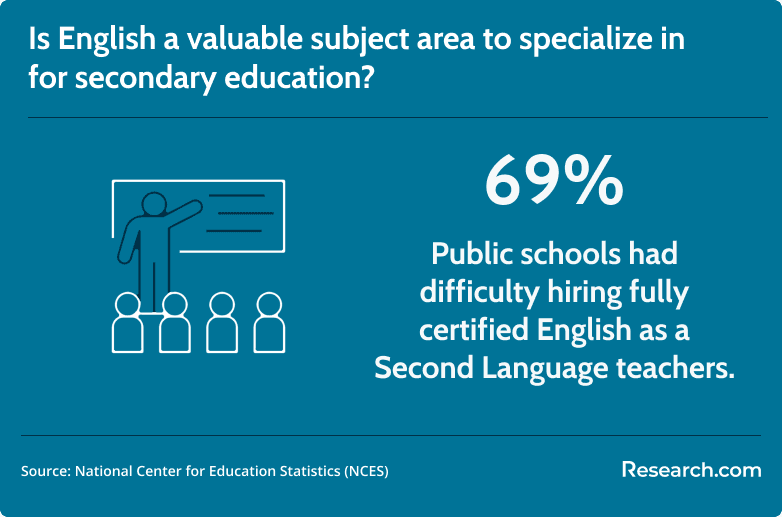
Secondary education students usually choose a specialization before or early in the program so they can build enough content knowledge for their certification area. This is especially important in high-need fields. With 69% of public schools reporting difficulty hiring professionals who meet complete ESL teacher education requirements, endorsements related to English language learning may strengthen employment options in some districts.
| Program component | Elementary education | Secondary education |
| Academic focus | Broad preparation across multiple elementary subjects | Deep preparation in one teaching subject |
| Development focus | Child development, early literacy, numeracy, and social-emotional growth | Adolescent development, content mastery, independence, and postsecondary readiness |
| Methods courses | Reading, math, science, social studies, classroom routines, and differentiated instruction | Subject-specific pedagogy, assessment, curriculum planning, and adolescent classroom management |
| Student teaching | Usually completed in a self-contained elementary classroom | Usually completed in a middle or high school subject-area classroom |
Elementary vs. secondary education degree: key differences
The main difference between an elementary and secondary education degree is the type of teacher each program prepares you to become. Elementary programs train teachers to support younger children across several subjects. Secondary programs train teachers to teach a specific subject to adolescents.
Grade levels and student age
Elementary education usually prepares teachers for kindergarten through 5th or 6th grade. These years are focused on building the habits, skills, and confidence students need for later schooling. Teachers must understand child development, early literacy, classroom routines, and how young children learn through modeling, repetition, play, and practice.
Secondary education is designed for middle and high school teaching, commonly serving students ages 11 to 18. Instruction becomes more specialized, and teachers help students develop advanced academic skills, career awareness, and readiness for college or the workforce.
Subject specialization
Elementary teachers are generalists. They may teach reading, writing, mathematics, science, social studies, and social-emotional skills to the same students throughout the day. The goal is to create a balanced foundation across subjects.
Secondary teachers are specialists. They usually teach one major content area, such as mathematics, English, science, history, or a career-focused subject. This pathway is better suited to students who want to spend their career working deeply in a discipline they enjoy.
Developmental focus
Elementary teachers spend significant time supporting early literacy, basic numeracy, self-regulation, peer interaction, and classroom behavior. They help children see themselves as capable learners.
Secondary teachers work with students who are developing abstract reasoning, independence, identity, and future plans. They must connect content to real-world applications while also handling the academic, social, and behavioral complexity of adolescence.
Instructional methods
Elementary instruction often uses hands-on lessons, movement, small groups, visuals, songs, games, guided reading, manipulatives, and frequent transitions. Teachers must be comfortable changing pace quickly and teaching multiple subjects in one day.
Secondary instruction is more content-driven. Depending on the subject, teachers may use lectures, labs, debates, Socratic seminars, research assignments, performance tasks, group projects, or independent work. Feedback is usually more detailed and tied to subject standards.
Field experience and student teaching
Both degrees require supervised classroom experience, but the placements differ. Elementary candidates usually student-teach in a classroom where one teacher handles several subjects. This builds skill in managing the full school day and supporting a consistent student group.
Secondary candidates usually student-teach in a subject-area classroom and may work with different groups of students across class periods. This builds experience in pacing, grading, and adapting instruction for multiple sections.
If your interest is not classroom teaching but supporting students with communication and speech challenges, a different graduate pathway may be more appropriate. For example, students interested in speech-language careers can review online speech pathology master's programs that don't require GRE.
| Decision factor | Elementary education degree | Secondary education degree |
| Best for | People who enjoy broad teaching, younger children, routines, and whole-child development | People who want to teach a specific subject and work with adolescents |
| Daily schedule | Often one main group of students for most of the day | Often several class periods with different student groups |
| Planning load | Multiple subject lessons and integrated activities | Subject-specific lessons, assessments, and grading |
| Student support | Heavy emphasis on early development, behavior, family contact, and foundational skills | Emphasis on academic independence, course performance, graduation, and future planning |
| Potential challenge | Managing many subjects and young learners’ constant developmental needs | Managing larger student loads, grading volume, and adolescent motivation |
Certification and licensure requirements for elementary and secondary teachers
Teaching certification requirements are set by each state, but most pathways include a bachelor’s degree, an approved teacher preparation program, supervised fieldwork, licensure exams, background checks, and an application to the state education agency. The process is similar for elementary and secondary teachers, but exams and placements must match the grade level and subject you plan to teach.
- Earn a bachelor’s degree in education, typically in 4 years. Elementary candidates usually study broad curriculum areas such as literacy, math, science, social studies, education theory, and child development. Secondary candidates often major or concentrate in a specific subject, such as math or English, while completing courses in adolescent learning and teaching methods. Most states require at least a bachelor’s degree for teacher certification.
- Complete a state-approved teacher preparation program. The program should be approved by the state board of education or recognized by an accreditor such as the Council for the Accreditation of Educator Preparation (CAEP). Fieldwork often includes 100 to 150 hours of supervised classroom observation, followed by a student teaching or internship experience lasting 12 to 16 weeks and totaling 450 to 600 hours under a certified mentor. Placements should match the license level sought; secondary candidates also need placements in their subject area.
- Pass required licensure exams. Elementary candidates often take a multiple-subject test, such as the Praxis® Elementary Education: Multiple Subjects (5001), covering Reading and Language Arts, Mathematics, Social Studies, and Science. Secondary teaching requirements usually include a pedagogy exam, such as the Praxis® Principles of Learning and Teaching – PLT, plus a subject test such as Praxis® Math 5165, Biology 5236, or English 5038.
- Complete background checks and fingerprinting. All 50 states require criminal background checks and fingerprint clearance from the Federal Bureau of Investigation. Depending on the state, candidates may need clearance before fieldwork, before student teaching, or before licensure.
- Apply for state certification. After completing degree, fieldwork, testing, and clearance requirements, candidates apply for an Initial or Provisional License through their state’s Department of Education. Applications may require transcripts, exam scores, student teaching verification, fingerprint or background clearance, and fees that typically range from $50 to $150 depending on the state.
- Renew or upgrade the license. Initial Licenses are generally valid for 3 to 5 years. To renew or move to a Professional or Standard License, teachers may need Continuing Education Units (CEUs), professional development hours, added coursework, mentoring, or performance evaluations. In New York, for example, teachers must complete 100 hours of professional development every 5 years to maintain certification.
Questions to ask before enrolling in a teacher preparation program
- Is the program approved for teacher licensure in the state where I plan to teach?
- Does the program lead to elementary certification, secondary certification, or both?
- For secondary education, does the program prepare me for the exact subject endorsement I want?
- Where do student teaching placements occur, and are they matched to my intended grade level?
- What licensure exams will I need, and does the program provide test preparation?
- If the program is online, how are field experiences and student teaching arranged locally?
- Will the license transfer if I move to another state?
How in demand are elementary and secondary education degrees in 2027?
Elementary and secondary education degrees remain relevant in 2027, even though the U.S. Bureau of Labor Statistics projects overall teacher employment to decline slightly by 1% from 2023 to 2033. That projection reflects enrollment shifts and budget pressure in some districts, but it does not erase the need for qualified teachers. Schools still need replacements for retirements and turnover, and many continue to struggle with shortages in math, science, special education, and underserved communities.
Statista (2024) reports that in 2021, the United States had 3.21 million public school teachers and 483,000 private school teachers. By 2031, those figures are projected to shift slightly to 3.19 million public school teachers and 487,000 private school teachers. The overall workforce appears relatively stable, but openings still occur when teachers leave, retire, relocate, or move into other education roles.
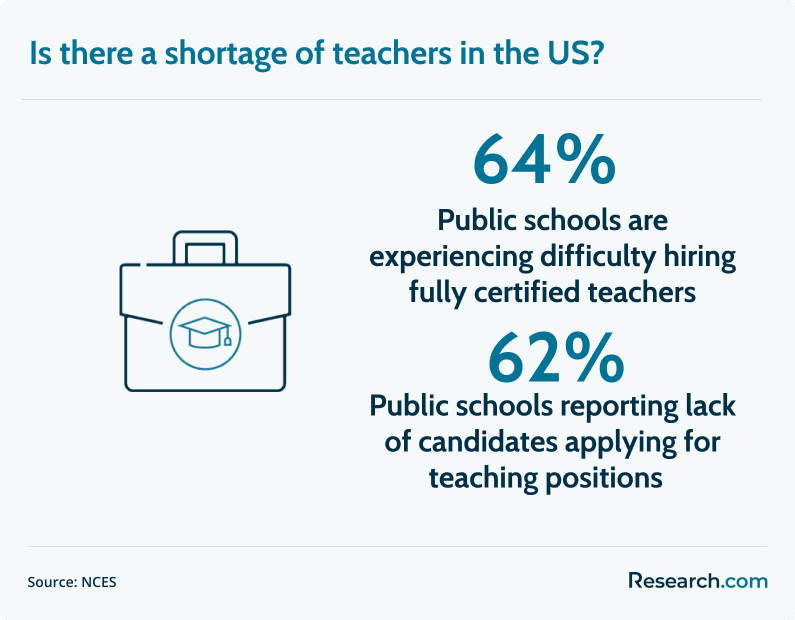
The National Center for Education Statistics reports that the leading hiring challenges for fully certified teachers in the 2024–25 school year are a lack of qualified candidates (64%) and too few applicants (62%). For aspiring teachers, that means opportunity may depend less on broad national growth and more on location, subject area, certification, and willingness to work in high-need schools.
If you are comparing teaching with other graduate or professional paths, be careful not to assume every advanced degree has the same labor-market logic. For example, students weighing technical graduate study may compare a master of engineering vs master of science, while future teachers must focus on state certification alignment and school hiring needs.
What skills do elementary and secondary teachers need?
Strong teachers need more than content knowledge. They must explain ideas clearly, manage classrooms, adapt instruction, use data, collaborate with colleagues, and support students with different academic, behavioral, cultural, and language needs.
- Clear communication. Teachers must explain concepts in language students can understand. Elementary teachers often simplify and repeat directions for younger learners, while secondary teachers translate complex content into teachable steps.
- Classroom management. Effective teachers create routines, expectations, and consequences that keep learning on track. Elementary management often relies on structure and reinforcement; secondary management often requires balancing authority with student independence.
- Adaptability and creativity. Students do not learn at the same pace or in the same way. Teachers must adjust lessons, provide alternatives, and use different activities when the first method does not work.
- Patience and empathy. Teachers work with students who may be frustrated, distracted, anxious, advanced, behind grade level, or dealing with challenges outside school. Patience helps teachers respond without escalating problems.
- Subject knowledge. Elementary teachers need confidence across multiple foundational subjects. Secondary teachers need deeper expertise in the specific discipline they teach.
- Organization and time management. Lesson planning, grading, parent communication, meetings, documentation, and professional development all require strong systems.
- Collaboration. Teachers work with grade-level teams, department colleagues, administrators, counselors, special education staff, multilingual learner specialists, and families.
- Technology and AI literacy. Digital tools are now part of instruction, assessment, communication, and planning. According to 55% of public school leaders, some teachers use AI for lesson plans, and 67% of public schools provide AI training to teachers (NCES, 2024).
| Skill | Why it matters in elementary teaching | Why it matters in secondary teaching |
| Communication | Young students need simple, repeated, concrete instructions. | Adolescents need clear explanations of abstract and advanced concepts. |
| Classroom management | Routines and transitions shape the full school day. | Teachers must maintain engagement across multiple class periods. |
| Content knowledge | Teachers cover several subjects at a foundational level. | Teachers must demonstrate depth in one subject area. |
| Family engagement | Family communication is frequent and often central to student support. | Family communication may focus on grades, credits, behavior, and graduation progress. |
| Assessment use | Data helps identify reading, math, and developmental gaps early. | Data supports course mastery, remediation, placement, and graduation readiness. |
What trends are shaping future education careers?
Teaching is changing because schools are responding to technology, staffing shortages, student mental health needs, learning gaps, and new expectations for personalized instruction. Future teachers should expect their preparation programs and workplaces to place more emphasis on digital fluency, data use, inclusive practices, and flexible instructional models.
- AI and instructional technology. Teachers are increasingly expected to understand learning platforms, digital assessments, AI-assisted planning tools, and responsible technology use. AI can support planning and feedback, but teachers still need professional judgment, subject expertise, and awareness of privacy and academic integrity concerns.
- Blended and online learning. Even in traditional schools, teachers often use online assignments, learning management systems, and digital resources. Programs that prepare teachers for both in-person and technology-supported instruction may offer stronger practical preparation.
- Social-emotional learning. Schools are paying closer attention to student belonging, behavior, self-regulation, and mental well-being. This affects classroom management and lesson planning at both elementary and secondary levels.
- High-need specializations. Districts may continue to prioritize teachers in shortage areas such as special education, STEM, ESL, and bilingual education, depending on local needs.
- Advanced and accelerated credentials. Working educators who want leadership roles may consider advanced online pathways, including options such as the shortest EdD program online, when the program fits their goals, budget, and schedule.
What are the financial aid options and career growth benefits of advanced qualifications?
Advanced qualifications can help teachers move into specialized, leadership, curriculum, or administrative roles, but they should be evaluated carefully. A graduate degree or certification is most valuable when it aligns with your state requirements, district salary schedule, endorsement needs, and long-term career plan.
Potential funding sources may include scholarships, grants, federal financial aid for eligible programs, district tuition reimbursement, employer-sponsored professional development, and loan forgiveness programs for qualifying service. Before enrolling, ask whether the credential will increase your salary, qualify you for a new role, or meet renewal requirements.
Some educators also explore adjacent fields when they want to broaden their career options. For example, a teacher interested in school libraries, information literacy, or educational resources may compare graduate options such as the cheapest library science degree online. The right choice depends on whether the degree supports your intended role, not simply whether it is affordable.
What are the options for accelerating my teaching degree?
Accelerated teaching programs can shorten the time to completion through transfer credits, year-round courses, online delivery, intensive terms, or alternative certification structures. They may be useful for career changers and students who already hold college credits, but speed should not come at the expense of licensure eligibility.
Before choosing an accelerated path, confirm that the program includes required fieldwork, student teaching, exam preparation, and state approval. A faster program is only worthwhile if it still leads to the license or endorsement you need. Students comparing timelines can review guidance on how to earn a teaching degree online fast.
How does the salary of an elementary teacher compare to that of a secondary teacher?
According to ZipRecruiter, elementary school teachers in the United States earn an average annual salary of $52,101, while high school teachers earn about $57,056 per year. That means secondary teachers typically earn about 9.5% more than elementary teachers. Actual salaries depend heavily on district salary schedules, location, years of experience, education level, union agreements, and additional responsibilities.
- Subject specialization can affect pay opportunities. High school teachers may teach advanced, AP, STEM, or specialized courses that are harder for districts to staff.
- Additional education and endorsements may matter. Secondary teachers often need subject-specific preparation and may pursue additional credentials that affect placement or salary schedules.
- Grade-level responsibilities differ. Secondary teachers often prepare students for graduation, exams, college, or careers, while elementary teachers carry broader responsibility for foundational development.
- Location is a major driver. Salaries vary widely by state, district, and cost of living. California and New York, for example, often appear among higher-paying teacher markets.
| Role | Average annual salary cited | Important salary context |
| Elementary school teacher | $52,101 | Pay may rise with graduate credits, experience, district salary steps, and added responsibilities. |
| High school teacher | $57,056 | Secondary teachers may earn more in some districts, especially in specialized or high-need subjects. |
| Difference | About 9.5% more for secondary teachers | This is an average comparison, not a guarantee for any individual teacher or district. |
The chart below shows that many of the highest-paying cities for secondary school teachers are in California and Massachusetts, with Corte Madera, CA, offering the top salary at $64,724. This pattern reflects the influence of regional cost of living and local education funding, although competitive salaries may also appear in less urban areas such as Holdrege, NE and Wyoming, WY.
How do you choose between an elementary and secondary education degree?
The best way to choose is to compare the daily work, not just the degree title. Ask yourself which students you want to spend your days with, how much subject specialization you want, and what classroom environment fits your strengths.
Some students make this decision the way doctoral-level educators compare an EdS vs EdD: the right choice depends on career purpose. Elementary education is usually better for people who enjoy broad instruction, child development, routines, and long-term relationships with one class. Secondary education is usually better for people who want to teach a specific subject in depth and mentor adolescents through academic and life transitions.
| Ask yourself | If your answer points to elementary education | If your answer points to secondary education |
| Which age group energizes me? | You enjoy younger children, early learning, and helping students build confidence from the ground up. | You enjoy teenagers, deeper discussion, and helping students prepare for adulthood. |
| Do I want breadth or depth? | You prefer teaching several subjects in one classroom. | You prefer becoming an expert in one subject area. |
| What type of classroom management fits me? | You are patient with routines, transitions, and early behavior development. | You can manage adolescent independence, motivation, and varied classroom personalities. |
| How do I feel about grading? | You prefer frequent informal assessment and foundational skill checks. | You are comfortable grading essays, labs, exams, projects, or subject-specific assignments across multiple classes. |
| What job market should I target? | You want flexibility across elementary grades and foundational instruction roles. | You want openings tied to subject demand, such as math, science, ESL, special education, or other shortage areas. |
Common mistakes to avoid when choosing a teaching degree
- Choosing based only on favorite age group. Age matters, but so do subject load, grading expectations, family communication, classroom management, and certification rules.
- Ignoring state licensure alignment. Not every education degree automatically qualifies you for the license you want. Confirm the grade band and endorsement before enrolling.
- Assuming online programs are automatically accepted everywhere. Online teacher preparation can be legitimate, but student teaching, exams, and state approval still matter.
- Looking only at tuition. Compare total cost, fees, books, testing expenses, travel for fieldwork, lost income, transfer credits, and financial aid.
- Overlooking shortage subjects. Secondary candidates should research local demand for their subject. Elementary candidates may strengthen options with endorsements in areas such as ESL or special education where appropriate.
- Assuming salary outcomes are guaranteed. Salary depends on district schedules, location, credentials, experience, and negotiated pay structures.
What additional certifications boost career advancement for educators?
Additional certifications can help teachers qualify for specialized classrooms, leadership opportunities, or hard-to-staff roles. The best certification is the one that solves a real hiring need in your district or advances your specific career goal.
- ESL or bilingual education. These credentials can help teachers serve multilingual learners and may be valuable in districts with growing language-diverse populations. Teachers can compare options for ESL teaching certification online.
- Special education. Special education credentials may open roles supporting students with disabilities and working on individualized education plans.
- STEM endorsements. Math, science, and technology-related endorsements may strengthen prospects in high-need secondary subjects.
- Gifted education. This credential can help teachers design advanced instruction and enrichment for high-performing learners.
- Technology integration. Instructional technology credentials may support roles in digital learning, coaching, or curriculum support.
- National board certification. This credential demonstrates advanced teaching practice and may improve professional mobility or salary prospects in some districts.
Teachers planning graduate study should review the prerequisites for masters in education before applying. Educators interested in non-classroom resource and information roles may also explore how a library science credential connects to jobs for MLIS.
What are the long-term career outcomes for educators with these degrees?
Elementary and secondary education degrees can lead to more than classroom teaching. Many educators remain in the classroom and advance through experience, graduate credits, leadership stipends, or specialist credentials. Others move into curriculum, administration, training, policy, or education-related organizations.
- Classroom teacher. Many graduates teach elementary, middle, or high school and develop expertise in grade-level instruction or a subject area.
- Lead teacher or mentor teacher. Experienced educators may coach new teachers, lead grade-level teams, or support professional learning.
- Instructional coach or curriculum specialist. Teachers with strong instructional knowledge may help colleagues improve lessons, assessments, and curriculum alignment.
- School administrator. With the required graduate preparation and licensure, teachers may become assistant principals, principals, or district leaders.
- Education policy or program roles. Some educators work in government, nonprofits, professional development, assessment, or educational publishing.
- Subject-area expert or academic pathway. Secondary teachers may strengthen their content knowledge with graduate study. For example, history educators may compare affordable online history master's programs if the degree supports their teaching, research, or advancement goals.
The data below shows that secondary school teachers working in state government roles outside schools and hospitals earned the highest average salary at $99,120, compared with $73,890 in traditional school settings (BLS, 2023). Other options, including educational support services and colleges and universities, report salaries above $68,000. These figures show that teaching skills can transfer beyond the K–12 classroom, especially into training, policy, administration, curriculum, and support roles.
Key Insights
- Elementary education is the better fit if you want to teach multiple subjects, work with younger children, and focus on foundational academic and social-emotional development.
- Secondary education is the better fit if you want to specialize in one subject and help adolescents prepare for graduation, college, careers, or technical training.
- Teacher demand is shaped by shortages, turnover, retirements, subject area, and location. Even with a projected 1% decline from 2023 to 2033, schools still report hiring challenges for fully certified teachers.
- Licensure is nonnegotiable. Before enrolling, confirm that the program is state-approved and leads to the exact grade level and endorsement you need.
- Preparation usually includes 100 to 150 hours of classroom observation, followed by 12 to 16 weeks of student teaching or internship totaling 450 to 600 hours.
- Elementary teachers earn an average annual salary of $52,101, while high school teachers earn about $57,056, meaning secondary teachers typically earn about 9.5% more. Individual salaries still depend on district, location, experience, and credentials.
- Additional certifications in ESL, special education, STEM, bilingual education, gifted education, or technology integration can improve flexibility and career mobility when they match local hiring needs.
References:
- Bureau of Labor Statistics. (2023a). High school teachers: Occupational outlook handbook. U.S. Department of Labor. https://www.bls.gov/ooh/education-training-and-library/high-school-teachers.htm
- Bureau of Labor Statistics. (2023b). Kindergarten and elementary school teachers: Occupational outlook handbook. U.S. Department of Labor. https://www.bls.gov/ooh/education-training-and-library/kindergarten-and-elementary-school-teachers.htm
- Bureau of Labor Statistics. (2023c). Occupational employment and wages, May 2023: Secondary school teachers, except special and career/technical education. https://www.bls.gov/oes/2023/may/oes252031.htm
- Gallup. (2025). 2025 Honesty and ethics of professions ratings. https://news.gallup.com/file/poll/655199/20250113HonestyEthics.pdf
- National Center for Education Statistics. (2024, October 17). Most public schools report challenges filling teacher vacancies. https://nces.ed.gov/whatsnew/press_releases/10_17_2024.asp
- Statista. (2024). Number of teachers in elementary and secondary schools in the United States from 1955 to 2031. https://www.statista.com/statistics/185012/number-of-teachers-in-elementary-and-secondary-schools-since-1955/
- Teacher Shortages. (n.d.). Tracking the teacher shortage crisis in the U.S. https://teachershortages.com/
- ZipRecruiter. (n.d.-a). Elementary school teacher salary. https://www.ziprecruiter.com/Salaries/Elementary-School-Teacher-Salary
- ZipRecruiter. (n.d.-b). High school teacher salary. https://www.ziprecruiter.com/Salaries/High-School-Teacher-Salary
Other Things To Know About Elementary and Secondary Education Degrees
In 2027, online degree programs for elementary and secondary education are structured to offer flexible, comprehensive curricula. Both levels include virtual classrooms, digital resources, and practical teaching experiences to prepare graduates for classroom environments in their respective educational areas.
In 2027, online degree programs for elementary and secondary education are widely available. Many universities offer flexible online curricula to accommodate diverse schedules and learning preferences, making education accessible to a broader audience while maintaining accreditation standards and quality of education.
In 2027, the main differences between an elementary and a secondary education degree include the age group focus, with elementary education usually covering kindergarten through sixth grade and secondary education focusing on middle and high school levels. The coursework also differs, with elementary degrees emphasizing foundational teaching methods, while secondary degrees require subject-specific expertise.


