
2027 Best Online TESOL Master's Degree Programs

Co-Founder and Chief Data Scientist
The global demand for English language instruction continues to rise, with the English Language Learning market projected to grow from $28.7 billion in 2024 to $70.7 billion by 2030. This growth reflects a mounting need for qualified educators trained in Teaching English to Speakers of Other Languages (TESOL).
For aspiring professionals seeking to join this expanding field, an online master’s in TESOL offers a flexible path to build credentials and access a global job market.
What are the benefits of getting an online TESOL master's degree?
- This degree can open doors to teaching positions in K–12 schools, universities, language institutes, and international education programs. It’s also useful for roles in curriculum design, educational consulting, and teacher training.
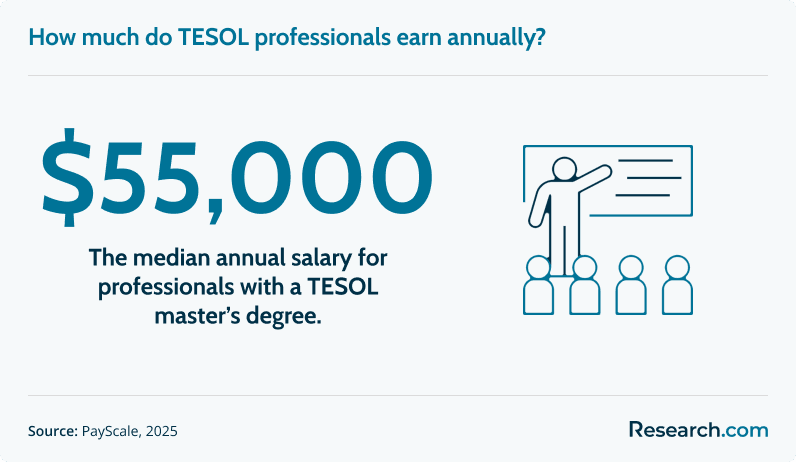
- According to PayScale, the median salary for professionals with a master’s in TESOL is around $55,000 per year, with higher earnings possible in leadership or international roles.
- Online TESOL programs allow students to study from anywhere, making it easier to balance work and education while gaining credentials that are respected worldwide.
What can I expect from an online TESOL master's degree?
An online TESOL master's program typically blends theory and practice to prepare students for diverse teaching environments. Coursework often covers second language acquisition, instructional methods, assessment strategies, and sociolinguistics. Many programs also include a practicum or supervised teaching component that can be completed locally or abroad.
Designed for flexibility, online learning enables professionals to study part-time or full-time, with asynchronous options allowing students to access lectures and assignments on their own schedule. Some programs may also offer specializations, such as K–12 ESL education, adult learning, or international teaching, to tailor the degree to specific career goals.
Where can I work with a TESOL master's degree?
Graduates with a TESOL master's degree are qualified to work in a wide range of settings. Common employers include public and private schools, colleges and universities, language academies, and nonprofit organizations focused on adult education or immigrant support. Internationally, TESOL graduates often find opportunities in government-sponsored programs, such as Fulbright or Peace Corps, and private English language institutes across Asia, Europe, and the Middle East.
Beyond teaching, some professionals move into roles in curriculum development, education policy, or teacher training, particularly with experience. Others may work for publishing companies, edtech firms, or government agencies involved in English language initiatives. The degree is especially valuable for those aiming to hold leadership or administrative positions in language education programs.
How much can I make with a TESOL master's degree?
Salaries for TESOL professionals vary widely depending on location, experience, and the type of employer. According to PayScale, the median salary for someone with a TESOL master’s is about $55,000 annually, but those teaching in U.S. K–12 public schools may earn between $45,000 and $65,000, depending on district pay scales and certifications. Those in higher education or curriculum development roles may earn more.
International teaching positions can offer additional benefits such as housing stipends, travel allowances, and tax-free income, particularly in countries like South Korea, UAE, and China, where experienced TESOL professionals may earn $60,000 or more annually. Administrative roles, such as program directors or teacher trainers, can also command higher salaries, especially in larger organizations or universities.
- List of the Best Online TESOL Master's Degree Programs for 2027 List of Programs
- How long does it take to complete an online TESOL master's degree program? Completion Time
- How does an online TESOL master's degree compare to an on-campus program? Online vs. Traditional
- What is the average cost of an online TESOL master's degree program? Cost
- What are the financial aid options for students enrolling in an online TESOL master's degree program? What are the financial aid options for students enrolling in an online TESOL master's degree program?
- What are the prerequisites for enrolling in an online TESOL master's degree program? Prerequisites
- What courses are typically in an online TESOL master's degree program? What courses are typically in an online TESOL master's degree program?
- What types of specializations are available in an online TESOL master's degree program? What types of specializations are available in an online TESOL master's degree program?
- How do you choose the best online TESOL master's degree program? How do you choose the best online TESOL master's degree program?
- What career paths are available for graduates of an online TESOL master's degree program? Career Paths
- What is the job market like for graduates of an online TESOL master's degree program? Job Outlook
- What advanced credentials can further elevate my TESOL career? What advanced credentials can further elevate my TESOL career?
- Can interdisciplinary studies enrich my TESOL practice? Can interdisciplinary studies enrich my TESOL practice?
- What support services boost success in an online TESOL master's degree program? What support services boost success in an online TESOL master's degree program?
Best Online Master’s in TESOL Programs for 2027: Costs, Credits, Accreditation, and Career Fit
Choosing an online master’s in TESOL is not just a question of which school has the lowest tuition. The bigger decision is whether the program prepares you for the specific English language teaching role you want: K–12 ESL instruction, adult education, bilingual education, international teaching, curriculum development, or teacher leadership.
This guide is for licensed teachers, aspiring ESL instructors, international educators, and education professionals comparing online TESOL graduate programs. You will learn how these programs differ, what they cost, how long they take, what admissions requirements to expect, which career paths they support, and how to avoid choosing a program that does not match your licensure or professional goals.
Quick answer: What is the best online TESOL master’s degree program?
The best online TESOL master’s program depends on your career goal, budget, state requirements, and preferred learning format. For example, certified teachers may prioritize CAEP-recognized programs aligned with ESL endorsement requirements, while working adults may prefer asynchronous, accelerated, or competency-based options. The programs below were selected using education data sources and program-level factors such as accreditation, cost, online delivery, required credits, and TESOL-related curriculum.
How Research.com evaluated these online TESOL master’s programs
A TESOL master’s degree is a significant academic and financial commitment, so rankings should be based on more than brand familiarity. Research.com reviewed online TESOL and closely related English language learning master’s programs using institutional and program data intended to help students compare options clearly.
Our evaluation drew from several established education data sources, including the IPEDS database, Peterson’s database and its Distance Learning Licensed Data Set, College Scorecard, and the National Center for Education Statistics.
To learn more about how Research.com builds school rankings, review our methodology page.
Best online TESOL master’s programs at a glance
| Rank | School | Program focus | Credits | Cost per credit | Accreditation |
| 1 | University of Missouri | TESOL emphasis within Learning, Teaching & Curriculum | 30 | $509 | HLC, CAEP |
| 2 | Concordia University Nebraska | M.Ed. in TESOL | 36 | $425 | HLC, NCATE |
| 3 | Capella University | English Language Learning specialization | 46 | $495 (GuidedPath); flat rate for FlexPath | HLC, CAEP |
| 4 | Grand Canyon University | MA in TESOL | 32 | $565 | HLC, NCATE |
| 5 | University of Nebraska at Kearney | ESL/ESOL | 36 | $348 (in-state); $515 (out-of-state) | HLC, CAEP |
| 6 | American College of Education | English as a Second Language and Bilingual Education | 31 | $235 | HLC, CAEP |
| 7 | Liberty University | Master of Education in TESL | 36 | $415 (full-time); $615 (part-time) | SACSCOC, CAEP |
| 8 | Regent University | M.Ed. in TESOL | 33 | $575 | SACSCOC, CAEP |
| 9 | Western Governors University | English Language Learning (PreK–12) | 31 | Flat rate ($3,975 per 6-month term) | NWCCU, CAEP |
| 10 | Kennesaw State University | M.Ed. in TESOL | 36 | $383 (in-state); $1,066 (out-of-state) | SACSCOC, CAEP |
1. University of Missouri
The University of Missouri offers a fully online Master of Education in Learning and Teaching and Curriculum with a TESOL emphasis. The program is built for certified teachers and education professionals who want to strengthen instruction for English language learners through practical classroom methods and research-informed teaching. Mizzou’s online delivery is designed for working educators, with asynchronous coursework and flexible pacing options that can support both U.S.-based and international students.
- Program Length: Two years (flexible pacing available)
- Tracks/concentrations: TESOL emphasis within Learning, Teaching & Curriculum
- Cost per Credit: $509
- Required Credits to Graduate: 30
- Accreditation: HLC, CAEP
2. Concordia University Nebraska
Concordia University Nebraska provides an online M.Ed. in TESOL for educators, mission workers, and professionals serving multilingual communities. The curriculum combines TESOL preparation with cultural awareness, global perspectives, and Christian values. Because the degree is delivered fully online with no campus requirement, it can work well for current teachers who need to continue working while adding ESL-focused expertise.
- Program Length: Two years
- Tracks/concentrations: N/A
- Cost per Credit: $425
- Required Credits to Graduate: 36
- Accreditation: HLC, NCATE
3. Capella University
Capella University offers a Master of Science in Education with a specialization in English Language Learning and Teaching. Students can choose between FlexPath and GuidedPath formats, making this option especially relevant for working professionals who want either a self-paced structure or a more guided schedule. Coursework addresses language assessment, culturally responsive instruction, classroom innovation, and English language learning across K–12 and adult education environments.
- Program Length: 12 to 24 months
- Tracks/concentrations: English Language Learning specialization
- Cost per Credit: $495 (GuidedPath); flat rate for FlexPath
- Required Credits to Graduate: 46
- Accreditation: HLC, CAEP
4. Grand Canyon University – Phoenix, Arizona
Grand Canyon University offers a fully online MA in TESOL for students preparing to teach English learners in U.S. or international settings. The program covers second language acquisition, linguistics, and TESOL instructional methods within a faith-based academic environment. Its asynchronous courses are designed for adults who need flexibility while building credentials for ESL teaching or related education roles.
- Program Length: 18 to 24 months
- Tracks/concentrations: N/A
- Cost per Credit: $565
- Required Credits to Graduate: 32
- Accreditation: HLC, NCATE
5. University of Nebraska at Kearney
The University of Nebraska at Kearney offers an online MA in Education – Curriculum and Instruction: ESL. The program is intended for certified teachers seeking ESL endorsement and practical preparation for K–12 or adult English learner settings. Students study language acquisition, instructional design, educational technology, and classroom application through a flexible online format supported by faculty engagement and peer interaction.
- Program Length: Two years
- Tracks/concentrations: ESL/ESOL
- Cost per Credit: $348 (in-state); $515 (out-of-state)
- Required Credits to Graduate: 36
- Accreditation: HLC, CAEP
6. American College of Education
American College of Education delivers an online M.Ed. in English as a Second Language and Bilingual Education with a strong affordability focus. The program is geared toward licensed educators who want deeper preparation in instructional planning, bilingual education, language theory, and ESL methodology. Multiple start dates and online delivery make it a practical choice for teachers seeking a manageable path to graduate study while remaining employed.
- Program Length: 18 months
- Tracks/concentrations: Bilingual Education
- Cost per Credit: $235
- Required Credits to Graduate: 31
- Accreditation: HLC, CAEP
7. Liberty University
Liberty University offers a 100% online Master of Education in TESL grounded in Christian principles. Students study linguistics, language acquisition, and instructional methods for diverse learners. The program’s eight-week courses and multiple start dates may appeal to professionals who want an accelerated online format and faith-based academic support while preparing for ESL teaching opportunities in the U.S. or abroad.
- Program Length: One and a half to two years
- Tracks/concentrations: N/A
- Cost per Credit: $415 (full-time); $615 (part-time)
- Required Credits to Graduate: 36
- Accreditation: SACSCOC, CAEP
8. Regent University
Regent offers an online M.Ed. in TESOL with a Christ-centered approach to language education. The curriculum includes grammar, second language acquisition, and TESOL teaching methods, with preparation for domestic and international education settings. Optional synchronous components may benefit students who want some live interaction while still studying primarily online. Regent’s emphasis on servant leadership may be a fit for students interested in missions, ministry-connected education, or global outreach.
- Program Length: 18 to 24 months
- Tracks/concentrations: N/A
- Cost per Credit: $575
- Required Credits to Graduate: 33
- Accreditation: SACSCOC, CAEP
9. Western Governors University
Western Governors University offers an M.A. in English Language Learning (PreK–12) for licensed teachers who want to add ESL endorsement. Its competency-based model allows students to progress based on demonstrated mastery, which can be valuable for experienced educators who can move quickly through familiar material. The asynchronous structure and flat-rate tuition model may reduce costs for students who complete coursework efficiently.
- Program Length: 12 to 24 months (self-paced)
- Tracks/concentrations: PreK–12 ESL Endorsement
- Cost per Credit: Flat rate ($3,975 per 6-month term)
- Required Credits to Graduate: 31
- Accreditation: NWCCU, CAEP
10. Kennesaw State University
Kennesaw State offers an online M.Ed. in TESOL for certified educators preparing to serve English learners in K–12 classrooms. The program emphasizes second language acquisition, culturally responsive teaching, instructional methods, and field-based learning. Its curriculum is structured around Georgia’s ESL endorsement requirements, so out-of-state students should confirm whether the program aligns with their own state’s licensure or endorsement rules.
- Program Length: Two years
- Tracks/concentrations: N/A
- Cost per Credit: $383 (in-state); $1,066 (out-of-state)
- Required Credits to Graduate: 36
- Accreditation: SACSCOC, CAEP
How long does an online TESOL master’s degree take?
Most online TESOL master’s programs take 18 to 24 months for students studying part time. Some formats can be completed in as little as 12 months, especially when students enroll full time, use accelerated terms, or choose a competency-based model. Your actual timeline depends on course load, transfer credit policies, practicum requirements, and whether you are also working as a teacher.
| Enrollment pace | Typical timeline | Best for | Trade-off |
| Accelerated or full-time | As little as 12 months | Students with strong availability and clear career urgency | Heavier workload and less schedule flexibility |
| Standard part-time | 18 to 24 months | Working teachers and career changers balancing employment | Longer time before graduation |
| Self-paced | 12 to 24 months (self-paced) | Experienced educators who can move quickly through familiar content | Requires strong discipline and independent study habits |
If you need a shorter credential before committing to a full graduate degree, compare fast-track ESL graduate certificate programs online. A certificate may be enough for educators who already hold a teaching license and need targeted ESL preparation rather than a complete master’s program.
Online TESOL master’s vs. on-campus TESOL master’s: Which format is better?
An online TESOL master’s can offer academic rigor comparable to an on-campus program when the institution is properly accredited and the curriculum meets your career or licensure goals. The better format depends on how you learn, whether you need local field placements, and how much flexibility your work schedule requires.
| Factor | Online TESOL master’s | On-campus TESOL master’s |
| Schedule | Often better for working adults because asynchronous courses may allow study outside school hours | Usually requires scheduled class attendance and commuting |
| Interaction | Uses discussion boards, video meetings, virtual collaboration, and faculty messaging | Offers face-to-face faculty access, peer interaction, and immediate classroom discussion |
| Field experience | May allow local practicums or classroom-based assignments in your current school | May provide campus-arranged observations, local school partnerships, or in-person practicum support |
| Networking | Can connect students across states and countries | May be stronger for local district or regional education networks |
| Best fit | Teachers, parents, military students, and working professionals needing flexibility | Students who prefer in-person learning and structured campus engagement |
If your goal is broader language development rather than TESOL specifically, you may also want to compare related educator pathways such as the fastest online Master's in Reading and Literacy.
How much does an online TESOL master’s degree cost?
The average cost per credit for an online TESOL master’s degree typically falls between $400 and $600, with total tuition ranging from $10,000 to $25,000, depending on the institution and residency status. Public universities may charge different rates for in-state and out-of-state students, while many private universities use a single online tuition rate.
When comparing programs, do not evaluate tuition alone. Required credits, fees, technology costs, books, practicum expenses, and the number of terms you need can all change the real price. A low cost per credit may not be the lowest total cost if the program requires more credits.
| Cost item | Why it matters | Question to ask |
| Cost per credit | Shows the basic tuition rate but not the full program cost | Is this rate the same for online, in-state, and out-of-state students? |
| Required credits | Determines total tuition exposure | How many credits are required to graduate? |
| Fees | Technology, graduation, student service, and course fees can add up | Can the school provide a full estimated cost of attendance? |
| Transfer credits | Accepted credits may reduce both time and tuition | Does the program accept prior graduate coursework? |
| Employer reimbursement | Some districts or organizations help teachers pay for graduate study | Does my employer cover TESOL, ESL, or endorsement-related coursework? |
Professionals with a TESOL master’s degree have a median salary of $55,000 per year, although individual outcomes vary by job title, employer, location, licensure, and experience. If your long-term goal is leadership rather than classroom instruction, you may also compare advanced options such as a fast-track education specialist degree online.
What financial aid is available for online TESOL master’s students?
Online TESOL master’s students may qualify for several types of financial support, but eligibility depends on the school, program status, enrollment load, and the student’s personal financial profile. Before enrolling, ask the financial aid office for a written estimate of aid options and total out-of-pocket cost.
- Federal Student Aid: Graduate students may be eligible for unsubsidized federal loans by completing the FAFSA.
- School-based scholarships and grants: Some universities provide awards for education, TESOL, bilingual education, or teacher preparation students.
- Employer tuition reimbursement: Teachers should check whether their district, school, or organization reimburses graduate coursework tied to ESL instruction or licensure needs.
- Teaching assistantships: These are less common in fully online programs, but some hybrid or university-based options may include assistantship opportunities.
- Private scholarships: Education associations, language-teaching organizations, and nonprofits may offer support for future ESL or bilingual educators.
What are the admissions requirements for an online TESOL master’s program?
Admission requirements vary, but most online TESOL master’s programs expect applicants to hold a bachelor’s degree and show readiness for graduate-level work in education, linguistics, English, or a related field. Some programs are designed only for licensed teachers, while others accept applicants planning to teach adults, international students, or community-based learners.
- A bachelor’s degree from an accredited institution, often in education, linguistics, English, or a related discipline
- A minimum GPA, typically around 2.75 to 3.0
- Letters of recommendation and a personal statement
- Teaching experience or a valid teaching license, if required by the program
According to Zippia, about 70% of ESL teachers hold a bachelor’s degree, while 19% have a master’s degree and 5% hold associate degrees. That does not mean every ESL role requires a master’s, but it does show why graduate study can matter for advancement, endorsement preparation, and specialized language education roles. For a broader overview of graduate education admissions, see what are the requirements for a master's degree in education.
What courses are included in an online TESOL master’s degree?
Online TESOL master’s programs usually combine language theory, teaching methods, assessment, culture, and applied classroom practice. The goal is to help graduates understand how English learners acquire language and how teachers can design instruction that supports academic, professional, and everyday communication.
Graduates may use this preparation in teaching, curriculum work, policy support, program coordination, and other careers with a masters in multilingual learner education.
Common core courses
- Second Language Acquisition: Examines how children and adults learn additional languages and how that process affects instruction.
- ESL Teaching Methodologies: Focuses on lesson planning, instructional strategies, and curriculum design for English learners.
- Assessment and Evaluation: Covers language proficiency assessment, classroom measurement, and ways to evaluate learner progress.
- Sociolinguistics and Culture: Explores how language, identity, culture, and social context shape communication and learning.
Possible electives or focus areas
- Technology in TESOL
- Bilingual Education
- Teaching English for Academic Purposes
Educators who work with young multilingual learners may also find value in a related credential such as a fast-track graduate certificate early childhood education online.
What TESOL master’s specializations should you consider?
Specializations help you tailor a TESOL master’s degree to a specific teaching setting or learner population. Choose a track based on where you want to work after graduation, not only on which elective sounds interesting.
| Specialization | Best for | What to confirm before enrolling |
| K–12 ESL Education | Licensed teachers who want to support English learners in schools | Whether the program meets your state’s ESL endorsement requirements |
| Adult Education and Literacy | Students interested in community colleges, workforce programs, refugee support, or adult learning centers | Whether coursework includes adult learning theory and practical teaching experience |
| International TESOL | Educators planning to teach English abroad or in international school environments | Whether the credential is recognized by your target employers or country |
| Curriculum and Instruction | Teachers pursuing instructional coaching, curriculum design, or leadership roles | Whether the program includes assessment, curriculum development, and teacher leadership content |
| Digital learning and outreach | Educators building online language programs or community engagement initiatives | Whether you need TESOL training, instructional design, or a separate option such as an online social media marketing degree |
According to recent data, 19% of ESL teachers majored in English, while others came from backgrounds in elementary education or general education. This variety reflects how TESOL draws from language, pedagogy, culture, assessment, and curriculum. Teachers aiming for leadership responsibilities may also compare TESOL study with the shortest master's programs in teacher leadership online.
How to choose the right online TESOL master’s program
The strongest TESOL program for one student may be the wrong choice for another. Start with your target job, then work backward to the credential, licensure alignment, cost, and schedule you need.
1. Verify accreditation and licensure alignment
Choose an institution with recognized accreditation, and if you are a teacher, confirm whether the program supports your state’s ESL endorsement or licensure requirements. Programmatic recognition from organizations such as CAEP can be an important quality signal, but state rules still matter.
2. Match the curriculum to your intended learners
A program built for PreK–12 endorsement may not be the best fit if you plan to teach adults abroad. Review course descriptions, field experience requirements, and specialization options before applying.
3. Compare total cost, not just tuition rate
Calculate the full price using cost per credit, required credits, fees, books, and the number of terms needed to finish. Ask whether scholarships, employer reimbursement, or transfer credits can reduce your total cost.
4. Decide how much structure you need
Asynchronous courses are convenient, but they require self-management. Synchronous or cohort-based programs may provide more accountability and interaction. Competency-based formats can be efficient for experienced teachers but may not suit students who need frequent deadlines.
5. Ask direct questions before committing
| Question | Why it matters |
| Does this program lead to ESL endorsement in my state? | Online programs do not automatically satisfy every state’s licensure rules. |
| Are practicum or field experiences required? | You may need to arrange placements locally, especially if you study online. |
| Can I complete the degree while teaching full time? | Course load and assignment pacing affect work-life balance. |
| What student support is available online? | Advising, tutoring, technical help, and career services can affect completion. |
| What are the total tuition and fee estimates? | Advertised tuition may not include all required expenses. |
Common mistakes to avoid
- Choosing a program before checking state requirements: If you need public school endorsement, verify licensure alignment first.
- Comparing only cost per credit: Total credits and fees can change the real cost.
- Assuming online means easier: Online graduate programs can be rigorous and require consistent weekly work.
- Ignoring practicum logistics: Field requirements may be difficult if your location or work schedule limits placement options.
- Relying only on rankings: A ranked program still needs to fit your career target, budget, and learning style.
What can you do with an online TESOL master’s degree?
An online TESOL master’s can support roles in schools, adult education programs, universities, community organizations, international education, and curriculum development. The right role depends on your teaching license, experience, location, and whether your program includes endorsement preparation.
| Career path | Typical setting | How a TESOL master’s may help |
| K–12 ESL Teacher | Public, private, or charter schools | Builds expertise in English learner instruction and may support endorsement goals |
| Adult ESL Instructor | Adult education centers, workforce programs, community organizations | Prepares teachers to support adult language, literacy, and workplace communication needs |
| University or Community College ESL Lecturer | Higher education or intensive English programs | Supports academic English instruction and language program teaching |
| TESOL Program Administrator | Schools, nonprofits, language centers, or international programs | Combines teaching knowledge with program coordination and leadership |
| Curriculum Specialist for English Language Programs (ELPs) | Districts, publishers, education companies, or language programs | Uses TESOL knowledge to design lessons, assessments, and learning materials |
| Teacher Trainer or Educational Consultant | Professional development, international education, or consulting | Applies advanced TESOL expertise to coach instructors and improve programs |
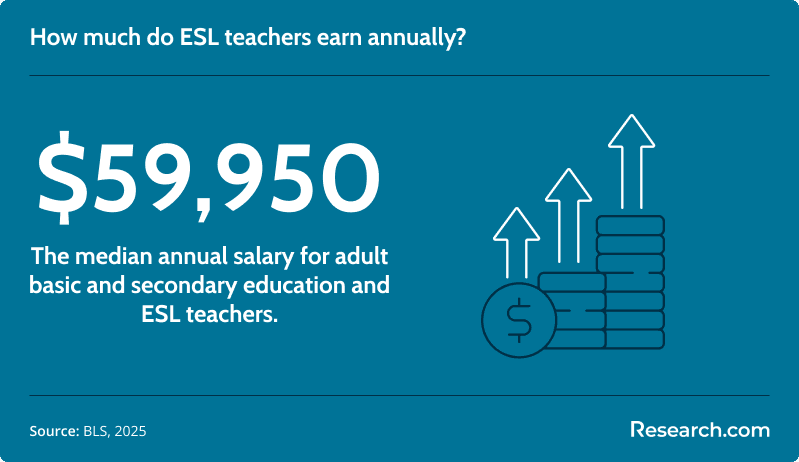
Professionals with a TESOL master’s degree typically earn a median salary of around $55,000, though earnings differ by role, location, employer, and experience. The U.S. Bureau of Labor Statistics reported that the median annual wage for adult basic and secondary education and ESL teachers was $59,950 as of May 2024.
If you want to serve learners with overlapping language, disability, and support needs, a graduate certificate in special education online may complement TESOL preparation.
What is the job market like for TESOL master’s graduates?
The TESOL job market is shaped by English learner enrollment, immigration and refugee support needs, adult education funding, global demand for English instruction, and employer requirements for teaching credentials. Demand can vary widely by region and role, so graduates should research local districts, adult education providers, international schools, universities, and online language education companies before choosing a program.
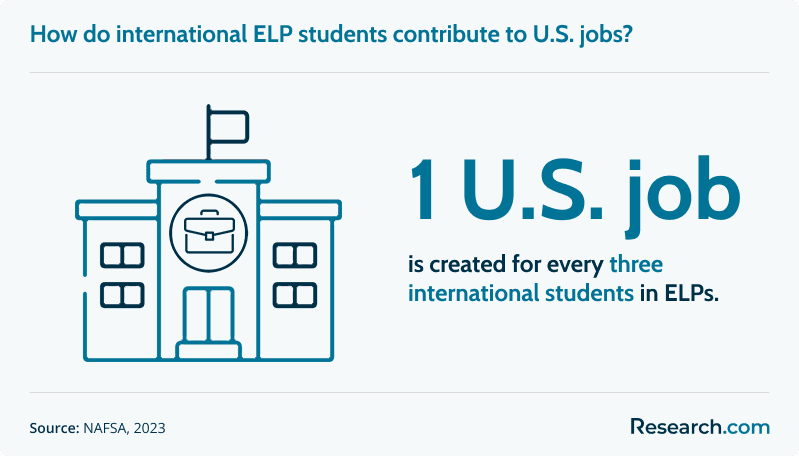
English language education also has a broader economic footprint. International students enrolled in ELPs at U.S. institutions contributed approximately $370 million to the economy and supported over 3,100 U.S. jobs. For every three international students in ELPs, one U.S. job is created across areas such as education, accommodation, dining, retail, telecommunications, and healthcare.
Research and Markets also described an English language learning market forecast to exceed revenues of $70 Billion by 2030, driven by globalization and cross-border communication. For TESOL professionals, this points to opportunity, but not a guarantee. The best employment outcomes typically depend on verified credentials, teaching experience, technology skills, and the ability to work with diverse learner populations.
If you plan to move into program management, budgeting, or organizational leadership, understanding the core subjects in a business administration program can help you identify business skills that complement TESOL expertise.
What advanced credentials can help after a TESOL master’s?
After a TESOL master’s, some professionals pursue advanced credentials to move into research, faculty roles, district leadership, curriculum administration, or executive-level education work. Doctoral study can be useful for TESOL educators who want to conduct research, lead academic programs, influence policy, or teach in higher education. If you are comparing accelerated doctoral routes, review options such as the fastest online EdD programs.
Can interdisciplinary study strengthen TESOL practice?
TESOL is closely connected to culture, migration, identity, community, and social systems. Interdisciplinary study can help teachers better understand the lived experiences of multilingual learners and design more culturally responsive instruction. For example, educators interested in culture and human behavior may find useful perspectives in the best online anthropology degrees.
What do graduates say about online TESOL master’s programs?
- : "Studying TESOL online made graduate school possible while I was working full time and caring for my family. I could complete lectures and assignments during the hours that fit my schedule, and the coursework connected directly to classroom situations. The virtual discussions and mentoring helped me feel supported rather than isolated, and I finished with stronger teaching strategies and more confidence. — Sara"
- : "The online format helped me move forward faster than I expected. I completed the degree in 18 months while continuing to work, and the program helped prepare me to teach adult English learners. The peer conversations, virtual activities, and language acquisition coursework made the experience practical and relevant. — Mark"
- : "What stood out to me was the mix of academic growth and cultural exchange. My classmates came from many teaching contexts, which made discussions richer. Courses in linguistics, assessment, and inclusive pedagogy helped me design stronger lesson plans and contribute more confidently to teacher workshops. — Linh"
What support services matter most in an online TESOL master’s program?
Support services can make the difference between enrolling and finishing. Strong online TESOL programs typically provide academic advising, technology help, virtual tutoring, faculty access, library resources, career services, and structured communication with peers. These services are especially important for students who are returning to school after several years, studying across time zones, or completing field experiences while working.
Students interested in academic language support, school libraries, multilingual research services, or information literacy may also explore related pathways such as an affordable online MLIS.
References:
- BLS. (2025, August 28). Adult basic and secondary education and ESL teachers. BLS.
- NAFSA. (2023). Economic Value of U.S. College and University ENGLISH LANGUAGE PROGRAMS. tesol.org.
- PayScale. (n.d.). Teaching English to speakers of other Languages (TESOL) salary. PayScale.
- Research and Markets. (2025, February 6). English Language Learning Market Boom: Forecast to Exceed Revenues of $70 Billion by 2030 with Globalization and Increasing Cross-border Communication Fueling Demand. Yahoo Finance.
- Zippia. (2025, January 8). Best Colleges and Degrees for ESL Teachers. Zippia.
Key Insights
- Start with your target role. A K–12 ESL endorsement pathway, adult ESL program, and international TESOL track can lead to different requirements and outcomes.
- Accreditation and state alignment are nonnegotiable. If you need licensure or endorsement, confirm requirements with your state before enrolling.
- Online TESOL programs can be flexible, but they are not automatically easier. Asynchronous and self-paced formats require strong time management.
- Total cost matters more than sticker tuition. Compare required credits, fees, residency rates, transfer policies, and employer reimbursement options.
- Most programs take 18 to 24 months part time. Accelerated and competency-based options may be faster for students who can handle a heavier pace.
- A TESOL master’s can support teaching and non-classroom roles. Graduates may pursue ESL instruction, curriculum development, program administration, teacher training, or language education consulting.
Other Things You Should Know About the Best Online TESOL Master's Degree Programs
Most U.S. public schools require a state-issued teaching license or certificate, plus ESL or ESOL endorsement in many states. Requirements usually include a bachelor’s degree, an approved educator-preparation program, supervised student teaching, and passing state exams such as Praxis content and pedagogy tests.
The best online TESOL master's programs in 2027 are typically accredited by recognized bodies such as the Commission on English Language Accreditation (CEA) or the TESOL International Association. Accreditation ensures programs meet high standards of quality and rigor.


