2027 Fastest Online Master’s in Teacher Leadership Programs

Co-Founder and Chief Data Scientist
Teachers who want to move into instructional coaching, curriculum leadership, department leadership, or school administration often look for one thing first: a credible online master’s program that can be completed quickly without weakening academic quality. The fastest online Master’s in Teacher Leadership programs are built for working educators who need flexibility, practical leadership training, and a clear path toward advancement.
Speed, however, should not be the only factor. An accelerated program is only worthwhile if it is accredited, aligned with your state’s licensure or endorsement requirements, realistic for your schedule, and connected to the leadership roles you actually want. This guide explains what these programs include, how to compare accelerated options, what they cost, which careers they can support, and what questions to ask before enrolling.
Quick Answer: What is the fastest online Master’s in Teacher Leadership?
The fastest online Master’s in Teacher Leadership programs commonly take 12–18 months to complete, although some programs run closer to 2 years. These degrees usually require about 30 to 42 credit hours and are designed for licensed educators who want to lead curriculum work, coach teachers, coordinate professional development, or prepare for administrative roles. The best choice is not simply the shortest program; it is the shortest accredited program that matches your state requirements, career goals, budget, and workload capacity.
What are the benefits of getting a qualification from the fastest online Master's in Teacher Leadership programs?
- Faster movement into leadership roles: A graduate credential in teacher leadership can help classroom educators qualify for positions such as instructional coach, curriculum specialist, department chair, lead teacher, or school administrator, depending on state and district requirements.
- Stronger salary potential in leadership tracks: Compensation depends heavily on district pay scales, location, experience, and role. As a general reference, lead teacher roles may average around $68,000, instructional coordinator roles can exceed $74,000, and principal roles may surpass $102,000 annually.
- Online flexibility for working teachers: Accelerated online formats allow educators to keep teaching while completing graduate coursework, often through shorter course terms and year-round scheduling.
- More influence beyond one classroom: Teacher leadership programs prepare educators to coach colleagues, improve curriculum, analyze student data, support schoolwide initiatives, and contribute to long-term instructional improvement.
What can I expect from the fastest online Master's in Teacher Leadership programs?
Accelerated online teacher leadership programs compress graduate-level leadership preparation into shorter terms, so students should expect a focused and demanding experience. These programs are usually designed for practicing teachers, which means assignments often connect directly to school-based problems, classroom data, curriculum evaluation, and teacher collaboration.
| Program Feature | What It Usually Means for Students | Decision Tip |
| Accelerated timeline | Many programs can be completed in 12-18 months, often through 8- to 10-week course terms or continuous enrollment. | Confirm whether the published timeline assumes full-time study, summer enrollment, or taking multiple courses at once. |
| Leadership-centered curriculum | Coursework commonly covers instructional coaching, curriculum design, assessment, educational technology, school law, ethics, and school improvement. | Match the curriculum to your goal: coaching, curriculum leadership, administration, or district-level work. |
| Online delivery | Programs may use recorded lectures, live virtual meetings, collaborative projects, discussion boards, and digital portfolios. | Ask whether courses are asynchronous, synchronous, or a mix, especially if you teach full time. |
| Applied fieldwork | Some programs include practicums, internships, capstones, or school-based leadership projects. | If you need principal certification or an administrative endorsement, verify fieldwork requirements before enrolling. |
| High workload intensity | Shorter programs often require more concentrated reading, writing, collaboration, and project work each term. | Do not choose the fastest option unless your work and family schedule can support the pace. |
- Advanced coursework: Expect classes in instructional leadership, curriculum development, assessment, professional learning, educational technology, school law, and ethical decision-making.
- Structured online learning: Programs often combine recorded instruction, live seminars, group projects, discussion-based learning, and field-based assignments.
- Practical school improvement work: Assignments frequently ask students to analyze data, design professional development, evaluate curriculum, or solve real challenges in their own schools.
- Condensed scheduling: Fast programs often run year-round and use shorter terms, which can reduce completion time but increase weekly workload.
Where can I work with a qualification from the fastest online Master's in Teacher Leadership programs?
A Master’s in Teacher Leadership can support roles inside schools, districts, nonprofits, and education-focused companies. The exact opportunities depend on your teaching license, state regulations, experience level, and whether the program includes an administrative licensure pathway.
- Public and private schools: Graduates may work as instructional coaches, lead teachers, department chairs, grade-level leaders, assistant principals, or curriculum-focused teacher leaders.
- School districts: District roles may include curriculum specialist, professional development coordinator, assessment coordinator, instructional specialist, or director-level curriculum work after sufficient experience.
- Charter and magnet schools: Teacher leaders may guide instructional teams, support specialized program models, manage innovation initiatives, or coordinate schoolwide improvement efforts.
- Educational nonprofits: Graduates may develop resources, manage teacher support programs, lead student success initiatives, or contribute to education policy and advocacy work.
- Education technology companies: Experienced educators may move into instructional design, professional learning, implementation consulting, content development, or customer training roles.
- Administration pathways: Some programs can support movement toward principal, academic dean, assistant principal, or director of curriculum and instruction roles, but licensure requirements must be checked by state.
How much can I earn with a qualification from the fastest online Master's in Teacher Leadership programs?
Earnings after an online Master’s in Teacher Leadership vary by job title, district salary schedule, state, prior experience, union agreements, and whether the role is school-based, district-based, or administrative. In broad terms, teacher leadership salaries can range from more than $68,000 in instructional leadership roles to more than $100,000 in senior administrative positions.
- Instructional-level roles: Lead teachers and instructional coaches commonly fall in the $68,000 to $85,000 annual range, depending on location and employer.
- Coordinator-level roles: Instructional coordinators and curriculum specialists may earn from $70,000 to more than $90,000, especially with experience and district-level responsibility.
- Administrative-level roles: Assistant principals, principals, and other senior school leaders may exceed $95,000 and reach well over $115,000 in some districts and school levels.
| Career Goal | Typical Fit for a Teacher Leadership Master’s | Important Requirement to Check |
| Instructional coach | Strong fit, especially for educators who want to mentor teachers and improve classroom instruction. | District experience requirements and subject-area expertise. |
| Curriculum specialist | Strong fit when the program emphasizes curriculum design, assessment, and standards alignment. | Experience with curriculum adoption, assessment data, and instructional materials. |
| Department chair or lead teacher | Good fit for teachers who want leadership responsibility while staying close to classroom practice. | School or district leadership selection process. |
| Assistant principal or principal | Possible fit if the program includes administrative leadership preparation. | State principal licensure, certification exams, internships, and experience rules. |
| Education consultant or EdTech role | Possible fit for educators with strong instructional design, coaching, or technology experience. | Portfolio, implementation experience, and marketable technical skills. |
- Fastest Online Master's in Teacher Leadership Programs for 2027
- What is the average cost of an online Master's degree in Teacher Leadership?
- What are the financial aid options for an online Master's degree in Teacher Leadership?
- What are the prerequisites for enrolling in an online Master's degree in Teacher Leadership?
- What courses are typically in an online Master's degree in Teacher Leadership?
- What types of specializations are available for Master's degree in Teacher Leadership graduates?
- How do you choose the best online Master's degree in Teacher Leadership?
- What career paths are available for graduates of online Master's degree in Teacher Leadership programs?
- How much can I earn with an online Master's degree in Teacher Leadership?
- What is the job market like for graduates with an online Master's degree in Teacher Leadership?
- What are some current and future trends in teacher leadership?
- What accreditation standards ensure the quality of an online Master's in Teacher Leadership program?
- How Do Online Master’s in Teacher Leadership Programs Ensure Student Support and Success?
- How Can Interdisciplinary Perspectives Strengthen Teacher Leadership?
- Can Complementary Credentials Strengthen Teacher Leadership Practices?
Fastest Online Master's in Teacher Leadership Programs for 2027
The programs below are accelerated or flexible online options for educators seeking graduate-level leadership preparation. Some are specifically labeled teacher leadership programs, while others are educational leadership programs that may lead toward school administration or principal certification. If you are comparing shorter education credentials before committing to a full master’s program, you may also want to review short online special education graduate certificate programs.
How do we rank schools?
Research.com rankings are designed to help students compare education options using transparent data sources and a consistent evaluation process. Our methodology draws from recognized education data sources, including:
- the IPEDS database
- Peterson's database, including the Distance Learning Licensed Data Set
- the College Scorecard database
- the National Center for Education Statistics
Use this list as a starting point, not as the only basis for enrollment. Before applying, confirm tuition, program length, field experience requirements, and state licensure alignment directly with the university.
| School | Program Length | Required Credits | Tuition | Best Fit |
| Concordia University Chicago | 2 years | 33 | $535/credit | Educators interested in higher education leadership |
| East Central University | 1.5 years | 33 | $388.80/credit | Teachers pursuing educational leadership and principal preparation |
| Lamar University | As few as 18 months | 36 | $12,963 total program, in-state and out-of-state | Teachers focused on instructional leadership and curriculum |
| Louisiana State University | 15 months | 34 | $378/credit, in-state and out-of-state | Educators seeking school administration or principal certification preparation |
| Methodist University | 2 years | 36 | $545 per credit hour | Educators interested in K–12 leadership and classroom technology |
| Saint Mary’s University of Minnesota | 24 months | 36 | $545/credit | Educators and training professionals seeking broad leadership preparation |
| University of Cincinnati | 1–2 years | 30 | $22,353, Ohio Resident and Non-Resident Program Total | Licensed educators choosing principal, special education, or policy tracks |
| University of Florida | 2 years | 32 | $448.73/credit | Working educators pursuing school leadership and Florida Level 1 eligibility |
| University of North Texas | 12–18 months | 30 | approximately $14,000 program total cost | Current educators seeking a fast educational leadership pathway |
| University of West Alabama | 1-2 years | 34 | $429/credit | Educators pursuing instructional leadership and Alabama Class A preparation |
1. Concordia University Chicago
The Master of Arts in Leadership with a Higher Education specialization at Concordia University Chicago is intended for education professionals who want to build leadership capacity in postsecondary and organizational settings. The program emphasizes organizational management, higher education policy, strategic planning, ethical leadership, and institutional effectiveness.
Students complete a capstone project that connects leadership theory with a practical issue in the field. The program also incorporates Christian values into its leadership model and draws on faculty experience in higher education practice.
This option is especially relevant for educators who want to understand institutional change, evidence-based decision-making, global trends in higher education, and leadership across diverse learning communities.
- Program Length: 2 years
- Tracks/Concentrations: Higher Education Leadership
- Tuition Cost: $535/credit
- Required Credits to Graduate: 33
- Accreditation: Higher Learning Commission (HLC)
2. East Central University
The online Master of Education in Educational Leadership at East Central University is designed for working teachers preparing for K–12 leadership and school administration roles. The program combines leadership theory with applied study in school law, curriculum development, data-informed decision-making, and school operations.
Courses are offered in an accelerated format, and students may complete the degree in as little as 18 months. A 146-hour practicum gives students supervised leadership experience in real school settings.
The curriculum is aligned with ELCC standards, and graduates may be eligible for principal certification in Oklahoma and other states that recognize these standards. Students should still verify certification portability with their own state agency before enrolling.
- Program Length: 1.5 years
- Tracks/Concentrations: Educational Leadership
- Tuition Cost: $388.80/credit
- Required Credits to Graduate: 33
- Accreditation: Higher Learning Commission (HLC), National Educational Leadership Program Recognition Standards (NELP
3. Lamar University
The Master of Education in Teacher Leadership at Lamar University focuses on preparing educators to lead curriculum design, instructional improvement, and research-based teaching initiatives. It is built for teachers who want to influence school improvement while remaining closely connected to classroom practice.
Students study learning communities, team building, mentoring, diverse learner needs, curriculum development, and data-informed instructional planning. The program also emphasizes relationship-building with teachers, parents, and the broader community.
Coursework is fully online and delivered in accelerated 5- or 8-week formats. A final capstone course requires students to apply leadership concepts to a practical educational challenge.
- Program Length: As few as 18 months
- Tracks/Concentrations: Teacher Leadership
- Tuition Cost: $12,963 (total program, in-state and out-of-state)
- Required Credits to Graduate: 36
- Accreditation: Southern Association of Colleges and Schools Commission on Colleges (SACSCOC)
4. Louisiana State University
The online Master of Education in Educational Leadership at Louisiana State University prepares educators for leadership roles focused on stronger schools and communities. The curriculum covers schoolwide planning, technology implementation, public education finance, leadership theory, research interpretation, and community engagement.
The program aligns with Educational Leadership Constituent Council (ELCC) and Professional Standards for Educational Leaders (PSEL) guidelines. It is positioned as an initial step in the principal certification process, but graduates must still meet state-specific certification and exam requirements.
Students complete recurring internship experiences that provide hands-on practice in educational leadership and school improvement.
- Program Length: 15 months
- Tracks/Concentrations: School Administration/Principal Certification
- Tuition Cost: $378/credit (in-state and out-of-state)
- Required Credits to Graduate: 34
- Accreditation: Southern Association of Colleges and Schools Commission on Colleges (SACSCOC); Council for the Accreditation of Educator Preparation (CAEP)
5. Methodist University
The online M.Ed. in Educational Leadership at Methodist University is designed for educators who want to advance while also strengthening their ability to integrate classroom technology effectively. The program is aligned with International Society for Technology in Education (ISTE) Standards.
Students study technology-supported assessment, differentiation, personalization, professional learning networks, and inclusive instructional design. The program also develops advocacy skills for thoughtful, high-quality technology integration across classrooms.
Faculty include university professors and adjunct instructors currently working in public schools. The program ends with two capstone courses and a digital portfolio tied to the ISTE Standards for Educators.
- Program Length: 2 years
- Tracks/Concentrations: K–12 School Leadership
- Tuition Cost: $545 per credit hour
- Required Credits to Graduate: 36
- Accreditation: Southern Association of Colleges and Schools Commission on Colleges (SACSCOC)
6. Saint Mary’s University of Minnesota
The online Master of Arts in Educational Leadership at Saint Mary’s University of Minnesota is built for students who want leadership skills applicable across K-12 education, higher education, business training, and organizational learning environments.
The curriculum emphasizes leadership foundations, organizational change, curriculum design, assessment, collaboration, and practical problem-solving. Students often work with peers on projects that connect leadership concepts to real professional challenges.
Faculty bring experience from education and business, giving students exposure to multiple leadership contexts. The degree culminates in a capstone project that integrates leadership theory with applied practice.
- Program Length: 24 months
- Tracks/Concentrations: General Educational Leadership
- Tuition Cost: $545/credit
- Required Credits to Graduate: 36
- Accreditation: Higher Learning Commission (HLC)
7. University of Cincinnati
The online M.Ed. in Educational Leadership at the University of Cincinnati is designed for licensed educators who want practical leadership preparation for educational organizations. Students can choose from Principal Leadership, Special Education Leadership, and General Administration & Policy concentrations.
The Principal Leadership and Special Education Leadership tracks are designed for licensure preparation and include internships that expose students to administrative responsibilities. The General Administration & Policy track is a non-licensure option for students interested in leadership, policy, or organizational roles without pursuing principal certification.
Coursework examines leadership theory, school systems, public education finance, revenue sources, fiscal operations, and organizational behavior. Instruction is delivered by faculty with real-world education leadership experience.
- Program Length: 1–2 years (30 credit hours)
- Tracks/Concentrations: Principal Leadership, Special Education Leadership, General Administration & Policy
- Tuition Cost: $22,353, Ohio Resident and Non-Resident Program Total
- Required Credits to Graduate: 30
- Accreditation: Higher Learning Commission (HLC); Council for the Accreditation of Educator Preparation (CAEP);
8. University of Florida
The online M.Ed. with a School Leadership track at the University of Florida is intended for working professionals preparing for school or district leadership. The program can support eligibility for Florida Level 1 Educational Leadership certification, which is required for principal roles in Florida public schools.
Students study educational administration, school law, finance, human resources, data-driven decision-making, and leadership for public school settings. The program may also be relevant to educators interested in private, charter, or out-of-state leadership pathways, but students should verify requirements outside Florida.
Coursework is delivered fully online in an asynchronous format, and students complete a field experience practicum to develop applied school leadership skills.
- Program Length: 2 years
- Tracks/Concentrations: School Leadership
- Tuition Cost: $448.73/credit
- Required Credits to Graduate: 32
- Accreditation: Council for the Accreditation of Educator Preparation (CAEP); Southern Association of Colleges and Schools Commission on Colleges (SACSCOC)
9. University of North Texas
The accelerated online M.Ed. in Educational Leadership at the University of North Texas is designed for current educators preparing for administrative leadership. The curriculum emphasizes current theory, research-based practice, student achievement, positive school culture, and effective teaching across grade levels.
Students complete coursework in instructional leadership, school law, school finance, ethical decision-making, and school improvement. The online format is intended for working educators, and the accelerated structure can allow completion in as little as 12 to 18 months.
A required practicum gives students applied administrative experience, while faculty with education leadership backgrounds provide guidance throughout the program.
- Program Length: 12–18 months
- Tracks/Concentrations: Educational Leadership
- Tuition Cost: approximately $14,000 program total cost
- Required Credits to Graduate: 30
- Accreditation: Southern Association of Colleges and Schools Commission on Colleges (SACSCOC)
10. University of West Alabama
The online M.Ed. in Instructional Leadership at the University of West Alabama prepares educators to lead learning organizations, supervise instruction, understand school law, and advocate for strong educational practice.
The program is designed for educators seeking master’s-level preparation and specifically supports the Class A Professional Educator Certificate in Alabama. Students complete required seminars, fieldwork preparation, and an internship for applied leadership experience.
Students also receive support through a mentorship model. Graduates may pursue leadership opportunities in public schools, private schools, and other educational organizations, subject to credential and employer requirements.
- Program Length: 1-2 years
- Tracks/Concentrations: Instructional Leadership
- Tuition Cost: $429/credit
- Required Credits to Graduate: 34
- Accreditation: Southern Association of Colleges and Schools Commission on Colleges (SACSCOC)
If cost is your main concern, compare this list with affordable online master’s degrees in educational leadership before deciding which program offers the best balance of speed, accreditation, and value.
What is the average cost of an online Master's degree in Teacher Leadership?
The cost of an online Master’s in Teacher Leadership varies widely by school type, credit requirement, residency status, fees, and whether tuition is charged per credit or as a total program package. Students comparing education pathways may also want to look at the pricing structure of related accelerated programs, such as a fast online bachelor’s in early childhood education, to understand how credit load and pacing affect total cost.
- Credit requirements: Most programs require 30 to 42 credit hours.
- Public universities: Total program costs may fall between $15,000 and $30,000, especially for in-state students.
- Out-of-state pricing: Public universities may charge more for nonresident students, although some online programs use the same rate for all students.
- Private universities: Private institutions often charge higher tuition, with total program costs often ranging from $25,000 to over $60,000.
- Extra expenses: Students should budget for technology fees, application fees, digital textbooks, course materials, graduation fees, testing costs, and possible travel for fieldwork or internships.
| Cost Factor | Why It Matters | Question to Ask |
| Per-credit tuition | A lower rate may not mean a lower total cost if the program requires more credits. | What is the total tuition for the full degree? |
| Fees | Online, technology, graduation, and assessment fees can increase the actual price. | Are all mandatory fees included in the published estimate? |
| Transfer credits | Accepted graduate transfer credits can reduce time and cost. | How many credits can I transfer, and from what type of institution? |
| Licensure costs | Certification exams, background checks, and state applications may be separate from tuition. | What costs are required after graduation for certification? |
| Schedule intensity | Accelerated enrollment may reduce time away from advancement but can limit ability to take overload teaching work. | Can I realistically complete this pace while working full time? |
Employment data for education administrators, all other, shows that these roles are concentrated in instructional and school-adjacent environments. The “other schools and instruction” industry accounts for 8,840 positions, followed closely by elementary and secondary schools with 8,750 administrators. Educational support services employ 6,540 people in this category, while federal, state, and local government employ 6,260. Colleges, universities, and professional schools account for 3,990 positions among the top industries.
This pattern suggests that many education administration opportunities are connected to K-12, alternative instructional settings, and support organizations rather than only higher education. Educators considering a leadership transition after a related pathway, such as a fast online master’s in early childhood education, should compare where jobs are actually concentrated before choosing a specialization.
What are the financial aid options for an online Master's degree in Teacher Leadership?
Financial aid can make an accelerated master’s program more manageable, but graduate students should compare aid types carefully. Loans reduce immediate costs but must be repaid, while grants, scholarships, tuition reimbursement, and loan forgiveness programs may lower long-term cost. Planning ahead is especially important for educators comparing degree cost with future Master of Education career outcomes.
- Federal student aid: Students can complete the Free Application for Federal Student Aid (FAFSA) to determine eligibility for federal graduate loans and other aid options.
- TEACH Grant: The Teacher Education Assistance for College and Higher Education (TEACH) Grant may provide funds for students completing coursework tied to teaching careers, but service obligations and conversion rules must be understood before accepting it.
- Employer tuition assistance: Some school districts reimburse tuition or provide professional development funding for teachers pursuing leadership credentials.
- Scholarships and grants: Universities, educator associations, community organizations, and professional groups may offer funding for graduate education students.
- State-specific aid: Some states offer grants, scholarship programs, or loan forgiveness opportunities for educators in high-need fields, schools, or geographic areas.
| Aid Option | Best For | Watch Out For |
| Federal loans | Students who need predictable funding for tuition and fees. | Interest, repayment terms, and total borrowing over the degree. |
| District reimbursement | Teachers whose employers support leadership development. | Grade requirements, repayment clauses, and continued employment obligations. |
| Scholarships | Students who can meet academic, service, or demographic eligibility criteria. | Deadlines, essays, recommendation letters, and renewal rules. |
| TEACH Grant | Educators committed to qualifying teaching service. | Failure to meet service terms can change the grant into a loan. |
| State programs | Teachers in shortage areas or high-need schools. | State residency, school type, subject area, and service requirements. |
What are the prerequisites for enrolling in an online Master's degree in Teacher Leadership?
Admission requirements vary, but most online Master’s in Teacher Leadership programs are built for educators who already have classroom experience. If you do not yet hold a bachelor’s degree, start by comparing accredited undergraduate options such as affordable online education degrees.
- Bachelor's degree: Applicants typically need a bachelor’s degree from a regionally accredited institution.
- Teaching license or certificate: Many programs require a current professional teaching license, especially programs tied to school leadership, principal licensure, or educator endorsements.
- Teaching experience: Programs often expect several years of full-time P-12 teaching experience before admission or before internship placement.
- Minimum GPA: A minimum undergraduate GPA is commonly required, often around 3.0 on a 4.0 scale, though some schools may offer conditional admission.
- Application documents: Applicants usually submit official transcripts, a resume, letters of recommendation, and a statement of purpose explaining leadership goals.
- Standardized tests: Many programs are test-optional and do not require GRE scores, but some schools may still request scores during holistic review.
What courses are typically in an online Master's degree in Teacher Leadership?
Online Master’s in Teacher Leadership programs are usually designed around leadership practice, instructional improvement, curriculum work, teacher collaboration, and schoolwide decision-making. Many overlap with broader online master’s in education programs, but teacher leadership degrees typically focus less on initial teacher preparation and more on leading other educators.
| Common Course | What Students Learn | How It Applies at Work |
| Foundations of Educational Leadership | Leadership theory, ethics, teacher leader roles, and school culture. | Helps educators understand how to influence teams without always holding a formal administrative title. |
| Curriculum Development and Evaluation | Curriculum design, standards alignment, assessment, and instructional materials review. | Useful for curriculum committees, department leadership, and district adoption work. |
| Instructional Coaching and Mentoring | Coaching cycles, feedback methods, adult learning, and teacher support. | Prepares graduates for coaching, mentoring, and professional learning roles. |
| Data-Driven Decision Making | Collection, analysis, and use of student and school data. | Supports school improvement planning and targeted intervention design. |
| School Law and Policy | Legal and ethical issues affecting schools, students, staff, and operations. | Important for leadership roles involving compliance, supervision, and student services. |
| Supervision and Professional Development | Instructional supervision, evaluation, and design of teacher learning experiences. | Supports department chairs, instructional coaches, and professional development coordinators. |
| Community and Family Engagement | Strategies for partnerships with families and community organizations. | Helps leaders build trust and support student learning beyond the classroom. |
A 2025 Educators for Excellence survey found that 81% of teachers create, buy, or download lessons to supplement school-provided curriculum. Among those who supplement, 34% say the provided curriculum is not easily differentiated for diverse learners, while 33% look for other materials because they believe the curriculum is not engaging for students.

For teacher leaders, this finding matters because curriculum quality, differentiation, and student engagement are not abstract issues. They are daily instructional problems that require coaching skill, materials evaluation, collaboration, and evidence-based improvement.
What types of specializations are available for Master's degree in Teacher Leadership graduates?
Specializations help students align a teacher leadership degree with a specific career goal. When comparing online education degree programs, review whether the concentration prepares you for coaching, curriculum leadership, technology integration, special education leadership, literacy work, or administration.
- Instructional coaching: Focuses on mentoring teachers, improving instructional practice, facilitating feedback cycles, and supporting classroom management strategies.
- Curriculum and instruction: Emphasizes curriculum design, assessment, standards alignment, instructional theory, and district-level curriculum leadership.
- Educational technology: Prepares educators to guide digital tool adoption, blended learning, online learning design, and responsible technology integration.
- Special education leadership: Develops knowledge of compliance, inclusive practices, supervision, and support systems for students with diverse learning needs.
- Literacy or reading leadership: Builds expertise in reading policy, literacy assessment, writing instruction, intervention, and coaching for literacy improvement.
- STEAM leadership: Centers on science, technology, engineering, arts, and mathematics initiatives, including interdisciplinary and project-based learning.
| If Your Goal Is... | Consider This Specialization | Why |
| Become an instructional coach | Instructional Coaching | It directly builds coaching, observation, feedback, and mentoring skills. |
| Lead curriculum adoption | Curriculum and Instruction | It prepares you to evaluate materials, align standards, and analyze assessment results. |
| Support digital learning | Educational Technology | It connects pedagogy with classroom technology, online tools, and implementation planning. |
| Move into special education leadership | Special Education Leadership | It addresses inclusive practice, compliance, and specialized program coordination. |
| Become a literacy coach | Literacy/Reading Leadership | It focuses on reading instruction, writing development, and literacy intervention. |
How do you choose the best among the fastest online Master's degree in Teacher Leadership programs?
The best accelerated program is the one that gets you to your goal without creating licensure problems, debt pressure, or an unsustainable workload. Speed should be evaluated alongside accreditation, curriculum fit, faculty expertise, support services, and outcomes. Students who have previously compared accelerated programs, such as an accelerated online bachelor’s in history, should use an even stricter checklist at the graduate level because licensure and career advancement stakes are higher.
- Check institutional accreditation: Confirm that the university is accredited by a recognized accreditor. Regional accreditation is especially important for graduate transfer, employer recognition, and financial aid eligibility.
- Review professional accreditation: If you are pursuing educator licensure or administrative certification, look for relevant professional recognition such as CAEP when applicable.
- Match the program to your career target: A teacher leadership program may be ideal for coaching and curriculum work, while an educational leadership program may be better for principal preparation.
- Verify state licensure alignment: Do not assume an online program meets your state’s principal, administrator, or endorsement rules. Ask the program and your state education agency.
- Compare workload and pacing: Accelerated 5-, 8-, or 10-week terms can be efficient but demanding for full-time teachers.
- Assess online student support: Look for advising, field placement support, technical help, library access, career services, and faculty availability.
- Calculate total cost: Use total program cost, not just tuition per credit, when comparing options.
| Common Mistake | Why It Can Hurt You | Better Approach |
| Choosing the shortest program without checking accreditation | The degree may not be accepted for financial aid, licensure, transfer, or employer advancement. | Verify institutional and program-level accreditation before applying. |
| Assuming every leadership degree leads to principal certification | Some tracks are non-licensure or designed for general leadership only. | Ask for written confirmation of licensure alignment in your state. |
| Comparing only per-credit tuition | A low per-credit rate can still become expensive with more credits and fees. | Request a full cost-of-attendance estimate. |
| Ignoring fieldwork requirements | Internships or practicums may require time during school hours or approval from your workplace. | Ask how field experiences are arranged for online students. |
| Relying only on rankings | A highly ranked program may not fit your state, schedule, or career goal. | Use rankings as a shortlist, then evaluate fit directly. |
What career paths are available for graduates of online Master's degree in Teacher Leadership programs?
A Master’s in Teacher Leadership can support several advancement paths, from school-based instructional leadership to district-level curriculum work. It may also pair well with adjacent education credentials, including a fast online master’s in early childhood education, for educators who want specialized expertise in early learning and leadership.
- Instructional coordinator or specialist: Works with teachers and administrators to design, implement, and evaluate curriculum and instructional strategies.
- Lead teacher or department chair: Mentors colleagues, coordinates curriculum, facilitates team meetings, and supports schoolwide instructional goals.
- Assistant principal or principal: Oversees school operations, supervises staff, leads improvement initiatives, and manages student and family concerns, usually requiring state administrative licensure.
- Professional development coordinator: Designs and delivers training for teachers, instructional staff, and school leaders.
- Curriculum director: Oversees curriculum strategy across a district, aligns materials with standards, and leads adoption or evaluation processes.
- Educational consultant: Advises schools, districts, nonprofits, or companies on instructional improvement, coaching systems, technology integration, or leadership development.
How much can I earn with an online Master's degree in Teacher Leadership?
Salary outcomes depend on role, state, district pay structure, school level, years of experience, and whether the position is instructional, supervisory, or administrative. Broader master’s in education salary comparisons can help you understand how teacher leadership compensation compares with other education-related careers.
Educators who move from undergraduate preparation, such as a fast online bachelor’s in early childhood education, into a graduate leadership program should evaluate salary growth against tuition cost and time commitment.
- Instructional-level roles: Lead teachers and instructional coaches typically earn between $65,000 and $80,000 annually.
- Coordinator-level roles: Instructional coordinators and curriculum specialists often earn from $70,000 to over $85,000.
- Administrative-level roles: Assistant principals, principals, and senior school leaders may exceed $95,000 and reach well over $115,000, depending on district and school level.
Salary data shown in the graph below illustrates a progression from student support and classroom-centered positions to specialist, management, and executive leadership roles. Academic advisors average $44,386, while K-12 teaching roles range from approximately $47,000 to $54,000.
Mid-level specialist and management positions show higher earnings. Human resources specialists and training specialists fall in the mid-to-high $60,000s, while education managers and training and development managers average between $69,500 and $73,737.
The highest compensation appears in administrative and director-level roles. Assistant principals average around $78,416, while elementary, middle, and high school principals range from $79,871 to $90,028. Executive directors average $87,070, IT consultants earn $103,494, and directors of teaching and learning reach $107,014.
The main takeaway is that earnings generally rise with administrative responsibility, systemwide influence, and specialized leadership expertise. A master’s degree can support that progression, but it does not guarantee a specific salary or promotion.
What is the job market like for graduates with an online Master's degree in Teacher Leadership?
The job market for teacher leadership graduates is best understood as stable and role-dependent. Schools continue to need skilled educators who can improve instruction, support teachers, implement curriculum, use data, and lead change. However, opportunities vary by state budgets, district priorities, student enrollment, licensure requirements, and specialization. As with workforce-focused degrees in other sectors, such as a fast online sustainability bachelor’s degree, the strongest outcomes usually come from matching credentials to real employer demand.
- K-12 schools remain central employers: Many roles are based in elementary, middle, and high schools, especially coaching, department leadership, and administration.
- Instructional coordination requires experience: The instructional coordinator role typically requires a master’s degree and five years or more of related experience.
- Specialized skills can improve competitiveness: Districts may value expertise in instructional technology, special education leadership, curriculum design, assessment, and data analysis.
- Charter, private, nonprofit, and EdTech employers add options: Graduates may find roles outside traditional public school systems, especially if they build portfolios and implementation experience.
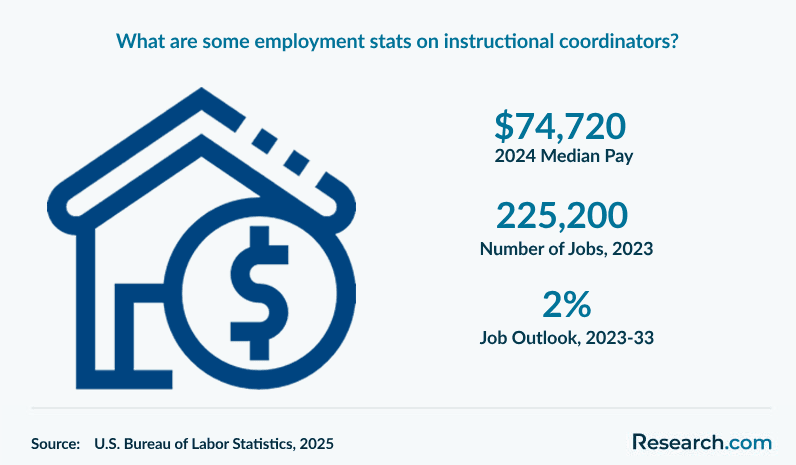
Instructional coordinators earned a median pay of $74,720 per year in 2024, or $35.92 per hour. The role typically requires a master’s degree and five years or more of experience in a related occupation. The field employed 225,200 people in 2023, and employment is projected to grow by 2% from 2023 to 2033, which is slower than average.
That projected growth equals an employment change of 4,100 jobs over the decade. For prospective students, this means instructional coordination can be a solid but competitive path. Building experience in coaching, curriculum evaluation, data use, and professional development can matter as much as completing the degree itself.
What are some current and future trends in teacher leadership?
Teacher leadership is changing as schools respond to technology, misinformation, equity concerns, teacher burnout, and pressure to improve student outcomes. Educators who want to build targeted expertise before or alongside a master’s program may also consider shorter credentials, such as a fast online graduate certificate in early childhood education.
- Evidence-based instruction: Schools increasingly expect teacher leaders to interpret data, evaluate interventions, and support instructional decisions with evidence.
- Artificial intelligence and EdTech: AI and EdTech are influencing lesson planning, assessment, tutoring, administrative workflows, and personalized learning. Teacher leaders must help schools use these tools responsibly and instructionally, not just adopt them quickly.
- Equity and inclusion: Leadership work increasingly includes culturally responsive practice, inclusive curriculum, support for diverse learners, and analysis of opportunity gaps.
- Social-emotional learning: Teacher leaders often help integrate social-emotional learning into academic planning and school culture initiatives.
- Teacher retention and support: Mentoring, coaching, collaboration, and professional learning communities are central to supporting teachers and reducing burnout.
- Micro-credentials and personalized professional learning: Micro-credentials and competency-based professional development are becoming more visible as schools look for flexible ways to build teacher skill.
Educators for Excellence reported that, among more than 1,000 teachers surveyed, 70% say misinformation affects classroom culture and student learning. The same survey found that 72% of teachers believe schools have a large role in teaching civic duties and responsibilities, while 67% believe schools have a large role in helping students develop media literacy to identify misinformation.
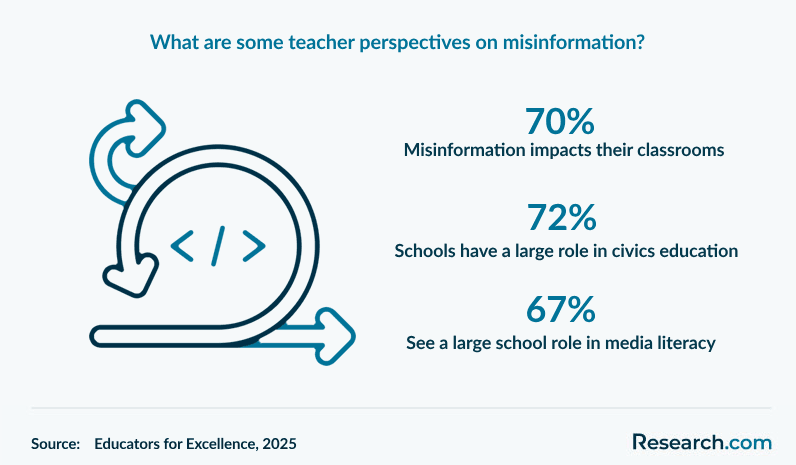
These findings point to a growing leadership responsibility: teacher leaders are not only supporting academic instruction, but also helping schools build students’ civic reasoning, media literacy, and critical thinking skills.
Here's What Graduates Say About Their Online Master's Degree in Teacher Leadership
-
: "
“I moved into an instructional coach role within six months of finishing the program. The curriculum design assignments were practical enough that I used my final project to help launch a literacy initiative at my school.” Eris
"
-
: "
“Finishing the degree in 15 months while teaching full time changed my career path. The online format gave me room to keep working, and the schedule made graduate school possible without stepping away from my classroom.” Ray
"
-
: "
“The program helped me see how I could lead beyond my own classroom. I completed it in under two years and now feel prepared to mentor new teachers and contribute to our school’s instructional vision.” Kimmy
"
What accreditation standards ensure the quality of an online Master's in Teacher Leadership program?
Accreditation is one of the most important quality checks for an online Master’s in Teacher Leadership. At minimum, students should confirm that the institution is accredited by a recognized accrediting agency. For educator preparation or leadership programs, programmatic accreditation or recognition, such as CAEP where applicable, may also matter for licensure, employer acceptance, and professional credibility.
Students pursuing administrative licensure should go one step further and ask whether the program meets the requirements of their state education agency. A program can be accredited and still not meet every state’s principal certification or endorsement rules. Educators planning for future doctoral study may also compare this pathway with options such as the fastest online doctorate in education programs.
How Do Online Master’s in Teacher Leadership Programs Ensure Student Support and Success?
Strong online programs do more than post readings and assignments. They provide advising, technical help, faculty access, library services, writing support, career guidance, and assistance with field experiences or internships. This support is especially important in accelerated programs because students have less time to recover from confusion, scheduling problems, or technology issues.
Before enrolling, ask how often advisors meet with online students, how quickly faculty respond, whether tutoring or writing help is available, and how fieldwork is coordinated for working teachers. Reliable support can also make later graduate study more manageable for students considering a low-cost online doctorate in educational leadership.
How Can Interdisciplinary Perspectives Strengthen Teacher Leadership?
Teacher leaders often solve problems that are not purely instructional. They address ethics, communication, community conflict, policy, technology, equity, and organizational change. Interdisciplinary study can strengthen these abilities by helping educators think more critically and make better decisions in complex school environments.
For example, an accelerated online philosophy degree can build ethical reasoning, argument analysis, and reflective judgment. While it is not a substitute for education leadership training, it can complement teacher leadership practice for educators interested in policy, ethics, or civic learning.
Can Complementary Credentials Strengthen Teacher Leadership Practices?
Complementary credentials can help teacher leaders serve specific student populations or lead specialized initiatives. The best add-on credential depends on the leader’s setting and goals. For example, a teacher leader working closely with multilingual learners, special education teams, or intervention programs may benefit from deeper training in communication, assessment, or student support.
An online SLP master’s, for instance, can provide advanced preparation related to communication challenges. While speech-language pathology is a separate professional pathway with its own requirements, knowledge from that field can broaden an educator’s understanding of student support and inclusive instruction.
Key Insights
- The fastest option is not always the best option. A 12–18 month program can be valuable, but only if it is accredited, manageable for your schedule, and aligned with your licensure or career goals.
- Teacher leadership and educational leadership are related but not identical. Teacher leadership often focuses on coaching, curriculum, and instructional improvement, while educational leadership programs may focus more directly on principal or administrator preparation.
- Licensure rules can determine whether a program is useful. If your goal is principal certification or an administrative endorsement, verify state requirements before applying.
- Costs vary widely. Programs may require 30 to 42 credit hours, with public university costs often ranging from $15,000 to $30,000 and private university costs often ranging from $25,000 to over $60,000.
- Career outcomes depend on role and experience. Instructional-level roles may earn $65,000 to $80,000, coordinator roles may reach $70,000 to over $85,000, and administrative roles may exceed $95,000 or reach well over $115,000.
- Instructional coordinator is a stable but competitive path. The role had 225,200 jobs in 2023, median pay of $74,720 in 2024, and projected growth of 2% from 2023 to 2033.
- Current school challenges increase the need for skilled teacher leaders. Educators are dealing with curriculum gaps, misinformation, technology adoption, equity concerns, and teacher retention pressures.
- Ask practical questions before enrolling. Confirm total cost, accreditation, licensure alignment, fieldwork expectations, online support, transfer credit rules, and whether the accelerated pace is realistic while teaching full time.
References:
- Bureau of Labor Statistics. (2023). Occupational Employment and Wage Statistics, May 2023: Social and Community Service Managers. U.S. Department of Labor. Bureau of Labor Statistics.
- Bureau of Labor Statistics. (2025, April 18). Instructional coordinators. U.S. Department of Labor, Occupational Outlook Handbook. Bureau of Labor Statistics.
- Educators for Excellence. (2025). Voices from the classroom: Two‑pager 2025. Educators for Excellence.
- PayScale. (2025). Master of Education (MEd), Educational Leadership Salary in the United States. PayScale.
Other Things You Should Know About the Fastest Online Master's Degree in Teacher Leadership Programs
Yes. Most fast-track teacher leadership programs require a current or expired state teaching license or certificate and prior classroom experience, often at least one to three years. Many also ask for a bachelor’s degree from a regionally accredited institution and a minimum GPA, commonly 2.75 to 3.0.
Typical admission requirements for 2027's fastest online master’s programs in teacher leadership include a bachelor's degree in education, a valid teaching license, and professional teaching experience. Some programs may also require a minimum GPA or letters of recommendation.