2027 M.Ed. vs MAT: Explaining the Difference

Co-Founder and Chief Data Scientist
If you are comparing a Master of Education (M.Ed.) with a Master of Arts in Teaching (MAT), the real question is not which degree is “better.” It is which degree matches the work you want to do next. An M.Ed. is usually built for educators who want to move into leadership, curriculum, administration, policy, instructional coaching, or specialized education roles. An MAT is usually designed for people who want to become licensed classroom teachers, change careers into teaching, or strengthen their teaching practice.
This guide explains the practical differences between the M.Ed. and MAT: goals, curriculum, admissions, completion time, cost, career paths, salaries, job outlook, accreditation, online options, and return on investment. It is written for current teachers, career changers, education majors, and working professionals who need a clear decision framework before applying to graduate school.
Quick Answer: M.Ed. vs. MAT
- Choose an M.Ed. if you want to work beyond the classroom in leadership, curriculum design, instructional coordination, school administration, education research, student services, or policy-related roles.
- Choose an MAT if your goal is to teach K-12 students, earn teacher certification, complete supervised student teaching, or improve classroom instruction.
- M.Ed. programs are often more flexible for working educators and are commonly available online, especially when they do not include licensure requirements.
- MAT programs may offer online coursework, but they often require in-person fieldwork or student teaching because teacher preparation must happen in real classrooms.
- Salary outcomes differ by role. MAT graduates earn a median salary of $65,000, while M.Ed. professionals in administrative roles can exceed $100,000.
- What are the primary goals of an M.Ed. compared to an MAT?
- Who is the ideal candidate for an M.Ed. program versus an MAT program?
- How do the curriculums of M.Ed. and MAT programs differ?
- What are the typical admission requirements for M.Ed. and MAT programs?
- How long does it take to complete an M.Ed. vs. an MAT?
- How do the costs of an M.Ed. and MAT differ?
- What roles can I have with an M.Ed. vs. an MAT?
- How much can I earn with an M.Ed. vs. an MAT?
- Could complementary certifications accelerate career growth?
- In which states can I earn more with an M.Ed. vs. an MAT?
- How does program accreditation influence career success?
- What is the job outlook for graduates of an M.Ed. vs. an MAT?
- How can interdisciplinary learning enhance educational innovation?
- How do career services and networking opportunities contribute to long-term success?
- What challenges do graduates face in transitioning to professional roles?
- How fast can I get my teaching degree?
- Is the ROI on an M.Ed. or MAT worth the investment?
- Can these degrees pave the way for education policy and government roles?
- Can interdisciplinary programs expand career opportunities beyond traditional education roles?
- How do I choose between an M.Ed. and an MAT?
- Should I pursue a doctoral degree after my M.Ed. or MAT?
- What financial aid opportunities can reduce the cost burden?
What are the primary goals of an M.Ed. compared to an MAT?
The M.Ed. and MAT are both graduate-level education degrees, but they are designed for different professional outcomes. The M.Ed., or Master of Education, is usually broader and more leadership-oriented. The MAT, or Master of Arts in Teaching, is usually more classroom-centered and often tied to teacher preparation or licensure.
- M.Ed. programs focus on educational leadership, curriculum planning, assessment, student support, research, school improvement, and policy. They are often chosen by educators who want to become administrators, instructional coordinators, curriculum specialists, education consultants, or leaders in school systems and higher education.
- MAT programs emphasize teaching methods, classroom management, subject-area instruction, lesson design, assessment, and supervised teaching experience. They are commonly chosen by aspiring teachers, career changers, and current teachers who want stronger classroom skills.
A graduate of an online bachelor in education can pursue either pathway. The best choice depends on whether the next career move is deeper classroom practice or a shift toward leadership, curriculum, administration, or policy work.
Who is the ideal candidate for an M.Ed. program versus an MAT program?
The right degree depends on your current experience, certification status, and long-term career target. An M.Ed. is often a better fit for licensed teachers and education professionals who want to move into advanced roles. An MAT is often a better fit for people who want to become classroom teachers or strengthen their teaching practice.
- An M.Ed. is usually right for you if you already work in education and want to become a principal, instructional coordinator, curriculum designer, education policy specialist, student services leader, or administrator.
- An MAT is usually right for you if you want to teach K-12 students, are entering education from another field, need a program with student teaching, or want more practice-based training in pedagogy and classroom instruction.
Students completing an elementary education degree online may choose either path. Those who want daily classroom interaction may prefer the MAT. Those who want to design programs, lead teams, or influence schoolwide decisions may be better served by the M.Ed.
Which Degree Fits Your Goal?
| If Your Goal Is To... | M.Ed. Fit | MAT Fit |
| Become a school principal, instructional coordinator, or education policy expert | Yes | No |
| Qualify for K-12 classroom teaching certification | Usually no | Yes |
| Work in curriculum design, instructional coaching, or higher education administration | Yes | Usually no |
| Move into teaching from a non-education career | Usually no | Yes |
| Improve instructional technique while staying in the classroom | Sometimes | Yes |
| Complete a flexible online program while working | Often available | Possible, but student teaching is commonly in person |
How do the curriculums of M.Ed. and MAT programs differ?
M.Ed. coursework is typically built around education systems, leadership, research, and program improvement. Students may study instructional leadership, curriculum development, assessment, educational psychology, education research, school law, organizational leadership, data use, and policy. Many programs end with a thesis, capstone, portfolio, or applied project that addresses a real education problem.
MAT coursework is usually centered on what happens inside the classroom. Common topics include lesson planning, classroom management, subject-specific teaching methods, differentiated instruction, student assessment, child or adolescent development, and culturally responsive teaching. MAT programs often culminate in a student teaching placement or internship.
Both degrees can support later doctoral study. If you are weighing long-term academic or leadership options, it can help to review what can you do with a doctorate in education, since an Ed.D. or Ph.D. may lead to university teaching, senior administration, policy work, research, or consulting.
Curriculum Comparison: M.Ed. vs. MAT
| Feature | M.Ed. (Master of Education) | MAT (Master of Arts in Teaching) |
| Main academic emphasis | Educational theory, leadership, curriculum, policy, and systems improvement | Classroom instruction, pedagogy, student learning, and subject specialization |
| Typical student profile | Teachers, administrators, instructional coaches, curriculum professionals, and education leaders | Aspiring K-12 teachers, career changers, and teachers seeking stronger classroom practice |
| Common courses | Instructional leadership, curriculum development, assessment methods, education research, educational psychology | Classroom management, pedagogy, subject-specific instruction, student assessment |
| Final requirement | Research thesis, portfolio, capstone, or applied education project | Student teaching, internship, or supervised classroom experience |
What are the typical admission requirements for M.Ed. and MAT programs?
Most M.Ed. and MAT programs require a bachelor’s degree, but admissions expectations differ depending on whether the program is designed for licensed educators, aspiring teachers, or career changers. Requirements also vary by state, university, specialization, and whether the program leads to teacher certification.
Common Admission Requirements
- Bachelor’s degree: M.Ed. programs may prefer applicants with an education background, while MAT programs often accept applicants from other fields who want to become teachers.
- Minimum GPA: Most programs require a 3.0 GPA, although some may review applicants with lower GPAs if they have strong professional experience or other evidence of readiness.
- Recommendation letters: Programs commonly ask for two to three letters from supervisors, professors, or professional mentors.
- Statement of purpose: Applicants usually explain their career goals, interest in education, and reasons for choosing the program.
- Standardized tests: GRE requirements vary, and many education graduate programs have removed this requirement.
- Teaching license or experience: Some M.Ed. programs require current teacher certification or classroom experience, especially for leadership-focused tracks.
- Fieldwork or student teaching: MAT programs that lead to licensure commonly include supervised classroom placement requirements.
If you are comparing an MA in Education online with an M.Ed. or MAT, read each program’s licensure language carefully. A program can be online, regionally accredited, and academically strong while still not meeting the teacher certification requirements in your state.
How long does it take to complete an M.Ed. vs. an MAT?
Most M.Ed. and MAT programs take 1 to 2 years, but the timeline depends on enrollment pace, credit requirements, field placements, certification requirements, and whether the student is working while enrolled.
- M.Ed. timeline: Full-time students may finish in 12-18 months, while working educators commonly complete the degree part time in 2 to 3 years.
- MAT timeline: Many MAT programs take 1.5 to 2 years because supervised teaching is built into the degree. Some accelerated MAT options may be completed in 12 months, especially for students who already have relevant teaching experience.
M.Ed. programs often have fewer required in-person components because many tracks focus on leadership, research, curriculum, or administration rather than initial teacher licensure. MAT programs can include online coursework, but student teaching typically requires placement in an approved school setting.
Online education has gained strong employer acceptance, which makes online M.Ed. and some online MAT programs realistic options for working adults. Still, online format alone does not guarantee a shorter path. Your completion time will depend on course sequencing, fieldwork, transfer credit, and how many courses you can handle each term.

How do the costs of an M.Ed. and MAT differ?
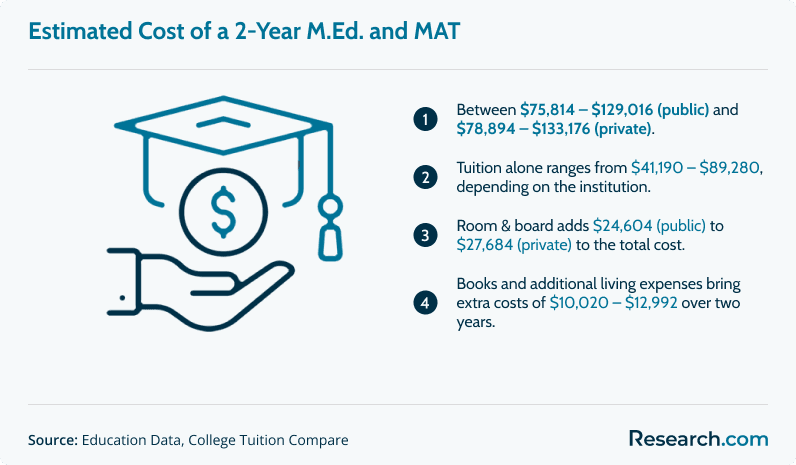
The overall cost of an M.Ed. and MAT can be similar, but the final price depends heavily on institution type, residency status, delivery format, program length, and living expenses. Over two years, total costs can range between $75,814 and $133,176 when tuition, books, housing, board, and related expenses are included.
Education Data Initiative reports that the average tuition for a Master of Education is $44,640. College Tuition Compare reports graduate education program tuition at $20,595 for out-of-state students and $11,450 on average for in-state students. The difference shows why students should compare program-level costs instead of relying on one national figure.
Cost Factors to Compare Before Enrolling
| Cost Factor | Why It Matters | Questions to Ask |
| Public vs. private institution | Public universities are often less expensive for in-state students, while private universities may charge more but offer institutional aid. | Is there an in-state tuition rate, online tuition rate, or educator discount? |
| Tuition and fees | Tuition is only part of the total cost; fees can add substantially to the final bill. | Are technology, placement, graduation, or program fees charged separately? |
| Books and materials | Students should budget for books at $1,220 per year. | Are digital materials included, or are textbooks purchased separately? |
| Housing and meals | Room and board can range from $12,302 - $13,842 per year. | Can online study reduce relocation or campus housing costs? |
| Living expenses | Living expenses may range from $3,790 - $5,276 per year. | Can you keep working while enrolled, or will the program reduce your income? |
| Student teaching requirements | MAT students may need to reduce work hours during full-time field placements. | How many weeks are required, and can placement happen near your home? |
When comparing M.Ed. and MAT programs, do not look only at tuition. A lower-tuition program may be more expensive if it requires travel, relocation, unpaid student teaching, or extra certification testing.
What roles can I have with an M.Ed. vs. an MAT?
The M.Ed. generally opens doors to leadership, curriculum, administration, counseling, school media, and systems-level roles. The MAT is more directly aligned with classroom teaching and teacher certification. Students pursuing a masters in early childhood education online should make the same distinction: choose the teaching-centered path for classroom work with young children, or the leadership-centered path for program administration and curriculum roles.
Roles Commonly Associated With M.Ed. Graduates
According to the Bureau of Labor Statistics, M.Ed.-aligned roles had total employment of 1,236,600 in 2023 across the following occupations:
- Elementary, Middle, and High School Principals – 292,000 employed
- Instructional Coordinators – 225,200 employed
- Postsecondary Education Administrators – 216,400 employed
- School and Career Counselors – 360,800 employed
- Librarians and Library Media Specialists – 142,200 employed
Roles Commonly Associated With MAT Graduates
Teaching-focused roles linked to MAT preparation had total employment of 2,243,000 in 2023 across the following occupations:
- High School Teachers – 1,071,400 employed
- Middle School Teachers – 640,000 employed
- Special Education Teachers – 531,600 employed
The M.Ed. is usually the stronger option for people who want to influence instruction at the program, school, district, or institutional level. The MAT is usually the stronger option for people who want their main professional identity to be classroom teacher.
How much can I earn with an M.Ed. vs. an MAT?
Earnings depend on job title, state, district salary schedules, licensure, experience, specialization, and whether the role is classroom-based or administrative. M.Ed. graduates often have access to positions with salaries from $64,000 to over $100,000, especially in leadership roles. MAT graduates generally work in teaching roles with salaries between $61,000 and $66,000, although experienced educators and specialized teachers can exceed $100,000 in some contexts.
BLS Salary Examples for M.Ed.-Aligned Roles
- Postsecondary Education Administrators – $102,610 median
- Elementary, Middle, and High School Principals – $103,460 median
- Instructional Coordinators – $74,620 median
- Librarians and Library Media Specialists – $64,370 median
BLS Salary Examples for MAT-Aligned Roles
- High School Teachers – $65,220 median
- Middle School Teachers – $64,290 median
- School and Career Counselors – $61,710 median
- Special Education Teachers – $65,910 median
The salary comparison is not simply “M.Ed. pays more.” The better interpretation is that M.Ed. programs often prepare graduates for administrative or specialized roles that may have higher salary ceilings, while MAT programs prepare graduates for teaching roles where pay is often governed by public school salary schedules, years of service, degree level, and state or district contracts.
Could complementary certifications accelerate career growth?
Targeted credentials can make either degree more useful when they support a clear career goal. A teacher with an MAT might add certification in special education, reading instruction, English language learning, or educational technology. An M.Ed. graduate might add credentials in school leadership, instructional design, library media, counseling support, or assessment.
The key is to avoid collecting credentials without a plan. Choose certifications that match job postings in your target district, state, or organization. For educators interested in information access, research support, and school media roles, an online library science degree may strengthen qualifications for work that combines teaching, technology, and resource management.
In which states can I earn more with an M.Ed. vs. an MAT?
Where you work can strongly affect earnings. Salaries vary by state funding, cost of living, collective bargaining, district size, teacher shortages, specialization, and administrative demand. Based on the figures below, M.Ed.-aligned professionals often earn the most in New York, California, and Connecticut, while MAT-aligned educators see strong pay in California, New York, and Washington.
Top-Paying States for M.Ed.-Aligned Careers
- New York – Education administrators earn up to $166,500, the highest in the country.
- California – Instructional coordinators earn an average of $97,770, with administrators making $140,700.
- Connecticut – Instructional coordinators report competitive average earnings of $89,960.
- District of Columbia – Librarians and media specialists earn $93,640, making it a top-paying location for that role.
Top-Paying States for MAT-Aligned Careers
- California – High school teachers earn $105,540, and special education teachers earn $105,270.
- New York – Preschool special education teachers earn $116,500, while secondary special education teachers make $92,890.
- Washington – Middle school special education teachers earn $90,530.
- Oregon – Special education teachers at all levels earn around $90,450.
Higher state salaries do not automatically mean a better financial outcome. Before relocating, compare cost of living, licensure transfer rules, job availability, pension systems, and district salary schedules.
How does program accreditation influence career success?
Accreditation is one of the most important checks when choosing an M.Ed. or MAT program. It signals that the institution or program has been reviewed against recognized academic standards. It can also affect financial aid eligibility, credit transfer, employer recognition, licensure eligibility, and admission to doctoral programs.
For MAT students, accreditation and state approval are especially important because teacher certification rules are state-specific. A program may be academically legitimate but still not lead to licensure in the state where you plan to teach. M.Ed. students should also verify accreditation, particularly if they plan to pursue principal licensure, counseling-related credentials, or doctoral study through options such as affordable online EdD programs.
Accreditation Questions to Ask
- Is the university institutionally accredited by a recognized accreditor?
- Is the education program approved for teacher certification or administrative licensure in my state?
- Will the degree qualify me for financial aid, salary advancement, or district reimbursement?
- Can credits transfer if I later pursue another graduate program?
- Do graduates meet licensure or endorsement requirements without extra coursework?
What is the job outlook for graduates of an M.Ed. vs. an MAT?
The outlook for M.Ed. and MAT graduates depends on the specific occupation. Administrative, counseling, and coordination roles show different patterns from classroom teaching roles. Even where projected growth is modest or negative, annual openings may remain substantial because of retirements, transfers, and workforce turnover.
Job Outlook for M.Ed.-Aligned Roles
- Postsecondary education administrators are projected to grow 3% from 2023 to 2033, with about 15,200 openings annually.
- Instructional coordinators are projected to grow 2%, with about 20,100 openings each year.
- Elementary, middle, and high school principals are projected to decline 1%, although about 20,800 openings are expected each year.
Job Outlook for MAT-Aligned Roles
- High school teachers are projected to decline 1%, with about 64,000 annual openings.
- Middle school teachers are projected to decline 1%, with about 41,400 annual openings.
- Special education teachers are projected to have 0% growth, with about 35,900 openings each year.
- School and career counselors are projected to grow 4%, adding 16,200 new jobs.
The practical takeaway is that neither degree guarantees employment, but both can support stable education careers when paired with the right licensure, specialization, location, and experience. Special education, counseling, instructional coordination, and administration may offer additional options for educators who want to move beyond a general classroom role.
How can interdisciplinary learning enhance educational innovation?
Education work increasingly overlaps with technology, communication, literacy, data, student support, and community engagement. Interdisciplinary learning can help teachers and education leaders design better lessons, lead stronger programs, and respond to complex student needs.
For example, training in writing, media, storytelling, and communication can support curriculum design, literacy instruction, professional development, and student engagement. Educators interested in those skills may find useful ideas in online creative writing programs, especially when their work involves narrative-based learning, curriculum writing, or communications.
How do career services and networking opportunities contribute to long-term success?
Career support matters because education hiring often depends on licensure timing, district partnerships, supervised placements, references, and professional networks. A strong M.Ed. or MAT program should help students understand job markets, prepare application materials, connect with schools or agencies, and plan for advancement.
When reviewing programs, ask whether they offer placement support, licensure advising, alumni mentoring, resume review, interview preparation, administrator networking, or district partnerships. Cost-conscious students should compare programs carefully; resources on masters in education online cheap can help identify lower-cost options while still considering career support and program quality.
What challenges do graduates face in transitioning to professional roles?
Graduates may face a difficult adjustment when moving from graduate coursework into full professional responsibility. New teachers may struggle with classroom management, workload, parent communication, and district expectations. New administrators or instructional leaders may need to build credibility, manage teams, use data effectively, and translate theory into practical school improvement.
The best preparation includes field experience, mentorship, technology fluency, licensure planning, and a professional network before graduation. Educators who want expertise in information organization, research support, and school resource management may also compare related pathways such as the cheapest MLIS programs.
How fast can I get my teaching degree?
The fastest route depends on your current education, state certification rules, transfer credits, testing requirements, and whether you need student teaching. Some accelerated MAT programs may shorten the academic timeline, but licensure steps can still take time. An M.Ed. may be faster for licensed educators who do not need a teaching placement, while an MAT may require a longer calendar because supervised teaching must be completed in an approved setting.
Before choosing an accelerated option, confirm that the program meets certification requirements where you plan to work. For a deeper look at fast-track options, review how fast can I get my teaching degree.
Is the ROI on an M.Ed. or MAT worth the investment?
Return on investment should be measured against your actual career goal, not just the degree title. An M.Ed. may provide stronger ROI for educators who can move into higher-paying leadership, administration, coordination, or specialized roles. An MAT may provide strong ROI for career changers who need a structured path into teaching certification and a stable classroom career.
To evaluate ROI, compare total cost, debt, lost income during student teaching, salary schedules, reimbursement options, licensure value, and job availability in your state. Also consider whether your previous education already supports your goal. For example, someone with a literacy or writing background may compare graduate teaching options with pathways such as the cheapest English bachelor degree online when planning a long-term route into English instruction or curriculum work.
Can these degrees pave the way for education policy and government roles?
An M.Ed. is generally the more direct route for education policy, government advisory, program evaluation, and public administration work because it often includes research, systems analysis, leadership, and curriculum study. An MAT can still contribute to policy work, especially when paired with classroom experience, advocacy, research skills, or later graduate study.
Policy-focused educators may work on curriculum standards, school funding, teacher development, program evaluation, accountability, or student services. Those comparing education policy with broader government careers may also examine related options such as affordable online degrees political science.
Can interdisciplinary programs expand career opportunities beyond traditional education roles?
Yes, but the added field should support a clear professional direction. Educators increasingly combine teaching or leadership preparation with specializations in educational technology, instructional design, literacy, student support, communication disorders, school media, or policy. These combinations can lead to roles outside traditional classroom teaching, including program coordination, training, consulting, curriculum development, and student services.
For example, students interested in communication, language development, and clinical support may explore SLP master's online programs to understand how education and specialized therapeutic practice can overlap.
How do I choose between an M.Ed. and an MAT?
Start with the job you want after graduation. Then work backward to the required license, degree type, field experience, and specialization. The wrong choice is usually caused by picking a degree name before confirming whether it leads to the desired role.
Decision Checklist
| Question | If Your Answer Points to M.Ed. | If Your Answer Points to MAT |
| Do you want to become a classroom teacher? | Only if you are already licensed or the M.Ed. includes licensure | Yes, especially for initial certification |
| Do you want to become a principal, coordinator, or administrator? | Yes | Usually no |
| Do you need student teaching? | Usually no | Often yes |
| Do you want an online program while working full time? | Often a strong fit | Possible, but field placement may limit flexibility |
| Are you seeking salary advancement on a teacher pay scale? | May help, depending on district policy | May help, depending on district policy |
| Do you want a specialized add-on credential? | Useful for leadership, technology, curriculum, counseling, or administration | Useful for special education, reading, ESL, or subject-area teaching |
Common Mistakes to Avoid
- Choosing based only on the degree name: M.Ed. and MAT programs vary widely, so review curriculum, licensure outcomes, and fieldwork requirements.
- Ignoring state licensure rules: This is especially risky for MAT students and anyone seeking principal, counseling, or specialist credentials.
- Comparing tuition but not total cost: Fees, books, travel, housing, and unpaid student teaching can change the real price.
- Assuming online means easier or faster: Online programs can be flexible, but they still require academic work and may include in-person placements.
- Relying only on rankings: Rankings can help with discovery, but accreditation, licensure fit, cost, placement support, and outcomes matter more.
- Adding certificates without a strategy: The best graduate certificates are the ones that match your target jobs and state requirements.
What Graduate Outcomes Can Look Like
- Jasper: An M.Ed. helped this educator move from classroom teaching into curriculum work, where the focus shifted to program design, teacher mentoring, and schoolwide instructional improvement.
- Ken: An MAT supported a career change into high school teaching by combining coursework with practical student teaching experience.
- Colette: An online M.Ed. allowed continued full-time employment while building the leadership preparation needed for a school administration role.
Should I pursue a doctoral degree after my M.Ed. or MAT?
A doctorate may make sense if your goals include senior leadership, university teaching, research, consulting, policy, or executive-level education roles. It is usually not necessary for most classroom teaching positions. Before applying, consider whether the doctoral credential is required for your target role, whether your employer values it, and whether the cost fits your long-term plans.
Working educators who need a flexible doctoral route may compare options such as an EdD degree program online, especially if they want to continue working while studying leadership, applied research, and organizational change.
What financial aid opportunities can reduce the cost burden?
Financial aid can make a major difference in the value of an M.Ed. or MAT. Students should compare federal aid eligibility, scholarships, grants, assistantships, district tuition reimbursement, employer benefits, state incentives, and loan forgiveness options when available. MAT students should also ask whether student teaching affects income or eligibility for paid residency models.
Do not assume the cheapest advertised tuition is the best deal. A slightly higher-cost program may be more valuable if it includes licensure support, placement help, strong advising, or employer partnerships. Students comparing affordability across education-related fields may also review options such as the cheapest online creative writing degree when planning a broader academic pathway.
Key Insights
- The M.Ed. is usually the better choice for leadership. It fits educators who want roles in administration, curriculum, instructional coordination, policy, school media, or student services.
- The MAT is usually the better choice for classroom teaching. It is often designed for teacher certification, career changers, and educators who want supervised teaching practice.
- Both degrees commonly take 1 to 2 years. M.Ed. programs may be more flexible for working professionals, while MAT programs often include in-person student teaching.
- Cost varies widely. Total two-year expenses can range between $75,814 and $133,176, so compare tuition, fees, books, living costs, and field placement requirements.
- Salary depends more on role than degree name. M.Ed.-aligned roles include salaries from $64,370 to $103,460 median in listed occupations, while MAT-aligned teaching roles include medians from $61,710 to $65,910.
- Location matters. M.Ed.-aligned professionals may see higher earnings in New York, California, and Connecticut, while MAT-aligned educators have strong salary examples in California, New York, and Washington.
- Accreditation and licensure fit are non-negotiable. Always confirm that the program is recognized and meets the requirements for the state and role you want.
- The best decision starts with your target job. Choose the degree only after confirming the required credential, fieldwork, certification, cost, timeline, and expected career payoff.
References:
- Bureau of Labor Statistics (BLS). Career and Technical Education Teachers. BLS.
- Bureau of Labor Statistics (BLS). Elementary, Middle, and High School Principals. BLS.
- Bureau of Labor Statistics (BLS). High School Teachers. BLS.
- Bureau of Labor Statistics (BLS). Instructional Coordinators. BLS.
- Bureau of Labor Statistics (BLS). Librarians and Library Media Specialists. BLS.
- Bureau of Labor Statistics (BLS). Middle School Teachers. BLS.
- Bureau of Labor Statistics (BLS). Postsecondary Education Administrators. BLS.
- Bureau of Labor Statistics (BLS). School and Career Counselors. BLS.
- Bureau of Labor Statistics (BLS). Special Education Teachers. BLS.
- College Tuition Compare. Education Major Tuition Costs. College Tuition Compare.
- Drexel University. Online Degree vs. Traditional Degree: Which is Right for You? Drexel University Online.
- EducationData.org. Average Cost of a Master’s Degree. Education Data Initiative.
- EducationData.org. Average Cost of College. Education Data Initiative.
Other Things You Should Know About M.Ed. vs MAT
In 2027, M.Ed. programs typically require around 30-36 credit hours, focusing on educational theory. MAT programs usually require 30-45 credit hours, emphasizing both theory and classroom practice. Specific requirements can vary by institution, so checking individual program details is essential.
The MAT is usually the stronger choice for initial classroom teaching licensure because it is built around pedagogy, supervised clinical practice, and state certification requirements. An M.Ed. more often serves licensed teachers who want advancement, specialization, or leadership roles rather than first-time licensure.
In 2027, M.Ed. graduates often pursue careers in educational leadership or policy, while MAT graduates typically enter classroom teaching. Both offer strong job prospects, but M.Ed. may lead to wider opportunities in administration compared to MAT’s classroom-focused roles.