2027 Most Affordable Online Bachelor’s in English Degree Programs

Co-Founder and Chief Data Scientist
Choosing an online English degree is not just a question of studying novels or improving essays. It is a decision about whether a flexible writing-focused bachelor’s program can help you build marketable communication, research, editing, teaching, publishing, legal, marketing, or content strategy skills without overpaying for college. In 2022, about 1.9 million workers in the U.S. held an English degree, according to the U.S. Bureau of Labor Statistics (2024a), and these graduates worked across education, management, business, media, administration, and other fields.
This guide is designed for students comparing affordable online bachelor’s in English programs, adult learners returning to college, transfer students, and working professionals who want a humanities degree with practical career value. You will learn which programs are among the most affordable, what online English coursework usually includes, how costs and financial aid work, what careers may be available, and how to evaluate whether this degree fits your goals.
Quick answer: Is an online bachelor’s in English worth considering?
An online bachelor’s in English can be a strong option if you want a flexible degree centered on writing, reading analysis, research, rhetoric, and communication. It is especially useful for students interested in teaching, editing, publishing, technical writing, marketing, public relations, law-related work, graduate school, or content roles. However, the value of the degree depends heavily on choosing an accredited program, keeping costs manageable, building a portfolio, gaining internships or writing experience, and matching electives to a clear career direction.
What are the main benefits of an online English degree?
- Flexible learning: Many online courses use asynchronous formats, allowing students to review lectures, complete readings, and submit assignments without being tied to a fixed classroom schedule.
- Transferable skills: English majors develop writing, interpretation, argumentation, editing, research, and critical thinking abilities that employers use in many industries.
- Broad earning potential: Depending on the role, industry, location, experience, and additional credentials, English graduates may earn anywhere from $55,000 to $100,000 or more annually.
What can I expect from an online English program?
An online bachelor’s in English typically covers the same academic foundation as a campus-based English degree: literature, writing, rhetoric, grammar, research, cultural analysis, and communication. The difference is the delivery format. Instead of attending most classes in person, students use a learning management system to access readings, lectures, discussion boards, assignments, feedback, and digital library resources.
Most programs are built for students who need flexibility, but that does not mean they are easier. English courses often require extensive reading, frequent writing, peer discussion, revision, and close attention to instructor feedback. Students who succeed online usually plan weekly reading time, keep up with discussion deadlines, and ask for help early when an essay, research project, or technology issue becomes difficult.
| Program feature | What it usually means for students | Why it matters |
| Flexible scheduling | Course materials may be available at any time, although assignments still follow deadlines. | This helps students balance school with work, caregiving, military service, or other responsibilities. |
| Online interaction | Students may participate through discussion boards, group projects, video meetings, peer reviews, and instructor comments. | English programs rely on conversation and feedback, so interaction quality affects learning. |
| Writing-heavy coursework | Students complete essays, analyses, creative pieces, technical documents, research papers, or professional writing projects. | These assignments can become portfolio samples for jobs, internships, or graduate applications. |
| Elective flexibility | Programs may offer options in creative writing, literature, technical communication, rhetoric, digital media, or linguistics. | Electives help students align the degree with a specific career path. |
Where can I work with an online English degree?
An online English degree can lead to several professional directions because the degree is skills-based rather than tied to one occupation. According to the BLS (2024a), 21% of English degree holders work in educational instruction and library occupations, 17% work in management, 10% work in business and financial operations, and 8% work in arts, media, entertainment, sports, and administrative support roles.
The best career path depends on the experience you build during the degree. A student who completes technical writing projects, learns digital tools, and interns with a software company will have a different profile than a student who focuses on literary analysis, teaching preparation, or creative writing workshops.
- Education and research: Graduates may work as tutors, teachers, librarians, instructional support staff, or research assistants, although teaching and library roles may require additional credentials or graduate education.
- Publishing and journalism: English majors often pursue editing, proofreading, copywriting, reporting, and publishing support roles for print, digital, or multimedia organizations.
- Corporate communication: Companies hire strong writers to prepare internal messages, executive communications, reports, brand copy, presentations, and public-facing content.
- Marketing and digital content: Graduates may write blogs, website pages, social media content, email campaigns, product descriptions, and content strategy documents.
- Government and political communication: English graduates may assist with speeches, policy summaries, public information materials, grant narratives, and constituent communications.
- Legal environments: Some graduates work as legal assistants, paralegals, or law clerks, while others use English as preparation for law school because the major strengthens reading, reasoning, and persuasive writing.
How much can I make with an online English degree?
Salary outcomes for English graduates vary widely. Your income may depend on your job title, location, industry, employer, prior experience, graduate education, certifications, and portfolio quality. The BLS (2024a) reports that English degree holders earn $60,000 on average.
BLS data also show that graduates who become technical writers, authors, and editors earn average yearly salaries between $85,000 and $87,500. Journalists, reporters, and news analysts earn $101,430. In marketing and public relations, annual pay may fall between $77,000 and $83,000. Paralegals and interpreters can earn anywhere from $63,000 to $67,000, while teachers may earn around $65,000 to $87,000 each year, depending on grade level.
| Career area | Salary information stated in source text | What can improve prospects |
| Writing and editing | Technical writers, authors, and editors earn between $85,000 and $87,500 on average yearly. | Portfolio samples, subject-matter knowledge, editing experience, and technical communication skills. |
| Journalism and news | Journalists, reporters, and news analysts earn $101,430. | Reporting clips, multimedia skills, data literacy, and internship experience. |
| Marketing and public relations | English graduates may earn between $77,000 and $83,000 annually. | SEO, analytics, campaign writing, brand strategy, and digital platform experience. |
| Legal and language services | Paralegals and interpreters may earn anywhere from $63,000 to $67,000. | Legal research skills, paralegal training, bilingual ability, and document management experience. |
| Teaching | Teachers can earn around $65,000 to $87,000 each year, depending on grade level. | State licensure, student teaching, graduate education, and classroom experience. |
Students should be careful not to treat salary figures as guarantees. Higher-paying English-related roles often require specialized skills, internships, graduate study, certifications, professional networks, or several years of experience. Freelance writing, editing, and marketing work can also provide flexible income, but contract work may be inconsistent and usually requires self-marketing.
- Most Affordable Online Bachelor’s in English Degree Programs for 2027
- How long does an online bachelor’s in English take?
- Online vs. on-campus English degrees: which format fits best?
- How much does an online bachelor’s in English cost?
- What financial aid can online English majors use?
- What are the admission requirements for an online English bachelor’s program?
- What support services should online English students expect?
- How can I check accreditation and program quality?
- What challenges do online English majors face?
- How do online English programs serve non-traditional students?
- What are the benefits of advanced online degrees after English?
- What is the ROI of an online English degree?
- Should I earn an online associate degree before a bachelor’s in English?
- How are online English programs responding to digital trends?
- What courses are included in an online English bachelor’s program?
- What specializations are available in online English programs?
- How should I choose the best online English bachelor’s program?
- What careers can online English graduates pursue?
- How can I move from an online English bachelor’s to graduate school?
- What is the job market like for online English degree graduates?
List of the Most Affordable Online Bachelor’s in English Degree Programs for 2027
How do we rank schools?
Affordability matters, but price should not be the only filter. Research.com’s team created this ranking of affordable online English bachelor’s programs using a defined ranking methodology and data from the Integrated Postsecondary Education Data System, Peterson’s database and its Distance Learning Licensed Data Set, College Scorecard, and the National Center for Education Statistics. Students should still confirm tuition, fees, transfer policies, and program requirements directly with each school before applying.
1. University of Central Florida
The University of Central Florida offers an online BA in English with academic options that connect literature, writing, and communication. The Creative Writing track supports students working in fiction, poetry, and nonfiction through practice, theory, and critique. The Literature track develops close reading, interpretation, and analytical writing. The Technical Communication track focuses on written, oral, and visual communication for business, science, and professional settings.
- Program Length: Four years
- Tracks/Concentrations:
- Creative Writing
- Literature
- Technical Communication
- Cost per Credit: $212.28 (resident), $748.89 (non-resident)
- Required Credits to Graduate: 120
- Accreditation: Southern Association of Colleges and Schools Commission on Colleges (SACSCOC)
2. Indiana University-East
Indiana University-East provides a BA in English that emphasizes technical and professional writing. Students study critical thinking, analysis, grammar, usage, inquiry, and report writing while building communication skills for workplace settings. The fully online structure is designed for students who need flexibility while preparing for careers that require strong writing and interpretation.
- Program Length: Four years
- Tracks/Concentrations: English
- Cost per Credit: $257.23 (resident), $378.10 (non-resident)
- Required Credits to Graduate: 120
- Accreditation: Higher Learning Commission (HLC)
3. University of Arkansas Online
The University of Arkansas Online offers an English degree that combines humanistic study with career-relevant writing. Students in the Creative Writing track develop their craft while reading influential literature. The Rhetoric and Writing Studies track prepares students for professional communication. The Topical Studies track lets students examine literature and culture through an adviser-supported area of focus.
- Program Length: Four years
- Tracks/Concentrations:
- Creative Writing
- Rhetoric and Writing Studies
- Topical Studies
- Cost per Credit: $263.18
- Required Credits to Graduate: 120
- Accreditation: HLC
4. Eastern Oregon University
Eastern Oregon University offers an online English program with opportunities to study literature, creative writing, and rhetoric. The curriculum includes fiction, poetry, journalism, screenwriting, grammar, and film, and it connects students with settings such as nonprofits, independent presses, and K-12 schools. Students may pursue a BA with a foreign language requirement or a BS with additional science credits.
- Program Length: Four years
- Tracks/Concentrations: English
- Cost per Credit: $316
- Required Credits to Graduate: 180
- Accreditation: Northwest Commission on Colleges and Universities (NWCCU)
5. Louisiana State University-Alexandria
Louisiana State University-Alexandria offers an online BA in English that develops analytical writing and literary understanding across poetry, fiction, drama, and nonfiction. Students study literary history, theory, and the development of ideas while also finding opportunities to publish creative work. The program uses live virtual instructor sessions and accelerated seven-week courses for students who need a structured but flexible format.
- Program Length: Four years
- Tracks/Concentrations: English
- Cost per Credit: $325
- Required Credits to Graduate: 120
- Accreditation: SACSCOC
6. University of Houston-Victoria
The University of Houston-Victoria offers a BA in English that supports career goals in education, media, public relations, business, law, and government. Coursework covers literary interpretation, grammar, rhetoric, narrative fiction, and language study. Students interested in high school English teaching can complete teacher certification coursework and pursue eligibility after passing certification exams.
- Program Length: Four years
- Tracks/Concentrations: English
- Cost per Credit: $325.98 (resident), $913.04 (non-resident)
- Required Credits to Graduate: 120
- Accreditation: SACSCOC
7. Thomas Edison State University
Thomas Edison State University offers an online BA in English focused on literature, writing, liberal arts, critical thinking, and communication. Students examine the English language, composition, research, argumentation, and rhetorical grammar through courses such as Public Speaking, American Literature, and Applied Liberal Arts Mathematics. The program is designed for students seeking a flexible route into writing, education, communication, and related fields.
- Program Length: Four years
- Tracks/Concentrations: English
- Cost per Credit: $427 (resident), $556 (non-resident)
- Required Credits to Graduate: 120
- Accreditation: Middle States Commission on Higher Education (MSCHE)
8. University of Colorado Denver
The University of Colorado Denver offers an online BA in English Writing, Rhetoric, and Technology for students who want advanced communication, analysis, and writing skills. Core topics include multimedia, sociolinguistics, and language theory. Elective options include Magazine Writing, Argumentation and Logic, Proposal and Grant Writing, and Screenwriting. The university also provides on-campus and hybrid BA options with concentrations in Creative Writing, Literature & Film, and Secondary English Teaching Licensure.
- Program Length: Four years
- Tracks/Concentrations: English Writing, Rhetoric, and Technology
- Cost per Credit: $506 (resident), $607 (non-resident)
- Required Credits to Graduate: 120
- Accreditation: HLC
9. University of Illinois Springfield
The University of Illinois Springfield offers a BA in English for students preparing for teaching, writing, editing, or graduate study. Online learners participate in a virtual academic community while completing coursework within a traditional semester calendar. Courses include Critical Reading, Rhetoric and College Writing, and Intro to Public, Professional, and Persuasive Writing.
- Program Length: Four years
- Tracks/Concentrations: English
- Cost per Credit: $544.50
- Required Credits to Graduate: 120
- Accreditation: HLC
10. Arizona State University
Arizona State University offers an online BA in English that builds communication, leadership, and analytical skills for multiple fields. Students explore writing, editing, literary interpretation, environmental issues, crisis communication, and digital storytelling. Electives include creative writing, business writing, and medieval literature, supporting career goals in journalism, education, public policy, social media, and other communication-focused areas.
- Program Length: Four years
- Tracks/Concentrations: English
- Cost per Credit: $663
- Required Credits to Graduate: 120
- Accreditation: HLC
How long does it take to complete an online bachelor’s English program?
Most full-time students complete an online bachelor’s in English in four years when the program requires 120 credit hours. Part-time students usually take longer, while students with approved transfer credits may finish sooner. The exact timeline depends on enrollment pace, transfer policies, term length, course availability, and whether the school offers accelerated or self-paced options.
Students should ask each school how often required English courses are offered. A program may advertise flexibility, but if a required seminar is available only once per year, that can affect graduation timing. This is especially important for students who work full time or need to maintain a predictable course load.
Prior college credit can make a major difference. Learners who completed general education courses, writing courses, or related humanities coursework may be able to transfer credits and reduce both time and cost. This flexible approach is similar to career-focused options such as an online paralegal certification, where students often compare pacing options around professional and personal commitments.
NCES data (2023a) show that 33,429 bachelor’s degrees in English language and literature were awarded in the 2021–2022 academic year, continuing an annual decline since 2013. The totals were 35,764 in 2020–2021 and 38,049 in 2019–2020. Even with fewer students choosing the major, English remains relevant for learners who intentionally connect writing and analysis to career preparation.
The chart below shows changes in the number of undergraduate English degrees awarded in the U.S.
How does an online bachelor’s English program compare to an on-campus program?
Online and campus-based English degrees can lead to similar academic outcomes when they are offered by accredited institutions and include comparable coursework. The best format depends on how you learn, how much flexibility you need, and what type of academic community you want.
| Factor | Online English degree | On-campus English degree |
| Schedule | Often more flexible, with asynchronous coursework or limited live meeting times. | Usually follows fixed class times and campus attendance requirements. |
| Cost considerations | May reduce commuting, housing, and relocation expenses, though online or technology fees may apply. | May include housing, meal plans, transportation, and campus-based fees. |
| Interaction | Uses discussion boards, video meetings, email, peer review tools, and virtual office hours. | Provides in-person discussion, immediate classroom feedback, and campus networking. |
| Learning style | Best for self-directed students who can manage reading and writing deadlines independently. | Best for students who prefer structured schedules and face-to-face engagement. |
| Resources | Provides digital libraries, virtual tutoring, online advising, and remote writing center access. | Offers physical libraries, campus events, research centers, in-person tutoring, and student organizations. |
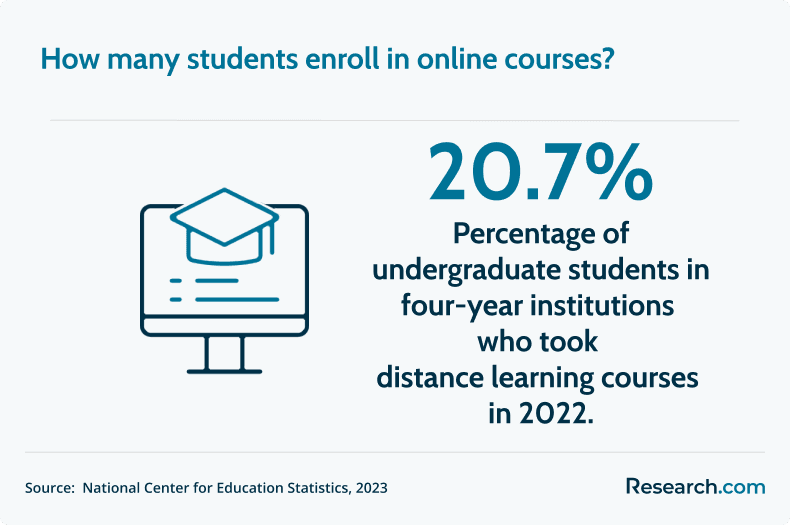
NCES data (2023b) show that 20.7% of undergraduate students at four-year institutions in fall 2022 were enrolled only in distance education courses, totaling 2,220,860 learners. By comparison, 47.3% of undergraduates, or 5,076,490 students, did not take any online courses. These figures show that online learning is now a major pathway, but it is not the only preferred format.
Choose online if flexibility, location independence, and cost control are your priorities. Choose campus if you want in-person discussion, easier access to campus activities, and a more structured daily routine.
What is the average cost of an online bachelor’s English program?
Students can expect online bachelor’s in English costs to vary significantly. The source text states that annual costs may range from $11,000 to $43,000, depending on institution type and residency status.
College Board data from Ma et al. (2024) show that in-state students at public four-year institutions paid an average of $11,610 for tuition and fees in the 2024–2025 academic year. Out-of-state students paid an average of $30,780. Private institutions charged up to $43,350 or more per year.
| Cost category | Amount stated in source text | What to check before enrolling |
| Public, in-state tuition and fees | $11,610 for the 2024–2025 academic year | Whether online students receive in-state or special online tuition rates. |
| Public, out-of-state tuition and fees | $30,780 | Whether the program charges nonresident tuition for fully online learners. |
| Private institution tuition and fees | Up to $43,350 or more per year | Scholarships, institutional grants, and total net price after aid. |
| Additional online costs | Technology, course materials, platform access, and resource fees may apply. | Whether fees are charged per course, per credit, or per term. |
Affordability should be judged by total cost, not tuition alone. Compare required credits, transfer credit acceptance, online fees, books, graduation fees, and financial aid. Students searching for the cheapest online creative writing degree should also check accreditation, faculty support, portfolio opportunities, and whether the curriculum matches their goals.
What are the financial aid options for students enrolling in an online bachelor’s English program?
Online English students may qualify for several types of financial aid, provided the institution and program meet eligibility rules. The best first step is to complete the Free Application for Federal Student Aid (FAFSA) and then compare school-specific aid offers.
- Institutional scholarships and grants: Colleges may offer awards based on academic achievement, financial need, writing ability, transfer status, or major-specific criteria.
- Private scholarships: External organizations and foundations may support humanities students, including examples such as the Go On Girl! Aspiring Writer Scholarship and the Bill Gove Scholarship.
- State-based funding: State grants and scholarships may be available to eligible residents, though requirements often depend on residency, academic performance, need, or enrollment status.
- Federal financial aid: Eligible students may use federal grants, loans, or work-study after submitting the FAFSA and meeting federal and institutional requirements.
Before accepting loans, calculate the total amount you are likely to borrow and compare it with realistic career plans. Grants and scholarships are preferable because they usually do not need to be repaid.
What are the prerequisites for enrolling in an online bachelor’s English program?
Admission requirements vary by institution, but online bachelor’s in English programs generally expect applicants to show college readiness, writing ability, and access to the technology needed for online learning.
- High school diploma or equivalent: Applicants usually need a high school diploma or GED, with transcripts submitted for review.
- Minimum GPA: Many schools use a minimum GPA, often around 2.5–3.0, although requirements differ by institution.
- High school preparation: Prior coursework in English literature, composition, and writing can help students transition into college-level reading and analysis.
- Standardized tests: Some colleges may request SAT or ACT scores, while many now use test-optional policies.
- Application essay or personal statement: A writing sample may help admissions teams evaluate motivation, communication skills, and academic fit.
- Letters of recommendation: Some programs request recommendations from teachers, mentors, supervisors, or other people who can comment on the applicant’s readiness.
- Technology access: Online students need a reliable computer, stable internet, and any software required by the program.
Transfer students should also ask about credit evaluations, residency requirements, maximum transfer credits, and whether previous writing or literature courses satisfy major requirements.
What student support services are available in online bachelor’s English programs?
Strong online English programs provide more than recorded lectures. Look for academic advising, writing center support, online tutoring, library database access, career counseling, technical support, and opportunities for faculty feedback. Because English coursework depends heavily on drafting and revision, access to writing help can make a meaningful difference.
Students comparing cost-conscious options can also review broader affordable pathways, including Research.com’s guide to the cheapest online degrees.
How can I verify the accreditation and quality of an online bachelor’s English program?
Accreditation is one of the most important checks before enrolling. Confirm that the institution is accredited by an agency recognized by the U.S. Department of Education or CHEA. Accreditation can affect financial aid eligibility, credit transfer, graduate school admission, and employer acceptance.
Quality checks should go beyond accreditation. Review course requirements, faculty credentials, student support, graduation requirements, transfer policies, online learning format, and career resources. Students who want additional context about institutional credibility can compare options through Research.com’s resource on non profit universities.
What are the common challenges in completing an online bachelor’s English program?
Online English programs require consistent reading and writing discipline. Common obstacles include procrastination, limited in-person connection, delayed assignment feedback, technology problems, and difficulty balancing school with work or family responsibilities.
Students can reduce these risks by choosing a program with active advising, responsive instructors, tutoring, library access, and technical help. Financial planning also matters. Learners who need federal aid should confirm that the institution participates in FAFSA-supported aid programs and may find Research.com’s guide to online colleges accepting FAFSA useful.
How do online bachelor’s English programs accommodate non-traditional learners?
Online English programs often work well for adult learners, working professionals, military-affiliated students, caregivers, transfer students, and seniors because they may offer asynchronous coursework, part-time schedules, remote advising, and digital academic resources. These features can make it easier to study without relocating or leaving a job.
Non-traditional students should ask whether the program offers credit for prior learning, transfer-friendly policies, evening or asynchronous classes, dedicated adult learner advising, and career services that recognize prior work experience. Students exploring later-life learning options may also compare online university courses for seniors.
What are the advantages of pursuing advanced online degrees after a bachelor’s in English?
A bachelor’s in English can support graduate study in fields such as English, creative writing, education, rhetoric, communication, law, library science, technical communication, public administration, or business. Advanced online degrees may help students deepen research skills, qualify for teaching or leadership roles, or specialize in a field that builds on writing and analysis.
Before enrolling in graduate school, compare cost, time commitment, career requirements, and likely return. Students considering doctoral pathways should review cost expectations carefully, including Research.com’s guide, How much does an online PhD cost?.
What is the return on investment of an online English degree?
The ROI of an online English degree depends on the total price paid, the time needed to finish, the amount of debt taken on, and the career path pursued after graduation. Because English is a broad degree, students improve ROI by choosing affordable tuition, transferring credits, using financial aid wisely, completing internships, building a writing portfolio, and selecting electives aligned with a job market.
Students should compare English with other majors based on skills, career goals, and cost. Research.com’s discussion of the most useful college degrees can provide additional context when evaluating long-term value.
Should I consider an online associate's degree before pursuing a bachelor's in English?
An online associate degree can be a practical starting point if you want to lower upfront costs, test your interest in college-level writing, or complete general education credits before transferring into a bachelor’s program. This route may be especially useful for students who need a lower-risk entry into higher education.
The key is transfer planning. Make sure credits from the associate program will apply toward the bachelor’s degree, especially composition, literature, humanities, and general education courses. Students comparing lower-cost starting points can review Research.com’s guide to the cheapest associate's degree.
How are online bachelor’s English programs adapting to digital trends?
Modern English programs increasingly include digital communication, multimedia writing, online research, content platforms, social media strategy, digital storytelling, and collaborative tools. These additions reflect how writing jobs have changed. Employers often want candidates who can write clearly, edit accurately, adapt tone for different audiences, and use digital tools responsibly.
Students who want to continue beyond the bachelor’s level may use these digital skills as preparation for graduate study. Research.com’s guide to easy master degrees can help students compare possible next steps after completing an English major.
What courses are typically in an online bachelor’s English program?
Online English bachelor’s programs usually combine literary study, writing practice, research methods, rhetoric, and communication. The strongest curricula help students connect academic reading and writing to workplace documents, public communication, teaching, publishing, or graduate study.
- Introduction to Literary Analysis: Students learn how to interpret poetry, fiction, drama, and prose by examining themes, structure, symbolism, genre, and literary techniques.
- Composition and Rhetoric: This course develops argumentative writing, audience awareness, organization, revision, and persuasive communication.
- American Literature: Students study major American writers, periods, movements, and cultural contexts while practicing close reading and critical analysis.
- Professional Writing Skills: Students prepare workplace documents such as reports, proposals, technical materials, business writing, and digital communication.
- Cultural Contexts in Literature: This course examines how literature reflects and responds to historical, social, political, and cultural conditions.
- Information Literacy: Students learn to find, evaluate, cite, and ethically use sources, with attention to academic integrity and digital research.
- Public Speaking: Students develop oral communication skills through speech planning, delivery, persuasion, and audience engagement.
Students pursuing education careers may later need licensure or teacher preparation. Research.com’s guide to the best online teacher certification programs can help aspiring teachers understand possible next steps.
English majors also need practical career skills: grammar, technical writing, creativity, research, analytical thinking, organization, problem-solving, resourcefulness, persuasion, and audience awareness. In Inside Higher Education, Mowreader (2024) reported that faculty were encouraged to help English majors better understand career pathways, recognize the skills they are building, and connect those skills to equity and career outcomes.
What types of specializations are available in online bachelor’s English programs?
Specializations help English majors turn a broad degree into a more focused career pathway. Not every school offers every concentration, so students should compare electives carefully before enrolling.
| Specialization | Best fit for students interested in | Typical focus |
| Creative Writing | Fiction, poetry, nonfiction, screenwriting, publishing, or MFA preparation. | Workshops, craft study, narrative structure, voice, and revision. |
| Literature | Teaching, graduate study, research, editing, or cultural analysis. | Literary periods, genres, authors, theory, and interpretation. |
| Professional Writing | Corporate communication, technical writing, marketing, grants, or business writing. | Clear audience-focused documents for workplace and digital settings. |
| Rhetoric and Composition | Teaching writing, editing, law, persuasion, or communication strategy. | Argumentation, writing theory, persuasive communication, and composition studies. |
| Linguistics | Language study, ESL, communication, research, or speech/language-related interests. | Phonetics, syntax, semantics, sociolinguistics, and language change. |
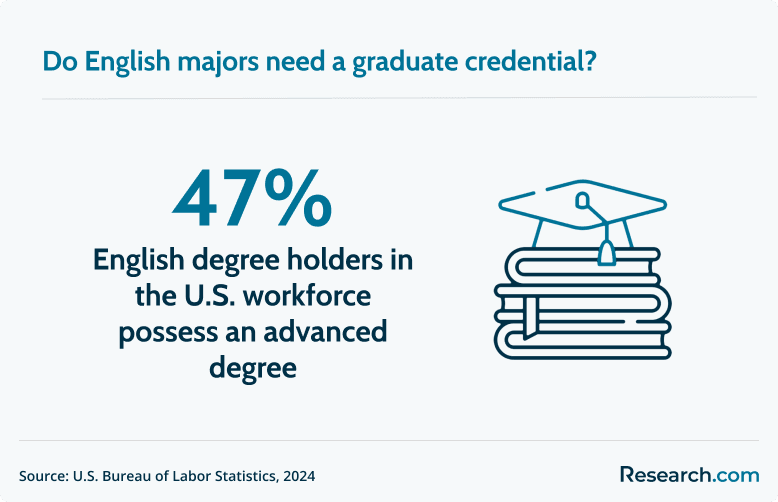
Students interested in teaching English language learners may later compare ESL masters programs online. Graduate education is common among English majors: around 47% of English degree holders in the workforce have an advanced degree, according to the BLS (2024a). Advanced credentials may support higher-level teaching, leadership, research, or specialized communication roles.
How to choose the best online bachelor’s English program?
The best online English program is not automatically the cheapest or the most recognizable. It is the program that is accredited, affordable for your situation, flexible enough for your schedule, and strong enough to support your career or graduate school goals.
- Confirm accreditation: Verify institutional accreditation before applying. This affects financial aid, transfer credit, employer recognition, and graduate school eligibility.
- Match specializations to goals: A student exploring careers in linguistics should not choose a program with only literature electives. Likewise, future technical writers should look for professional writing or technical communication coursework.
- Review the curriculum: Look for a balance of literature, writing, research, rhetoric, and practical communication courses.
- Check delivery format: Determine whether classes are asynchronous, synchronous, accelerated, self-paced, semester-based, full-time, or part-time.
- Evaluate faculty and support: Review faculty backgrounds and confirm access to advising, writing centers, tutoring, library services, and career support.
- Compare total cost: Include tuition, fees, books, transfer credit policies, financial aid, and time to completion.
Common mistakes to avoid when choosing an online English degree
- Choosing based only on tuition: Low tuition is helpful, but poor support, limited transfer credit, or weak course availability can increase total cost.
- Ignoring accreditation: A non-accredited option can create problems with financial aid, transfer, employment, or graduate school admission.
- Assuming all online programs are self-paced: Some require live class meetings or strict weekly deadlines.
- Overlooking portfolio development: Writing samples, internships, publications, and projects often matter as much as the degree title.
- Failing to plan for licensure: Students who want to teach should confirm state certification requirements before enrolling.
- Relying only on rankings: Rankings are useful starting points, but program fit, cost, accreditation, and outcomes matter more for individual decisions.
What career paths are available for graduates of online bachelor’s English programs?
English graduates can pursue roles that require writing, editing, analysis, persuasion, storytelling, research, instruction, and audience-focused communication. Some jobs are directly tied to writing, while others use English skills in management, HR, marketing, law, education, or media.
The following career options include salary data from the BLS and PayScale as presented in the source text:
- Public Relations Managers ($159,420): These professionals guide an organization’s public image, communication strategy, media relationships, and crisis messaging.
- Human Resource Managers ($154,740): HR managers oversee recruitment, employee relations, workplace policies, compliance, and performance systems.
- Technical Writers ($86,620): Technical writers create manuals, guides, instructions, and documentation that make complex information easier to understand.
- Editors ($85,110): Editors revise written work for clarity, accuracy, structure, grammar, style, and audience fit.
- Instructional Coordinators ($77,200): These professionals help design, evaluate, and improve curricula, teaching materials, and instructional standards.
- English Teachers ($65,430–$87,090): English teachers support student learning in reading, writing, language, and literature across different education levels.
- Script Writers ($60,000): Script writers develop dialogue, characters, storylines, and narratives for film, television, games, and other media.
- Social Media Managers ($58,359): Social media managers plan, write, schedule, and evaluate content across digital platforms.
- Content Writers ($56,259): Content writers produce blogs, articles, website copy, product content, and informational materials.
- Digital Marketing Specialists ($55,910): These professionals use SEO, content, analytics, and campaign planning to improve online visibility and audience engagement. Students interested in this field may compare a digital marketing degree online with an English degree that includes marketing-oriented electives.
Students should connect coursework to career evidence. For example, aspiring editors should build before-and-after editing samples, future technical writers should create documentation projects, and prospective marketers should learn SEO and analytics alongside writing.
The chart below summarizes annual salaries for selected careers related to English graduates.
How can I transition effectively from an online bachelor's in English to graduate studies?
Students planning for graduate school should use the bachelor’s program strategically. Choose advanced electives, complete substantial research or writing projects, build relationships with faculty who can write recommendations, and save polished samples for applications. If possible, pursue internships, tutoring, publications, conference presentations, or independent research.
Graduate school admissions often depend on academic fit, writing quality, purpose, recommendations, and readiness for advanced work. Students exploring accelerated doctoral options can also review Research.com’s guide to a 1 year PhD program, while keeping in mind that doctoral timelines and requirements vary widely by field and institution.
What is the job market for graduates with an online English degree?
The job market for English graduates is broad rather than linear. Opportunities exist in education, digital media, publishing, public relations, marketing, business communication, law-related support, and content strategy. Demand depends on the specific role, industry, location, and skill set.
For example, writers are projected to have 15,100 annual job openings from 2023 to 2033, while video camera operators and editors are expected to see 7,100 openings during the same period. Marketing managers are associated with around 34,800 annual opportunities, and PR specialists are expected to have 27,100 openings throughout the decade.
Digital skills are increasingly important. English graduates who understand SEO, content strategy, analytics, audience research, AI-assisted workflows, and ethical communication can compete for roles that blend writing with technology. According to LinkedIn’s Work Change Report (2025), global hiring for AI-related roles has increased by over 300% in the past eight years. Humanities graduates do not need to become software engineers to respond to this trend, but they should understand how AI affects writing, research, editing, marketing, and workplace communication.
Soft skills and green skills are also becoming more relevant. English graduates who can explain complex ideas clearly, evaluate sources, write responsibly, adapt to new tools, and communicate sustainability-related information may find opportunities in corporate communication, policy, marketing, education, and nonprofit work.
The chart below shows average annual job openings for selected roles connected to English graduates.
Key Insights
- An online English degree is most valuable when it is career-directed. Pair the major with a specialization, portfolio, internships, digital skills, or graduate school preparation.
- Accreditation is non-negotiable. It affects financial aid, transfer credit, graduate admission, and employer confidence.
- Cost varies widely. The source text reports annual online bachelor’s costs from $11,000 to $43,000, so students should compare total net price, not just tuition.
- Online learning rewards discipline. Flexible schedules help working and non-traditional students, but English coursework still requires heavy reading, writing, revision, and discussion.
- Career outcomes are diverse but not automatic. English graduates work in education, management, business, media, administration, marketing, legal support, and communication roles, but stronger outcomes usually require experience and focused skills.
- AI and digital communication are reshaping English-related careers. Students who combine strong writing with SEO, content strategy, analytics, responsible AI use, and multimedia communication will be better positioned for modern roles.
References:
- College Board pricing and aid data: Ma, J., Pender, M., & Oster, M. (2024). Trends in College Pricing and Student Aid 2024. https://research.collegeboard.org/media/pdf/Trends-in-College-Pricing-and-Student-Aid-2024-ADA.pdf
- NCES distance education enrollment table: National Center for Education Statistics. (2023a, December). Digest of Education Statistics. https://nces.ed.gov/programs/digest/d23/tables/dt23_311.15.asp
- NCES bachelor’s degrees by field table: National Center for Education Statistics. (2023b, September). Digest of Education Statistics. https://nces.ed.gov/programs/digest/d23/tables/dt23_322.10.asp
- U.S. Bureau of Labor Statistics field of degree profile for English. (2024a, August 29). Occupational Outlook Handbook. https://www.bls.gov/ooh/field-of-degree/english/english-field-of-degree.htm
- U.S. Bureau of Labor Statistics occupational projections and worker characteristics. (2024b, August 29). https://www.bls.gov/emp/tables/occupational-projections-and-characteristics.htm
Other Things You Should Know About Online Bachelor’s in English Degrees
Yes. Many online English bachelor’s programs accept up to 90 transfer credits toward a 120-credit degree, but the final 30 credits are usually completed at the awarding institution. Schools often require official transcripts and a minimum 2.0 GPA for transfer review.
Typical admission requirements for 2027 online English degree programs include a high school diploma or GED, transcripts, and a completed application. Some programs may require SAT or ACT scores and a personal statement. Always check specific program requirements for any variations.