
2027 Best Medical Assistant Schools & Programs in California – How to Become a Medical Assistant in California

Co-Founder and Chief Data Scientist
Choosing a medical assistant school in California is not just about finding the shortest program or the lowest tuition. The better question is whether a program prepares you for real clinical and administrative work, helps you qualify for certification if you want it, and connects you with employers in a competitive healthcare market.
Medical assisting remains a strong entry point into healthcare because the role combines patient-facing clinical support with front-office responsibilities. The U.S. Bureau of Labor Statistics projected 12% employment growth for medical assistants from 2024 to 2034, while California’s medical assistant occupation is projected to grow 12.5% over the next decade, with about 8,400 job openings each year through 2030.
This guide explains how medical assistant programs in California differ, what training and certification standards matter, how long programs usually take, what costs to compare, and which school features are worth prioritizing. It is designed for students who want to enter healthcare quickly, career changers looking for a practical clinical role, and current medical assistants thinking about advancement into nursing, billing and coding, diagnostic imaging, pharmacy, or healthcare administration.
Quick Answer: What Is the Best Way to Become a Medical Assistant in California?
The most practical route is to earn a high school diploma or GED, complete a medical assisting program at a community college, vocational school, technical school, or university, gain supervised hands-on training, and consider a recognized certification. California does not require medical assistants to hold a state license, but many employers prefer applicants who complete formal training and earn certification from an approved organization.
For most students, the best program is not automatically the fastest one. A strong California medical assistant program should offer accredited or institutionally recognized training, clinical and administrative coursework, supervised externship experience, transparent tuition, certification exam preparation, and job placement support.
- Is medical assisting a good career in California?
- How do you become a medical assistant in California?
- How long do California medical assistant programs take?
- California schools with medical assistant programs for 2027
- How to choose a medical assistant program in California
- Accreditation and certification standards
- Job placement and career support
- Should medical assistants add diagnostic imaging skills?
- Can medical assistants move into pharmacy careers?
- Why clinical training and externships matter
- Can billing and coding credentials help?
- Networking benefits during training
- Can you finish medical assistant training in a few weeks?
- California nursing license requirements
- Allied health paths that complement medical assisting
- Future trends affecting California medical assistants
- Accelerated medical assistant programs in California
- Career growth after medical assistant training
- Can medical assistants transition to LPN roles?
- How to qualify for LVN programs in California
Is Medical Assisting a Good Career in California?
Medical assisting can be a good California career path for people who want to enter healthcare without spending several years in school. The role is especially practical for students who are comfortable with both patient interaction and office-based tasks, because medical assistants often move between exam rooms, reception areas, electronic health record systems, and provider support duties.
Nationally, medical assistants held about 811,000 jobs in the U.S. in 2024. Most work full time, and the largest share are employed in physician offices, where they may record patient histories, prepare exam rooms, schedule appointments, document information, and assist clinicians during routine care.
| Employer Type | Share of Medical Assistant Employment |
| Offices of physicians | 57% |
| Hospitals; state, local, and private | 17% |
| Outpatient care centers | 10% |
| Offices of other health practitioners | 7% |
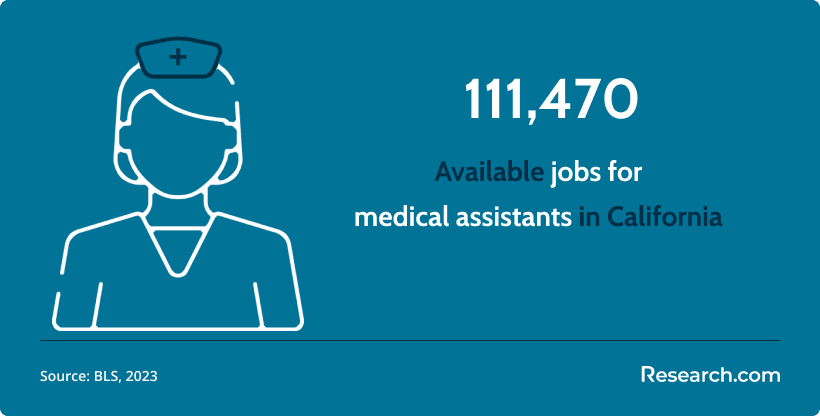
California leads the nation in medical assistant employment, with 111,470 positions. That scale matters: students can find opportunities across primary care offices, specialty clinics, outpatient centers, hospital-affiliated practices, urgent care locations, and community health organizations.
California medical assistants commonly work under physicians, podiatrists, optometrists, registered nurses, and other supervising healthcare professionals. They do not need the same level of schooling required for many of the highest-paid medical professionals, but they must understand the limits of their role and perform assigned tasks under appropriate supervision. The Medical Board of California provides guidance on what medical assistants may do in the state.
| State | Employment | Hourly Wage | Annual Mean Wage |
| California | 111,470 | $23.01 | $47,850 |
| Texas | 66,550 | $17.75 | $36,910 |
| Florida | 58,530 | $18.21 | $37,870 |
| New York | 35,720 | $21.16 | $44,020 |
| Georgia | 25,500 | $18.06 | $37,560 |
Who Is This Career Best For?
| Medical Assisting May Fit You If... | You May Want Another Path If... |
| You want a faster entry into healthcare than nursing or allied health degree programs usually require. | You want independent clinical decision-making authority early in your career. |
| You are comfortable with both administrative work and basic clinical support. | You prefer a role with minimal patient interaction. |
| You want experience before deciding whether to pursue nursing, healthcare administration, diagnostic imaging, or billing and coding. | You are seeking a role that always requires a bachelor’s or graduate degree from the start. |
| You can follow protocols, document accurately, and work under supervision. | You are not comfortable with fast-paced clinics, changing schedules, or multitasking. |
What Are the Steps to Becoming a Medical Assistant in California?
California does not use a single state licensing pathway for medical assistants, so your preparation should be guided by employer expectations, certification eligibility, and the type of medical setting where you want to work. The safest approach is to complete formal training, document your clinical competencies, and pursue certification if it improves your hiring prospects.
- Earn a high school diploma or GED. A GED is a high school equivalency credential for people who did not complete a traditional high school program.
- Choose a medical assisting program through a community college, vocational school, technical institution, private college, or university.
- Complete coursework in both clinical and administrative areas, such as medical terminology, anatomy and physiology, patient intake, basic procedures, medical office systems, and documentation.
- Complete supervised practical training. California medical assistants must be trained and supervised before performing specific services.
- Prepare for and pass a medical assistant examination if your program or certification pathway requires one.
- Consider voluntary certification from an organization recognized by the Medical Board of California.
- Apply for entry-level roles in physician offices, outpatient care centers, clinics, hospital-affiliated practices, and specialty offices.
The Medical Board of California identifies the following approved medical assistant certifying organizations:
- American Association of Medical Assistants (AAMA)
- American Medical Certification Association (AMCA)
- American Medical Technologists (AMT)
- California Certifying Board of Medical Assistants (CCBMA)
- Multiskilled Medical Certification Institute, Inc.
Medical Assistant Program Length in California
Medical assistant program length depends on the credential, school format, course load, and externship requirement. Certificate and diploma programs are usually the fastest route. Associate degree programs take longer but may be better for students who want transferable college credits or a stronger foundation for future healthcare education.
| Program Type | Typical Length | Best For | Main Trade-Off |
| Certificate or diploma | Eight to 18 months | Students who want to qualify for entry-level medical assistant work quickly. | May offer fewer general education or transferable credits than an associate degree. |
| Associate degree | Two years | Students who may later pursue nursing, healthcare administration, or another allied health field. | Takes longer and may cost more, depending on the school and residency status. |
| Accelerated program | As little as a few weeks in some formats | Career changers or students who can handle an intensive schedule. | Students must carefully verify externship quality, certification preparation, and employer recognition. |
A certificate or diploma may be enough for entry-level employment, especially if the program includes hands-on training and certification exam preparation. An associate degree may be a better long-term choice if you want to continue into licensed practical nurse (LPN), licensed vocational nurse (LVN), registered nurse (RN), or administrative roles later.
Medical assistants who eventually want leadership or operations roles may also look beyond clinical training. For example, students with an associate degree who are interested in pursuing an MBA in healthcare management should ask schools whether credits can transfer into future degree pathways or whether bridge options are available.
Tuition and Costs of Medical Assistant Programs in California
Medical assistant school costs in California vary by institution type, campus location, program length, credential level, fees, supplies, and residency classification. Tuition is only one part of the total cost, so students should compare books, uniforms, background checks, immunizations, certification exam fees, technology fees, transportation, and lost work hours.
Public institutions often charge different rates for California residents and non-residents. Residency rules exist because state residents contribute to California’s tax base, which helps subsidize public education. Non-resident students are often charged more to help offset the cost of instruction.
For tuition purposes, California residency generally requires continuous physical presence in the state for at least one year, or 366 days, before the residence determination date, which is the first day of classes. Students must also show intent to make California their permanent home, according to University of California guidance.
In general, California residents in a public two-year program pay $1,380 in tuition and fees, while non-residents pay $8,622. Grants, scholarships, employer tuition assistance, payment plans, and financial aid can reduce out-of-pocket costs, but truly free medical assistant programs are uncommon.
Cost Questions to Ask Before Enrolling
- Is the published tuition the full program cost, or are supplies and fees separate?
- Are certification exam fees included?
- Does the program require unpaid externship hours during normal work hours?
- Can I use federal or state financial aid?
- Are payment plans, scholarships, grants, or workforce funding available?
- Will credits transfer if I later pursue an associate degree, nursing program, or healthcare administration degree?
California Schools Offering Medical Assistant Programs for 2027
The schools below represent different California medical assistant training options, including certificate and associate degree pathways. Use this list as a starting point, not as a final enrollment decision. Before applying, confirm current tuition, accreditation status, delivery format, externship requirements, certification exam preparation, and job placement outcomes directly with the school.
1. San Joaquin Valley College
San Joaquin Valley College offers a clinical medical assisting program through a California-based private institution with campus and online learning options. The program is designed for students who want a shorter certificate pathway into entry-level medical assisting work.
- Program Length: As few as nine months
- Tracks/concentrations: Not specified
- Cost per Credit/Tuition: A certificate program in clinical medical assisting offered on the Antelope Valley (Lancaster) campus costs $19,620.
- Required Credits to Graduate: 60 credit units
- Accreditation: California Bureau of Private Postsecondary Education (BPPE)
2. De Anza College
De Anza College provides a medical assisting certificate of achievement-advanced program intended to prepare students for entry-level healthcare employment.
- Program Length: 18 months full-time, two or more years if part-time
- Tracks/concentrations: Not specified but includes courses in basic and advanced procedural and disease coding, medical terminology, and medical office procedures
- Cost per Credit/Tuition: The cost of attendance for students living at home with no dependents is $21,676.
- Required Credits to Graduate: Not specified
- Accreditation: Commission on Accreditation of Allied Health Education Programs (CAAHEP)
3. West Valley College
West Valley College offers a medical assistant associate of science degree focused on front-office and back-office preparation for physician offices, clinics, and other outpatient settings.
- Program Length: Not specified
- Tracks/concentrations: Not specified but includes courses in medical terminology, anatomy and physiology, medical office procedures, and clinical procedures
- Cost per Credit/Tuition: West Valley College’s tuition fees vary depending on the student’s residency status and the number of units they take.
- Required Credits to Graduate: 64
- Accreditation: ACCJC and WASC
4. Chabot College
Chabot College offers a medical assisting certificate program that prepares graduates to seek work as medical assistants in ambulatory care environments.
- Program Length: 35 weeks
- Tracks/concentrations: Not specified
- Cost per Credit/Tuition: The cost of enrollment per unit is $46 for all students, with the exception of those who are legally exempt.
- Required Credits to Graduate: 34
- Accreditation: CAAHEP
5. Carrington College
Carrington College offers medical assisting training that can lead to a certificate or degree. The curriculum is structured around entry-level competencies across cognitive knowledge, hands-on skills, and professional behavior.
- Program Length: As few as nine months (certificate program)
- Tracks/concentrations: Clinical, administrative, externship
- Cost per Credit/Tuition: The medical assisting certificate program in Pleasant Hill, Sacramento, San Jose, San Leandro, Stockton, and online costs $3,451 per term.
- Required Credits to Graduate: 36+ (certificate program)
- Accreditation: ACCJC and WASC
What to Look for in a Medical Assistant Program in California
A strong program should prepare you for the job you actually want, not just help you finish quickly. Compare schools using measurable factors: accreditation, clinical training, certification preparation, cost transparency, schedule flexibility, graduate support, and employer reputation.
| Selection Factor | Why It Matters | What to Ask |
| Accreditation or institutional approval | Accreditation can affect quality assurance, certification eligibility, employer confidence, and transfer options. | Is the program accredited by CAAHEP, ABHES, or another recognized body, or is the institution approved by a relevant state or regional agency? |
| Certification preparation | Certification is not required by California for all medical assistants, but employers may prefer or require it. | Which certification exams do graduates typically take, and what support is provided? |
| Clinical and administrative curriculum | Medical assistants need both patient care and office workflow skills. | Does the curriculum include medical terminology, anatomy and physiology, clinical procedures, medical office procedures, documentation, and patient communication? |
| Externship or hands-on practice | Supervised practice helps students move from classroom learning to clinical performance. | How many externship hours are required, and where are placements located? |
| Cost and aid options | The cheapest listed tuition may not be the lowest total cost. | Are books, uniforms, exam fees, background checks, and supplies included? Can students use available financial aid opportunities? |
| Schedule and format | Working adults and parents may need evening, hybrid, or online coursework. | Which parts are online, which are in person, and when are labs or externships scheduled? |
| Eligibility requirements | Some programs require documents or prerequisites before admission or externship placement. | Do I need a GED or diploma, CPR certification, immunization records, background check, or government-issued ID? |
| Career support | Employer connections can help with the first job search. | Does the school provide resume help, interview practice, job leads, or employer networking? |
Students who want to keep advancing should also ask whether credits can apply toward related programs. If your long-term goal involves clinic operations, compliance, or leadership, a later healthcare administration degree may align better than staying only in direct patient support roles.
Common Mistakes to Avoid
- Choosing only by speed. A very short program may be convenient, but it should still provide enough clinical practice and certification preparation.
- Ignoring accreditation and approval status. Accreditation can affect exam eligibility, employer trust, transfer credit, and financial aid options.
- Comparing tuition without total costs. Supplies, exams, transportation, and externship scheduling can change the real price.
- Assuming online means fully online. Many medical assistant programs require in-person labs, skills checks, or externships.
- Not checking externship sites. A strong externship can improve confidence, references, and job leads.
- Assuming certification guarantees employment or salary. Certification can help, but hiring and pay depend on location, employer, experience, and demand.
What Are the Accreditation and Certification Standards for Medical Assistant Programs in California?
Accreditation and certification serve different purposes. Accreditation evaluates the quality of a school or program, while certification verifies that an individual has met a professional competency standard. In California, medical assistants are not licensed in the same way nurses are, but certification can make a graduate more competitive and may be required by specific employers.
Students should confirm whether a program is accredited by a recognized healthcare education accreditor, such as the Commission on Accreditation of Allied Health Education Programs (CAAHEP) or the Accrediting Bureau of Health Education Schools (ABHES), when applicable. They should also verify whether the program qualifies them for the certification exam they intend to take.
If you are comparing allied health careers beyond medical assisting, it can help to review adjacent pathways such as how to become a nutritionist in California, but do not assume requirements transfer directly. Each healthcare occupation has its own education, certification, or licensure rules.
What Job Placement Support Do Medical Assistant Programs in California Offer?
Job placement support can make a meaningful difference for first-time healthcare workers. Good programs often help students prepare resumes, practice interviews, identify local employers, and connect with externship sites. Some schools also maintain relationships with clinics, physician practices, urgent care centers, and outpatient facilities that hire graduates.
When comparing programs, ask for specific support rather than broad claims. Find out whether the school offers one-on-one career advising, employer events, alumni referrals, certification exam guidance, and help applying for entry-level positions. Students who later want to move into advanced clinical roles can also research longer pathways, including how to become a nurse practitioner in California, to understand how far additional education can lead.
Should I Expand My Skills to Include Diagnostic Imaging?
Diagnostic imaging is not a standard medical assistant requirement, but it can be a useful adjacent interest for students who enjoy technology, anatomy, patient positioning, and procedural support. Medical assistants who discover they like clinical technology may later explore imaging-related education instead of staying in general clinic support.
Before adding imaging coursework, check whether the training leads to a recognized credential or simply provides exposure. If you are seriously interested in imaging careers, compare dedicated sonography programs rather than assuming a short add-on course will qualify you for imaging roles.
Can a Medical Assistant Transition to a Pharmacy Career?
Yes, a medical assistant can move toward pharmacy work, but the transition is not automatic. Medical assisting experience can help with patient communication, clinic workflows, documentation, and healthcare professionalism, but pharmacy careers require separate knowledge of medications, dispensing rules, pharmacology, and regulatory standards.
Students considering this shift should look for pharmacy-specific education and credential requirements. A useful next step is to review how to become a licensed pharmacist in California and compare the education timeline with your current goals.
What Role Do Clinical Training and Externships Play in Medical Assistant Programs?
Clinical training is where students learn whether they can perform calmly, accurately, and professionally in real healthcare settings. Externships expose students to patient flow, provider expectations, documentation habits, infection control, privacy rules, and day-to-day clinic operations.
A strong externship can also help students build references and employment contacts. Ask each school where students are placed, how placements are assigned, whether sites are near your home, what schedule is required, and whether students receive feedback from supervisors.
Hands-on practice is also valuable if you later explore other short-training healthcare careers. Students comparing broader options can review the highest paying medical jobs with little schooling, but should remember that each role has different scope, credentials, and employer expectations.
Can Adding Billing and Coding Certifications Advance My Medical Assisting Career in California?
Billing and coding credentials can help medical assistants who enjoy administrative healthcare work and want to move toward revenue cycle, claims, coding accuracy, compliance support, or medical office operations. This combination can be useful in small practices where staff members handle both patient intake and administrative documentation.
However, billing and coding is a distinct skill set. If you want that path, choose training that covers coding systems, payer rules, claim submission, documentation standards, and compliance. To evaluate the pathway in more detail, review how to become a medical biller and coder in California.
What Are the Benefits of Networking Opportunities During a Medical Assistant Program?
Networking is especially useful for medical assistant students because many first jobs come through externships, instructor referrals, alumni connections, and local employer relationships. A program with strong community ties can help students move from training into interviews faster.
- Employer introductions: Schools with clinic and outpatient partnerships may connect students with hiring managers before graduation.
- Instructor referrals: Faculty who know your reliability, communication style, and clinical skills may be able to recommend you for openings.
- Mentorship: Experienced medical assistants, nurses, and office managers can explain how to succeed in real clinical environments.
- Externship leads: Networking can help students secure practical placements that match their schedule, location, or specialty interests.
- Continuing education awareness: Peers and professionals can share information about certifications, bridge programs, and allied health options.
- Professional confidence: Meeting healthcare workers before graduation makes the first job search less intimidating.
Can You Complete a Medical Assistant Program in Just a Few Weeks?
Some accelerated programs are marketed to students who want to train quickly, including medical assistant degree online 6 weeks options. These programs may appeal to motivated students who can study intensively and already understand the demands of healthcare work.
The key is to verify quality before enrolling. A short program should still teach medical terminology, patient care basics, infection control, documentation, administrative workflows, and clinical procedures. It should also explain whether graduates are prepared for certification exams and whether externship experience is included.
What Are the Nursing License Requirements in California?
Medical assisting can be a stepping stone toward nursing, but it is not the same as nursing licensure. Nursing roles require completion of an approved nursing program, required clinical education, and licensing examinations. If your long-term plan is to become a nurse, review the current nursing license requirements in California before choosing a medical assistant program, especially if transfer credits matter to you.
What Complementary Allied Health Opportunities Can Enhance My Medical Assisting Role?
Medical assistants who want to grow can move in several directions: administrative leadership, billing and coding, nursing, pharmacy, diagnostic imaging, laboratory support, or healthcare management. The best option depends on whether you prefer patient care, technology, office systems, compliance, or leadership.
For example, students interested in imaging technology can compare medical assisting with how to become a radiology technician in California. Those who prefer office leadership may eventually move toward management-focused education instead.
What Future Trends Are Shaping Medical Assistant Roles in California?
California medical assistants are increasingly expected to be comfortable with electronic health records, patient portals, telehealth workflows, digital scheduling, automated reminders, and team-based care. These tools do not eliminate the need for medical assistants; they change what employers expect from them.
Students should look for programs that teach accurate documentation, privacy practices, digital communication, and patient-centered service. Because healthcare teams are becoming more integrated, it can also help to understand broader clinical education trends by reviewing resources such as top nursing schools in California.
Accelerated Medical Assistant Programs in California: Fast Training With Important Trade-Offs
Accelerated medical assistant programs are designed for students who want to enter the workforce quickly. They compress coursework into a shorter schedule and may use online, hybrid, evening, or intensive formats. These programs can be useful, but they require discipline and careful comparison.
Key Features of Accelerated Medical Assistant Programs
- Shorter completion time: Some accelerated options can be completed in as little as six weeks, while other fast-track programs take several months.
- Intensive pacing: Students may need to study daily and complete assignments quickly.
- Flexible delivery: Some programs use online or hybrid coursework, but clinical skills and externships may still require in-person attendance.
- Core curriculum focus: Accelerated programs typically emphasize medical terminology, basic clinical skills, administrative tasks, and patient care fundamentals.
- Career-entry orientation: Many students use accelerated training to start working sooner, then return later for additional credentials.
Who Should Consider Accelerated Programs?
Accelerated programs may work well for focused students, career changers, and people who can dedicate substantial time to studying. They may not be ideal for students who need a slower pace, extensive academic support, or a broader associate degree pathway.
Before enrolling, compare externship support, certification preparation, tuition, employer recognition, and refund policies. To explore this format further, review fast track medical assistant programs.
Career Growth Opportunities After Completing a Medical Assistant Program in California
Medical assisting can be a stable entry-level healthcare role, but many professionals use it as a foundation for advancement. Experience in patient intake, documentation, scheduling, vital signs, and clinical support can clarify whether you want to stay in ambulatory care or pursue another healthcare credential.
| Growth Path | Why Medical Assisting Helps | Next Step to Research |
| LVN or LPN pathway | Patient care exposure helps you understand clinical routines before entering nursing education. | Review state-approved nursing program requirements and prerequisites. |
| RN pathway | Medical assisting can confirm whether you want deeper clinical responsibility. | Compare nursing schools, prerequisites, clinical requirements, and licensing steps. |
| Billing and coding | Clinic documentation experience can support administrative specialization. | Look for coding and billing certification training. |
| Healthcare administration | Front-office and workflow experience can support later supervisory or management goals. | Compare healthcare management and administration degree options. |
| Diagnostic imaging or allied health | Patient care experience can help you transition into more technical clinical fields. | Research program prerequisites, licensure, and certification requirements. |
If you are considering nursing, start by reviewing how to become a nurse in California. Nursing has separate admissions, clinical, and licensing requirements, so early planning can prevent wasted credits or missed prerequisites.
Can a Medical Assistant Seamlessly Transition to an LPN Role?
A medical assistant can transition toward an LPN role, but the move is not seamless in the sense of automatic qualification. LPN programs require nursing-specific coursework, clinical education, and compliance with state licensing rules. Medical assistant experience may strengthen your application and confidence, but it does not replace nursing education.
If you want the fastest realistic route, compare approved programs, prerequisites, clinical schedules, exam preparation, and state requirements. A good starting point is how to become an LPN fast in California.
How Do I Meet the Eligibility Requirements for LVN Programs in California?
LVN programs in California typically expect applicants to meet academic, clinical, and documentation requirements. These may include a high school diploma or equivalent, prior healthcare training, immunization records, background screening, entrance testing, prerequisite coursework, or proof of clinical readiness.
Medical assisting can help you build healthcare experience before applying, but each LVN program sets its own admissions standards. Before you commit to a medical assistant program as a stepping stone, ask whether credits or experience will be recognized. For a broader pathway overview, read how to become a LVN nurse in California.
How to Decide Which California Medical Assistant School Is Right for You
The best medical assistant school is the one that fits your career timeline, budget, learning style, transportation needs, and long-term healthcare goals. Do not rely only on a ranking, advertisement, or tuition number. Verify program details directly with admissions, financial aid, and career services.
- Decide whether you want the fastest entry-level route or a longer degree pathway with more transfer potential.
- Check accreditation, institutional approval, certification exam preparation, and employer reputation.
- Compare total cost, not just tuition.
- Ask where clinical labs and externships take place.
- Confirm whether online courses still require in-person attendance.
- Review graduation, certification, and job placement support information when available.
- Speak with current students or recent graduates if possible.
- Choose the program that supports both your first job and your next career step.
Students who later want management roles can explore healthcare management education. Those looking for graduate-level advancement can also compare affordable Master’s Degrees in Healthcare Administration, including (MHA) online programs.
Key Insights
- California is a major medical assistant employment market. The state has 111,470 medical assistant positions and an annual mean wage of $47,850, based on the data provided.
- Growth projections are favorable, but verify current figures. The article data includes 12% national growth from 2024 to 2034 and 12.5% projected California growth with about 8,400 annual openings through 2030. It also cites 18.2% growth through 2032 and 17,900 new positions, so students should confirm the latest labor market data before making a decision.
- Certification is not the same as licensure. California does not require a universal state medical assistant license, but certification from an approved organization can improve employer confidence.
- Program length should match your goals. Certificate and diploma programs usually take eight to 18 months, associate degrees typically take two years, and accelerated options may be much shorter but require careful vetting.
- Accreditation, externships, and job support matter. These factors often have more long-term value than choosing solely by speed or advertised tuition.
- Total cost can vary widely. California residents in a public two-year program generally pay $1,380 in tuition and fees, while non-residents pay $8,622, but supplies, exams, transportation, and externship costs can change the final price.
- Medical assisting can lead to other healthcare paths. With additional education, medical assistants may move toward LVN/LPN, RN, billing and coding, diagnostic imaging, pharmacy, or healthcare administration roles.
Related Articles for Nearby States
- 2027 Best Medical Assistant Schools & Programs in Oregon – How to Become a Medical Assistant in Oregon
- 2027 Best Medical Assistant Schools & Programs in Arizona – How to Become a Medical Assistant in Arizona
- 2027 Best Medical Assistant Schools & Programs in Idaho – How to Become a Medical Assistant in Idaho
- 2027 Best Medical Assistant Schools & Programs in Utah – How to Become a Medical Assistant in Utah
- 2027 Best Medical Assistant Schools & Programs in Washington – How to Become a Medical Assistant in Washington
- 2027 Best Medical Assistant Schools & Programs in New Mexico – How to Become a Medical Assistant in New Mexico
- 2027 Best Medical Assistant Schools & Programs in Colorado – How to Become a Medical Assistant in Colorado
- 2027 Best Medical Assistant Schools & Programs in Montana – How to Become a Medical Assistant in Montana
- 2027 Best Medical Assistant Schools & Programs in Wyoming – How to Become a Medical Assistant in Wyoming
- 2027 Best Medical Assistant Schools & Programs in Texas – How to Become a Medical Assistant in Texas
References:
- California Certifying Board for Medical Assistants. Recent news and announcements. https://ccbma.org/recent-news-announcements
- Carrington College. 2026 academic catalog. https://docs.carrington.edu/catalog/carrington-college.pdf Carrington medical assisting program information sheet
- Chabot College. Medical Assisting Certificate of Achievement. https://chabot.curriqunet.com/DynamicReports/AllFieldsReportByEntity/456?entityType=Program&reportId=356
- De Anza College. Cost of attending. https://www.deanza.edu/financialaid/apply/cost.html
- EducationData.org. Average cost of college by state. https://educationdata.org/average-cost-of-college-by-state
- Hanson, M. Average cost of college and tuition. Education Data Initiative. https://educationdata.org/average-cost-of-college
- National Career College. Medical assistant salary in California 2026. https://nccusa.edu/blog/medical-assistant-salary-in-california/ SJVC consumer information catalog
- U.S. Bureau of Labor Statistics. Medical Assistants, Occupational Outlook Handbook. https://www.bls.gov/ooh/healthcare/medical-assistants.htm#tab-6
- University of California Office of the President. How to establish residency. https://www.ucop.edu/residency/establishing-residency.html
Other Things You Should Know About Medical Assistant Schools & Programs in California
To become a medical assistant in California, you need to obtain a high school diploma or GED, enroll in a medical assisting training program, pass the medical assistant examination, and consider obtaining certification from a recognized organization. Afterward, you must complete specialized on-the-job training under supervision.
Certification is not legally required to work as a medical assistant in California, but it is highly recommended. Certification can enhance employment prospects, improve salary potential, and demonstrate a commitment to the profession. Many employers prefer or require certification such as the CMA (Certified Medical Assistant) or the RMA (Registered Medical Assistant).
Before enrolling in a California medical assistant program, you typically need a high school diploma or GED. Some programs may require prerequisite courses such as biology or medical terminology, and a background check may also be necessary for admission.
Many medical assistant programs in California include externships as part of their curriculum. An externship provides hands-on experience, often totaling 160 to 200 hours, and is usually completed in a healthcare setting such as a hospital or clinic, enhancing both skills and employability.
Yes, some schools in California offer online medical assistant programs or hybrid programs that combine online coursework with in-person clinical training. These programs provide flexibility for students who need to balance their studies with other commitments.
Yes. Most California programs require proof of MMR, varicella, Tdap, flu, and TB clearance, plus a criminal background check and drug screening before externship placement. Clinical sites may also require CPR certification and health insurance before students can begin hands-on training.


