
2027 Master’s in Social Work (MSW) Programs in Ohio (OH) – Online & On-Campus

Co-Founder and Chief Data Scientist
Choosing a Master of Social Work program in Ohio is not just a graduate school decision. It affects whether you qualify for Ohio social work licensure, how quickly you can move into clinical or leadership roles, where you complete field education, and how much debt you may take on before entering the workforce.
This guide is for prospective MSW students comparing Ohio programs, working adults considering online study, BSW graduates looking for advanced standing options, and career changers who want a clear route into social work. You will learn how Ohio MSW programs work, what they cost, how licensure is structured, which schools offer notable options, what salaries and jobs may be available, and how to choose a program that fits your career goals.
An MSW can prepare graduates for clinical practice, program management, policy work, community services, healthcare social work, school-based roles, and nonprofit leadership. If you are still exploring the degree itself, it may help to review what you can do with a master’s in social work and how it compares with broader social work degree pathways.
Master’s in Social Work Programs in Ohio Table of Contents
- Ohio social worker requirements
- How long the path usually takes
- Typical MSW costs in Ohio
- Ohio MSW schools for 2027
- How to compare MSW programs in Ohio
- Online MSW programs in Ohio for 2027
- Ways to pay for an Ohio MSW
- MSW jobs and salaries in Ohio
- What affects online MSW cost in Ohio
- Clinical specialization benefits
- Diversity and inclusion in Ohio MSW education
- Career support after graduation
- Interdisciplinary learning in MSW programs
- Online MSW options for working adults
- Networking opportunities for MSW students
- One-year and advanced standing MSW options
- Rural and underserved community careers
- MSW admission requirements in Ohio
Quick Answer: Is an MSW in Ohio a Good Path?
An MSW in Ohio can be a strong choice if you want to qualify for advanced social work roles, pursue Licensed Independent Social Worker status, or specialize in areas such as mental health, children and families, healthcare, aging, substance misuse, community practice, or policy. Ohio has high employment levels for several social work-related occupations, and many MSW programs offer online, hybrid, full-time, part-time, and advanced standing formats.
The best choice depends on your starting point. Students with a CSWE-accredited BSW may be able to complete an advanced standing route in about one year, while traditional MSW students commonly study for about two years. Costs vary widely by school, residency status, format, fees, and field placement requirements. Before enrolling, confirm CSWE accreditation, Ohio licensure alignment, field placement support, total program cost, and whether the curriculum matches your intended career.
How to Become a Social Worker in Ohio
Ohio’s social work pathway usually combines formal education, supervised field experience, state licensure, and continuing education. A bachelor’s degree may support entry-level roles, but an MSW is commonly needed for advanced clinical, supervisory, and independent practice opportunities.
1. Earn a Bachelor’s Degree
A bachelor’s degree is the usual starting point for professional social work preparation. According to Zippia (2025), about 65% of social workers hold bachelor’s degrees. Their majors vary: 54% studied social work, 16% studied psychology, 7% completed sociology, and 5% earned criminal justice degrees.
The most direct route is a Bachelor of Social Work from a Council on Social Work Education-accredited program. A CSWE-accredited BSW may make a student eligible for advanced standing MSW admission, which can shorten graduate study. Students from related majors may still qualify for traditional MSW programs, but they should expect a longer foundation curriculum.
2. Complete a CSWE-Accredited MSW Program
Master of Social Work programs in Ohio build advanced practice skills in assessment, intervention, ethics, policy, research, human behavior, social justice, and field-based practice. Many programs also prepare students for specialized work in clinical services, administration, child welfare, healthcare, aging, community organizing, substance abuse, and policy advocacy.
Graduate education is especially important for students seeking advanced licensure. More than 94% of licensed social workers hold master’s degrees, according to ASWB (2025). Students interested in clinical licensure can also compare Ohio MSW programs with online licensed clinical social work degree options to understand how program structure affects licensure preparation.
3. Complete Field Education or Practicum Requirements
Field education is where MSW students apply classroom learning in supervised practice settings. Placements may occur in hospitals, behavioral health agencies, schools, courts, nonprofit organizations, community clinics, government offices, or rural service agencies.
Students should not treat field placement as a formality. The placement often shapes early career direction, references, clinical skills, and job leads. A student planning to become a therapist, for example, should look for strong mental health or clinical placement options, while someone focused on policy or program leadership may benefit more from community, government, or nonprofit administrative settings.
4. Apply for Ohio Social Work Licensure
Graduates seeking licensure apply through the Ohio Counselor, Social Worker, and Marriage and Family Therapist Board. Ohio commonly distinguishes between the Licensed Social Worker credential and Licensed Independent Social Worker status.
An LSW generally allows social workers to practice under supervision. LISW status is designed for professionals who meet additional requirements for independent practice. LISW-level work may include clinical assessment, therapy, diagnosis and treatment of mental health conditions, and independent professional judgment within the scope permitted by Ohio rules.
Applicants pursuing advanced licensure should review current Ohio board requirements and the ASWB exam preparation information. Social Work License Map (2026) lists the LSW application fee at $80, with other related fees possible.
5. Maintain Licensure Through Continuing Education
Licensed social workers must keep their credentials active by meeting Ohio continuing education rules. Workshops, professional training, ethics courses, supervision education, and events such as the NASW Ohio Annual Conference can help practitioners stay current on law, ethics, evidence-based practice, documentation expectations, and emerging community needs.
| Step | What to Do | Why It Matters |
| Bachelor’s education | Earn a BSW or related bachelor’s degree | Creates the academic foundation for entry-level roles or MSW admission |
| MSW program | Choose a CSWE-accredited Ohio program | Supports advanced practice preparation and licensure eligibility |
| Field education | Complete supervised practice placements | Builds job-ready skills and professional references |
| Licensure | Apply for LSW or work toward LISW | Determines scope of practice and independence |
| Continuing education | Complete required professional learning | Keeps licensure active and strengthens long-term practice |
How Long Does It Take to Become a Social Worker in Ohio?
The timeline depends on the degree level and license you plan to pursue. An associate degree can take two years for students not immediately seeking licensure (Gwynedd Mercy University, nd). A bachelor’s degree in social work typically takes four years. Traditional MSW programs in Ohio are commonly completed in two years, while advanced standing options may be shorter for eligible BSW graduates.
After graduate study, students pursuing higher licensure may need about two to three years of supervised experience before applying for independent practice credentials. Overall, the full path to advanced social work practice in Ohio often takes around seven to nine years. A doctoral pathway can add about three to five additional years.
| Path | Typical Time | Best Fit |
| Associate degree | Two years | Students exploring human services support roles without immediate licensure plans |
| Bachelor’s degree | Four years | Students seeking entry-level social work or MSW preparation |
| Traditional MSW | Two years | Students without a CSWE-accredited BSW or those needing the full graduate curriculum |
| Supervised post-graduate experience | About two to three years | Graduates working toward independent or advanced licensure |
| Doctoral study | About three to five additional years | Students interested in research, academia, advanced leadership, or policy scholarship |
What Is the Typical Cost of MSW Programs in Ohio?
The cost of an MSW in Ohio can vary substantially. Tuition is only one part of the price. Students should also account for university fees, technology fees, books, commuting or residency costs, field placement travel, lost work hours, exam fees, licensure fees, and interest if loans are used.
How Much Does an MSW Program in Ohio Cost?
College Tuition Compare (2025) reports that the average annual cost of social work graduate programs in Ohio and other states is $13,500. Out-of-state students pay about $28,900 per year.
Education Data Initiative reports that the cost of a master’s degree generally ranges from $30,000 to $120,000, with an average of $62,650. MSW degrees categorized under Master of Arts programs average $65,880 each year, while MSW programs outside that label average about $72,770 annually.
| Cost Factor | What to Check Before Enrolling |
| Residency status | Ask whether online students pay in-state, out-of-state, or special online tuition |
| Credit requirement | Compare total credits, not just price per credit |
| Field placement | Confirm whether travel, background checks, immunizations, or placement fees apply |
| Program length | Estimate how full-time, part-time, or advanced standing study affects income and loan needs |
| Financial aid | Review scholarships, assistantships, employer benefits, federal aid, and service-based funding |
| Licensure costs | Budget for application fees, exams, supervision, continuing education, and renewals |
Is an MSW in Ohio Worth It?
An MSW in Ohio may be worth it for students who want access to advanced roles, independent practice pathways, clinical specialization, supervisory jobs, or leadership positions in social service organizations. Ohio has strong employment levels in several social work-related categories: it ranks fifth among U.S. states for employment of social workers with 2,770 employed professionals, third for mental health and substance abuse social workers with 5,820 employed professionals, and fifth for rehabilitation counselors with 3,410 employed professionals.
The degree is most valuable when it connects directly to a realistic career plan. For example, students pursuing LISW status, therapy roles, healthcare social work, program leadership, or policy work may benefit more from an MSW than students who only need entry-level human services experience.
An MSW can also support career mobility into adjacent fields. Students comparing counseling, psychology, and social work routes may find it useful to explore broader social work careers and the differences between a Master of Social Work and Master of Psychology.
Who Should Strongly Consider an Ohio MSW?
- BSW graduates who want advanced standing: A one-year or accelerated route may reduce time and cost.
- Future clinical practitioners: An MSW is often central to the path toward independent clinical practice.
- Working adults in human services: Online or part-time programs may help them advance without leaving employment.
- Students committed to Ohio practice: Local field placements and state-specific licensure advising can be valuable.
- Future managers or policy professionals: Graduate training can strengthen program planning, evaluation, supervision, and advocacy skills.
Who May Want a Different Path?
- Students unsure about direct service work: Social work involves emotionally demanding client, family, and community issues.
- Applicants who only want short-term employment: An MSW may not be necessary for every human services role.
- Students focused mainly on psychological testing: Psychology, counseling, or doctoral routes may be more appropriate depending on scope of practice.
- Students unable to complete field hours: Practicum requirements are essential and can be difficult to schedule around full-time work.
What Should You Consider When Choosing an MSW Program in Ohio?
The right MSW program is the one that matches your licensure goal, schedule, budget, learning style, and preferred population. A low tuition rate can be attractive, but it should never outweigh accreditation, field placement quality, and licensure fit.
- CSWE accreditation: Confirm that the program is accredited by the Council on Social Work Education. Accreditation is central for licensure recognition and employer confidence.
- Licensure alignment: Ask whether the curriculum and field education support Ohio LSW and LISW preparation.
- Specialization options: Compare concentrations such as mental health, substance abuse, healthcare, child welfare, aging, clinical practice, school social work, community practice, or policy.
- Field placement support: Find out whether the school locates placements for online students or expects students to identify sites independently.
- Format: Decide whether online, campus-based, hybrid, synchronous, asynchronous, full-time, or part-time study best fits your life.
- Faculty expertise: Review faculty practice backgrounds, research interests, and clinical or community experience.
- Total cost: Compare tuition, fees, travel, books, technology, placement-related costs, and lost wages.
- Student support: Look for advising, writing help, exam preparation, career services, disability services, and alumni mentorship.
| Decision Question | Why It Matters | What to Ask the School |
| Is the program CSWE-accredited? | Accreditation affects licensure eligibility and employer acceptance | Is the MSW currently accredited, and when is the next review? |
| Can I complete fieldwork near me? | Field placement logistics can make or break online study | Who secures placements, and what agencies are commonly used? |
| Does the program match my career goal? | Clinical, policy, school, healthcare, and community roles require different preparation | Which electives, certificates, and field sites support my target role? |
| What is the true cost? | Published tuition may exclude fees and indirect expenses | What is the estimated total program cost through graduation? |
| How flexible is the schedule? | Working adults may need evening, asynchronous, or part-time options | Are courses live, recorded, asynchronous, or hybrid? |
Ohio Schools Offering Master of Social Work Programs for 2027
Ohio has several MSW options with different strengths. The following programs illustrate how schools vary by format, price, specialization, credit requirement, and field education structure. Students should verify all tuition, admission, accreditation, and licensure information directly with each university before applying.
University of Cincinnati Master of Social Work
The University of Cincinnati offers a Master of Social Work focused on direct practice. Coursework covers areas such as psychosocial theory, social welfare policy, and social work methods. Students complete field education through the university’s network of more than 200 agency partners, typically under instructor supervision for 14 to 17 hours each week. Concentration options include children and families, health and aging, and mental health.
- Program length: 2 years
- Tracks or concentrations: Direct Practice, Children & Families, Health & Aging, Mental Health
- Cost per credit: $746
- Credits required: 60
- Accreditation: Council on Social Work Education
Ohio University Master of Social Work
Ohio University prepares MSW students for clinical social work with attention to rural settings. The program emphasizes practice with individuals, families, groups, organizations, and communities. Its CSWE-accredited curriculum is organized around nine competencies, including professional behavior and diversity in practice. Students can choose among two-year full-time, three-year part-time, four-year part-time, one-year advanced standing, and online options.
- Program length: 2 years
- Tracks or concentrations: No Information Available
- Cost per credit: $654 (in-state); $673 (out-of-state)
- Credits required: 62
- Accreditation: Council on Social Work Education
Miami University Master of Social Work
Miami University in Oxford, Ohio, offers a hybrid MSW designed for students preparing to serve people and communities across the lifespan. The 24-month curriculum emphasizes social justice and family-centered practice, with courses in advanced social work practice, social work ethics, and human behavior. Students complete 500 hours of field education. Miami University also offers an option combining bachelor’s and master’s study in social work.
- Program length: 2 years
- Tracks or concentrations: No Information Available
- Cost per credit: $700
- Credits required: 57
- Accreditation: Council on Social Work Education
| School | Format Notes | Credits | Cost per Credit | Best Known Fit |
| University of Cincinnati | Direct practice focus with field education through more than 200 agency partners | 60 | $746 | Students seeking children and families, health and aging, or mental health options |
| Ohio University | Multiple schedules, including online and advanced standing | 62 | $654 (in-state); $673 (out-of-state) | Students interested in rural clinical social work |
| Miami University | Hybrid 24-month program with 500 field education hours | 57 | $700 | Students seeking a social justice and family-centered curriculum |
Online Master of Social Work Programs in Ohio for 2027
Online MSW programs can be a practical option for students who need to keep working, care for family, or live far from campus. However, online does not mean self-contained. MSW students still complete field education in approved practice settings, and some programs may require synchronous classes, campus visits, orientation sessions, or specific placement schedules.
Before choosing an online MSW, ask how field placements are arranged, whether the program supports students in your location, and whether online tuition differs from campus tuition. Students should also confirm that the program’s curriculum supports the Ohio license they plan to pursue.
Case Western Reserve University Online Master of Social Work
The online MSW at Case Western Reserve University is designed for students who want to address community needs and pursue broader social change. Tracks include Children, Youth, and Families; Mental Health with Adults; and Community Practice for Social Change. The program includes a 900-hour field education component that supports applied learning and career preparation.
- Program length: 2 years
- Tracks or concentrations: Children, Youth, and Families; Mental Health with Adults; Community Practice for Social Change
- Cost per credit: $1,650
- Credits required: 60
- Accreditation: Council on Social Work Education
Cleveland State University Online Master of Social Work
Cleveland State University offers an online MSW with asynchronous coursework and both full-time and part-time options. Students can focus on Clinical Social Work or Advanced Generalist Social Work. The CSWE-accredited program includes 900 hours of field education and offers certificates in chemical dependency, gerontology, and school social work.
- Program length: 2 years
- Tracks or concentrations: Clinical Social Work, Advanced Generalist Social Work
- Cost per credit: $590.40 (in-state); $653.85 (out-of-state)
- Credits required: 60
- Accreditation: Council on Social Work Education
The Ohio State University Online Master of Social Work
The Ohio State University offers an MSW with focus areas such as aging and health, mental health and substance misuse, child and youth services, and community and social justice. The CSWE-accredited program includes substantial field education and academic advising to help students connect theory with professional practice. Online and on-campus formats are available.
- Program length: 2 years
- Tracks or concentrations: Aging and Health, Mental Health and Substance Misuse, Child and Youth Services, Community and Social Justice
- Cost per credit: $412.7
- Credits required: 63
- Accreditation: Council on Social Work Education
| Online Program | Credits | Field Education | Cost per Credit | Format Consideration |
| Case Western Reserve University | 60 | 900-hour field education course | $1,650 | Strong fit for students interested in clinical, family, or social change tracks |
| Cleveland State University | 60 | 900 hours of field education | $590.40 (in-state); $653.85 (out-of-state) | Asynchronous coursework with full-time and part-time options |
| The Ohio State University | 63 | Substantial field education experience | $412.7 | Available online and on campus with academic advising |
How Can I Finance My MSW Program in Ohio?
Financing an MSW should start before applications are submitted. Compare each school’s full cost of attendance, not only tuition. Then build a funding plan that combines aid sources where possible.
- Federal student aid: Complete the FAFSA and review eligibility for federal loans or other aid.
- Institutional scholarships: Ask each MSW department about awards for social work students, advanced standing students, part-time students, or students serving high-need communities.
- Graduate assistantships: Some universities may offer assistantships, tuition support, or stipends, though availability varies.
- Employer tuition support: Human services agencies, hospitals, schools, and government employers may offer reimbursement or professional development funds.
- Service-based programs: Students planning to work in underserved communities should ask about loan repayment or service-linked funding options.
- Part-time enrollment: A slower schedule can reduce term-by-term pressure, although it may extend the time before higher earnings are possible.
Students still building their undergraduate plan may also compare online BSW options through Research.com’s guide to a social work degree online.
What Can You Do With an MSW Program in Ohio?
An MSW can lead to direct practice, clinical, administrative, policy, healthcare, school, nonprofit, government, and community-based roles. In Ohio, graduates may work with children and families, older adults, people experiencing mental health or substance use challenges, justice-involved populations, veterans, people with disabilities, rural communities, and underserved neighborhoods.
Are Social Work Occupations in Ohio in High Demand?
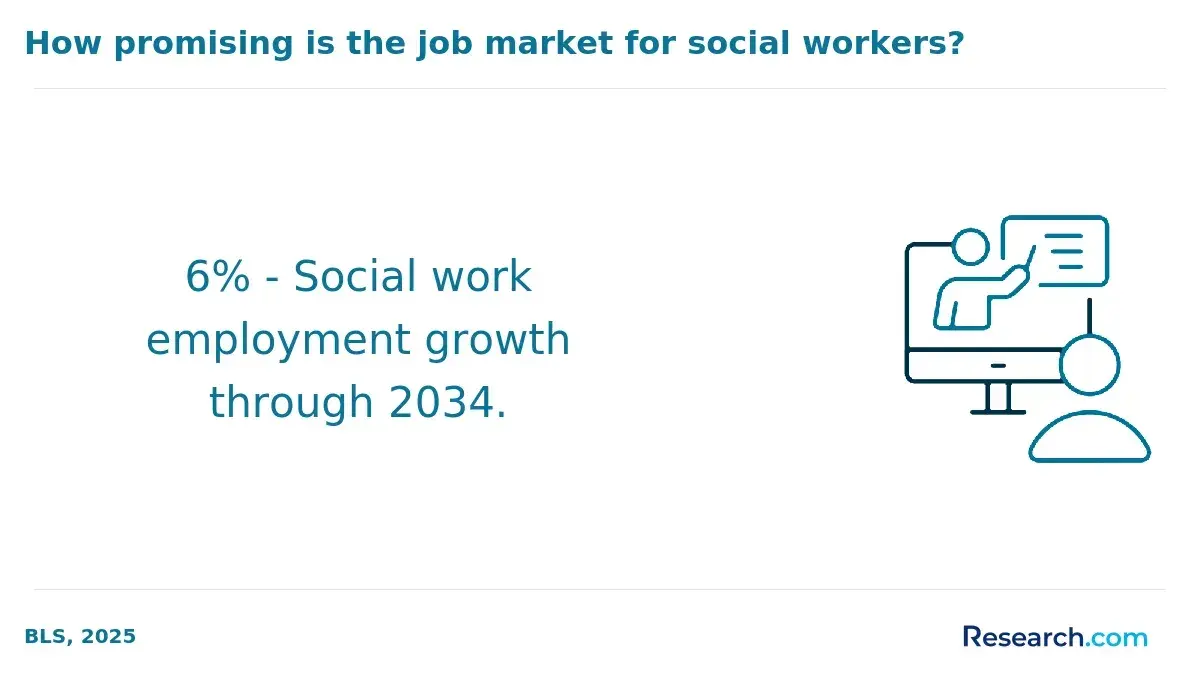
The U.S. Bureau of Labor Statistics projects employment of social workers to grow by 6% through 2034, faster than the average for all occupations. During that period, about 74,000 social worker openings are projected each year, on average.
Ohio is described as the seventh-largest employment home among U.S. states, and employment for child, family, and school social workers; healthcare social workers; mental health social workers; and related professionals is substantially higher than the national average per state. Students considering adjacent public safety or justice-related work may also compare possibilities through Research.com’s guide on jobs with a criminology degree.
Common MSW Career Paths in Ohio
| Role | What the Role Does | Reported Pay |
| Social Service Program Manager | Plans, manages, and evaluates social service programs; coordinates staff, budgets, partnerships, and services | Median Salary: $78,628 |
| Social and Community Service Manager | Oversees programs serving communities and individuals; assesses needs, manages staff, allocates resources, and reviews outcomes | Median Salary: $74,000 |
| Community Policy Manager | Develops and evaluates policies or initiatives that respond to community needs and support social change | Median Salary: $112,919 |
| Case Manager | Assesses client needs, coordinates services, builds care plans, monitors progress, and advocates for clients | Median Salary: $91,002 |
| Senior Social Worker | Provides advanced practice, guidance, supervision, mentorship, program support, and quality assurance | Average Salary: $73,466 |
What Salary Can You Earn With an MSW in Ohio?
The median annual salary for social workers in the United States is $61,330. Salary.com (2025) reports that graduates of MSW programs in Ohio earn $68,836 annually.
Education level can also affect earnings. Zippia (2025) reports that professionals with a bachelor’s degree earn an average of $55,400, compared with $62,900 for those with master’s degrees. Among licensed social workers, those with bachelor’s degrees usually earn $63,200, while licensed professionals with an MSW average $72,600.
These figures should be treated as benchmarks, not guarantees. Salary depends on license level, experience, employer type, setting, specialization, geography, caseload, supervisory responsibility, and funding model.
What Factors Influence the Online MSW Cost in Ohio?
Online MSW pricing can be difficult to compare because schools structure tuition and fees differently. Some charge by credit, some charge separate online learning fees, and others have different rates for in-state and out-of-state students.
- Tuition model: Review whether the school charges flat-rate, per-credit, in-state, out-of-state, or online-specific tuition.
- Technology and platform fees: Online programs may include technology, distance learning, or proctoring costs.
- Field placement expenses: Travel, background checks, health records, liability insurance, and required training can add costs.
- Residency requirements: Hybrid sessions or campus visits may require travel and lodging.
- Time away from work: Field hours may reduce work availability, especially in clinical placements.
- Student services: Advising, field placement coordination, career services, and exam support can affect both cost and value.
Students comparing low-cost options can use Research.com’s guide to online MSW cost to understand how tuition models and affordability factors differ across programs.
What Are the Benefits of Clinical Specialization in Ohio MSW Programs?
A clinical specialization is useful for students who want to provide therapy, assessment, diagnosis-related services, crisis intervention, or behavioral health support within the scope allowed by Ohio licensure. Clinical MSW coursework usually emphasizes mental health assessment, evidence-informed interventions, trauma-informed practice, ethics, documentation, and supervised client work.
Clinical training can also support progress toward independent practice, especially for students who intend to pursue LISW status. However, clinical specialization is not the best fit for every student. Those interested in policy, macro practice, nonprofit leadership, school systems, or community organizing may benefit more from advanced generalist, community practice, or policy-centered tracks.
Students comparing clinical routes outside Ohio can explore clinical MSW programs online and then verify whether any program meets Ohio licensure expectations.
How Do Ohio MSW Programs Promote Diversity and Inclusion in Social Work?
Social workers in Ohio serve communities with different racial, cultural, economic, rural, urban, linguistic, disability, age, and family experiences. MSW programs respond by teaching culturally responsive practice, anti-oppressive frameworks, ethics, community engagement, and policy awareness.
Strong programs do more than add one diversity course. They integrate inclusion across field education, case analysis, research, policy, clinical assessment, and community partnerships. Students should ask how programs prepare graduates to work with marginalized communities and how field sites expose students to real practice across diverse populations.
Students comparing helping professions may also review the difference between a social worker vs psychology career path.
What Post-Graduation Support Do Ohio MSW Programs Provide?
Post-graduation support can influence how quickly MSW graduates move from degree completion to employment and licensure progress. Useful support may include job boards, employer panels, resume reviews, interview preparation, supervision guidance, alumni mentorship, licensure exam resources, and continuing education opportunities.
Ask each program how it supports graduates after commencement. Strong schools can often explain how students connect with field placement employers, alumni networks, local agencies, hospitals, schools, and nonprofit organizations. Graduates exploring roles across settings can also review Research.com’s guide to careers for masters in social work.
How Does Interdisciplinary Integration Enrich MSW Education in Ohio?
Many social problems do not fit neatly into one discipline. Poverty, addiction, trauma, housing instability, aging, disability, public health, criminal justice involvement, and school challenges often require social workers to collaborate with psychologists, nurses, educators, public health professionals, attorneys, sociologists, and policy analysts.
MSW programs that include interdisciplinary learning can help students understand systems more clearly and communicate across professional settings. Relevant coursework may draw from psychology, public health, sociology, policy, human development, healthcare, or law. Students interested in social systems and community research may also compare related options such as cheap online sociology degree programs.
Can Busy Professionals Benefit From Accessible Online MSW Pathways in Ohio?
Yes, online MSW pathways can work well for busy professionals, but only when the program’s schedule, field placement process, and support services match the student’s life. A flexible course format does not remove the need for supervised practice hours, deadlines, group work, advising, or licensure preparation.
Working adults should ask whether courses are asynchronous or live, whether field placements can be completed during evenings or weekends, how many hours per week are required, and whether part-time enrollment is available. Students looking for less selective or more accessible options can review easy online MSW degree programs, while still confirming accreditation and licensure alignment.
Current Trends Affecting MSW Students in Ohio
MSW students entering the field should pay attention to changes in service delivery, technology, and employer expectations. Telehealth and hybrid service models have expanded access in some settings, especially for behavioral health support. Integrated care is also important as social workers increasingly collaborate with medical, mental health, addiction, school, and community service teams.
Artificial intelligence and automation are beginning to affect administrative workflows, documentation, scheduling, resource navigation, and data analysis. These tools may reduce some repetitive tasks, but they do not replace core social work judgment, ethics, relationship-building, crisis response, advocacy, or culturally responsive assessment. Students should build comfort with digital tools while protecting client privacy and professional boundaries.
Employers also continue to value practical experience. Field education, supervision readiness, trauma-informed care, documentation skills, and the ability to work across systems can matter as much as classroom performance.
What Professional Networking Opportunities Are Available for MSW Students in Ohio?
Networking is not just about finding a job after graduation. For MSW students, it can help identify field placements, supervisors, mentors, references, specialization paths, continuing education opportunities, and licensure guidance.
- Professional associations: Organizations such as the Ohio Chapter of NASW can connect students with advocacy updates, training, conferences, and experienced practitioners.
- Field placements: Practicum sites are often the most important early-career network. Supervisors and colleagues can become references, mentors, or future employers.
- University career services: Resume reviews, mock interviews, job fairs, and employer panels can help students translate MSW experience into targeted applications.
- Faculty relationships: Faculty can connect students with research, policy work, doctoral study, publications, and community projects.
- Alumni networks: Graduates can offer practical advice about licensure, agency culture, interviews, and local hiring patterns.
- Community service: Volunteering with nonprofits, schools, shelters, clinics, and advocacy groups can build relationships while strengthening practice insight.
If you are still deciding whether the field fits you, Research.com’s guide on whether social work is a good major can help you think through the personal and career trade-offs.
Are There 1-Year MSW Programs Available in Ohio?
Yes. One-year MSW options are typically advanced standing programs for students who already hold a Bachelor of Social Work from an accredited institution and meet academic requirements set by the school. These programs build on prior BSW coursework and move more quickly into advanced practice classes and field education.
Advanced standing can reduce time and cost, but it is not automatically easier. Students complete graduate-level work at an accelerated pace and still need to satisfy field placement expectations. This path is best for strong BSW graduates who are ready for intensive study and have a clear social work career direction.
Students comparing accelerated formats can review Research.com’s guide to 1-year MSW programs online and then confirm which options meet Ohio licensure expectations.
MSW Career Opportunities in Rural and Underserved Communities in Ohio
Rural and underserved Ohio communities can offer meaningful opportunities for MSW graduates. These settings may need social workers in schools, hospitals, community mental health agencies, county services, addiction treatment programs, aging services, child welfare, and local government.
- Broad practice exposure: Social workers in smaller communities may handle a wider range of needs than those in highly specialized urban settings.
- Community impact: Work may directly influence access to healthcare, education, mental health care, housing support, and public benefits.
- Specialized roles: Students interested in justice-involved populations may also explore forensic social work, including information related to forensic social worker salary.
- Policy relevance: Rural practice can reveal service gaps that inform advocacy, grant writing, and public policy work.
What Are the Admission Requirements for an MSW Program in Ohio?
Admission requirements vary by university, but most Ohio MSW programs expect applicants to have a bachelor’s degree from an accredited institution. Advanced standing applicants usually need a CSWE-accredited BSW and must meet the school’s academic standards.
- Completed bachelor’s degree: Traditional MSW applicants may come from social work or related fields.
- CSWE-accredited BSW: Usually required for advanced standing admission.
- Minimum GPA: Many programs set a minimum undergraduate GPA.
- Personal statement: Applicants often explain their commitment to social work, career goals, and readiness for graduate study.
- Letters of recommendation: Schools may request academic, professional, or field-related references.
- Experience: Volunteer, human services, advocacy, or professional experience can strengthen an application.
- Interview: Some programs may interview applicants to assess communication skills, fit, and readiness for fieldwork.
Students interested in behavioral health and addiction services may also compare related graduate pathways such as a master's in addiction counseling.
Common Mistakes to Avoid When Choosing an Ohio MSW Program
| Mistake | Why It Can Hurt You | Better Approach |
| Choosing without checking CSWE accreditation | Accreditation affects licensure and employer recognition | Verify accreditation directly before applying |
| Comparing only tuition per credit | Total cost depends on credits, fees, field expenses, and schedule | Calculate full program cost through graduation |
| Assuming online means fully flexible | Field hours and live sessions may still require fixed availability | Ask for a sample weekly schedule and practicum expectations |
| Ignoring field placement support | A weak placement process can delay graduation or limit experience | Ask who finds placements and what agencies are available |
| Assuming every MSW leads to the same license | Licensure rules depend on state requirements and supervision | Confirm Ohio LSW and LISW alignment with the board |
| Relying only on rankings | A highly ranked school may not fit your budget, schedule, or specialization | Balance reputation with licensure fit, cost, field quality, and support |
| Treating salary figures as guaranteed | Pay varies by employer, license, location, and experience | Compare local job postings and talk with alumni in your target role |
Is Ohio Ideal for Social Workers?
Ohio can be a strong state for social workers because of its employment levels, range of MSW programs, and opportunities across healthcare, mental health, schools, child and family services, community agencies, government, and nonprofit organizations. Students comparing helping professions may also find it useful to review the job outlook for psychology careers.
The state may be especially appealing for students who want to study and practice in the same region. Ohio MSW programs can provide local field placements, state-specific advising, and professional networks that help graduates move into supervised practice and eventually advanced licensure.
Still, Ohio is not automatically the best choice for every student. Compare the total cost, licensure requirements, specialization options, and field placement access against programs in other states. For comparison, Research.com also covers MSW programs in Colorado and human services degree options in Massachusetts.
Key Insights
- An MSW is most valuable when tied to a clear license or career goal. It is especially relevant for students pursuing LISW status, clinical work, leadership, program management, policy, or specialized practice.
- CSWE accreditation should be nonnegotiable. Accreditation affects licensure recognition, employer trust, and eligibility for advanced standing routes.
- Ohio offers multiple study formats. Students can find campus-based, online, hybrid, full-time, part-time, and advanced standing MSW options.
- Field placement quality matters as much as coursework. Practicum experiences shape skills, references, specialization, and early job opportunities.
- Costs vary widely. Compare total program cost, not just tuition per credit, and include fees, field placement expenses, licensure costs, and lost work time.
- Salary outcomes are not guaranteed. Reported salaries vary by license level, role, employer, specialization, location, and experience.
- Online MSW programs still require real-world practice. Flexibility helps working adults, but field hours and supervision requirements remain central.
- The best Ohio MSW program is the one that fits your intended practice area. Clinical, school, healthcare, rural, policy, community, and leadership paths require different program strengths.
References
- Association of Social Work Boards. (2025). The licensed social work workforce: Social work workforce study series report 2. https://www.aswb.org/wp-content/uploads/2025/07/Social-Work-Workforce-Study-Series-Report-2.pdf
- College Tuition Compare. (2025). Graduate tuition & fees - social work (MSW) programs in Ohio. https://www.collegetuitioncompare.com/graduate-programs/social-work/oh/
- Council on Social Work Education. (n.d.). Social Work at a Glance. https://www.cswe.org/students/prepare-for-your-education/social-work-at-a-glance/
- Ohio State University. (n.d.). Master of Social Work. Ohio State University Online. https://online.osu.edu/masters-degree/master-social-work/
- Ohio Counselor, Social Worker & Marriage and Family Therapist Board. (n.d.). Social Workers. https://cswmft.ohio.gov/get-licensed/social-workers
- Ohio Counselor, Social Worker & Marriage and Family Therapist Board. (n.d.). Get Licensed: Ohio CSWMFT. https://cswmft.ohio.gov/get-licensed
- National Association of Social Workers. (n.d.). Types of social work degrees. https://www.socialworkers.org/Careers/Career-Center/Explore-Social-Work/Types-of-Social-Work-Degrees
- Salary.com. (2025). Social worker salary in Ohio. https://www.salary.com/research/salary/benchmark/social-worker-salary/oh
- Social Work License Map. (2026). 2026 state by state social work licensure guide. https://socialworklicensemap.com/social-work-licensure/
- U.S. Bureau of Labor Statistics. (2025). Occupational outlook handbook: Social workers. https://www.bls.gov/ooh/community-and-social-service/social-workers.htm
Other Things You Should Know About Master’s in Social Work (MSW) Programs in Ohio (OH)
Ohio MSW programs typically require field education, including at least 900 hours of supervised practicum spread over two years. This hands-on training is essential for gaining practical experience and meeting the state’s standards for social work licensure.
Ohio offers two main licensure options: Licensed Social Worker (LSW) and Licensed Independent Social Worker (LISW). An LSW requires a bachelor’s degree and passing the ASWB exam, while an LISW requires an MSW degree, additional supervised practice hours, and passing the Master’s-level ASWB exam.
In 2027, completing a Master’s in Social Work (MSW) program in Ohio typically takes two years for full-time students. Part-time options are available, extending the duration to about three to four years. Some accelerated programs may allow completion in as little as 16 months.
MSW graduates in Ohio can pursue various roles such as social service program manager, community policy manager, case manager, and senior social worker. These roles offer competitive salaries, with social workers in Ohio earning an average annual salary of $68,836.
To gain admission into an MSW program in Ohio, you typically need a bachelor's degree from an accredited institution and a minimum GPA of 3.0. Some programs may also require prerequisite coursework in social and behavioral sciences or relevant work experience.


