
2027 Is a Degree in Social Work Worth It?

Co-Founder and Chief Data Scientist
Students often avoid pursuing a social work degree because they think it won't lead to good pay. Based on my 10 years of career planning, I understand the importance of making informed decisions about your education and career path. That's why I've delved into the latest data from credible sources to provide a comprehensive guide on whether a social work degree is worth it.
In 2023, the BLS predicted that the demand for social workers will increase by 7% in the next decade, which is more than the average growth rate for all occupations. Is it worth investing your time and money into pursuing a degree in social work? In this article, I'll break down the factors you need to consider, from job prospects and earning potential to your impact on people's lives. By the end, you'll understand whether a degree in social work aligns with your goals and aspirations.
What are the benefits of getting a social work degree?
- With a social work degree, you can work in government agencies, healthcare centers, schools, non-profits, and companies.
- Studying social work online lets you learn at your own pace and from anywhere.
- Social workers with a degree can make around $58,380 a year, more than the average salary for all occupations.
What can I expect from a social work degree?
Regarding what you'll be studying in a social work degree, expect a mix of psychology, sociology, and social policy courses. These classes are designed to equip you with the skills needed to help individuals and communities overcome challenges. On average, annual tuition for a social work degree program can range from $10,000 to $30,000, depending on location and whether you attend a public or private institution. Financial aid options, like scholarships and grants, may help offset these costs. Most programs take around four years to complete a bachelor's degree. However, pursuing a master's degree in social work (MSW) can add one to two years of study.
Where can I work with a social work degree?
You could be in traditional settings like government agencies, healthcare facilities, or schools. You could work as a child welfare worker, medical social worker, or school counselor in these roles. You could also find opportunities in non-profit organizations, mental health clinics, or corporate settings. You could focus on community outreach, counseling, or employee assistance programs here. Your possibilities are vast, and you can make a meaningful impact wherever you lend your skills and expertise.
According to data published by the BLS in 2023, the following are the largest employers of social work graduates:
- Individual and family services (17%)
- Local government, excluding education and hospitals (14%)
- State government, excluding education and hospitals (13%)
- Educational services: state, local, and private (9%)
- Community and vocational rehabilitation services (3%)
How much can I make with a social work degree?
With a social work degree, you can earn around $58,380 per year, more than the median pay for all occupations. That said, your salary can vary depending on your location, level of experience, and the specific field of social work you pursue. While entry-level positions may offer lower wages, gaining experience and specialized certifications can lead to higher earning potential over time.
The following are the top-paying states for social workers based on annual salary:
- District of Columbia ($94,250)
- New Hampshire ($93,910)
- Rhode Island ($93,520)
- Oklahoma ($91,090)
- Washington ($90,580)
- 2025 List of Fields You Can Pursue with a Social Work Degree Social Work Careers
- How long does it take to complete a social work degree? Completion Time
- How does an online social work degree compare to an on-campus program? Online vs. On-Campus
- What is the average cost of a social work degree? Degree Cost
- What are the financial aid options for students enrolling in a social work program? Financial Aid
- What are the prerequisites for enrolling in a social work program? Prerequisites
- What courses are typically in a social work program? What courses are typically in a social work program?
- What types of specializations are available in social work programs? What types of specializations are available in social work programs?
- How to choose the best social work program? How to choose the best social work program?
- What skills are essential to thrive in social work? What skills are essential to thrive in social work?
- What are the licensing and certification requirements for social work professionals? What are the licensing and certification requirements for social work professionals?
- Is accreditation a critical factor when selecting an online social work program? Is accreditation a critical factor when selecting an online social work program?
- What career paths are available for graduates of a social work program? What career paths are available for graduates of a social work program?
- Should I Pursue a Doctorate to Further My Career in Social Work? Should I Pursue a Doctorate to Further My Career in Social Work?
- What is the job market for graduates with a social work degree? What is the job market for graduates with a social work degree?
- What are the global opportunities for social workers? What are the global opportunities for social workers?
- Career Growth and Specialized Roles in Social Work Career Growth and Specialized Roles in Social Work
- How does pursuing an advanced degree enhance long-term career success in social work? How does pursuing an advanced degree enhance long-term career success in social work?
- The Role of Technology in Modern Social Work Education The Role of Technology in Modern Social Work Education
- How do internships and field placements contribute to a successful social work career? How do internships and field placements contribute to a successful social work career?
- How Can Professional Networking Accelerate Your Social Work Career? How Can Professional Networking Accelerate Your Social Work Career?
2027 Guide to Fields You Can Pursue With a Social Work Degree
A social work degree can lead to far more than one job title. Graduates work in hospitals, schools, child welfare agencies, mental health clinics, correctional settings, nonprofits, policy organizations, and community programs. The right path depends on the population you want to serve, the level of responsibility you want, your state’s licensing rules, and whether you plan to stop at a bachelor’s degree or continue into an MSW, DSW, or PhD.
This guide explains the major fields available to social work graduates, how degree levels affect career options, what online and campus programs offer, how to compare costs and accreditation, and what practical steps can help you choose a program that supports your long-term goals.
Quick Answer: What Can You Do With a Social Work Degree?
With a social work degree, you can work in direct client services, clinical counseling, school support, healthcare navigation, child and family services, substance abuse treatment, community development, nonprofit leadership, policy advocacy, research, or social service administration. A bachelor’s degree often prepares graduates for entry-level and case management roles, while an MSW is commonly required for clinical practice and many advanced positions. Doctoral degrees are typically pursued by professionals interested in research, university teaching, executive leadership, policy work, or advanced practice supervision.
| Degree Level | Common Career Direction | Best Fit |
| Bachelor’s degree | Case management, community outreach, youth services, school support, entry-level human services | Students who want to enter the field quickly and work in supervised service roles |
| Master’s degree | Clinical social work, healthcare social work, family therapy, policy advocacy, program coordination | Professionals seeking licensure, clinical responsibilities, or leadership options |
| Doctorate degree | Research, higher education, advanced administration, policy analysis, consulting, clinical supervision | Experienced social workers aiming for senior leadership, scholarship, or specialized expertise |
Top Fields for Social Work Graduates
1. Child Welfare
Child welfare social workers focus on protecting children from unsafe living conditions, neglect, abuse, family instability, and other risks. Their work may involve home visits, safety planning, court documentation, foster care coordination, family reunification services, and collaboration with schools, courts, healthcare providers, and community agencies. This field is best for people who can stay calm under pressure, communicate clearly with families in crisis, and advocate for children while navigating complex legal and ethical responsibilities.
2. Healthcare
Healthcare social workers help patients and families manage the social, emotional, financial, and practical challenges that often come with illness, disability, injury, or end-of-life care. They may assist with discharge planning, insurance barriers, care coordination, crisis counseling, transportation, housing needs, and referrals to community resources. This path is well suited to students who want to work in hospitals, clinics, hospice programs, rehabilitation centers, or long-term care settings.
3. Mental Health
Mental health social workers support individuals, families, and groups dealing with depression, anxiety, trauma, addiction, grief, severe mental illness, and other behavioral health concerns. Depending on education and licensure, they may provide counseling, therapy, crisis intervention, assessment, treatment planning, and referrals. Students interested in this field should understand that independent clinical practice usually requires graduate education, supervised experience, and state licensure.
4. Schools
School social workers help students address nonacademic barriers that affect learning, attendance, behavior, emotional regulation, peer relationships, family stability, and safety. They often work with teachers, school counselors, administrators, parents, and community agencies to support students through individual counseling, group interventions, crisis response, and resource coordination. This field fits people who care about child and adolescent development and can balance student advocacy with school system requirements.
5. Substance Abuse Counseling
Substance abuse counseling focuses on helping people reduce, manage, or recover from drug and alcohol use disorders. Social work graduates in this field may conduct assessments, develop treatment plans, lead individual or group counseling sessions, connect clients with recovery resources, and support relapse prevention. Students who choose this route should review their state’s credentialing rules because substance abuse counseling titles and practice requirements vary.
6. Gerontology
Gerontological social workers serve older adults and their families by addressing aging-related needs such as healthcare access, long-term care planning, housing, elder abuse prevention, social isolation, caregiving stress, benefits navigation, and end-of-life decisions. This field is a strong fit for people who want to help older adults maintain dignity, independence, safety, and quality of life while coordinating services across healthcare, housing, and community systems.
7. Criminal Justice
Criminal justice social workers assist people involved with courts, correctional institutions, probation, parole, victim services, reentry programs, and diversion initiatives. Their work may involve trauma support, substance abuse referrals, mental health services, restorative justice, family support, risk assessment, and reintegration planning. This field can be rewarding for social workers interested in rehabilitation, public safety, social justice, and reducing barriers that contribute to recidivism.
8. Community Development
Community development social workers work at the neighborhood, organizational, or systems level rather than focusing only on individual clients. They assess community needs, organize residents, design programs, advocate for resources, build partnerships, and support initiatives related to housing, food security, education, public health, economic opportunity, and civic participation. This path is especially relevant for students drawn to advocacy, organizing, program design, and long-term social change.
9. Nonprofit Organizations
Nonprofit social workers may provide direct services, manage programs, write grants, coordinate volunteers, evaluate outcomes, advocate for policy change, or lead community partnerships. They often work with populations affected by poverty, homelessness, domestic violence, disability, immigration challenges, food insecurity, or limited access to care. This route can appeal to graduates who want mission-driven work and are open to combining service delivery with administration and fundraising realities.
10. Family Services
Family services social workers help families manage conflict, domestic violence, parenting stress, custody challenges, behavioral issues, financial hardship, and relationship strain. Their responsibilities may include counseling, safety planning, parenting education, crisis intervention, referrals, and coordination with courts or social service agencies. This field requires strong boundaries, cultural humility, trauma-informed practice, and the ability to work with multiple family members who may have competing needs.
What Graduates Say About Studying Social Work
- Janice: "Studying social work helped me understand how classroom theory becomes practical support for real people. Through counseling practice and community outreach, I learned how to listen, assess needs, and respond with useful resources. I now work as a social worker and see the impact of those skills in daily practice."
- Lenny: "Choosing social work gave me a deeper understanding of psychology, sociology, empathy, and advocacy. My internships exposed me to different communities and showed me how social workers can support individuals while also pushing for broader social change."
- Shane: "I chose social work because I wanted meaningful work centered on helping people. My coursework and field experience prepared me to work directly with clients, and becoming licensed made it possible to contribute in a more focused professional role."
Key Findings for Prospective Social Work Students
- A social work degree is versatile. Graduates can pursue direct service, clinical, school, healthcare, criminal justice, nonprofit, policy, research, and leadership roles.
- Degree level matters. A bachelor’s degree can support entry-level roles, while an MSW is often important for clinical practice and advanced responsibilities.
- Accreditation is not optional. Students should verify that a program meets recognized social work education standards, especially if they plan to pursue licensure.
- Field education is central to the degree. Internships and supervised placements are where students build the practical judgment employers expect.
- Licensure is state-specific. Requirements differ by location, so students should check rules before enrolling, especially in online programs.
How Long Does It Take to Complete a Social Work Degree?
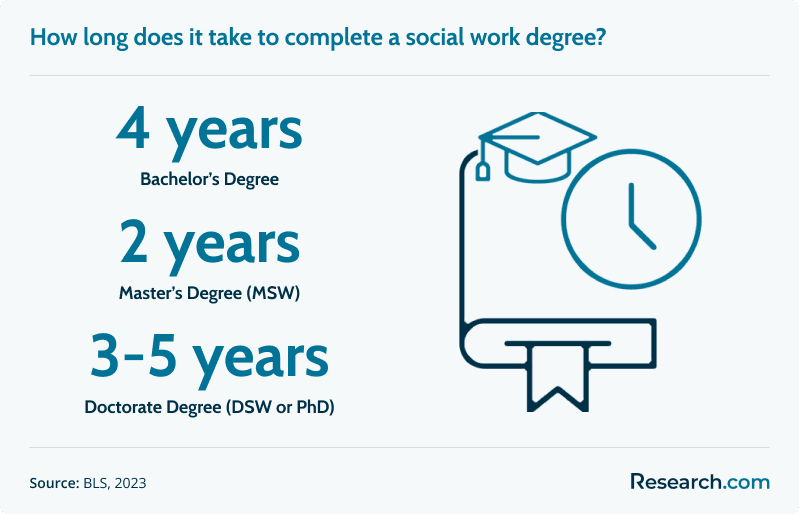
The time required depends on the degree level, enrollment status, transfer credits, field placement requirements, and whether the program offers accelerated or advanced-standing options. In general, students should plan for around four years for a bachelor’s degree, about two years for a full-time MSW, and several additional years for doctoral study.
| Degree | Typical Time to Complete | Academic Requirements Mentioned | Who It Usually Fits |
| Bachelor’s degree | Around four years | 120-130 credits of coursework, including social welfare policy, human behavior, and field practicum experiences | Students preparing for entry-level social work and human services roles |
| Master’s degree (MSW) | About two years for full-time students | 60 credits of coursework, including clinical practice, social policy analysis, research methods, and supervised fieldwork or internships | Graduates seeking clinical, specialized, or advanced practice options |
| Doctorate degree (DSW or PhD) | Three to five years or more | 60-90 credits beyond the master’s level, original research, dissertation work, and sometimes teaching or advanced clinical practice | Professionals interested in research, academic roles, policy, consulting, or senior leadership |
How Does an Online Social Work Degree Compare With an On-Campus Program?
Online and campus-based social work programs can both prepare students for the profession, but they differ in scheduling, access to faculty, peer interaction, field placement logistics, and student support. The best format depends on your location, work schedule, learning style, and whether the program can place or support you in fieldwork that meets your goals and licensure needs.
| Factor | Online Social Work Program | On-Campus Social Work Program |
| Flexibility | Often better for working adults or students with family responsibilities because coursework may be completed remotely or with fewer campus visits | Better for students who prefer a predictable classroom schedule and in-person structure |
| Accessibility | Useful for students who cannot relocate or who live far from a campus-based program | May be easier for students who live near campus and want direct access to faculty, classmates, and facilities |
| Interaction | May use video meetings, online discussions, group projects, and virtual advising | Provides more face-to-face discussion, networking, and informal campus interaction |
| Field experience | Students may need local placements, remote coordination, and careful planning; this is similar to how students evaluate placement support in the cheapest online education leadership degrees | Field offices may have established relationships with nearby agencies and supervisors |
| Cost and resources | May reduce relocation, commuting, and housing costs, but students should review technology fees and online learning expenses | May provide easier access to libraries, student organizations, faculty offices, research facilities, and campus support services |
What Is the Average Cost of a Social Work Degree?
Tuition varies widely by school type, residency status, degree level, and delivery format. Undergraduate social work programs at public universities may charge different rates for in-state and out-of-state students, with in-state students paying between $300 and $1,000 per credit hour. Private institutions may charge substantially more. Graduate programs, including MSW programs, may cost between $500 and $1,500 per credit hour.
Students comparing online options should look beyond advertised tuition. Some online programs may charge lower tuition, while others add technology, distance learning, placement, or program fees. A realistic cost estimate should include tuition, fees, books, technology, transportation to field placements, lost work hours, and any required campus visits.
The chart below lists the most in-demand social work jobs in 2022, according to BLS.
What Financial Aid Options Are Available for Social Work Students?
Social work students may be able to reduce out-of-pocket costs through grants, scholarships, loans, work-study roles, assistantships, or fellowships. The right mix depends on degree level, financial need, academic record, employer support, and whether the student attends full time or part time.
- Scholarships: Scholarships do not have to be repaid and may be awarded for academic achievement, financial need, service commitment, community involvement, or interest in a specific population or practice area. The NCES revealed that 64% of undergraduate students received grants.
- Grants: Grants are usually need-based funds from federal, state, institutional, or private sources. Like scholarships, they generally do not require repayment if eligibility rules are met.
- Loans: Federal student loans, including Direct Loans, can help cover education costs but must be repaid with interest. Private loans may be available, but students should compare repayment terms carefully. The NCES indicated that the average loan amount for undergraduates amounted to $7,700.
- Work-study programs: Work-study may allow eligible students to earn money through part-time employment while enrolled. Social work students may be able to find roles in community programs, campus offices, research projects, or service organizations.
- Assistantships and fellowships: Graduate students may qualify for assistantships or fellowships that provide tuition support, stipends, or professional experience in exchange for teaching, research, administrative, or service responsibilities.
What Are the Prerequisites for Enrolling in a Social Work Program?
Admission requirements vary by school and degree level, but most programs look for evidence that applicants can handle academic work, communicate effectively, understand service-oriented work, and demonstrate readiness for field placement. Graduate programs usually review both academic preparation and professional fit.
- Educational background: Undergraduate programs usually require a high school diploma or equivalent. Graduate programs usually require a bachelor’s degree from an accredited institution. Some schools may prefer or require prior coursework in areas such as psychology, sociology, statistics, or human services.
- Work or volunteer experience: Programs may value applicants who have served in shelters, schools, hospitals, crisis centers, youth programs, advocacy organizations, or other social service settings. Experience can show commitment and help applicants understand the realities of the field.
- Letters of recommendation: Recommendations from faculty, supervisors, employers, or professionals in related fields can help admissions committees evaluate academic readiness, ethical judgment, communication skills, and suitability for social work.
- Personal statement or essay: A strong essay explains why the applicant wants to study social work, what experiences shaped that decision, which populations or issues matter to them, and how the program aligns with their professional goals.
- Interview: Some programs use interviews to assess maturity, communication skills, self-awareness, professional boundaries, and fit with the program’s mission and field education expectations.
What Courses Are Typically Included in a Social Work Program?
Social work curricula usually combine theory, ethics, policy, research, practice methods, and supervised field education. While course names differ by school, many programs cover the following areas:
- Introduction to social work: An overview of the profession’s history, mission, ethics, values, systems, and major practice settings.
- Human behavior in the social environment: A study of psychological, biological, social, and cultural influences on development and behavior. Students interested in this area may also compare related coursework in the cheapest psychology degree online.
- Social welfare policy and services: An examination of public programs, policy development, service delivery, inequality, and the effects of policy decisions on individuals and communities.
- Cultural diversity and social work practice: Training in culturally responsive, equitable, and inclusive practice with diverse populations.
- Research methods in social work: Instruction in research design, data collection, analysis, evidence-based practice, and program evaluation.
- Social work practice with individuals and families: Skill development in assessment, interviewing, intervention planning, counseling approaches, and family support.
- Group dynamics and interventions: Preparation for leading, evaluating, and supporting therapeutic, educational, or community groups.
- Community organization and development: Strategies for engaging communities, identifying needs, building coalitions, and designing programs.
- Field education or internship: Supervised professional experience that allows students to apply classroom learning in agencies, schools, hospitals, nonprofits, or community organizations.
- Policy advocacy and social change: Training in policy analysis, advocacy, grassroots organizing, and strategies for addressing systemic injustice.
What Social Work Specializations Are Available?
Social work specializations are often grouped into micro, mezzo, and macro practice. These categories help students understand whether they prefer direct client work, family and organization-level practice, or systems-level change.
| Specialization Level | Primary Focus | Examples of Roles or Settings |
| Micro specialization | Direct work with individuals, families, or small groups | Clinical social work, case management, substance abuse counseling, youth counseling |
| Mezzo specialization | Work with groups, families, organizations, schools, and communities | Community organizing, program management, family therapy, school social work |
| Macro specialization | Policy, systems, institutions, research, and large-scale social change | Policy analysis, advocacy, nonprofit leadership, social policy research, global social work |
How Should You Choose the Best Social Work Program?
The best social work program is not necessarily the cheapest, fastest, or highest ranked. It is the program that is accredited, fits your career goal, provides appropriate field placements, supports licensure preparation, and offers a realistic total cost. Use the following criteria before applying.
- Accreditation: Confirm whether the program is accredited by the Council on Social Work Education (CSWE). Students considering nontraditional formats should also review accredited social work programs online.
- Specializations: Match the program’s concentrations with your intended field, such as clinical social work, child and family services, healthcare, school social work, policy, or community practice.
- Field education support: Ask who finds placements, whether placements are available near you, how supervision works, and whether placements align with your career interests.
- Faculty expertise: Review faculty backgrounds to see whether instructors have experience in your area of interest.
- Student support: Compare advising, writing support, career services, licensing guidance, mental health support, and help for online learners.
- Location and delivery format: Consider commuting, relocation, online requirements, campus visits, and field placement travel.
- Total cost and aid: Compare tuition, fees, books, technology costs, transportation, and available aid rather than focusing only on per-credit tuition.
- Reputation and outcomes: Review graduation rates, job placement information, alumni networks, and employer relationships when available.
- Diversity and inclusion: Look for evidence that the program prepares students to work effectively with varied communities and social identities.
- Licensure alignment: Confirm whether the curriculum and fieldwork meet requirements in the state where you intend to practice.
Questions to Ask Before Enrolling
- Is the program accredited by the appropriate social work accreditor?
- Does the program prepare students for the license I want in my state?
- Who is responsible for arranging field placements?
- Can online students complete placements in their local area?
- What are the full costs beyond tuition?
- What percentage of students complete the program and obtain relevant employment?
- Are there part-time, accelerated, or advanced-standing options?
- How does the school support students who are working while enrolled?
What Skills Are Essential to Succeed in Social Work?
Strong social workers combine compassion with professional judgment. They must build trust, assess risk, document clearly, collaborate with other professionals, and make ethical decisions in difficult situations. Communication, empathy, cultural humility, crisis response, critical thinking, advocacy, and boundary-setting are especially important. Digital case management, virtual communication, and data-informed practice are also becoming more relevant, particularly for students interested in specialized areas such as macro social work.
| Skill | Why It Matters |
| Active listening | Clients often disclose sensitive information, and accurate listening helps social workers understand needs and risks. |
| Ethical judgment | Social workers routinely balance confidentiality, safety, client autonomy, and legal obligations. |
| Cultural humility | Effective practice requires respect for clients’ identities, communities, histories, and lived experiences. |
| Documentation | Clear records support continuity of care, legal compliance, supervision, and accountability. |
| Advocacy | Clients may need help navigating systems that are complex, under-resourced, or inequitable. |
| Technology use | Modern practice often involves telehealth platforms, case management systems, electronic records, and digital collaboration. |
What Are the Licensing and Certification Requirements for Social Work Professionals?
Licensure and certification rules are set by states, so requirements can differ significantly depending on where you plan to work. Common requirements include graduation from an accredited program, supervised field or post-degree experience, a licensing exam, background checks, application fees, and continuing education. Clinical practice usually has more rigorous requirements than entry-level or supervised nonclinical roles.
Students who want broader career mobility should verify licensure rules before choosing a program, especially if they are considering an online master's in social work. Online study can be a good fit, but the program must still align with the state where the student expects to become licensed.
Is Accreditation Critical When Selecting an Online Social Work Program?
Yes. Accreditation is one of the most important factors in choosing a social work program because it helps verify academic quality and may be required for licensure eligibility. Accredited programs follow recognized standards for curriculum, ethics, field education, and professional preparation. Without appropriate accreditation, students may have trouble transferring credits, qualifying for licensure, or gaining employer recognition.
Before enrolling, confirm accreditation directly with the school and the recognized accrediting organization. Students comparing price-sensitive options may also find it useful to review the most affordable MSW programs, but affordability should never replace accreditation and licensure fit.
What Career Paths Are Available for Social Work Graduates?
Social work careers vary by education level, practice setting, licensure status, and specialization. The salaries below are listed as annual median salary figures from the original source data and should be treated as estimates rather than guaranteed outcomes. Actual pay can vary by location, employer, experience, licensure, and job duties.
Bachelor’s Degree Career Options
| Role | What the Role Involves | Annual Median Salary |
| Case Manager | Assesses client needs, creates service plans, coordinates care, connects people with housing, healthcare, benefits, and social services, and monitors progress. | $47,743 |
| Community Outreach Worker | Works with communities to identify needs, explain available services, support enrollment in programs, and address barriers related to poverty, housing, health, and access. | $45,377 |
| Substance Abuse Counselor | Supports people facing addiction through assessment, treatment planning, counseling, group sessions, and recovery resources. Students may enter this area through social work or an online substance abuse counseling degree. | $52,978 |
| Youth Counselor | Helps children and adolescents manage family conflict, school challenges, peer relationships, behavioral concerns, and emotional stress. Students do not need to become a Christian counselor to work with young people in supportive counseling roles. | $41,520 |
| School Social Worker | Supports student well-being by addressing emotional, behavioral, family, and social factors that interfere with learning and school participation. | $66,114 |
Master’s Degree Career Options
| Role | What the Role Involves | Annual Median Salary |
| Licensed Clinical Social Worker (LCSW) | Provides assessment, counseling, psychotherapy, and crisis intervention for individuals, families, or groups. Students interested in this route often compare LCSW masters programs. Earnings may be compared with a forensic psychologist salary, but the education and licensing pathways differ. | $94,158 |
| Healthcare Social Worker | Assists patients and families with care planning, emotional support, discharge needs, insurance barriers, patient advocacy, and referrals. Some professionals also build administrative knowledge through the cheapest online healthcare management degree. | $78,890 |
| Family Therapist | Works with couples and families to improve communication, reduce conflict, address relational patterns, and build healthier coping strategies. Students comparing graduate options may also review the cheapest online masters programs. | $61,001 |
| Policy Analyst/Advocate | Researches social issues, analyzes legislation, supports policy reform, organizes public education efforts, and advocates for more equitable social welfare systems. Students comparing justice-focused pathways may also review how justice and corrections social work salary varies by role and location. | $60,627 |
Doctorate Degree Career Options
| Role | What the Role Involves | Annual Median Salary |
| University Professor/Researcher | Teaches future social workers, conducts research, publishes scholarship, mentors students, and contributes to the development of the profession. | $114,792 |
| Clinical Supervisor | Guides clinicians, reviews cases, supports ethical practice, and helps practitioners strengthen assessment and intervention skills. Some professionals compare doctoral social work training with the most affordable PhD psychology programs. | $79,349 |
| Program Director/Administrator | Oversees social service programs, manages staff, handles budgets, coordinates stakeholders, ensures compliance, and improves service delivery. | $78,196 |
| Policy Analyst/Researcher | Studies social welfare systems, evaluates program effectiveness, analyzes policy problems, and recommends evidence-based changes. | $113,102 |
| Consultant/Trainer | Advises agencies on program development, cultural competency, trauma-informed care, staff training, and organizational improvement. | $76,266 |
The chart below illustrates the top-paying job roles for social work graduates, according to ZipRecruiter estimates.
Should You Pursue a Doctorate to Advance in Social Work?
A doctorate is not necessary for every social work career. Many professionals build strong careers with an MSW and appropriate licensure. A DSW or PhD makes more sense for social workers who want to teach, conduct research, shape policy, consult, supervise advanced practice, or move into senior leadership. Before enrolling, compare the cost, time commitment, dissertation or capstone expectations, and likely career benefit. Professionals seeking flexible options may review the cheapest online doctorate programs in social work.
What Is the Job Market for Social Work Graduates?
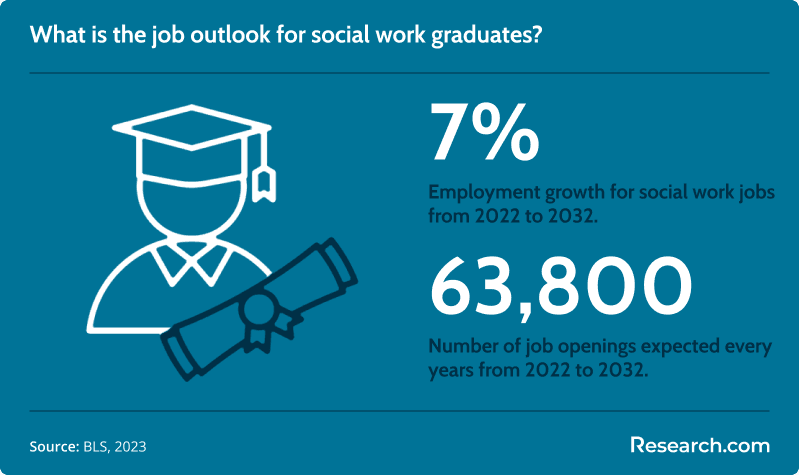
Employment opportunities for social work graduates are expected to grow by 7% between 2022 and 2032, which is faster than the average for all occupations. Around 63,800 job openings for social workers are expected each year. Demand is connected to needs in mental health care, substance abuse services, child welfare, healthcare, aging services, schools, and community support systems. Job availability still varies by region, specialization, licensure, and employer funding.
What Global Opportunities Are Available for Social Workers?
Social work can extend beyond local agencies and domestic policy systems. International roles often require cultural humility, language skills, crisis response ability, policy knowledge, and experience working with vulnerable populations. Some roles may also require advanced education, specialized field experience, or knowledge of international development and humanitarian systems.
- NGOs and humanitarian aid: Organizations such as UNICEF, Oxfam, and Save the Children may employ social workers in roles related to poverty, child welfare, education, refugee support, emergency response, and community protection.
- Global health initiatives: Social workers may contribute to projects involving HIV/AIDS, mental health awareness, substance abuse, maternal health, disability support, and public health advocacy, sometimes in collaboration with organizations such as the World Health Organization (WHO).
- International policy and advocacy: Social workers interested in systems change may work with organizations such as the United Nations (UN) on issues involving human rights, gender equality, sustainable development, migration, and social protection.
- Cross-cultural counseling and support: Migrants, refugees, expatriates, and displaced families may need help with trauma, legal systems, housing, social benefits, language barriers, and community integration.
- Education and capacity building: Some social workers train local practitioners, strengthen service systems, develop community resilience, and support program improvement in under-resourced regions.
Students who want clinical preparation with scheduling flexibility may compare online clinical MSW programs, particularly if they plan to work with diverse populations or pursue counseling-oriented roles.
Career Growth and Specialized Roles in Social Work
Career growth in social work usually depends on education, licensure, experience, specialization, supervision history, and leadership ability. Entry-level roles can build a foundation, but advanced practice, clinical authority, and senior management often require graduate training.
- Bachelor’s in Social Work (BSW): Graduates commonly begin in supervised roles such as social work assistant, case manager, community outreach worker, youth services worker, or human services coordinator. Leadership and clinical roles often require additional education.
- Master’s in Social Work (MSW): The MSW can support clinical practice, licensure preparation, program coordination, healthcare roles, school social work, policy work, and management responsibilities.
- Doctorate in Social Work (DSW) vs PhD:
- DSW: Often emphasizes advanced practice, clinical leadership, administration, policy implementation, and applied problem-solving.
- PhD: Usually emphasizes research, scholarship, teaching, theory development, and policy analysis. Students comparing advanced options should review the differences between a DSW vs PhD.
How Can an Advanced Degree Improve Long-Term Social Work Career Options?
Advanced degrees can expand access to clinical, supervisory, administrative, policy, research, and teaching roles. They may also strengthen a professional’s ability to evaluate programs, lead teams, manage complex cases, and advocate for systemic change. However, students should compare the cost and time required against the specific role they want. For role-by-role guidance, review career options for careers with masters in social work.
How Is Technology Changing Social Work Education and Practice?
Technology is changing how social work students learn, document, communicate, and serve clients. Online learning has expanded access, but students still need strong field experience and licensure-aligned training. Programs may now include digital tools, simulations, online collaboration, telehealth preparation, and data-informed practice.
- Online learning platforms: More programs offer remote coursework, hybrid formats, and accelerated options, including a social work degree fast track for students who qualify.
- Virtual simulations: Some programs use simulated client interactions to help students practice interviewing, crisis response, case planning, and ethical decision-making.
- Digital research and collaboration: Students increasingly use online databases, e-books, video meetings, discussion boards, and shared documents for coursework and group projects.
- Data-informed decisions: Coursework may cover evidence-based practice, program evaluation, and the responsible use of data in policy and case management.
- Telehealth services: Social work education may include preparation for remote counseling, virtual case management, and digital confidentiality concerns.
- Mobile tools: Case tracking, secure communication, appointment reminders, and documentation tools are becoming more common in practice settings.
- Digital advocacy: Students may learn how online platforms can support public education, community organizing, policy communication, and awareness campaigns.
How Do Internships and Field Placements Support a Social Work Career?
Field education is where social work students learn to apply theory to real situations. Internships and placements help students practice assessment, documentation, professional communication, ethical decision-making, crisis response, case management, and client engagement under supervision. They also help students identify which populations and settings fit them best.
Students should ask whether placements are available in their desired field, whether supervision meets licensure expectations, and how the school supports students if a placement becomes unsuitable. Advanced programs, including MSW advanced standing online options, often use intensive field components to build practice readiness more quickly for eligible students.
How Can Professional Networking Accelerate a Social Work Career?
Networking can help social workers find mentors, learn about emerging practice areas, identify job openings, and build partnerships with agencies, schools, hospitals, government offices, and nonprofits. Professional associations, alumni groups, conferences, field supervisors, continuing education events, and online communities can all support career development. Networking is also useful for graduates exploring related human services jobs.
How Do State-Specific Licensure and Certification Pathways Shape Your Social Work Career?
State rules influence what roles you can hold, what services you can provide, whether you can practice independently, and what title you can use. Students should check requirements before selecting a program, especially if they live in one state, study online through a school in another, and plan to move after graduation. Licensure pathways may include specific degrees, supervised hours, exams, continuing education, background checks, and periodic renewal.
Because requirements vary, prospective students should review official state boards and compare credentialing expectations. For related state-by-state credential information, see counseling certification requirements by state.
Common Mistakes to Avoid When Choosing a Social Work Degree
| Mistake | Why It Can Hurt You | Better Approach |
| Choosing a program without checking accreditation | It may affect licensure eligibility, transfer options, and employer recognition. | Verify accreditation before applying or paying deposits. |
| Comparing only tuition | Fees, books, technology, travel, and field placement costs can change the real price. | Calculate total cost of attendance and available aid. |
| Assuming all online programs meet your state’s licensure rules | Licensure requirements vary by state and may not align with every program. | Confirm state board requirements and ask the program for written guidance. |
| Ignoring field placement support | Poor placement coordination can delay graduation or limit relevant experience. | Ask how placements are arranged, supervised, and matched to career goals. |
| Choosing a specialization too quickly | Students may commit before understanding the daily realities of the work. | Use electives, internships, informational interviews, and volunteer work to test interests. |
| Assuming salary outcomes are guaranteed | Pay varies by location, employer, license, experience, and funding source. | Research local job postings and licensure requirements before borrowing heavily. |
References:
- Bureau of Labor Statistics (BLS). (2023a). Social Workers. Occupational Outlook Handbook. BLS.
- Bureau of Labor Statistics (BLS). (2023b). 21-1029 Social Workers, All Other. Occupational Employment and Wage Statistics. BLS.
- National Center for Education Statistics (NCES). (2023a). Nearly Three-Quarters of Undergraduates Received Some Type of Financial Aid in 2019-20. Press Release. NCES.
- National Center for Education Statistics (NCES). (2023b). Loans for Undergraduate Students and Debt for Bachelor’s Degree Recipients. Postsecondary Education. NCES.
- ZipRecruiter. (2024a). Professor Salary. ZipRecruiter.
- ZipRecruiter. (2024b). Policy Researcher Salary. ZipRecruiter.
- ZipRecruiter. (2024c). Licensed Clinical Social Worker Salary. ZipRecruiter.
- ZipRecruiter. (2024d). Clinical Supervisor Salary. ZipRecruiter.
- ZipRecruiter. (2024e). Healthcare Social Worker. ZipRecruiter.
Key Insights
- A social work degree can lead to many fields, including child welfare, healthcare, mental health, schools, substance abuse counseling, gerontology, criminal justice, community development, nonprofits, and family services.
- The most important decision is not only where to study, but which degree level matches your intended role. A BSW can support entry-level work, an MSW is often central for clinical and advanced practice, and a doctorate is best for research, teaching, consulting, or senior leadership.
- Accreditation and state licensure alignment should be checked before enrollment, especially for online programs and clinical career goals.
- Field placements are a major part of social work preparation. Ask how placements are secured, supervised, and connected to your career interests.
- Cost should be evaluated as a full investment, including tuition, fees, technology, transportation, books, and time away from work.
- Social work can be deeply meaningful, but it also requires resilience, ethical judgment, cultural humility, strong documentation, and the ability to work within complex systems.
Other Things You Should Know About Social Work Degree
The job outlook for social work graduates in 2027 is positive, with the Bureau of Labor Statistics predicting a 9% growth in employment opportunities for social workers from 2026 to 2036. This increase is attributed to rising demand for healthcare and social services.
For licensure, the degree should come from a program accredited by the Council on Social Work Education, or CSWE, in the United States. Most state licensing boards require a CSWE-accredited BSW or MSW before you can apply for supervised practice and the ASWB exam.
In 2027, social workers face challenges like increased demand for mental health services, evolving policies, and resource constraints. Students can prepare by focusing on in-demand skills such as digital literacy, advocacy, and cultural competence, alongside real-world internships and workshops, to navigate complex cases and diverse communities effectively.
In 2027, social work students can access scholarships like the NASW Foundation scholarships and the Verne LaMarr Lyons Scholarship. These scholarships often require full-time enrollment and focus on specific areas like minority social work or healthcare, providing crucial financial support.


