
2027 Best Accredited Schools for Social Work That Offer Multiple Degrees

Co-Founder and Chief Data Scientist
Choosing a social work school is not just a college decision. It can affect your licensure eligibility, field placement options, debt level, salary potential, and the populations you are prepared to serve. The stakes are higher now because communities continue to need trained professionals in child welfare, healthcare, mental health, substance use treatment, schools, corrections, and public agencies. At the same time, the United States faces a potential shortfall of nearly 200,000 social workers by 2030.
This guide is for students comparing accredited social work schools at the bachelor’s, master’s, and doctoral levels. You will learn what to expect from social work programs, how long they take, what they cost, how accreditation and licensure work, which specializations may fit your goals, and how to compare programs without relying only on rankings.
Quick answer: What should you look for in a social work school?
The best social work school for you is accredited, affordable for your situation, aligned with your state’s licensure requirements, and strong in the practice area you want to enter. For most students, Council on Social Work Education accreditation is one of the first things to verify because it can affect eligibility for advanced standing MSW programs, clinical licensure, and employer recognition.
Students should also compare field placement support, online versus campus delivery, faculty expertise, graduation timelines, total cost after aid, transfer credit rules, and whether the program prepares graduates for roles such as school social worker, healthcare social worker, mental health and substance abuse social worker, or licensed clinical social worker.
What are the benefits of getting a social work degree?
- Access to a broad public-service profession: Social work includes more than one career path. Graduates may work in schools, hospitals, community agencies, government offices, correctional settings, nonprofits, and behavioral health organizations.
- Preparation for a field with ongoing openings: The profession includes over 708,000 positions, and about 63,800 job openings for social workers are projected annually.
- A pathway to advanced practice: A BSW can lead to entry-level roles or advanced standing MSW options, while an MSW is commonly required for clinical and specialized positions. Online social work schools may help working adults pursue these credentials with more scheduling flexibility.
What can I expect from social work programs?
Accredited social work programs combine classroom study, ethics training, supervised field education, and practice-based learning. The goal is to prepare students to assess needs, connect people with services, advocate for clients, understand social welfare systems, and work responsibly with vulnerable populations.
- Practice preparation: Programs may cover direct practice, clinical methods, case management, policy advocacy, community organizing, research, and program administration.
- Field experience: Students usually complete supervised placements in settings such as schools, hospitals, behavioral health centers, child welfare agencies, government programs, and community organizations.
- Professional ethics: Students learn how to manage confidentiality, boundaries, mandated reporting, cultural humility, documentation, and ethical decision-making.
- Specialized training: Depending on the degree level, students may focus on clinical social work, healthcare, children and families, school social work, substance abuse, policy, leadership, or social welfare research.
A strong program should do more than provide courses. It should help you understand the realities of social work practice, including high caseloads, documentation demands, interdisciplinary collaboration, crisis response, and the emotional resilience required to remain effective in the field.
Where can I work with a social work degree?
Social work graduates are employed in many environments because social needs appear across education, healthcare, courts, housing, aging services, behavioral health, and family support systems. According to the U.S. Bureau of Labor Statistics, social workers often collaborate with teachers, physicians, counselors, public officials, nonprofit leaders, and other service providers.
| Social work area | Common work settings | What the role often involves |
| Child, family, and school social work | Schools, child welfare agencies, family service organizations, community programs | Supporting children and families, addressing abuse or neglect concerns, helping students with academic and social barriers, coordinating services |
| Healthcare social work | Hospitals, clinics, hospice programs, rehabilitation centers, long-term care settings | Helping patients and families navigate illness, discharge planning, benefits, care coordination, grief, and chronic disease challenges |
| Mental health and substance abuse social work | Behavioral health clinics, addiction treatment centers, community mental health agencies, hospitals | Providing assessment, counseling support, treatment planning, crisis intervention, referrals, and relapse-prevention support |
| Social workers, all other | Government agencies, criminal justice settings, public service programs, community organizations | Working in specialized roles that may include criminal justice, adult protective services, policy support, or community services |
- Child, Family, and School Social Workers: This category includes 355,300 jobs. California, New York, and Texas report high employment levels and competitive wages for this group.
- Healthcare Social Workers: This field includes 191,400 professionals. California leads in employment and reports an annual mean wage of $93,200.
- Mental Health and Substance Abuse Social Workers: California and New York have a strong employment presence, and top wages are well above the national average.
- Social Workers, All Other: These roles may include criminal justice, adult protective services, or community service work. California, Florida, and Minnesota have many positions, while D.C. offers top salaries.
Rural communities are especially affected by shortages, which can create opportunities for graduates who are willing to work outside major metropolitan areas. Technology, telehealth, electronic case management, and digital outreach are also changing how social workers reach clients, especially in behavioral health and remote-service settings.
How much can I make with a social work degree?
Social workers earn a median annual wage of $58,380, or about $28.07 per hour. Actual pay depends heavily on degree level, licensure status, state, employer, specialization, experience, and whether the role is clinical, administrative, school-based, healthcare-focused, or policy-oriented.
| Social work category | Reported wage information | Important salary note |
| Healthcare social workers | Mean annual wage of $67,430 | Healthcare settings may pay more than some child and family service roles, but requirements can be more specialized. |
| Child, family, and school social workers | Mean annual wage of $59,190 | Pay varies by state, school district, agency type, and level of responsibility. |
| Social Workers, All Other | Mean annual wage of $68,800 | This category includes specialized roles such as criminal justice and adult protective services. |
| Healthcare social workers in California | Mean annual wage of $93,200 | High-wage states may also have higher living costs and stronger competition. |
| Mental health and substance abuse social workers in New York | Up to $92,470 | Licensure and specialization can strongly influence access to higher-paying roles. |
Salary should be part of your decision, but it should not be the only factor. Before enrolling, compare tuition, fees, field placement requirements, time out of the workforce, loan repayment options, and the license you need for your target role.
- 2027 Best Social Work Schools
- How long does it take to complete a social work program?
- What is the average cost of social work schools?
- How can you find affordable social work programs?
- What are the financial aid options for students enrolling in social work schools?
- What are the prerequisites for enrolling in social work schools?
- What courses are typically offered in social work schools?
- What types of specializations are available in social work schools?
- How to Choose the Best Social Work Schools
- What career paths are available for graduates of social work schools?
- How do DSW and PhD in Social Work differ?
- What are the licensing and certification requirements for social work professionals?
- What Essential Skills Do Social Work Programs Instill?
- How Do Social Work Schools Promote Diversity, Equity, and Inclusion?
- Are online advanced standing MSW programs a viable option for career advancement?
- What additional career opportunities does a human services degree offer?
- What is the job market for graduates of social work schools?
- What Role Does Technology Play in Enhancing Social Work Education?
- What is the role of technology in social work education?
- How Do State-Specific Licensing and Certification Requirements Impact Your Practice?
- Why Accreditation Matters in Social Work Education
2027 Best Social Work Schools
The schools below offer recognized social work education across multiple degree levels and can serve as starting points for students comparing accredited options. Because social work is tied closely to licensure, field education, and state-specific practice rules, use this list as a research tool rather than as the only basis for your decision.
Graduates enter a profession with a median annual wage of $58,380 and a projected need for trained workers across healthcare, schools, mental health, child welfare, and public service. When reviewing each school, pay close attention to degree level, accreditation, field placement structure, specialization options, and whether the program fits your state and career goals.
How do we rank schools?
Research.com rankings are developed through research and data review by our editorial and research teams. To understand the broader ranking process, review our methodology overview. Sources used to support credible school evaluation include:
- IPEDS database
- Peterson’s database
- Distance Learning Licensed Data Set, College Scorecard database
- National Center for Education Statistics
1. University of Pennsylvania
The University of Pennsylvania offers a wide range of social work and social policy programs through its Philadelphia-based school. Its options span professional practice, research, nonprofit leadership, social policy, dual-degree study, and continuing education. Founded by Benjamin Franklin and established before the American Revolution, the university serves over 22,250 students and brings an Ivy League setting to social work education.
Accreditation: Council of Social Work Education (CSWE)
Programs:
- Bachelor of Arts in Social Work
- Master of Social Work
- MS in Social Policy
- MSSP+DA
- MS in Nonprofit Leadership
- PhD in Social Welfare
- Doctorate in Clinical Social Work
- MSW Dual Degree Programs
- MSSP Dual Degree Programs
- NPL Dual Degree Programs
2. Columbia University
Columbia University has a long history in social work education and offers programs built around CSWE standards. Its MSW curriculum includes 60 credits and pathways in areas such as clinical practice, policy, and administration. Doctoral students may study social policy, practice, mental health, human behavior, and related research areas. Columbia dates back to the 1750s and serves over 33,350 students.
Accreditation: CSWE
Programs:
- Bachelor of Science in Social Work
- Master of Social Work
- Online Master of Social Work
- PhD in Social Work
3. University of Washington
The University of Washington offers social work and social welfare degrees from undergraduate through doctoral study. The program has been associated with more than 600 field placement opportunities and includes a Social Welfare Ph.D. designed for intensive scholarly preparation. Founded in 1861, UW is a public Ivy and Association of American Universities member serving almost 47,700 students across campuses. Its program was globally top-ranked by the Center for World Rankings in 2017.
Accreditation: CSWE
Programs:
- Bachelor of Arts in Social Welfare
- Master of Social Work
- PhD in Social Welfare
4. University of North Carolina at Chapel Hill
The University of North Carolina at Chapel Hill has a century-long record in social work education and offers MSW, doctoral, online, advanced standing, and dual-degree pathways. Its field education network extends across 50 North Carolina counties. UNC-Chapel Hill is the flagship of the UNC system, dates to 1789, serves over 29,950 students annually, and has the distinction of graduating students in the 18th century.
Accreditation: CSWE
Programs:
- Bachelor of Science in Social Work
- 2-Year MSW Program
- 3-Year MSW Program – Chapel Hill
- 12-Month Advanced Standing MSW Program
- Online MSW Program
- Ph.D. in Social Work
- Dual-Degree Program — Divinity
- Dual-Degree Program — Law
- Dual-Degree Program — Public Administration
- Dual-Degree Program — Public Health
5. University of California, Los Angeles
The Luskin School of Public Affairs at the University of California, Los Angeles offers social welfare education within a large public research university. Students can pursue public affairs, gerontology-related study, MSW options, doctoral training, and joint degrees with law, public policy, Asian American studies, and public health. UCLA was established in 1919, is a land and space-grant university, serves over 45,650 students, and is recognized among leading public universities globally.
Accreditation: CSWE
Programs:
- BA in Public Affairs, Minor in Public Affairs
- BA in Public Affairs, Minor in Gerontology
- Master of Social Welfare
- PhD in Social Welfare
- Joint degree—MSW-Juris Doctor
- Joint degree—MSW-Master of Public Policy
- Joint degree—MSW-Asian American Studies (MA)
- Joint degree—Joint degree—MSW-Master of Public Health
How to use this ranking responsibly
A ranking can help you build an initial shortlist, but it should not replace your own program evaluation. Social work education is highly practical: the “best” school depends on where you plan to practice, what license you need, how much debt you can manage, and which populations you want to serve.
- Do not choose on prestige alone: A well-known university may not be the best fit if it lacks your specialization, state placement support, or affordable tuition structure.
- Confirm accreditation before applying: For social work, CSWE accreditation is especially important because it can affect advanced standing, licensure, and employer expectations.
- Ask about field education early: Field placements are central to social work training. Find out whether the school assigns placements, helps online students locally, or expects students to secure sites themselves.
- Compare total cost, not just tuition: Fees, travel, residency requirements, technology costs, lost work hours, and licensing exam preparation can change the real price of a degree.
Key Findings
- Social workers with a master's degree average $49,311 three years after graduation, showing a notable earnings increase.
- A master's degree in social work shows a 90.1% ROI after 20 years.
- Graduates with master's degrees in social work may begin seeing returns on their investment in about 8.4 years.
- The national average annual wage for social workers is $58,380, while healthcare and “all other” categories earn up to $62,940 and $63,770, respectively.
- Employment for social workers is projected to grow by 7% from 2022 to 2032.
- California, New York, and the District of Columbia are among the highest-paying locations for social workers, with annual wages well above the national average.
How long does it take to complete a social work program?
Program length depends on the degree level, enrollment status, transfer credits, advanced standing eligibility, and whether you study online, on campus, full time, or part time.
| Degree level | Typical completion time | Best fit |
| Bachelor of Social Work (BSW) | Usually four years full time | Students seeking entry-level social service roles or a foundation for advanced standing MSW study |
| Master of Social Work (MSW) | Usually two years after a bachelor’s degree | Students pursuing specialized, clinical, leadership, school, healthcare, or policy-focused roles |
| Advanced standing MSW | May be shortened to one year for students with a BSW | BSW graduates who meet program requirements and want a faster MSW pathway |
| PhD in Social Welfare or Doctor of Social Work | Often 3 to 5 years | Students pursuing research, teaching, policy leadership, advanced practice, or executive roles |
A BSW generally introduces human behavior, social welfare policy, ethics, research basics, and supervised field learning. An MSW goes deeper into assessment, intervention, policy, specialized practice, and professional field education. Students aiming for clinical licensure may explore online clinical MSW pathways, but they should always confirm that the program meets their state’s requirements.
Doctoral programs vary more widely because timelines depend on research scope, dissertation requirements, practice projects, faculty supervision, and whether the student enrolls full time or part time.
What is the average cost of social work schools?
Social work school costs vary by degree level, residency status, delivery format, public versus private institution, and financial aid. For undergraduate social work programs, the average tuition for the 2023-2024 academic year is approximately $10,008 for in-state students and $26,954 for out-of-state students.
Graduate tuition is also a major planning factor. If you are comparing graduate costs broadly, this guide explains how much a master’s degree costs. For social work graduate programs, in-state students pay around $11,118, while out-of-state students pay about $22,741.
Students who want a related but potentially lower-cost route may compare social work programs with an affordable online human services degree. Human services programs can be useful for community support, case management, and nonprofit roles, although they may not lead to the same licensure options as a CSWE-accredited social work degree.
The chart below compares social work tuition fees.
How can you find affordable social work programs?
Affordability is not just about finding the lowest tuition. A cheaper program can become expensive if credits do not transfer, field placements require unpaid hours far from home, or the degree does not meet licensure requirements in your state. A more expensive program may be worth considering if it offers strong placement support, advanced standing, employer partnerships, scholarships, or a faster path to licensure.
Ways to reduce the cost of a social work degree
- Start with in-state public options: Residency status can make a major difference in tuition.
- Check online programs carefully: Online delivery may reduce relocation and commuting costs, but fieldwork still takes place in approved agencies.
- Look for advanced standing if you have a BSW: Eligible students may complete an MSW faster, reducing tuition and time away from work.
- Compare total program cost: Include tuition, fees, books, technology costs, travel, residency weekends, background checks, and licensing-related expenses.
- Use targeted affordability lists: Students looking specifically for MSW options can compare affordable MSW programs.
- Apply for aid early: Scholarships, grants, assistantships, and work-study funds may have priority deadlines.
| Cost factor | Why it matters | Question to ask |
| Accreditation | A low-cost program may not be a good investment if it does not support licensure or advanced study. | Is the program CSWE-accredited? |
| Field placement support | Students may need local agencies that meet program and licensure expectations. | Who finds and approves my field placement? |
| Transfer credit policy | Accepted credits can reduce time and cost. | How many credits can I transfer, and which courses qualify? |
| Online requirements | Some online programs still require campus visits or synchronous sessions. | Are there in-person residencies or fixed class meeting times? |
| Licensure alignment | Requirements differ by state and role. | Does this program meet the education requirements where I plan to practice? |
What are the financial aid options for students enrolling in social work schools?
Financial aid can make a social work degree more realistic, especially for students who plan to work in public service roles where salaries may vary by setting and state. Aid packages can include funds that do not require repayment, loans that do, and employment-based options that offset costs.
- Scholarships and Grants: These are typically the most valuable forms of aid because they do not have to be repaid. Scholarships may be merit-based, while grants often consider financial need.
- Student Loans: Federal and private loans can cover remaining costs after grants and scholarships, but students should compare interest rates, repayment rules, and forgiveness options before borrowing.
- Work-Study Programs: These programs provide part-time employment that can help students pay expenses. Although 66% of students apply for federal financial aid, only 18% participate in work-study.
- State Aid: State support differs widely. The average spend is $1,051 per full-time student.
Students interested in community health, prevention, and public systems may also compare adjacent pathways such as the most affordable online public health degrees. Public health and social work overlap in population needs, but they lead to different training models and career outcomes.
Financial aid access has expanded, with 18.8% more students receiving financial aid over the past 20 years. Even so, students should borrow cautiously and compare expected salary, licensure timeline, and repayment obligations before committing.
What are the prerequisites for enrolling in social work schools?
Admission requirements depend on whether you are applying to a BSW, MSW, or doctoral program. Competitive applicants usually show academic readiness, service experience, communication skills, ethical awareness, and a clear reason for entering the field.
| Program type | Common prerequisites | How to strengthen your application |
| BSW | High school diploma or GED, and sometimes SAT/ACT scores | Volunteer in human services, take psychology or sociology courses, and show commitment to community work. |
| MSW | Bachelor’s degree, transcripts, recommendation letters, statement of purpose, and sometimes social service experience | Explain your population of interest, connect your experience to social work values, and confirm whether a BSW is required for advanced standing. |
| PhD or DSW | Usually an MSW, research or professional experience, writing sample, and advanced academic preparation | Identify faculty alignment, prepare a focused research or practice agenda, and show readiness for doctoral-level work. |
Bachelor’s Degree (BSW):
- High School Diploma or GED: Most programs require proof of secondary school completion or equivalent preparation.
- SAT/ACT Scores: Some institutions still request standardized test scores, although many have test-optional policies.
- Volunteer or Work Experience: Prior service experience is not always required, but it can show readiness for the profession.
Master’s Degree (MSW):
- Bachelor’s Degree: Applicants need an undergraduate degree. A BSW is helpful and may qualify students for advanced standing, but it is not always required for regular MSW admission.
- Transcripts: Schools review academic performance, especially in relevant social science, writing, statistics, or human services coursework.
- Professional Experience: Some programs prefer or require paid or volunteer experience in social services.
- Letters of Recommendation: References usually come from professors, supervisors, or professionals who can speak to your readiness.
- Statement of Purpose: Applicants explain why they want to study social work and what career direction they hope to pursue.
Doctoral Programs (PhD or DSW):
- Master’s Degree in Social Work: Most doctoral programs expect applicants to hold an MSW.
- Research Experience: PhD programs often look closely at research preparation and methodological interests.
- Academic Writing Sample: A writing sample helps programs assess analytical and scholarly ability.
- Professional Experience: Practice experience can be especially important for DSW applicants and applied doctoral programs.
What courses are typically offered in social work schools?
Social work curricula are designed to connect theory, policy, human behavior, ethics, assessment, and field practice. Some programs also draw on teaching, counseling, public health, psychology, and organizational leadership. Students interested in education-related support roles may find useful comparisons in affordable online master's programs for teachers, although teaching and social work remain distinct professional paths.
| Degree level | Common courses | What students learn |
| BSW | Introduction to Social Work, Human Behavior and the Social Environment, Social Welfare Policy | Professional foundations, systems thinking, ethics, policy context, and generalist practice. |
| MSW | Advanced Clinical Practice, Policy Analysis and Advocacy, Research Methods | Assessment, intervention planning, evidence-informed practice, leadership, advocacy, and specialization. |
| PhD or DSW | Advanced Theoretical Approaches, Dissertation Seminar, Leadership and Management in Social Work | Research design, theory development, advanced leadership, policy analysis, or applied practice innovation. |
Students should review course sequencing carefully. A program may advertise a specialization, but the number of electives, field placements, and faculty expertise in that area determine how much focused preparation students actually receive.
What types of specializations are available in social work schools?
Specializations help students prepare for particular client populations, work settings, or professional licenses. For example, students interested in schools and student support may compare social work options with the most affordable online school counseling degrees, but they should remember that school counseling and school social work have different licensure and job requirements.
| Specialization | Best for students interested in | Typical settings |
| Clinical Social Work | Mental health assessment, treatment planning, therapy-related practice, and behavioral health | Clinics, hospitals, community mental health centers, private practice after licensure |
| School Social Work | Student support, family engagement, attendance barriers, crisis response, and school systems | Elementary, middle, and high schools |
| Healthcare Social Work | Patient advocacy, chronic illness, discharge planning, hospice, and care coordination | Hospitals, clinics, rehabilitation centers, hospice agencies |
| Child and Family Social Work | Child welfare, family services, foster care, prevention, and family stability | Child welfare agencies, nonprofits, family service organizations |
| Substance Abuse Social Work | Addiction treatment, recovery support, relapse prevention, and co-occurring disorders | Treatment centers, behavioral health programs, hospitals, community agencies |
Choose a specialization based on your preferred population, work environment, emotional fit, licensing requirements, and long-term advancement goals.
How to Choose the Best Social Work Schools
Before comparing brochures or rankings, confirm accreditation. Students considering online study should understand how online college accreditation works and how programmatic accreditation differs from institutional accreditation. Social work applicants should also consider related disciplines such as psychology; for example, affordable online master’s programs in psychology may support mental health interests, but they do not replace a social work degree when a social work license is required.
Program selection checklist
- Verify CSWE accreditation: Students can begin by reviewing CSWE-accredited online MSW programs and confirming status directly with the school.
- Match the program to your license goal: Ask whether the curriculum and field hours support the license you want in the state where you plan to practice.
- Review field placement policies: Find out whether placements are arranged by the school, chosen by students, or handled through a shared process.
- Compare specializations: Make sure the school offers fieldwork and electives in your intended area, not just a general concentration label.
- Check flexibility: Working students may need asynchronous courses, evening options, part-time pacing, or online delivery.
- Evaluate speed carefully: Some students may benefit from 16-month online MSW programs, but accelerated schedules can be demanding.
- Ask about outcomes: Request information on licensure exam preparation, employment support, field placement completion, and alumni career paths.
Best fit by degree level
| Degree | What to prioritize | What to avoid |
| BSW | CSWE accreditation, strong generalist practice training, field placement quality, transfer credit acceptance | Programs with unclear field requirements or weak pathways to MSW advanced standing |
| MSW | Licensure alignment, specialization fit, supervised field education, faculty expertise, flexibility for working adults | Programs that do not support your state, practice area, or clinical goals |
| PhD | Research mentorship, funding, faculty alignment, methodology training, publication and teaching opportunities | Programs without faculty working in your research area |
| DSW | Applied leadership, advanced practice, organizational change, executive or clinical innovation focus | Programs that do not clearly connect coursework to your practice goals |
What career paths are available for graduates of social work schools?
Social work careers vary by degree level and licensure. A BSW may qualify graduates for generalist and case management roles, while an MSW is often needed for clinical, school, healthcare, and advanced practice positions. Some professionals also move into corrections, where corrections social workers support people involved in the justice system and may advocate for improved conditions and reentry services.
Students weighing graduate school often ask whether a master’s in social work is worth it. The answer depends on cost, licensure goals, salary expectations, and whether the MSW unlocks roles that a bachelor’s degree alone cannot.
- Child, Family, and School Social Workers: These professionals support children, families, and students through schools, community agencies, and child welfare organizations. Salaries range from $37,900 to $85,590 annually.
- Healthcare Social Workers: These social workers help people and families cope with chronic illness, terminal illness, treatment decisions, discharge planning, and care coordination. They often work in hospitals and healthcare settings and earn between $41,840 and $97,790 annually. Students interested in loss, bereavement, and end-of-life support may also explore how to become a grief counselor.
- Mental Health and Substance Abuse Social Workers: These professionals support clients with mental health conditions, addiction, or co-occurring challenges. Wages range from $37,150 to $100,090.
- Clinical Social Workers: Clinical social workers are licensed to diagnose and treat mental, emotional, and behavioral disorders. Many work in clinics, hospitals, community health centers, or private practice.
- School Social Workers: These professionals help students manage social, emotional, family, attendance, and environmental issues that affect learning.
- Public Health Social Workers: These social workers focus on community-level health and social conditions, often contributing to programs, policy, outreach, and prevention initiatives.
The chart below summarizes median annual salaries for selected social work specializations.
How do DSW and PhD in Social Work differ?
A Doctor of Social Work and a PhD in Social Work are both advanced degrees, but they are designed for different outcomes. A PhD is usually research-oriented and often prepares graduates for academic, policy research, or high-level scholarly roles. A DSW is generally practice-oriented and focuses more on advanced clinical practice, leadership, program development, and organizational change.
| Degree | Primary focus | Common career direction |
| DSW | Applied practice, leadership, clinical innovation, and management | Advanced practitioner, agency leader, clinical director, program executive, practice consultant |
| PhD in Social Work | Research, theory, policy analysis, and scholarship | Professor, researcher, policy analyst, principal investigator, academic leader |
For a deeper comparison of curricula, career outcomes, and decision factors, review this guide to the DSW degree and PhD in Social Work.
What are the licensing and certification requirements for social work professionals?
Social work licensure is set by states, so requirements differ depending on where you plan to practice and which title or scope of practice you seek. In general, licensure may involve completing an accredited degree, accumulating supervised experience, passing an Association of Social Work Boards exam, and meeting continuing education rules.
Students pursuing clinical practice should be especially careful. An online or accelerated program may be convenient, but convenience does not guarantee state licensure eligibility. If speed is a priority, compare accelerated online social work programs only after confirming accreditation, field education, supervision requirements, and state alignment.
What Essential Skills Do Social Work Programs Instill?
Strong social work programs develop practical, ethical, and interpersonal skills that graduates use daily. These skills are important whether you work with individuals, families, groups, organizations, or communities.
- Assessment and interviewing: Understanding client needs, risk factors, strengths, and environmental context.
- Communication: Listening carefully, documenting clearly, coordinating with providers, and explaining resources in plain language.
- Ethical reasoning: Managing confidentiality, boundaries, dual relationships, mandated reporting, and conflicts of interest.
- Cultural competence and humility: Serving people from different backgrounds while recognizing systemic barriers and personal bias.
- Advocacy: Helping clients navigate systems and supporting policy or organizational improvements.
- Case management: Coordinating services, referrals, follow-ups, and documentation across agencies.
- Research literacy: Using evidence-informed methods and evaluating whether interventions are working.
- Resilience and self-awareness: Managing stress, secondary trauma, and professional boundaries.
These competencies are especially important for advanced roles and jobs for a master’s degree in social work, where employers often expect leadership, specialized practice knowledge, and sound judgment.
How Do Social Work Schools Promote Diversity, Equity, and Inclusion?
Diversity, equity, and inclusion are central to social work education because social workers often serve communities affected by poverty, discrimination, disability, trauma, immigration barriers, health inequities, housing instability, and unequal access to services. Programs increasingly address these issues through coursework, field education, community partnerships, and case-based learning.
Students should look for programs that move beyond general statements and show how DEI is taught and assessed. Useful signs include required coursework on systemic inequity, faculty expertise in underserved populations, partnerships with diverse agencies, bilingual or culturally specific placement options, and training in ethical service delivery across cultures.
Students seeking advanced practice and leadership roles may also compare affordable online DSW programs that emphasize inclusive leadership, community impact, and systems-level change.
Are online advanced standing MSW programs a viable option for career advancement?
Online advanced standing MSW programs can be a strong option for students who already hold a BSW and want to move into advanced practice more quickly. These programs typically build on prior social work education rather than repeating foundational content, which can reduce time-to-degree.
They are not automatically the right choice for everyone. Students should confirm eligibility requirements, CSWE accreditation, field placement support, state licensure alignment, synchronous class expectations, and whether the accelerated pace is manageable with work and family responsibilities.
To compare options, review this guide to online advanced standing MSW programs.
What additional career opportunities does a human services degree offer?
A human services degree can prepare graduates for support roles in community programs, nonprofit agencies, social service organizations, advocacy groups, and public service settings. It may be a practical option for students who want to help people but do not plan to pursue social work licensure.
However, human services and social work degrees are not interchangeable in every career path. Students who want to become licensed social workers, especially clinical social workers, should verify whether a social work degree is required in their state. For broader career ideas, see this guide to jobs you can get with a human services degree.
What is the job market for graduates of social work schools?
The social work job market is supported by demand in healthcare, mental health, child and family services, schools, aging services, and community-based care. According to the BLS, there were around 728,600 social workers in 2022, and employment is projected to grow by 7% from 2022 to 2032, faster than the average for all occupations.
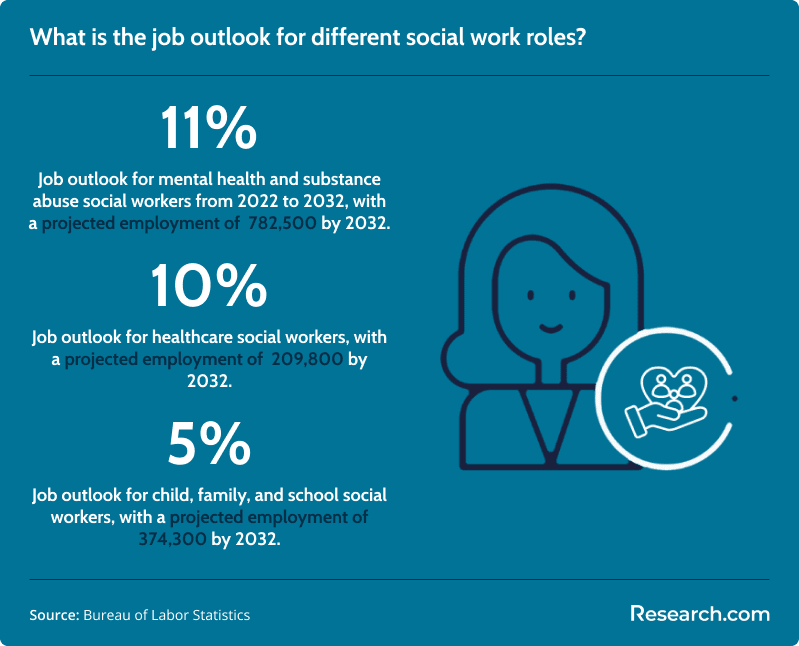
Some specializations are expected to grow faster than others. Healthcare social workers are projected to experience 10% growth due to the aging population. Mental health and substance abuse social workers are projected to see 11% growth as demand for addiction and mental health services continues to expand.
Students should interpret job outlook data realistically. Growth projections do not guarantee employment in a specific city, agency, or specialization. Local demand, licensure status, internships, language skills, experience, and willingness to work in high-need areas can all affect opportunities.
The image below provides additional context on the job outlook for social workers.
What Role Does Technology Play in Enhancing Social Work Education?
Technology now affects both how social work is taught and how services are delivered. Students may use learning management systems, virtual simulations, online advising, digital case studies, telehealth platforms, electronic documentation tools, and remote collaboration software. To understand the broader degree pathway, review this overview of a social work degree.
Technology can expand access for students who cannot relocate or attend traditional daytime classes. It can also help future social workers practice decision-making through simulated cases before entering field placements. At the same time, students must learn the limits of technology, including privacy, informed consent, digital equity, crisis response, and documentation standards.
What is the role of technology in social work education?
Technology supports social work education by making courses more flexible, improving access to resources, and preparing students for digital service delivery. Many accredited programs use online platforms for lectures, discussions, assignments, advising, and communication with field instructors.
Simulation tools and case-based digital learning can help students practice assessment, interviewing, crisis planning, ethical decision-making, and interdisciplinary collaboration. These tools do not replace field education, but they can strengthen preparation before students work with clients.
Telehealth has also become important in mental health and social service delivery. Social workers may serve clients who live in remote areas, have transportation barriers, or cannot easily attend in-person appointments. Because of this, programs should teach students about privacy, secure communication, documentation, boundaries, and state practice rules related to remote services.
How can you choose affordable online social work programs?
Affordable online social work programs can be useful for students who need flexibility, want to avoid relocation, or plan to keep working while studying. The key is to choose a program that is both affordable and academically appropriate for your goals.
- Confirm accreditation first: Affordability does not matter if the degree does not support your career or licensure plans.
- Ask how field placements work: Online students still need supervised field education, and placement support varies by school.
- Compare online fees: Some programs charge technology, distance learning, or residency fees that raise the final cost.
- Check pacing options: Part-time study may help working adults, while full-time or accelerated options may reduce time-to-degree.
- Review student support: Online learners should have access to advising, library services, tutoring, career services, and field placement coordination.
Students starting at the bachelor’s level can compare affordable online BSW programs. A BSW can provide a foundation for entry-level social service roles and may support advanced standing MSW eligibility later.
How Do State-Specific Licensing and Certification Requirements Impact Your Practice?
State rules determine what title you can use, what services you can provide, whether you can practice independently, and what supervision or exam requirements apply. This matters most for students pursuing clinical practice, school social work, or counseling-adjacent roles.
If you may move after graduation, check requirements in every state where you might practice. Do not assume that one state’s rules will transfer automatically to another. Students considering counseling-related pathways can also review counselor licensure requirements by state to understand how regulated helping professions differ by location.
Why Accreditation Matters in Social Work Education
Accreditation is one of the most important factors in choosing a social work program. CSWE accreditation signals that a program meets recognized standards for curriculum, field education, assessment, and professional preparation. For many students, it also affects eligibility for licensure, advanced standing, employer recognition, and graduate study.
Graduating from an accredited program is often required for credentials such as Licensed Clinical Social Worker. This is especially important for students who want to work in mental health, healthcare, child welfare, school settings, or independent clinical practice.
Accreditation also helps students compare programs more safely. A school may advertise flexibility, low tuition, or fast completion, but students should first verify that the degree is recognized for the professional path they want. To understand the MSW pathway more clearly, read this guide explaining what an MSW is.
Common mistakes to avoid when choosing a social work school
| Mistake | Why it can hurt you | Better approach |
| Choosing a program without checking accreditation | You may create problems for licensure, advanced standing, or employer recognition. | Verify CSWE accreditation before applying. |
| Focusing only on tuition | Fees, field travel, lost work hours, and extra terms can raise the true cost. | Compare total cost of attendance and expected time-to-completion. |
| Assuming online programs are fully remote | Field placements, residencies, or live class sessions may still be required. | Ask about in-person expectations before enrolling. |
| Ignoring state licensure rules | A program may not meet requirements where you want to practice. | Check your state board’s education, supervision, and exam rules. |
| Relying only on rankings | A highly ranked school may not fit your budget, location, specialization, or license goal. | Use rankings as a starting point, then evaluate fit. |
| Assuming salary outcomes are guaranteed | Pay depends on state, role, license, employer, experience, and specialization. | Compare local labor market data and realistic entry-level opportunities. |
Questions to ask before applying to a social work school
- Is the program CSWE-accredited?
- Does the program meet educational requirements for the license I want in my state?
- How are field placements arranged, especially for online students?
- Can I complete field hours near where I live?
- What specializations are offered, and how many courses and placements support each one?
- What is the total cost after tuition, fees, travel, books, and technology expenses?
- Are scholarships, grants, assistantships, or work-study opportunities available?
- Can I transfer credits or qualify for advanced standing?
- What support is available for licensure exam preparation?
- What roles do recent graduates commonly enter?
Key Insights
- Accreditation should come first: For social work students, CSWE accreditation can affect licensure, advanced standing, and employer acceptance.
- The right degree depends on your goal: A BSW can support entry-level roles, an MSW is commonly needed for specialized and clinical practice, and doctoral degrees serve advanced research, leadership, or practice goals.
- Field education is central: Ask how placements are found, supervised, and approved before choosing an online or campus program.
- Cost requires a full calculation: Compare tuition, fees, time-to-degree, travel, field placement demands, and financial aid rather than choosing by sticker price alone.
- Licensure is state-specific: Always verify requirements in the state where you plan to work, especially if your goal is clinical or independent practice.
- Social work offers multiple career paths: Graduates may work in child and family services, schools, healthcare, mental health, substance use treatment, corrections, public health, nonprofits, or policy roles.
- Technology is now part of preparation: Online learning, telehealth, digital documentation, and simulation tools are increasingly relevant, but students still need strong ethics, communication, and in-person field experience.
- Rankings are useful but incomplete: Use them to identify strong programs, then make your final decision based on accreditation, affordability, specialization, placement support, and licensure fit.
References:
- Child, Family, and School Social Workers. (2023, April 25). Bureau of Labor Statistics.
- Healthcare Social Workers. (2023, April 25). Bureau of Labor Statistics.
- Mental Health and Substance Abuse Social Workers. (2023, April 25). Bureau of Labor Statistics.
- Sheppard, E. (2024, March 11). Social care in 2024: the needs, the challenges and reasons to be optimistic. The Guardian.
- Social Workers: Occupational Outlook Handbook. (2024, April 17). U.S. Bureau of Labor Statistics.
- Social Workers, All Other. (2023, April 25). Bureau of Labor Statistics.
- Wecker, M. (2023, April 11). The U.S. is facing a social worker shortage as demand for youth mental health services grows. Youth Today.
Other Things You Should Know About Social Work Schools
The best accredited social work schools in 2027 typically require a bachelor's degree, a minimum GPA of 3.0, a statement of purpose, letters of recommendation, and relevant work experience. Some programs may also require GRE scores, depending on the institution's specific criteria.
In 2027, the best accredited schools for social work offer a range of degrees including Bachelor's in Social Work (BSW), Master's in Social Work (MSW), and Doctor of Social Work (DSW) or Ph.D. programs, providing students pathways to specialize in clinical, community, or policy-focused social work.
Look for regional institutional accreditation plus program approval from the Council on Social Work Education, or CSWE. If the school offers clinical preparation, its MSW should meet state licensing-board standards and include the field practicum required by CSWE-accredited programs.


