2027 Best Online One-Year MBA Programs

Co-Founder and Chief Data Scientist
An online one-year MBA is designed for professionals who want graduate business training without stepping away from work for two years. The appeal is clear: you can build management, finance, strategy, analytics, and leadership skills in a compressed format while studying online. The trade-off is that these programs move quickly, often require strong time management, and may not be ideal for students who need a slower pace or extensive in-person networking.
This guide is for working adults comparing fast online MBA options, especially those trying to balance cost, accreditation, admission requirements, specialization choices, and career outcomes. You will learn what one-year MBA programs include, how they compare with campus and executive MBA formats, what they may cost, how to judge return on investment, and which ranked programs stand out for 2027.
Quick Answer: Is an Online One-Year MBA Worth Considering?
An online one-year MBA can be a practical choice if you already have professional experience, want to move into management or a specialized business role, and can handle an intensive academic schedule. These programs commonly require 30 to 45 credits, although some listed programs require more. Tuition can vary widely, from $500 to $2,000 per credit hour or from about $20,000 to $60,000 per year, depending on the school and fee structure. The best programs are accredited, transparent about costs, and aligned with your target industry.
- Graduates may pursue roles such as product manager, marketing manager or director, financial analyst, operations manager, business consultant, healthcare administrator, and human resources manager.
- Online delivery can help students keep working while completing graduate business coursework, but the accelerated format leaves little room for falling behind.
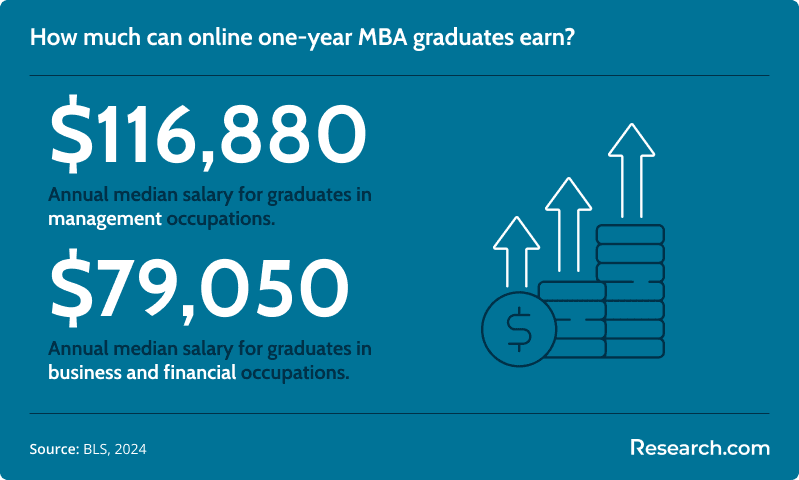
- According to 2024 BLS data, business and financial occupations have an average annual salary of $79,050, while management occupations have an average annual salary of $116,880.
- A 2024 GMAC report found that 20% of graduate business students preferred one-year MBA programs, showing sustained interest in shorter business degrees.
What can I expect from online one-year MBA degree programs?
Online one-year MBA programs compress a traditional graduate business curriculum into a shorter schedule. Students usually study core areas such as finance, accounting, marketing, leadership, operations, organizational behavior, business analytics, and strategy. Many programs also use case studies, team assignments, simulations, capstone projects, or consulting-style projects so students can apply business concepts to practical problems.
The format is usually built for working professionals. Courses may be asynchronous, live online, or a blend of both. Some programs include required in-person immersions or residencies, while others are fully online. Because the timeline is short, students should expect a heavier weekly workload than in a two-year or part-time MBA program.
Costs differ significantly by institution. Some online one-year MBA programs charge between $500 and $2,000 per credit hour, and many require about 30 to 45 credit hours. A lower per-credit price does not always mean a lower total cost, so students should compare total program tuition, mandatory fees, residency expenses, textbooks or digital materials, and employer reimbursement options before enrolling.
| What to evaluate | Why it matters | Questions to ask before applying |
| Accreditation | Accreditation helps verify academic quality and can influence employer confidence. | Is the business school accredited by AACSB, AMBA, or another recognized accreditor? |
| Program pace | A one-year MBA can be intense, especially for students working full time. | How many courses will I take at once, and how many hours per week should I expect? |
| Total cost | Fees, residencies, and technology charges can change the real price. | What is the total cost of attendance, not just tuition? |
| Career support | Online students need access to coaching, employer connections, and alumni networks. | Are career services available to online MBA students during and after graduation? |
| Specialization fit | Concentrations can help target roles in finance, analytics, healthcare, marketing, or project management. | Does the program offer coursework that matches my next career move? |
Where can I work with an online one-year MBA degree?
An online one-year MBA can be used in many business settings because the curriculum is broad. Graduates often move into management, analysis, consulting, operations, marketing, finance, technology, healthcare, or entrepreneurship. The degree is not tied to one industry, which is one reason professionals use it to change functions or prepare for leadership roles.
In finance, MBA graduates may analyze investments, budgets, risk, or corporate performance. In healthcare, they may manage departments, clinics, hospitals, payer organizations, or healthcare operations. In technology, common roles include product management, business development, operations leadership, and strategy. Marketing-focused graduates may lead brand, growth, digital marketing, or customer strategy teams.
The strongest outcomes usually come when the MBA builds on prior experience. For example, a nurse or healthcare professional who adds an MBA may be more competitive for healthcare administration roles, while an engineer who completes a STEM-focused MBA may be better positioned for technology commercialization, product strategy, or operations leadership.
How much can I make with an online one-year MBA degree?
Salary outcomes vary by industry, location, prior experience, employer, specialization, and job level. An MBA does not guarantee a specific salary. However, BLS data provides useful benchmarks for business-related fields. According to 2024 data from the BLS, the average annual salary for business and financial occupations is $79,050. Management occupations have a higher average annual salary of $116,880.
The BLS lists the following among the top-paying business and financial occupations based on annual median pay:
- Financial Analysts ($99,890)
- Personal Financial Advisors ($99,580)
- Management Analysts ($99,410)
- Project Management Specialists ($98,580)
- Labor Relations Specialists ($89,980)
Some MBA graduates may eventually earn more in senior leadership roles such as director, vice president, general manager, or executive. Others may see more modest gains if they remain in the same function or employer. For that reason, students should evaluate salary data by role and industry rather than relying only on broad MBA averages.
- Best Online One-Year MBA Programs for 2027
- How long does an online one-year MBA take?
- Online one-year MBA vs. on-campus MBA
- Average cost of online one-year MBA programs
- Financial aid options for online MBA students
- Common admission requirements
- Leadership development in accelerated MBA programs
- Common courses in one-year online MBA programs
- How to evaluate MBA return on investment
- Challenges of completing an online one-year MBA
- How competitive are online one-year MBA admissions?
- How to find affordable online one-year MBA programs
- Why accreditation matters
- Trends shaping online MBA programs
- Online one-year MBA vs. online executive MBA
- One-year MBA vs. 18 month MBA programs
- Hidden costs to watch for
- How to improve the financial value of your MBA
- Common online one-year MBA specializations
- Networking and mentorship in online MBA programs
- Healthcare management specialization and career prospects
- How to choose the best online one-year MBA program
- Further education after an online one-year MBA
- Advantages of an accelerated MBA
- How an undergraduate degree can strengthen MBA outcomes
- International recognition of online one-year MBAs
- Specialized doctorate options after an MBA
- Career paths after an online one-year MBA
- How specialization can affect salary outcomes
- Affordability and long-term career growth
- Project management training in an online MBA
- Job market for online one-year MBA graduates
List of the Best Online One-Year MBA Programs for 2027
How do we rank our schools?
Research.com evaluates schools using transparent, data-informed criteria so students can compare programs more confidently. The ranking process uses sources such as the IPEDS database, Peterson’s database, the College Scorecard, and the National Center for Education Statistics. These sources help verify institutional data, program characteristics, and student-facing information. To learn more about the evaluation process, review the Research.com methodology page.
| School | Credits | Duration | Cost | Accreditation |
| American University | 45 credits | 12, 15, or 18 months | $2,000 per credit hour | AACSB |
| Texas Tech University | 42 credits | 12 or 24 months | $13,836 for residents, $21,180 for non-residents | AACSB |
| Baylor University | 42 credits | 14 months | $1,189 per credit hour | AACSB |
| Boise State University | 49 credits | 7-week courses | $750 per credit hour | AACSB |
| University of Florida | 32 credits | 16 months | $49,205 total cost | AACSB |
| Pace University | 39 credits | 12 months | $1,510 per credit hour | AACSB |
| University of Tennessee, Knoxville | 33 credits | 12 months or less | $85,000 total cost | AACSB |
| John Carroll University | 30 credits | 12 to 36 months | $1,150 per credit hour | AACSB |
| University of South Florida | 33 to 49 credits | 12 to 24 months | $24,750 to $32,702 total cost | AACSB |
| West Virginia University | 30 credit hours | 12 to 24 months | $1,004 per credit hour | AACSB |
1. American University
American University’s online MBA is offered through the Kogod School of Business and is structured for professionals who want a flexible but rigorous business education. Students may complete the program in 12, 15, or 18 months, which gives applicants room to choose a pace that fits work and personal obligations. The program includes in-person immersions, including opportunities in Washington, DC, that can support professional networking. Coursework emphasizes strategic management, financial analysis, leadership, and global business perspectives.
- Required Credits to Graduate: 45 credits
- Duration: 12, 15, or 18 months
- Tracks/Concentrations: Business Analytics, Entrepreneurship, Marketing, Cybersecurity, Finance, Consulting, Legal Studies
- Cost: $2,000 per credit hour
- Accreditation: Association to Advance Collegiate Schools of Business (AACSB)
2. Texas Tech University
The STEM MBA from Texas Tech University’s Rawls College is an accelerated business degree with a strong technology and commercialization focus. Students can finish in one year, and the curriculum uses applied projects to connect business fundamentals with STEM-driven markets. Course topics include financial analysis, leadership, critical thinking, and technology commercialization. A capstone project asks students to develop STEM-based ideas into marketable products, and graduates also earn Microsoft Office Excel Specialist certification.
- Required Credits to Graduate: 42 credits
- Duration: 12 or 24 months
- Tracks/Concentrations: STEM
- Cost: $13,836 for residents, $21,180 for non-residents
- Accreditation: AACSB
3. Baylor University
Baylor University’s online MBA can be completed in as little as 14 months and mirrors the quality expectations of the school’s campus-based business programs. The program is designed for working professionals who want 24/7 online access and a flexible learning environment. Students can use Baylor’s alumni network of over 160,000 graduates while building leadership, communication, and analytical skills for career advancement.
- Required Credits to Graduate: 42 credits
- Duration: 14 months
- Tracks/Concentrations: Cybersecurity, Executive Communication, Global Trade and Supply Chain Management, Marketing
- Cost: $1,189 per credit hour
- Accreditation: AACSB
4. Boise State University
Boise State University’s online MBA is built for professionals with two or more years of experience who want a fully online format. The program offers six start dates each year and uses seven-week courses, which can help students progress steadily while balancing work responsibilities. It includes eight MBA emphasis areas and uses digital content instead of traditional textbooks, which may simplify access to course materials.
- Required Credits to Graduate: 49 credits
- Duration: 7-week courses
- Tracks/Concentrations: Business Administration, Business Analytics, Construction Management, Cyber, Finance, Healthcare Leadership, Marketing Leadership
- Cost: $750 per credit hour
- Accreditation: AACSB
5. University of Florida
The University of Florida’s online one-year MBA is an accelerated option for business students who meet specific prerequisites. The program requires 32 credits and offers the same degree as the longer MBA format, but it is designed for qualified students who can move through graduate business coursework at a faster pace. This format may be especially useful for applicants with prior business coursework or professional preparation.
- Required Credits to Graduate: 32 credits
- Duration: 16 months
- Tracks/Concentrations: N/A
- Cost: $49,205 total cost
- Accreditation: AACSB
6. Pace University
Pace University’s online MBA is available in one- and two-year formats and uses project-based coursework to connect business theory with workplace challenges. Students study areas such as business economics, financial accounting, and global business. Pace also provides career services that include one-on-one coaching, resume support, and networking access connected to 10,000 employers.
- Required Credits to Graduate: 39 credits
- Duration: 12 months
- Tracks/Concentrations: Business, Corporate Finance, Marketing Management
- Cost: $1,510 per credit hour
- Accreditation: AACSB
7. University of Tennessee, Knoxville
The Executive MBA – Strategic Leadership program at the University of Tennessee, Knoxville is intended for experienced professionals who want to strengthen executive-level leadership skills. The format combines distance learning with on-site residencies, allowing students to apply coursework directly to workplace projects. Four immersive residencies provide structured opportunities for applied learning, peer interaction, and leadership development.
- Required Credits to Graduate: 33 credits
- Duration: 12 months or less
- Tracks/Concentrations: Strategic Leadership, Healthcare Leadership, Global Supply Chain, Aerospace and Defense, Physician Executive MBA
- Cost: $85,000 total cost
- Accreditation: AACSB
8. John Carroll University
John Carroll University’s MBA emphasizes ethical leadership, innovation, global business, and practical decision-making. The curriculum explores issues such as market disruption, legal constraints, social responsibility, and business strategy. Students who want a values-driven business education may find the program’s emphasis on ethics and leadership especially relevant.
- Required Credits to Graduate: 30 credits
- Duration: 12 to 36 months
- Tracks/Concentrations: Accounting, Economics, Finance, Innovation & Entrepreneurship, International Business, Management, Marketing, Nonprofit Administration
- Cost: $1,150 per credit hour
- Accreditation: AACSB
9. University of South Florida
The University of South Florida’s online MBA focuses on analytics-informed decision-making, ethics, and flexible graduate business education. Students can choose concentrations in areas such as finance, cybersecurity, healthcare analytics, and related fields. The program may be completed in as little as 12 months full-time, while also offering longer options for students who need more flexibility.
- Required Credits to Graduate: 33 to 49 credits
- Duration: 12 to 24 months
- Tracks/Concentrations: Blue Economy, Compliance, Risk and Anti-Money Laundering, Cybersecurity, Data Analytics, Finance, Healthcare Analytics, Personal Financial Planning
- Cost: $24,750 to $32,702 total cost
- Accreditation: AACSB
10. West Virginia University
West Virginia University’s online MBA uses applied projects to help students develop practical management and analytical skills. The program offers certificates in areas such as business data analytics, forensic accounting, and business cybersecurity management. Its flexible online structure can serve professionals who want career growth without leaving the workforce.
- Required Credits to Graduate: 30 credit hours
- Duration: 12 to 24 months
- Tracks/Concentrations: Business Data Analytics, Forensic Accounting and Fraud Examination, Business Cybersecurity Management
- Cost: $1,004 per credit hour
- Accreditation: AACSB
What Graduates Often Value in One-Year MBA Programs
-
: "
"The one-year MBA was demanding, but the online structure made it possible to keep working while strengthening my leadership and business skills." – Silas
"
-
: "
"The biggest benefit was flexibility. I could manage family responsibilities, continue my job, and still complete a graduate business degree in a short period of time." – André
"
-
: "
"The group projects helped me feel connected to classmates even though the program was online, and I was able to apply several assignments directly at work." – Melanie
"
Key Findings
- Many online one-year MBA programs require 30 to 45 credits, though several programs on this list require 49 credits or offer variable credit ranges.
- The shortest programs are designed around a 12-month schedule, but some online MBA options listed here take 14 months, 16 months, 18 months, 24 months, or longer depending on pacing.
- Program costs vary sharply. Common published ranges include $30,000 to $90,000, while specific programs in this guide list costs from $13,836 for residents to $85,000 total cost.
- Career outcomes depend on experience, role, market, specialization, and employer. Some graduates target salaries ranging from $80,000 to $150,000, but individual results are not guaranteed.
- BLS projections show management occupations growing faster than average from 2023 to 2033, and business and financial occupations are also projected to grow faster than average during this period.
How long does it take to complete an online one-year MBA program?
Online one-year MBA programs are usually designed for completion in about 12 months, but “one-year” can mean different things by school. Some programs require exactly one year of full-time study, while others offer accelerated tracks alongside 15-month, 16-month, 18-month, 24-month, or part-time options. Students should verify whether the advertised timeline assumes full-time enrollment, waived prerequisites, prior business coursework, or a specific start date.
Accelerated MBA programs often use shorter academic terms, intensive modules, and year-round enrollment. This structure can help students finish quickly, but it also requires consistent weekly study time. Applicants who travel frequently, manage heavy work schedules, or have significant family obligations should ask whether the program allows course sequencing changes or temporary pauses.
An accelerated MBA may also be a stepping stone for later graduate study. Students thinking beyond the MBA can compare doctoral business options, including the cheapest DBA degree online, before committing to a long-term academic plan.
The chart below ranks different graduate-level business degrees by student preference, as reported by the GMAC in 2024.
How does an online one-year MBA program compare to an on-campus program?
Online and campus MBA programs can both offer rigorous graduate business education, but they serve different student needs. Online one-year MBA programs prioritize access, speed, and schedule flexibility. On-campus programs may offer more face-to-face networking, campus recruiting, and immersive peer interaction. The better option depends on your career stage, learning style, location, and need for flexibility.
| Comparison factor | Online one-year MBA | On-campus MBA |
| Flexibility | Often allows students to study from any location and access materials online. | Requires attendance on campus and may be harder to fit around full-time work. |
| Completion speed | Designed for fast completion, commonly around 12 months. | Often takes longer, though accelerated campus options exist. |
| Networking | Relies on virtual events, group projects, alumni platforms, and optional immersions. | Offers more spontaneous in-person interaction and campus-based recruiting. |
| Cost considerations | May reduce commuting, relocation, and housing costs, but technology and residency fees can apply. | May involve relocation, transportation, campus fees, or lost income if studied full time. |
| Best for | Working professionals who need flexibility and already have career momentum. | Students who value in-person recruiting, campus life, and structured networking. |
Online MBA programs can also fit students looking for flexible graduate credentials within the broader market for cheap online masters degrees, but affordability should always be weighed against accreditation, outcomes, and support services.
What is the average cost of online one-year MBA programs?
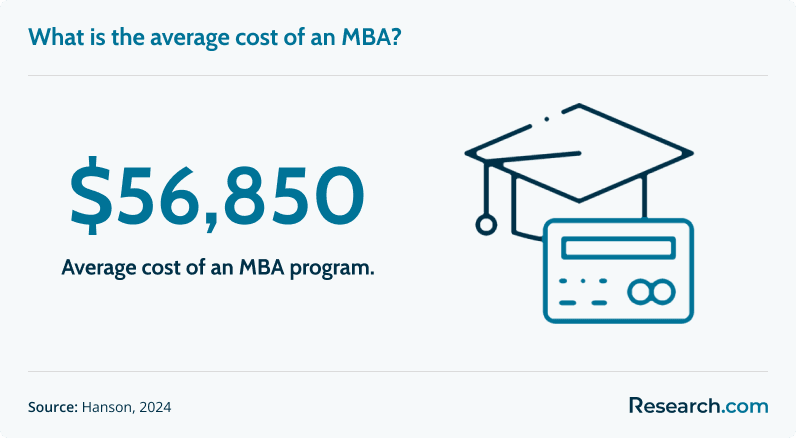
The average cost of online one-year MBA programs depends on the institution, residency status, credit requirements, and fee structure. Tuition is often listed from $20,000 to $60,000 per year, while total expenses may reach $30,000 to $70,000 for the full program. Some programs cost less, and some executive-style or residency-heavy programs cost more.
Students comparing lower-cost options can start with Research.com’s guide to the best online MBA under 30k. However, a lower price should not be the only deciding factor. An inexpensive program may still be a poor fit if it lacks the specialization, accreditation, faculty access, or career support you need.
| Cost category | What it may include | Why to check it |
| Tuition | Per-credit or total program tuition | This is the largest expense, but it may not include mandatory fees. |
| Technology fees | Online platform access, digital systems, or technical services | These can add recurring costs each term. |
| Residency or immersion costs | Travel, lodging, meals, and program fees for in-person sessions | Even online programs may require campus or city-based attendance. |
| Books and materials | Textbooks, simulations, digital content, or course packets | Some programs include digital content; others bill separately. |
| Graduation and application fees | Application processing, transcript, and graduation charges | Small fees can add up across the full program. |
What are the financial aid options for students enrolling in an online one-year MBA program?
Online MBA students may be able to use several funding sources. Availability depends on the school, enrollment status, citizenship or residency, employer policies, and academic eligibility. Always ask the school’s financial aid office whether online MBA students qualify for the same aid options as campus students.
- Federal Student Loans: Eligible students can submit the FAFSA to be considered for federal loan options. Federal loans may offer borrower protections and repayment choices that differ from private loans.
- Private Loans: Banks, credit unions, and private lenders may offer graduate education loans. Compare interest rates, fees, repayment timelines, cosigner rules, and deferment options before borrowing.
- Employer Tuition Assistance: Some employers reimburse tuition or pay part of the cost for job-relevant graduate education. Companies such as Deloitte and AT&T provide financial support to employees pursuing an MBA.
- Scholarships: Business schools and outside organizations may offer merit-based, need-based, demographic, or industry-specific scholarships. The Forté Foundation, for example, provides MBA scholarships for women.
- Grants: Some students may qualify for grants that do not need to be repaid. Ask each school about institutional, state, or federal grant eligibility for graduate business students.
- Graduate Assistantships: A limited number of schools offer assistantships that exchange part-time work for tuition support or stipends. These opportunities are often competitive and may be less common in fully online programs.
- Military Benefits: Veterans and active-duty military members may use benefits such as the GI Bill. Some universities also provide military-specific scholarships or tuition discounts.
- Corporate Partnerships: Universities may partner with employers to provide tuition discounts to employees. Ask your HR department whether your company has preferred-school agreements.
What are the prerequisites for enrolling in an online one-year MBA program?
Admission requirements vary, but accelerated MBA programs often expect applicants to be ready for graduate-level business work from the first term. Some programs prefer applicants with business coursework, professional experience, or quantitative preparation because the pace leaves little time for remediation.
- Bachelor’s Degree: Applicants typically need a bachelor’s degree from an accredited institution. Some programs prefer business or related majors, while others accept students from any academic background.
- Work Experience: Many one-year MBA programs prefer or require 2-5 years of professional experience so students can contribute to case discussions and applied projects.
- GMAT or GRE Scores: Some schools require standardized test scores, while others offer waivers for applicants with strong grades, advanced degrees, or meaningful professional experience.
- Letters of Recommendation: Programs often request two or three recommendations from supervisors, colleagues, professors, or professional contacts who can speak to leadership potential and readiness.
- Personal Statement or Essay: Applicants usually explain their career goals, reasons for pursuing an MBA, and fit with the program’s format and curriculum.
- English Proficiency: International applicants may need TOEFL or IELTS scores unless they meet an English-language education or residency exemption.
The chart below lists the most popular graduate fields of study, as reported by the NCES in 2024.
What is the role of leadership development in one-year MBA programs?
Leadership development is central to most online one-year MBA programs because many students enroll to move into management, lead teams, or influence strategy. Strong programs do more than teach management vocabulary; they give students structured practice in decision-making, communication, conflict resolution, ethical judgment, and change management.
Common leadership-related courses include organizational behavior, strategic leadership, executive communication, and business ethics. Applied components such as case studies, simulations, capstone projects, and team assignments help students test leadership approaches in realistic business scenarios.
Students who want a deeper leadership focus may compare general MBA programs with an online MBA in leadership. A specialized leadership MBA may provide more coursework in organizational change, team performance, negotiation, and global leadership, while a general MBA may offer broader business coverage.
What courses are typically in online one-year MBA programs?
Online one-year MBA programs usually begin with core business courses and may add electives, concentrations, or a capstone. Because the format is accelerated, students should check whether foundational courses are built into the program or expected before admission.
- Financial Management: Covers budgeting, forecasting, capital allocation, financial analysis, and investment decision-making.
- Marketing Strategy: Examines customers, markets, brand positioning, digital marketing, and campaign planning.
- Operations Management: Focuses on processes, resource use, productivity, supply chains, and organizational efficiency.
- Organizational Behavior: Studies people, teams, workplace culture, motivation, and leadership. Related undergraduate foundations may also appear in the cheapest BS in Organizational Leadership degree online.
- Strategic Management: Teaches students how to assess competition, set priorities, and implement long-term organizational plans.
- Managerial Economics: Applies economic reasoning to pricing, markets, competition, and business decision-making.
- Business Ethics: Explores responsible leadership, governance, stakeholder obligations, and ethical dilemmas.
- Entrepreneurship: Covers opportunity analysis, innovation, business planning, startup finance, and risk management.
How can you evaluate the ROI of online one-year MBA programs?
Return on investment is not just a salary calculation. For an online one-year MBA, ROI should include total cost, time to completion, opportunity cost, expected career movement, employer support, alumni access, and how well the curriculum matches your target role. A fast program can improve ROI by shortening the time to graduation, but only if the degree supports a realistic career goal.
Start by calculating your full cost of attendance. Include tuition, fees, books, travel for residencies, interest on loans, and any income reduction if you cut work hours. Then compare that total with realistic post-MBA outcomes for your background. Some programs report graduates with an average salary increase of 30% or more within the first year of completion, but applicants should verify whether those figures apply to online students, full-time students, or a specific graduating class.
Next, examine the program’s career infrastructure. Strong MBA ROI often depends on access to advisors, employer events, alumni connections, interview preparation, and industry-specific networking. Programs with tracks in technology management, analytics, healthcare, finance, or other high-demand areas may be more valuable when they match your existing experience and target market.
For a broader comparison of fast MBA options, review Research.com’s guide to 12 month MBA online programs. Use rankings as a starting point, then verify costs, outcomes, accreditation, and career services directly with each school.
| ROI factor | Positive signal | Warning sign |
| Total cost | The school publishes a clear full-program cost. | Fees, residencies, and materials are hard to find. |
| Career alignment | The curriculum directly supports your target role or industry. | The program is general and lacks relevant electives or projects. |
| Employer value | Your employer recognizes the school and may offer tuition assistance. | Your employer is unsure whether the degree helps promotion decisions. |
| Student support | Online students receive career coaching, advising, and alumni access. | Support services are mainly designed for campus students. |
| Time commitment | You can realistically complete the workload without harming job performance. | The schedule is too compressed for your work and family obligations. |
What are the challenges of completing an online one-year MBA program?
The main challenge is intensity. A one-year MBA compresses a large amount of graduate business content into a short period, which can make weekly reading, assignments, team projects, and exams difficult to manage alongside full-time work. Students who fall behind early may have less time to recover than they would in a longer program.
Networking can also require more deliberate effort. Online students may not have the same informal access to classmates, faculty, recruiters, or alumni that campus students experience. Before enrolling, ask how the program supports mentorship, virtual networking, student groups, career coaching, and employer engagement.
Applicants targeting senior roles should also verify whether the program’s career services and curriculum prepare students for competitive paths, including the highest paying MBA jobs. The degree alone is rarely enough; outcomes depend on experience, skills, professional network, and job-market timing.
How competitive is admission for an online one-year MBA program?
Admission competitiveness varies widely. Some online one-year MBA programs are selective and expect strong undergraduate performance, meaningful work experience, leadership evidence, and clear career goals. Others use more flexible criteria or offer test waivers for qualified applicants.
Applicants should compare each school’s requirements rather than assuming all accelerated programs are equally difficult to enter. Review GPA expectations, work experience requirements, GMAT or GRE policies, recommendation rules, and essay prompts. If your academic record is uneven, look for programs that weigh professional experience heavily. If your work experience is limited, a less accelerated MBA or a program with foundation courses may be a better fit.
Students looking for broader admission options can review Research.com’s guide to easy to get into MBA programs, then compare those options against accreditation, cost, and career support.
How can I find affordable online one-year MBA programs?
To find an affordable online one-year MBA, compare the full program cost rather than the advertised per-credit tuition alone. Include required credits, mandatory fees, residency travel, software, books, graduation fees, and loan interest. A program with low tuition but high fees may not be the lowest-cost option.
Use a shortlist strategy. First, filter for accreditation and delivery format. Next, compare total costs and financial aid. Then evaluate curriculum fit, employer reputation, and career support. Research.com’s guide to cheap MBA programs can help identify lower-cost options, but you should still confirm current pricing directly with each school.
What role does accreditation play in an online one-year MBA program?
Accreditation is one of the most important quality checks for any MBA program. It signals that an institution or business school has gone through external review for academic standards, curriculum quality, faculty qualifications, student support, and continuous improvement. For business programs, AACSB accreditation is widely recognized, and some students may also consider AMBA or other respected accrediting bodies.
Before applying, verify accreditation through the school and the accreditor, not only through marketing materials. You can search AACSB-accredited schools through AACSB. Students comparing accredited online MBA options can also review Research.com’s guide to the top MBA online.
How are emerging trends shaping online one-year MBA programs?
Online MBA programs are changing as employers place more emphasis on analytics, digital transformation, AI-supported decision-making, cybersecurity awareness, and cross-functional leadership. Many programs now include business analytics, technology management, digital collaboration, and data-informed strategy in the curriculum.
Instructional delivery is also evolving. Programs may use asynchronous modules, live virtual sessions, online simulations, team collaboration tools, and shorter course formats. These features can improve flexibility, but students should still ask how much live participation is required and whether the technology supports meaningful interaction.
Students prioritizing speed can compare formats in Research.com’s guide to the fastest MBA online options. Fast completion should be weighed against workload, academic depth, and networking access.
How does an online one-year MBA compare with online executive MBA programs?
An online one-year MBA is usually designed for professionals who want broad graduate business training and faster career movement. It may serve early- to mid-career professionals, career changers, entrepreneurs, analysts, and managers moving into broader leadership roles.
Online executive MBA programs are typically built for more experienced leaders who already manage teams, budgets, business units, or strategic initiatives. These programs often emphasize peer learning, executive decision-making, organizational strategy, and high-level leadership application. Research.com’s guide to online executive MBA programs can help experienced professionals compare that path with a standard accelerated MBA.
| Program type | Best for | Common focus |
| Online one-year MBA | Professionals seeking fast graduate business training | Business fundamentals, leadership, analytics, finance, marketing, strategy |
| Online executive MBA | Experienced managers and senior professionals | Executive leadership, strategy, peer learning, organizational transformation |
Is a one-year MBA the best fit compared to 18 month MBA programs?
A one-year MBA is best for students who can manage a concentrated schedule and want to finish as quickly as possible. It may be a strong option if you already have business knowledge, employer support, clear career goals, and enough weekly time for intensive study.
By contrast, 18 month MBA programs may give students more room for electives, networking, career coaching, internships, or deeper exploration of complex subjects. The additional time can be useful for career changers who need to build a new professional network or students who cannot sustain a 12-month workload.
What are the hidden costs associated with an online one-year MBA program?
Hidden costs can change the affordability of an online MBA. Beyond tuition, students may pay technology fees, online learning fees, proctoring charges, digital platform fees, textbooks or simulations, graduation fees, and travel costs for required residencies. Some programs also require students to attend networking events or immersions that involve lodging and transportation.
Ask each school for a full cost-of-attendance estimate before applying. Research.com’s guide to MBA online fees explains common online MBA cost categories and can help you avoid comparing programs on tuition alone.
How can I optimize the financial investment of my online one-year MBA?
To improve the financial value of an online one-year MBA, begin with a written budget. Include tuition, fees, books, travel, lost income if applicable, and loan interest. Then subtract scholarships, employer tuition assistance, military benefits, and any cash payments you can make without excessive financial strain.
Next, connect the MBA to a specific career move. A program is more likely to be worth the cost if it supports a realistic promotion, industry transition, specialization, or business goal. Compare school-reported outcomes with public labor-market data and your own professional network. For detailed cost categories, review Research.com’s guide to online MBA cost.
- Confirm accreditation and online student eligibility for aid.
- Request the full cost of attendance from each school.
- Ask your employer about tuition reimbursement before applying.
- Compare specializations against your target job descriptions.
- Estimate your payback period using conservative salary assumptions.
- Avoid borrowing based on best-case salary outcomes.
What types of specializations are available in an online one-year MBA program?
Specializations help students connect a broad MBA curriculum to a specific career direction. Not every one-year MBA offers concentrations because shorter programs sometimes prioritize core coursework. If specialization is important, confirm how many electives are available and whether the concentration can be completed within the accelerated timeline.
- Finance: Focuses on corporate finance, investment analysis, financial strategy, and risk. Students interested in financial operations may also compare shorter credentials such as bookkeeper certification.
- Marketing: Covers consumer behavior, brand strategy, digital campaigns, market research, and growth strategy.
- Healthcare Management: Prepares students for leadership in hospitals, healthcare systems, insurance organizations, and related healthcare settings.
- Entrepreneurship: Explores venture creation, innovation, business planning, funding, and startup growth.
- Data Analytics: Teaches students to use data for business decisions in finance, marketing, operations, and strategy. Students who want deeper technical preparation before graduate business study may also consider the cheapest online BS in Computer Information Systems.
- International Business: Examines global markets, international trade, cross-cultural management, and multinational strategy.
- Project Management: Focuses on planning, execution, budgeting, risk management, and leading complex initiatives.
How can online one-year MBA programs enhance networking and mentorship opportunities?
Networking in an online MBA does not happen automatically. Strong programs build it into the student experience through live sessions, discussion groups, alumni platforms, virtual employer events, peer teams, mentoring programs, and optional residencies. Students should ask whether networking opportunities are structured, frequent, and available to online students in the same way they are to campus students.
Mentorship can be especially valuable in an accelerated program because students have limited time to explore career options. Look for access to faculty mentors, alumni mentors, executive speakers, career coaches, and industry-specific groups. If affordability and accreditation are both priorities, Research.com’s guide to the cheapest AACSB accredited online MBA can help you compare programs with recognized business accreditation.
Can a healthcare management specialization boost my career prospects?
A healthcare management specialization can help professionals connect business training to healthcare operations, compliance, finance, strategy, and leadership. It may be especially useful for clinicians, administrators, analysts, or managers who want to move into hospital administration, clinical operations, health system leadership, healthcare consulting, or related roles.
The value depends on your background and target role. A healthcare specialization may be more useful than a general MBA if employers in your market prefer candidates who understand healthcare regulations, patient-centered operations, quality improvement, and digital transformation. Students comparing cost-conscious options can review the most affordable online MBA healthcare management programs.
How to choose the best online one-year MBA program?
The best online one-year MBA is not automatically the highest-ranked or fastest option. It is the program that matches your career goal, budget, learning style, schedule, and support needs. Use the following criteria before applying.
- Accreditation: Confirm that the institution and business school meet recognized standards. Business accreditation from organizations such as AACSB or AMBA can strengthen degree credibility.
- Curriculum: Review required courses, electives, capstones, and concentrations. Make sure the program teaches the skills required for your target roles.
- Flexibility: Check whether courses are asynchronous, live, hybrid, or cohort-based. Ask about attendance rules and assignment deadlines.
- Cost: Compare full program cost, not just tuition. Include technology, residency, materials, and graduation fees.
- Faculty: Look for faculty with relevant academic credentials, business experience, research expertise, or industry connections.
- Networking Opportunities: Ask how online students meet classmates, alumni, employers, and faculty outside normal coursework.
- Student Support: Confirm access to academic advising, technical help, library resources, tutoring, and career coaching.
- Specializations: Choose a concentration only if it supports your goals. Students interested in technology leadership may also compare options such as an affordable online masters in artificial intelligence.
- Reputation: Review rankings, employer perception, alumni outcomes, and student feedback, but do not rely on reputation alone.
- Job Placement: Ask for career outcomes specific to online MBA students, not only full-time campus MBA graduates.
| Common mistake | Why it can hurt you | Better approach |
| Choosing only by speed | The fastest program may not offer the support or specialization you need. | Balance timeline with curriculum, workload, and career services. |
| Ignoring accreditation | Employers may question the quality of the degree. | Verify institutional and business-school accreditation before applying. |
| Comparing tuition only | Fees and residencies can significantly change total cost. | Use total cost of attendance for all comparisons. |
| Assuming online means self-paced | Many online MBAs have strict deadlines, cohorts, or live sessions. | Ask for sample weekly schedules and attendance expectations. |
| Relying only on rankings | A highly ranked program may not fit your industry or budget. | Use rankings as a filter, then evaluate personal fit. |
| Expecting guaranteed salary growth | MBA salary outcomes vary widely by experience and market. | Use conservative ROI estimates and role-specific salary data. |
Is further education a viable next step after an online one-year MBA?
Further education can make sense if your career goal requires deeper specialization, research training, licensure-related preparation, or executive credibility in a specific field. For many MBA graduates, additional education is not immediately necessary; professional experience, certifications, and targeted networking may provide better short-term value.
However, some professionals combine business training with advanced healthcare, technology, or research credentials. For example, students interested in linking management with pharmacy or clinical innovation may explore the best online Pharm D programs. Before enrolling in another degree, compare the cost, time commitment, licensure implications, and career payoff.
What are the advantages of completing an accelerated MBA?
An accelerated MBA allows students to earn a graduate business degree faster than traditional two-year formats. This can reduce time away from career progression and help professionals apply new skills quickly. For students who are already working, an online accelerated format may also make it possible to study without relocating or leaving employment.
The main advantages are speed, flexibility, and applied learning. Many accelerated programs use case studies, team projects, and capstones that connect coursework to current business problems. Students can often bring workplace challenges into class discussions and apply new frameworks immediately.
Cost can also be an advantage when a shorter program reduces total enrollment time, although this is not always true. Students focused on affordability can compare options such as an MBA under 10k per year, while still checking accreditation and support services.
How can a complementary undergraduate degree boost my online one-year MBA career?
Your undergraduate background can shape how employers interpret your MBA. A business degree may help you move quickly through foundational concepts, while a technical, healthcare, engineering, or analytics background can make you more competitive for specialized leadership roles. The strongest profile often combines domain expertise with business strategy.
For example, professionals with healthcare undergraduate preparation may use an MBA to pursue healthcare administration or operations leadership. Students comparing healthcare-focused undergraduate options can review Research.com’s guide to the best paying bachelor degrees in healthcare and consider how those backgrounds may pair with graduate management training.
Is an online one-year MBA recognized internationally?
An online one-year MBA from an accredited institution may be recognized by employers outside the United States, but international acceptance depends on the school’s reputation, accreditation, curriculum, country-specific expectations, and employer policies. Students seeking global roles should verify whether the program includes international business content, global peer interaction, and alumni or employer connections beyond the U.S.
If international mobility is a priority, ask admissions staff how graduates use the degree globally and whether the diploma or transcript identifies the delivery mode. You can also compare recognized options in Research.com’s guide to the best one year online MBA programs.
Can pursuing a specialized doctorate complement an online one-year MBA for career advancement?
A specialized doctorate can complement an MBA when your goal requires advanced professional expertise, research capability, or leadership in a regulated field. This route is most relevant for professionals who want to combine strategic management with deep domain knowledge in healthcare, pharmacy, technology, education, or organizational leadership.
The decision should be made carefully. Doctoral programs require major time and financial commitments, and not all roles require them. Students considering pharmacy-focused leadership pathways can compare cheapest online PharmD programs accredited options while verifying licensure and accreditation requirements directly with each school and relevant regulatory body.
What career paths are available for graduates of an online one-year MBA program?
Online one-year MBA graduates can pursue many business roles, especially when the degree builds on prior professional experience. The best career path depends on your specialization, industry background, leadership experience, and willingness to network.
- Business Consultant: Helps organizations improve processes, solve business problems, manage change, or evaluate strategy.
- Marketing Manager: Oversees marketing campaigns, customer strategy, brand positioning, analytics, and team execution.
- Financial Analyst: Evaluates budgets, investments, forecasts, and financial performance for organizations or clients.
- Operations Manager: Improves workflows, productivity, supply chains, service delivery, and organizational efficiency.
- Entrepreneur: Uses MBA training in finance, marketing, strategy, and management to launch or grow a business.
- Product Manager: Coordinates product strategy, customer needs, development priorities, market research, and launch planning.
- Healthcare Administrator: Manages healthcare departments, clinics, hospitals, or operational teams in health-related organizations.
- Human Resources Manager: Leads hiring, employee relations, performance systems, benefits, workforce planning, and workplace culture. Some professionals combine MBA study with online HR masters training.
The chart below lists the industries planning to hire more MBA graduates in 2024, according to GMAC.
Does specialization impact salary outcomes?
Specialization can influence salary outcomes because some concentrations align with higher-paying industries or roles. Finance, analytics, technology management, healthcare management, and project management may lead to different compensation patterns depending on employer demand and prior experience. However, a concentration alone does not guarantee higher pay.
Students should compare specialization choices against job postings, BLS data, employer expectations, and alumni outcomes. Research.com’s guide to the highest paid MBA specialization programs can help you explore how concentrations relate to compensation, but your individual results will depend on market conditions and career history.
How does program affordability influence long-term career growth?
Affordability affects long-term career growth because high debt can limit your flexibility after graduation. If you borrow heavily, you may feel pressured to choose the highest-paying job available rather than the role that best supports your long-term goals. A lower-cost MBA can improve ROI when it still provides accreditation, relevant coursework, and strong career support.
For students targeting healthcare leadership, comparing an affordable online MBA degree in healthcare management can be a useful benchmark. The goal is not simply to find the cheapest program, but to find the lowest-cost program that still meets your professional needs.
How can project management training boost my online one-year MBA experience?
Project management training can strengthen an MBA by giving students practical tools for planning, execution, budgeting, risk management, stakeholder communication, and team coordination. These skills are useful in operations, consulting, technology, healthcare, construction, finance, marketing, and entrepreneurship.
Students who manage cross-functional work may benefit from MBA courses or electives that include agile methods, resource allocation, process improvement, and project leadership. If you want a deeper credential focused specifically on projects, compare options such as an affordable online project management degree.
What is the job market for graduates with an online one-year MBA degree?
The job market for MBA graduates depends on industry, specialization, experience level, and location. According to 2024 BLS data, management occupations are projected to grow faster than average from 2023 to 2033, with about 1.2 million job openings each year. Business and financial occupations are also projected to grow faster than average, with around 963,500 job openings expected each year during that period.
These projections suggest continued demand for business, management, and financial skills. Still, MBA graduates should not assume automatic advancement. Employers usually look for a combination of education, measurable achievements, communication skills, analytical ability, leadership experience, and industry knowledge.
Some graduates pursue further education in leadership or organizational development. Those considering doctoral-level leadership paths can compare options related to doctor of education in organizational leadership salary, while weighing the time and cost of additional study.
Key Insights
- An online one-year MBA is best for experienced professionals who need speed and flexibility, not for students who want a slower pace or extensive in-person networking.
- Accreditation should be a non-negotiable filter. Verify both institutional accreditation and business-school accreditation before applying.
- Total cost matters more than tuition. Include technology fees, residencies, books, travel, graduation fees, and loan interest in your comparison.
- ROI depends on your career plan. A program is more valuable when its curriculum, specialization, alumni network, and career support connect directly to your target role.
- Specializations can help, but only when they match market demand and your prior experience. Choose a concentration based on job postings and employer expectations, not just personal interest.
- Online MBA networking requires effort. Look for programs with structured mentorship, alumni engagement, live events, and accessible career coaching for online students.
- Do not rely only on rankings. Use rankings to build a shortlist, then verify costs, admissions requirements, support services, accreditation, and outcomes directly with each school.
References:
- Bureau of Labor Statistics (BLS). (2024a). Business and Financial Occupations. Occupational Outlook Handbook. BLS.
- Bureau of Labor Statistics (BLS). (2024b). Management Occupations. Occupational Outlook Handbook. BLS.
- Graduate Management Admission Council (GMAC). (2024a). Corporate Recruiters Survey. GMAC.
- Graduate Management Admission Council (GMAC). (2024b). Prospective Students Survey. GMAC.
- Hanson, M. (2024). Average Cost of a Master’s Degree. Education Data Initiative.
- National Center for Education Statistics (NCES). (2024). Graduate Degree Fields. Postsecondary Education. NCES.
Other Things You Should Know About Online One-Year MBA Programs
Most programs require a current laptop with a webcam, microphone, and updated Windows or macOS, plus reliable broadband internet. Many schools also require Microsoft Office or Google Workspace and, for live classes, headphones and a quiet space for proctored exams and video meetings.
The minimum GMAT score for many top online one-year MBA programs in 2027 typically ranges from 600 to 700. However, some programs may accept students with lower scores, especially if they have substantial work experience or other impressive credentials.
Students should have a reliable computer with a high-speed internet connection, updated operating systems, and necessary software like Microsoft Office. Some programs also require specific platforms like Zoom for virtual classes, ensuring seamless access to course materials and live sessions.