
2027 Average GMAT Score & Scores for Top MBA Programs

Co-Founder and Chief Data Scientist
According to the Graduate Management Admission Council (GMAC), candidates submitted 91,440 total GMAT scores in testing year 2024, and 80.7% of those were directed to MBA programs, showing just how central the GMAT remains to business school admissions.
The challenge for applicants is not only achieving a competitive GMAT score but also interpreting how it aligns with the expectations of different MBA programs. With average GMAT scores at leading schools often exceeding 730, the margin for standing out can feel narrow.
This article aims to provide clarity by outlining the average GMAT score overall, examining trends, and presenting score expectations across top MBA programs for 2027.
Key Things You Should Know About Average GMAT Score and Scores for Top MBA Programs
- The GMAT is a standardized test used by business schools worldwide, with scores ranging from 200 to 800, and it continues to play a central role in MBA admissions.
- The average GMAT score across all test-takers typically falls in the mid-600s, while the average for top MBA programs is usually much higher, often above 700.
- Leading MBA programs such as Harvard, Stanford, and Wharton consistently report some of the highest GMAT scores, which helps applicants benchmark their own performance against competitive standards.
- What is the average GMAT score for all test-takers for 2027? Average GMAT
- What GMAT score is considered competitive for top MBA programs? Competitive Scores
- How have average GMAT scores changed over the past five years? Historical Data
- Is it possible to get admitted with a lower GMAT if you have strong work experience? Is it possible to get admitted with a lower GMAT if you have strong work experience?
- Do MBA programs prefer GMAT over GRE for 2027? GMAT vs. GRE
- Does a higher GMAT score increase MBA scholarship opportunities? Does a higher GMAT score increase MBA scholarship opportunities?
- Can international students qualify for GMAT-based MBA scholarships? International Students
- How can I improve my GMAT score quickly for 2027? Improving GMAT
- Will MBA programs continue to require GMAT scores in the future? Will MBA programs continue to require GMAT scores in the future?
- What are the average GMAT scores for MBA programs in the U.S. vs. Europe? US vs. Europe
- Are online MBA programs reshaping GMAT score expectations? Are online MBA programs reshaping GMAT score expectations?
- Could alternative graduate pathways complement a strong GMAT score? Could alternative graduate pathways complement a strong GMAT score?
Understanding Average GMAT Scores Before You Apply
The GMAT is more than a test score for many MBA applicants. It can shape school selection, scholarship competitiveness, and how admissions committees interpret academic readiness. For 2027, the key question is not simply “What is the average GMAT score?” but “What score is strong enough for the programs I want?”
This guide explains how average GMAT scores compare with scores at competitive MBA programs, how score trends have changed, when a lower score may still be acceptable, and how to decide whether to submit the GMAT or GRE. It is designed for MBA applicants, international candidates, working professionals, and students comparing graduate business pathways.
Quick Answer: What GMAT Score Should Applicants Target?
A mid-600s GMAT score is close to the broad average for recent test-takers, but applicants aiming for highly selective MBA programs usually need a much stronger result. Many leading MBA programs report average GMAT scores above 700, and schools such as Harvard, Stanford, and Wharton are commonly associated with averages in the 730–740 range. A score below those levels does not automatically rule out admission, but applicants need stronger evidence in other areas, such as leadership experience, academic history, career impact, and recommendations.
| Applicant Goal | Score Context | How to Interpret It |
| General MBA consideration | Mid-600s average among recent test-takers | Useful benchmark for understanding the overall testing pool, but not enough by itself to judge competitiveness at selective schools. |
| Competitive MBA programs | Many top programs report averages above 700 | Applicants should usually aim above the overall mean if targeting selective admissions. |
| Elite MBA programs | Harvard, Stanford, and Wharton are often in the 730–740 range | A score in this range can strengthen the academic portion of an application, though admission still depends on the full profile. |
| Scholarship consideration | Higher scores may support merit-based aid | Strong GMAT performance can help, but schools also consider leadership, work history, and applicant background. |
What is the average GMAT score for all test-takers for 2027?
The average GMAT score for 2027 gives applicants a baseline for comparing their performance with the broader testing population. Based on GMAC reporting from recent testing years, mean scores have generally stayed in the mid-600s. That range is useful for context, but applicants should not confuse the overall average with the score typically expected at the most selective MBA programs.
The GMAT continues to be closely linked to MBA admissions. In testing year 2024, candidates sent 91,440 GMAT scores, and over 80% of those scores went to MBA programs. That pattern shows why the exam still matters for applicants who want a standardized way to demonstrate readiness for graduate business coursework.
Applicants comparing business-related graduate options should also consider whether an MBA is the right credential. For example, students focused on healthcare administration may want to review how an MHA differs from an MBA, since GMAT expectations are typically more connected to MBA admissions than to some other professional graduate degrees.
What GMAT score is considered competitive for top MBA programs?
A competitive GMAT score depends heavily on the schools on your list. For applicants targeting top-ranked MBA programs, the broad test-taker average is usually not the right benchmark. Many highly selective programs report average GMAT scores above 700, and institutions such as Harvard, Stanford, and Wharton are frequently associated with averages in the 730–740 range.
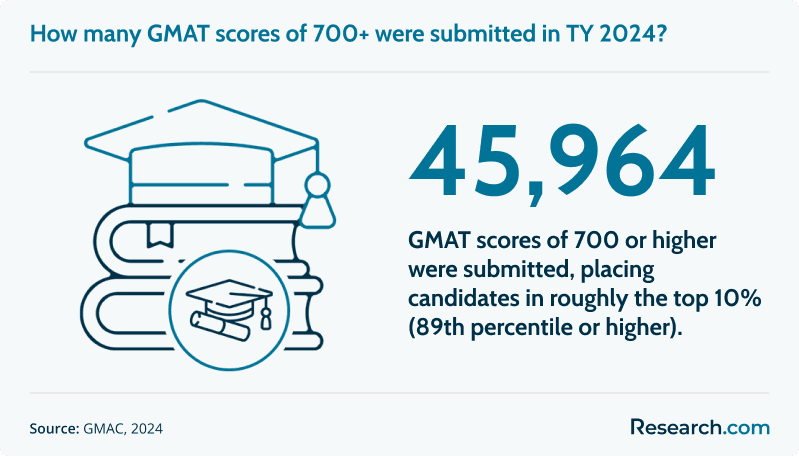
GMAC data from testing year 2024 illustrates how concentrated high scores are in MBA admissions. During that year, 45,964 GMAT scores of 700 or higher were submitted, representing applicants scoring at roughly the top 10% level, or the 89th percentile or higher.
Among those high-scoring submissions, 86.5% were sent to MBA programs. For applicants, this means the strongest GMAT scores are not evenly distributed across all graduate programs; they are heavily concentrated in MBA applicant pools, especially at selective institutions.
Score expectations may vary in specialized MBA tracks. A candidate exploring accelerated online MBA options in human resource management, for instance, should still prepare seriously for admissions requirements but may also see professional experience, leadership roles, and HR-related career goals weighed alongside test performance.
| GMAT Score Situation | What It May Signal | What Applicants Should Do |
| Below a target school’s average | The academic testing profile may be weaker than the admitted-class benchmark. | Strengthen essays, recommendations, resume impact, quantitative coursework evidence, and interview preparation. |
| Near the school’s average | The score is generally aligned with the school’s reported profile. | Focus on differentiating the application through leadership, goals, fit, and career progression. |
| Above the school’s average | The test score can become a clear strength. | Use the advantage strategically, but avoid assuming the score alone will secure admission or funding. |
| 700 or higher | The score places the applicant among a high-performing testing group. | Compare the score with each school’s admitted-class profile rather than relying only on the overall percentile. |
How have average GMAT scores changed over the past five years?
GMAT score patterns have changed over recent testing years, and applicants should pay attention to both score movement and test format. In U.S. programs, the mean score increased from 627 in 2020 to 661 in 2024. Over the same period, candidate age rose from 25.8 years in 2020 to 26.6 years in 2024, suggesting a slightly more experienced applicant pool.
GMAC also separates reporting for the GMAT (10th Edition) and the newer GMAT Exam format. In 2024, the GMAT (10th Ed.) mean was 661, while the GMAT Exam mean was 622. Applicants should understand which version they are taking and confirm how each school interprets scores from different exam formats.
Even with rising averages, MBA admissions are not decided by score alone. Programs with specialized career outcomes, such as fast-track online MBA programs in sports management, may review test performance together with industry experience, leadership potential, and clarity of career direction.
| Trend | Reported Figure | Why It Matters for Applicants |
| U.S. mean score in 2020 | 627 | Provides a starting point for understanding recent score movement. |
| U.S. mean score in 2024 | 661 | Shows that applicants may be competing in a stronger testing environment than in earlier years. |
| Average candidate age in 2020 | 25.8 years | Helps applicants understand the experience level of prior testing groups. |
| Average candidate age in 2024 | 26.6 years | Suggests a modest shift toward candidates with slightly more professional experience. |
| 2024 GMAT (10th Ed.) mean | 661 | Should be compared carefully with school-specific reporting. |
| 2024 GMAT Exam mean | 622 | Highlights why applicants should not compare different test formats without context. |
Is it possible to get admitted with a lower GMAT if you have strong work experience?
Yes. A lower GMAT score can still be compatible with MBA admission when the rest of the application is strong. Admissions committees typically evaluate candidates through a broader review that includes undergraduate performance, career advancement, leadership, recommendations, essays, interview performance, and evidence of quantitative readiness.
Work experience can be especially important for applicants whose scores fall below a school’s average. Candidates with 10+ years in leadership positions, significant management responsibility, measurable business results, or unusual industry expertise may be able to show value that a test score does not fully capture.
This is particularly relevant in career-focused MBA concentrations. For example, applicants considering a fast-track online MBA in healthcare management may be evaluated partly on healthcare leadership experience, operational knowledge, and professional maturity.
The practical takeaway is simple: prepare for the highest GMAT score you can reasonably achieve, but do not treat one score as the entire application. If your score is below target, your strategy should be to prove readiness through other credible evidence.
| If Your GMAT Is Lower Than Desired | How to Strengthen the Application |
| Quantitative score is weak | Show recent success in statistics, accounting, finance, analytics, or other quantitative coursework when available. |
| Total score is below the school average | Apply to a balanced school list that includes reach, target, and more attainable programs. |
| Work history is strong | Use the resume and essays to quantify leadership outcomes, promotions, budget responsibility, revenue impact, or operational results. |
| Career goals are unclear | Clarify why the MBA is necessary, why now, and how the specific program supports the next career step. |
| Retesting is possible | Use diagnostic results to decide whether another attempt is likely to improve the application meaningfully. |
Do MBA programs prefer GMAT over GRE for 2027?
For 2027, many MBA programs accept both the GMAT and GRE, but the GMAT remains the more traditional business school exam. The GMAT was created for graduate management education, while the GRE serves a broader range of graduate fields. That history is one reason MBA applicants still often view the GMAT as the standard benchmark.
However, applicants should not assume that a strong GRE score is inferior. If a school states that it accepts both tests, the better choice is usually the exam on which the applicant can produce the stronger, more representative result. Candidates applying only to MBA programs may prefer the GMAT, while those applying to multiple graduate fields may find the GRE more flexible.
Applicants interested in emerging business areas, including accelerated online MBA programs in entrepreneurship, should check each school’s policy before registering for an exam. The right test is the one that fits the applicant’s strengths and the program’s stated requirements.
| Choose the GMAT If... | Choose the GRE If... |
| You are focused primarily on MBA or graduate management programs. | You are applying to business school and other graduate programs outside business. |
| Your target schools strongly emphasize GMAT reporting or scholarship review. | Your GRE practice results are meaningfully stronger than your GMAT practice results. |
| You want to submit the exam most closely associated with MBA admissions. | You want more flexibility across different graduate school applications. |
| Your quantitative and data reasoning strengths align well with the GMAT format. | Your verbal or broader graduate-test strengths translate better to the GRE. |
Does a higher GMAT score increase MBA scholarship opportunities?
A higher GMAT score can improve a candidate’s position for merit-based MBA scholarships, but it does not guarantee funding. Business schools may use standardized test scores as one way to compare applicants across academic systems, industries, and countries. A strong score can help an applicant stand out, especially when paired with a strong professional record.
Scholarship decisions are usually broader than test performance. Schools may also consider leadership, career impact, academic history, personal background, service, and fit with the program’s goals. For example, applicants to the shortest online MBA programs in nonprofit management may be able to support their scholarship case through mission-driven achievements as well as academic indicators.
Applicants seeking scholarships should treat the GMAT as one lever among several. A high score can make the application more competitive, but the strongest funding cases usually connect test readiness with leadership potential and a clear career plan.
Can international students qualify for GMAT-based MBA scholarships?
Yes. International students can qualify for GMAT-based MBA scholarships when schools make those awards available to noncitizens. Because the GMAT is standardized, it can help admissions and scholarship committees compare candidates from different academic systems more consistently.
The U.S. remains a major destination for graduate management education. With more than 550 AACSB-accredited business schools and schools accredited by EFMD or AMBA, the U.S. offers one of the world’s largest graduate business education networks.
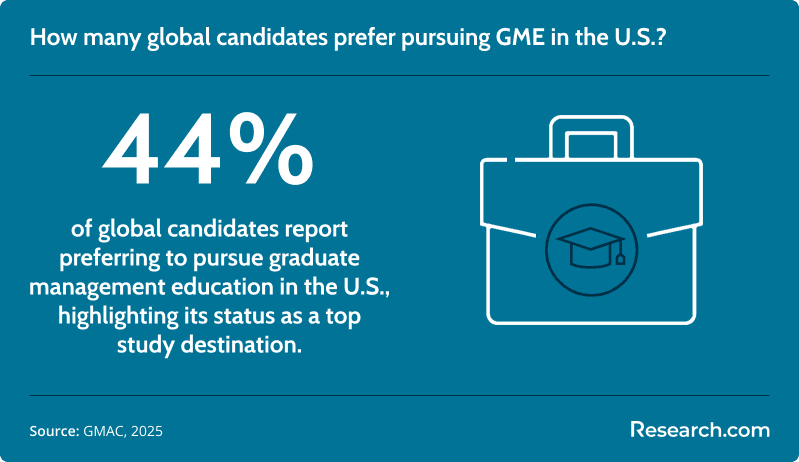
GMAC has also reported that 44% of global candidates prefer to pursue graduate management education in the U.S. For international applicants, a strong GMAT score may therefore support both admission and funding opportunities at U.S. institutions, although visa rules, program policies, and scholarship eligibility requirements must be reviewed carefully.
International candidates should also evaluate the long-term financial case for graduate education. That same decision logic applies across fields; for example, reviewing salary outcomes for a cybersecurity master’s degree can help students think critically about credential cost, career mobility, and return on investment.
How can I improve my GMAT score quickly for 2027?
Fast GMAT improvement requires targeted preparation, not simply more hours. Start by taking a diagnostic practice test, then review which question types, timing issues, or content areas are pulling the score down. Candidates can also benefit from understanding how other GMAT test-takers experience the exam, especially when managing stress, pacing, and confidence.
Short-term preparation should focus on the highest-impact weaknesses first. If timing is the problem, timed practice sets matter more than passive review. If accuracy is the issue, error logs and concept review are more useful than repeatedly taking full tests without analysis.
Working professionals should build a realistic study schedule that protects consistency. Short, focused study blocks can be more productive than irregular marathon sessions. Applicants who need structure may also find value in accelerated learning formats, such as 6-week online college courses, as a model for disciplined, time-bound academic preparation.
| Preparation Step | Why It Helps | Common Mistake to Avoid |
| Take a diagnostic test first | Shows whether content gaps, timing, or strategy are the biggest problems. | Studying everything equally without knowing where points are being lost. |
| Keep an error log | Reveals repeated mistakes and patterns across question types. | Reviewing only correct answers and ignoring why wrong answers seemed attractive. |
| Practice under time limits | Builds pacing and reduces test-day surprises. | Practicing untimed and assuming speed will improve automatically. |
| Use official-style questions | Helps align preparation with the actual exam’s reasoning demands. | Relying only on generic test-prep drills that do not match GMAT logic. |
| Decide whether to retest strategically | Prevents wasted time if another attempt is unlikely to change admissions outcomes. | Retesting repeatedly without changing the study plan. |
Will MBA programs continue to require GMAT scores in the future?
The GMAT’s role is changing, but it has not disappeared from MBA admissions. Some programs have adopted test-optional or test-flexible policies, yet many still accept and value GMAT scores as evidence of academic readiness.
GMAC data shows that in testing year 2024, 2,038 MBA programs in the U.S. accepted GMAT scores. That was slightly below 2,046 in 2023, but still above 2,000. The decline suggests some movement in admissions policy, but not a broad abandonment of the exam.
For applicants, the safest approach is to check the policy for each target program. A GMAT score may be especially useful for candidates applying to selective schools, seeking merit scholarships, coming from less familiar academic systems, or trying to offset a weaker undergraduate record.
This resembles other professional credentials that remain valuable even as industries evolve. For example, the CFE certification continues to serve as a recognized standard in fraud examination, finance, and auditing even as technology changes the field.
What are the average GMAT scores for MBA programs in the U.S. vs. Europe?
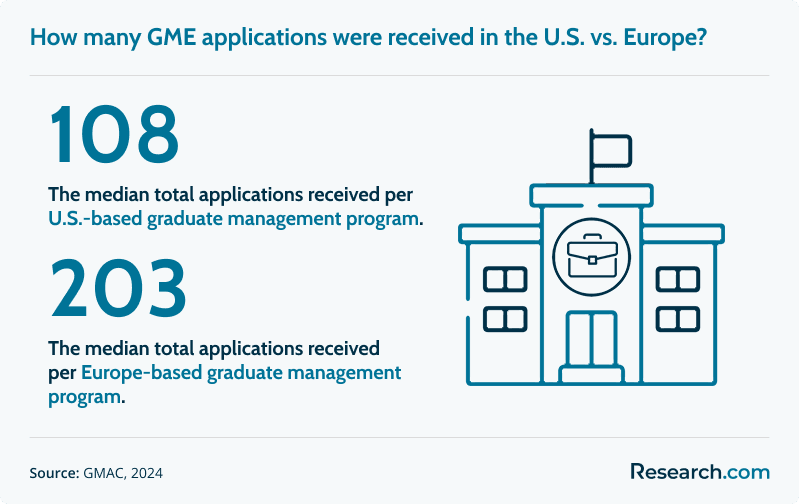
GMAT expectations can differ by region because admissions markets, applicant profiles, and program models differ. In 2024, European graduate management programs received a median of 203 total applications per program, compared with 108 per program in the U.S. This application-volume difference can affect how schools evaluate selectivity, experience, and test scores.
At the top tier, U.S. MBA programs are often associated with high GMAT averages, especially at schools such as Harvard, Stanford, and Wharton. European programs may also value strong scores, but many place substantial weight on international experience, career maturity, multilingual or cross-border exposure, and leadership trajectory.
Applicants comparing regions should not rely on one universal “good GMAT score.” Instead, compare your score with each school’s admitted-student profile, program format, class experience level, and career placement goals. The same type of fit analysis applies to specialized pathways such as RN to MBA career transitions, where professional background and program design can matter as much as test metrics.
| Factor | U.S. MBA Programs | European MBA Programs |
| Application volume reported in 2024 | Median of 108 total applications per program | Median of 203 total applications per program |
| Typical evaluation emphasis | GMAT score, academic readiness, career progression, leadership, and fit | Professional maturity, international exposure, leadership, score strength, and fit |
| Best applicant strategy | Compare your score with each school’s class profile and scholarship expectations. | Show global perspective, career clarity, and readiness for intensive business study. |
Are online MBA programs reshaping GMAT score expectations?
Online MBA programs have contributed to more flexible admissions models, especially for working professionals. Many online programs still value standardized testing, but some also place greater emphasis on work experience, career progression, digital collaboration skills, and evidence that the applicant can manage graduate study while balancing professional responsibilities.
Applicants comparing affordable online MBA programs should look beyond whether the GMAT is required. They should also review accreditation, total cost, faculty access, student support, employer reputation, course delivery format, and whether the program’s career outcomes match their goals.
When Should You Submit a GMAT Score?
Submitting a GMAT score makes the most sense when it strengthens the application or helps answer a concern. If your score is above a school’s average, it can reinforce academic readiness. If your undergraduate record is uneven, a strong GMAT may help show that you can handle quantitative graduate coursework. If you are seeking merit aid, a competitive score may also support scholarship review.
| Submit the GMAT When... | Consider Withholding or Retesting When... |
| Your score is at or above the program’s reported average. | Your score is far below the school’s profile and the program is test-optional. |
| You need to offset a weaker undergraduate GPA or limited quantitative coursework. | Your practice tests suggest a short retake window could produce a stronger result. |
| You are applying for merit scholarships where scores may be reviewed. | Your professional record is strong and the school clearly states that testing is optional. |
| You are an international applicant using the score to provide a standardized academic signal. | Your score distracts from an otherwise strong leadership, academic, or career profile. |
How to Choose MBA Programs Based on Your GMAT Score
Your GMAT score should shape your school list, but it should not be the only factor. Build a balanced list by comparing your score, work experience, academic background, career goals, program format, cost, and scholarship potential.
- Find each school’s score profile. Compare your score with the program’s latest reported average or middle range when available.
- Separate reach, target, and safer options. A school where your score is far below the average may still be possible, but it should not be your only option.
- Check test policies carefully. Confirm whether the GMAT is required, optional, waived, or accepted alongside the GRE.
- Evaluate the full cost. Tuition is only one part of the investment; also consider fees, travel, lost income, technology costs, and financing terms.
- Review accreditation and employer recognition. Accreditation and reputation can affect credit transfer, employer confidence, and long-term credential value.
- Connect the program to your career plan. The best MBA choice is not always the highest-ranked school; it is the program that supports your target role, industry, network, and budget.
Common Mistakes Applicants Make With GMAT Scores
| Mistake | Why It Hurts | Better Approach |
| Using the overall GMAT average as the target for every school | Selective MBA programs often report averages well above the broader testing mean. | Compare your score with each target program’s admitted-class profile. |
| Assuming a high score guarantees admission | MBA admissions also weighs leadership, goals, essays, recommendations, and fit. | Use a strong score as one advantage, not as a substitute for a complete application. |
| Ignoring test format differences | GMAT (10th Edition) and GMAT Exam averages are reported separately in GMAC data. | Confirm how each school reviews the version of the exam you submit. |
| Applying only to reach schools | A score below several target-school averages can increase admissions risk. | Create a balanced list with reach, target, and more attainable programs. |
| Choosing a program based only on rankings | Rankings may not reflect cost, format, specialization strength, or employer fit. | Compare accreditation, curriculum, outcomes, support, schedule, and total cost. |
| Assuming online programs have lower standards | Quality online MBA programs may still expect strong academic and professional evidence. | Review each program’s actual admissions policy instead of relying on assumptions. |
Questions to Ask Before Applying With Your GMAT Score
- Is my GMAT score above, near, or below the average for each school on my list?
- Does the program require the GMAT, accept the GRE, offer waivers, or use a test-optional policy?
- If my score is weak, what other evidence can show academic readiness?
- Will a stronger GMAT score improve my scholarship chances enough to justify retesting?
- How does my work experience compare with the typical admitted student profile?
- Does the program’s format fit my schedule, especially if I am working full time?
- Is the school properly accredited and recognized by employers in my target industry?
- What is the total cost of attendance, and how much debt would I need to take on?
- Does the curriculum support my intended career path or specialization?
- Would an MBA, specialized master’s degree, or shorter credential be the better fit?
Could alternative graduate pathways complement a strong GMAT score?
A strong GMAT score can support an MBA application, but an MBA is not the only path to business leadership. Some professionals may benefit from a specialized graduate program that builds targeted skills in operations, analytics, healthcare, project management, finance, or entrepreneurship.
For example, an accelerated online project management degree may suit professionals who want focused training in planning, execution, team coordination, and operational delivery. This type of pathway can complement an MBA plan or serve as an alternative for students who need a more specialized credential.
Applicant Perspectives on GMAT Scores
- : "I earned a 720 on the GMAT, which placed me near the average for several competitive MBA programs I was considering. Preparing took months of steady practice, but the result helped me feel more confident during the application process. Admissions staff reminded me that the score was only one part of the file, yet it clearly strengthened my academic profile. — Sarah"
- : "My GMAT score was 680, below the published averages at some of the top MBA programs on my list. I focused on showing career progress, leadership responsibility, and concrete professional results. I was eventually admitted to a respected business school that reviewed applicants holistically. That experience showed me that the GMAT matters, but it does not define the entire candidate. — Jimmy"
- : "A 750 GMAT score helped make my application more competitive and contributed to a merit-based scholarship. The study process was demanding, but the score created opportunities that affected both admission and affordability. For me, the GMAT became more than a requirement; it helped reduce financial pressure during the MBA. — Kate"
References:
- GMAC. (2024). Application Trends Survey Regional Profiles: Europe 2024. gmac.com.
- GMAC. (2024). Application Trends Survey Regional Profiles: United States 2024. gmac.com.
- GMAC. (2024). GMAT Geographic Trend Report: Testing Year 2024. gmac.com.
- GMAC. (2025). Demand for Graduate Management Education. gmac.com.
Key Insights
- The overall average GMAT score is a helpful benchmark, but top MBA programs often expect scores well above the general testing mean.
- Many selective MBA programs report average scores above 700, while Harvard, Stanford, and Wharton are commonly associated with 730–740 averages.
- In testing year 2024, 91,440 GMAT scores were sent, and over 80% went to MBA programs, confirming the exam’s continued importance in business school admissions.
- A lower GMAT score can be offset by strong leadership, career progression, recommendations, and evidence of quantitative readiness.
- GMAT and GRE policies vary by school, so applicants should choose the test that best supports their target programs and overall profile.
- Higher GMAT scores may improve merit scholarship competitiveness, but funding decisions usually consider more than test performance.
- Online, specialized, and international MBA programs may evaluate applicants differently, making school-specific research essential.
- The strongest application strategy is not chasing one universal score; it is matching your GMAT result, experience, budget, and career goals to the right program list.
Other Things You Should Know About Average GMAT Score and Scores for Top MBA Programs
In 2027, the average GMAT score needed for top MBA programs typically ranges from 700 to 740. This range reflects the scores at elite institutions such as Stanford, Harvard, and Wharton. While individual scores may vary by program, applicants should aim for this range to remain competitive.
In 2027, the average GMAT score for top MBA programs hovers around 720. Programs like Stanford and Harvard typically expect applicants to achieve scores above this range, reflecting their competitive admissions landscape. A score near or above 720 significantly enhances an applicant’s competitiveness in these top-tier programs.


