2027 What Can You Do With an Artificial Intelligence Degree?

Co-Founder and Chief Data Scientist
AI careers are booming and broadening fast. In 2024, 78% of organizations reported using AI, up from 55% a year earlier. At the same time, job postings requiring generative AI expertise, including skills with large language models and tools like ChatGPT, have surged, signaling strong demand for graduates with specialized knowledge.
For students pursuing an AI degree, this translates into opportunities not only in building models but also in shaping how they are implemented and regulated. This article explores the career paths, industry applications, and future opportunities available to those with an artificial intelligence degree—helping you understand where your skills can make the biggest impact.
Key things you should know about what to do with an artificial intelligence degree
- Graduates with an artificial intelligence degree can pursue roles such as machine learning engineer, data scientist, AI researcher, computer vision engineer, natural language processing specialist, robotics engineer, and AI product manager.
- AI-related jobs command median annual salaries between $110,000 and $140,000, with specialized or senior positions (e.g., AI architect or lead ML engineer) often exceeding $160,000.
- A bachelor’s degree in AI generally takes 4 years of full-time study, master’s programs typically require 1–2 years, and PhD programs range from 4–6 years.
- What are the top jobs you can get with an artificial intelligence degree? Top Jobs
- What skills does an AI degree help you develop? AI Skills
- What industries actively hire graduates with AI degrees? Top Industries
- How do AI professionals transition from technical roles to AI leadership? How do AI professionals transition from technical roles to AI leadership?
- What advanced degrees can you pursue after an AI bachelor's program? Advanced Degrees
- Which universities offer cutting-edge AI graduate programs? University Programs
- What is the average salary for AI graduates? Average Salary
- What is the job market demand for AI graduates? Job Market
- What job search strategies work for AI degree holders? What job search strategies work for AI degree holders?
- What are the best practices for AI graduates entering a changing workforce? What are the best practices for AI graduates entering a changing workforce?
- How can combining AI expertise with healthcare administration drive career advancement? How can combining AI expertise with healthcare administration drive career advancement?
- Can accelerated advanced degrees boost your AI career? Can accelerated advanced degrees boost your AI career?
What jobs can you get with an artificial intelligence degree?
An artificial intelligence degree can lead to technical, analytical, research, product, and leadership roles in fields that now depend on automation, predictive modeling, intelligent software, and data-driven decision-making. The main challenge for students is not whether AI skills are useful, but which career path fits their strengths: coding, math, research, business strategy, robotics, healthcare, finance, or product development.
This guide explains the most common jobs for AI graduates, the skills employers look for, industries hiring AI talent, salary expectations, graduate school options, and practical ways to build a stronger job search strategy. It is designed for students considering an AI degree, current AI majors planning their next step, and professionals deciding whether advanced AI training is worth the investment.
Quick answer: the best AI degree jobs
The strongest career options for artificial intelligence graduates include machine learning engineer, data scientist, AI research scientist, computer vision engineer, natural language processing engineer, robotics engineer, AI software developer, and AI product manager. Technical roles usually require strong programming, mathematics, statistics, model development, and data skills. Product and leadership roles also require communication, ethics, business judgment, and the ability to translate AI capabilities into practical organizational value.
| AI career path | Best fit for graduates who enjoy | Common work focus |
| Machine learning engineer | Programming, model optimization, production systems | Building and deploying models that learn from data |
| Data scientist | Statistics, analysis, business questions, visualization | Finding patterns in data and explaining insights to decision-makers |
| AI research scientist | Advanced theory, experimentation, publishing, innovation | Developing new AI methods, architectures, and algorithms |
| Computer vision engineer | Images, video, robotics, perception systems | Training AI systems to interpret visual information |
| NLP engineer | Language, search, chatbots, speech tools | Creating systems that process and generate human language |
| Robotics engineer | Hardware, sensors, autonomy, controls | Designing intelligent machines and autonomous systems |
| AI product manager | Business strategy, user needs, technical coordination | Guiding AI products from concept to launch |
Machine learning engineer
Machine learning engineers create the systems that allow software to detect patterns, make predictions, and improve performance from data. Their work often includes preparing datasets, selecting algorithms, training models, testing performance, and helping move models into real-world applications.
This role is a strong fit for AI graduates who like both software engineering and applied mathematics. Employers typically look for evidence that candidates can build models that work outside the classroom, not just complete isolated assignments.
Data scientist
Data scientists use data to answer business, scientific, operational, or policy questions. An AI degree can be especially useful because it gives students exposure to advanced modeling, neural networks, natural language processing, and automation techniques.
Unlike some machine learning roles, data science often requires heavy communication with non-technical stakeholders. Graduates must be able to explain uncertainty, limitations, and trade-offs clearly, especially when analysis affects budgets, operations, customer experience, or public outcomes.
AI research scientist
AI research scientists focus on advancing the field rather than only applying existing tools. They may work in universities, government laboratories, or corporate research and development teams. Their projects can involve new model architectures, better training methods, reinforcement learning, robotics, natural language systems, or safety and alignment problems.
This path is best suited to students who enjoy theory, experimentation, academic literature, and long-term innovation. Many research-heavy roles prefer or require graduate study, especially at the master’s or doctoral level.
Other strong AI career options
AI graduates can also move into specialized roles. Computer vision engineers build systems for image and video interpretation. Natural language processing engineers work on chatbots, search, translation, speech tools, and document intelligence. Robotics engineers combine AI with sensors, mechanics, and control systems. AI software developers build applications that use machine learning models, while AI product managers coordinate technical teams, business priorities, user needs, and responsible deployment.
Students who are interested in user-facing AI tools should also understand how AI teams collaborate with design professionals. If you are comparing adjacent technology paths, reviewing short online UX design degree options can help clarify the difference between building AI systems and designing the experiences around them.
What skills does an artificial intelligence degree teach?
An artificial intelligence degree develops a mix of computer science, mathematics, statistics, data management, and applied problem-solving skills. Strong programs do more than teach students to use AI tools. They help students understand how models work, how data quality affects results, and how to evaluate whether an AI system is reliable enough for a real setting.
Employers increasingly expect AI graduates to combine technical fluency with sound judgment. A model that performs well in a lab can still fail if the data is biased, the system is poorly integrated, or the results are not explainable to users and decision-makers.
- Programming and software development: AI students usually build fluency in languages such as Python, Java, and C++. They may also learn frameworks such as TensorFlow and PyTorch, along with software engineering practices needed to move models into usable products.
- Machine learning and deep learning: Coursework often covers supervised learning, unsupervised learning, reinforcement learning, neural networks, model evaluation, and optimization. These skills support applications such as image recognition, language processing, recommendation systems, and predictive analytics.
- Mathematics and statistics: AI depends heavily on linear algebra, calculus, probability, and statistical reasoning. These areas help students understand model behavior, measure performance, and avoid drawing false conclusions from data.
- Data preparation and management: AI graduates learn how to collect, clean, transform, store, and analyze large datasets. They may also study databases, data visualization, feature engineering, and data pipelines.
- Critical thinking and problem decomposition: AI work requires breaking complex problems into smaller technical questions. Graduates need to identify what can be automated, what should remain human-controlled, and what risks must be managed before deployment.
- Communication and responsible AI: Strong candidates can explain model limitations, privacy concerns, bias risks, and performance trade-offs to technical and non-technical audiences.
| Skill area | Why it matters in AI jobs | How students can prove it |
| Python and AI frameworks | Most AI roles require hands-on model development | GitHub projects, internships, research code, deployed demos |
| Statistics and model evaluation | Employers need candidates who can test whether results are meaningful | Projects with clear metrics, validation methods, and error analysis |
| Data engineering basics | Models depend on clean, accessible, well-structured data | Portfolio work showing data cleaning, pipelines, and database use |
| Ethics and governance | AI systems can affect privacy, fairness, safety, and compliance | Case studies, documentation, risk assessments, bias testing |
| Communication | AI teams work with executives, clients, clinicians, analysts, designers, and engineers | Presentations, reports, stakeholder-focused project summaries |
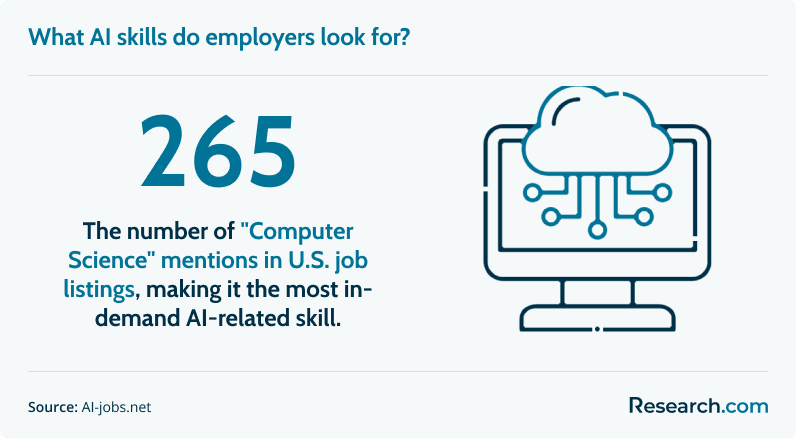
What industries hire artificial intelligence graduates?
Artificial intelligence is no longer limited to large technology companies. Organizations use AI to automate routine work, improve forecasting, personalize services, detect anomalies, support research, and optimize operations. This gives AI graduates career options across several industries, although job duties and risk levels vary by sector.
- Technology and software: AI graduates work on search systems, recommendation engines, virtual assistants, cloud tools, cybersecurity products, developer platforms, and consumer applications.
- Healthcare and biotechnology: AI supports medical imaging, patient monitoring, drug discovery, clinical workflow improvement, and predictive diagnostics. Graduates in this field often work closely with clinicians, researchers, compliance teams, and health informatics specialists.
- Finance and banking: Financial institutions use AI for fraud detection, risk modeling, credit scoring, trading systems, customer support, and operational efficiency. AI can support finance careers, but it does not automatically lead to executive roles such as chief financial officer; students considering that route should understand the broader business and leadership requirements behind a CFO career and salary path.
- Manufacturing and robotics: AI helps companies monitor equipment, improve quality control, automate production, and design smarter machines. This path is useful for graduates who want to connect software with physical systems.
- Transportation and automotive: AI is used in route optimization, autonomous vehicle development, logistics, predictive maintenance, and traffic management.
- Gaming and interactive media: AI can support character behavior, procedural content, player analytics, and personalization. Students comparing AI development with creative technology roles may also explore the video game designer career path.
AI graduates who want to move into management should consider how technical expertise connects to business operations, staffing, budgets, risk, and product strategy. For example, learning about engineering management MBA salary potential can help technical professionals evaluate whether graduate business training supports their long-term leadership goals.
The following chart summarizes how the American public views potential AI benefits:
How do AI professionals move from technical roles into leadership?
AI leadership usually develops in stages. Most professionals first build credibility by solving technical problems, then expand into project ownership, stakeholder communication, responsible AI governance, and strategy. The strongest AI leaders can challenge technical assumptions while also explaining business value, risk, cost, and implementation constraints.
Build deep technical credibility first
AI leaders need enough technical depth to evaluate models, question unrealistic timelines, understand data limitations, and guide engineering teams. Early-career professionals often build this foundation by working on model development, data pipelines, performance testing, deployment, and maintenance.
Take ownership of larger initiatives
The next step is moving beyond individual technical tasks. Aspiring leaders can volunteer to coordinate projects, mentor junior team members, document model decisions, lead cross-functional meetings, and connect AI work to measurable organizational outcomes.
This transition is similar to broader applied science careers: technical knowledge becomes more valuable when paired with judgment, communication, and problem-solving across industries. Students exploring flexible technical paths may find it useful to compare AI careers with options described in applied sciences degree career outcomes.
Develop strategy, ethics, and governance skills
AI leaders must think beyond accuracy scores. They are often responsible for aligning AI projects with business goals, evaluating privacy and bias risks, setting approval processes, ensuring human oversight, and deciding when an AI solution should not be deployed. Some professionals pursue an MBA, executive certificate, or specialized leadership training to strengthen these capabilities.
| Career stage | Main priority | How to prepare |
| Entry-level AI role | Build reliable technical skills | Contribute to models, datasets, testing, documentation, and production support |
| Mid-level specialist | Own larger technical decisions | Lead project components, mentor others, improve workflows, and communicate trade-offs |
| AI team lead or architect | Connect technical choices to business results | Manage timelines, risk, stakeholder expectations, and model governance |
| AI director or executive | Set strategy and accountability | Oversee portfolios, budgets, compliance, responsible AI policies, and organizational adoption |
What advanced degrees can you pursue after a bachelor’s in AI?
A bachelor’s degree in artificial intelligence can be enough for some entry-level roles, especially when paired with internships and a strong portfolio. Graduate study may be valuable for students who want deeper specialization, research-heavy work, senior technical roles, or leadership positions in complex industries.
A master’s in artificial intelligence or machine learning typically focuses on advanced neural networks, reinforcement learning, computer vision, natural language processing, and large-scale model development. Students comparing graduate outcomes can review jobs after a master’s in artificial intelligence to see how specialization may affect role options.
A master’s in data science can be a better fit for graduates who want broader work in analytics, business intelligence, statistical modeling, and data strategy. This path is useful when the goal is to apply AI methods to organizational decision-making rather than focus only on model engineering.
A PhD in Artificial Intelligence, Computer Science, or Robotics is most appropriate for students who want academic careers, advanced research roles, or highly specialized innovation work. Doctoral study requires sustained independent research and is not necessary for every AI career.
Some professionals choose business-oriented graduate programs instead. For example, accelerated online MBA programs in entrepreneurship may appeal to AI graduates who want to launch technology ventures, lead innovation teams, or move toward executive roles.
| Graduate option | Best for | When it may not be necessary |
| Master’s in AI or machine learning | Advanced engineering, applied research, model specialization | If you already have strong experience and want product or analyst roles |
| Master’s in data science | Analytics, statistics, business intelligence, applied modeling | If your goal is robotics, theory-heavy AI research, or low-level systems work |
| PhD in AI, computer science, or robotics | Academic research, corporate R&D, advanced innovation roles | If you want faster entry into industry or management-focused work |
| MBA or technology management degree | AI product leadership, entrepreneurship, executive strategy | If you still need stronger technical depth before moving into management |
Which universities are known for advanced AI graduate study?
Students considering graduate school should look beyond reputation alone. Important factors include faculty research areas, lab access, industry partnerships, funding options, thesis requirements, internship pipelines, and whether the curriculum matches the student’s intended specialization.
Massachusetts Institute of Technology (MIT)
MIT is widely associated with advanced AI education and research. Its Computer Science and Artificial Intelligence Laboratory (CSAIL) is known for work across robotics, machine learning, computational biology, and related areas, while the Schwarzman College of Computing supports computing and AI work across disciplines.
Stanford University
Stanford’s Artificial Intelligence Laboratory, established in 1962, has long played a major role in AI research. Its location near Silicon Valley supports collaboration with technology companies, and its AI-related work spans natural language processing, deep learning, robotics, and other fields.
Carnegie Mellon University (CMU)
Carnegie Mellon University’s School of Computer Science is strongly associated with artificial intelligence, machine learning, robotics, and autonomous systems. Its graduate offerings and industry connections make it a major option for students pursuing technically demanding AI careers.
University of California, Berkeley (UC Berkeley)
UC Berkeley is home to the Berkeley Artificial Intelligence Research Lab. Its work includes reinforcement learning, computer vision, human-compatible AI, and research that connects technical progress with societal impact and responsible development.
What salary can AI graduates expect?
Salary outcomes vary by role, degree level, employer, location, experience, portfolio quality, and industry. The figures below should be treated as broad ranges rather than guaranteed outcomes.
Entry-level professionals with an artificial intelligence degree credential start in the range of $85,000 to $110,000 annually, while those with a master’s degree can expect $100,000 to $130,000.
Graduates entering roles such as machine learning engineer, data scientist, AI software developer, or related technical positions may earn more in high-cost technology markets such as San Francisco, Seattle, and New York. Compensation can also differ significantly between startups, large technology companies, government agencies, universities, healthcare systems, financial institutions, and consulting firms.
With experience, AI professionals tend to see rapid salary growth. Mid-level professionals earn between $130,000 and $160,000. Senior experts, AI architects, or research leads can make $170,000 to $200,000+. Some employers also offer bonuses, stock options, or profit-sharing, especially in technology companies and AI-focused startups.
| Career level | Salary range stated | What can influence pay |
| Entry-level AI graduate | $85,000 to $110,000 annually | Internships, portfolio, location, programming strength, employer type |
| Master’s-level candidate | $100,000 to $130,000 | Specialization, research experience, advanced model skills, project depth |
| Mid-level AI professional | $130,000 to $160,000 | Production experience, team responsibility, domain expertise, measurable impact |
| Senior expert, AI architect, or research lead | $170,000 to $200,000+ | Leadership scope, technical authority, company size, equity or bonus structure |
What is the job market demand for AI degree graduates?
Demand for AI talent is strong because organizations are embedding AI into products, workflows, research, operations, and customer experiences. However, the market is also becoming more competitive. Employers increasingly want candidates who can show practical experience, strong fundamentals, and the ability to work responsibly with real data.
AI roles are not limited to technology companies. Healthcare, finance, automotive, manufacturing, agriculture, sports, education, media, and government organizations all use AI in different ways. The best opportunities often go to graduates who combine AI skills with knowledge of a specific field.
Industry reports consistently point to growth in AI-related work, and the BLS sees a 36% growth for data scientists from 2023 to 2033. That figure is especially relevant for AI students because many data science roles use machine learning, predictive modeling, and automated analytics.
AI is also changing specialized analytics fields. For example, students asking what you can do with a master’s degree in sports analytics will find that teams and sports organizations increasingly use machine learning for player evaluation, performance modeling, fan engagement, and business operations.
Data scientist is the 2nd most popular job posting in the U.S.
What job search strategies work best for AI graduates?
AI hiring is evidence-driven. A degree can open doors, but employers usually want proof that candidates can build, evaluate, explain, and improve AI systems. Graduates should treat the job search as a portfolio-building and networking process, not only an application process.
- Build a focused portfolio: Include projects, research, notebooks, deployed demos, technical write-ups, and open-source contributions on platforms such as GitHub or Kaggle. Prioritize depth and documentation over a long list of unfinished projects.
- Show business or domain impact: Explain what problem the project solved, what data was used, how performance was measured, and what limitations remain. This makes your work easier for recruiters and hiring managers to evaluate.
- Network in AI communities: Attend conferences, webinars, meetups, university events, and technical workshops. Referrals and informal conversations can reveal roles before they appear on broad job boards.
- Customize every application: Match your resume to the role. A machine learning engineer posting should emphasize production systems and model deployment, while a data scientist posting should highlight statistics, analysis, and communication.
- Keep learning, but avoid random credential stacking: Follow research updates, complete targeted courses, and practice with current tools. If your goal is game AI or interactive media, comparing AI roles with online game development degree programs may help you choose better projects and electives.
- Use specialized and general job boards: Search AI-focused job sites, company career pages, university networks, LinkedIn listings, and professional communities. Niche roles may not appear on the largest platforms first.
| Common mistake | Why it hurts AI graduates | Better approach |
| Submitting the same resume everywhere | AI job titles vary widely, and generic resumes miss role-specific keywords | Create tailored versions for machine learning, data science, research, and product roles |
| Listing tools without showing results | Employers need evidence of applied skill, not just software names | Describe model performance, data challenges, and project outcomes |
| Ignoring data cleaning and evaluation | Real AI work depends heavily on data quality and validation | Document preprocessing, assumptions, metrics, errors, and limitations |
| Relying only on coursework | Class assignments may not show independence or production readiness | Add internships, research, open-source work, competitions, or applied projects |
| Overlooking communication skills | AI professionals often explain risk and value to non-technical teams | Practice concise technical writing, presentations, and stakeholder summaries |
How can AI graduates prepare for a changing workforce?
AI tools, employer expectations, and governance standards are changing quickly. Graduates who build adaptable careers focus on fundamentals, continuous learning, practical experience, and responsible deployment rather than chasing every new tool.
- Commit to continuous learning: New frameworks, model types, regulations, and workflows appear regularly. Graduates who need structured upskilling can compare options such as an accelerated online graduate certificate in data analytics.
- Build cross-disciplinary knowledge: AI is most valuable when applied to real problems. Understanding healthcare, finance, manufacturing, education, sports, or another domain helps graduates design more useful systems.
- Strengthen soft skills: Communication, teamwork, documentation, and problem framing are essential when AI teams work with executives, clients, clinicians, regulators, designers, or operations staff.
- Prioritize responsible AI: Employers increasingly care about bias, explainability, privacy, transparency, security, and accountability. Graduates should be ready to discuss how they identify and reduce AI-related risks.
- Learn to work with AI-assisted development: AI coding tools and automated workflows can improve productivity, but graduates still need to review outputs, test assumptions, protect data, and understand the underlying systems.
Questions to ask before choosing an AI degree or graduate program
- Is the program housed in computer science, engineering, data science, business, or another department?
- Does the curriculum include machine learning, deep learning, statistics, data structures, algorithms, ethics, and deployment?
- Are there research labs, capstone projects, internships, or industry partnerships?
- Can students build a portfolio that is visible to employers?
- Does the program teach responsible AI, privacy, bias evaluation, and governance?
- Are graduates prepared for the specific roles you want, such as machine learning engineer, data scientist, researcher, or product manager?
- How much does the program cost, and what financial aid, employer tuition support, or assistantships may be available?
- Will the format work for your schedule, especially if you are comparing full-time, part-time, online, or accelerated options?
How can AI expertise and healthcare administration work together?
AI skills can be especially powerful when combined with healthcare administration knowledge. Healthcare organizations need professionals who understand data, clinical workflows, patient privacy, operational efficiency, and evidence-based decision-making. AI graduates who add healthcare administration training may be better prepared for roles involving health informatics, workflow optimization, patient care analytics, and technology implementation.
This path is not only technical. It requires understanding how hospitals, clinics, insurers, and public health organizations make decisions. Students who want this blend of technical and managerial preparation may compare options such as an accredited online healthcare administration degree.
Can accelerated advanced degrees help an AI career?
Accelerated advanced degrees can help AI professionals gain targeted expertise faster, especially when they are moving into a specialized field. The value depends on the program’s quality, accreditation, curriculum, faculty, workload, and fit with the student’s career goal. Speed alone should not be the deciding factor.
For example, AI professionals interested in healthcare may benefit from health informatics training because the field combines data systems, healthcare operations, privacy requirements, and clinical decision support. A program such as a fast online master’s in health informatics may be worth considering if it aligns with the student’s timeline, budget, and target roles.
Here’s what graduates say about working in artificial intelligence
- Mara: "AI work lets me tackle problems that are difficult, practical, and constantly changing. I like that the work is never routine; every project forces me to rethink the data, the model, and the people who will depend on the result."
- Miguel: "My role connects me with engineers, researchers, designers, and business teams from different backgrounds. The field moves quickly, so I have to keep learning, but that is also what makes the career feel durable and exciting."
- Alina: "What keeps me interested is the mix of precision and imagination. Building a model requires math and discipline, but finding the right approach often takes creativity. Seeing a system improve after careful design is still rewarding every time."
References
- BLS. (2025, April 18). Data Scientists. Retrieved August 13, 2025, from BLS.
- Georgieva, K. (2024, January 14). AI Will Transform the Global Economy. Retrieved August 13, 2025, from IMF.
- LinkedIn. (n.d.). Workplace Learning Report 2024. Retrieved August 13, 2025, from LinkedIn.
- Stanford University. (n.d.). The 2025 AI Index Report. Retrieved August 13, 2025, from Stanford University.
Key Insights
- An artificial intelligence degree can lead to roles in machine learning engineering, data science, AI research, computer vision, NLP, robotics, software development, and AI product management.
- The best career path depends on your strengths. Choose machine learning engineering for coding and deployment, data science for analysis and communication, research for theory and experimentation, and product management for business-facing AI work.
- AI graduates need more than programming skills. Employers value statistics, data preparation, model evaluation, communication, domain knowledge, and responsible AI judgment.
- Salary potential is strong, but not guaranteed. Reported ranges include $85,000 to $110,000 for entry-level AI degree holders, $100,000 to $130,000 for master’s-level candidates, $130,000 to $160,000 for mid-level professionals, and $170,000 to $200,000+ for senior experts, architects, or research leads.
- The BLS sees a 36% growth for data scientists from 2023 to 2033, making data-related AI skills especially valuable for graduates entering the workforce.
- Graduate school can help, but it should match the goal. A master’s in AI supports advanced technical roles, a data science degree supports analytics careers, a PhD supports research, and an MBA can support leadership or entrepreneurship.
- The strongest job candidates show applied proof: documented projects, clean code, clear metrics, real data experience, internships, research, and the ability to explain limitations honestly.
- Do not choose an AI program based only on speed, prestige, or tuition. Compare curriculum depth, faculty expertise, portfolio opportunities, industry connections, responsible AI training, cost, and career alignment.
Other Things You Should Know About What You Can Do with an Artificial Intelligence Degree
Many federal AI roles require at least a Secret clearance, and some defense or intelligence positions require Top Secret or TS/SCI access. Employers usually sponsor the clearance after hiring, and the process can take several months through the Office of Personnel Management or a federal agency.
In 2027, AI graduates can explore various career paths, including AI research scientists, machine learning engineers, data scientists, and AI consultants. Emerging fields such as AI ethics and AI in healthcare are also gaining prominence, providing graduates with dynamic and impactful roles. The demand for AI expertise spans across industries, offering diverse opportunities for innovation.
In 2027, an AI degree is highly relevant for emerging technologies such as quantum computing, autonomous systems, and personalized medicine. These fields increasingly rely on AI expertise for innovation and practical applications, providing AI graduates with diverse career opportunities.