2027 Best Online Bachelor’s Degrees in Finance Programs

Co-Founder and Chief Data Scientist
An online bachelor’s degree in finance can be a practical route into banking, financial analysis, investment services, insurance, corporate finance, fintech, and related business roles. The hard part is not deciding whether finance is useful; it is choosing a program that fits your budget, schedule, career target, and need for employer-recognized credentials. This guide explains what to expect from an online finance degree, how programs differ, what they cost, which careers may be available, and how to compare schools without relying only on rankings or tuition.
You will also find a ranked program list, cost and financial aid guidance, curriculum expectations, specialization options, career paths, salary data, and practical questions to ask before enrolling. The goal is to help you choose an online bachelor’s in finance that supports your next move rather than simply checking the box for a degree.
Quick answer: Is an online bachelor’s degree in finance worth considering?
Yes, an online bachelor’s degree in finance can be worth considering if you want a flexible path into finance, business, banking, insurance, financial planning, investment analysis, or fintech-related roles. The strongest programs are accredited, transparent about total costs, offer career support, include applied coursework such as financial modeling or data analytics, and fit your schedule without requiring you to pause work or family responsibilities.
The degree is not automatically a guarantee of a high-paying job. Your return depends on the school’s reputation, total tuition, transfer credits, internships, certifications, networking, location, experience, and the finance specialization you pursue.
What are the benefits of getting an online bachelor’s degree in finance?
- A finance degree can prepare students for multiple career directions, including banking, investment management, financial analysis, insurance, real estate finance, financial planning, and business consulting.
- The starting salaries for some common finance professions range from $66,910 to $92,980.
- Finance graduates may qualify for roles with stronger compensation potential than some other majors, especially when they add internships, technical skills, certifications, or graduate study.
What can I expect from an online bachelor’s degree in finance?
An online bachelor’s degree in finance usually combines business fundamentals with courses in financial markets, corporate finance, investments, accounting, economics, statistics, risk, and financial decision-making. Most programs are designed for students who want the same academic foundation as campus-based finance majors but need the flexibility to study from home, work while enrolled, or attend a school outside their local area.
Finance is broader than stock picking or banking. Students learn how organizations raise capital, evaluate risk, manage cash flow, analyze investments, interpret financial statements, and make decisions under uncertainty. These skills are useful in traditional finance roles, but they also apply to consulting, operations, entrepreneurship, government budgeting, nonprofit management, and technology-driven financial services.
Expect a mix of quantitative coursework, business writing, case analysis, spreadsheet work, presentations, and group projects. Strong online programs also include career resources, academic advising, access to finance databases or software, and opportunities to build a portfolio of projects that show employers what you can do.
Where can I work with an online bachelor’s degree in finance?
Graduates with an online bachelor’s degree in finance can pursue opportunities in traditional financial services and in business roles where financial analysis matters. Common employer categories include banks, credit unions, insurance companies, investment firms, real estate companies, corporate finance departments, consulting firms, government agencies, nonprofit organizations, and fintech companies.
In more traditional finance settings, graduates may move into commercial banking, loan analysis, wealth management support, insurance underwriting, investment operations, or corporate financial analysis. In technology-focused finance environments, roles may involve financial data analysis, product support, risk analytics, payment systems, digital banking, or blockchain-related research, depending on the graduate’s technical preparation.
The degree can also support careers outside financial institutions. Government employers hire budget and policy analysts, nonprofit organizations need finance-aware grant and program managers, and consulting firms value candidates who can interpret data, build financial models, and explain business recommendations clearly.
How much can I make with an online bachelor’s degree in finance?
Based on data from the US Bureau of Labor Statistics, the starting salaries for some common finance professions are $79,540 for financial analysts, $90,530 for personal financial advisors, $92,980 for investment banking analysts, and $66, 910 for loan officers.
Your actual earnings can differ widely based on your role, city, employer type, internship history, technical skills, licenses, certifications, and experience. Jobs in major finance hubs and metropolitan areas often pay more than similar roles in smaller markets, but they may also come with higher living costs and stronger competition.
Entry-level finance jobs usually pay less than roles requiring several years of experience, client portfolios, advanced modeling skills, leadership responsibility, or specialized credentials. Certifications, industry licenses, a master’s degree, and a record of measurable results can improve your long-term earning potential, but no degree can guarantee a specific salary.
- 2027 ranked online bachelor’s degrees in finance
- How long does an online bachelor’s in finance take?
- Online finance degree vs. on-campus finance degree
- Average cost of an online bachelor’s degree in finance
- Financial aid options for online finance students
- Admissions requirements and prerequisites
- Common courses in an online finance bachelor’s program
- Finance specializations available online
- How to choose the best online finance degree
- Career paths for online finance degree graduates
- Can an accelerated online finance degree speed up career growth?
- Do employers recognize online finance degrees?
- How to evaluate ROI for an online finance degree
- Finance job market outlook
- Challenges of online finance programs
- Leadership and interpersonal skill development online
- Finance plus business administration
- Legal and regulatory competencies in finance programs
- How to advance in finance
- How to maximize earning potential
- Career support and job placement services
- What to consider before choosing a program
2027 Best Online Bachelor’s Degrees in Finance
How do we rank schools?
Selecting an online finance program is a major academic and financial decision. Research.com’s ranking is designed to give students a structured starting point, not a substitute for your own due diligence. The ranking is developed using Research.com’s methodology and considers data that can help students compare program quality, cost, access, and institutional information.
The ranking draws on recognized sources such as the IPEDS database, Peterson’s Distance Learning Licensed Data Set, the College Scorecard database, and the National Center for Education Statistics. Use the list below to identify promising options, then verify tuition, transfer policies, accreditation, online format, and career services directly with each school.
1. Florida International University (FIU)
The Florida International University online Bachelor of Science in Finance has been offered since 2012 and is built for students who need flexibility while preparing for finance-related careers. Its asynchronous delivery can work well for working adults, while the curriculum emphasizes analytical finance skills in areas such as investments, corporate finance, and financial modeling.
- Program Length: 4 years
- Tracks/Concentrations: Corporate Finance, Investment Management, Banking
- Cost per Credit: $215.03 for in-state, $620.80 for out-of-state
- Required Credits to Graduate: 120
- Accreditation: Southern Association of Colleges and Schools Commission on Colleges (SACSCOC)
2. Oklahoma State University (OSU)
The Oklahoma State University online Bachelor of Science in Finance uses asynchronous online coursework and is structured for students entering finance or changing careers. The program focuses on applied financial knowledge and includes options connected to financial planning and fintech.
- Program Length: 4 years
- Tracks/Concentrations: Corporate Finance, Financial Analysis
- Cost per Credit: $329.40 for in-state, $1,002.30 for out-of-state
- Required Credits to Graduate: 120
- Accreditation: Higher Learning Commission (HLC)
3. Oregon State University (OSU)
The Oregon State University online Bachelor of Science in Finance, established in 2017, offers a foundation in finance theory and practice through flexible asynchronous coursework. Students complete a capstone project that connects finance concepts to practical business scenarios.
- Program Length: 4 years
- Tracks/Concentrations: Finance
- Cost per Credit: $318 for residents, $1,029 for non-residents
- Required Credits to Graduate: 120
- Accreditation: Northwest Commission on Colleges and Universities (NWCCU)
4. University of Wisconsin Whitewater (UWW)
The University of Wisconsin Whitewater online Bachelor of Science in Finance is designed for learners who want practical finance training with the flexibility of asynchronous courses and flexible start dates. Case studies and simulations help students connect classroom concepts to real finance problems.
- Program Length: 4 years
- Tracks/Concentrations: Financial Planning, Corporate Finance
- Cost per Credit: $370.65 for residents, $560.69 for non-residents
- Required Credits to Graduate: 120
- Accreditation: Higher Learning Commission (HLC)
5. Texas A&M University-Central Texas (TAMUCT)
The Texas A&M University-Central Texas online Bachelor of Science in Finance, established in 2012, is aimed at students seeking entry-level finance roles or advancement from a current business position. Its asynchronous format covers core financial principles and includes study options tied to financial planning and wealth management.
- Program Length: 4 years
- Tracks/Concentrations: Finance
- Cost per Credit: $225.88 for residents, $610.88 for non-residents
- Required Credits to Graduate: 120
- Accreditation: Southern Association of Colleges and Schools Commission on Colleges (SACSCOC)
6. The Pennsylvania State University (PSU)
The online Bachelor of Science in Finance at Pennsylvania State University serves both first-time college students and working adults. Students complete asynchronous coursework and can align their studies with interests such as corporate finance, financial planning, and investments.
- Program Length: 4 years
- Tracks/Concentrations: Finance
- Cost per Credit: $586 for residents, $1,014 for non-residents
- Required Credits to Graduate: 120
- Accreditation: Middle States Commission on Higher Education (MSCHE)
7. Western Carolina University (WCU)
The online Bachelor of Science in Finance at Western Carolina University, established in 2019, offers a flexible route for students seeking an accessible finance degree. Its asynchronous coursework covers finance fundamentals and includes options in areas such as financial planning and fintech.
- Program Length: 4 years
- Tracks/Concentrations: Corporate Finance, Financial Planning
- Cost per Credit: $183 for residents, $689 for non-residents
- Required Credits to Graduate: 120
- Accreditation: Southern Association of Colleges and Schools Commission on Colleges (SACSCOC)
8. University of Alabama at Birmingham (UAB)
The University of Alabama at Birmingham online Bachelor of Science in Finance, established in 2019, is intended for students preparing to enter or move up within finance. The program uses asynchronous online courses and includes an optional financial planning concentration.
- Program Length: 4 years
- Tracks/Concentrations: Finance
- Cost per Credit: $444 for residents, $1,029 for non-residents
- Required Credits to Graduate: 120
- Accreditation: Southern Association of Colleges and Schools Commission on Colleges (SACSCOC)
9. University of North Carolina at Greensboro (UNCG)
The online Bachelor of Science in Finance at the University of North Carolina at Greensboro provides asynchronous study for students who want broad finance preparation and optional focus areas. The program emphasizes ethical decision-making and offers paths connected to financial management, financial institutions, markets, planning, and risk management.
- Program Length: 4 years
- Tracks/Concentrations: Financial Management or Financial Institutions and Markets
- Cost per Credit: $150.58 for residents, $438.07 for non-residents
- Required Credits to Graduate: 120
- Accreditation: Southern Association of Colleges and Schools Commission on Colleges (SACSCOC)
10. University of Minnesota Crookston (UMC)
The University of Minnesota Crookston online Bachelor of Science in Finance, established in 2012, is described as a finance program with an agribusiness and rural economics emphasis. Its asynchronous format may appeal to students interested in banking, agribusiness finance, and financial services in rural communities.
- Program Length: 4 years
- Tracks/Concentrations: Finance
- Cost per Credit: $432.69 for residents, $465.84 for non-residents
- Required Credits to Graduate: 120
- Accreditation: Higher Learning Commission (HLC)
Key Findings
- An online bachelor’s degree in finance takes at least four years to complete.
- 120 credit hours is the typical requirement to graduate.
- In public institutions, the average tuition range is $38,496 $60,593.
- For private institutions, the tuition cost is between $45,232 $248,000.
- The BLS projects a 7% growth in employment for business and financial operations occupations.
How long does it take to complete an online bachelor’s degree in finance program?
Most online bachelor’s degrees in finance are designed around a four-year timeline for full-time students. Full-time enrollment commonly means taking 12-18 credit hours per semester. Because many programs require 120 credits, the timeline depends heavily on how many credits you take each term and whether you bring in transfer credits.
Some schools offer accelerated options that may allow motivated students to finish in less than four years by taking heavier course loads, attending summer sessions, or using shorter academic terms. In some cases, completion time might be as short as two years, especially for students who already have substantial transfer credit.
Part-time students should expect a longer timeline. If you are balancing work, caregiving, military service, or other obligations, finishing in five or more years may be more realistic. Before enrolling, ask the school for sample full-time, part-time, and accelerated degree plans so you can see the workload before committing.
How does an online bachelor’s degree in finance compare to an on-campus program?
Online and campus-based finance programs usually share the same academic goal: preparing students in economics, accounting, business law, investments, statistics, financial planning, portfolio management, and related finance skills. Many online degree programs require the same 120 credits as campus programs and are built around a traditional four-year timeline, although some online students complete faster by taking accelerated terms or transferring credits.
The biggest differences are format, flexibility, interaction style, and access to campus-based experiences. A high-quality online degree can be academically comparable to an on-campus degree, but it requires more self-direction and careful planning.
| Factor | Online bachelor’s in finance | On-campus bachelor’s in finance |
| Best fit | Working adults, transfer students, military students, parents, and learners who need location flexibility | Students who want daily campus life, in-person networking, and structured schedules |
| Course delivery | Often asynchronous, sometimes with scheduled live sessions | Primarily scheduled in-person classes |
| Learning materials | E-books, learning management systems, downloadable resources, cloud collaboration, videos, and simulations | Textbooks, lectures, labs, campus resources, and in-person group work |
| Schedule control | More flexible, especially in asynchronous programs | Less flexible because class meetings are fixed |
| Networking | Requires intentional effort through virtual events, LinkedIn, alumni outreach, and online clubs | More spontaneous through campus events, classmates, faculty offices, and student organizations |
| Technology demands | Requires reliable internet, software access, and comfort with online platforms | Technology is still important, but campus support and physical classrooms reduce some access barriers |
| Cost considerations | May reduce relocation, commuting, and housing costs, but technology and online fees can apply | May include room, board, commuting, parking, and campus activity costs |
Teaching methods
Online finance courses may use recorded lectures, live virtual meetings, interactive modules, spreadsheet assignments, discussion boards, simulations, or case-based projects. Campus courses rely more heavily on scheduled lectures and in-person discussion.
Learning environment
Online students can study from home, a library, a workplace break room, or any stable internet-connected location. That flexibility is valuable, but it also means students must create their own structure and minimize distractions.
Pacing and time management
Asynchronous online courses may let students complete weekly work on their own schedule, but deadlines still matter. Students who need external structure may prefer live online sessions, hybrid courses, or campus-based learning.
Student support
Good online programs provide academic advising, tutoring, library access, technical support, career services, and faculty office hours. Before enrolling, verify whether online students receive the same level of support as campus students.
What is the average cost of an online bachelor’s degree in finance program?
In public institutions, the average tuition range is $38,496 $60,593, while for private institutions, the cost is between $45,232 $248,000.
Total cost varies by school type, residency status, transfer credits, program length, technology fees, course materials, and whether tuition is charged per credit or as a flat rate. Public universities often charge lower rates to in-state students, while out-of-state students may pay substantially more unless the school offers a special online tuition rate.
Do not compare programs by tuition alone. Add mandatory fees, books, software, exam proctoring, graduation fees, travel for any required campus sessions, and the cost of reducing work hours if the program is intensive. Ask for a full cost estimate based on your transfer credits and intended pace.
What are the financial aid options for students enrolling in an online bachelor’s degree in finance program?
A finance degree may lead to strong career options and is often discussed among the highest-paying college majors, but students should still be cautious about borrowing. Financial aid can reduce upfront costs, but loans must be repaid and should be weighed against realistic career outcomes.
Common funding sources include federal aid, state aid, institutional scholarships, private scholarships, employer tuition assistance, and work-study opportunities when available.
Federal Aid
- Federal Pell Grant: A need-based grant for eligible undergraduate students that does not have to be repaid.
- Federal Stafford Loans: Subsidized and unsubsidized loans that can help cover tuition and related costs, though interest and repayment obligations apply.
- Federal Work-Study Program: A program that lets eligible students earn money through approved part-time work.
State and Institutional Aid
- State grants: Some states provide need-based or merit-based aid to residents pursuing college degrees.
- Institutional scholarships: Colleges may award scholarships based on grades, financial need, major, transfer status, military affiliation, or other criteria.
Other Scholarship Opportunities
- Private scholarships: Foundations, businesses, community organizations, and scholarship platforms may offer awards for business or finance students.
- Professional organizations: Groups such as the Financial Planning Association (FPA) or the National Association of Certified Public Accountants (AICPA) may provide scholarship opportunities relevant to finance students.
- Employer-sponsored tuition assistance: Working students should ask whether their employer offers tuition reimbursement or education benefits.
What are the prerequisites for enrolling in an online bachelor’s degree in finance program?
Admissions requirements vary by institution, but most online bachelor’s programs in finance expect applicants to have a high school diploma or equivalent and meet the school’s undergraduate admission standards. UniversityHQ (2025) notes that reputable online programs commonly require proof of prior education and basic academic readiness. edX (2025) describes finance bachelor’s programs as pathways for building skills in financial analysis, investment strategy, and economic decision-making.
- High school diploma or GED. This is the usual baseline requirement for bachelor’s-level admission.
- Official transcripts. Schools generally request transcripts from all high schools and colleges previously attended.
- ACT or SAT. Some institutions still ask for standardized test scores, while others use test-optional policies. If you are comparing the ACT or SAT, confirm which, if either, your target program requires.
- Math placement test. Finance programs rely on quantitative reasoning, so students may need placement testing or prerequisite math courses.
- General education. Expect requirements in writing, math, science, humanities, and social sciences unless transfer credits cover them.
- Business foundation courses. Because finance sits within the broader business field, many programs require accounting, economics, statistics, or introductory business courses similar to those found in a business degree.
This chart shows the demand per functional area in public finance.
What courses are typically in an online bachelor’s degree in finance program?
Course titles differ by university, but most online finance programs cover business foundations, quantitative analysis, financial decision-making, and applied finance tools. Some schools also use a blended learning model that combines online coursework with limited in-person or scheduled live components.
Students who work full-time should look closely at course sequencing. Finance courses often build on accounting, statistics, economics, and spreadsheet skills, so falling behind in early prerequisites can delay progress through the major.
Core Finance Courses
- Principles of Finance: Introduces financial markets, institutions, financial instruments, and the role of finance in business decisions.
- Financial Accounting: Covers how organizations record, summarize, and report financial activity.
- Investments: Examines asset classes, portfolio construction, risk, return, and investment analysis.
- Corporate Finance: Focuses on capital budgeting, financing decisions, valuation, and how companies manage financial resources.
- Financial Modeling: Teaches students to build spreadsheet-based models for forecasting, valuation, and scenario analysis.
- Financial Management: Explores cash flow, working capital, capital structure, and long-term financial planning.
Business Core Courses
- Principles of Economics: Introduces microeconomic and macroeconomic concepts that affect markets and business decisions.
- Management Information Systems: Explains how organizations use information systems and technology to support operations and analysis.
- Marketing Principles: Covers customer research, pricing, promotion, product strategy, and market positioning.
- Business Law: Reviews legal concepts relevant to contracts, business relationships, liability, and regulation.
- Business Communication: Develops professional writing, presentations, reporting, and communication for business audiences.
Common Electives
- Financial Planning: Covers topics such as retirement planning, estate planning, insurance, and wealth management.
- International Finance: Looks at foreign exchange, global markets, trade finance, and multinational finance decisions.
- Fintech: Explores technology-driven financial services, digital payments, and innovation in finance.
- Data Analytics in Finance: Uses data tools to evaluate trends, build models, and support financial decisions.
- Real Estate Finance: Studies financing for residential, commercial, and investment real estate.
What awaits you after finishing the online courses and your degree? Consider the following employment levels of online graduates.
What types of specializations are available in online bachelor’s degree in finance programs?
Many online bachelor’s degrees in finance allow students to focus electives around a career direction. A specialization is most useful when it aligns with your target role, internship strategy, certification plans, and long-term industry interest.
| Specialization | Best for students interested in | Typical career direction |
| Financial Planning | Personal finance, retirement planning, estate planning, and wealth management | Financial advisor, wealth management associate, planning analyst |
| Investment Banking | Mergers and acquisitions, corporate finance, capital markets, and valuation | Investment banking analyst, corporate finance analyst, capital markets support |
| Commercial Banking | Lending, credit analysis, client relationships, and bank operations | Loan officer, credit analyst, banking associate |
| International Finance | Global markets, foreign exchange, and multinational business | International finance analyst, trade finance associate, multinational corporate finance support |
| Risk Management | Identifying, measuring, and reducing financial and operational risks | Risk analyst, compliance analyst, enterprise risk associate |
| Fintech | The intersection of finance and technology, including AI, blockchain, and digital payments | Fintech analyst, product analyst, digital banking support |
| Data Analytics in Finance | Financial data, quantitative modeling, forecasting, and dashboarding | Financial data analyst, business intelligence analyst, quantitative analyst |
| Sustainable Finance | ESG factors, responsible investing, and sustainability-focused financial decisions | ESG analyst, sustainable finance associate, investment research support |
| Regulatory Compliance | Financial rules, anti-money laundering, know-your-customer procedures, and governance | Compliance analyst, AML analyst, regulatory operations associate |
How do you choose the best online bachelor’s degree in finance program?
The best online finance degree is not always the highest-ranked or the cheapest. It is the program that is accredited, affordable for your situation, academically rigorous, flexible enough for your schedule, and aligned with your target finance role.
Start with accreditation
Confirm that the institution is accredited by a recognized accrediting organization. Accreditation affects credit transfer, graduate school eligibility, employer acceptance, and federal financial aid access. Look for information from regional accrediting bodies such as the Higher Learning Commission or the Middle States Commission on Higher Education, or other recognized accreditors. You can also use the Council for Higher Education database of accredited institutions and programs.
Compare total cost, not just tuition
Ask for a written estimate that includes tuition, fees, books, software, online learning fees, technology fees, graduation fees, and any required travel. A lower per-credit rate can become less attractive if transfer credits are limited or if mandatory fees are high.
Check online format
Find out whether the program is fully online, hybrid, asynchronous, synchronous, or a mix. A fully asynchronous format gives maximum flexibility, while scheduled live sessions can provide more structure and interaction. Neither format is automatically better; the right choice depends on your learning style and schedule.
Review curriculum and career fit
Look for courses and electives that match your goals. Investment banking, corporate finance, financial planning, fintech, data analytics, and compliance require different skill sets. If you already know your preferred direction, choose a program that supports it through electives, projects, internships, or career advising.
Evaluate support services
Strong online programs provide tutoring, advising, library access, writing support, technical help, career coaching, and internship guidance. Technical reliability matters because online students depend on learning platforms, video tools, proctoring systems, and online databases.
Ask about location-based requirements
Some online programs still require campus visits, proctored exams, orientation, internships, or experiences tied to specific locations. Also check whether residency affects tuition. Being out of state may raise costs unless the school charges a flat online rate.
| Question to ask | Why it matters |
| Is the school institutionally accredited? | Accreditation affects aid, transfer, graduate study, and employer recognition. |
| How many of my credits will transfer? | Transfer credit can shorten completion time and lower total cost. |
| Is tuition different for in-state and out-of-state online students? | Residency rules can substantially change affordability. |
| Are courses asynchronous, synchronous, or hybrid? | The format determines how easily the program fits work and family obligations. |
| Does the program include internships or career placement support? | Experience and networking often matter as much as coursework in finance hiring. |
| What software and technical tools are required? | Finance students may need spreadsheets, databases, modeling tools, and reliable hardware. |
What career paths are available for graduates of online bachelor’s degrees in finance programs?
Online finance graduates can pursue a wide range of roles, but entry-level outcomes depend on internships, technical skills, networking, location, and employer requirements. Some roles may require licensing, certifications, or graduate education for advancement.
Traditional Finance
- Banking: Loan officer, financial analyst, credit analyst, wealth management advisor, investment banker, risk management analyst.
- Accounting: Staff accountant, auditor, tax analyst, forensic accountant.
- Insurance: Underwriter, claims adjuster, risk analyst, actuary.
- Investment Management: Investment analyst, portfolio manager, research analyst, financial advisor.
- Real Estate: Financial analyst, appraiser, loan officer, property manager.
Emerging Fields
- Fintech: Product manager, data analyst, risk analyst, blockchain specialist.
- Financial planning: Certified financial planner (CFP), personal finance advisor, retirement planning specialist.
- Data analytics: Financial data analyst, business intelligence analyst, quantitative analyst.
- Risk management: Enterprise risk analyst, operational risk analyst, IT risk analyst.
Beyond Finance
- Consulting: Management consultant, business consultant, financial consultant.
- Government: Budget analyst, financial analyst, policy analyst.
- Non-profit: Grant writer, program manager, development director.
- Entrepreneurship: Starting your own finance-related business.
Can an accelerated finance degree online fast-track my career growth?
An accelerated online finance program can help students finish faster, but it is best for learners who can handle a heavier pace without sacrificing grades, comprehension, or work quality. These programs may compress coursework into shorter terms, increase the number of credits taken each session, or allow year-round study. Students who already have transfer credits may benefit the most.
Acceleration can reduce opportunity cost by helping you enter the job market sooner, but it can also limit time for internships, networking, certification preparation, or deeper skill development. If speed is important, compare programs carefully and review options for an accelerated finance degree online to see whether the pace is realistic for your work and personal responsibilities.
Are online finance degrees recognized by leading employers?
Employers are generally more concerned with accreditation, school reputation, relevant skills, experience, and performance than with whether a degree was earned online or on campus. An online finance degree is most credible when it comes from an accredited institution, uses a rigorous curriculum, and gives students ways to demonstrate practical ability through projects, internships, case studies, or certifications.
To strengthen employer confidence, students should build evidence beyond the diploma: financial models, spreadsheet projects, internship experience, LinkedIn recommendations, professional memberships, and relevant certifications. Students comparing flexible pathways may also review broader options such as the easiest online degree, while remembering that “easy” should never replace accreditation, rigor, or career fit.
Is the ROI of an online bachelor's degree in finance worth the investment?
The return on investment for an online bachelor’s degree in finance depends on the total cost of attendance, how much you borrow, how long you take to graduate, your transfer credits, your target role, and the strength of your job search strategy. A lower-cost program with strong career services and generous transfer credit may produce a better ROI than a more expensive program with limited support.
Students should compare expected debt against realistic entry-level salaries, not only best-case outcomes. They should also consider whether the bachelor’s degree will be enough for their goals or whether they may later pursue graduate study, such as the cheapest MS finance in USA. ROI improves when students use the program to gain experience, build marketable skills, and connect with employers before graduation.
What is the job market for graduates with an online bachelor’s degree in finance?
The job market for finance graduates is generally favorable, but it is competitive. Candidates who combine finance coursework with internships, data skills, communication ability, and industry knowledge are usually better positioned than those who rely on the degree alone.
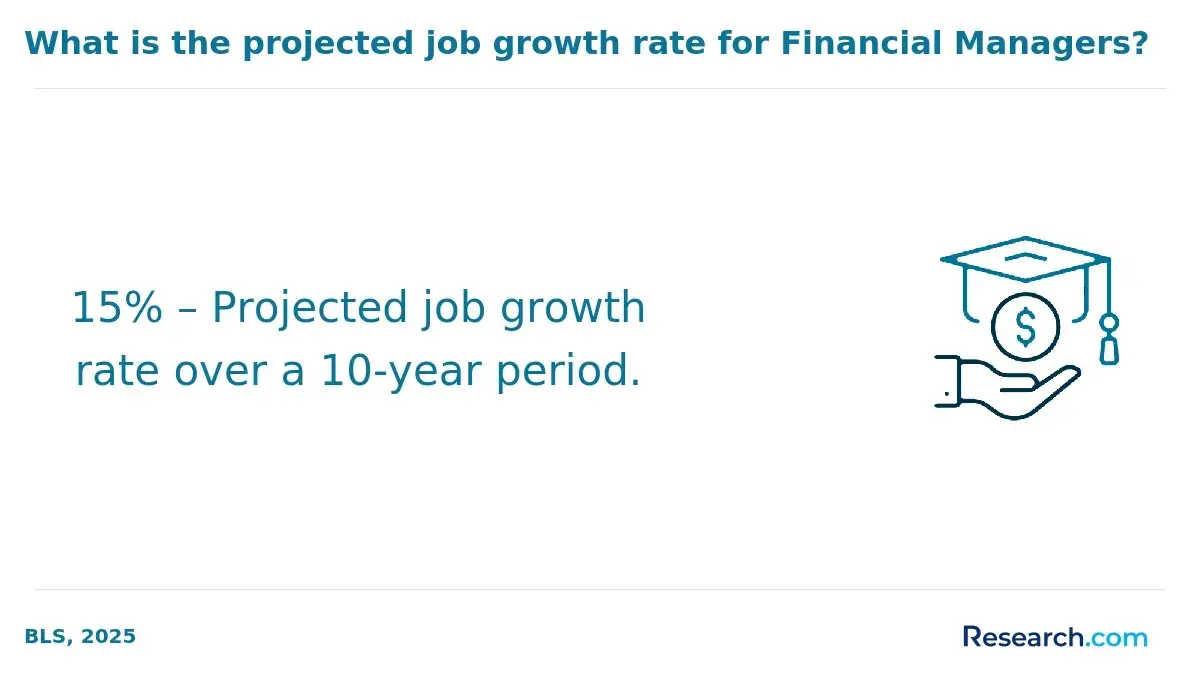
The U.S. Bureau of Labor Statistics (2025) projects that employment for business and financial operations occupations will grow by 7% in 2032, faster than the average for all occupations. This category includes roles such as financial analysts, financial advisors, and loan officers. Fintech, cybersecurity, data analytics, and AI-driven financial tools are also changing what employers expect from finance professionals.
Accredited online degrees are increasingly accepted, but students still need to show that they can analyze data, explain financial decisions, use technology, and work with clients or internal stakeholders. The finance industry rewards strong technical ability and practical experience, so internships, projects, and certifications can help graduates stand out.
This chart shows some of the top-paying industries for financial managers.
What challenges might I face in an online finance program?
Online finance programs require discipline because students must manage deadlines, quantitative assignments, online discussions, exams, and group projects without the structure of daily campus attendance. Students who struggle with self-paced learning may need calendar systems, study groups, tutoring, and regular advisor check-ins.
Technology can also be a barrier. Reliable internet, updated hardware, spreadsheet software, learning management system access, and comfort with virtual collaboration are essential. Students should ask about technical support hours before enrolling, especially if they study at night or on weekends.
Another challenge is networking. Online students may not naturally meet classmates or employers unless they intentionally attend virtual events, join finance organizations, contact alumni, and use career services. Students considering future graduate business study can also compare structured programs such as the cheapest accredited online MBA to understand how different online formats support working professionals.
How do online finance programs develop essential leadership and interpersonal skills?
Strong online finance programs do not limit students to independent reading and quizzes. They often use group projects, case discussions, presentations, peer feedback, simulations, and live sessions to help students practice leadership, communication, negotiation, and conflict management.
These skills matter because finance professionals must explain complex information to non-finance audiences, collaborate with managers, advise clients, and defend recommendations. Students who want broader leadership development across industries may also explore programs such as cheap online MBA programs with healthcare concentration, especially if they plan to move into management later.
Can combining finance with business administration expand career opportunities?
Combining finance with business administration can make a graduate more versatile. Finance builds depth in analysis, markets, valuation, and capital decisions, while business administration adds knowledge of management, marketing, operations, strategy, and organizational leadership.
This combination can be useful for students who want corporate roles rather than narrowly financial positions. It can also help aspiring entrepreneurs, consultants, operations analysts, and managers who need to understand both financial performance and business strategy. Students interested in broader business preparation can compare related online business administration degrees.
How do online finance programs address legal and regulatory competencies?
Finance professionals operate in a regulated environment, so strong programs introduce students to business law, ethics, corporate governance, compliance, risk management, and financial regulation. These topics help students understand how legal requirements shape lending, investment management, reporting, consumer finance, anti-money laundering practices, and client relationships.
Students who want deeper legal knowledge may consider future graduate study or interdisciplinary programs. For example, those interested in compliance, governance, or corporate legal issues can review online master's programs in business law as a possible next step after gaining finance experience.
How can I advance my career in the field of finance?
Career growth in finance usually requires more than earning a bachelor’s degree. Graduates should build work experience, technical skill, professional credibility, and a network. Internships, entry-level analyst roles, rotational programs, and finance-related campus or online projects can all help students move from academic knowledge to job-ready ability.
Advanced credentials can also matter. Depending on the role, professionals may consider an MBA with a finance concentration, Chartered Financial Analyst (CFA), Certified Financial Planner (CFP), or other specialized designations. Skills in Excel, Python, financial modeling, valuation, risk analysis, and data visualization can also improve competitiveness. If you want to compare salary possibilities by role, Research.com’s guide to how much do finance majors make can help you understand how compensation differs across finance careers.
How can I maximize networking opportunities in an online finance program?
Networking is especially important for online students because many relationships will not happen casually in a hallway, classroom, or campus event. You need a plan for building professional visibility before graduation.
- Participate in discussion forums: Add thoughtful analysis, respond to classmates, and use course conversations to identify peers with similar goals.
- Attend virtual events and webinars: Join employer panels, alumni talks, career fairs, and finance webinars, then follow up with personalized messages.
- Join finance-related student organizations: Virtual finance clubs, investment groups, and professional societies can provide speaker events and peer connections.
- Use LinkedIn strategically: Connect with classmates, faculty, alumni, guest speakers, and recruiters. Share relevant finance content and comment professionally on industry discussions.
- Seek mentorship from faculty and alumni: Ask specific questions about career paths, certifications, internships, and skill gaps rather than sending generic networking messages.
How to maximize earning potential with an online bachelor's degree in finance
An online bachelor’s degree in finance can open the door, but earning potential grows when students make strategic choices during and after the program. The most effective approach is to pair the degree with marketable skills, real experience, targeted networking, and a clear specialization.
Pursue relevant certifications and designations
Professional credentials can signal specialized knowledge, but they should match your career goal. A student interested in wealth management should not choose the same path as someone aiming for risk management or investment research.
- Chartered Financial Analyst (CFA): Often associated with investment analysis, asset management, research, and portfolio management.
- Certified Financial Planner (CFP): Useful for students aiming toward personal financial planning, advising, and wealth management.
- Financial Risk Manager (FRM): Relevant for students interested in risk analysis and risk management roles.
Gain practical experience early
Internships, part-time finance roles, bank positions, analyst assistant work, and project-based experience can improve job prospects. Employers often want evidence that graduates can apply finance concepts, not just explain them in exams.
Choose specializations with strong alignment
Some finance niches are more competitive and may offer higher compensation potential. Investment banking, corporate finance, hedge funds, private equity, risk management, and fintech can be attractive, but they often require strong grades, technical ability, networking, and persistence.
- Investment Banking: Commonly associated with mergers and acquisitions, capital markets, and intensive financial modeling.
- Corporate Finance: Includes roles such as financial analyst, finance manager, and long-term pathways toward senior finance leadership.
- Hedge Funds and Private Equity: Competitive areas that often require strong analytical ability, relevant experience, and specialized knowledge.
Consider consulting or advisory work
Finance professionals who advise organizations or individuals may increase their income as they build expertise, client trust, and a measurable track record. Consulting and advisory roles require communication, problem-solving, and the ability to turn analysis into action.
Build a professional network
Networking can lead to internship referrals, interview opportunities, mentorship, and salary negotiation insight. Students should engage with alumni, professors, employers, and professional organizations such as the Financial Planning Association (FPA) or CFA Institute.
Evaluate advanced degrees carefully
A Master’s in Finance or MBA with a finance concentration can support advancement, but graduate school should be chosen for a specific reason. Compare tuition, career outcomes, employer support, and whether the credential is necessary for your target roles.
Look at high-demand sectors
Finance professionals work across many industries. Tech, fintech, healthcare, pharmaceuticals, and other complex sectors may value finance graduates who can combine industry knowledge with analysis, data skills, and strategic thinking.
Students seeking a lower-cost starting point may compare options from cheap accredited online colleges, but affordability should be balanced with accreditation, curriculum quality, transfer policies, and career support.
How do online finance programs offer career support and job placement services?
The strongest online finance programs provide career services that are accessible to remote students, not just campus learners. Useful support may include resume reviews, interview preparation, career coaching, internship leads, employer events, alumni networking, and virtual career fairs.
Ask whether career services are tailored to finance majors. General job boards are less valuable than finance-specific coaching, employer connections, industry panels, and internship guidance. Students planning executive or management paths later can also research advanced options such as the least expensive executive MBA.
What should you consider when choosing an online bachelor’s degree in finance program?
Before applying, compare programs through the lens of career fit, affordability, academic credibility, and student support. A program that works well for a full-time student may not work for a working parent, transfer student, or student aiming for a highly competitive finance role.
Program Accreditation
Confirm that the institution is accredited by a recognized accreditor. Accreditation helps ensure that the degree meets accepted academic standards and is more likely to be respected by employers and graduate schools.
Cost and Affordability
Compare tuition, fees, financial aid, transfer credits, and total out-of-pocket cost. If cost is a major factor, review resources such as the best affordable college for finance, then verify the latest tuition and fees directly with the school.
Curriculum and Specializations
Review the course list carefully. Students interested in investment banking, corporate finance, financial planning, fintech, or compliance should choose programs with electives and projects that support those goals.
Common mistakes to avoid when choosing an online finance degree
| Mistake | Why it can hurt you | Better approach |
| Choosing a program without checking accreditation | It can affect financial aid, credit transfer, graduate admissions, and employer acceptance. | Verify institutional accreditation before applying. |
| Comparing only tuition rates | Fees, books, software, and lost transfer credits can change the true cost. | Request a full cost estimate based on your situation. |
| Assuming all online programs are self-paced | Some require live sessions, proctored exams, or fixed weekly deadlines. | Ask about synchronous requirements and course schedules. |
| Ignoring career services | Finance hiring often depends on internships, networking, and employer access. | Choose a program with finance-relevant career support. |
| Picking a specialization without a career plan | A specialization may not help if it does not match your target role. | Map electives to specific jobs, certifications, and internships. |
| Assuming salary outcomes are guaranteed | Pay depends on role, region, experience, skills, and employer. | Use salary data as a planning tool, not a promise. |
What certifications are valuable for finance graduates?
The most valuable finance certification depends on the career path you want. Some credentials are broad and widely recognized, while others are best for specific areas such as financial planning, risk, accounting, or management finance.
Highly Recognized Certifications
- Chartered Financial Analyst (CFA). This designation is associated with investment analysis, portfolio management, asset management, and research. It requires passing three rigorous exams and demonstrating relevant work experience.
- Certified Financial Planner (CFP). This credential is designed for professionals who provide personal financial planning and wealth management services. It involves an exam and experience requirements.
- Certified Public Accountant (CPA). Although accounting-focused, the CPA can be valuable for finance professionals who work in reporting, auditing, tax, controls, or corporate accounting-related finance roles.
Specialized Certifications
- Financial Risk Manager (FRM). This certification focuses on financial risk identification, measurement, and management.
- Financial Risk Certified Associate (FRCA). This credential can provide foundational risk management knowledge for early-career professionals.
- Certified Management Accountant (CMA). This certification emphasizes management accounting, budgeting, forecasting, and corporate finance decision support.
What are the highest paying jobs for bachelor’s degree in finance graduates?
The table below lists several high-paying roles for bachelor’s degree in finance graduates, along with median annual salaries according to the Bureau of Labor Statistics (BLS). These figures should be used for comparison, not as guaranteed outcomes.
| Role | Median Annual Salary |
| Investment Banking Analyst | $101,380 |
| Securities, Commodities, and Financial Services Sales Agent | $89,540 |
| Investment Banking Associate | $139,140 |
| Financial Manager | $127,990 |
| Personal Financial Advisor | $88,890 |
| Management Analyst | $99,240 |
| Financial Trader | $130,330 |
| Securities Salesperson | $84,140 |
| Actuary | $101,590 |
| Risk Management Analyst | $105,390 |
What is the difference between a bachelor’s in finance and a bachelor’s in accounting?
Finance and accounting overlap, but they prepare students for different types of work. Finance focuses on using money strategically: investing, raising capital, assessing risk, forecasting performance, and making financial decisions. Accounting focuses on recording, reporting, auditing, and verifying financial activity according to rules and standards.
| Category | Bachelor of Science in Finance | Bachelor of Science in Accounting |
| Main focus | Analyzing and managing financial resources for individuals, companies, and organizations | Recording, reviewing, reporting, and verifying financial transactions |
| Typical coursework | Financial markets, investments, corporate finance, risk management, financial modeling, financial analysis, derivatives, securities, economic analysis | Financial accounting, managerial accounting, auditing, tax accounting, cost accounting, financial statement analysis, internal controls, ethical standards |
| Common careers | Investment banking, corporate finance, financial analyst, wealth management, commercial banking, financial consultant, risk analyst, quantitative analyst | Public accountant, auditor, tax accountant, corporate accountant, fraud examiner, cost accountant, financial analyst with additional training |
| Key strengths developed | Quantitative analysis, modeling, problem-solving, investment thinking, communication, teamwork | Accuracy, compliance, attention to detail, research, critical thinking, communication, internal controls |
Choose finance if you are drawn to markets, investments, valuation, capital decisions, and financial strategy. Choose accounting if you prefer structured reporting, audit trails, tax rules, controls, and detailed financial documentation. If you are undecided, look at entry-level job descriptions in both fields and compare the daily tasks.
What online resources are available to enhance learning in a bachelor's degree in finance?
- Online libraries and databases: Use academic journals, market research, financial data, and company information to strengthen assignments.
- Financial modeling software: Practice tools such as Excel, QuickBooks, financial calculators, and other applications used in business settings.
- Webinars and workshops: Attend sessions led by faculty, employers, alumni, and industry professionals.
- Virtual simulations: Apply investment, risk, and financial analysis concepts in interactive environments.
- Online communities: Join finance forums, student groups, alumni networks, and professional discussions to build knowledge and connections.
Current trends affecting online finance students
- AI and automation: Finance teams increasingly use automation, analytics, and AI-supported tools for forecasting, reporting, fraud detection, and customer service. Students should build data and technology skills alongside finance theory.
- Fintech growth: Digital payments, online banking, blockchain applications, and embedded finance are changing the types of employers hiring finance graduates.
- Skills-based hiring: Employers often look for demonstrated ability in Excel, financial modeling, data analysis, communication, and problem-solving, not only degree completion.
- Compliance and risk awareness: Financial regulation, cybersecurity, anti-money laundering requirements, and data privacy concerns make compliance knowledge more valuable.
- Flexible education demand: Online and hybrid formats remain important for adults who need to study while working, but students should still verify accreditation, support services, and career outcomes.
Key Insights
- An online bachelor’s degree in finance can be a strong option if you need flexibility and want preparation for banking, financial analysis, corporate finance, investment services, insurance, fintech, or business roles.
- The best program is not automatically the cheapest or highest-ranked. Prioritize accreditation, total cost, transfer credit, curriculum fit, online format, career services, and employer relevance.
- Most programs require 120 credits and are commonly designed around a four-year timeline, though transfer credits, accelerated terms, and part-time enrollment can change completion time.
- Finance salaries vary widely. Use salary data to compare possibilities, but remember that earnings depend on experience, location, specialization, certifications, and employer type.
- Students who want stronger ROI should seek internships, build financial modeling and data skills, network actively, and consider certifications that match their target career path.
- Online finance students must be intentional about time management and networking. Flexibility is valuable, but it also requires discipline and proactive use of support services.
- Before enrolling, ask schools for a full cost estimate, transfer evaluation, course format details, accreditation information, career support access, and examples of outcomes for online finance graduates.
References:
- Chernev, B. (n.d.). 29 Astonishing E-learning Statistics.
- Corporate Finance Institute. (n.d.). Finance Definition.
- Ewing, J. (n.d.). United States is the richest country in the world, and it has the biggest wealth gap.
- Government Finance Officers Association (n.d.). Employment Landscape of the State and Local Public Finance Workforce.
- McGrath, M. (n.d.). A Global Financial Literacy Test Finds That Just 57% Of Adults In U.S. Are Financially Literate.
- Sarkar, S. (n.d.). A Brief History of Online Education.
- US Bureau of Labor Statistics (n.d.). Business and Financial Occupations.
- edX. (2025). Bachelor’s degrees in finance: Overview and career opportunities. edX.
- UniversityHQ. (2025). Online finance degrees: Admissions requirements and program guide. UniversityHQ.
Other Things You Should Know About Online Bachelor’s Degree in Finance
Most online finance bachelor’s programs require calculus, statistics, and at least one course in business algebra or quantitative methods. Many also ask for intermediate microeconomics or economics for decision-making before upper-level finance classes in corporate finance, investments, and financial modeling.
A top online finance bachelor’s degree for 2027 should include financial analysis, investment principles, risk management, and corporate finance. Courses in economics, accounting, and quantitative methods are essential, emphasizing technical skills, analytical thinking, and a comprehensive understanding of financial systems.