
2027 Most Affordable Online Master's Degrees in Economics

Co-Founder and Chief Data Scientist
Earning a master's degree in economics can open doors to a variety of careers in business, finance, and government. But the cost of a traditional on-campus program can be a major barrier. According to recent data, the average tuition and fees for a graduate economics program in the 2023-2024 academic year was $38,560.
Fortunately, there are now many affordable online economics degree programs available. Using my decades of experience in academic planning, I put together this guide to the most affordable online master's degrees in economics. I've also highlighted each program's duration, specializations, tuition, required credits, and accreditation to give students a more accurate picture.
What are the benefits of getting an online master's degree in economics?
- Common career options for online master's economics holders include economic analysts, financial analysts, policy analysts, consultants, and government economists.
- In 2023, the average yearly salary for economists was $115,730.
- Online economics master programs can accelerate or prolong time completion depending on your availability and commitment.
What can I expect from an online master's degree in economics?
An online master's in economics offers a strong foundation in economic theory and its applications, all while providing the convenience of online learning. While your schedule may be flexible, expect to dedicate a significant amount of time per week to coursework, readings, and assignments.
- Students can also expect a curriculum that covers essential topics, such as microeconomic and macroeconomic principles, econometrics, and applied economic analysis.
- Moreover, many online economics degree programs offer specialized tracks like financial economics, international economics, or public policy, allowing students to focus their studies based on their career aspirations.
- Depending on their schedule, students may take up to 2 years to complete an online master's degree in economics.
- Depending on the institution, an online master's degree in economics may cost up to $40,000.
- Courses in an online economics degree are delivered online through a learning management system, with lectures available on-demand or streamed live. Interaction with classmates and professors can happen through discussion forums, video conferencing, or collaborative projects.
Where can I work with an online master's degree in economics?
With an online master's degree in economics, graduates can pursue diverse career paths in public and private sectors. Opportunities abound in government agencies, financial institutions, consulting firms, research organizations, and multinational corporations. Roles include economic analysts, policy advisors, financial analysts, market researchers, and data scientists.
The versatility of an online economics degree equips graduates with analytical skills and a deep understanding of economic principles, allowing them to contribute effectively to decision-making processes, strategic planning, and policy formulation across various industries and sectors.
How much can I make with an online master's degree in economics?
The Bureau of Labor Statistics (BLS) reports that the average yearly salary for economists in May 2023 was $115,730. With more experience or specialization, which includes federal government and scientific research and development services, salaries can significantly increase, ranging from $135,000 to over $140,000 per year.
The affordability of an online economics degree doesn't typically affect earning potential directly. Rather, it allows graduates to maximize their return on investment by entering the job market with valuable skills at a lower educational cost. Graduates can expect competitive salaries given their specialized skills in economic analysis and quantitative reasoning.
- Most Affordable Online Master's Degrees in Economics for 2027 Affordable Programs
- How long does it take to complete an affordable online master's degree in economics? Completion Time
- How does an online master's degree in economics compare to an on-campus program? How does an online master's degree in economics compare to an on-campus program?
- What is the average cost of an affordable online master's degree in economics? Average Cost
- What are the financial aid options for students enrolling in an affordable online master's degree in economics? Financial Aid
- What are the prerequisites for enrolling in an affordable online master's degree in economics? Requirements
- What courses are typically in an affordable online master's degree in economics? What courses are typically in an affordable online master's degree in economics?
- What types of specializations are available in an affordable online master's degree in economics? What types of specializations are available in an affordable online master's degree in economics?
- How to choose the best online master's degree in economics? How to choose the best online master's degree in economics?
- Why choose accredited online colleges for your economics degree? Why choose accredited online colleges for your economics degree?
- Is an online master's degree in economics a sound financial investment? Is an online master's degree in economics a sound financial investment?
- What are the advantages and disadvantages of an online master's degree in economics? What are the advantages and disadvantages of an online master's degree in economics?
- What career paths are available for graduates of an affordable online master's degree in economics? What career paths are available for graduates of an affordable online master's degree in economics?
- What emerging trends are shaping online master's programs in economics? What emerging trends are shaping online master's programs in economics?
- How do online master's programs integrate fintech and blockchain innovations? How do online master's programs integrate fintech and blockchain innovations?
- What is the impact of economic trends on job opportunities for graduates? What is the impact of economic trends on job opportunities for graduates?
- What is the job market for graduates with an affordable online master's degree in economics? Job Market
- How can online master's students enhance networking and mentorship opportunities? How can online master's students enhance networking and mentorship opportunities?
- How do online master's programs in economics integrate practical, real-world experiences? How do online master's programs in economics integrate practical, real-world experiences?
- What are the application requirements for online Master's Degrees in Economics? What are the application requirements for online Master's Degrees in Economics?
- How do interdisciplinary studies expand career opportunities in online economics programs? How do interdisciplinary studies expand career opportunities in online economics programs?
- Are there alternative advanced degrees that provide comparable value? Are there alternative advanced degrees that provide comparable value?
Most Affordable Online Master's Degrees in Economics for 2027
An online master’s degree in economics can be a practical way to build advanced skills in economic modeling, data analysis, forecasting, policy evaluation, and business decision-making without leaving your job or relocating. The challenge is choosing a program that is affordable, credible, flexible, and aligned with the kind of economics career you want.
This guide compares affordable online master’s programs in economics and closely related fields, explains what students typically study, outlines admissions and cost factors, and shows how to evaluate whether a program is worth the investment. It is designed for working professionals, recent graduates, career changers, and students comparing online graduate economics programs by cost, accreditation, curriculum, flexibility, and career outcomes.
Quick Answer: What Is the Most Affordable Online Master’s in Economics?
Based on the program list below, Georgia Southern University has the lowest listed annual tuition at $5,370 per year for its online MS in Applied Economics. Other lower-cost options include Emporia State University at $7,529 per year and the University of North Dakota at $7,661 per year. However, the cheapest program is not automatically the best choice. Students should also compare accreditation, required credits, delivery format, quantitative coursework, software training, faculty support, and whether the curriculum fits their target career path.
How We Ranked These Schools
Because graduate school is a major financial decision, affordability should be evaluated with reliable institutional and federal education data. Research.com analyzed available program information using sources such as the IPEDS database, Peterson's database with emphasis on its Distance Learning Licensed Data Set, the College Scorecard database, and the National Center for Education Statistics.
For more detail on how Research.com evaluates schools and programs, review the Research.com methodology.
Affordable Online Master’s Degrees in Economics: Program Comparison
| Rank | School and Program | Listed Tuition or Cost | Credits | Program Length | Accreditation |
| 1 | Georgia Southern University Online MS in Applied Economics | $5,370 per year | 30 | 1 year | Association for the Advancement of Collegiate Schools of Business (AACSB) |
| 2 | Youngstown State University MS in Applied Economics | $13,560 (resident); $13,920 (nonresident); $19,346-$20,707 (international) | 30 | 1 year | Higher Learning Commission (HLC) |
| 3 | Emporia State University Online MS in Informatics, Quantitative Economics emphasis | $7,529 per year | 36 | 1 year | HLC |
| 4 | University of North Dakota MS in Applied Economics and Predictive Analysis | $7,661 per year | 30 | 2 years | AACSB |
| 5 | Idaho State University MBA-Applied Economics | $9,126 per year | 30 | 1 year | Northwest Commission on Colleges and Universities |
| 6 | Murray State University Masters in Economic Development | $9,143 per year | 30 | 1 year | Southern Association of Colleges and Schools Commission on Colleges Commission on Colleges (SACSCOC) |
| 7 | Western Illinois University MBA-Economics | $9,578 | 33 | 1 year | AACSB |
| 8 | SUNY Empire State University MA in Community and Economic Development | $12,204 per year | 30 | 1 year | Middle States Commission on Higher Education (MSCHE) |
| 9 | University of Missouri MA in Economics | $15,750 | 30 | 2 years | HLC |
| 10 | Wright State University MBA in Economics | $13,221 | 33-46.5 | 1-2 years | SACSCOC |
1. Georgia Southern University Online MS in Applied Economics
Georgia Southern University offers a public university online MS in Applied Economics for students who want training in applied economic reasoning, quantitative analysis, and econometrics. Coursework may be completed through synchronous or asynchronous instruction. Example courses include Math for Applied Economics, Microeconomics, and Applied Econometrics. Graduates may pursue roles such as financial analyst, accountant, or management consultant.
- Program Length: 1 year
- Tracks/Concentrations: No information available
- Tuition: $5,370 per year
- Required Credits to Graduate: 30
- Accreditation: Association for the Advancement of Collegiate Schools of Business (AACSB)
2. Youngstown State University MS in Applied Economics
Youngstown State University provides an MS in Applied Economics focused on using economic ideas to evaluate practical problems in business, public policy, and society. The curriculum develops critical thinking, problem-solving, database design, data analysis, data mining, economics, and statistics skills. It may fit students who want to apply economic analysis in organizations, government agencies, or research-focused settings.
- Program Length: 1 year
- Tracks/Concentrations: No information available
- Yearly Tuition & Fees: $13,560 (resident); $13,920 (nonresident); $19,346-$20,707 (international)
- Required Credits to Graduate: 30
- Accreditation: Higher Learning Commission (HLC)
3. Emporia State University Online MS in Informatics, Quantitative Economics Emphasis
Emporia State University offers an online MS in Informatics with a Quantitative Economics emphasis. The program has a STEM-centered structure and focuses on transforming data into usable information. Sample courses include Programming and Data Analysis for Informatics, Economic Theory, and Econometrics. Graduates may move into jobs such as legal document analyst, account manager, or market researcher.
- Program Length: 1 year
- Tracks/Concentrations: No information available
- Tuition: $7,529 per year
- Required Credits to Graduate: 36
- Accreditation: HLC
4. University of North Dakota MS in Applied Economics and Predictive Analysis
UND offers an MS in Applied Economics and Predictive Analysis for students who want stronger preparation in research, forecasting, and data-driven economic analysis. The program is available online and on campus. Students begin with econometrics and statistical analysis and work with industry-standard tools and programming languages such as R and Python. Many graduates pursue forecasting and economic research careers.
- Program Length: 2 years
- Tracks/Concentrations: No information available
- Tuition: $7,661 per year
- Required Credits to Graduate: 30
- Accreditation: AACSB
5. Idaho State University MBA-Applied Economics
The Idaho State University MBA-Applied Economics option is designed to be accessible to students who do not already hold a business degree. The program is offered at the university's resident tuition rate regardless of where a student lives. Core courses cover management, economics, marketing and finance, accounting, and data analytics. Students may also choose a specific business concentration, with each concentration requiring 9 extra credits from 5500 or 6600 level electives.
- Program Length: 1 year
- Tracks/Concentrations: Accounting, Economics, Finance, Healthcare Administration Marketing, Operations Management
- Tuition: $9,126 per year
- Required Credits to Graduate: 30
- Accreditation: Northwest Commission on Colleges and Universities
6. Murray State University Masters in Economic Development
Murray State University offers a Masters in Economic Development for students interested in regional growth, community planning, and applied economic strategy. The curriculum addresses topics related to city, regional and urban planning, economics, demography, political science, geography and mapping, infrastructure, education, and tourism. Students can study online or in person and receive training with IMPLAN, Geographic Information System (GIS), and related statistical and economic tools.
- Program Length: 1 year
- Tracks/Concentrations: No information available
- Tuition: $9,143 per year
- Required Credits to Graduate: 30
- Accreditation: Southern Association of Colleges and Schools Commission on Colleges Commission on Colleges (SACSCOC)
7. Western Illinois University MBA-Economics
Western Illinois University offers an MBA-Economics that may be completed synchronously or asynchronously. The curriculum gives students a business foundation while adding economics coursework for learners who want to use economic analysis in management, finance, consulting, or policy-related roles. Courses include Econometrics, Economic Development, and International Trade, along with a seminar in economics.
- Program Length: 1 year
- Tracks/Concentrations: No information available
- Tuition: $9,578
- Required Credits to Graduate: 33
- Accreditation: AACSB
8. SUNY Empire State University MA in Community and Economic Development
SUNY Empire State offers an MA in Community and Economic Development for professionals working in government, nonprofit, and private-sector settings. The program emphasizes how businesses, local governments, and community groups collaborate to improve cities, schools, neighborhoods, and public resources. Its curriculum connects economic development concepts with community development theory and practice.
- Program Length: 1 year
- Tracks/Concentrations: No information available
- Tuition: $12,204 per year
- Required Credits to Graduate: 30
- Accreditation: Middle States Commission on Higher Education (MSCHE)
9. University of Missouri MA in Economics
University of Missouri offers an MA in Economics that combines economic theory with newer data analytics applications. The program addresses big data utilization, globalization, global trade, economic development, and global finance. Students are expected to conduct research and examine social, political, and organizational conflicts through an economic lens.
- Program Length: 2 years
- Tracks/Concentrations: Cybersecurity Engineering, Data Science, Software Engineering
- Estimated Cost: $15,750
- Required Credits to Graduate: 30
- Accreditation: HLC
10. Wright State University MBA in Economics
Wright State University offers an MBA in Economics with online, on-campus, and flexible scheduling options. The program is designed to develop business professionals who understand broad organizational strategy, ethical decision-making, and opportunities in the international marketplace. It may appeal to students who want economics training within a broader MBA structure.
- Program Length: 1-2 years
- Tracks/Concentrations: Business Economics, Finance, Healthcare Management, Interdisciplianry Business, International Business, and more
- Tuition: $13,221
- Required Credits to Graduate: 33-46.5
- Accreditation: SACSCOC
How Long Does It Take to Complete an Affordable Online Master’s Degree in Economics?
Most online master’s degrees in economics take about 1.5 to 2 years for full-time students, although several programs in this list advertise 1-year completion options. Students who need a shorter path may also compare economics programs with other quick degrees, but completion speed should not be the only factor.
Program length depends on the number of required credits, whether courses are offered every term, the student’s undergraduate preparation, and whether prerequisite courses are needed. A 30-credit program may be faster than a 36-credit program, but scheduling format matters just as much as credit count.
Part-time enrollment can be useful for working adults, caregivers, and students using employer tuition assistance. It usually extends the timeline, but it may reduce academic pressure and make tuition payments easier to manage.
Online vs. On-Campus Master’s in Economics: Which Format Is Better?
An online economics master’s degree is usually best for students who need location flexibility, want to continue working, or cannot commute to campus. Online courses may be asynchronous, synchronous, or a combination of both. Asynchronous courses provide more schedule control, while synchronous courses offer more direct interaction with classmates and faculty.
On-campus economics programs may offer easier access to faculty offices, in-person research groups, campus recruiting, and informal networking. Students who learn best through live discussion or want a traditional graduate school environment may prefer this route.
| Factor | Online Economics Master’s | On-Campus Economics Master’s |
| Best for | Working adults, remote learners, students who cannot relocate | Students who want in-person networking, campus resources, and face-to-face instruction |
| Flexibility | Usually higher, especially with asynchronous courses | Usually lower because of fixed class times and location requirements |
| Networking | Requires more intentional effort through virtual events, faculty contact, and alumni platforms | Often easier through campus events, research groups, and peer interaction |
| Costs | May reduce commuting, relocation, and some campus-related expenses | May involve housing, transportation, and additional campus-based costs |
| Learning fit | Works best for self-directed students with strong time management | Works best for students who prefer structured schedules and direct classroom engagement |
Online and hybrid instruction became more prominent beginning in 2021, and instructional models continue to influence how graduate programs deliver coursework, advising, and student support.
What Is the Average Cost of an Affordable Online Master’s Degree in Economics?
Based on the programs listed in this guide, an affordable online master’s-level economics program may cost $5,000 to $15,000 per year. Actual cost varies by institution, tuition structure, fees, credit requirements, residency status, and program length. In general, these options fall near the cost range students may see when comparing other specialized low-cost graduate programs, such as affordable online master's degrees in taxation.
NCES reports that the 2022-2023 cost of full-time graduate programs is $20,015 at private schools and $11,554 at public institutions. This makes it important to compare not only annual tuition but also total program cost.
Students should budget for more than tuition. Common additional expenses include application fees, distance learning fees, textbooks, statistical software, a reliable computer, internet service, exam proctoring, and graduation fees. Students planning to use federal aid should verify whether a school is among online colleges that accept FAFSA.
When comparing cheap online degrees, look at total net cost rather than sticker price. A program with slightly higher tuition may be cheaper overall if it offers better transfer credit policies, employer partnerships, scholarships, or shorter completion time.
What Financial Aid Options Are Available for Online Master’s Students in Economics?
Students in online economics master’s programs may qualify for federal financial aid, institutional scholarships, employer tuition assistance, fellowships, assistantships, private scholarships, or payment plans. Eligibility depends on the school, enrollment status, accreditation, citizenship or residency status, academic record, and the specific funding program.
- Hsiao Memorial Social Sciences Scholarship: Offered by the Asian Pacific Fund in honor of economics professor Liang-Lin Hsiao, this scholarship is available to graduate economics students with at least a 3.0 GPA.
- NSF Graduate Research Fellowship: The National Science Foundation provides this fellowship for students in research-centered master's programs at accredited institutions. The award includes tuition support and a yearly stipend.
- Byron Hanke Fellowship: This fellowship supports student research projects and provides an amount between $3,000-$5,000.
- American Institute for Economic Research's Graduate Fellowship: AIER runs a 12-week program for graduate students whose work relates to free enterprise, property rights, economic liberty, and legal institutions. Fellows receive a weekly stipend worth $350, along with lunch, travel costs, and housing in the AIER manor or cottages.
The College Board reported that total graduate enrollment increased from 3.066 million to 3.205 million between 2001 and 2021. It also reported that total financial aid for graduate students has increased significantly since the 2002-2003 academic year.
What Are the Prerequisites for an Online Master’s in Economics?
Admissions standards vary by school, so applicants should review each program’s requirements before applying. A student with a strong quantitative background may be admitted more easily than a student who has not taken economics, statistics, or calculus coursework.
- Prior education: Many programs accept applicants from multiple academic backgrounds, but some prefer a bachelor’s degree in economics, business, mathematics, statistics, finance, or a related field. Students who earned the least expensive online bachelor's degree should still confirm that their institution was properly accredited.
- Minimum GPA: Programs often set undergraduate GPA expectations, commonly ranging from 2.5 to 3.0 on a 4.0 scale.
- GRE or GMAT: Some schools require standardized test scores, particularly for applicants with weaker quantitative preparation or non-economics backgrounds.
- Work experience: Professional experience may strengthen an application, especially for applied economics, business economics, public policy, or economic development tracks.
- Prerequisite coursework: Applicants may need prior coursework in microeconomics, macroeconomics, calculus, statistics, econometrics, programming, or computer science.
What Courses Are Common in an Affordable Online Master’s Degree in Economics?
Online economics master’s programs usually combine theory, quantitative methods, applied analysis, and research. The strongest programs help students move beyond abstract concepts and use data to answer business, policy, financial, and social questions.
- Microeconomic Theory: Examines consumer behavior, producer decisions, market equilibrium, market structures, and the incentives that shape individual and firm-level choices.
- Macroeconomic Theory: Covers inflation, unemployment, national income, economic growth, monetary policy, fiscal policy, and stabilization strategies.
- Econometrics: Builds statistical analysis skills through regression, time series analysis, hypothesis testing, and economic modeling.
- Applied Economic Analysis: Uses economic theory and quantitative tools to study practical issues such as labor markets, environmental policy, healthcare economics, and public policy evaluation.
- Financial Economics: Explores asset pricing, portfolio theory, financial markets, corporate finance, and risk management.
- International Economics: Studies trade, exchange rates, international finance, global development, trade policy, and globalization.
- Research Methods and Seminar Courses: Develops research design, data collection, literature review, analysis, and presentation skills, often through a thesis, capstone, or applied project.
What Specializations Are Available in Online Master’s Programs in Economics?
Specializations help students connect economics training to a specific labor market. The right concentration depends on whether the student wants to work in finance, consulting, public policy, economic development, sustainability, research, or analytics.
| Specialization | What It Emphasizes | Best Fit |
| Financial Economics | Financial markets, asset pricing, risk management, corporate finance, and investment-related analysis | Students aiming for finance, banking, investment analysis, or risk roles |
| International Economics | Global trade, international finance, economic development, globalization, and international agreements | Students interested in global organizations, trade policy, development, or multinational firms |
| Public Policy and Administration | Policy evaluation, taxation, government spending, welfare economics, and public-sector management | Students targeting government, think tanks, nonprofit research, or public administration |
| Applied Economics | Using theory and quantitative methods to solve real-world problems in labor, healthcare, environment, or regions | Students who want versatile analytical roles in business, government, or consulting |
| Data Analytics and Econometrics | Advanced statistics, forecasting, data modeling, economic research, and predictive analysis | Students seeking data-heavy roles that require coding, modeling, and statistical software |
| Environmental and Natural Resource Economics | Sustainability, energy economics, climate change economics, natural resource management, and environmental policy | Students interested in environmental consulting, government, NGOs, or sustainability strategy |
How to Choose the Best Online Master’s Degree in Economics Program
The best online economics master’s program is the one that matches your career goal, academic preparation, budget, schedule, and preferred learning format. Rankings can help narrow the search, but they should not replace your own program-by-program comparison.
- Confirm accreditation: Institutional accreditation matters for credit transfer, financial aid eligibility, and employer recognition. Business-focused programs may also hold specialized accreditation from AACSB or the Accreditation Council for Business Schools and Programs (ACBSP). Students comparing cheap online masters degrees should verify accreditation before applying.
- Compare curriculum depth: Review whether the program includes econometrics, data analysis, programming, forecasting, and research methods. Students still evaluating academic direction can also explore broader guidance on college majors.
- Check software and technical requirements: Strong economics programs often use R, Python, Stata, Excel, GIS, or other statistical tools. Ask whether software licenses are included in tuition.
- Evaluate student support: Look for academic advising, tutoring, library access, technical support, career coaching, and faculty availability for online students.
- Review outcomes carefully: Ask about job placement support, alumni employers, internship access, capstone projects, and whether online students receive the same career services as campus students.
| Question to Ask | Why It Matters |
| Is the institution accredited? | Accreditation affects financial aid, transferability, academic quality, and employer recognition. |
| Are courses synchronous, asynchronous, or both? | The format determines how well the program fits your work schedule and learning style. |
| Does the program teach econometrics and data tools? | Economics roles increasingly require quantitative and technical skills. |
| What is the total program cost? | Annual tuition alone does not show fees, software, books, or total credits required. |
| Are online students eligible for internships, career fairs, and alumni networking? | Career support can affect your ability to translate the degree into employment or advancement. |
Why Accreditation Matters for an Online Economics Degree
Choosing an accredited institution is one of the most important safeguards when enrolling in an online master’s program. Accreditation shows that a school has been reviewed for academic quality, governance, student support, and institutional stability. Students comparing the most accredited online colleges should distinguish between institutional accreditation and programmatic business accreditation.
Accreditation Supports Academic Quality
Accredited institutions are expected to meet standards set by recognized accrediting bodies. This review process evaluates areas such as curriculum design, faculty qualifications, learning resources, assessment practices, and student services.
Accreditation Improves Degree Recognition
Employers, graduate schools, and professional organizations are more likely to recognize degrees from accredited institutions. If a student later applies to a Ph.D. in Economics or another graduate program, accreditation can affect whether prior coursework is accepted.
Accreditation Affects Financial Aid
Federal financial aid is generally available only through eligible accredited institutions. Many scholarships and grants also require enrollment in an accredited program.
Accreditation Can Influence Credit Transfer
Students who change schools, add a certificate, or continue into doctoral study may need previous credits reviewed. Credits from accredited institutions are more likely to be considered by receiving schools, although transfer is never guaranteed.
Accreditation Often Signals Stronger Student Support
Accredited colleges commonly provide advising, digital libraries, career services, technical help, and student success resources. Online students should confirm that these services are available remotely, not only on campus.
Is an Online Master’s Degree in Economics Worth the Cost?
An online master’s in economics can be a sound investment if it helps the student qualify for analytical, research, consulting, finance, policy, or management roles that require stronger quantitative skills. It is less likely to pay off if the program is poorly aligned with the student’s career plan, lacks data-focused coursework, or creates debt that cannot be supported by realistic earnings expectations.
To evaluate return on investment, compare total tuition and fees against likely career advancement, opportunity cost, employer tuition support, and the value of the credential in your target field. Students comparing economics with other high paying master's degrees should remember that salary outcomes depend on occupation, location, experience, industry, and individual performance.
Advantages and Disadvantages of an Online Master’s Degree in Economics
| Advantages | Disadvantages |
| Flexible scheduling can help working professionals remain employed while studying. | Online learning requires strong time management and self-discipline. |
| Students may avoid relocation, commuting, and some campus-related expenses. | Networking may require more intentional effort than in a campus program. |
| Asynchronous courses can allow study during evenings, weekends, or nontraditional hours. | Some courses may require live sessions, group work, or proctored exams that reduce flexibility. |
| Students can often apply economic analysis directly to current workplace problems. | Not every online program offers the same access to research, internships, or faculty mentorship. |
| Accredited online degrees are increasingly common in graduate education. | Students must carefully avoid unaccredited or weakly supported programs. |
What Career Paths Are Available After an Online Master’s Degree in Economics?
A master’s degree in economics can prepare graduates for roles that depend on economic reasoning, statistical analysis, policy interpretation, forecasting, and data-informed decision-making. Career options vary by specialization, technical skills, prior experience, and industry.
- Economic Analyst: Studies data, economic indicators, market behavior, and policy trends to support decisions in business, government, or research organizations.
- Financial Analyst: Reviews financial data, market trends, and organizational performance to guide investment, budgeting, or planning decisions.
- Policy Analyst: Evaluates public policies, conducts research, and prepares recommendations for government agencies, think tanks, nonprofits, or advocacy groups.
- Consultant: Applies economic expertise to market analysis, impact studies, regulatory issues, pricing decisions, or organizational strategy.
- Government Economist: Analyzes economic conditions, forecasts trends, and supports public policy development within government agencies.
Current Trends Shaping Online Master’s Programs in Economics
Graduate economics programs are placing greater emphasis on applied data analysis, programming, fintech, policy evaluation, and interdisciplinary training. Employers increasingly expect economics graduates to interpret large datasets, use statistical software, communicate findings clearly, and connect analysis to business or policy decisions.
Some programs now include coursework or electives related to finance, analytics, technology, and market behavior. Students interested in the finance side of economics may also compare economics programs with the cheapest online masters in finance to decide whether economics, finance, or a blended path offers the better fit.
How Do Online Economics Programs Address Fintech and Blockchain?
Some online economics and business programs are adding content related to fintech, digital currencies, blockchain, algorithmic trading, smart contracts, and digital financial systems. These topics are most relevant for students interested in financial markets, risk, banking, regulation, or data-heavy finance roles.
Not every economics program includes these subjects, so students should examine the course catalog before enrolling. Those specifically seeking digital finance coursework may also review options related to a cryptocurrency university or related fintech education pathways.
How Do Economic Trends Affect Job Opportunities for Economics Graduates?
Labor market opportunities for economics graduates are shaped by demand for data analysis, public policy expertise, financial modeling, sustainability planning, and technology-enabled decision-making. Students should choose electives and projects that match where the job market is moving.
- Demand for data analysis: Organizations rely on data-driven decisions, creating opportunities for graduates who can model, interpret, and explain complex datasets.
- Sustainability and environmental priorities: Students with environmental economics or resource management training may find opportunities in agencies, NGOs, and companies focused on sustainability.
- Changing financial markets: Regulation, risk, and financial technology continue to create demand for economists with finance and quantitative skills.
- Public policy analysis: Economic disruptions, recessions, and public health crises increase the need for professionals who can forecast impacts and evaluate policy responses.
- Technology and automation: Economists who can use programming, modeling software, and automated data tools may be better positioned for analytical roles.
What Is the Job Market for Graduates With an Online Master’s Degree in Economics?
BLS data indicates that around 1,200 vacancies for economists are expected annually over the next 10 years, with 6% job growth from 2022 to 2032.
Organizations use economic research and quantitative analysis to evaluate demand, pricing, sales, public policy, financial conditions, and market risks. The expansion of big data, advertising analytics, and global economic complexity also supports demand for professionals who can translate economic information into decisions.
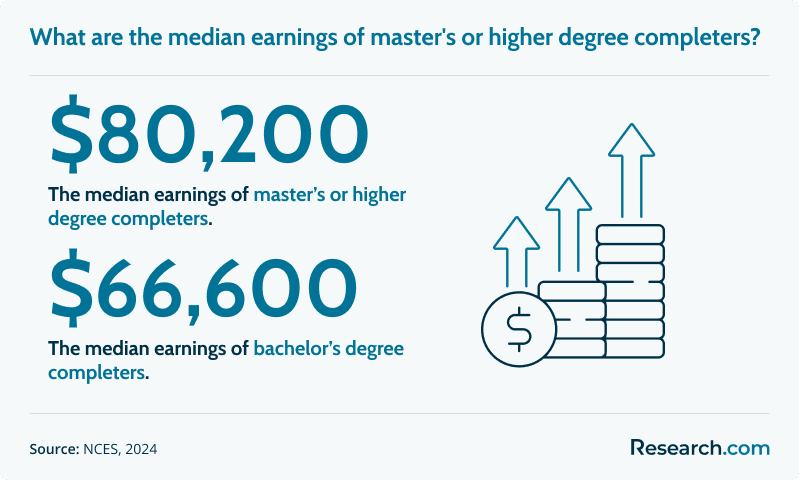
Employers often prefer candidates with a master's degree for economist positions, especially when the role requires advanced research, modeling, forecasting, or policy expertise. However, the degree alone does not guarantee employment. Students should build a portfolio of applied projects, software skills, writing samples, and professional connections while enrolled.
Students still comparing lower-cost academic paths may also explore cheap online environmental science degree programs, the cheapest online associate degrees in computer science, or the cheapest online sociology degrees.
How Can Online Economics Students Build Networking and Mentorship?
Online students should treat networking as part of the degree, not an optional extra. Because casual campus interactions are limited, students need to create regular contact with faculty, classmates, alumni, and employers.
- Attend virtual research talks, webinars, alumni panels, and online career fairs.
- Ask faculty about research assistant opportunities, applied projects, or thesis supervision.
- Join economics, finance, data analytics, public policy, or industry-specific professional groups.
- Use career services early instead of waiting until graduation.
- Build relationships with classmates through group projects, discussion boards, and study groups.
Students considering complementary business or finance credentials may also compare options such as the cheapest online finance degree to broaden their professional network and technical skill set.
How Do Online Economics Programs Include Real-World Experience?
Strong online economics programs connect theory to practice through capstones, research projects, case studies, internships, simulations, consulting-style assignments, and data analysis projects. These experiences help students show employers that they can apply economic concepts to real decisions.
When reviewing a program, ask whether students work with real datasets, write policy briefs, complete forecasting projects, analyze regional economies, or use industry software. Students interested in the overlap between economics and finance may also examine accelerated business options such as a fast-track finance degree.
What Are the Application Requirements for Online Master’s Degrees in Economics?
Application requirements vary by university, but most online economics master’s programs ask for evidence that applicants can handle graduate-level quantitative, analytical, and writing work.
- A bachelor's degree from an accredited institution, often in economics or a related field such as finance, mathematics, or statistics.
- A strong academic record, with many programs expecting a GPA of 3.0 or higher.
- GRE or GMAT scores if required by the program, especially for applicants with lower GPAs or limited economics coursework.
- A resume or CV describing academic preparation, work experience, technical skills, and relevant accomplishments.
- A statement of purpose explaining career goals, academic interests, and reasons for pursuing graduate economics study.
- Letters of recommendation from professors, supervisors, or professionals who can evaluate the applicant’s readiness for graduate study.
Students comparing broader low-cost graduate options can also review Research.com’s guide to a cheap online masters degree in USA.
What Graduates Say About Online Master’s Degrees in Economics
- Eunice: "Completing my master’s in economics online required discipline, but the flexible format let me connect coursework to my job immediately. The platform was interactive, faculty were responsive, and I finished with more confidence in my ability to move forward professionally."
- Mark: "The online economics master’s program helped me shift toward consulting while continuing to work. Discussions with classmates from different professional backgrounds gave me a broader view of how economic analysis is used in real organizations."
- Zola: "I valued the practical assignments most. Case studies, simulations, and applied projects made the material feel relevant, and the virtual format still created a supportive academic community."
Common Mistakes to Avoid When Choosing an Online Economics Master’s Program
| Mistake | Better Approach |
| Choosing only by lowest tuition | Compare total program cost, accreditation, courses, support services, and career alignment. |
| Ignoring accreditation | Verify institutional accreditation and, for business programs, check whether AACSB or another relevant business accreditation applies. |
| Assuming all online programs are equally flexible | Ask whether classes are synchronous, asynchronous, accelerated, or cohort-based. |
| Overlooking quantitative requirements | Review prerequisites in calculus, statistics, economics, programming, or econometrics before applying. |
| Waiting until graduation to think about careers | Use projects, internships, faculty mentorship, and career services throughout the program. |
| Relying only on rankings | Use rankings as a starting point, then evaluate fit, cost, outcomes, and support. |
How Do Interdisciplinary Economics Programs Expand Career Options?
Many online economics programs now connect economics with business, public policy, data analytics, finance, sustainability, and technology. This can help students apply economic reasoning to broader organizational problems rather than staying within theory alone.
For example, a student who studies economics alongside business administration may be better prepared to translate market analysis into strategy, budgeting, pricing, or operations decisions. Students who want more business-focused preparation can compare economics programs with an online business administration college pathway or related graduate business options.
Are There Alternative Advanced Degrees With Similar Value?
An online master’s degree in economics is best for students who want specialized training in economic theory, econometrics, forecasting, policy analysis, and applied data work. However, some professionals may benefit more from a broader business, leadership, analytics, finance, or doctoral-level program depending on their goals.
For students pursuing executive leadership, consulting, entrepreneurship, or academic-adjacent business research, a doctoral business program may be worth comparing. Review curriculum, cost, time commitment, research expectations, and career outcomes before choosing between economics and alternatives such as the cheapest online DBA.
Key Insights
- The lowest listed tuition in this guide is Georgia Southern University’s $5,370 per year online MS in Applied Economics, but affordability should be judged by total cost, not tuition alone.
- Most online economics master’s programs take 1.5 to 2 years, though several listed programs offer 1-year formats.
- Accreditation is essential because it affects financial aid, degree recognition, transfer options, and academic credibility.
- The strongest career preparation usually comes from programs with econometrics, data analytics, forecasting, programming, and applied research projects.
- Online study works best for self-directed students who can manage deadlines, participate actively, and seek out networking opportunities.
- BLS data shows around 1,200 vacancies for economists annually over the next 10 years and 6% job growth from 2022 to 2032.
- An online master’s in economics is most worthwhile when the curriculum, cost, and career services align with a specific goal, such as economic analysis, finance, consulting, policy, forecasting, or economic development.
References:
- American Economic Association. Funding Opportunities for Graduate School. Retrieved June 25, 2024, from the American Economic Association.
- BLS. (2024, April 17). Economists: Occupational Outlook Handbook. Retrieved June 25, 2024, from the U.S. Bureau of Labor Statistics. BLS.
- NCES. (n.d.). Trend Generator. Retrieved June 25, 2024, from the NCES.
- Zippia. (2024, April 5). Economist demographics and statistics [2024]: Number of economists in the US. Zippia.
Other Things You Should Know about Affordable Online Master's Degrees in Economics
Yes, some affordable online master's programs in economics offer scholarships. These can range from merit-based awards to needs-based financial assistance, impacting overall costs. Details of available scholarships vary by institution, so it's crucial to inquire directly with the school for specific opportunities.
Many affordable online economics master's programs waive the GRE, while others still ask for it or allow it for conditional admission. Schools commonly require a bachelor's degree, official transcripts, and a minimum GPA, often around 3.0, instead of standardized test scores.
The cost for online master’s degrees in economics in 2027 typically ranges from $10,000 to $30,000. Ultimately, costs can vary based on factors such as the institution's reputation, geographic location, and available financial aid or scholarships.


