2027 Best Online Economics Degree Programs

Co-Founder and Chief Data Scientist
An online economics degree is for students who want the analytical training of an economics major without relocating, commuting, or leaving work. The decision is not just “online or campus.” You need to know whether the program is accredited, whether it teaches enough math and data analysis for your target career, how much it will cost, and whether the degree can support jobs in finance, policy, consulting, business analytics, or graduate study.
This guide explains what to expect from an online economics bachelor’s program, how leading programs compare, what students usually pay, which careers may be available after graduation, and how to choose a program that fits your goals. It also covers admissions requirements, common courses, specialization options, financial aid, employer perceptions, and mistakes to avoid before enrolling.
Quick answer: Is an online economics degree worth it?
An online economics degree can be worth it if you choose an accredited school, build strong quantitative skills, and use the program to prepare for a specific career path such as financial analysis, market research, policy analysis, consulting, banking, or graduate study. Most bachelor’s programs require 120 to 125 credits, and full-time students often finish in four years. Online study can reduce commuting and housing costs, but tuition varies widely, so students should compare total program cost, transfer credit rules, career support, and course delivery format before enrolling.
What are the main benefits of getting an online economics degree?
- An online economics degree can prepare students for careers in finance, government, consulting, research, business operations, and data-focused roles.
- Students study economic theory, statistics, econometrics, market behavior, policy analysis, and data interpretation, which are useful across many industries.
- Online programs can be a practical option for working adults, military students, transfer students, parents, and learners who need more control over their weekly schedule.
- Economics graduates may qualify for roles such as financial analyst, market research analyst, budget analyst, data analyst, public policy analyst, or economic research assistant, depending on experience and skills.
- The field can lead to competitive salaries, including financial analyst roles with a median salary of about $99,890 per year and economist roles with a median salary of $115,730, though many economist positions require graduate education.
What can I expect from an online economics degree?
An online economics degree teaches students how individuals, businesses, governments, and global markets make decisions under constraints. The major usually combines economic theory with math, statistics, research methods, and applied analysis. Students learn how to evaluate incentives, measure trends, interpret financial and economic data, and explain how policy or market changes can affect organizations and communities.
Most bachelor’s programs require 120 to 125 credits. About 30 to 40 credits are commonly devoted to economics major coursework, while the rest may include general education, electives, business courses, math, writing, and social science requirements. Many programs also include a capstone, senior research project, applied case study, or final paper that asks students to analyze an economic issue using data and theory.
Coursework typically includes microeconomics, macroeconomics, statistics, econometrics, economic theory, finance, international economics, and public policy. Some programs allow students to concentrate in areas such as financial economics, behavioral economics, law and policy, managerial economics, economic development, or data analytics.
| Program feature | What it usually means for students |
| Credits | Most programs require 120 to 125 credits for a bachelor’s degree. |
| Major coursework | Students often complete around 30 to 40 credits in economics-focused classes. |
| Format | Courses may be asynchronous, live online, hybrid, accelerated, or semester-based. |
| Applied requirement | Some programs include a capstone, research project, internship, simulation, or case analysis. |
| Cost structure | Many schools charge by credit, with public universities often charging $300 to $600 per credit and private schools costing more. |
Where can I work with an online economics degree?
Economics graduates work in organizations that need people who can interpret data, evaluate trade-offs, forecast trends, and explain how market forces or policies affect decisions. Common employers include financial institutions, consulting firms, corporations, research organizations, government agencies, healthcare systems, technology companies, and nonprofits.
According to 2024 data from the BLS, the largest employers of economists include:
- The federal government (28%)
- Management, scientific, and technical consulting services (16%)
- State government (13%)
- Scientific research and development services (9%)
- Local government (8%)
A bachelor’s degree in economics may lead directly to analyst, research, business, finance, or policy support roles. However, the title “economist” often requires a master’s degree or higher, especially in research-intensive, federal, academic, and senior consulting positions.
How much can I make with an online economics degree?
Salary depends on the job title, location, employer, technical skills, experience, and whether the role requires graduate study. An online degree from an accredited institution is generally evaluated like a campus degree, but earnings are never guaranteed. Students should compare likely entry-level roles with the total cost of the program before enrolling.
- Economists with a master’s degree have a median salary of $115,730.
- Financial analysts earn a median salary of about $99,890 per year.
- Market research analysts make around $74,680 annually.
- Budget analysts have a median income of $84,940 per year.
- Economic research assistants and similar entry-level roles start at $50,000 to $65,000 annually.
Finance and consulting roles may offer higher pay than some public-sector jobs, while government roles may provide stability and mission-driven work. Students who add skills in Excel, SQL, Python, R, econometrics, visualization, and financial modeling may be better positioned for analyst roles.
- List of the Best Online Economics Degree Programs for 2027
- How long does it take to complete an online economics degree?
- How does an online economics degree program compare to an on-campus program?
- What is the average cost of an online economics degree program?
- What are the financial aid options for students enrolling in an online economics degree program?
- What are the prerequisites for enrolling in an online economics degree program?
- What courses are typically in an online economics degree program?
- What types of specializations are available in an online economics degree?
- Can supplementary certifications boost my career prospects?
- Can an online economics degree lead to advanced business education?
- Do employers value online economics degrees?
- What support systems help online economics students succeed?
- Can an online economics degree offer a solid return on investment?
- How to choose the best online economics degree program?
- Can an online economics degree fast-track your MBA journey?
- What measures ensure academic excellence in online economics programs?
- How can an online economics degree support entrepreneurship?
- What are some common challenges in online economics degree programs?
- Can supplementary business credentials enhance your economics degree?
- What career paths are available for graduates of an online economics degree program?
- What is the job market for graduates with an online economics degree?
List of the Best Online Economics Degree Programs for 2027
How do we rank schools?
Research.com rankings are designed to help students compare programs using transparent information from recognized education data sources. Our process draws from the IPEDS database, Peterson’s database, the College Scorecard, and the National Center for Education Statistics. You can read more about how Research.com evaluates schools on our methodology page.
Florida International University
Florida International University offers an online Bachelor of Arts in Economics designed for students who want a broad understanding of markets, policy, and economic institutions. The program emphasizes analytical reasoning and applied problem-solving, with coursework in microeconomics, macroeconomics, and quantitative methods. Students may use the degree for business, government, international organization roles, or future study in economics, business, law, or public administration.
- Required Credits to Graduate: 120
- Cost: $235.57 per credit hour for residents, $648.87 per credit hour for non-residents
- Accreditation: Association to Advance Collegiate Schools of Business (AACSB)
San José State University
San José State University’s online Bachelor’s in Economics is structured to match the academic expectations of its campus-based offering. Students study economic theory, policy evaluation, quantitative analysis, and communication of economic ideas. Required and elective coursework includes microeconomics, macroeconomics, and a History of Economic Thought course, making the program relevant for students interested in research, consulting, public service, or graduate study.
- Required Credits to Graduate: 120
- Cost: $500 per credit hour
- Accreditation: AACSB
George Mason University
George Mason University gives online students a choice between a Bachelor of Science and a Bachelor of Arts in Economics. The BS is a better fit for students who want more quantitative preparation for consulting, finance, government, or research roles. The BA provides a broader liberal arts path that can support interests in law, public policy, business, and interdisciplinary study. Both options develop economic reasoning and analytical skills.
- Required Credits to Graduate: 120
- Cost: $433 per credit hour for residents, $1,452.50 per credit hour for non-residents
- Accreditation: AACSB, Southern Association of Colleges and Schools Commission on Colleges (SACSCOC)
University of Utah
The University of Utah’s online Bachelor of Science in Economics focuses on data-informed decision-making in business, finance, government, and public affairs. Students examine market behavior, global trade, public policy, and economic modeling. The program also allows focus areas such as economic development or sustainability, which may appeal to students planning careers in policy, analysis, law, or public administration.
- Required Credits to Graduate: 122
- Cost: $520 per credit hour
- Accreditation: Association of American Universities
University of North Carolina at Greensboro
The University of North Carolina at Greensboro offers online BA and BS options in Economics. The BA provides flexibility for students who want to pair economics with another discipline, while the BS emphasizes analytical preparation for data-driven work. Students take courses in market analysis, economic modeling, and public policy, preparing for careers in business, government, nonprofit organizations, or graduate school.
- Required Credits to Graduate: 120
- Cost: $5,468 per year for residents, $21,820 per year for non-residents
- Accreditation: AACSB
Oregon State University
Oregon State University’s online economics program includes three focus areas: general economics, law and policy, and managerial economics. Students build skills in quantitative analysis, problem-solving, applied research, and professional communication. The law and policy option may be especially useful for students considering public service or legal careers, while the managerial economics option can support business, banking, or consulting goals.
- Required Credits to Graduate: 120
- Cost: $366 per credit hour
- Accreditation: AACSB
University of Illinois Springfield
The University of Illinois Springfield offers a Bachelor of Business Administration with an economics concentration. This option may suit students who want economics training within a broader business degree. Coursework covers microeconomic and macroeconomic theory, research methods, and data analysis. Graduates may pursue roles in financial services, policy analysis, business management, law school preparation, or MBA pathways.
- Required Credits to Graduate: 120
- Cost: $550 per credit hour
- Accreditation: AACSB
Washington State University
Washington State University’s fully online Bachelor of Science in Economic Sciences emphasizes analytical thinking and evidence-based decision-making. Students study economic systems, statistical methods, market analysis, and business applications. The program can prepare graduates for analyst, advisor, revenue agent, and related roles while also connecting students with the university’s alumni and business network.
- Required Credits to Graduate: 120
- Cost: $583.90 per credit hour for residents, $651 per credit hour for non-residents
- Accreditation: Northwest Commission on Colleges and Universities (NWCCU)
North Carolina A&T State University
North Carolina A&T State University’s online Bachelor of Science in Economics develops skills in economic modeling, market analysis, and data interpretation. Students can use electives to shape the degree around finance, business, public policy, or related interests. The program may work well for learners seeking flexibility, government or consulting careers, corporate roles, or preparation for law school or graduate study.
- Required Credits to Graduate: 120
- Cost: $120 per credit hour for residents, $588 per credit hour for non-residents
- Accreditation: AACSB
University of Missouri – Columbia
The University of Missouri offers online Bachelor of Science and Bachelor of Arts options in Economics. The BS includes more advanced quantitative coursework and may fit students interested in finance, data science, or policy research. The BA offers a broader academic path for students considering law, business, or interdisciplinary careers. Core topics include microeconomics, macroeconomics, econometrics, and quantitative economics.
- Required Credits to Graduate: 120
- Cost: $647.90 per credit hour
- Accreditation: Higher Learning Commission (HLC)
How long does it take to complete an online economics degree?
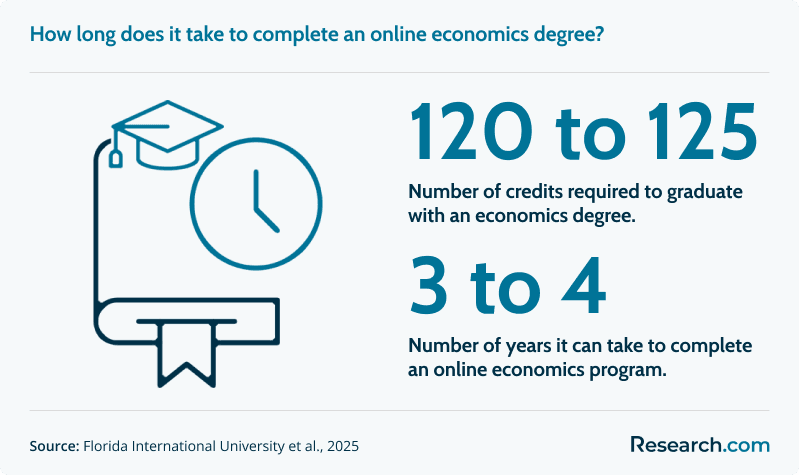
A full-time student usually completes an online bachelor’s degree in economics in four years by taking about 15 credits per semester across eight semesters. Because most programs require 120 to 125 credits, transfer credits, summer enrollment, and course availability can make a major difference in the actual timeline.
Part-time students often need five to six years, especially if they take one or two courses per term while working or managing family responsibilities. Some online programs offer accelerated terms or year-round enrollment, which may help motivated students finish faster.
Accelerated pathways may allow completion in three years through heavier course loads, shorter sessions, or continuous enrollment. Some schools also offer bachelor’s-to-master’s options, allowing qualified undergraduates to begin graduate-level coursework before finishing the bachelor’s degree.
| Enrollment pace | Typical timeline | Best for |
| Full-time | About four years | Students who can take a standard 15-credit semester load |
| Part-time | Often five to six years | Working adults, caregivers, and students managing multiple commitments |
| Accelerated | As little as three years in some programs | Students with strong time management, transfer credits, or year-round availability |
| Bachelor’s-to-master’s bridge | Varies by school | Students planning graduate study in economics, business, finance, public policy, or analytics |
How does an online economics degree program compare to an on-campus program?
The main difference is delivery format, not necessarily academic substance. Accredited online economics programs often use the same faculty standards, learning outcomes, and core curriculum as campus programs. The better choice depends on your schedule, learning preferences, networking needs, budget, and access to internships or local opportunities.
| Factor | Online economics degree | On-campus economics degree |
| Schedule | Often more flexible, especially if courses are asynchronous | Usually follows fixed class meeting times |
| Interaction | Uses discussion boards, video meetings, virtual office hours, email, and online group work | Offers face-to-face discussion, campus events, and in-person faculty access |
| Pacing | May include accelerated or self-paced options; some students combine economics with an accelerated online marketing degree to broaden business skills | Often follows a more traditional semester sequence |
| Cost | May reduce commuting, housing, and relocation expenses | May involve room, board, transportation, parking, and campus fees |
| Networking | Requires intentional effort through virtual events, internships, alumni platforms, and faculty outreach | Can make informal networking easier through clubs, lectures, and campus career fairs |
Choose online if flexibility is your priority and you are comfortable managing deadlines independently. Choose campus if you want daily in-person interaction, campus life, and local networking built into the experience.
What is the average cost of an online economics degree program?
Program cost depends on the institution, residency status, transfer credits, fees, and whether tuition is charged by semester, year, or credit hour. In-state students pay an average of $40,900 for tuition over four years for public universities. Out-of-state students pay more, averaging around $59,000. Private colleges are the most expensive, with tuition averaging $62,700 for an online bachelor’s degree. These figures refer to tuition and do not necessarily include books, technology fees, software, exams, or other expenses.
Many online bachelor’s programs use per-credit pricing. Public universities often charge $300 to $600 per credit, while private schools may charge more. Since most economics bachelor’s degrees require 120 to 125 credits, transfer credits from community college or prior study can substantially reduce the total price.
| Cost item | Why it matters |
| Tuition | The largest cost; compare in-state, out-of-state, and online-specific rates. |
| Fees | Technology, online learning, graduation, course, and student service fees can add up. |
| Books and materials | Economics courses may require textbooks, access codes, statistical software, or digital tools. |
| Transfer credits | Accepted credits can shorten the program and reduce tuition. |
| Time to completion | Taking longer may increase costs through additional fees or repeated courses. |
The chart below illustrates the most common degree levels for economists, as reported by Zippia in 2025.
What are the financial aid options for students enrolling in an online economics degree program?
Online economics students may qualify for many of the same financial aid options as campus students, provided the school and program meet eligibility requirements. Before enrolling, confirm that the institution participates in federal aid programs and that your enrollment level qualifies you for aid.
- Federal Financial Aid: Start with the Free Application for Federal Student Aid (FAFSA) to be considered for grants, federal loans, and work-study. Pell Grants can help eligible low-income students pay for school without repayment.
- State and Institutional Aid: Some states offer grants or scholarships for residents enrolled online. Many online colleges that accept FAFSA also provide institutional aid based on need, academic record, transfer status, or major.
- Scholarships and Private Grants: Economics majors may find awards through professional organizations, local foundations, employers, and scholarship search platforms. Private scholarships can reduce borrowing but may have separate deadlines.
- Employer Tuition Assistance: If you work in finance, analytics, business, government, or a related field, ask whether your employer offers tuition reimbursement or education benefits.
- Military and Veteran Benefits: Active-duty service members, veterans, and eligible dependents may be able to use GI Bill® benefits, military tuition assistance, or school-specific military scholarships.
What are the prerequisites for enrolling in an online economics degree program?
Admissions requirements vary, but most online economics bachelor’s programs expect applicants to show college readiness in writing, math, and basic quantitative reasoning. Transfer students may need to submit transcripts from every college previously attended.
- High School Diploma or GED: Most schools require proof of graduation or an equivalent credential. Some programs may look for a minimum GPA, typically around 2.5 to 3.0.
- Standardized Test Scores: Many universities have test-optional admissions policies, but some still use SAT or ACT scores for placement, admission review, or scholarships.
- Math Preparation: Algebra, statistics, precalculus, or introductory economics can help students prepare for quantitative coursework. Students who need additional preparation may be placed into remedial or prerequisite classes.
- English Proficiency: International applicants whose first language is not English may need TOEFL or IELTS scores.
- Application Materials: Some schools request essays, recommendations, resumes, or personal statements, especially for competitive or upper-division programs.
- Technology Readiness: Online students need reliable internet, a capable computer, webcam or microphone access if required, and comfort with spreadsheets and common tools such as Microsoft Excel.
What courses are typically in an online economics degree program?
Online economics programs usually begin with foundational theory and then move into statistics, modeling, research, finance, policy, and applied analysis. The best curriculum for you depends on whether you want a policy-oriented, finance-oriented, business-oriented, or data-oriented career path.
- Microeconomics and Macroeconomics: These core classes explain individual and firm behavior, supply and demand, national economic policy, inflation, unemployment, growth, and global financial conditions.
- Statistics for Economics: Students learn probability, data analysis, statistical inference, and quantitative reasoning used in economic research and business forecasting.
- Econometrics: This advanced methods course teaches students how to test economic relationships with real-world data and build evidence-based arguments.
- Money and Banking: This class examines financial institutions, central banking, monetary policy, credit markets, and how banking systems affect the wider economy.
- International Economics: Students study trade, exchange rates, globalization, tariffs, capital flows, and relationships among national economies.
- Public Policy and Economic Development: This course explores taxation, regulation, government spending, poverty, economic growth, and policy trade-offs.
- Financial Accounting: Accounting knowledge helps students read financial statements and evaluate organizational performance. It can also support students considering MBA accounting programs later.
What types of specializations are available in an online economics degree?
Specializations help students connect economics coursework to a career direction. Not every school offers every concentration, so review the course catalog before applying. If a formal specialization is not available, you may still be able to use electives to build a similar focus.
| Specialization | Best fit for students interested in |
| Financial Economics | Banking, investments, corporate finance, asset management, and risk analysis |
| International Economics | Global trade, exchange rates, multinational companies, and international policy |
| Public Policy and Economic Development | Government, think tanks, nonprofits, taxation, regulation, and social policy |
| Behavioral Economics | Consumer decision-making, marketing, consulting, psychology, and applied research |
| Data Analytics and Econometrics | Data analysis, market research, forecasting, business intelligence, and policy evaluation |
| Environmental Economics | Sustainability, natural resources, environmental consulting, and government agencies |
The chart below lists the top-paying industries for economists, as reported by the BLS in 2024.
Can supplementary certifications boost my career prospects?
Certifications can help economics graduates show practical skills that may not be obvious from a transcript alone. They are most useful when they match a target role, such as financial analysis, data analytics, project management, business intelligence, risk management, or software-based analysis. Students comparing options can review certifications that pay well to identify credentials that complement economics training without replacing the value of an accredited degree.
Can an online economics degree lead to advanced business education?
Yes. Economics is a strong foundation for graduate business education because it develops quantitative reasoning, market analysis, and decision-making under uncertainty. Students who want to move into management, finance, consulting, or executive leadership may later pursue an MBA. If cost is a major concern, comparing affordable online MBA options can help graduates find a path that builds on economics coursework while controlling expenses.
Do employers value online economics degrees?
Employers usually care most about whether the institution is accredited, whether the curriculum is rigorous, and whether the graduate can demonstrate relevant skills. An online economics degree from a reputable school can be competitive, especially when the student has internship experience, projects, strong quantitative coursework, and evidence of software or data skills. Graduates who later pursue online MBA programs can also use business graduate study to strengthen management and leadership credentials.
What support systems help online economics students succeed?
Strong online programs provide more than recorded lectures. Look for academic advising, tutoring, library access, writing support, career coaching, technical assistance, faculty office hours, alumni networking, and internship guidance. Students planning graduate business education may also value advising that helps them evaluate pathways such as accelerated online MBA programs.
Can an online economics degree offer a solid return on investment?
An online economics degree has stronger ROI potential when tuition is reasonable, transfer credits are accepted, the program is accredited, and the curriculum supports marketable roles. Students should compare total cost with likely entry-level job options, not just long-term economist salaries that may require a master’s degree. Some graduates later pursue advanced credentials such as the cheapest AACSB online DBA, but doctoral study should be evaluated separately based on career goals, cost, and time commitment.
How to choose the best online economics degree program?
The best online economics degree is not automatically the cheapest or highest-ranked option. It is the program that matches your career plan, budget, learning style, transfer history, and academic preparation. Use the checklist below before applying.
- Verify accreditation: Confirm institutional accreditation first. If the program sits within a business school, you may also want to compare accredited online business degree programs with AACSB or ACBSP recognition.
- Review the curriculum: Look for microeconomics, macroeconomics, statistics, econometrics, and applied data work. Finance-focused students should seek investment, banking, and quantitative electives.
- Match specializations to careers: Choose financial economics for banking or investment interests, policy economics for government work, and econometrics or analytics for data-heavy roles.
- Ask about transfer credits: Transfer policies can affect both cost and time to graduation. Request a credit evaluation before committing.
- Compare total cost: Include tuition, fees, books, software, technology requirements, and lost income if you reduce work hours.
- Evaluate course format: Asynchronous courses offer flexibility, while live online courses provide more structure. Choose the format you can realistically sustain.
- Check career support: Ask whether online students receive the same internship assistance, resume reviews, employer events, and alumni access as campus students.
| Question to ask | Why it matters |
| Is the school institutionally accredited? | Accreditation affects financial aid, transfer credits, employer confidence, and graduate school eligibility. |
| How many credits will transfer? | Accepted transfer credits can reduce both cost and completion time. |
| Are courses asynchronous, synchronous, or mixed? | The format determines how much scheduling flexibility you will have. |
| Does the curriculum include econometrics and applied data analysis? | These courses can strengthen preparation for analyst and research roles. |
| What career services are available to online students? | Online learners need access to internships, networking, resume support, and job search coaching. |
Can an online economics degree fast-track your MBA journey?
An economics degree can strengthen an MBA application because it shows preparation in quantitative reasoning, markets, incentives, and analytical problem-solving. Students who know they want graduate business training should choose electives in accounting, finance, statistics, management, and data analytics. Comparing top accelerated MBA programs can help economics graduates understand how quickly they may be able to move into advanced business study.
What measures ensure academic excellence in online economics programs?
Quality online economics programs rely on recognized accreditation, qualified faculty, clear learning outcomes, assessment standards, updated course content, and reliable learning technology. Students should also check whether online courses are designed for remote delivery rather than simply copied from campus classes. Learners interested in senior leadership may eventually compare graduate options such as affordable online executive MBA programs, but the undergraduate program should first provide strong academic fundamentals.
How can an online economics degree support entrepreneurship?
Economics can help entrepreneurs understand pricing, competition, customer behavior, resource allocation, market entry, and risk. Students who want to start a business should pair economics coursework with accounting, marketing, management, entrepreneurship, and analytics electives. For broader career ideas connected to business creation, Research.com’s guide on what you can do with an entrepreneurship degree may be useful.
What are some common challenges in online economics degree programs?
Online economics courses can be demanding because they combine theory, math, writing, and data analysis. Students need discipline, steady internet access, and a plan for getting help before falling behind. Networking can also require more effort than in a campus program. Students interested in finance-heavy roles may consider pairing economics with finance electives or reviewing options such as the fastest online finance degrees.
| Common mistake | Better approach |
| Choosing a program only because it is cheap | Compare accreditation, transfer policy, curriculum strength, graduation requirements, and career support. |
| Ignoring math and statistics requirements | Review placement rules and refresh algebra, statistics, and spreadsheet skills before starting. |
| Assuming online means easier | Expect the same level of reading, problem sets, projects, and exams as a campus program. |
| Waiting until senior year to think about careers | Build a portfolio of projects, internships, software skills, and faculty references early. |
| Relying only on rankings | Use rankings as a starting point, then verify fit, cost, schedule, and outcomes. |
Can supplementary business credentials enhance your economics degree?
Additional business credentials can be helpful when they fill a specific skill gap. For example, students who want more practical exposure to management, operations, or business administration may compare an accelerated online associates business degree with other short-term options. The goal is not to collect credentials, but to build a coherent profile for finance, consulting, analytics, policy, or entrepreneurship roles.
What career paths are available for graduates of an online economics degree program?
An online economics degree can support several career paths, but the right role depends on your skills, internships, electives, and whether you pursue graduate education. Students should review job postings early and choose coursework that matches employer requirements.
| Career path | What the role involves | Helpful preparation |
| Financial Analyst | Evaluates investments, financial performance, market conditions, and business risks. Students who want advanced finance preparation may compare online master of finance programs. | Finance, accounting, Excel, financial modeling, statistics |
| Market Research Analyst | Studies consumer behavior, pricing, demand, and market trends to support business decisions. | Statistics, survey methods, behavioral economics, data visualization |
| Economic Consultant | Analyzes markets, regulations, competition, damages, or policy issues for companies, agencies, or legal teams. | Econometrics, writing, research methods, industry specialization |
| Public Policy Analyst | Evaluates the economic effects of laws, regulations, budgets, and public programs. | Public policy, economic development, statistics, government experience |
| Data Analyst | Uses data to identify patterns, build reports, and support business or policy decisions. | SQL, Python or R, Excel, econometrics, visualization tools |
| Banking and Investment Roles | Works in lending, risk assessment, portfolio support, credit analysis, or commercial banking. | Finance, accounting, risk analysis, communication skills |
What is the job market for graduates with an online economics degree?
The job market for economics graduates is shaped by demand for people who can interpret data, evaluate risk, forecast trends, and explain economic trade-offs. Graduates may find opportunities in government, finance, technology, healthcare, consulting, research, and business operations. However, many economist positions require graduate-level education, so bachelor’s graduates should also target analyst and research support roles.
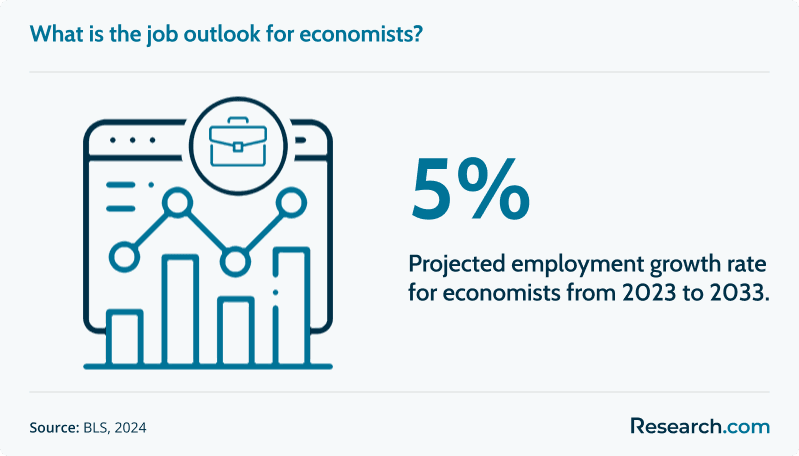
- Steady Job Growth: Employment for economists is expected to grow by 5% from 2023 to 2033. Around 1,000 new openings for economists will become available each year.
- Demand for Data Analysis: Employers increasingly use data to guide pricing, hiring, investment, policy, and operational decisions. Economics graduates with strong quantitative and software skills may be competitive for analyst roles.
- Government and Policy Needs: Federal, state, and local governments employ economists and analysts to examine budgets, programs, regulations, labor markets, and economic conditions.
- Global Markets: Organizations involved in international trade, supply chains, finance, and multinational operations need workers who understand exchange rates, market risks, and global economic trends.
What do graduates say about online economics study?
I was unsure whether an online degree would feel rigorous, but the flexibility helped me keep working while I studied. I could connect class concepts directly to my finance job, and that made the material more useful right away. — Ravi
The online format introduced me to classmates with different professional and cultural backgrounds. The discussions were more varied than I expected, and that helped me think more critically about global economic issues. — Amina
Econometrics was challenging, but the online tools, recordings, and practice assignments helped me work through difficult material at my own pace. The program gave me confidence to consider graduate study in finance. — Stanley
Key Insights
- An online economics degree is strongest when it combines accredited instruction, quantitative coursework, applied data analysis, and career support.
- Most programs require 120 to 125 credits and take about four years full-time, though part-time students may need five to six years and some accelerated options may take as little as three years.
- Cost varies by school and residency status. Public universities often charge $300 to $600 per credit, and average four-year online bachelor’s tuition figures include $40,900 for in-state public universities, around $59,000 for out-of-state students, and $62,700 for private colleges.
- A bachelor’s degree can lead to analyst, finance, research, policy, and business roles, but many economist positions require a master’s degree.
- Career outcomes depend heavily on skills. Econometrics, statistics, Excel, SQL, Python, R, financial modeling, and clear writing can make an economics graduate more competitive.
- Do not choose a program based only on price or rankings. Verify accreditation, transfer credits, course format, fees, specialization options, and career services before enrolling.
- Employment for economists is expected to grow by 5% from 2023 to 2033, with around 1,000 new openings each year, but students should also evaluate related analyst roles when planning their career path.
References:
- Bureau of Labor Statistics (BLS). (2024a). 19-3011 Economists. Occupational Employment and Wages. BLS.
- Bureau of Labor Statistics (BLS). (2024b). Economists. Occupational Outlook Handbook. BLS.
- Hanson, M. (2024). Average Cost of Online College. Education Data Initiative.
- National Center for Education Statistics (NCES). (2024). Average undergraduate tuition, fees, room, and board charges for full-time students in degree-granting postsecondary institutions, by control and level of institution and state: Academic years 2021-22 and 2022-23. Digest of Education Statistics. NCES.
- Zippia. (2025a). Economist Demographics and Statistics in the US. Zippia.
- Zippia. (2025b). Economist Education Requirements. Zippia.
Other Things You Should Know About Online Economics Degrees
Most online economics bachelor’s degrees require 120 semester credits. Students usually complete about 40 general education credits, 30 to 36 economics and related major credits, and the remaining credits in electives or supporting courses such as calculus, statistics, and business.
Admission requirements for online economics degree programs in 2027 often include a high school diploma or equivalent, transcripts, and possibly standardized test scores. While specific prerequisites like math or business coursework may vary, foundational skills in these areas are generally recommended.
Some 2027 online economics degree programs offering internships include Arizona State University and Penn State World Campus. These internships provide practical experience, helping students apply theoretical knowledge in real-world economic settings, enhancing both their skills and employment prospects post-graduation.