
2027 How to Become an Electrician in Nevada

Co-Founder and Chief Data Scientist
Becoming an electrician in Nevada is a practical route into a licensed skilled trade with paid training, clear advancement steps, and demand tied to construction, maintenance, energy, and infrastructure work. For many people, the biggest questions are not whether electricians are needed, but how to qualify legally, how long training takes, what it costs, and whether the earnings justify the commitment.
This guide explains the Nevada electrician path from entry-level training through apprenticeship, licensing, renewal, specialization, and business ownership. It is designed for high school graduates, career changers, veterans, construction workers, and technical students comparing skilled-trade careers. You will learn what education is required, how apprenticeships work, what wages look like, which credentials matter, and how to avoid expensive mistakes before choosing a program.
Quick Answer: How to Become an Electrician in Nevada
- Most future electricians in Nevada begin by entering a registered apprenticeship or technical training pathway that combines classroom instruction with paid supervised work.
- Nevada requires electricians to complete a state-approved apprenticeship program of at least 8,000 hours combined with 576 hours of classroom instruction.
- Employment for electricians in Nevada is projected to grow by 14.2% through 2032, which points to continued demand for trained workers.
- Electricians in Nevada earn an annual mean wage of $68,650, according to May 2023 Bureau of Labor Statistics data.
- To work legally at the journeyman or master level, electricians in Nevada must pass the required licensing exam and meet state experience requirements.
- What education is required to become an electrician in Nevada?
- How do you enter an electrician apprenticeship in Nevada?
- How much do electricians make in Nevada?
- What certifications do electricians need in Nevada?
- How long does an electrician apprenticeship take in Nevada?
- How much does electrician training cost in Nevada?
- Can electricians expand their options with HVAC training?
- What related trades can improve career flexibility in Nevada?
- How can you start an electrical business in Nevada?
- How can Nevada electricians stay competitive with advanced training?
- Can electrical workers move into medical technology careers in Nevada?
- What license do you need to be an electrician in Nevada?
- How often do you need to renew your electrician license in Nevada?
- What skills do successful electricians in Nevada need?
What education is required to become an electrician in Nevada?
Electrician education in Nevada usually starts with the basics: electrical theory, jobsite safety, blueprint reading, wiring methods, conduit work, troubleshooting, and the National Electrical Code. These topics prepare students for supervised fieldwork and, later, the licensing exams connected to the Nevada State Contractors Board process.
The most important training step is a registered apprenticeship. Apprenticeships combine paid on-the-job experience with structured classroom instruction, which is why they are often the preferred route for people who want to earn while they learn. A typical apprentice builds experience in residential, commercial, and sometimes industrial environments while learning under licensed electricians.
Nevada apprenticeship training commonly includes about 8,000 hours of hands-on work and 576 hours of related classroom education. During that period, apprentices may learn service panel installation, branch circuits, motor controls, conduit bending, safety procedures, code interpretation, and diagnostic methods used on real jobsites.
Several Nevada institutions and training providers are commonly associated with electrician preparation, including Nevada State College, the College of Southern Nevada, and Truckee Meadows Community College. The College of Southern Nevada, for example, offers coursework connected to the National Electrical Code, which is especially important for exam preparation and safe field practice.
Before enrolling, ask whether the program is connected to registered apprenticeship opportunities, whether credits or classroom hours apply toward licensing requirements, and whether the curriculum reflects current National Electrical Code material. A short technical program can be useful, but it should not be confused with the full experience requirement needed for licensure.
| Training option | Best for | What to check before enrolling |
| Registered apprenticeship | Students who want paid field experience and a direct licensing pathway | Confirm required work hours, classroom hours, wage progression, and employer placement process |
| Community college or technical coursework | Learners who want structured instruction before or during apprenticeship | Ask whether courses align with Nevada licensing expectations and apprenticeship classroom requirements |
| Exam preparation course | Apprentices nearing journeyman or master testing | Make sure the course covers the NEC, Nevada rules, trade calculations, and practice exams |
| Specialized short course | Working electricians seeking skills in areas such as solar, controls, or smart systems | Check whether the credential is recognized by employers, unions, contractors, or inspection authorities |
Review classes, code seminars, and trade workshops can improve test readiness. Organizations such as the Nevada Chapter of the National Electrical Contractors Association may offer or point candidates toward practical preparation in code interpretation, calculations, and jobsite problem-solving.
The strongest preparation usually combines three things: classroom learning, documented field hours, and regular code practice. Candidates who keep records, ask questions on the job, and begin exam review early are less likely to be surprised by licensing requirements later.
How do you get into an electrician apprenticeship program in Nevada?
Getting into an electrician apprenticeship in Nevada requires meeting eligibility standards, applying through a recognized sponsor, and showing that you are ready for physically demanding technical work. Apprenticeships are competitive because they offer paid training and a structured route toward licensure.
Basic eligibility requirements
Most apprenticeship sponsors expect applicants to meet a few baseline requirements before they are considered for placement.
- Minimum age: Applicants are commonly expected to be at least 18 years old.
- Education: A high school diploma or GED is typically required.
- Math readiness: Electrical work relies on algebra, measurements, load calculations, and formulas, so many programs use a math or aptitude test.
- Work readiness: Candidates should be prepared for early schedules, travel to jobsites, physical labor, ladder work, and strict safety rules.
Where to apply
Prospective apprentices can start by contacting established apprenticeship sponsors and local training organizations. In Nevada, common starting points include the Nevada State Electrical Joint Apprenticeship and Training Committee and local chapters of the International Brotherhood of Electrical Workers, including IBEW-connected training routes.
Application processes vary, but candidates may need transcripts, proof of age, a valid driver’s license, aptitude testing, interviews, and placement on an applicant list. Some programs admit students at set times during the year, so deadlines matter.
What apprenticeship training includes
Apprentices learn under supervision while completing classroom instruction. Training covers jobsite safety, the National Electrical Code, wiring methods, electrical theory, blueprint reading, tools, troubleshooting, and installation standards. Some program descriptions cite 8,000 hours of supervised work plus 720 hours of classroom instruction, so applicants should verify the current hour requirements with the specific sponsor and licensing authority before committing.
Why apprenticeship is the central step
An apprenticeship is not just a requirement to check off. It is where future electricians learn how electrical systems behave in real buildings, how to work safely around energized equipment, how inspections work, and how to communicate with supervisors, contractors, and clients.
- Field experience: Apprentices work on actual installations, repairs, and troubleshooting tasks under licensed supervision.
- Mentorship: Journeymen and supervisors teach practical judgment that cannot be learned from a textbook alone.
- Employer access: Apprenticeship programs can connect trainees with contractors, unions, and long-term job opportunities.
- Technology exposure: Apprentices may encounter smart building systems, renewable energy equipment, advanced tools, and modern diagnostic software.
Construction employment in Nevada grew by 4.5% in 2023, which helps explain why apprenticeship connections can be valuable. Workers who want to compare electrician training with other hands-on occupations can also review Research.com’s guide to high-demand trades and vocational training.
How to strengthen your apprenticeship application
- Complete high school or GED coursework with attention to algebra, geometry, physics, shop, or technical education when available.
- Prepare for the aptitude test instead of assuming basic math will be enough.
- Gather transcripts, identification, work history, and references before the application window opens.
- Show reliability through prior work experience, military service, volunteer projects, or construction exposure.
- Ask the sponsor how applicants are ranked and whether reapplication is allowed if you are not selected the first time.
How much do electricians make in Nevada?
Electrician pay in Nevada depends on experience, license level, location, union status, overtime, specialization, and whether the electrician works as an employee or contractor. The Bureau of Labor Statistics reports an annual mean wage of $68,650 for electricians in Nevada based on May 2023 data.
Other salary descriptions place Nevada electrician earnings at about $63,000 annually, or roughly $5,250 per month. Entry-level workers are often described as starting between $35,000 and $42,000 per year, while journeymen may earn between $60,000 and $75,000 annually as they gain experience and credentials.
Higher-paying opportunities are often concentrated in Las Vegas, Henderson, and Reno, where wages are frequently described in the $70,000 to $80,000 range. These labor markets benefit from residential construction, commercial projects, hospitality development, maintenance needs, and renewable energy work.
| Career stage | Typical earnings information cited | What can affect pay |
| Apprentice or entry-level worker | $35,000 to $42,000 annually | Apprenticeship year, wage scale, employer, hours worked, and union status |
| Working electrician average | About $63,000 annually or $5,250 per month | Region, specialty, overtime, service work, and construction demand |
| Journeyman electrician | $60,000 to $75,000 annually | License level, project complexity, certifications, and supervisory responsibility |
| Higher-paying Nevada markets | $70,000 to $80,000 annually in Las Vegas, Henderson, and Reno | Commercial construction, maintenance contracts, industrial work, and renewable energy projects |
| BLS Nevada annual mean wage | $68,650 | Statewide mean based on May 2023 Bureau of Labor Statistics data |
How electricians can increase earnings
Pay usually rises with documented experience, license progression, specialized skills, and the ability to work independently. Electricians who learn solar installation, industrial wiring, controls, smart-home systems, or high-demand maintenance skills may qualify for more complex assignments.
- Earn the journeyman license as soon as you meet the requirements.
- Build experience in commercial, industrial, renewable energy, or specialized service work.
- Consider union opportunities, including International Brotherhood of Electrical Workers pathways, where available.
- Track continuing education and advanced training to show employers you are current with code and technology.
- Develop estimating, crew leadership, and customer communication skills if you want to move into supervisory or contracting roles.
Some electricians eventually move from tools to management, estimating, training, inspection, consulting, or business ownership. A small number may pursue advanced academic credentials for leadership or research-oriented roles; readers considering that route can compare options such as a part-time PhD, though most electrical career advancement does not require a doctorate.
What certifications do electricians need in Nevada?
The most important credentials for electricians in Nevada are state-recognized licenses. Additional certifications can help with specialization, but they do not replace the legal licensing requirements for the type of electrical work you plan to perform.
Core Nevada electrician credentials
- Journeyman Electrician License: Generally requires completion of required apprenticeship experience and passing an exam covering trade knowledge, electrical theory, the National Electrical Code, and Nevada-specific requirements.
- Master Electrician License: Typically requires experience as a licensed journeyman and successful completion of a more advanced examination.
- Electrical Contractor License: Needed for those who want to operate an electrical contracting business, bid jobs, hire workers, or supervise electrical contracting operations.
Common training routes include community college coursework, employer-sponsored training, and union-affiliated apprenticeships. Examples referenced in Nevada training discussions include the College of Southern Nevada and IBEW Local 357, both of which are associated with structured electrical training pathways.
Specialized certifications that may improve employability
Optional credentials can help electricians move into inspection, construction oversight, technology-heavy systems, or specialized installation work. Examples include Certified Electrical Inspector credentials, Construction Electrician Certification, and certifications from the National Institute for Certification in Engineering Technologies.
| Credential type | When it matters | Decision tip |
| Journeyman license | When you want to work independently within the legal scope allowed by Nevada rules | Prioritize this if your goal is stable field employment after apprenticeship |
| Master electrician credential | When you want advanced responsibility or qualification for higher-level work | Ask whether your target employers reward master-level credentials with higher pay or promotion |
| Electrical contractor license | When you want to run a business or contract directly with customers | Study the insurance, bonding, financial, and compliance obligations before applying |
| Inspector or technical certification | When you want to move into inspection, quality control, code compliance, or specialized systems | Choose credentials that match your target work, not just certificates that look impressive |
Certification decisions should match the work you actually want to do. A residential service electrician may benefit from different training than someone pursuing industrial controls, renewable energy, or inspection. If you are comparing skilled trades more broadly, Research.com’s overview of automotive mechanic trade school programs can help illustrate how accreditation and recognized credentials matter across technical careers.
How long does an electrician apprenticeship take in Nevada?
An electrician apprenticeship in Nevada usually takes about 4 to 5 years. The timeline is tied to the time needed to complete roughly 8,000 hours of supervised on-the-job training and 576 hours of classroom instruction. Some apprenticeship descriptions cite different classroom-hour totals, so applicants should confirm requirements with the program sponsor and the appropriate Nevada licensing authority before enrolling.
The length can vary. Full-time apprentices who receive steady job assignments may progress faster than apprentices affected by seasonal slowdowns, limited employer placements, or part-time schedules. Some union-affiliated programs, including programs connected to IBEW Local 357 in Las Vegas, may offer structured schedules, overtime opportunities, or intensive classroom formats that help motivated apprentices stay on track.
Prior experience can also matter. Military electrical experience, prior technical school coursework, or documented work in related electrical settings may qualify for review, but credit is not automatic. Keep records, transcripts, job descriptions, and supervisor documentation if you plan to request recognition of previous experience.
| Factor | How it can affect the timeline | What to do |
| Full-time jobsite placement | Helps apprentices accumulate work hours consistently | Ask how the sponsor places apprentices and handles layoffs or slow periods |
| Classroom completion | Delayed coursework can slow licensing eligibility | Attend required classes on schedule and avoid falling behind in code study |
| Prior experience | May reduce the time needed if accepted by the program or licensing body | Submit complete documentation early |
| Exam readiness | Failing the licensing exam can delay advancement | Use code review, practice exams, and study groups before testing |
Choosing the right pathway matters because not every technical program serves the same purpose. If you are deciding between a trade school, apprenticeship, or vocational program, Research.com’s comparison of a vocational program vs. trade school can help clarify which format fits your schedule, budget, and licensing goals.
This stage is also where safety habits become permanent. Electrical work carries real risk, and structured supervised training helps future electricians learn how to prevent shocks, fires, equipment damage, and jobsite fatalities.
How much does electrician training cost in Nevada?
The cost to become an electrician in Nevada is commonly described as ranging from $5,000 to $20,000, depending on the training route, school, program length, tools, exam preparation, and licensing expenses. Apprenticeships may require a smaller upfront education cost than full-time school programs because apprentices earn wages while training, but they still require a multi-year commitment.
Community college electrical programs are often described as costing between $4,000 and $10,000 and may last from a few months to two years, depending on whether the student pursues a certificate, diploma, or associate degree. These programs can be useful, but students should confirm whether coursework transfers into an apprenticeship or counts toward licensing-related classroom requirements.
Additional expenses can include tools, boots, safety equipment, books, code manuals, exam preparation, application fees, and continuing education. Licensing preparation courses and exam-related costs are described as ranging from $100 to $300, with additional state application and renewal costs depending on license type.
| Cost category | What it may include | How to control the cost |
| Tuition or classroom training | Community college, technical school, or apprenticeship-related instruction | Ask whether the program is approved, whether credits apply, and whether employer or union support is available |
| Tools and safety gear | Hand tools, meters, boots, gloves, eye protection, and work clothing | Request the required tool list before enrolling and buy in stages when allowed |
| Books and code materials | National Electrical Code resources, textbooks, and study guides | Confirm the required edition before purchasing |
| Exam and licensing costs | Preparation courses, exam fees, applications, and renewals | Budget early so exam readiness is not delayed by fees |
| Lost time or transportation | Travel to school, jobsites, union halls, or testing centers | Choose a program with realistic commute and work schedules |
Financial aid may be available through participating colleges and trade schools, including federal aid options such as Pell Grants and student loans. Apprenticeships can reduce financial pressure because trainees earn wages while building experience. Some unions, employers, and veteran benefits such as the GI Bill may also help cover training-related costs.
Students who need flexible scheduling should compare local, hybrid, and online-supported training carefully. Research.com’s guide to the best online trade schools can help you understand what online trade education can and cannot provide. For electrical careers, remember that online coursework cannot replace supervised hands-on training required for licensure.
Can an Electrician Broaden Their Expertise with HVAC Training?
Yes. HVAC training can be a useful add-on for electricians who want to work on building systems that combine wiring, controls, motors, thermostats, sensors, and climate equipment. Electrical knowledge transfers well to HVAC service because both fields require troubleshooting, safety discipline, schematic reading, and an understanding of how equipment interacts with power systems.
This path makes the most sense for electricians interested in service work, building automation, maintenance, or small-business ownership. It may be less useful for someone who wants to specialize only in large-scale commercial electrical construction. To compare the requirements, review Research.com’s guide on how to become an HVAC technician in Nevada.
What additional trades can boost your career prospects in Nevada?
Electricians can improve career flexibility by learning adjacent trades that overlap with electrical systems. Mechanical maintenance, HVAC, automotive electrical systems, controls, and equipment repair can all broaden the type of work a technician can handle. Cross-training is especially valuable in facilities maintenance, industrial settings, and small companies where one worker may diagnose multiple systems.
However, cross-training should be strategic. Do not chase unrelated certificates if they do not support your target job. If mechanical systems interest you, Research.com’s guide on how to become a mechanic in Nevada can help you compare requirements and career fit.
How can I launch my own electrical business in Nevada?
Starting an electrical business in Nevada requires more than technical skill. You need the proper contractor licensing, a clear service model, insurance, bonding if required, pricing discipline, recordkeeping, customer communication, and compliance with state and local rules. Many strong electricians struggle as business owners because they underestimate estimating, taxes, payroll, scheduling, and cash flow.
Before launching, define whether you will focus on residential service calls, commercial tenant improvements, maintenance contracts, solar-related work, new construction, or a specialized niche. Then compare startup costs, required equipment, licensing obligations, and local competition. If you need formal business training, Research.com’s overview of the top business schools in Nevada can provide a starting point for learning about management, accounting, marketing, and operations.
| Business startup question | Why it matters |
| What license classification do I need? | Operating outside your legal scope can create penalties and liability |
| What work will I specialize in? | A focused service model makes pricing, marketing, and tool purchases easier |
| How will I estimate jobs? | Poor estimating can turn busy work into unprofitable work |
| What insurance and bonding apply? | Coverage protects the business, customers, and employees |
| How will I document code compliance? | Permits, inspections, and records are central to professional electrical contracting |
How can electricians in Nevada stay competitive through continuous education and advanced training?
Electricians stay competitive by keeping pace with code changes, safety practices, diagnostic tools, and new building technologies. Continuing education is not only a renewal task; it is also a way to qualify for better assignments, reduce mistakes, and move into specialized work.
Relevant training areas may include National Electrical Code updates, renewable energy systems, smart building controls, electric vehicle infrastructure, industrial troubleshooting, low-voltage systems, estimating, project management, and safety leadership. The right choice depends on whether your goal is higher wages, business ownership, supervisory work, inspection, or career change.
Some technical workers eventually explore healthcare technology because it also involves equipment, safety protocols, and precision. Electricians considering a lateral move can start with Research.com’s guide on how to become a radiology technician in Nevada.
Can I Transition from Electrical Work to a Medical Technology Career in Nevada?
Yes, but it is a career change rather than a simple certification upgrade. Electrical workers may bring useful strengths to medical technology roles, including schematic reading, troubleshooting, safety awareness, attention to detail, and comfort with complex equipment. However, healthcare careers usually have their own education, clinical training, certification, and licensing expectations.
This move may make sense if you want a less construction-based environment, are interested in patient care or diagnostic equipment, and are willing to complete healthcare-specific training. It may not be the best fit if your priority is to keep building on your existing electrical license as quickly as possible. For one possible pathway, see Research.com’s guide on how to become an ultrasound technician in Nevada.
What license do you need to be an electrician in Nevada?
The license you need in Nevada depends on the type of electrical work you plan to perform and whether you want to work under supervision, work independently, or operate a contracting business. Licensing exists to protect public safety and ensure electricians understand the National Electrical Code, Nevada rules, and safe installation practices.
Nevada electrician licensing and contractor regulation are associated with the Nevada State Contractors Board and the Nevada State Fire Marshal’s Office. Because requirements can change and may vary by classification, applicants should confirm details directly with the appropriate state authority before applying.
- Apprentice Electrician: Allows a trainee to gain supervised field experience while completing apprenticeship requirements.
- Journeyman Electrician: Allows qualified electricians to work independently within the authorized scope but not necessarily to operate an electrical contracting business.
- Electrical Contractor License: Required for those who want to run an electrical contracting company, bid work, and supervise electrical contracting operations.
Typical licensing steps
- Complete the required education and supervised work experience through an approved or recognized pathway.
- Maintain detailed records of classroom hours, jobsite hours, supervisors, and types of work performed.
- Prepare for an exam covering the National Electrical Code, trade calculations, Nevada rules, safety, and electrical theory.
- Submit the application, documentation, fees, and any required background or reference materials.
- Complete continuing education and renewal requirements after licensure.
One Nevada requirement described for continuing education is a minimum of 6 hours of code update courses every two years. Other renewal descriptions cite higher continuing education totals, so electricians should verify the exact current requirement for their license classification before the renewal deadline.
| License level | Best suited for | Main caution |
| Apprentice | New entrants learning under licensed supervision | You cannot treat apprenticeship status as permission to work independently |
| Journeyman | Electricians who have completed training and passed the required exam | Working independently is different from operating a contracting business |
| Electrical contractor | Electricians who want to own or manage an electrical contracting company | Business compliance, insurance, finances, and state rules become as important as technical skill |
How often do you need to renew your electrician license in Nevada?
Electricians in Nevada are described as needing to renew their licenses every two years. Renewal helps ensure that licensed workers remain current on safety standards, code changes, and regulatory expectations.
A typical renewal process includes submitting a renewal application, paying the applicable fee, confirming that the license is in good standing, and documenting required continuing education. Some descriptions cite at least 16 hours of continuing education focused on codes, safety, and industry standards. Because another requirement cited in licensing discussions is 6 hours of code update courses every two years, electricians should confirm the exact requirement for their license type with the Nevada State Contractors Board or the relevant licensing authority.
Continuing education matters because electrical codes change and Nevada-specific rules may affect installation, inspection, and permitting practices. Missing a renewal deadline or failing to document continuing education can interrupt legal work eligibility and create unnecessary cost.
- Track your license expiration date as soon as your license is issued.
- Keep certificates from continuing education courses in a dedicated folder.
- Choose courses recognized by the appropriate Nevada authority.
- Do not wait until the final week to complete continuing education or submit renewal paperwork.
- Monitor official communications for changes in code adoption or renewal requirements.
Nevada’s construction industry was described as having 5% job growth in 2023, so staying current with renewal requirements is important for uninterrupted employment and credibility with employers, contractors, and clients.
Renewal costs and education requirements should be treated as part of the ongoing cost of the career. Electricians who plan ahead can build those expenses into their budget, especially if they are pursuing higher-paying specialties or contractor licensing.
What are the essential skills needed to be a successful electrician in Nevada?
Successful electricians in Nevada need technical skill, safety judgment, physical readiness, and communication ability. The work is hands-on, but it is also analytical: electricians interpret plans, calculate loads, follow code, identify hazards, and solve problems under time pressure.
- Electrical fundamentals: Electricians must understand circuits, wiring methods, grounding, panels, protective devices, and system behavior.
- Code knowledge: Familiarity with the National Electrical Code and Nevada-specific requirements is essential for safe, legal installations.
- Troubleshooting: Good electricians can isolate faults, test safely, and identify the real cause of a problem instead of guessing.
- Technology comfort: Smart homes, renewable energy, controls, and diagnostic tools require workers who can learn new systems quickly.
- Attention to detail: Small mistakes in wiring, labeling, torque, or calculations can create serious hazards.
- Communication: Electricians must explain issues to clients, coordinate with contractors, document work, and follow supervisor instructions.
- Physical stamina: The job can involve lifting, climbing, crawling, bending conduit, working outdoors, and maintaining focus over long shifts.
- Professional reliability: Showing up on time, following safety rules, and documenting work accurately affect advancement as much as raw technical ability.
Apprenticeships are the best place to build these skills because trainees learn under supervision while seeing how experienced electricians handle real jobsite conditions. Community college and technical coursework can reinforce theory, math, and safety knowledge, but field repetition is what turns knowledge into competence.
Career planning resources from the Nevada Department of Employment, Training and Rehabilitation can help students understand local labor market conditions. Professional organizations, including IBEW Local 357, may also provide networking, training, and continuing education opportunities.
Common mistakes to avoid
- Choosing a program without checking licensing alignment: A course may be useful, but it may not count toward apprenticeship or licensing requirements.
- Looking only at tuition: Tools, transportation, exam fees, books, and lost work time can change the real cost.
- Assuming online training is enough: Electrical licensing requires hands-on supervised experience; online coursework alone is not a substitute.
- Ignoring math preparation: Aptitude tests, code calculations, and field measurements all require numerical confidence.
- Waiting to study code until the end: The National Electrical Code should be studied throughout training, not only before the exam.
- Failing to keep records: Poor documentation of hours and supervisors can delay licensing applications.
- Choosing certificates without a goal: Specialized training should support a specific job target, such as solar, inspection, industrial maintenance, or controls.
What is the job outlook for electricians over the next 10 years in Nevada?
The job outlook for electricians in Nevada is strong, with employment projected to grow by about 14.2% through 2032, according to the U.S. Bureau of Labor Statistics. This outlook reflects continued demand connected to population growth, construction, maintenance, energy work, and development in major Nevada labor markets.
Las Vegas is a major employment center because of residential construction, commercial buildings, hotels, casinos, and ongoing maintenance needs. Henderson and Reno also offer opportunities, especially where manufacturing, technology, utilities, and industrial facilities require skilled electrical workers.
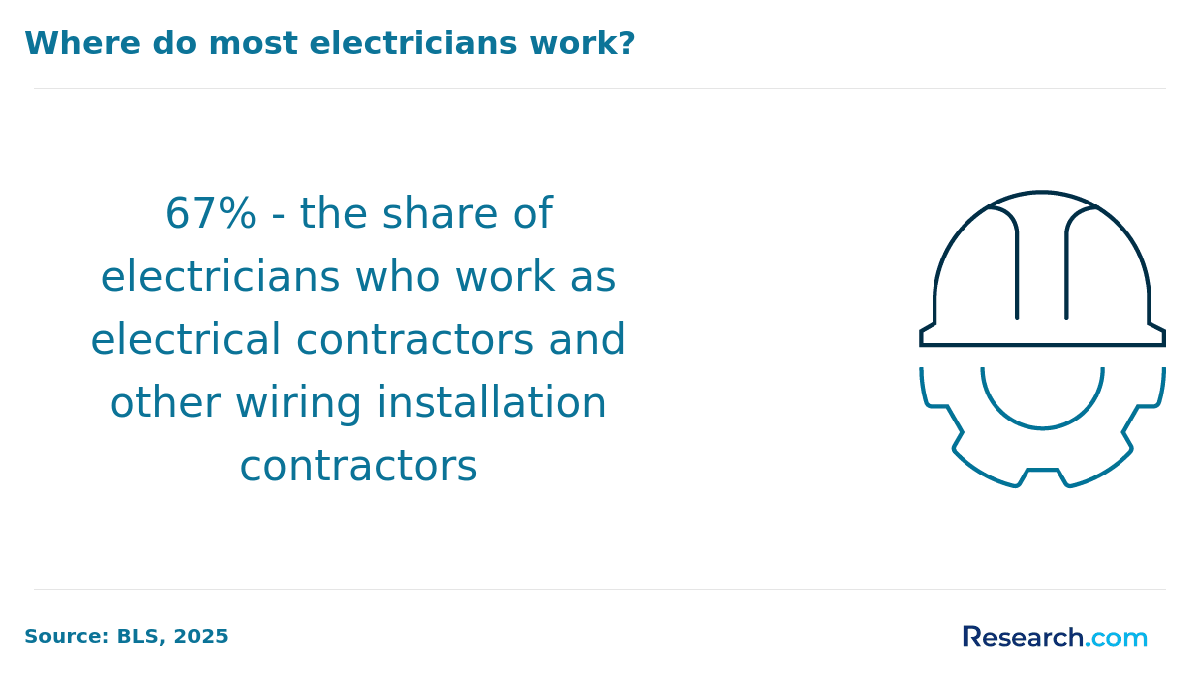
More than 60% of Nevada’s electricians work in construction, while others work in manufacturing, utilities, maintenance services, and related industries. This means new workers should understand that construction cycles can affect employment, but electricians with maintenance, troubleshooting, industrial, or renewable energy skills may have more options across sectors.
Trends affecting electrician careers in Nevada
- Renewable energy: Solar, wind, and related electrical infrastructure can create demand for electricians with specialized installation and maintenance skills.
- Smart buildings: Homes and commercial properties increasingly use connected controls, sensors, security systems, and energy management technology.
- Electric vehicle infrastructure: Charging equipment and related service needs can expand opportunities for electricians who understand load calculations and code requirements.
- Safety and code compliance: Employers value electricians who keep up with code changes and can pass inspections without costly rework.
- Credential-based advancement: Apprenticeship completion, licensure, and targeted certifications can separate serious candidates from informal laborers.
For new entrants, the best strategy is to complete a recognized apprenticeship, earn the journeyman credential, and build a record in high-demand environments such as construction, industrial maintenance, renewable energy, or smart systems.
What Electricians in Nevada Say About Their Careers
-
: "
My apprenticeship through the Nevada State College program changed how I saw the trade. The mix of classroom instruction and supervised jobsite work helped me take on more complex assignments with confidence. Working on projects tied to Las Vegas growth makes the job feel meaningful, and the steady need for electricians gives me room to keep advancing. - Kristian
"
-
: "
Truckee Meadows Community College helped me build skills I did not expect to develop. The training emphasized safety, technical accuracy, and service to the community. Nevada’s mix of desert conditions and fast-growing cities keeps the work challenging, and I like knowing that my work helps power local homes and businesses. - Marlon
"
-
: "
After graduating from Great Basin College, I found opportunities in Nevada’s renewable energy sector that I had not originally planned for. Solar and geothermal projects keep the work interesting and push me to keep learning. It is rewarding to work in a field connected to the state’s energy future. - Anton
"
Related Articles for Nearby States
- 2027 How to Become an Electrician in California
- 2027 How to Become an Electrician in Oregon
- 2027 How to Become an Electrician in Idaho
- 2027 How to Become an Electrician in Arizona
- 2027 How to Become an Electrician in Utah
- 2027 How to Become an Electrician in Washington
- 2027 How to Become an Electrician in Montana
- 2027 How to Become an Electrician in Wyoming
- 2027 How to Become an Electrician in Colorado
- 2027 How to Become an Electrician in New Mexico
References:
- Bureau of Labor Statistics. (2025, April 18). Electricians: Occupational outlook handbook. U.S. Department of Labor. bls.gov
- Faraday Careers. (n.d.). Electrician job outlook for 2022. faradaycareers.com
- Independent Electrical Contractors Rocky Mountain. (n.d.). How to become an electrician. iecrm.org
- Labor & Industries Washington State. (n.d.). Electrical licensing, exams & education. lni.wa.gov
- NECA-IBEW Local 48. (2025). 2025’s job outlook for electrical professionals. necaibew48.com
- Refrigeration School, Inc. (RSI). (n.d.). What is the job outlook for an electrician? rsi.edu
- Tesla Training Center. (n.d.). Job outlook for electrical workers. teslatrainingchicago.com
Key Insights
- The standard Nevada electrician pathway is apprenticeship first: supervised work, classroom instruction, exam preparation, and then licensure.
- Nevada training requirements are commonly described as 8,000 hours of on-the-job training plus 576 hours of classroom instruction, though some program descriptions cite different classroom totals; verify requirements before enrolling.
- The Bureau of Labor Statistics reports a Nevada annual mean wage of $68,650 for electricians based on May 2023 data, while other salary descriptions place typical earnings around $63,000 with higher ranges in Las Vegas, Henderson, and Reno.
- Licensing level matters. Apprentice, journeyman, master, and contractor pathways serve different career goals and legal scopes of work.
- Training cost is more than tuition. Budget for tools, safety gear, books, exams, licensing, transportation, and continuing education.
- The strongest long-term opportunities may go to electricians who pair licensure with specializations such as renewable energy, smart systems, industrial maintenance, controls, or business skills.
- Before choosing a school or apprenticeship, ask whether the program is recognized, whether hours count toward licensing, what placement support exists, and what total out-of-pocket costs you should expect.
Other Things You Should Know About Becoming an Electrician in Nevada
The Nevada State Contractors Board issues electrician licenses and regulates electrical contracting. To work as a licensed electrical contractor, applicants must meet the board’s experience and testing rules, then submit an application under Nevada Revised Statutes Chapter 624 and Nevada Administrative Code Chapter 624.
To apply for an electrician license in Nevada, you must complete an apprenticeship with at least 8,000 hours of work experience, pass the state exam, and submit your application to the Nevada State Contractors Board in 2027.


