2027 Best Online Trade Schools

Co-Founder and Chief Data Scientist
Online trade schools can be a practical route into skilled work, but they are not all built the same. Some programs are fully online, some are hybrid, and others require in-person labs, clinical hours, externships, apprenticeships, or local skills assessments. The right choice depends on your trade, your schedule, your budget, accreditation, employer recognition, and whether you plan to enter the workforce quickly or use your credits toward a future degree.
This guide is for students comparing online trade schools, working adults planning a career change, and recent high school graduates who want a shorter training path than a traditional four-year degree. You will learn how online trade schools work, which schools stand out, what to check before enrolling, how much programs may cost, which trades have strong employment potential, and how to avoid common mistakes that can waste time and money.
Quick Answer: Are Online Trade Schools Worth Considering?
Online trade schools can be worth considering when the program is accredited, aligned with your target occupation, transparent about hands-on requirements, and connected to employer-recognized credentials. They are especially useful for students who need flexible scheduling, want a shorter training route, or are pursuing fields where much of the theory can be taught online. However, trades that require extensive physical practice—such as electrical work, HVAC, automotive technology, welding, and certain healthcare roles—usually require labs, internships, externships, apprenticeships, or supervised local training.
What are the benefits of online trade schools?
- Shorter training timelines: Many trade school programs are designed to take six months to two years, helping students prepare for employment faster than many traditional degree paths.
- Potentially lower overall cost: Online and hybrid trade programs may cost less than four-year college programs, especially when students can avoid relocation, campus housing, or commuting expenses.
- Career-focused curriculum: Programs often concentrate on job-ready skills in areas such as construction, mechanical repair, healthcare support, business technology, and information technology.
- Flexible learning: Online coursework can help students balance training with work, caregiving, military service, or other responsibilities.
- Broader school access: Students may be able to compare programs outside their local area, though they should still verify in-person training and licensing requirements in their state.
- Best online trade schools for 2027
- How to choose the right online trade school for your career goal
- Accelerated and fast-track options in online trade schools
- Online trade school tuition and total cost
- Technology and equipment requirements for online trade programs
- Career services available to online trade school students
- Trade fields with strong demand and solid wages
- Typical admissions requirements for online trade schools
- How to check whether trade school credits can transfer and admissions factors to review
- Pros and cons of online trade schools
- How online trade schools handle hands-on training
- Whether online trade credentials can support further study
- Flexible scheduling options in online trade programs
- Fast-track programs in online trade schools
- Financial aid options for online trade school students
- Employer recognition of online trade school credentials
- Accreditation and quality assurance in online trade schools and financial aid questions
- Return on investment for online trade schools
- Using a trade credential as a pathway to a bachelor’s degree
- Emerging trends in online trade education
- Career development opportunities in online trade schools and ways to reduce training costs
Best Online Trade Schools for 2027
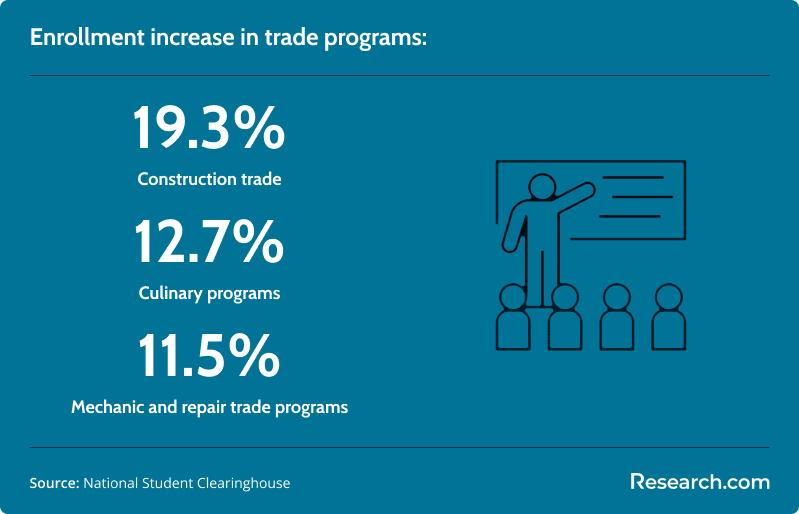
Demand for skilled trade education has strengthened in recent years. According to the National Student Clearinghouse Research Center, enrollment in mechanic and repair trades programs increased by 11.5% year over year, adding 9,950 students. In 2021, construction trade programs also saw a 19.3% enrollment increase. These shifts align with broader interest in career and technical education and the renewed attention to skilled trade pathways noted in reporting on the comeback of skilled trade education.
The schools below can be useful starting points for students comparing online and hybrid trade training options. They include institutions offering career-focused certificates, diplomas, associate degrees, and technical pathways in fields such as HVAC, automotive technology, healthcare, business, information technology, maintenance, and skilled trades. Students interested in healthcare-focused vocational options may also want to compare related pathways such as online respiratory therapy programs.
Research.com identified these schools using information from the IPEDS database, Peterson’s Data and its Distance Learning Licensed Data Set, the College Scorecard database, and the National Center for Education Statistics. The Research.com team applied its published research methodology for data review and analysis.
| School | Program Areas Listed | Accreditation Listed | Best Fit |
| Ashworth College | HVAC, automotive technician, carpentry, home inspection, electrician | Distance Education Accrediting Commission (DEAC) | Students seeking self-paced online trade training through a school affiliated with the Penn Foster Network |
| Carrington College | Electrical technology, HVAC-R technician, maintenance technician | Accrediting Commission for Community and Junior Colleges, Western Association of Schools and Colleges (ACCJC/WASC) | Students looking for trade programs tied to infrastructure, power, heating, cooling, and maintenance work |
| Northcentral Technical College | Automotive technology, diesel mechanics, welding, carpentry, and more | Commission on Accreditation of Allied Health Education Programs (CAAHEP), National Accrediting Agency for Clinical Laboratory Sciences (NAACLS) | Learners comparing certificates, technical diplomas, associate degrees, continuing education, and professional development options |
| Penn Foster College | HVAC, medical assistant, electrician, bookkeeping, and more | Distance Education Accrediting Commission (DEAC) | Students who want flexible, self-paced online skilled trades and career training programs |
| Wiregrass Georgia Technical College | Business administration, healthcare administration, criminal justice, information technology, and more | Commission on Dental Accreditation-American Dental Association (CDA-ADA, Commission on Accreditation of Allied Health Education Programs (CAAHEP), Accreditation Commission for Education in Nursing (ACEN) | Students interested in online and blended technical certificates, diplomas, and occupational programs, including options related to bookkeeping certification |
| Minnesota West Community and Technical College | IT, healthcare, business, education, and more | Commission on Accreditation of Allied Health Education Programs (CAAHEP), National Accrediting Agency for Clinical Laboratory Sciences (NACLS) | Students seeking career-oriented certificates, diplomas, or associate of Applied Science programs with possible transfer options |
| West Kentucky Community and Technical College | Air conditioning technology, administrative office technology, automotive technology, and more | Southern Association of Colleges and Schools Commission on Colleges (SACSCOC) | Working adults and first-time students considering career-ready certificates, diplomas, and associate degrees |
| Northwood Technical College | Advanced EMT, agricultural power equipment and technician, dementia care, and more | Higher Learning Commission | Students who want career pathway credentials with online, hybrid, and part-time study possibilities |
| Clovis Community College | Mechatronics and industrial automation, food safety, accounting, and more | Higher Learning Commission | Students comparing online vocational degrees and certificates in business, legal studies, technology, and applied fields |
| Central Community College | Business administration, early childhood education, criminal justice, and more | Higher Learning Commission | Students looking for online associate, certificate, and diploma options across career and technical fields |
Key Findings About Online Trade Education
- Mechanic and repair trades program enrollment increased by 11.5% year over year, representing 9,950 new students.
- Construction trade enrollment increased by 19.3% in 2021.
- In 2021-2022, there were 1,794,068 postsecondary career and technical education (CTE) concentrators in the US.
- Of all postsecondary CTE concentrators in 2021-22, about 27.82% were enrolled in the health sciences.
- In FY21, about $1.3 billion in federal funds supported CTE programs through the Department of Education.
- Online trade schools can help students build STEM and digital skills, which matters because 80% of middle-skill jobs require foundational digital skills.
How Do I Choose the Best Online Trade School for My Career Goals?
The best online trade school is the one that matches the occupation you want, prepares you for any required certification or licensure, provides enough hands-on training, and is affordable after financial aid. Bureau of Labor Statistics data cited in the source material indicates that at least four trade school job types are projected to create more than 140,000 jobs each through 2032, including electricians, plumbers, carpenters, and HVAC technicians (BLS, 2022). That demand can make trade training appealing, but only if the program actually prepares you for the work employers expect.
| Selection Factor | What to Check | Why It Matters |
| Accreditation | Confirm institutional accreditation and, when relevant, programmatic accreditation. | Accreditation can affect financial aid eligibility, transfer credit, employer confidence, and licensure preparation. |
| Hands-on training | Ask whether labs, simulations, tool kits, externships, clinical hours, or local skills sessions are required. | Many trades cannot be learned through videos and readings alone. |
| Career alignment | Compare the curriculum with job postings in your area. | The program should teach the tools, codes, software, safety practices, and procedures employers list. |
| Credential outcome | Identify whether you earn a certificate, diploma, associate degree, industry certification preparation, or continuing education credit. | Different credentials carry different value depending on the trade and employer. |
| Licensure requirements | Ask whether the program satisfies state requirements for your intended occupation. | Electrical, healthcare, HVAC, and other fields may have state-specific rules. |
| Cost transparency | Review tuition, fees, books, software, tools, exam fees, travel, and required equipment. | The lowest tuition is not always the lowest total cost. |
| Career services | Look for resume support, mock interviews, employer connections, apprenticeship guidance, and job boards. | Career support can help you convert training into interviews and work experience. |
Before enrolling, ask the admissions office for written answers about accreditation, in-person requirements, graduate outcomes, employer partnerships, and whether the program prepares you for any exams required in your state. Do not rely only on marketing language such as “career-ready” or “job-focused.”
Skilled labor demand varies by occupation and region. Use the chart below as one additional data point when comparing career paths, but also review local job postings and state licensing rules.
Are There Any Accelerated or Fast-Track Options Offered by Online Trade Schools?
Yes. Many online trade schools offer accelerated formats, but the structure depends on the school, the trade, and whether in-person training is required. In 2021-2022, there were 1,794,068 postsecondary career and technical education (CTE) concentrators in the US, showing the scale of postsecondary career training nationwide.
Accelerated options usually appear in two forms. Course-level acceleration may include shorter terms, condensed modules, intensive schedules, or self-paced lessons that let motivated students move more quickly. Program-level acceleration may include credit for prior learning, modular credentials, transfer credit, work experience evaluation, or early completion options when courses are available.
| Fast-Track Format | How It Works | Best For | Watch Out For |
| Condensed terms | Courses cover the same material in a shorter calendar period. | Students with strong study habits and predictable weekly availability. | Workload can be intense, especially with labs or clinical requirements. |
| Self-paced modules | Students move through lessons as they demonstrate progress. | Independent learners who can stay organized without frequent live meetings. | Some students fall behind without scheduled deadlines. |
| Credit for prior learning | Relevant work, military training, certifications, or prior coursework may reduce required credits. | Adults with experience in a related field. | Credit policies vary widely and should be confirmed in writing. |
| Stackable certificates | Short credentials build toward a larger diploma or degree. | Students who want to work sooner while keeping future education options open. | Not every certificate transfers or applies to a higher credential. |
How Much Does Tuition Cost for Online Trade School Programs?
Online trade school cost depends on program length, credential level, institution type, required equipment, software, exam fees, and whether hands-on training requires travel. Short certificate programs usually cost less than longer diploma or associate degree programs. Fields that require specialized tools, clinical training, industry software, or lab equipment may cost more.
For example, the four-month certified nursing assistant (CNA) program at Carrington College costs $5,995, while the one-year web development program at Spring Hill College costs $14,400. Based on those examples, program costs can range from around $6,000 to $14,000, but those figures should not be treated as universal. Always request a complete cost sheet for the exact program you are considering.
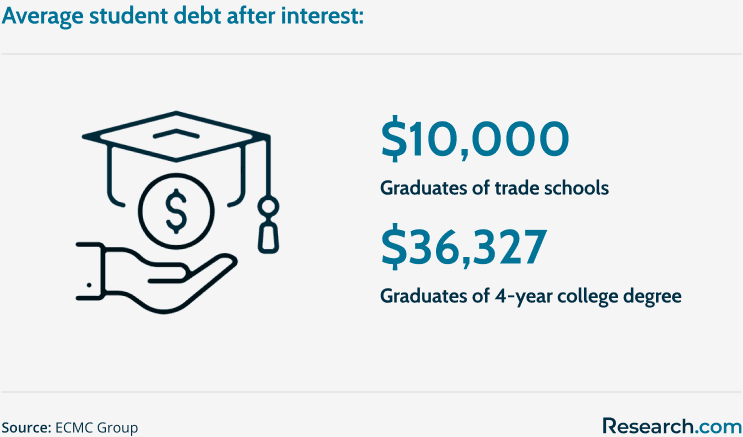
One study cited in the source material found that students who attend trade school graduate with an average of $10,000 in debt. By comparison, students who attend college collect an average student debt of $36,327, after interest. Debt can still be a serious issue, so compare net cost after grants, scholarships, employer benefits, and payment plans—not just advertised tuition.
| Cost Category | Questions to Ask Before Enrolling |
| Tuition | Is tuition charged by course, credit, term, module, or program? |
| Fees | Are there technology, registration, graduation, lab, background check, or testing fees? |
| Tools and supplies | Will I need to buy tools, uniforms, safety equipment, textbooks, or software? |
| Hands-on training | Will I need to travel for labs, internships, externships, or clinical placements? |
| Certification exams | Are exam fees included, or will I pay separately? |
| Financial aid | Is the school eligible for federal aid, state aid, scholarships, or employer tuition assistance? |
Do I Need Any Special Technology or Equipment to Enroll in Online Trade Schools?
Most online trade school students need reliable internet access, a laptop or desktop computer with adequate processing power, enough memory and storage, a webcam, and a microphone. Some programs also require a quiet testing environment, online proctoring tools, or specific browser settings.
Program-specific requirements can be more expensive. A design, IT, or manufacturing-related program may require specialized software. An electrician program may require electrical testing equipment. Automotive, HVAC, healthcare, or skilled construction programs may require tool kits, uniforms, safety gear, or in-person lab materials.
Before enrolling, ask for the official technology and equipment list. Confirm whether items are included in tuition, purchased through the school, or bought independently. Also ask whether required software works on your operating system and whether a tablet or Chromebook is acceptable.
What Kind of Career Support and Guidance Is Available for Online Trade School Students?
As reporting has noted, two-year skilled trades programs are booming, and career support has become an important differentiator among schools. Strong online trade schools do more than post lectures; they help students connect training to employment.
- Career advising: Counselors can help students clarify goals, compare occupations, and understand local employment requirements.
- Resume and portfolio support: Students may receive help describing technical skills, safety training, projects, certifications, and work experience.
- Interview preparation: Mock interviews and feedback can help students explain their skills clearly to employers.
- Employer connections: Some schools maintain job boards, employer networks, apprenticeship contacts, or hiring events.
- Internship and externship support: Healthcare, technical, and mechanical programs may help students identify supervised practice sites.
- Certification guidance: Advisors may explain which exams, licenses, or industry credentials are relevant after program completion.
Which Trade Fields Are in High Demand and Offer Good Salaries?
Trade demand depends heavily on location, licensing rules, infrastructure needs, healthcare systems, technology adoption, and employer shortages. Of all postsecondary CTE concentrators in 2021-22, about 27.82% are enrolled in the health sciences, showing the size of healthcare-related career and technical training.
Fields often associated with steady demand include construction trades, electrical work, plumbing, carpentry, HVAC, healthcare support, cybersecurity, medical assisting, respiratory therapy, dental hygiene, licensed practical nursing, CNC machining, welding, automation, mechatronics, and automotive technology. Students considering healthcare technical roles can also review career-specific guides such as how to become a dialysis technician.
| Trade Job | Median Annual Wage |
| Boilermakers | $64,290 |
| Electricians | $64,040 |
| Elevator and Escalator Installers and Repairers | $97,860 |
| Industrial Machinery Mechanics | $59,840 |
| Millwrights | $60,330 |
Salary tables are useful, but they should not be read as guarantees. Pay varies by region, union status, employer, apprenticeship completion, overtime, experience, licensing, and industry specialization.
What Are the Typical Admissions Requirements for Online Trade Schools?
Most online trade schools require a high school diploma or GED. Some may accept homeschool documentation, state equivalency credentials, or other approved alternatives. Admissions requirements are usually simpler than those for many four-year colleges, but selective healthcare, technical, or licensure-aligned programs may require additional steps.
- Education proof: High school diploma, GED, or accepted equivalent.
- Age requirement: Some programs require students to meet a minimum age threshold for enrollment, clinical placements, or licensure eligibility.
- GPA review: Certain programs may consider high school or prior college grades.
- Testing: Some healthcare programs may request standardized test scores, such as the test of essential academic skills (TEAS or ATI TEAS).
- English proficiency: Students whose first language is not English may need TOEFL, IELTS, or another approved measure.
- Program-specific screening: Healthcare and public safety programs may require immunizations, background checks, drug screening, CPR certification, interviews, portfolios, or essays.
Trade programs in high-interest fields such as construction trades, culinary training, and mechanic and repair may add prerequisites or capacity limits. Always review the exact program page rather than relying on general admissions information.
How Do I Determine If Online Trade School Credits Can Transfer to Other Institutions?
Credit transfer is never automatic. The receiving college decides whether to accept credits, how many to accept, and whether they count toward electives, major requirements, general education, or nothing at all. If you may pursue a future associate or bachelor’s degree, investigate transfer before enrolling.
- Confirm accreditation: Credits from accredited institutions are generally easier to evaluate, but accreditation alone does not guarantee transfer.
- Ask about articulation agreements: Some trade schools have formal transfer pathways with colleges and universities.
- Compare course content: Transfer is more likely when courses match the receiving school’s credit hours, learning outcomes, rigor, and subject matter.
- Check credential level: Associate degree credits may transfer differently from diploma or certificate coursework.
- Get answers in writing: Speak with advisors at both the trade school and the future institution you may attend.
- Save documentation: Keep syllabi, course descriptions, transcripts, assessment records, and certification information.
If your long-term goal includes a bachelor’s degree, choose a program with clear transfer policies instead of assuming your trade credits will apply later.
What Are the Pros and Cons of Attending Online Trade School?
Online trade schools can be a strong fit for motivated learners who need flexibility and want career-focused training. They can also be a poor fit for students who need extensive face-to-face coaching or who choose a hands-on trade without verifying local lab, apprenticeship, or licensure requirements. Digital skill development can be an added advantage because online trade schools can help students build STEM skills relevant to fields such as information systems careers, and 80% of middle-skill jobs require foundational digital skills.
| Advantages | Trade-Offs |
| Students can study from home or another location with internet access. | Some programs still require in-person labs, clinical hours, externships, or travel. |
| Flexible schedules can help working adults and parents stay enrolled. | Online learning requires strong self-discipline and time management. |
| Students may access programs not offered nearby. | Licensure and employer expectations may differ by state or region. |
| Costs may be lower when students avoid commuting, relocation, or housing expenses. | Tools, software, exam fees, and travel can raise the true cost. |
| Some programs are self-paced or accelerated. | Fast programs can be difficult for students who need more instructor support. |
When Online Trade School Makes Sense
- You need flexible scheduling because of work, family, military service, or transportation limits.
- Your chosen field allows a large portion of theory, safety, software, or procedure training online.
- The program has a clear plan for hands-on practice and assessment.
- The credential is recognized by employers or licensing bodies in your area.
- You have the discipline to keep up with coursework without daily in-person structure.
When You Should Consider a Campus or Apprenticeship-Based Route
- Your trade requires extensive supervised practice with equipment, tools, patients, vehicles, wiring, or machinery.
- You learn best through direct demonstration and immediate instructor feedback.
- Your state requires specific in-person hours or apprenticeship arrangements.
- The online program cannot clearly explain how students complete hands-on requirements.
- You are entering a field such as automotive technology, where physical diagnostics and equipment practice are central to training.
Automotive technology and related skilled fields remain important options for students who want applied mechanical work. The chart below provides additional context for demand in this area.
How Do Online Trade Schools Deliver Practical, Hands-On Training?
Online trade schools use several models to teach practical skills. Programs may combine video demonstrations, interactive simulations, virtual labs, mailed tool kits, local externships, employer partnerships, weekend labs, campus intensives, or supervised field placements. The strongest programs explain these requirements before enrollment and identify who is responsible for arranging local placements.
| Hands-On Training Method | How It Helps | Important Question |
| Virtual simulations | Students can practice procedures, safety decisions, troubleshooting, or software workflows in a controlled environment. | Are simulations supplemental, or do they replace required in-person practice? |
| Tool kits or lab kits | Students complete structured exercises at home using approved materials. | Are the tools included in tuition, and are they sufficient for employer expectations? |
| Local externships or clinical placements | Students gain supervised experience in a real work setting. | Does the school place students, or must students find sites themselves? |
| Campus intensives | Students travel for short, concentrated lab sessions. | How often is travel required, and what are the added costs? |
| Apprenticeship pathways | Students combine instruction with paid or supervised work experience. | Does the school have employer or union connections in your region? |
If you want a practical career route with shorter training, compare programs carefully with occupation-specific resources such as easy trades to learn that pay well.
Can Online Trade Schools Facilitate Advanced Academic Opportunities?
Some online trade schools can support further education, especially when credits are earned through an accredited institution and the school has articulation agreements with colleges or universities. Students may be able to move from a certificate to a diploma, from a diploma to an associate degree, or from an associate degree toward a bachelor’s program.
However, students should not assume every trade credential will transfer. Certificate programs focused on workforce training may have limited academic transfer value. If your long-term goal includes research, teaching, management, or advanced academic work, ask how your current training could fit into later education. Students exploring long-term online academic pathways may also review options such as doctoral programs online, although doctoral study is a very different commitment from trade training.
Are Flexible Scheduling Options Offered by Online Trade Schools?
Yes. Many online trade schools offer asynchronous coursework, evening classes, weekend sessions, self-paced modules, or hybrid schedules. Flexibility is one of the main reasons students consider online trade education, but the schedule still depends on the program format and hands-on requirements.
- Asynchronous courses: Students access lessons, readings, videos, and assignments on their own schedule.
- Synchronous sessions: Students attend live online classes at set times, often in the evening or on weekends.
- Hybrid programs: Students complete lecture material online and attend labs, assessments, or field experiences in person.
- Self-paced learning: Students progress through modules at their own speed, subject to school deadlines and academic policies.
Before choosing a program, compare live class times, assignment deadlines, lab schedules, externship expectations, and minimum weekly study hours. A flexible program can still be demanding.
What New Skills and Qualifications Will Be in Demand for Trade Jobs in the Future?
Trade jobs are changing as technology, energy systems, automation, and digital tools become more common in the workplace. In fiscal year 2021, about $1.3 billion in federal funds were used to support career and technical education programs through the Department of Education, according to the cited source material.
Future-ready trade training increasingly includes digital diagnostics, smart building systems, energy-efficient technologies, safety compliance, data tools, remote monitoring, and advanced equipment. Construction workers may benefit from knowledge of modular building methods, drone technology, and 3D printing applications. Energy-related trades may require familiarity with solar panel systems, wind power infrastructure, battery storage technologies, microgrids, and electric vehicle charging stations.
Plumbers and pipefitters may see continued need for skills tied to water-saving fixtures, rainwater harvesting systems, and greywater recycling systems. HVAC technicians may need to understand smart HVAC systems, sustainable climate control, and indoor air quality improvements. Students should look for programs that update curriculum based on employer input rather than teaching outdated tools or methods.
What Are the Fast-Track Programs in Online Trade Schools?
Fast-track online trade programs are designed for students who want to complete training quickly and enter the workforce sooner. Common fast-track areas include HVAC, automotive technology, medical assisting, administrative technology, IT support, bookkeeping, coding-related training, and other certificate-based programs. Depending on the field, some programs can be completed in as little as six months, while others may take up to a year.
Fast-track programs can reduce time in school, but they are not automatically easier or cheaper. Students may face heavier weekly workloads, fewer breaks, and more compressed deadlines. If the trade requires hands-on training, acceleration may also mean that labs, externships, or assessments happen on a tighter schedule.
Students comparing accelerated education options can also review broader lists of fast-track college programs, but they should distinguish between academic degree acceleration and occupation-specific trade training.
What Financial Aid Options Are Available for Online Trade School Students?
Financial aid availability depends on the school, program length, accreditation, enrollment status, and credential type. Not every online trade school or short certificate program qualifies for federal aid, so students should confirm eligibility before assuming grants or loans are available.
- Federal financial aid: Students enrolled in eligible programs at accredited institutions may be able to complete the Free Application for Federal Student Aid (FAFSA) and access grants or federal loans. Students comparing broader affordability options may also review affordable online colleges.
- Scholarships: Trade associations, employers, nonprofits, local foundations, and schools may offer awards for students in technical and vocational programs.
- Employer tuition assistance: Some employers reimburse or help pay for training related to an employee’s current or future role.
- State and local grants: Workforce development agencies and state programs may support vocational training in high-need fields.
- Payment plans: Some schools allow students to divide tuition into installments, though students should check fees and cancellation policies.
- Private loans: Private financing may be available, but interest rates and repayment protections can differ from federal loans.
Do Employers Recognize Online Trade School Credentials Equally?
Employer recognition depends on the credential, the school’s accreditation, the trade, the applicant’s demonstrated skills, and whether the program includes verified hands-on training. Employers are more likely to value an online trade credential when it is tied to recognized industry standards, prepares students for relevant certifications, and is supported by work samples, apprenticeships, externships, or practical assessments.
For many hiring managers, the key question is not simply whether the program was online. It is whether the graduate can perform the work safely, accurately, and reliably. Additional credentials may strengthen a resume when they are relevant to the job; students can compare examples of online certifications that pay well as part of a broader career plan.
Are Online Trade Schools Accredited and How Is Educational Quality Ensured?
Many online trade schools are accredited, but students must verify accreditation directly. Accreditation helps show that an institution has been reviewed against established standards. In some fields, programmatic accreditation may also matter for licensure, certification exams, clinical placement, or employer recognition.
Quality assurance can include curriculum reviews, employer advisory boards, instructor credential requirements, student learning assessments, certification exam alignment, and graduate outcome tracking. Students should also review complaint histories, refund policies, licensure disclosures, and whether the program’s curriculum is updated for current industry tools and safety practices.
Students who want a faster but still structured academic route can compare trade credentials with options such as an accelerated online college program, but the right path depends on whether the goal is immediate trade employment, transfer credit, or a bachelor’s degree.
What Is the Return on Investment for Online Trade Schools?
The return on investment for an online trade school depends on total cost, time to completion, job placement support, local wages, licensing requirements, and how quickly the credential can lead to paid work. A low-cost program may have poor ROI if employers do not recognize it. A more expensive program may be worthwhile if it leads to required credentials, strong hands-on preparation, and better job access.
| ROI Factor | Why It Matters | What to Ask |
| Total program cost | Tuition alone does not show the full financial commitment. | What is the total cost including tools, fees, exams, software, and travel? |
| Completion time | Shorter programs may let students start earning sooner. | How long do students typically take to finish? |
| Credential value | Some credentials are more useful to employers than others. | Which jobs does this credential prepare graduates to pursue? |
| Licensure alignment | A program that does not meet state rules may delay employment. | Does this program meet requirements in my state? |
| Career outcomes | Placement support and employer relationships can affect job search success. | What career services are available, and are outcomes published? |
Students who want shorter education-to-career timelines can also compare trade school options with quick high paying degrees, while remembering that pay depends on field, location, experience, and employer demand.
Can a Trade Credential Facilitate a Transition to a Bachelor's Degree Program?
Yes, but only in some cases. Trade credentials can support a later bachelor’s degree when credits are accepted by the receiving institution, the courses align with degree requirements, and the trade school has transfer agreements. Associate degree programs usually provide clearer transfer potential than short workforce certificates, although policies vary.
Students who want both job-ready training and future degree mobility should ask whether the program has articulation agreements, which colleges accept its credits, and how many credits apply toward a bachelor’s degree. If cost is a major concern, compare transfer-friendly trade pathways with affordable online bachelor’s degrees.
What Emerging Trends Are Shaping Online Trade Education?
Online trade education is becoming more technology-driven and competency-focused. Schools are adding virtual simulations, remote labs, augmented reality tools, digital troubleshooting exercises, and industry software to help students practice decision-making before working with real equipment or clients.
Competency-based education is also gaining attention because it allows students to progress by demonstrating skills rather than simply completing seat time. Employer partnerships remain important because trade curricula must reflect current workplace tools, safety expectations, and certification requirements. Some institutions also promote accelerated academic options, including pathways such as an online associate degree in 6 months, though students should verify rigor, accreditation, transfer value, and employer recognition before enrolling.
What Career Development Opportunities Do Online Trade Schools Offer?
Strong online trade schools provide career development support throughout the student journey, not just at graduation. Advising can help students choose the right credential, understand employer expectations, prepare for interviews, and identify apprenticeships, externships, or entry-level roles.
Some schools offer virtual career fairs, resume builders, job boards, mock interviews, alumni networks, employer panels, and networking events. Others provide more limited support, so students should compare services carefully. If a school advertises job placement assistance, ask what that means in practice: referrals, employer introductions, job search coaching, or only access to an online job board.
Students seeking a simpler admissions process while comparing online options may also review resources on accredited online colleges with no application fee, but admissions convenience should never replace checks for accreditation, program quality, cost, and career fit.
Common Mistakes to Avoid When Choosing an Online Trade School
| Mistake | Why It Can Hurt You | Better Approach |
| Choosing a school without checking accreditation | It may affect financial aid, transfer credit, licensure, and employer confidence. | Verify accreditation through official accreditor and school sources before applying. |
| Focusing only on tuition | Tools, software, fees, travel, and exam costs can change the total price. | Ask for a full cost-of-attendance estimate. |
| Assuming online means fully remote | Many trade programs require labs, externships, or clinical hours. | Confirm every in-person requirement and who arranges placements. |
| Ignoring state licensure rules | A program may not qualify you for work in your state. | Check state licensing boards and ask the school for state-specific disclosures. |
| Relying only on rankings | A highly visible school may not be the best fit for your trade or region. | Compare curriculum, outcomes, cost, scheduling, and employer recognition. |
| Assuming credits will transfer | Transfer decisions are controlled by the receiving institution. | Get transfer guidance in writing before enrolling. |
| Expecting guaranteed salary outcomes | Wages vary by location, experience, credential, and labor market conditions. | Use salary data as a planning tool, not a promise. |
Questions to Ask Before Enrolling in an Online Trade School
- Is the institution accredited, and is the specific program accredited if my field requires it?
- Does this program prepare me for licensure, certification, or employment in my state?
- What parts of the program are online, hybrid, or in person?
- Who arranges externships, clinical placements, apprenticeships, or labs?
- What tools, software, uniforms, books, and equipment will I need?
- What is the full cost, including fees, exams, and travel?
- Can I use federal financial aid, scholarships, employer assistance, or payment plans?
- What credential will I earn, and which employers recognize it?
- What are the program completion, job placement, and certification exam outcomes?
- Will credits transfer if I later pursue an associate or bachelor’s degree?
References
- Association for Career and Technical Education (2022). STEM is CTE.
- National Student Clearinghouse Research Center (2022). Overview: Spring 2022 Enrollment Estimates.
- Perkins Collaborative Resource Network (2023). National Enrollment Profile.
- U.S. Bureau of Labor Statistics (2022). Beyond construction trades: Apprenticeships in a variety of careers.
- U.S. Government Accountability Office (2022). Career and Technical Education: Perspectives on program strategies and challenges.
Key Insights
- Online trade schools are most useful when they combine flexible coursework with verified hands-on training, accreditation, and employer-recognized credentials.
- Not every trade can be learned fully online. Electrical, HVAC, automotive, healthcare, and mechanical fields often require labs, externships, apprenticeships, or supervised skills practice.
- Cost comparisons should include tuition, fees, software, tools, exam costs, travel, and lost work time—not tuition alone.
- Accreditation, licensure alignment, and transfer policies should be verified before enrollment, especially if you may use financial aid or pursue a future degree.
- Fast-track programs can help students finish sooner, but compressed schedules require strong time management and may still include in-person requirements.
- Career services matter. Look for schools that provide practical job search support, employer connections, interview preparation, and guidance on certifications or apprenticeships.
- Salary and job outlook data should guide your research, not guarantee your outcome. Local demand, experience, licensing, and employer expectations determine real opportunities.
Other Things You Should Know About Online Trade Schools
Yes, many top online trade schools in 2027 offer hands-on training opportunities through local partnerships. These allow students to gain practical experience in facilities or workshops nearby, crucial for fields like electrical work or automotive repair, complementing their online studies.
Yes, many online trade schools in 2027 provide financial aid options, including scholarships, grants, and student loans. Eligibility criteria vary, so check specific school offerings. Federal aid may also be available if the school is accredited and participates in Title IV programs.
Yes. Many online trade schools prepare students for certification tests, and some use approved third-party testing centers for the final exam. Programs in HVAC, welding, medical billing, and IT often align with credentials from bodies such as NCCER, CompTIA, or ASE.
In 2027, several online trade schools are recognized for their exceptional programs. Penn Foster, Ashworth College, and Ultimate Medical Academy stand out for their diverse course offerings, strong student support, and competitive tuition fees. These institutions provide flexible schedules, allowing students to balance studies with personal commitments effectively.