Most Affordable Online Community Colleges for 2027

Co-Founder and Chief Data Scientist
Choosing an educational path that provides high career value without incurring substantial debt is a critical challenge. With 1,026 community colleges operating nationwide, the sheer number of options can make it difficult to distinguish a wise investment from a costly mistake. This is where strategic guidance becomes essential.
This is more than a simple ranking. It is a comprehensive guide developed by career planning experts with over a decade of experience. We have designed it to help you identify the best affordable online community colleges and make a sound, strategic decision for your professional future.
What are the benefits of getting a degree from an online community college?
- Earning a degree from an online community college provides a direct pathway to essential, in-demand careers in fields like healthcare, information technology, and business.
- Graduates earn a competitive average salary of $66,881 per year, representing a significant return on a low-cost educational investment.
- The online format offers the flexibility to balance your education with work and family commitments, allowing you to learn on your own schedule.
What can I expect from an online community college?
You can expect a flexible, career-focused education with robust student support. These programs are specifically designed for students who are often balancing school with work and family, so the coursework is practical and directly applicable to the job market.
Unlike large universities, community colleges are known for smaller class sizes, typically averaging between 25 and 35 students. This allows for more direct interaction with instructors who are often industry professionals themselves.
From dedicated academic advising to online tutoring and career services, the support systems at affordable online community colleges are built to help you succeed. The entire experience is structured to provide a clear, manageable path toward your career goals.
Where can I work with a degree from an online community college?
Graduates have two powerful pathways. The first is direct entry into the workforce, where you can apply your skills in high-demand settings like hospitals, corporate offices, technology firms, and manufacturing facilities. These roles provide immediate career traction and earning potential.
The second pathway is continuing your education by transferring credits to a four-year university. This is a highly strategic and cost-effective route to earning a bachelor's degree, allowing you to complete foundational coursework at a fraction of the cost before seamlessly transitioning to your target institution.
How much can I make with a degree from an online community college?
Graduates earn a competitive salary that provides a significant return on their educational investment. The data shows that community college graduates earn an average annual wage of $66,881.
This strong earning potential is only part of the financial picture. By choosing a community college for the first two years, students can save around $30,000 in potential debt compared to attending a public four-year university from the start. This makes it a financially sound strategy for launching a successful career.
Popular College Degrees Worth Considering for 2027
Pursuing a degree at an online community college offers flexibility, affordability, and practical career pathways. These programs prepare students for both immediate employment and further academic study. Here are the most popular degrees worth considering:
1. Business Administration
A business administration degree prepares students for diverse career paths in management, finance, marketing, consulting, and entrepreneurship. The curriculum often includes courses in organizational leadership, business law, economics, and strategic planning. Graduates are well-positioned to assume leadership roles across corporate, nonprofit, and government sectors.
2. Psychology
Psychology graduates pursue careers in counseling, research, human resources, education, or continue to advanced clinical practice. Programs typically cover cognitive psychology, developmental psychology, research methods, and abnormal psychology. This degree builds a foundation for understanding human behavior and mental processes, opening pathways for both professional practice and graduate study.
3. Counseling
A counseling degree leads to careers as licensed professional counselors, marriage and family therapists, or school guidance counselors. Coursework often emphasizes human development, multicultural counseling, group therapy, and ethics in practice. Students gain the knowledge and clinical training necessary to support individuals and families in diverse settings.
4. Nursing
Nursing remains one of the most in-demand fields, offering careers as registered nurses, nurse practitioners, or specialized clinicians in areas such as pediatrics or critical care. Nursing curricula typically include anatomy, physiology, pharmacology, and supervised clinical rotations. Graduates are prepared to provide evidence-based care in hospitals, clinics, and community health environments.
5. Social Work
Social Work programs prepare graduates for careers in child welfare, healthcare, mental health services, and community advocacy. The curriculum often includes courses in social policy, human behavior, case management, and field practicum experiences. With a strong emphasis on service and equity, this degree equips students to make meaningful contributions across public and private sectors.
- List of the Most Affordable Online Community Colleges for 2027 Affordabl Colleges
- How long does it take to complete a degree at an affordable online community college? Completion Time
- How does an online community college compare to a traditional on-campus program? How does an online community college compare to a traditional on-campus program?
- What is the average cost of attending an affordable online community college? Program Cost
- What are the financial aid options for students enrolling in an affordable online community college? Financial Aid
- What are the prerequisites for enrolling in an online community college? What are the prerequisites for enrolling in an online community college?
- What courses are typically offered at online community colleges? What courses are typically offered at online community colleges?
- What types of specializations are available at online community colleges? Specializations
- How to Choose the Best Affordable Online Community College How to Choose the Best Affordable Online Community College
- What career paths are available for graduates of online community colleges? Career Paths
- What is the job market for graduates of online community colleges? Job Market
- How Can Supplemental Certifications Enhance Your Online Community College Credentials? How Can Supplemental Certifications Enhance Your Online Community College Credentials?
Most Affordable Online Community Colleges for 2027: Cost, Programs, and How to Choose
Choosing an online community college is usually a cost-and-flexibility decision: you want a credential that can improve your career options or transfer cleanly to a bachelor’s degree without creating unnecessary debt. The right school can help you complete general education credits, earn a career certificate, or prepare for fields such as healthcare, business, information technology, skilled trades, and public service while studying around work or family obligations.
This guide explains how affordable online community colleges compare, what they cost, how long they take, what financial aid may be available, and how to avoid common enrollment mistakes. It is designed for first-time college students, working adults, parents, veterans, transfer students, and career changers, including learners exploring practical routes into tech jobs that don't require a degree.
Quick Answer: Are Affordable Online Community Colleges Worth It?
Affordable online community colleges can be worth it when the school is properly accredited, the program matches your transfer or career goal, and the total cost remains manageable after financial aid. They are especially useful for students who want lower tuition, flexible scheduling, career-focused training, or transferable credits before entering a four-year institution.
The main caution is that “online” and “affordable” are not enough by themselves. Before enrolling, confirm accreditation, transfer agreements, program availability in your state, technology requirements, student support services, and whether the credential leads to the job, license, certification, or bachelor’s pathway you want.
How We Rank Affordable Online Community Colleges
Because college affordability depends on more than tuition alone, Research.com evaluates schools using a data-informed approach that considers cost, accessibility, student persistence, online enrollment, admissions, and accreditation. Our ranking draws from established education data sources, including the IPEDS database, Peterson's database, the College Scorecard database, and The National Center for Education Statistics.
These sources help compare colleges using consistent institutional data. Students should still use rankings as a starting point, not the final decision. Program fit, transferability, aid eligibility, and career outcomes should be checked directly with each college. For a closer explanation of how Research.com evaluates schools, review our methodology page.
Most Affordable Online Community Colleges for 2027
The colleges below offer online learning options at community or technical college prices. Use this list to identify possible schools, then verify the specific online program, tuition classification, fees, and transfer or career requirements before applying.
| Rank | School | Online Enrollment Rate | Retention Rate | Acceptance Rate | Tuition | Accreditation |
| 1 | Western Texas College | 87% | 68% | 97% | $3,300 (in-state) | $4,890 (out-of-state) | Southern Association of Colleges and Schools Commission on Colleges (SACSCOC) |
| 2 | Wayne Community College | 81% | 70% | 78% | $1,299 (in-state) | $4,371 (out-of-state) | Southern Association of Colleges and Schools Commission on Colleges (SACSCOC) |
| 3 | Copiah-Lincoln Community College | 64% | 73% | 100% | $4,710 (in-state) | $6,710 (out-of-state) | Southern Association of Colleges and Schools Commission on Colleges (SACSCOC) |
| 4 | Coastal Pines Technical College | 38% | 62% | 100% | $1,605 (in-state) | $1,961 (out-of-state) | Southern Association of Colleges and Schools Commission on Colleges (SACSCOC) |
| 5 | Southern Crescent Technical College | 76% | 68% | 87% | $4,764 (in-state) | $8,364 (out-of-state) | Southern Association of Colleges and Schools Commission on Colleges (SACSCOC) |
| 6 | Fox Valley Technical College | 31% | 68% | 95% | $3,668.40 (in-state) | $5,502.72 (out-of-state) | Higher Learning Commission (HLC) |
| 7 | Washtenaw Community College | 67% | 65% | 88% | $2,464 (in-state) | $3,212 (out-of-state) | Higher Learning Commission (HLC) |
| 8 | Vance-Granville Community College | 88% | 71% | 77% | $1,216 (in-state) | $4,288 (out-of-state) | Southern Association of Colleges and Schools Commission on Colleges (SACSCOC) |
| 9 | Northeast Community College | 49% | 71% | 77% | $3,300 (in-state) | $4,590 (out-of-state) | Higher Learning Commission (HLC) |
| 10 | Lurleen B. Wallace Community College | 62% | 62% | 87% | $3,460 (in-state) | $6,040 (out-of-state) | Southern Association of Colleges and Schools Commission on Colleges (SACSCOC) |
1. Western Texas College
Western Texas College offers associate degree pathways for students who want to transfer to a four-year university as well as learners preparing for technical careers. Online students can work with an Online Advisor for course selection and degree planning, which is especially important for students trying to avoid taking credits that do not fit their goal.
- Online Enrollment Rate: 87%
- Retention Rate: 68%
- Acceptance Rate: 97%
- Tuition: $3,300 (in-state) | $4,890 (out-of-state)
- Accreditation: Southern Association of Colleges and Schools Commission on Colleges (SACSCOC)
2. Wayne Community College
Wayne Community College provides online associate degrees, diplomas, and certificates across career-oriented fields. Students interested in technology can find programs connected to areas such as Artificial Intelligence Engineering, Cybersecurity, and Software Development, making the college a practical option for learners who want job-relevant technical training.
- Online Enrollment Rate: 81%
- Retention Rate: 70%
- Acceptance Rate: 78%
- Tuition: $1,299 (in-state) | $4,371 (out-of-state)
- Accreditation: Southern Association of Colleges and Schools Commission on Colleges (SACSCOC)
3. Copiah-Lincoln Community College
Copiah-Lincoln Community College serves both transfer-focused students and those planning to enter the workforce in two years or less. Its eLearning options are supported by enrollment services that can help students move from application through graduation with fewer administrative barriers.
- Online Enrollment Rate: 64%
- Retention Rate: 73%
- Acceptance Rate: 100%
- Tuition: $4,710 (in-state) | $6,710 (out-of-state)
- Accreditation: Southern Association of Colleges and Schools Commission on Colleges (SACSCOC)
4. Coastal Pines Technical College
Coastal Pines Technical College offers more than 150 programs, including online options in areas such as business, criminal justice, and early childhood education. Its eCampus partnership with other technical colleges in Georgia can expand course access for students who need additional scheduling flexibility.
- Online Enrollment Rate: 38%
- Retention Rate: 62%
- Acceptance Rate: 100%
- Tuition: $1,605 (in-state) | $1,961 (out-of-state)
- Accreditation: Southern Association of Colleges and Schools Commission on Colleges (SACSCOC)
5. Southern Crescent Technical College
Southern Crescent Technical College emphasizes short, career-connected programs built with industry needs in mind. The college also participates in the HOPE Career Grant, which may create tuition-free pathways for eligible students in selected high-demand technical fields.
- Online Enrollment Rate: 76%
- Retention Rate: 68%
- Acceptance Rate: 87%
- Tuition: $4,764 (in-state) | $8,364 (out-of-state)
- Accreditation: Southern Association of Colleges and Schools Commission on Colleges (SACSCOC)
6. Fox Valley Technical College
Fox Valley Technical College provides career-focused training in more than 200 programs, with online options in fields such as business, health science, and information technology. Students who plan to continue into a bachelor’s program should review the college’s university transfer agreements before choosing courses.
- Online Enrollment Rate: 31%
- Retention Rate: 68%
- Acceptance Rate: 95%
- Tuition: $3,668.40 (in-state) | $5,502.72 (out-of-state)
- Accreditation: Higher Learning Commission (HLC)
7. Washtenaw Community College
Washtenaw Community College offers more than 130 programs, including more than 40 fully online options. Its transfer focus and industry-informed curriculum make it a useful choice for students comparing both academic-transfer and career-entry routes.
- Online Enrollment Rate: 67%
- Retention Rate: 65%
- Acceptance Rate: 88%
- Tuition: $2,464 (in-state) | $3,212 (out-of-state)
- Accreditation: Higher Learning Commission (HLC)
8. Vance-Granville Community College
Vance-Granville Community College offers in-person, online, and hybrid study formats through an open-door admissions model. Its use of high school GPA for English and math placement can simplify enrollment for students who want to begin college-level coursework without unnecessary delays.
- Online Enrollment Rate: 88%
- Retention Rate: 71%
- Acceptance Rate: 77%
- Tuition: $1,216 (in-state) | $4,288 (out-of-state)
- Accreditation: Southern Association of Colleges and Schools Commission on Colleges (SACSCOC)
9. Northeast Community College
Northeast Community College provides flexible class formats for students balancing school with work, caregiving, or other commitments. Its fully online degree options can support both immediate employment goals and transfer plans.
- Online Enrollment Rate: 49%
- Retention Rate: 71%
- Acceptance Rate: 77%
- Tuition: $3,300 (in-state) | $4,590 (out-of-state)
- Accreditation: Higher Learning Commission (HLC)
10. Lurleen B. Wallace Community College
Lurleen B. Wallace Community College offers an accessible admission route with no application deadline or entrance exam requirement. Students using distance education can complete an Associate in Arts or Associate in Science degree entirely online, making it a strong fit for learners planning a transfer-oriented pathway.
- Online Enrollment Rate: 62%
- Retention Rate: 62%
- Acceptance Rate: 87%
- Tuition: $3,460 (in-state) | $6,040 (out-of-state)
- Accreditation: Southern Association of Colleges and Schools Commission on Colleges (SACSCOC)
How Long Does an Online Community College Degree Take?
A community college undergraduate program usually takes two to four years of full-time study, depending on the credential, credit load, and whether the student is completing an associate degree or a longer transfer pathway. Many programs require approximately 60-120 credit hours, and a common full-time schedule is 15 credits per semester during the fall and spring. Community colleges awarded nearly 860,000 associate degrees in a single academic year, showing how common this route remains for undergraduate learners.
The actual timeline depends on your pace. Full-time students may finish an associate degree faster, while part-time students often take longer because they are working, parenting, or managing other responsibilities. Some students use community college as the first step in a longer academic plan, later transferring into bachelor’s programs and eventually graduate options such as the fastest online master's in science education degree programs.
| Student Goal | Typical Path | What to Check Before Enrolling |
| Transfer to a bachelor’s program | Complete general education and lower-division major courses | Articulation agreements, course equivalencies, GPA requirements, and transfer deadlines |
| Enter the workforce quickly | Earn a certificate, diploma, or applied associate degree | Employer demand, required certifications, clinical or lab requirements, and career services |
| Study while working | Take part-time online courses each term | Course rotation, asynchronous options, advising access, and maximum completion time |
| Prepare for licensure | Complete a state-approved or professionally aligned program | State eligibility rules, supervised experience requirements, exams, and in-person components |
Online Community College vs. On-Campus Community College
If the college is properly accredited, the format alone does not determine the academic value of the credential. The better question is whether online or on-campus learning matches how you study, how much structure you need, and what your program requires.
| Factor | Online Community College | On-Campus Community College |
| Schedule flexibility | Best for students who need to study around work, caregiving, or irregular schedules | Best for students who prefer fixed class times and a predictable weekly routine |
| Location | Coursework can often be completed from home, although some programs may require labs, clinicals, testing, or fieldwork | Students attend classes and use campus facilities in person |
| Interaction | Communication usually happens through discussion boards, video meetings, email, and learning platforms | Students can meet instructors, classmates, tutors, and advisors face to face |
| Learning style | Works well for self-directed learners who can manage deadlines independently | Works well for students who benefit from immediate in-person feedback and classroom structure |
| Best use case | Working adults, parents, transfer students, career changers, and students far from campus | Students in hands-on programs or those who want stronger campus involvement |
Why Online Programs Appeal to Community College Students
Online community college programs are built around access. Students can often complete assignments at times that fit their schedules, which matters for learners with jobs, children, transportation limits, or military obligations. This format has become a standard part of community college education, with 58% of community college students taking at least some of their courses online.
When Campus Learning May Be Better
On-campus study can be the stronger choice for students who need labs, specialized equipment, hands-on practice, or frequent in-person support. It can also help students who struggle with online time management or who learn better through live discussion and immediate feedback.
Online learning can also support long-term academic mobility. For example, a student may begin with online community college coursework, complete a nursing degree, and later explore advanced options such as BSN to MSN programs. Employer acceptance also continues to improve: research reports that 87.4% of employers who have hired recent online graduates agree that they are as well or better prepared than on-campus peers, and 61% of HR leaders view online degrees as equal to or better than traditional degrees.
How Much Does an Affordable Online Community College Cost?
The average annual tuition for a public community college is approximately $3,990 for in-district students. That is substantially lower than the average tuition of $11,260 at public four-year universities, which is why many students complete their first two years at a community college before transferring.
Tuition is only the starting point. Your final cost can change based on residency status, program fees, books, technology requirements, online course fees, transportation for required in-person components, and financial aid. The lowest sticker price is not always the lowest real cost if credits do not transfer or if a program requires extra fees that were not obvious at the start.
Community colleges can be especially useful for veterans and adult learners who want to keep costs down while preserving transfer options. Students who later continue their education may compare pathways such as affordable online bachelor's programs for veterans to maximize previously earned credits.
| Cost Factor | Why It Matters | Question to Ask |
| Residency classification | In-district, in-state, and out-of-state rates can differ significantly | What documents prove residency, and when is the deadline? |
| Online course fees | Some colleges charge additional fees for online classes or learning platforms | Are online fees included in the tuition estimate? |
| Books and materials | Textbooks, access codes, software, and lab kits can raise total cost | Does the program use open educational resources or low-cost materials? |
| Transfer efficiency | Lost credits can make a “cheap” program more expensive over time | Which courses are guaranteed to transfer to my target university? |
| Program requirements | Clinicals, labs, internships, testing, or background checks may add costs | Are there required in-person components or professional fees? |
Financial Aid Options for Online Community College Students
The most important first step for financial aid is completing the Free Application for Federal Student Aid (FAFSA). About 61% of community college students apply for federal aid, and the FAFSA can determine eligibility for several types of support.
- Federal Pell Grants: Federal gift aid for eligible students that does not need to be repaid.
- Federal Supplemental Educational Opportunity Grant (FSEOG): Grant funding for students with exceptional financial need; repayment is not required.
- Federal Work-Study: A program that helps eligible students earn money through part-time work while enrolled.
- Direct Subsidized Loans: Need-based federal loans where the government pays interest while the borrower is in school.
- Direct Unsubsidized Loans: Federal loans that are not based on financial need; interest accrues while the student is enrolled.
- State Aid: Grant or scholarship programs offered by states, often with residency, income, program, or enrollment requirements.
- Institutional Scholarships: Funding from the college based on factors such as academic performance, financial need, major, or student background.
How to Reduce Your Total Cost
- Submit the FAFSA as early as possible and correct errors quickly.
- Ask the college for a full cost estimate, not just tuition.
- Confirm whether you qualify for in-district or in-state pricing.
- Compare grant and scholarship eligibility before borrowing.
- If you plan to transfer, get written confirmation that your courses apply to your intended bachelor’s degree.
- Consider part-time enrollment only after checking whether it changes aid eligibility or program completion timelines.
Admissions Requirements for Online Community Colleges
Most community colleges are designed to be accessible, and many use open admissions policies. That does not mean every program is automatic. General admission to the college may be simple, while selective programs such as nursing, dental hygiene, or some technical fields may require prerequisites, tests, background checks, clinical eligibility, or additional applications.
- High School Diploma or GED: Most degree-seeking students need proof of high school completion or an equivalent credential.
- Application for Admission: Students typically submit an online application through the college website.
- Proof of Residency: Documentation may be required to qualify for in-district or in-state tuition rates.
- Placement Tests: Some colleges use math and English assessments, while others may use high school GPA or prior coursework.
- Official Transcripts: Colleges may request high school records and transcripts from any previously attended colleges.
This access-focused model can be a starting point for long-term academic growth. A student may begin with an associate degree, continue into a bachelor’s program, and later research advanced credentials such as what is an education specialist degree when planning a career in education leadership or specialization.
What Courses Do Online Community Colleges Offer?
Online community colleges usually combine general education courses with program-specific and career-focused classes. This mix allows students to build transferable academic credits while also developing skills that connect to jobs, certifications, or licensure pathways.
| Course Type | Examples | Best For |
| General Education | English, mathematics, social sciences, humanities, and natural sciences | Students planning to transfer or complete an associate degree |
| Major-Specific Courses | Business principles, introductory nursing concepts, criminal justice, accounting, or programming fundamentals | Students building knowledge in a chosen academic or career field |
| Career-Specific Courses | Applied technical training, workplace software, patient care skills, cybersecurity labs, or early childhood education practice | Students preparing for employment after a certificate, diploma, or applied associate degree |
| Electives | Courses outside the major or within a specialization | Students exploring interests, meeting degree requirements, or strengthening transfer preparation |
Students who plan to transfer should pay close attention to general education requirements. Well-chosen credits can reduce the cost of a future bachelor’s degree, including applied and technical fields such as the fastest online bachelor's degree programs in analytics.
Common Online Community College Specializations
Online community colleges often focus on practical fields where students can either transfer or prepare for employment. Availability varies by college and state, especially for programs with clinical, lab, or licensing requirements.
- Healthcare: Programs may include nursing, dental hygiene, medical assisting, and health information technology. Students should check in-person clinical requirements and state eligibility rules.
- Information Technology: Common options include cybersecurity, network administration, programming, web development, and software support.
- Business: Students can study accounting, marketing, management, entrepreneurship, office administration, and supply chain logistics.
- Skilled Trades: Some training may be available online or in hybrid formats, including pathways connected to the affordable online HVAC trade schools.
- Public Service: Options may include criminal justice, paralegal studies, human services, and early childhood education.
- Creative Arts: Students may pursue graphic design, digital media, photography, web media, or related creative technology fields.
Who Should Consider an Online Community College?
An online community college can be a strong fit if you need a lower-cost starting point, want to stay employed while studying, or plan to complete transferable credits before entering a four-year program. It can also work well for adults returning to school after a long break because community colleges often provide placement support, advising, and shorter credential options.
| Choose This Path If... | Consider Another Option If... |
| You want to lower the cost of general education credits before transferring. | Your target university does not accept many credits from the community college you are considering. |
| You need flexible online classes because of work, family, transportation, or military obligations. | You learn best through daily in-person structure and direct classroom interaction. |
| You want a certificate, diploma, or associate degree connected to a specific job field. | Your career goal requires a bachelor’s degree or higher from the start. |
| You are exploring college and want a lower-risk entry point. | You need a program with extensive hands-on labs that are not available near you. |
| You want to improve skills without committing immediately to a four-year degree. | You need a selective licensure program and cannot meet its clinical or in-person requirements. |
How to Choose the Best Affordable Online Community College
The best online community college is not simply the one with the lowest tuition. It is the school that offers the right credential, at a sustainable cost, with credits or training that move you toward a specific goal.
- Confirm accreditation first. Accreditation affects credit transfer, financial aid eligibility, and employer confidence. Avoid schools that cannot clearly show recognized accreditation.
- Define your goal before choosing courses. Decide whether you are pursuing transfer, immediate employment, licensure, certification, or personal upskilling.
- Check transfer agreements. If you plan to earn a bachelor’s degree later, ask which universities accept the credits and whether your intended major has special requirements.
- Compare total cost, not just tuition. Include fees, books, software, equipment, testing, commuting for required in-person components, and lost credits.
- Review online student support. Look for remote advising, tutoring, library access, disability services, financial aid counseling, and career support.
- Ask about course scheduling. Some “online” programs still have required live sessions, campus visits, labs, internships, or proctored exams.
- Match the program to employer expectations. For career programs, ask whether the curriculum prepares students for relevant certifications, portfolios, clinical skills, or entry-level job requirements.
- Be cautious with unrealistic promises. Avoid institutions that guarantee jobs, pressure you to enroll quickly, hide costs, or lack clear accreditation information.
Questions to Ask Before You Enroll
- Is the college accredited, and by which accreditor?
- Is my program fully online, or are labs, clinicals, exams, or internships required in person?
- What is the complete cost after tuition, fees, books, technology, and required materials?
- Will my credits transfer to my intended bachelor’s program?
- Does the program meet state licensing or certification requirements where I plan to work?
- How often are required courses offered online?
- What happens if I need to pause enrollment for work or family reasons?
- What career placement, internship, or employer connection support is available?
Current Trends Affecting Online Community Colleges
Online community colleges are being shaped by several practical shifts. More students now expect flexible scheduling, employers increasingly look for job-ready skills, and many adults want shorter credentials that can lead to work or stack into a future degree. Fields such as cybersecurity, healthcare support, analytics, logistics, and technical maintenance continue to influence program design at many community and technical colleges.
Artificial intelligence and automation are also changing what students need to learn. Technology programs may place more emphasis on cybersecurity, software tools, data skills, and applied problem-solving, while business and healthcare programs increasingly expect students to be comfortable with digital systems. The best programs do not just teach theory; they help students practice with the tools and workflows used in their target field.
Career Paths for Online Community College Graduates
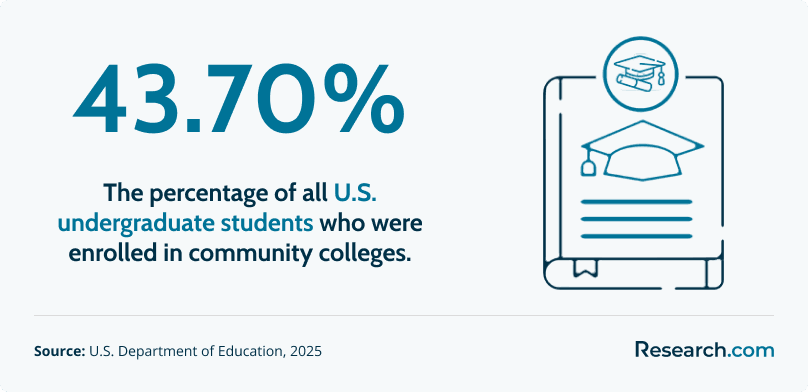
Community college graduates can move into many career areas, especially when their program includes applied training, certification preparation, clinical experience, or transfer-ready coursework. Community colleges serve a major share of the undergraduate population, with 43.7% of all U.S. undergraduate students attending community colleges.
| Career Path | What the Role Involves | Median Salary |
| Registered Nurse (RN) | Provides and coordinates patient care, educates patients about health conditions, and supports patients and families during treatment. | $81,220 per year |
| Web Developer | Builds and maintains websites, focusing on design, functionality, performance, capacity, and user needs. | $80,730 per year |
| Paralegal | Supports attorneys by organizing files, conducting legal research, preparing documents, and assisting with case management. | $59,200 per year |
| Maintenance Technician | Maintains buildings, equipment, and mechanical systems; some students prepare through programs such as affordable online maintenance technician trade school programs. | $59,790 per year |
| Dental Hygienist | Checks patients for oral health issues, performs preventive care, and cleans and polishes teeth. | $81,400 per year |
Important Career Reality Check
Salaries are not guaranteed. Outcomes depend on location, employer demand, experience, licensure, certifications, clinical requirements, portfolio quality, and the strength of the student’s job search. Before choosing a program, compare local job postings with the courses and credentials offered by the college.
Job Market Outlook for Online Community College Graduates
The job market can be favorable for graduates who complete programs aligned with employer needs, particularly in healthcare, technology, business operations, skilled trades, and technical services. Community colleges are often built around middle-skill roles that require more than a high school diploma but less than a bachelor’s degree.
That said, demand varies by region and occupation. A program with strong job prospects in one state may have fewer openings in another. Students should review local employer requirements, internship availability, certification expectations, and whether a program has relationships with nearby employers. Some graduates also use community college credits as a foundation for bachelor’s programs in fields such as hospitality, including pathways connected to the fastest online hospitality management degree programs.
What Graduates Say About Online Community Colleges
- : "With a full-time job and two small children, commuting to campus was not realistic for me. Online classes let me study after my kids went to bed, and my instructors understood that many of us were balancing school with real responsibilities. Finishing my degree helped me move into a steadier paralegal role and gave my family more security. Gemma"
- : "Most of my friends went straight to a large university, but I chose to complete my general education credits online at a community college first. The courses were strong, my credits transferred, and I am working toward the same bachelor’s degree with far less debt. For me, it was the smartest financial route. Vincent"
- : "I wanted to enter technology, but I could not pause my life for four years. My cybersecurity program focused on the exact skills and certifications employers were asking for, and the labs helped me practice what I learned right away. The program felt practical from the first term. Jerome"
Common Mistakes to Avoid
| Mistake | Why It Can Hurt You | Better Approach |
| Choosing only by lowest tuition | A low price may not include fees, materials, or transfer losses | Compare the complete cost of finishing the credential |
| Ignoring accreditation | Credits may not transfer, and financial aid or employer acceptance may be affected | Verify accreditation before applying |
| Assuming every online program is fully remote | Some programs require labs, clinicals, internships, or proctored exams | Ask about all in-person requirements in writing |
| Taking courses without a degree plan | Unnecessary credits can delay graduation and increase cost | Meet with an advisor before registering each term |
| Overlooking licensure rules | A program may not meet requirements in the state where you plan to work | Confirm state eligibility before enrolling in healthcare, education, legal, or technical licensing pathways |
| Relying only on rankings | A highly ranked school may not offer your exact program or transfer route | Use rankings to build a shortlist, then verify program fit |
How Supplemental Certifications Can Strengthen an Online Community College Credential
An associate degree or certificate can provide a strong base, but targeted supplemental certifications may help students show specific skills in areas such as cybersecurity, data analytics, project management, software tools, or technical operations. These add-on credentials can be useful when employers want proof of practical competency in addition to a college transcript.
The best certification depends on your career target. A student entering IT may prioritize vendor or security credentials, while a business student may focus on analytics or project management tools. Students who continue beyond community college may also compare advanced credential options such as the cheapest graduate certification programs online after completing a bachelor’s degree.
References
- Data USA. (n.d.). Community college education. Retrieved from Data USA.
- National Student Clearinghouse Research Center. (n.d.). Current term enrollment estimates. Retrieved from NSC Research Center.
- Statista. (n.d.). Community colleges in the United States. Retrieved from Statista.
- U.S. Department of Education. (n.d.). Community college: Facts at a glance. Retrieved from U.S. Department of Education.
Key Insights
- Affordable online community colleges are best for students who need lower tuition, flexible scheduling, transferable credits, or career-focused training.
- Accreditation is nonnegotiable. It affects credit transfer, financial aid, employer recognition, and the long-term value of the credential.
- The cheapest listed tuition is not always the cheapest path. Fees, materials, lost transfer credits, and required in-person components can change the real cost.
- Online study works best for self-directed students who can manage deadlines, technology, and communication without constant in-person structure.
- Students planning to transfer should confirm course equivalencies and articulation agreements before enrolling, not after completing credits.
- Career-focused students should compare program outcomes with local job postings, certification requirements, licensure rules, and employer expectations.
- Financial aid starts with the FAFSA, but students should also ask about state aid, institutional scholarships, work-study, and program-specific grants.
- Rankings can help narrow your search, but the right choice is the school that fits your program goal, schedule, budget, and next step after graduation.
Other Things You Should Know About Online Community Colleges
Most online community colleges in 2027 require applicants to have a high school diploma or GED. Some may also ask for placement test scores or transcripts. Check each college's specific requirements for additional criteria or documentation needed before applying.
It should hold institutional accreditation from a U.S. Department of Education-recognized regional accreditor, such as the Higher Learning Commission or SACSCOC. Accreditation affects federal aid eligibility, credit transfer, and employer recognition, and schools usually publish their accreditor on the college website and in the catalog.