
Most Affordable Online Colleges with Open Admissions for 2027

Co-Founder and Chief Data Scientist
If you've ever worried that you didn't have the right academic background for college or that employers might not respect an affordable online degree, you're not alone. Many people feel intimidated by the path to higher education. The good news is that the landscape has changed. A recent survey found that 87.4% of employers have hired graduates with online degrees, indicating that the quality of your education, rather than the method of delivery, is what matters.
Our career planning experts, with over a decade of experience, created this guide to cut through the confusion. We'll show you the clear, straightforward path to earning a degree from one of the most affordable online colleges with open admissions.
What are the benefits of getting a degree from an online college with open admissions?
- Earning an accredited degree from an online college prepares you for professional careers in high-demand fields like business, IT, and healthcare, opening the door to roles like project coordinator or help desk analyst.
- Graduates with a bachelor's degree have a projected average starting salary of $68,680, representing a significant boost in earning potential.
- The flexibility of online learning allows you to build your education around your existing work and family commitments, not the other way around.
What can I expect from an online college with open admissions?
You can expect a structured and supportive learning environment. Your courses will be fully accredited and delivered through an online portal, often called a Learning Management System or LMS. This is where you'll access all your course materials, participate in class discussions, and submit your assignments.
Most programs at affordable online colleges with open admissions offer asynchronous classes, meaning you can log in and complete your work on your own schedule. You will also have access to essential support services like academic advising and faculty office hours to help you succeed.
Where can I work with a degree from an online college with open admissions?
You can work in any professional field that requires a bachelor's degree from an accredited institution. Employers value a school's regional accreditation, not its specific admissions policy. The degree you earn holds the same weight as one from a traditional campus program because accreditation is the quality signal that hiring managers look for.
This opens doors to roles in corporate offices, government agencies, healthcare systems, and nonprofit organizations. Your career path will be shaped by your major, not by the admissions process of your college.
How much can I make with a degree from an online college with open admissions?
Graduates with a bachelor's degree can expect a significant salary increase, with an average starting projection of $68,680 per year. This earning potential is not determined by the college's admissions policy but by the value an accredited degree provides in the job market.
However, the most critical factor in your future earnings is your chosen field of study. Aligning your major with a high-demand career field is the key to maximizing the return on your educational investment and achieving your long-term financial goals.
Popular College Degrees Worth Considering for 2027
Selecting an academic pathway is a critical decision that can shape one’s professional opportunities and long-term career success. Below are some of the most popular degree paths, offering strong career potential, flexibility, and growth opportunities.
1. Business Administration
A versatile degree that opens doors to careers in management, finance, marketing, and entrepreneurship. With a strong foundation in leadership and organizational strategy, graduates are well-prepared to take on roles in corporate or startup environments. It’s also one of the best degrees for career changers, offering flexibility across nearly every industry.
2. Psychology
One of the most sought-after degrees, psychology provides insights into human behavior and mental processes. Graduates often pursue careers in counseling, research, human resources, or continue to advanced clinical roles. This degree also serves as a stepping stone for graduate programs in mental health, education, or neuroscience.
3. Counseling
Counseling programs train compassionate professionals to guide individuals and families through challenges such as stress, relationships, and mental health concerns. This degree is a strong foundation for those seeking licensure as professional counselors or therapists. It’s especially valuable for students passionate about making a direct impact on people’s emotional well-being.
4. Nursing
Known for its high demand and strong job security, nursing combines science with compassionate care. Graduates can work in hospitals, clinics, or community health settings, with opportunities to specialize in areas like pediatrics, critical care, or midwifery. As healthcare evolves, nursing degrees remain at the forefront of innovation and patient-centered care.
5. Social Work
Social work degrees prepare students to advocate for individuals and communities, focusing on areas like child welfare, healthcare, and social justice. Graduates often become licensed social workers, counselors, or program directors serving diverse populations. This field continues to grow as society places greater emphasis on mental health and community support systems.
- List of the Most Affordable Online Colleges with Open Admissions for 2027 Affordable Colleges
- How long does it take to complete a degree at an affordable online college with open admissions? Completion Time
- How does an online college with open admissions compare to a traditional on-campus program? How does an online college with open admissions compare to a traditional on-campus program?
- What is the average cost of attending an affordable online college with open admissions? Program Cost
- What are the financial aid options for students enrolling in an affordable online college with open admissions? Financial Aid
- What are the prerequisites for enrolling in an online college with open admissions? What are the prerequisites for enrolling in an online college with open admissions?
- What courses are typically offered at online colleges with open admissions? What courses are typically offered at online colleges with open admissions?
- What types of specializations are available at online colleges with open admissions? What types of specializations are available at online colleges with open admissions?
- How to Choose the Best Affordable Online College with Open Admissions How to Choose the Best Affordable Online College with Open Admissions
- What career paths are available for graduates of online colleges with open admissions? Career Paths
- What is the job market for graduates of online colleges with open admissions? Job Market
- Can additional certifications boost your career growth? Can additional certifications boost your career growth?
Most Affordable Online Colleges with Open Admissions for 2027
Choosing an online college with open admissions is often about solving three problems at once: getting accepted, keeping costs manageable, and finding a program flexible enough to fit around work, caregiving, military service, or other responsibilities. These schools can be especially useful for adult learners, transfer students, first-generation college students, and applicants who want a more accessible route into a degree program without competitive admissions barriers.
This guide explains how affordable online colleges with open admissions work, what they typically cost, how long they take, how they compare with campus programs, and how to evaluate whether a school is worth your time and money. It also highlights access-oriented online options, including low-cost online community colleges, that may help students start or finish a degree with less financial pressure.
Quick Answer: Are Affordable Online Colleges with Open Admissions Worth Considering?
Yes, an affordable online college with open admissions can be a practical option if the institution is properly accredited, the program matches your career goal, and the total cost after aid is realistic. Open admissions usually means the school does not require a highly selective admissions profile, but students still commonly need a high school diploma or equivalent, official records, and proof that they are ready for college-level work.
The best choice is not always the school with the lowest advertised tuition. Compare accreditation, transfer credit rules, student support, graduation requirements, online course format, financial aid eligibility, and whether the degree will meet employer, licensing, or graduate school expectations.
How This Ranking Was Built
Because cost and access matter most to students researching open-admission online colleges, the ranking emphasizes affordability, institutional credibility, online availability, and data transparency. Research.com draws from established education data sources, including the IPEDS database, Peterson's database, the College Scorecard database, and The National Center for Education Statistics.
These sources help verify institutional information, tuition-related data, student outcomes, and accreditation context. Readers who want a fuller explanation of how Research.com evaluates schools can review the Research.com methodology.
Affordable Online Colleges with Open Admissions: School Highlights
The schools below offer online or flexible degree pathways that may appeal to students looking for accessible admissions, lower tuition, transfer-friendly policies, or adult-focused support. Always confirm current admission requirements, program availability, tuition, fees, and state authorization directly with the school before applying.
| School | Typical Program Length | Credits Required | Listed Cost | Accreditation |
| Southern New Hampshire University | Approximately 4 years | 120 | $342 per credit | New England Commission of Higher Education (NECHE) |
| Purdue University | Approximately 4 years | 180 | $371 per credit | Higher Learning Commission (HLC) |
| National University | Approximately 4 years | 180 | $370 per credit | WASC Senior College and University Commission (WSCUC) |
| Athens State University | Approximately 2 years | 120 | $263 per credit | Southern Association of Colleges and Schools Commission on Colleges (SACSCOC) |
| Columbia Southern University | Approximately 4 years | 120 | $278 per credit | Southern Association of Colleges and Schools Commission on Colleges (SACSCOC) |
| SUNY Empire State University | Approximately 4 years | 120 | $295 in-state; $353 out-of-state per credit | Middle States Commission on Higher Education (MSCHE) |
| Thomas Edison State University | Approximately 4 years | 120 | $3,522 in-state; $4,561 out-of-state total tuition | Middle States Commission on Higher Education (MSCHE) |
| American Public University System | Approximately 4 years | 120 | $350 per credit | Higher Learning Commission (HLC) |
1. Southern New Hampshire University
Southern New Hampshire University is a private nonprofit institution known for large-scale online education and career-aligned degree options. Students who need many online program choices may find it useful because it offers over 150 career-focused online bachelor's programs.
- Program length: Approximately 4 years
- Required credits to graduate: 120
- Cost per credit: $342
- Accreditation: New England Commission of Higher Education (NECHE)
2. Purdue University
Purdue University offers online pathways connected to the Purdue University system and may be a strong fit for working adults, military-affiliated learners, and students hoping to apply prior college, professional, or military experience toward a degree.
- Program length: Approximately 4 years
- Required credits to graduate: 180
- Cost per credit: $371
- Accreditation: Higher Learning Commission (HLC)
3. National University
National University focuses on adult and nontraditional students through flexible online terms and support services. Its four- and eight-week online course formats may help learners who prefer shorter academic sessions instead of traditional semesters.
- Program length: Approximately 4 years
- Required credits to graduate: 180
- Cost per credit: $370
- Accreditation: WASC Senior College and University Commission (WSCUC)
4. Athens State University
Athens State University is structured for degree completion, making it especially relevant for transfer students who already have lower-division coursework and want to finish the junior and senior years of a bachelor's degree online or through hybrid study.
- Program length: Approximately 2 years
- Required credits to graduate: 120
- Cost per credit: $263
- Accreditation: Southern Association of Colleges and Schools Commission on Colleges (SACSCOC)
5. Columbia Southern University
Columbia Southern University offers online programs built for adult learners in practical fields such as occupational safety and health, business, and criminal justice. Its lower listed per-credit cost may appeal to students comparing budget-conscious online bachelor's options.
- Program length: Approximately 4 years
- Required credits to graduate: 120
- Cost per credit: $278
- Accreditation: Southern Association of Colleges and Schools Commission on Colleges (SACSCOC)
6. SUNY Empire State University
SUNY Empire State University combines online learning with the public university structure of the State University of New York system. It may work well for adult learners who want mentoring, prior learning assessment, transfer options, or the ability to shape a degree around previous experience and career goals.
- Program length: Approximately 4 years
- Required credits to graduate: 120
- Cost per credit: $295 (In-State); $353 (Out-of-State)
- Accreditation: Middle States Commission on Higher Education (MSCHE)
7. Thomas Edison State University
Thomas Edison State University is designed for self-directed adult learners and students with prior learning. It is often considered by people seeking credit for military training, professional education, prior college work, or other college-level learning gained outside a traditional classroom.
- Program length: Approximately 4 years
- Required credits to graduate: 120
- Total tuition: $3,522 (In-State); $4,561 (Out-of-State)
- Accreditation: Middle States Commission on Higher Education (MSCHE)
8. American Public University System
American Public University System began with a focus on military learners and now serves a broader population of working adults, public service professionals, and students seeking online career-oriented programs. It offers over 200 online programs.
- Program length: Approximately 4 years
- Required credits to graduate: 120
- Cost per credit: $350
- Accreditation: Higher Learning Commission (HLC)
How Long Does It Take to Earn a Degree at an Affordable Online College with Open Admissions?
A bachelor's degree commonly requires about 120 credits and takes a full-time student around four years to finish. The actual timeline can be shorter or longer depending on transfer credits, course load, academic calendar, prior learning credit, and whether the student stops out temporarily for work or personal reasons.
Many online colleges use accelerated 8-week terms or multiple start dates, which can help motivated students complete courses faster. However, accelerated does not always mean easier. Students balancing employment or family responsibilities should estimate weekly study time before enrolling in back-to-back short courses. Similar flexibility appears in other online formats, including an online MSN-MHA dual degree, where pacing can matter as much as curriculum.
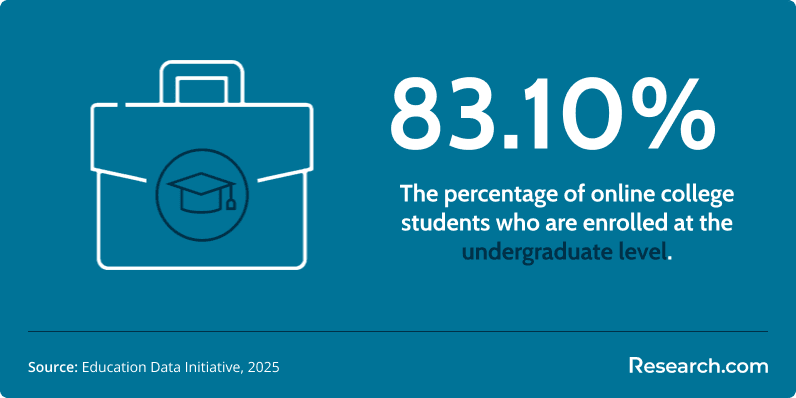
Online undergraduate study is a major part of the distance education market, with 83.1% of all online college students enrolled at the undergraduate level. Students who want the quickest path should compare transfer policies, credit for prior learning, and term structure. Some fields also offer accelerated pathways, such as the fastest online public administration degree programs, for learners who need a shorter route to completion.
Online Open-Admission Colleges vs. Traditional On-Campus Programs
An accredited online degree can carry the same academic legitimacy as a campus-based degree when the institution and program meet recognized standards. The major differences usually involve schedule, learning environment, interaction style, and access to physical campus resources rather than the basic value of the credential.
This is also true in many graduate and professional fields. For example, online MBA operations management programs may use rigorous coursework comparable to campus programs while giving students more control over when and where they study.
| Factor | Online Open-Admission College | Traditional On-Campus Program |
| Best for | Working adults, parents, military learners, rural students, and transfer students who need flexibility | Students who want face-to-face classes, campus life, and structured weekly schedules |
| Schedule | Often asynchronous or offered in shorter terms, though deadlines still apply | Usually tied to fixed class meeting times and semester calendars |
| Student experience | More independent; requires self-management and comfort with online platforms | More in-person interaction with faculty, peers, clubs, labs, and campus services |
| Technology needs | Reliable internet, updated computer, learning management system access, and basic digital skills | Less dependent on home technology, though most courses still use online systems |
| Flexibility | Usually stronger for students with jobs or caregiving responsibilities | Usually less flexible but may offer a more immersive environment |
When an Online Program Makes More Sense
Online programs are often the better option when a student cannot commute regularly, needs to study outside standard business hours, or wants to use transfer credits to finish faster. Dedicated online colleges report high enrollment rates (70.3%) and student satisfaction (87%), which suggests that purpose-built online systems can work well for students who choose them intentionally.
When a Campus Program May Be Better
A campus program may be a stronger fit for students who want in-person labs, residence life, direct access to facilities, athletic programs, or frequent face-to-face faculty interaction. Some learners also benefit from the structure of attending class at fixed times each week.
Remote learning also depends on technology access. Internet connectivity issues reported by 45% of students in some settings show why students should check their equipment, broadband reliability, and backup plans before committing to a fully online format. For career changers researching flexible training, such as those exploring how to become a nurse later in life, online coursework can be helpful, but clinical, licensure, and in-person requirements still need careful review.
Average Cost of an Affordable Online College with Open Admissions
The average total tuition for an online bachelor's degree is around $40,536. That number is useful for broad comparison, but it should not be the only figure you use. Your real cost depends on financial aid, transfer credits, residency status, fees, books, technology, and how long you remain enrolled.
Affordability is a major concern for 77% of online students, so it is important to separate sticker price from net price. The net price is the estimated amount you pay after grants and scholarships are applied. Before enrolling, use each college's official net price calculator and request a written breakdown of tuition, mandatory fees, technology costs, proctoring charges, graduation fees, and payment plan terms.
Cost Questions to Ask Before Applying
- What is the total program cost if I bring in no transfer credits? This shows the maximum likely tuition exposure.
- How many of my previous credits will apply to my degree? Accepted credits can reduce both cost and time.
- Are online students charged extra technology, platform, or proctoring fees? These costs can change the real price.
- Will tuition differ if I live out of state? Some public institutions charge different rates for in-state and out-of-state students.
- What happens to my financial aid if I study part time? Enrollment intensity can affect aid eligibility and disbursement.
Financial Aid Options for Online Students at Open-Admission Colleges
Students in accredited online programs may qualify for many of the same aid options as campus students. The most important step is completing the federal aid application and confirming that both the institution and program are eligible for the aid you plan to use. Military-affiliated students should also ask about veteran benefits and school-specific support; related options are often discussed in guides such as online MBA programs for veterans.
| Aid Type | How It Helps | What to Check |
| FAFSA | The Free Application for Federal Student Aid determines eligibility for federal aid and many school-based awards. | Submit it early and verify the school participates in federal aid programs. |
| Pell Grants | Federal grant aid for eligible students with financial need that does not have to be repaid. | Eligibility can depend on financial need, enrollment status, and lifetime limits. |
| Federal Student Loans | Government-backed loans that may offer borrower protections and repayment options. | Borrow only what you need and review repayment obligations before accepting loans. |
| Institutional Scholarships | School-funded awards based on need, merit, background, program, or other criteria. | 26% of students find these offers attractive, but deadlines and renewal rules vary. |
| Work-Study Programs | Part-time work opportunities that help students earn money for education expenses. | Online students should ask whether remote or local placements are available. |
| State Grants | State-funded aid that may lower costs for eligible residents. | Residency, institution type, and program eligibility rules differ by state. |
Financial aid is common among online learners, with 75.4% receiving some type of aid and more than half qualifying for Pell Grants. Students comparing shorter credentials should also weigh cost against career value. For example, the career impact of college certificate programs may be relevant if a certificate can meet a near-term employment goal before committing to a full degree.
Typical Admission Requirements for Online Colleges with Open Admissions
Open admissions does not mean there are no requirements. It usually means the college is less selective and admits students who meet baseline eligibility standards. Applicants should still expect to provide documentation, choose a program, and complete placement, advising, or onboarding steps before enrolling in classes.
This access-focused model is becoming more visible across higher education. Some graduate programs reduce barriers in different ways, such as online master's in accounting programs with no GMAT requirement, but admissions standards still vary by level and field.
- High school diploma or equivalent: Most undergraduate programs require proof that the applicant completed secondary education.
- Completed application: Students usually submit personal information, academic history, intended major, and residency details through an online form.
- Application fee: Some schools charge a nonrefundable processing fee, while others waive it during certain periods.
- Official transcripts: Colleges typically need records from high school and any previously attended colleges to verify credits and placement.
- Proof of English proficiency: Non-native English speakers may need TOEFL, IELTS, or similar documentation depending on school policy.
Applicants pursuing regulated fields should be especially careful. Admission to an online program does not automatically guarantee eligibility for licensure, certification, clinical placement, or state approval. Similar caution applies when evaluating graduate options such as online SLP master's programs with no GRE requirement, where state and professional requirements can be highly specific.
Common Courses in Online Open-Admission Degree Programs
Most online bachelor's programs include general education, major requirements, electives, and a final applied experience. Students may attend different types of institutions to complete these courses; 58% attend private for-profit, 28% public, and 21% private nonprofit colleges.
| Course Category | Purpose | Examples |
| General Education Courses | Build broad academic skills that support writing, reasoning, communication, and quantitative literacy. | English composition, college math, science, humanities, social science |
| Major Core Courses | Cover the required foundation of the chosen field. | Introduction to Business, Fundamentals of Information Technology, Principles of Psychology |
| Major Electives | Let students focus on a narrower interest within the major. | Digital marketing, cybersecurity, health informatics, corrections administration |
| Free Electives | Allow students to explore additional subjects or apply transfer credits. | Communication, leadership, statistics, foreign language, professional writing |
| Capstone Project or Internship | Connect coursework to applied problem-solving, workplace skills, or professional experience. | Final research project, portfolio, supervised internship, business plan |
Students should review whether courses transfer easily and whether the curriculum supports future education. For example, business and accounting students may compare double major options for accounting students if they want broader preparation for finance, analytics, or management roles.
Popular Specializations at Online Colleges with Open Admissions
Specializations, sometimes called concentrations, help students connect a broad degree to a specific career direction. They can be useful when employers want focused skills, but they should be chosen carefully. A concentration is most valuable when it aligns with job postings, certification goals, graduate school plans, or current work experience.
A general business degree, for instance, may later support graduate study in human resources, including options such as the fastest online master's degree in human resources management programs.
- Business Administration: Common tracks include marketing, finance, project management, entrepreneurship, and management.
- Information Technology: Students may focus on cybersecurity, network administration, software development, or systems support.
- Healthcare Administration: Possible concentrations include health informatics, long-term care management, public health, and healthcare operations.
- Psychology: Options may include child development, counseling-related studies, human services, or industrial-organizational psychology.
- Criminal Justice: Students may specialize in law enforcement, corrections, homeland security, or emergency management.
How to Choose the Best Affordable Online College with Open Admissions
The right school is the one that is accredited, affordable after aid, realistic for your schedule, and aligned with your career or transfer plan. Use the steps below before submitting an application or accepting financial aid.
- Verify institutional accreditation. Confirm the school is accredited by a recognized accreditor and that the accreditation status is current.
- Check program-level requirements. Some fields require specialized accreditation, licensure approval, clinical hours, internships, or state-specific authorization.
- Calculate net price, not just tuition. Compare total cost after grants and scholarships, plus fees, books, technology, and lost transfer credits.
- Ask for a transfer credit evaluation. Do this before enrolling if you have prior college, military, workplace, or certificate-based learning.
- Review course format. Determine whether classes are asynchronous, live online, hybrid, self-paced, or term-based.
- Evaluate academic support. Look for advising, tutoring, writing help, library access, disability services, and career services for online students.
- Compare outcomes carefully. Graduation rates, retention, debt, employment support, and alumni feedback can help you judge whether the program serves students well.
Common Mistakes to Avoid
| Mistake | Why It Can Hurt You | Better Approach |
| Choosing only the lowest tuition | A cheap program can become expensive if credits do not transfer, fees are high, or support is weak. | Compare total net cost and completion likelihood. |
| Ignoring accreditation | Unrecognized accreditation can limit transfer, employment, financial aid, or graduate school options. | Verify accreditation before applying. |
| Assuming open admissions means easy completion | Online classes still require deadlines, writing, exams, projects, and self-discipline. | Estimate weekly study hours and start with a manageable course load. |
| Overlooking licensure rules | Some online programs may not meet requirements in every state. | Contact the relevant licensing board before enrolling in regulated fields. |
| Accepting all available loans | Borrowing more than needed increases long-term repayment pressure. | Use grants, scholarships, employer aid, and payment plans first when possible. |
| Relying only on rankings | A ranked school may still be a poor fit for your goals, schedule, or location. | Use rankings as a starting point, then verify fit with your own criteria. |
Career Paths for Graduates of Online Colleges with Open Admissions
An accredited online degree can support entry into many professional roles, but career outcomes depend heavily on the major, work experience, internships, location, employer expectations, and the student's ability to demonstrate skills. The positions below are examples of roles graduates may pursue in business, technology, human resources, administration, and operations.
| Career Path | Typical Work | Median Salary |
| Project Coordinator | Supports project planning, tracks deadlines, organizes documentation, and communicates with team members. | $65,000 per year |
| Marketing Assistant | Helps with campaigns, research, content creation, reporting, and day-to-day marketing operations. | $58,000 per year |
| Help Desk Analyst | Provides technical support, troubleshoots hardware and software issues, and helps users resolve IT problems. | $60,000 per year |
| Human Resources Assistant | Supports recruiting, onboarding, payroll administration, benefits paperwork, and employee records. | $55,000 per year |
| Administrative Services Manager | Oversees office operations, facilities, records, support staff, and organizational processes. | $70,000 per year |
Students who want a faster route into a specific occupation may also consider shorter applied credentials. For example, a fast-track online medical assistant associate degree may offer a more direct healthcare entry pathway than a broad bachelor's program, depending on the student's goal.
Job Market Outlook for Graduates
The job market for graduates with a bachelor's degree from online colleges with open admission is described as strong, with a projected employment growth rate of 5.6%. However, students should not treat any single percentage as a guarantee. Labor demand varies by major, region, industry, experience level, and economic conditions.
The strongest strategy is to pair an affordable degree with marketable skills, internships or projects, career services, and evidence of applied learning. Students interested in digital communications, for example, may compare options such as the fastest online social media degree programs if they want coursework tied to content strategy, analytics, and platform-based marketing roles.
Current Trends Affecting Online Open-Admission Colleges
- More students are prioritizing cost transparency. With online bachelor's tuition averaging around $40,536, students increasingly need net price estimates before committing.
- Transfer credit is becoming a major affordability tool. Adult learners often save time and money when schools accept prior college, military, workplace, or assessed learning.
- Online quality expectations are higher. Students now expect reliable learning platforms, accessible faculty, advising, tutoring, and career support rather than simple recorded lectures.
- Employer focus is shifting toward demonstrable skills. A degree still matters, but portfolios, certifications, projects, internships, and software skills can strengthen a graduate's profile.
- Technology access remains a real barrier. Connectivity problems, device quality, and digital readiness can affect student success in fully online programs.
What Graduates Say About Online Colleges with Open Admissions
- Josh: "I was worried about paying too much for a degree that would not change my career options. The deciding factor was finding a program that was affordable and regionally accredited. Pell Grants covered a large part of my tuition, and the degree helped me move into a professional role with benefits and much stronger pay than I had before."
- Kristina: "I saw the degree as a long-term career move. I needed a bachelor's credential to be considered for management roles, and the online format let me keep working while I finished it. The payoff was not only a new job opportunity, but also more stability for my family."
- Kevin: "I already had experience, but I could not move past a certain level without finishing my bachelor's degree. What helped most was that I could use class projects at work almost immediately. My manager noticed the difference before graduation, and that helped lead to a promotion."
Can Additional Certifications Improve Career Growth?
Yes, targeted certifications can strengthen an online degree when they match a specific job function, software platform, compliance requirement, or technical skill. They are especially useful in fields such as IT, project management, human resources, healthcare administration, business analytics, marketing, and public safety.
A certification should not be chosen at random. Review job postings in your target field and identify the credentials employers mention repeatedly. If you already hold a bachelor's degree and want a shorter credential instead of another full degree, compare options such as the most affordable online graduate certificate programs.
Questions to Ask an Admissions Advisor Before You Enroll
- Is the institution currently accredited, and is my specific program covered by that accreditation?
- Does this program qualify for federal financial aid?
- How many of my transfer credits will apply directly to the degree, not just as electives?
- What is my estimated total cost after grants, scholarships, fees, and required materials?
- Are courses asynchronous, live online, self-paced, or offered in fixed terms?
- What happens if I need to pause enrollment for work, health, military, or family reasons?
- Does the program meet licensure, certification, or graduate school requirements in my state?
- What career services are available specifically to online students?
- What technology will I need, and are there proctored exams?
- What support is available if I struggle academically?
Key Insights
- Affordable online colleges with open admissions can expand access, but students still need to verify accreditation, aid eligibility, transfer policies, and program fit.
- The lowest sticker price is not always the best value. Net price, accepted credits, fees, and time to completion determine the real cost.
- A typical bachelor's degree requires about 120 credits and often takes around four years, but transfer credits and accelerated terms may shorten the path.
- Online and campus degrees can be academically comparable when properly accredited, but the learning experience is different. Online study requires reliable technology and strong self-management.
- Financial aid can make a major difference: 75.4% of online students receive some type of aid, and more than half qualify for Pell Grants.
- Open admissions reduces entry barriers, but it does not remove academic expectations. Students should choose a manageable course load and use advising, tutoring, and career services early.
- Career outcomes depend on the major, experience, location, and skills. Pairing a degree with internships, projects, certifications, or prior work experience can improve employability.
References:
References
- Association for Institutional Research. (2023, March 30). Online colleges and universities: Are they delivering on diversity and inclusion? A recent analysis from IPEDS data. Retrieved from AIR.
- Bureau of Labor Statistics. (2024, July 26). Median weekly earnings of full-time workers with only a bachelor’s degree $1,541 in Q2 2024. The Economics Daily. Retrieved from BLS.
- Bureau of Labor Statistics. (n.d.). Education pays. Employment Projections. Retrieved from BLS. Average cost of online college.
- National Center for Education Statistics. (n.d.). Fast facts: Tuition costs of colleges and universities. Retrieved from NCES.
- ZipRecruiter. (2024). College graduate salary. Retrieved from ZipRecruiter.
Other Things You Should Know About Online Colleges with Open Admissions
Many open-admission online colleges do not require SAT or ACT scores, but some use placement tests in math, English, or reading before registration. Schools may accept ACCUPLACER, ALEKS, or an internal assessment, and students can often use prior coursework or transfer credits to bypass testing.
In 2027, affordable online colleges with open admissions include institutions like Western Governors University, Southern New Hampshire University, and American Public University. These schools offer open admissions and competitive tuition rates, making higher education more accessible to prospective students.
Yes, many affordable online colleges with open admissions offer part-time study options. This flexibility allows students to balance their education with work or personal commitments, often requiring fewer credit hours per term to maintain enrollment.


