2027 Best 6-Month LPN to RN Programs Online

Co-Founder and Chief Data Scientist
Navigating the transition from Licensed Practical Nurse (LPN) to Registered Nurse (RN) can be challenging, especially for those seeking accelerated paths. This article addresses the need for swift, high-quality educational programs by highlighting the best 6-month or accelerated bridge online LPN to RN programs.
These programs offer a flexible and efficient solution for nurses eager to advance their careers without compromising their current professional and personal commitments.
What are the benefits of getting a 6-month online LPN to RN degree?
- Generally, an online LPN to RN degree opens up various job opportunities in the nursing field. Graduates can pursue RN positions in hospitals, clinics, and other healthcare settings.
- Registered Nurses in the United States can expect a median annual salary of $87,710.
- Obtaining a six-month or accelerated bridge program like an LPN to RN degree online offers flexibility. It enables working nurses to balance their education with job and personal commitments while advancing their careers in nursing.
What can I expect from a 6-month online LPN to RN program?
Although finding a program that transitions from LPN to RN in exactly six months is rare, there are accelerated bridge programs that can be completed in as little as two semesters. These programs offer a condensed curriculum, enhancing the LPN's knowledge and skills to quickly meet coursework and clinical requirements.
The theoretical components of LPN to RN bridge programs can often be completed online. Still, an in-person clinical component is always required. Students must complete hands-on clinical training at approved healthcare facilities, which can only be done partially online.
Meanwhile, the curriculum builds upon the LPN's existing knowledge and skills to meet the educational and clinical requirements for becoming an RN. Courses cover topics such as nursing theory, pharmacology, pathophysiology, and advanced patient care.
Once you are ready for the next big ticket, you can pursue a 6-month RN to BSN program online.
Where can I work with a 6-month online LPN to RN program?
Generally, graduates of accelerated online LPN to RN programs can find employment in various healthcare settings. Registered Nurses are qualified to work in hospitals, nursing homes, assisted living facilities, doctor's offices, clinics, schools, home health agencies, and other healthcare organizations.
RNs are in high demand across the healthcare industry. They are critical in providing direct patient care, administering medications, monitoring vital signs, and coordinating with other medical professionals. The flexibility and versatility of the RN role allow online LPN to RN program graduates to pursue opportunities in fast-paced hospital environments, more relaxed outpatient settings, or specialized areas like pediatrics, geriatrics, or critical care. With their expanded scope of practice and advanced nursing skills, these professionals can significantly impact patient outcomes in various healthcare settings.
How much can I make with a 6-month online LPN to RN program?
Graduates of six-month online LPN to RN bridge programs can expect a significant salary increase after becoming registered nurses. These programs provide practical nurses with the necessary skills and qualifications to advance their careers quickly and effectively. As RNs, they can access higher-paying positions and more opportunities for professional growth.
Licensed practical Nurses in the United States have an average annual salary of $53,700. Once they become RNs, they can expect a median annual wage of $87,710. Note that RN salaries also vary by state. Below are the top-paying states for Registered Nurses:
- California: $137,690
- Hawaii: $119,710
- Oregon: $113,440
- Washington: $111,030
- Alaska: $109,210
- 2027 List of the Best 6-Month LPN to RN Programs Online Best Programs
- How long does it take to complete an online LPN to RN program? How long does it take to complete an online LPN to RN program?
- How does a 6-month online LPN to RN program compare to an on-campus program? Online vs. On-Campus
- What is the average cost of a 6-month online LPN to RN program? Cost
- What are the financial aid options for students enrolling in a 6-month online LPN to RN program? Financial Aid
- What are the prerequisites for enrolling in a 6-month online LPN to RN program? Requirements
- What courses are typically in a 6-month online LPN to RN program? Courses
- What types of specializations are available in 6-month online LPN to RN programs? Specializations
- How to Choose the Best 6-Month Online LPN to RN Program How to Choose the Best 6-Month Online LPN to RN Program
- Tips for Reducing the Financial Burden of LPN to RN Programs Tips for Reducing the Financial Burden of LPN to RN Programs
- Valuable Nursing Certifications for LPN to RN Graduates Valuable Nursing Certifications for LPN to RN Graduates
- What are the licensing and exam requirements following a 6-month online LPN to RN program? What are the licensing and exam requirements following a 6-month online LPN to RN program?
- What career paths are available for graduates of a 6-month online LPN to RN program? What career paths are available for graduates of a 6-month online LPN to RN program?
- What technology and support services ensure success in 6-month online LPN to RN programs? What technology and support services ensure success in 6-month online LPN to RN programs?
- How do 6-month online LPN to RN programs compare to online accelerated BSN programs near me? How do 6-month online LPN to RN programs compare to online accelerated BSN programs near me?
- What is the job market for graduates with a 6-month online LPN to RN degree? Job Outlook
- Are There Any Alternative Programs for Aspiring Nurses? Are There Any Alternative Programs for Aspiring Nurses?
- What are the most common challenges faced by students in accelerated LPN to RN programs What are the most common challenges faced by students in accelerated LPN to RN programs
- What are the opportunities for further education and career progression after a 6-month online LPN to RN program? What are the opportunities for further education and career progression after a 6-month online LPN to RN program?
- Why is accreditation important when choosing an LPN to RN program? Why is accreditation important when choosing an LPN to RN program?
- How does faculty expertise influence outcomes in a 6-month online LPN to RN program? How does faculty expertise influence outcomes in a 6-month online LPN to RN program?
2027 Guide to the Best Fast Online and Hybrid LPN to RN Programs
Licensed practical nurses who want more clinical responsibility, broader job options, and access to registered nurse roles often search for the fastest possible LPN to RN pathway. The challenge is that “6-month LPN to RN programs online” can be misleading: true six-month options are uncommon, and nursing programs almost always require in-person labs, simulations, exams, or clinical rotations even when coursework is online.
This guide is for working LPNs and LVNs comparing accelerated LPN-to-ADN, LPN-to-AAS, and bridge RN programs. It explains which programs move quickly, what “online” usually means in nursing education, how to compare accreditation and clinical requirements, what costs to expect, and how to avoid choosing a program that will not support RN licensure.
Quick Answer: Can You Complete an LPN to RN Program Online in 6 Months?
Some LPN to RN bridge programs advertise completion timelines as short as 6 months, but most accelerated LPN-to-ADN programs take 9 to 18 months. Programs described as online are usually hybrid because students still need supervised clinical experience, labs, simulations, testing, or campus visits. Before enrolling, verify the program’s nursing accreditation, state board approval, NCLEX-RN eligibility, clinical placement process, total cost, and whether your LPN credits or prerequisites will transfer.
| Decision Point | What LPNs Should Know |
| Fastest realistic timeline | Some options list 6 months, but many programs take 9 months, 12 months, 15 months, 2 semesters, or 3 semesters. |
| Fully online availability | Expect hybrid requirements because RN preparation includes hands-on clinical training. |
| Most common credential | Many bridge programs lead to an ADN, AAS, or Associate Degree in Nursing. |
| Main licensure step | Graduates must meet state requirements and pass the NCLEX-RN exam. |
| Biggest risk | Choosing a program without confirming accreditation, clinical placement, and state board acceptance. |
How Research.com Ranked These Fast LPN to RN Programs
Because nursing school affects licensure, employment options, and long-term earning potential, students need clear information before committing to a bridge program. Research.com reviewed accelerated LPN to RN options using public education data and program-level details where available. Sources used in the ranking process include:
- The Integrated Postsecondary Education Data System (IPEDS) database
- Peterson’s database, including the Distance Learning Licensed Data Set
- College Scorecard database
- National Center for Education Statistics
Our evaluation also considers factors such as graduation rate, student-faculty ratio, program focus, delivery format, and available program information. More details about the Research.com ranking process are available on our methodology page.
Best Fast Online and Hybrid LPN to RN Programs for 2027
The programs below are bridge options for current LPNs or LVNs seeking RN preparation. Not every school on this list is a true six-month program, and not every program is fully online. Use the program length, accreditation status, required credits, and campus or clinical expectations to decide which options are realistic for your schedule and state licensure goals.
| School | Program Length | Required Credits | Cost Information | Accreditation Listed |
| ATA College | 15 months | 90 | $345 per credit | Pursuing pre-accreditation candidacy status from the National League for Nursing Commission for Nursing Education Accreditation (NLN CNEA) |
| Catawba Valley Community College | 9 months | 60-72 | $4,500 | ACEN |
| Coastal Bend College | 8 months | 43 | N/A | Southern Association of Colleges and Schools Commission on Colleges (SACSCOC) |
| Highland Community College | 2 semesters | 22 | $157 (RN tuition) | ACEN |
| Hutchinson Community College | 3 semesters | 69 | $124 (in-state), $155 (out-of-state) | ACEN |
| Mississippi Gulf Coast Community College | 6 months | 66 | N/A | ACEN |
| Missouri State-West Plains | 12 months | 65 | $11,069 (total tuition & fees) | ACEN |
| Pennsylvania College of Technology | 6 months | 69 | $515 (in-state), $773 (out-of-state) | ACEN |
| Sampson Community College | 6-9 months | 23 | N/A | ACEN |
| Cape Fear Community College | 2 semesters | N/A | $8,061.50 (in-state); $14019.50 (out-of-state) | ACEN |
1. ATA College
ATA College offers an LPN to RN Bridge program for licensed practical nurses who want an accelerated route toward registered nursing practice. The curriculum includes NCLEX preparation assessments intended to strengthen nursing judgment, test readiness, and core clinical knowledge.
- Program Length: 15 months
- Tracks/concentrations: N/A
- Cost per Credit: $345
- Required Credits to Graduate: 90
- Accreditation: ATA College is pursuing pre-accreditation candidacy status from the National League for Nursing Commission for Nursing Education Accreditation (NLN CNEA)
2. Catawba Valley Community College
The LPN-RN Bridge program at Catawba Valley Community College is built for LPNs who completed a regionally accredited practical nursing program. The pathway leads to an ADN and combines online learning with scheduled campus and clinical requirements. Students attend classes and labs two days per week and complete 12-hour Saturday clinicals.
- Program Length: 9 months
- Tracks/concentrations: N/A
- Cost per Credit: $4,500
- Required Credits to Graduate: 60-72
- Accreditation: ACEN
3. Coastal Bend College
Coastal Bend College in Texas offers an LVN-to-RN bridge option for students seeking a 6-9 month pathway. The program uses online and in-person lectures, labs, and outside clinical experiences. Students should plan for at least two days per week of in-person lectures and labs, while clinical assignments may vary by location and schedule within the college district.
- Program Length: 8 months
- Tracks/concentrations: N/A
- Cost per Credit: N/A
- Required Credits to Graduate: 43
- Accreditation: Southern Association of Colleges and Schools Commission on Colleges (SACSCOC)
4. Highland Community College
Highland Community College in Atchison, Kansas, provides an LPN to RN Completion Program that results in an Associate Degree in Nursing. This two-semester, in-person pathway is designed for licensed practical nurses ready to move into registered nursing preparation.
- Program Length: 2 semesters
- Tracks/concentrations: N/A
- Cost per Credit: $157 (RN tuition)
- Required Credits to Graduate: 22
- Accreditation: ACEN
5. Hutchinson Community College
Hutchinson Community College offers an LPN to RN Online Bridge program leading to an Associate of Applied Science degree. The program prepares graduates for the NCLEX-RN exam and state licensure as registered nurses. The AD Nursing program is accredited by the Kansas Board of Nursing and the Accreditation Commission for Education in Nursing (ACEN).
- Program Length: 3 semesters
- Tracks/concentrations: N/A
- Cost per Credit: $124 (in-state), $155 (out-of-state)
- Required Credits to Graduate: 69
- Accreditation: ACEN
6. Mississippi Gulf Coast Community College
Mississippi Gulf Coast Community College offers a hybrid LPN-to-RN pathway for licensed practical nurses who want to move into RN-level practice. Hybrid courses require at least 25% face-to-face meeting time, so students should confirm campus attendance expectations before applying.
- Program Length: 6 months
- Tracks/concentrations: N/A
- Cost per Credit: N/A
- Required Credits to Graduate: 66
- Accreditation: ACEN
7. Missouri State-West Plains
Missouri State-West Plains College offers an LPN to RN Bridge program for practical nurses seeking a structured route into registered nursing. The curriculum builds on prior LPN training while expanding students’ clinical reasoning and RN-level nursing responsibilities.
- Program Length: 12 months
- Tracks/concentrations: N/A
- Cost per Credit: $11,069 (total tuition & fees)
- Required Credits to Graduate: 65
- Accreditation: ACEN
8. Pennsylvania College of Technology
Pennsylvania College of Technology provides an LPN to RN pathway that awards an Associate of Applied Science degree. The program is designed to help LPNs meet registered nursing education requirements and prepare for the NCLEX-RN exam through coursework across nursing specialty areas.
- Program Length: 6 months
- Tracks/concentrations: N/A
- Cost per Credit: $515 (in-state), $773 (out-of-state)
- Required Credits to Graduate: 69
- Accreditation: ACEN
9. Sampson Community College
Sampson Community College offers an online LPN-to-ADN pathway for practical nurses who want a shorter route to RN eligibility. Coursework is delivered mainly online, with campus visits for orientation and testing. Students must also complete clinical requirements, and graduates are prepared to sit for the NCLEX-RN exam.
- Program Length: 6-9 months
- Tracks/concentrations: N/A
- Cost per Credit: N/A
- Required Credits to Graduate: 23
- Accreditation: ACEN
10. Cape Fear Community College
Cape Fear Community College offers a hybrid LPN-to-RN pathway for licensed practical nurses seeking RN preparation. The program focuses on nursing care for clients and groups across the lifespan and across healthcare settings.
- Program Length: 2 semesters
- Tracks/concentrations: N/A
- Cost per Credit: $8,061.50 (in-state); $14019.50 (out-of-state)
- Required Credits to Graduate: N/A
- Accreditation: ACEN
What Students Often Value in Fast LPN to RN Programs
- : "The biggest benefit was being able to keep working while completing RN coursework. The schedule was demanding, but the online materials and instructor support made the transition manageable. — Sienna"
- : "I needed a bridge program that respected my LPN experience without removing the hands-on practice required for RN preparation. The mix of online learning, labs, and clinical work helped me build confidence. — James"
- : "The pace was intense, so organization mattered. Having access to course materials at any time helped me stay on track while balancing family, work, and clinical requirements. — Emilia"
Key Findings
- “6-month online LPN to RN” is a narrow category. Some schools list 6-month or 6-9 month timelines, but many fast bridge programs take longer.
- Most online LPN to RN programs are hybrid because RN education requires clinical practice, skills validation, and sometimes campus-based labs or exams.
- Accreditation and state board approval should come before speed, cost, or convenience in your decision.
- Costs vary widely, and students should compare total program price, fees, travel, clinical expenses, and lost work hours rather than tuition alone.
- The RN labor market remains favorable based on available BLS projections, but salary outcomes depend on location, employer, experience, specialty, and schedule.
How Long Does an Online LPN to RN Program Take?
The completion time depends on the credential, course load, transfer credits, prerequisites, and clinical requirements. A six-month option exists at some schools but is rare. LPN-to-ADN programs commonly take 12 to 18 months, while LPN-to-BSN programs generally require about two years. Students comparing speed-focused pathways may also want to review fastest accelerated associate degree programs.
- Full-time vs. part-time enrollment: Full-time students may finish sooner, but the workload can be difficult for LPNs working long shifts.
- Prerequisite completion: Anatomy, physiology, pharmacology, and other requirements can add time if they are not finished before admission.
- Clinical scheduling: Clinical placements may occur on weekends, evenings, or specific weekdays depending on the program and facility availability.
- Transfer credits: Programs that award credit for prior LPN coursework may shorten the academic path.
If speed is your main priority, compare nursing pathways with other short career-focused programs, including 1 year degrees that pay well. If you are still deciding whether practical nursing or an associate nursing pathway is the better starting point, compare LPN certificates vs. nursing associate degrees online.
Online vs. On-Campus LPN to RN Programs: Which Format Fits You?
A fast online LPN to RN bridge program can be convenient for working nurses, but “online” does not remove the need for clinical training. Some LPNs enter nursing through other bridge routes, including an MA to LPN bridge program online, but the RN step typically involves more advanced clinical requirements.
| Format | Best For | Advantages | Trade-Offs |
| Mostly online or hybrid LPN to RN | Working LPNs who need flexibility and can manage independent study | More control over lecture time, reduced commuting for didactic coursework, easier fit around work shifts | May require students to coordinate clinical sites, travel for labs or exams, and stay highly self-directed |
| Campus-based LPN to RN | Students who prefer structured schedules and in-person support | More direct access to faculty, labs, classmates, and established local clinical arrangements | Less schedule flexibility and more commuting or relocation pressure |
| LPN to BSN | LPNs who want a bachelor’s credential and broader long-term academic options | Can support future leadership, graduate study, or specialty pathways | Usually longer than ADN or AAS bridge programs |
Choose based on clinical access, learning style, work schedule, and licensure needs—not just whether a program advertises online delivery. If you are comparing accelerated options outside nursing, Research.com also reviews fast track MBA 6 months online programs for business-focused students.
How Much Does a 6-Month Online LPN to RN Program Cost?
Costs vary by institution, residency status, credits required, fees, clinical supplies, and travel. Based on the research used for this guide, six-month online LPN-to-RN programs often cost between $10,000 and $20,000. A shorter program may reduce time away from work, but accelerated tuition and fees can still be substantial.
- Application fees
- Lab and technology fees
- Graduation fees
- Study materials
- Clinical essentials
Students should compare the full cost of attendance, not only tuition. Online students may save on campus housing or commuting but may pay for internet, technology, remote testing, travel to clinical sites, or short campus residencies.
| In-Person Instruction | Online Instruction |
| Housing – $1,513 per month | Rental – $1,504 per month |
| Campus Meal Plan – $562 per month | Food/Groceries – $345 per month |
| Campus Computer Lab – Free | Internet – $50 per month |
| Parking Permit – $269 per semester | Electricity and Heat – $175 per month |
| Health Services Plan – $2,000 per year | Online Learning Fee – $25-$100 per month |
| Transportation Costs – $1,425 per year | Books – $1,295 per year |
| Books and supplies – $1,295 per year | |
| Room Furniture – $970 | |
| Used car – $7,000-$11,000 |
Financial Aid Options for LPN to RN Students
Financial aid can make an accelerated bridge program more manageable, but students should confirm that the school and program qualify for the aid they plan to use. Common options include:
- FAFSA: Completing the FAFSA is the starting point for federal grants, federal loans, and work-study eligibility.
- Scholarships and grants: Nursing students may qualify for school-based, private, employer-sponsored, or community scholarships. Some awards focus on adult learners, first-generation students, or students from underrepresented groups.
- Federal and state programs: Some government programs support nurses who work in high-need communities or shortage areas.
- Institutional aid packages: Schools may combine grants, loans, and work-study options. Ask the nursing department and financial aid office whether bridge students are eligible.
- Private loans: Private loans can cover remaining costs after other aid, but students should compare interest rates, repayment terms, and borrower protections carefully.
Common Admission Requirements for 6-Month and Accelerated LPN to RN Programs
Admission requirements differ by state and school, but accelerated bridge programs generally expect applicants to already be licensed practical nurses. If you are not yet an LPN, start with a guide on how to become an LPN before comparing RN bridge programs.
- Active LPN license: Applicants usually need a current practical nursing license in good standing.
- Prerequisite coursework: Anatomy, physiology, pharmacology, and related science courses are common prerequisites.
- Minimum GPA: Many schools require a minimum GPA, often around 2.5 or 3.0.
- Entrance exam: Some programs require an exam such as the HESI A2, which assesses areas such as math, science, and reading comprehension.
- Recommendations: Programs may request academic or professional references.
- Recent clinical experience: Some schools may require around 1,000 hours of clinical experience as an LPN within the last three years.
Students who want less selective or more flexible online options outside RN bridge education can compare easiest degrees to get online, but nursing programs should never be chosen only because they appear easy to enter.
Courses Commonly Found in Accelerated LPN to RN Programs
Bridge curricula build on practical nursing experience and shift students toward RN-level assessment, care planning, delegation, patient education, and clinical judgment. Common courses include:
- Advanced Nursing Concepts and Theories: Expands students’ understanding of patient care, pharmacology, pathophysiology, and RN responsibilities.
- Pathophysiology: Examines how disease processes affect body systems and patient presentation.
- Advanced Pharmacology: Covers medication administration, dosage considerations, therapeutic effects, adverse reactions, and safety practices.
- Community and Public Health Nursing: Introduces population health, prevention, health promotion, education, and nursing roles outside acute care settings.
Do 6-Month LPN to RN Programs Offer Specializations?
Most six-month or accelerated LPN to RN programs do not offer formal specializations. Their purpose is to prepare students for general RN practice and NCLEX-RN eligibility. Specialization usually comes later through work experience, certifications, a BSN completion pathway, graduate education, or advanced practice preparation.
To become licensed as an RN, graduates typically follow these steps:
- Complete an accredited nursing education program: Finish a nursing diploma, Associate Degree in Nursing, or Bachelor’s Degree in Nursing from an accepted RN program.
- Prepare for the NCLEX-RN exam: Study for the National Council Licensure Examination for Registered Nurses.
- Pass the NCLEX-RN exam: Demonstrate the knowledge and clinical judgment required for entry-level RN practice.
- Apply for state licensure: Submit required documentation to the state where you plan to practice, since state requirements vary.
- Consider advanced training: After licensure, RNs may pursue credentials in areas such as public health, occupational health, or advanced practice. Students planning a future APRN route can compare the shortest online nurse practitioner program options.
How to Choose the Best Online or Hybrid LPN to RN Program
The best program is not automatically the shortest or cheapest. A strong LPN to RN program should lead to licensure eligibility, provide reliable clinical training, support NCLEX preparation, and fit your work and family schedule.
| Factor | What to Ask Before Enrolling | Why It Matters |
| Accreditation | Is the nursing program accredited by ACEN, CNEA, or another recognized nursing accreditor? Is the institution accredited? | Accreditation can affect licensure, transfer credits, employer acceptance, and financial aid eligibility. |
| State board approval | Does the program meet RN licensure requirements in the state where I plan to practice? | A program may be legitimate but still not meet every state’s requirements. |
| Clinical placement | Does the school arrange clinical placements, or must students find their own sites and preceptors? | Clinical placement problems can delay graduation. |
| NCLEX preparation | What review tools, practice assessments, and remediation support are included? | Passing the NCLEX-RN is required for RN licensure. |
| Schedule | How many days per week are required for labs, exams, clinicals, or campus visits? | Working LPNs need a schedule they can realistically sustain. |
| Total cost | What is the full cost after tuition, fees, books, supplies, background checks, testing, and travel? | Low tuition does not always mean low total cost. |
Accreditation is especially important in nursing. Research.com applies similar quality-focused evaluation principles across degree areas, including resources such as accredited library science programs, but nursing students must also check state board approval and clinical eligibility. LPNs are not the only healthcare professionals who use bridge pathways; paramedics can review paramedic to nurse bridge program options.
Ways to Reduce the Cost of an LPN to RN Program
Accelerated nursing programs can be financially stressful because students often balance tuition, clinical expenses, and reduced work availability. These strategies can help lower out-of-pocket costs:
- Apply for nursing scholarships and grants: Look for awards through the school, local hospitals, state nursing associations, community foundations, and healthcare employers.
- Ask about employer tuition assistance: Some healthcare employers reimburse tuition or sponsor LPNs who agree to continue working for the organization after graduation.
- Compare lower-cost accredited options: Community colleges and public institutions may offer more affordable bridge routes. Reviewing LPN training cost can also help students understand how nursing education costs differ by credential.
- Complete the FAFSA early: Federal and state aid may be limited by deadlines, enrollment status, and program eligibility.
- Use part-time or flexible scheduling carefully: Keeping income can reduce borrowing, but extending the program may increase total costs or delay RN earnings.
Useful Certifications After Earning RN Licensure
After completing an LPN to RN program and obtaining RN licensure, certifications can help nurses qualify for specific clinical units or demonstrate readiness for specialized care environments. Common options include:
- Basic Life Support (BLS): A widely required credential covering essential life-saving skills.
- Advanced Cardiac Life Support (ACLS): Often recommended for RNs in emergency, intensive care, telemetry, or critical care settings.
- Pediatric Advanced Life Support (PALS): Useful for nurses who work with infants, children, or pediatric emergencies.
- Critical Care Registered Nurse (CCRN): A credential for RNs pursuing critical care practice.
Certification requirements vary by employer and unit. For a broader comparison of credential options, review this guide to nursing certifications.
Licensing and NCLEX-RN Requirements After an LPN to RN Program
Graduating from an accelerated LPN to RN program does not automatically make someone an RN. Graduates must apply through the appropriate state board of nursing, submit required documents, and pass the NCLEX-RN exam. State requirements may include official transcripts, background checks, proof of clinical hours, fees, and other documentation.
Students planning long-term academic advancement after RN licensure may also compare graduate options, including guides that explain what is the easiest masters degree to get. However, nursing graduate programs still have clinical, accreditation, and licensure considerations that should be reviewed separately.
Career Paths After Completing an LPN to RN Program
An LPN to RN bridge program is primarily designed to prepare graduates for RN licensure and entry-level registered nursing roles. Over time, additional education and experience can lead to broader clinical, teaching, management, or advanced practice opportunities.
- Registered Nurse: RNs work in hospitals, clinics, nursing homes, community health settings, and other care environments. Duties may include assessment, care planning, medication administration, patient education, and care coordination.
- Nurse Practitioner: RNs who later complete advanced graduate education may pursue nurse practitioner roles in areas such as pediatrics, gerontology, or family medicine.
- Nurse Educator: Experienced nurses may move into teaching, training, mentoring, or academic roles.
- Nurse Manager: RNs with leadership ability and clinical experience may supervise staff, coordinate patient care, and manage department operations.
Technology and Student Support in Online LPN to RN Programs
Online and hybrid bridge programs require more than recorded lectures. Students should look for a learning platform that supports simulations, secure testing, instructor communication, digital library access, online tutoring, and technical help. Strong support is especially important in accelerated programs because missed assignments, clinical documentation problems, or technology failures can quickly affect progress.
Students who plan to continue into graduate nursing should also compare support models in advanced online programs, including online FNP programs.
LPN to RN Bridge Programs vs. Online Accelerated BSN Programs
LPN to RN bridge programs and accelerated BSN programs serve different students. Bridge programs are designed for licensed practical nurses who already have nursing training and patient care experience. Accelerated BSN programs are usually intended for students who need a broader bachelor’s-level nursing curriculum and may not have the same prior nursing background.
| Program Type | Designed For | Typical Goal | Important Consideration |
| LPN to RN bridge | Current LPNs or LVNs | Move from practical nursing to RN eligibility, often through ADN or AAS preparation | Fast but usually focused on general RN preparation rather than bachelor’s-level coursework |
| Accelerated BSN | Students seeking a bachelor’s-level nursing pathway | Earn a BSN and prepare for RN licensure | May offer broader academic preparation but can take longer or require different prerequisites |
If you are deciding between these routes, compare curriculum length, clinical placement, state approval, and long-term goals. Students seeking bachelor’s-level options can explore online accelerated BSN programs near me.
Job Market and Salary Outlook for LPN to RN Graduates
Moving from LPN to RN can expand career options and may increase earning potential, though actual pay depends on location, employer, shift differentials, experience, specialty, and union or facility policies. Licensed Practical Nurses in the United States have an average annual salary ranging between $48,800 and $59,700. Registered Nurses in the U.S. receive an average annual salary ranging between $62,950 and $112,910.
According to the Bureau of Labor Statistics (BLS), employment of RNs is projected to grow 6% from 2022 to 2032, which is faster than the average for all occupations.
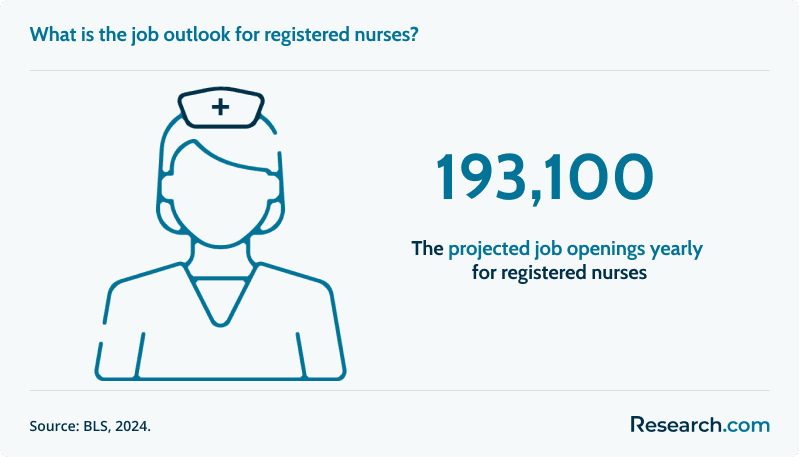
On average, about 193,100 openings for RNs are projected each year over the decade. Many openings are expected to come from the need to replace workers who transfer to other occupations or leave the labor force, including retirees.
The chart below shows the percent change in employment of RNs from 2022 to 2032.
Students comparing healthcare with other future-focused fields can also review top degrees in demand for the future.
Alternatives If a 6-Month LPN to RN Program Is Not the Right Fit
A fast bridge program is not always the best choice. If you are not yet an LPN, need a slower schedule, or want a different entry point into nursing, consider starting with a practical nursing program such as a 6 month LPN program online. Students who already hold RN licensure and want a bachelor’s credential may instead compare RN-to-BSN options.
| Alternative Path | Who It May Fit | What to Watch |
| LPN program | Students beginning their nursing career | Does not lead directly to RN licensure; additional education is needed later. |
| Traditional ADN | Students who need a more paced route to RN eligibility | May take longer than a bridge program. |
| LPN to BSN | LPNs who want a bachelor’s degree rather than an associate pathway | Usually requires more time and coursework. |
| Accelerated BSN | Students seeking a BSN route to RN licensure | Prerequisites and clinical schedules can be intensive. |
Common Challenges in Accelerated LPN to RN Programs
Fast bridge programs can work well for disciplined students, but the compressed schedule leaves little room for falling behind. Common challenges include:
- Time management pressure: Condensed coursework and clinical hours require a realistic weekly plan. Use a calendar, block study time, and avoid overloading work shifts during exam-heavy weeks.
- Work-school balance: Many LPNs continue working while enrolled. Consider reducing hours, requesting predictable shifts, or discussing tuition support with your employer.
- Online learning adjustment: Students new to online education should learn the platform before classes begin and use technical support early.
- Clinical placement delays: Ask the school whether it arranges sites or expects students to secure them. Start documentation, immunizations, background checks, and onboarding early.
- Fast academic pace: Review material before lectures, use tutoring when available, and form study groups with classmates who are equally committed.
Common Mistakes to Avoid When Choosing an LPN to RN Program
| Mistake | Why It Can Hurt You | Better Approach |
| Choosing only by the shortest timeline | A fast program is not useful if it does not meet licensure or clinical requirements. | Confirm accreditation, state approval, clinical placement, and NCLEX eligibility first. |
| Assuming online means no campus or clinical visits | Nursing education requires hands-on training and skills validation. | Ask for a complete schedule of labs, exams, simulations, and clinical rotations. |
| Comparing tuition only | Fees, books, supplies, travel, testing, and lost work hours can change affordability. | Request a full cost estimate from each school. |
| Ignoring transfer credit rules | Missing or rejected prerequisites can extend your timeline. | Send transcripts early and get a written transfer evaluation. |
| Assuming salary outcomes are guaranteed | RN pay varies by region, specialty, employer, and experience. | Research local RN job postings and employer requirements before enrolling. |
Further Education and Career Growth After an LPN to RN Program
After earning RN licensure, many nurses continue into BSN completion programs, graduate nursing programs, leadership training, or specialty certifications. Some RNs later pursue bridge options such as RN to MSN bridge programs, which can support advanced clinical practice, leadership, education, or research-focused goals.
Continuing education can be valuable, but it should match your career plan. A nurse interested in bedside specialty care may prioritize certifications and unit experience, while a nurse aiming for advanced practice or administration may need a BSN, MSN, or other graduate credential.
Why Accreditation Matters in an LPN to RN Program
Accreditation is one of the most important checks before enrolling. Whether you are comparing bridge options or searching for the easiest LPN program to get into, nursing students should verify that the program meets recognized academic and professional standards.
- Education quality: Accredited programs are reviewed for curriculum, faculty, clinical preparation, and student outcomes.
- Licensure eligibility: State boards may require graduation from an approved or accredited program before allowing graduates to sit for the NCLEX-RN.
- Employment and education mobility: Employers and future degree programs often prefer or require accredited nursing education.
- Financial aid access: Accreditation can affect whether students qualify for federal financial aid.
How Clinical Affiliations Affect Student Outcomes
Clinical partnerships can determine how smoothly students complete hands-on requirements. Programs with established healthcare affiliations may offer more predictable rotations, clearer onboarding processes, and stronger connections to local employers. Programs with limited clinical networks may require students to find their own sites, which can be difficult in competitive or rural areas.
Not all nursing pathways have the same clinical expectations. For example, licensed RNs seeking bachelor’s completion options may compare RN to BSN online without clinicals, but LPN to RN students should expect direct clinical training because they are preparing for initial RN licensure.
How Faculty Expertise Influences Success in an Accelerated LPN to RN Program
Faculty quality matters more in accelerated programs because students must master complex RN-level material quickly. Experienced instructors can connect theory to bedside practice, model clinical judgment, and help students prepare for NCLEX-style reasoning. Strong faculty support also helps students adjust from task-focused LPN responsibilities to the broader assessment, planning, delegation, and coordination duties of RN practice.
Nurses who eventually move into leadership may pursue graduate education and administrative roles. Career-focused students can review information on nurse executive leader MSN salary as part of long-term planning.
Can an LPN to RN Program Lead to Nurse Practitioner Roles?
Yes, but not directly. An LPN to RN program can be an early step toward advanced practice, but nurse practitioner roles require additional education, advanced clinical training, and state-specific licensure or certification requirements. After becoming an RN, students may need a BSN, MSN, or bridge pathway depending on their starting credential and target program. For a broader timeline discussion, see how to become a nurse practitioner fast.
What Is the ROI of a 6-Month Online LPN to RN Program?
The return on investment depends on total program cost, how quickly you graduate, whether you pass the NCLEX-RN, local RN wages, and whether you can keep earning income while enrolled. The potential upside is access to RN roles and the salary range associated with registered nursing. The risk is taking on debt for a program that does not fit your schedule, meet state requirements, or provide reliable clinical support.
If your long-term goal is advanced practice, factor in the cost and time for future degrees as well. Students comparing accelerated career progression can revisit how to become a nurse practitioner fast.
Can an Accelerated LPN to RN Program Support Healthcare Leadership Goals?
An LPN to RN bridge program can help build the clinical foundation needed for leadership, but management and executive roles usually require experience, strong performance as an RN, and often additional education. After RN licensure, nurses may move into charge nurse roles, unit management, quality improvement, education, or graduate-level leadership programs. Students exploring future executive routes can compare career outcomes such as nurse executive leader MSN salary.
References
- Bureau of Labor Statistics, U.S. Department of Labor. (2024). Occupational outlook handbook: Registered nurses. Retrieved June 4, 2024, from https://www.bls.gov/ooh/healthcare/registered-nurses.htm
- Bureau of Labor Statistics. (2024). Occupational employment and wage statistics: Registered nurses. U.S. Department of Labor. Retrieved June 4, 2024, from https://www.bls.gov/oes/current/oes291141.htm
- Hanson, M. (2023, August 23). Cost of online education vs. traditional education. EducationData.org. Retrieved June 4, 2024, from https://educationdata.org/cost-of-online-education-vs-traditional-education
- Salary.com. (2024). Licensed Practical Nurse (LPN) salary in the United States. Retrieved June 4, 2024, from https://www.salary.com/research/salary/alternate/licensed-practical-nurse-lpn-salary
- Salary.com. (2024). Registered nurse (RN) salary in the United States. Retrieved June 4, 2024, from https://www.salary.com/research/salary/general/registered-nurse-rn-salary
Key Insights
- True 6-month LPN to RN programs are uncommon; many accelerated bridge programs take 9 to 18 months or are measured in semesters.
- Online LPN to RN programs are usually hybrid because RN training requires clinical practice and skills evaluation.
- Accreditation, state board approval, and NCLEX-RN eligibility should be verified before considering cost or speed.
- The best program for a working LPN is the one with a realistic schedule, transparent clinical placement process, clear total cost, and strong student support.
- Be cautious with any program that promises an easy or fully online path to RN licensure without clearly explaining labs, clinicals, state requirements, and exam preparation.
Other Things You Should Know About the Best 6-Month LPN to RN Programs Online
The critical eligibility requirements for 6-month LPN to RN online programs in 2027 typically include having a valid LPN license, a minimum amount of clinical experience, a high school diploma or GED, and sometimes completion of prerequisite coursework. Each program may have additional criteria, so it’s important to check specific details and admission requirements before applying.
Most 6-month LPN to RN bridge programs require supervised clinical rotations at approved healthcare sites, even when coursework is online. Programs commonly expect 180 to 400 clinical hours before graduation, and those hours must meet the state board of nursing and CCNE or ACEN standards.
The Accreditation Commission for Education in Nursing (ACEN) and the Commission on Collegiate Nursing Education (CCNE) are key accrediting bodies for 6-month LPN to RN programs online in 2027, ensuring that programs meet rigorous educational standards for nursing education.