
2027 Best Fast-Track RN to BSN Online Programs

Co-Founder and Chief Data Scientist
Registered nurses often choose a fast-track RN to BSN online program when they already have an RN license and want the bachelor’s credential without stepping away from work. The decision is not only about speed. You also need to compare accreditation, transfer credits, clinical or practice requirements, tuition structure, employer support, and whether the program fits your work schedule.
This guide is for licensed RNs comparing online RN to BSN programs, especially accelerated options that can be completed in about one to two years or less. You will learn what these programs include, how long they take, what they cost, which schools appear in this 2027 list, how online and campus formats differ, and how to judge whether the degree is worth the investment for your nursing career.
Quick Answer: Is a Fast-Track RN to BSN Online Program Worth It?
A fast-track RN to BSN online program can be worth it for registered nurses who want broader career options, stronger preparation in leadership and evidence-based practice, and a credential many employers prefer. The U.S. Bureau of Labor Statistics reported a median annual wage of $86,070 for registered nurses in 2023, and the field is projected to grow 6% between 2022 and 2032. The American Association of Colleges of Nursing also reported that 27.7% of employers require new RNs to have a BSN, while 71.7% strongly prefer BSN-prepared nurses.
The degree is most practical if you can transfer a large share of prior nursing credits, choose an accredited program, maintain steady coursework while working, and avoid taking on debt that does not match your career goals.
What are the main benefits of earning a nursing degree?
- More career settings: A nursing degree can support work in areas such as nurse informatics, school nursing, emergency room nursing, community health, and other patient-care or systems-focused roles.
- Lower total attendance costs online: Online nursing programs may help reduce expenses tied to campus fees, transportation, room and board, and relocation.
- Competitive earning potential: Registered nurses had a median annual wage of $86,070 in 2023, according to the BLS.
What can I expect from a fast-track RN to BSN degree?
A fast-track RN to BSN degree is a bachelor’s completion pathway for registered nurses who already completed an ADN or nursing diploma program. Instead of repeating the full prelicensure BSN curriculum, students usually build on prior RN education and clinical experience while completing upper-division nursing, leadership, community health, research, and general education requirements.
| What to Expect | What It Means for Working RNs |
| Accelerated pacing | Fast-track programs often compress coursework into a shorter timeline, commonly about one to two years, which can require frequent assignments and disciplined weekly study time. |
| Competency-based focus | The program still needs to meet RN-to-BSN learning outcomes even if the format is accelerated. |
| Career mobility | A BSN may help you qualify for roles where employers prefer or require bachelor’s-prepared nurses. |
| Online support systems | Many programs provide enrollment advisors, academic advising, faculty access, tutoring, online learning platforms, and career guidance. |
| High self-management demand | The online format is convenient, but it rewards students who can plan ahead, meet deadlines, and communicate early when work or life conflicts arise. |
Where can I work with a fast-track RN to BSN degree?
A BSN does not replace your RN license; it strengthens your academic preparation and may expand where and how you practice. Graduates can work across many healthcare and community settings, including:
- Hospitals: General hospitals, specialty hospitals, children’s hospitals, cardiac centers, rural critical access hospitals, and other inpatient facilities.
- Clinics: Outpatient clinics, family practice offices, urgent care centers, oncology clinics, pediatric clinics, and other specialty practices.
- Physician offices: Roles involving patient assessments, medication support, care coordination, procedures, and patient education.
- Home health agencies: In-home care for patients recovering from surgery or illness, managing chronic conditions, or needing ongoing clinical support.
- Long-term care facilities: Skilled nursing facilities, rehabilitation centers, assisted living facilities, and nursing homes.
- Public health departments: Community-based education, prevention programs, population health initiatives, and disease-prevention work.
- School health services: Student health support, care coordination, basic treatment, and management of school-based health concerns.
- Government agencies: Nursing roles through the Veterans Health Administration and other public agencies.
- Military nursing: Opportunities through the U.S. Army Nurse Corps, Navy Nurse Corps, Air Force Nurse Corps, and related service branches.
- Relief and humanitarian organizations: Disaster response and crisis support through organizations such as the Red Cross, Doctors Without Borders, and similar groups.
How much can I make with a fast-track RN to BSN degree?
Nursing pay depends on location, work setting, shift differentials, specialty, union contracts, experience, and education level. For a broad national benchmark, the BLS reported a median annual wage of $86,070 for registered nurses in 2023.
State-level employment and wage patterns can vary sharply. According to BLS data, the top five states by registered nurse employment in 2019 were California with 302,770 employees and an annual mean wage of $113,240; Texas with 218,090 employees and an annual mean wage of $74,540; Florida with 181,670 employees and an annual mean wage of $67,610; New York with 178,320 employees and an annual mean wage of $87,840; and Pennsylvania with 148,040 employees and an annual mean wage of $71,410.
- 2027 Best Fast-Track RN to BSN Online Programs
- How long does it take to complete an RN to BSN degree program?
- How does an online RN to BSN degree compare to an on-campus program?
- What is the average cost of an RN to BSN degree program?
- What are the financial aid options for students enrolling in an RN to BSN degree program?
- What are the prerequisites for enrolling in an RN to BSN degree program?
- What courses are typically in an RN to BSN degree program?
- What types of specializations are available in RN to BSN degree programs?
- How do you choose the best RN to BSN degree program?
- What career paths are available for graduates of RN to BSN degree programs?
- What is the job market for graduates with an RN to BSN degree?
- How do I verify the accreditation and quality of an online RN to BSN program?
- How can I evaluate the financial investment and long-term value of an LPN program?
- What are the benefits of pursuing a dual degree in nursing and business?
- How can I assess the return on investment of an RN to BSN degree?
- What factors should non-nurse degree holders consider when choosing accelerated BSN programs?
- What are the potential challenges in RN to BSN online programs?
- What alternatives are available for LPNs who want to pursue a BSN degree?
- What are the advanced nursing careers beyond BSN?
- How to transition from an RN to BSN degree to an MSN program?
- What is the difference between RN to BSN programs and ADN to MSN bridge programs?
2027 Best Fast-Track RN to BSN Online Programs
How do we rank schools?
Research.com builds rankings to help students compare schools using transparent, data-informed criteria rather than marketing claims alone. Our team reviews institutional and program information through a structured research and data analysis process designed to make school comparisons easier for prospective students.
Data sources used in this process include:
- Integrated Postsecondary Education Data System, also known as the IPEDS database
- Peterson’s database, including its Distance Learning Licensed Data Set
1. Cleveland State University
Cleveland State University offers an online Accelerated Bachelor of Science in Nursing program for students who already hold a non-nursing bachelor’s degree. The 16-month ABSN combines online learning with residencies and clinical placements. It is not a standard RN to BSN completion program, so it is most relevant for career changers who need prelicensure BSN preparation. The program includes NCLEX preparation support and is accredited by the Commission on Collegiate Nursing Education.
- Program Length: 16 months
- Tracks/concentrations: BSN
- Cost: In-state $434.60/credit (total program cost (in-state): $20,860.80 + fees); Out-of-State $619.70/credit (total program cost (out-of-state): $29,745.60 + fees)
- Required Credits to Graduate: 69 Total Credit Hours / 778 Clinical Hours and 145 Lab Hours
- Accreditation: Commission on Collegiate Nursing Education
2. University of Cincinnati
The University of Cincinnati College of Nursing provides an online RN to BSN option built for working registered nurses. Students complete nine core nursing courses, and the program can be completed in as little as nine months. Transfer credits, scholarships, tuition benefits, enrollment advising, and ongoing student support may help make the program more manageable for nurses balancing work and school.
- Program Length: 8-12 months
- Tracks/concentrations: BSN
- Cost (program total): Ohio resident $22,008 / Ohio non-resident $22,548
- Required Credits to Graduate: 27 core nursing credits
- Accreditation: Commission on Collegiate Nursing Education
3. University of North Carolina Wilmington
The University of North Carolina Wilmington offers a CCNE-accredited online RN to BSN program that can be completed in as few as 12 months. The curriculum includes 9 core nursing courses and 1 elective, with topics such as leadership, nursing research, gerontological nursing, and community health. Multiple start dates make the program easier to enter without waiting for a single annual cohort.
- Program Length: 12 months
- Tracks/concentrations: BSN
- Cost: In-state $185.13 / Out-of-state residents $862.80 per credit
- Required Credits to Graduate: 30
- Accreditation: Commission on Collegiate Nursing Education
4. Georgia Southern University
Georgia Southern University offers an online RN to BSN program through its School of Nursing. The pathway is designed for registered nurses with an associate degree in nursing, current RN licensure, and the required GPA. Students may complete the program in as few as 2 semesters (less than 12 months), making it a strong fit for nurses who want a short timeline and can keep up with accelerated coursework.
- Program Length: 2 semesters (less than 12 months)
- Tracks/concentrations: BSN
- Cost (per credit hour): In-state $159.00 / Out of state $182.13
- Required Credits to Graduate: 120
- Accreditation: Commission on Collegiate Nursing Education
5. University of Louisiana at Lafayette
The University of Louisiana at Lafayette offers an online RN to BSN program for working nurses who want a flexible completion route. The program can be completed in as few as 12 months and emphasizes leadership preparation and continued professional growth. Partner tuition is available through December 2024.
- Program Length: 12 months
- Tracks/concentrations: BSN
- Cost: Package tuition of $9,500, or $316.67 per credit
- Required Credits to Graduate: 30
- Accreditation: Commission on Collegiate Nursing Education
6. Capella University
Capella University provides an online RN-to-BSN completion program for licensed nurses. The program includes preparation in patient care, information management, and generalist nursing practice. Its FlexPath option may allow completion in under 9 months and can cost less than $10,000, depending on pace and eligibility.
- Program Length: 9 months
- Tracks/concentrations: BSN
- Cost (total): $13,480 (FlexPath options available, e.g., <$10,000)
- Required Credits to Graduate: 180
- Accreditation: Commission on Collegiate Nursing Education
7. University of Wyoming
The University of Wyoming Fay Whitney School of Nursing offers a geographically asynchronous RN-to-BSN program for registered nurses with an ADN or diploma from a regionally accredited program. The pathway is designed in relation to Wyoming’s ReNEW model and serves RNs who graduated before ReNEW was implemented in 2018, specifically those who did not earn an ADN from a post-2018 Wyoming Community College. Coursework is fully online and does not require campus attendance.
- Program Length: not available
- Tracks/concentrations: BSN
- Cost (per credit): Wyoming Resident $258 / Non-Resident $418 / Children of Alumni $358
- Required Credits to Graduate: 120
- Accreditation: Commission on Collegiate Nursing Education
8. Ohio State University
Ohio State University offers an online RN to BSN program for working registered nurses. The program can be completed in as few as 12 months, has no prerequisite courses, and uses asynchronous coursework so students can study around work schedules. Its competency-based curriculum may allow experienced nurses to receive credit for prior learning.
- Program Length: 12 months
- Tracks/concentrations: BSN
- Cost: $566.58/credit (includes instructional, general, and program fees).
- Required Credits to Graduate: 25
- Accreditation: Commission on Collegiate Nursing Education
9. Appalachian State University
Appalachian State University offers a regionally accredited online RN to BSN program for nurses who hold an ADN or nursing diploma and a current, unrestricted RN license. The program can be completed in as few as one year, requires 30 credit hours taught by Appalachian, and offers asynchronous courses with three pacing options. The curriculum emphasizes evidence-based practice and leadership preparation.
- Program Length: 12 months
- Tracks/concentrations: BSN
- Cost: $204 per credit hour (NC Residents)
- Required Credits to Graduate: 30 taught by Appalachian (120 total)
- Accreditation: Commission on Collegiate Nursing Education
10. University of Texas at Arlington
The University of Texas at Arlington offers a CCNE-accredited online RN to BSN program that can be completed in as few as 9 months. Students complete general education and nursing coursework, and clinical requirements are addressed through workplace assignments. Applicants need an active RN license and a minimum GPA of 2.25. The UTA RN to BSN program also offers multiple start dates during the year.
- Program Length: 9 months
- Tracks/concentrations: BSN
- Cost: Total tuition: $8,995
- Required Credits to Graduate: 32 credits
- Accreditation: Commission on Collegiate Nursing Education
If you want additional choices, compare these easy online RN to BSN programs. Nurses who need fewer practice-placement demands can also review online RN to BSN programs without clinical requirements.
How should you use this RN to BSN program list?
Do not choose a program based on speed alone. A nine-month program may be appealing, but the best choice depends on how many credits you can transfer, whether the program is accredited, how tuition is charged, whether your employer reimburses tuition, and whether the workload fits your schedule.
| If Your Priority Is... | Look Closely At... | Why It Matters |
| Fast completion | Program length, course sequencing, and start dates | Some programs advertise short timelines but require continuous enrollment or heavy course loads. |
| Lower cost | Per-credit rates, flat tuition, transfer credit policy, fees, and residency status | The lowest advertised tuition may not reflect your total cost after fees and missing prerequisites. |
| Work-life balance | Asynchronous courses, part-time options, assignment frequency, and support services | Many RN to BSN students work full time, so schedule design can determine persistence. |
| Graduate school later | CCNE or ACEN accreditation, GPA expectations, research coursework, and faculty support | MSN and DNP programs often expect strong undergraduate preparation and an accredited BSN. |
| Leadership roles | Courses in leadership, population health, informatics, and evidence-based practice | These areas are commonly tied to advancement beyond bedside staff roles. |
What graduates say about earning an RN to BSN online
“Working full-time nights in the ER while raising a family was not easy, but the online format gave me the control I needed. I could complete assignments around my shifts, and faculty support made a real difference. Earning the BSN helped me feel ready to pursue leadership opportunities in my hospital.” — Ash
“Returning to school after years as an RN felt daunting at first. The online discussions helped because classmates brought perspectives from different regions and nursing settings. I finished with more confidence and a clearer interest in public health.” — Brock
“The fast-track structure pushed me, but it also reminded me why I chose nursing. Courses in evidence-based practice changed the way I think through patient care. After completing the BSN, I felt more prepared to pursue my goal of becoming a nurse practitioner.” — Misty
Key Findings for RN to BSN Students
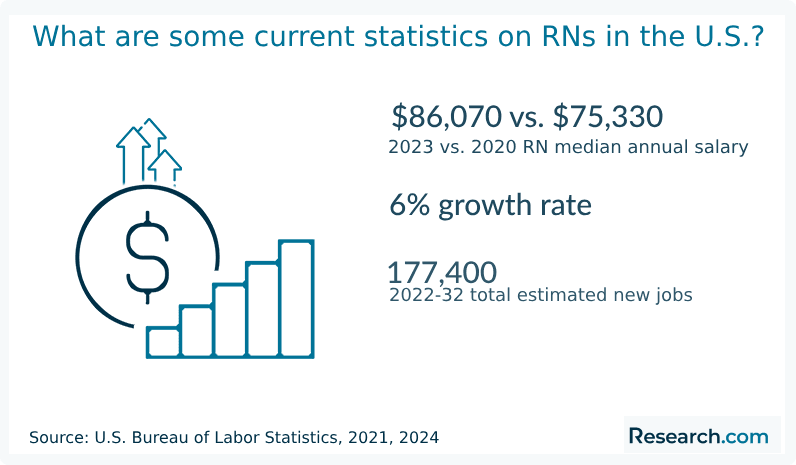
- The U.S. Bureau of Labor Statistics reported that the median annual wage for registered nurses increased from $75,330 in May 2020 to $86,070 in 2023.
- The registered nursing occupation is projected to grow 6% between 2022 and 2032, which the BLS classifies as faster than average.
- The BLS projects an estimated 177,400 new jobs from 2022 -32.
- Location, experience, and specialization can place BSN-educated nurses in a salary range between $52,080 and $111,220.
- The 2022 annual survey by the American Association of Colleges of Nursing found that 27.7% of employers require new registered nurses to hold a BSN.
- The same survey found that 71.7% of employers strongly prefer nurses with a BSN.
- Higher salaries often require higher degrees; nursing managers average $103,727 per year, and family nurse practitioners have high salaries of $100,213 annually.
- RN to BSN programs are increasingly available online, giving working nurses more ways to complete the bachelor’s degree while staying employed.
How long does it take to complete an RN to BSN degree program?
RN to BSN completion time depends on your transfer credits, enrollment pace, course sequence, and whether you choose an accelerated or traditional format. Like an accelerated BSN program online, a fast-track RN to BSN pathway moves quickly and requires consistent weekly progress.
| Factor | How It Affects Completion Time |
| Enrollment pace | Full-time students usually finish sooner than part-time students, but full-time study can be difficult for nurses working long shifts. |
| Fast-track design | Accelerated programs are built for shorter completion, often around one to two years for full-time students. |
| Traditional pacing | Traditional RN to BSN programs may take three to four years for part-time students; students can also compare best accelerated BSN program options if they are looking at broader nursing pathways. |
| Transfer credits | The more credits accepted from your ADN or diploma program, the fewer credits you may need to complete at the BSN-granting institution. |
| Course sequencing | Some programs require courses in a fixed order, while others give students more flexibility to adjust the schedule. |
The short completion timeline is one reason RN to BSN programs appeal to working nurses. Registered nurses had a median annual salary of $86,070 in 2023, with a projected 6% growth rate between 2022 and 2032. The salary rose from $75,330 in May 2020, showing an increase in the national RN wage benchmark over that period.
How does an online RN to BSN degree compare to an on-campus program?
Online and on-campus RN to BSN programs can lead to the same BSN credential when they are properly accredited, but the learning experience is different. The right format depends on how you learn, where you live, how predictable your schedule is, and how much structure you need.
| Comparison Area | Online RN to BSN | On-Campus RN to BSN |
| Schedule flexibility | Often better for nurses with changing shifts because coursework may be asynchronous. | Requires set class times and travel to campus. |
| Time to completion | Fast-track online programs may take 1-2 years, depending on transferred credits and enrollment pace. | Traditional on-campus programs can take 3-4 years for part-time students. |
| Learning style | Best for self-directed students who can manage deadlines independently. | Better for students who want face-to-face interaction and a more structured classroom routine. |
| Clinical or practice requirements | May require students to coordinate approved local experiences or workplace-based assignments. | May have established partnerships with local healthcare facilities, although arrangements vary. |
| Networking | Often built through discussion boards, virtual groups, and online faculty contact. | More likely to include in-person peer and faculty interaction. |
What is the average cost of an RN to BSN degree program?
RN to BSN programs are usually less expensive than completing a full BSN from the beginning because registered nurses often bring prior ADN or diploma credits. Many BSN degrees require 120 total credits, and RN to BSN students may transfer a substantial portion of that requirement.
Program pricing varies by institution and residency. In the programs listed above, in-state tuition ranges from $159 per credit hour at Georgia Southern University to $434.60 per credit hour at Cleveland State University. Out-of-state rates can be much higher, including $862.80 per credit hour at the University of North Carolina Wilmington.
Some schools charge flat program tuition instead of a simple per-credit rate. Examples include the University of Louisiana at Lafayette at $9,500 and the University of Texas at Arlington at $8,995. Private universities such as Capella University may have higher published total costs but can offer flexible payment or pacing models. Always compare the full cost after fees, transfer credits, residency status, and course-load requirements.
What are the financial aid options for students enrolling in an RN to BSN degree program?
RN to BSN students may be able to combine several forms of financial aid. Availability depends on eligibility, enrollment status, school participation, and whether you already used prior aid during your ADN or diploma program.
- Federal grants: Pell Grants may be available to eligible undergraduate students pursuing RN to BSN completion.
- Federal loans: Subsidized and unsubsidized federal student loans can help cover education costs. Subsidized loans have government-paid interest while you are in school.
- Nursing student loan programs: The Health Resources and Services Administration offers nursing-related funding programs, including options that may connect to service in underserved areas.
- State grants: Some states provide scholarships or grants for nursing students. Check your state education agency and nursing board for current opportunities.
- Scholarships: Nursing associations, hospitals, foundations, and local organizations may offer awards for RN to BSN students.
- Employer tuition reimbursement: Hospitals and healthcare systems may help pay for BSN completion, especially when the degree supports workforce development goals.
Students focused on lowering debt can also compare the cheapest online nursing programs before committing to a school.
What are the prerequisites for enrolling in an RN to BSN degree program?
Admission requirements differ by school, but most RN to BSN programs look for proof that you are already licensed, prepared for upper-division nursing coursework, and able to complete remaining general education or science requirements.
| Common Requirement | What to Check Before Applying |
| Active RN license | You generally need to be a registered nurse with an active and unrestricted license in the state connected to your enrollment or practice. |
| ADN or nursing diploma | Most programs require an associate degree in nursing or a nursing diploma from an accredited program. |
| Minimum GPA | Schools often require a minimum GPA, commonly around 2.5 to 3.2, based on prior undergraduate coursework. |
| Credit requirements | RN-to-BSN programs often connect to the approximately 120 credits required for BSN completion, including transfer credits from the ADN program. |
| Prerequisite courses | Common prerequisites may include Anatomy and Physiology, Microbiology, Statistics, and English Composition. |
| Standardized tests | Some programs may request scores such as the TEAS, though requirements vary. |
| Professional materials | You may need a nursing resume and letters of recommendation from supervisors, faculty, or clinical leaders. |
What courses are typically in an RN to BSN degree program?
RN to BSN curricula vary, but most programs strengthen the areas that separate bachelor’s-level nursing education from entry-level RN preparation: leadership, research, population health, informatics, communication, and evidence-based practice.
- General education courses: These courses develop communication, analysis, ethics, and broader social understanding.
- English Composition: Strengthens professional writing for documentation, care plans, patient education, and workplace communication.
- Humanities and Social Sciences: Builds context around ethics, psychology, cultural competence, and social factors that affect health.
- Statistics: Helps nurses interpret healthcare data, read research, and evaluate patient outcomes.
- Science courses: These courses deepen understanding of disease, medications, nutrition, and patient care decisions.
- Advanced Nutrition: Applies nutrition principles to patient assessment, health promotion, recovery, and lifespan care.
- Pathophysiology: Examines disease processes and how they connect to nursing interventions.
- Pharmacology: Covers medication actions, side effects, safe administration, and patient-specific considerations.
- Nursing-specific courses: These courses prepare RNs for broader professional responsibility.
- Community Health Nursing: Focuses on population health, prevention, health disparities, and community interventions.
- Evidence-Based Practice in Nursing: Teaches students to evaluate research and apply findings to patient care.
- Healthcare Informatics: Covers electronic health records, clinical data systems, and technology-supported care.
- Nursing Leadership and Management: Builds skills in delegation, quality improvement, teamwork, and healthcare operations.
- Clinical practicums or practice-based assignments: Students may apply BSN-level concepts in real healthcare or community settings, often under approved supervision or through workplace-related projects.
What types of specializations are available in RN to BSN degree programs?
Most RN to BSN programs do not offer formal specializations in the same way MSN or certificate programs do. The BSN is usually designed as a broad professional foundation, not a narrow specialty credential.
That said, some programs offer electives or project options that let students explore areas such as:
- Cardiac Care
- Emergency Nursing
- Mental Health Nursing
- Pediatrics
- Women’s Health
Deeper specialization usually happens after the BSN through certification, employer-based training, or graduate study. Nurses planning a graduate path can compare the best shortest online MSN programs. Nurses who are more interested in management, budgeting, operations, and healthcare systems may also consider affordable online Masters in Healthcare Administration programs.
How do you choose the best RN to BSN degree program?
The best RN to BSN program is the one that is accredited, affordable for your situation, realistic for your schedule, and aligned with your next career step. Use the checklist below before applying.
| Selection Factor | Questions to Ask |
| Accreditation | Is the nursing program accredited by ACEN or the Commission on Collegiate Nursing Education? |
| Transfer credits | How many ADN or diploma credits will the school accept, and will you need extra general education courses? |
| Total cost | What is the full cost after tuition, fees, books, technology fees, and any required travel or clinical expenses? |
| Program format | Are courses asynchronous, synchronous, full-time, part-time, self-paced, or cohort-based? |
| Clinical or practice requirements | Will the school arrange placements, allow workplace-based projects, or require you to identify approved sites? |
| Student support | Are advisors, tutoring, faculty office hours, library access, and career services available to online students? |
| Faculty background | Do faculty members have experience in leadership, community health, informatics, research, or your area of interest? |
| Outcomes | Does the program share graduation rates, student satisfaction, employer feedback, or alumni career outcomes? |
| Future graduate study | Will the BSN meet admission expectations for MSN, NP, or DNP programs you may want later? |
According to the 2022 survey by the American Association of Colleges of Nursing, 27.7% of employers require newly hired registered nurses to have a BSN, and 71.7% strongly prefer BSN-prepared nurses.
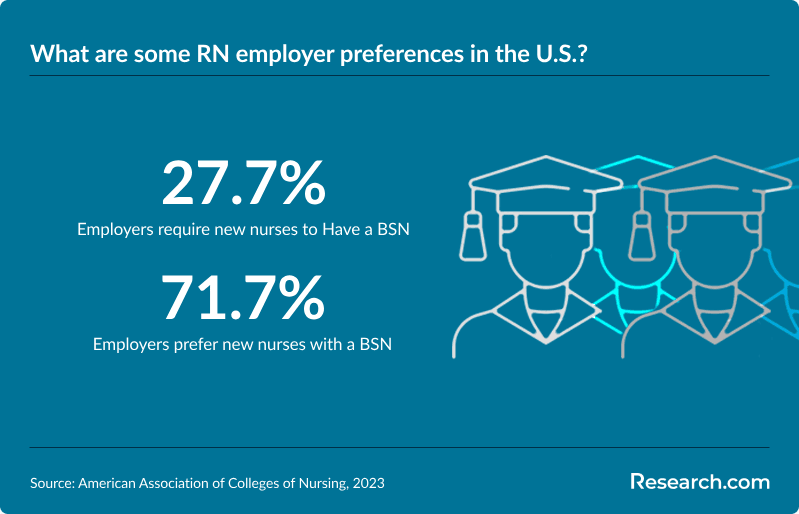
Those employer preferences create a strong reason for RNs to consider BSN completion, especially if they want more options in hospitals, leadership, public health, specialty practice, or graduate education.
What career paths are available for graduates of RN to BSN degree programs?
An RN to BSN degree may support movement into broader clinical, leadership, community, education, and graduate-study pathways. The BSN does not guarantee promotion, but it can remove a credential barrier in workplaces that prefer bachelor’s-prepared nurses.
- Clinical specialties: BSN-prepared nurses may pursue areas such as critical care nursing, emergency room nursing, labor and delivery nursing, neonatal intensive care nursing, operating room nursing, oncology nursing, pediatric nursing, and many other specialties.
- Leadership and management: The degree can support preparation for roles such as case manager, clinical supervisor, director of nursing, or nurse manager.
- Education and training: Some BSN graduates help train patients, staff, or future nurses in hospitals, schools, or workforce-development programs.
- Research and informatics: Nurses with BSN preparation may contribute to quality improvement, evidence-based practice, data use, and health technology initiatives.
- Community health nursing: BSN graduates can work in prevention, public health education, community outreach, and population health programs.
- Advanced practice nursing: A BSN is commonly the foundation for MSN study, which can lead to roles such as clinical nurse specialist, nurse anesthetist, nurse midwife, or nurse practitioner.
If nurse practitioner roles are your long-term goal, compare some of the cheapest online nurse practitioner programs. Nurses planning broader graduate study can also review affordable MSN programs online.
What is the job market for graduates with an RN to BSN degree?
The BLS outlook for registered nurses remains favorable. Registered nurses had a median annual salary of $86,070 in 2023, and employment is projected to grow 6% between 2022 and 2032. The BLS projects an estimated 177,400 new jobs during that period. On average, BSN-educated nurses can earn between $52,080 and $111,220, with results varying by role, state, employer, and experience.
PayScale salary data also shows how pay can change as nurses move into different roles or pursue higher credentials.
Registered nurses typically earn around $69,621 annually. Career progression can lead to roles such as Nurse Case Manager, averaging $80,779, or Nursing Manager, averaging $103,727. Advanced practice roles may offer additional earning potential; Family Nurse Practitioners have an average salary of $100,213. Nurses considering that path can compare the cheapest online FNP programs.
For nurses seeking the highest practice and leadership preparation, graduate education may be necessary. Several online DNP programs are available for nurses planning doctoral-level study.
What are the benefits of enrolling in an affordable RN to BSN program online?
An affordable online RN to BSN program can be a practical route for working nurses because it reduces several common barriers: relocation, campus commuting, rigid scheduling, and high total cost. The key is to confirm that “affordable” does not come at the expense of accreditation, student support, or transfer-credit value.
Cost Savings
Online programs can help students avoid expenses tied to housing, commuting, meal plans, and some campus-based fees. Lower tuition also matters, but total cost should include books, technology charges, fees, and any practice-placement expenses.
Flexibility and Convenience
Many online RN to BSN programs use asynchronous coursework, allowing nurses to study outside scheduled shifts. This is especially useful for RNs working nights, weekends, rotating schedules, or multiple jobs.
Accessibility for Rural and Underserved Areas
Online study can make BSN completion possible for nurses who live far from a campus-based nursing school. Students still need to verify any local practice or project requirements before enrolling.
Career Advancement Opportunities
A BSN may strengthen eligibility for leadership, specialty, public health, and graduate-school pathways, particularly in organizations that prefer bachelor’s-prepared nurses.
Networking Opportunities
Online programs can still create professional connections through discussion boards, group projects, virtual meetings, alumni networks, and faculty interaction.
Customizable Learning Experiences
Some programs allow elective choices that align with interests such as pediatrics, oncology, informatics, leadership, or community health.
To compare cost-focused options, review affordable RN to BSN online programs.
How do I verify the accreditation and quality of an online RN to BSN program?
Start with accreditation. The institution should hold recognized institutional accreditation, and the nursing program should be accredited by a recognized nursing accreditor such as CCNE or ACEN. Accreditation matters because it signals that the curriculum, faculty, governance, and student outcomes have been reviewed against nursing education standards.
Next, look at quality indicators. Ask the school for graduation statistics, retention information, student support availability, faculty qualifications, transfer-credit policies, and how practice experiences are handled. If you plan to pursue graduate study, confirm that MSN or DNP programs you are considering will accept the BSN. Nurses exploring doctoral pathways can also review this list of online DNP programs.
How can I evaluate the financial investment and long-term value of an LPN program?
If you are comparing LPN, LPN-to-RN, LPN-to-BSN, and RN-to-BSN routes, evaluate the entire cost of each step rather than looking only at tuition. Include fees, textbooks, uniforms, exams, technology, transportation, clinical-placement expenses, and the income you may lose if you reduce work hours.
Long-term value should also include job placement, employer reputation, transferability of credits, licensure outcomes, and whether the program creates a realistic path to RN or BSN completion. For a cost-focused breakdown, see How much is the LPN program?.
What are the benefits of pursuing a dual degree in nursing and business?
A nursing and business dual degree can make sense for nurses who want to move beyond direct patient care into administration, operations, finance, strategy, consulting, or executive leadership. The nursing side builds clinical credibility, while the business side strengthens skills in budgeting, workforce planning, analytics, organizational leadership, and healthcare operations.
This path is not necessary for every nurse. It is most useful if your target roles involve managing teams, service lines, budgets, quality initiatives, or healthcare systems. Nurses interested in that combination can explore dual MBA MSN programs.
How can I assess the return on investment of an RN to BSN degree?
To evaluate RN to BSN ROI, compare the full cost of the degree against the career outcomes you are realistically pursuing. Include tuition, fees, materials, time to completion, transfer credits, employer reimbursement, financial aid, and any income loss from reduced work hours.
Then identify what the BSN may help you access: employers that require or prefer a BSN, leadership tracks, specialty roles, public health positions, and future MSN or DNP admission. Do not assume a salary increase is automatic. The degree is more valuable when it directly supports a role, employer requirement, or graduate pathway you actually want.
Students comparing accelerated nursing options can also review easy accelerated nursing programs to understand how admission accessibility and pacing affect the overall investment.
What factors should non-nurse degree holders consider when choosing accelerated BSN programs?
Non-nurse degree holders need a different pathway from licensed RNs. Accelerated BSN programs are designed for students who already hold a bachelor’s degree in another field and need prelicensure nursing preparation. These programs are typically intensive and include both academic nursing coursework and supervised clinical training.
Before enrolling, confirm accreditation, NCLEX preparation, clinical placement support, schedule intensity, prerequisite requirements, and total cost. Career changers comparing price-sensitive routes can review the cheapest accelerated BSN programs in the US for non nurses.
What are the potential challenges in RN to BSN online programs?
Online RN to BSN programs can be flexible, but they are not effortless. The most common challenges are time pressure, competing work shifts, limited face-to-face interaction, heavy reading and writing expectations, and the need to stay organized without a traditional classroom schedule.
| Common Challenge | Better Strategy |
| Underestimating weekly workload | Ask for sample course schedules and plan study blocks before classes begin. |
| Falling behind in asynchronous courses | Treat online deadlines like scheduled shifts and use calendar reminders. |
| Assuming online means no practice requirement | Confirm clinical, practicum, project, or workplace-based expectations before enrolling. |
| Choosing based only on speed | Balance completion time with accreditation, support, cost, and transfer credits. |
| Ignoring technology needs | Make sure you have reliable internet, a functional computer, and access to required software. |
For a deeper look at academic difficulty and workload, review challenges in RN to BSN programs.
What alternatives are available for LPNs who want to pursue a BSN degree?
LPNs and LVNs usually cannot enter a standard RN to BSN program because those programs are designed for licensed registered nurses. A more appropriate option is an LPN-to-BSN or LPN-to-RN pathway that helps practical nurses progress toward RN licensure and bachelor’s-level preparation.
These bridge programs build on practical nursing experience while adding the academic and clinical preparation needed for baccalaureate-level nursing. LPNs comparing online options can start with online RN to BSN pathways designed for practical nurses moving toward the BSN.
What are the advanced nursing careers beyond BSN?
The BSN can be a foundation for advanced nursing roles, but most advanced practice, advanced leadership, and faculty pathways require graduate education. An MSN can prepare nurses for roles such as nurse practitioner, clinical nurse specialist, nurse educator, or nurse administrator. A DNP can support high-level clinical practice and leadership preparation.
- Primary Care: Nurse practitioners diagnose and treat patients across the lifespan. If this pathway interests you, compare the easiest nurse practitioner degree options.
- Critical Care: Critical care nurses focus on patients with life-threatening conditions, often in intensive care settings.
- Anesthesia: Nurse anesthetists provide anesthesia care before, during, and after procedures.
- Education: Nurse educators teach future nurses in academic and clinical settings.
- Leadership: Nurse leaders manage teams, improve care systems, and oversee healthcare operations.
A BSN is not the endpoint for every nurse. For those who want advanced practice, education, administration, or doctoral-level leadership, it can be the step that makes graduate study possible.
How to transition from an RN to BSN degree to an MSN program?
After completing an RN to BSN program, many nurses move into MSN study to specialize clinically, teach, or lead healthcare teams. The transition is smoother when you plan early and choose BSN courses and experiences that support your intended MSN track.
Eligibility and prerequisites
Most MSN programs require a BSN, an active RN license, transcripts, a minimum GPA, recommendations, and professional nursing experience. Some programs may require GRE scores, while others waive that requirement for applicants with strong academic or clinical backgrounds.
Choosing the right MSN pathway
- Nurse Practitioner: Prepares nurses for primary or specialty care roles with defined patient populations.
- Nurse Educator: Builds teaching skills for academic, hospital, and clinical training settings.
- Nursing Administration: Focuses on leadership, management, policy, and healthcare operations.
- Clinical Nurse Specialist: Emphasizes advanced clinical expertise, consultation, and systems improvement.
Nurses seeking a flexible bridge can compare RN to MSN online programs, which may help working professionals move efficiently from RN preparation into graduate-level nursing.
What to check before applying to an online MSN
- Program accreditation through CCNE or ACEN
- Clinical placement support and state authorization
- Specialty match with your licensure and career goals
- Part-time and full-time pacing options
- Total cost, fees, and employer tuition reimbursement
What is the difference between RN to BSN programs and ADN to MSN bridge programs?
RN to BSN programs help registered nurses complete the bachelor’s degree by expanding knowledge in leadership, research, population health, informatics, and evidence-based practice. ADN to MSN bridge programs are more direct graduate pathways for ADN-prepared nurses who want to move toward advanced roles without stopping at a traditional standalone BSN program.
| Pathway | Best For | Main Trade-Off |
| RN to BSN | Licensed RNs who want the bachelor’s credential, more employer options, or a foundation for later graduate study. | May require a separate MSN application later if you decide to pursue advanced practice. |
| ADN to MSN bridge | ADN-prepared RNs who are ready to commit to graduate-level specialization sooner. | Can be more demanding because graduate coursework begins earlier in the pathway. |
If your goal is advanced practice, compare RN to NP programs online to see whether a bridge pathway fits your experience and timeline.
Common Mistakes to Avoid When Choosing an RN to BSN Online Program
- Choosing the fastest program without checking accreditation: Speed is not useful if the program does not meet recognized nursing education standards.
- Comparing only tuition: Fees, transfer-credit limits, books, and required coursework can change the true price.
- Assuming every online program is available in your state: State authorization and practice requirements can affect eligibility.
- Overlooking transfer-credit policy: A school with a higher per-credit rate may still cost less if it accepts more of your prior credits.
- Ignoring workload while working full time: Accelerated online programs can be intense, especially for nurses working nights or rotating shifts.
- Assuming a BSN automatically raises pay: Salary outcomes depend on employer policy, location, role, experience, and whether you move into a higher-paying position.
- Not asking about clinical or practice projects: Some RN to BSN programs require approved practice experiences, even when coursework is fully online.
References
- American Association of Colleges of Nursing (AACN). (2023). AACN Annual Report 2023. AACN.
- U.S. Bureau of Labor Statistics. (2019). Occupational Employment and Wages, May 2019: 29-1141 Registered Nurses. Bureau of Labor Statistics.
- Bureau of Labor Statistics. (2020). Registered nurses. Bureau of Labor Statistics.
- Bureau of Labor Statistics. (2024). Registered nurses. Bureau of Labor Statistics.
- Payscale. (2024). Director, Nursing Salary. PayScale.
- Payscale. (2024). Family Nurse Practitioner (NP) Salary. PayScale.
- Payscale. (2024). Nurse Case Manager Salary. PayScale.
- Payscale. (2024). Nursing Manager Salary. PayScale.
- Payscale. (2024). Registered Nurse (RN) Salary. PayScale.
Key Insights
- A fast-track RN to BSN online program is best for licensed RNs who can manage accelerated coursework while working and who need the BSN for career mobility, employer preference, or graduate study.
- Accreditation should be your first filter. Look for recognized nursing accreditation such as CCNE or ACEN before comparing cost or speed.
- The cheapest program is not always the best value. Transfer credits, fees, residency status, employer reimbursement, and required practice experiences can change the real cost.
- Online RN to BSN programs offer flexibility, but they still require planning, technology readiness, consistent communication, and strong time management.
- The BSN can support roles in leadership, community health, specialty nursing, informatics, education, and future MSN or DNP study, but salary gains are not guaranteed and depend on employer, location, experience, and role.
- Before enrolling, ask each school how many credits will transfer, whether coursework is asynchronous, whether any clinical or practice projects are required, and what support is available to online nursing students.
Other Things You Need to Know About RN to BSN Degree Programs
Yes. Many RN to BSN programs require a supervised community or population-health practicum, often 90 to 120 clinical hours. Some schools let students complete the hours near their workplace, but the placement must be approved by the nursing program and meet state and school rules.
Admission requirements for 2027 fast-track RN to BSN online programs generally include a valid RN license, an associate degree or diploma in nursing, a minimum GPA (often around 2.5-3.0), and completion of prerequisite courses. Some programs may require letters of recommendation, a resume, or a personal statement.


