2027 Best Accelerated RN to BSN to MSN Online Bridge Programs

Co-Founder and Chief Data Scientist
If you are a registered nurse aiming to elevate your credentials and take on advanced roles in healthcare, online RN to BSN to MSN programs may be the path for you. These programs are designed for RNs with an associate degree or nursing diploma who want to earn both a BSN and MSN in one streamlined, flexible route.
According to the Bureau of Labor Statistics (2024), the United States will need a combined number of 435,600 nurse practitioners and nurse midwives by 2033, signaling strong demand and long-term job security. As a career planning and education expert, I have researched the best programs. We will cover admissions, clinical requirements, career outcomes, costs, and more.
What are the benefits of opting for accelerated RN to BSN to MSN online bridge programs?
- Graduates of this program can become nurse practitioners and nurse midwives, which are projected to grow by a remarkable 40% from 2023 to 2033 (BLS, 2024).
- The median annual salary for nurse practitioners and nurse midwives is $132,050, or approximately $63.48 per hour, reflecting the high value and demand for advanced nursing roles (BLS, 2024).
- Programs are offered fully online, allowing working nurses to earn their degrees with flexible schedules and complete clinical requirements locally.
What can I expect from an accelerated RN to BSN to MSN online bridge program?
Accelerated online RN to BSN to MSN programs are designed for motivated RNs seeking to earn both a BSN and MSN in a streamlined, time-efficient format. You can expect a rigorous academic load, especially if BSN and MSN courses are taken back-to-back or simultaneously.
Most programs follow an 8-week or 10-week term format, requiring strong time management and self-discipline. Coursework includes a combination of theory, research, leadership, and clinical practice, with practicum hours typically completed in your local area.
Unlike RN to MSN programs that do not award a BSN, this bridge pathway confers both degrees, which can be a major advantage when applying for leadership positions or roles at institutions that require a BSN. Program structure varies by school—some award the BSN halfway through, others at the end alongside the MSN, and some may allow students to start MSN-level classes before officially completing the BSN requirements.
In short, expect an intense but rewarding experience that demands consistent engagement, especially if you're balancing school with full-time work. However, the flexibility of online learning and the dual-degree outcome make it a smart choice for ambitious RNs looking to elevate their careers.
Where can I work after completing an accelerated RN to BSN to MSN online bridge program?
After completing an online RN to BSN to MSN program, you'll be qualified for a variety of advanced roles in the healthcare system, depending on your MSN concentration. Graduates often work as nurse practitioners in primary care clinics, specialty practices, or hospital systems, where they diagnose, treat, and manage patient care independently or alongside physicians.
Those who specialize in nursing education may teach in nursing schools, clinical training programs, or hospital education departments. If you choose a leadership or administration track, you can work as a nurse manager, director of nursing, or healthcare executive in hospitals, long-term care facilities, or public health organizations.
Other career paths include roles in nursing informatics, public health nursing, or care coordination. This dual-degree pathway opens doors to higher-paying, leadership-focused positions and offers greater flexibility and long-term advancement than bedside RN roles alone.
How much can I make with an accelerated RN to BSN to MSN online bridge program?
Earning both a BSN and MSN through an accelerated bridge program can significantly boost your earning potential, especially when paired with a specialized role. Salaries vary by position, location, and experience, but most MSN-prepared nurses enjoy above-average pay and strong job stability. Below are the average annual salaries for common career paths after completing this program, according to ZipRecruiter (2025):
- Nurse Practitioner: $130,295
- Nurse Midwife: $113,401
- Nurse Educator: $102,263
- Nurse Administrator: $84,334
- Public Health or Community Health Nurse: $78,437
- Nursing Informatics Specialist: $98,409
- Top Accelerated RN to BSN to MSN Online Bridge Programs for 2027 List of Programs
- How fast can I complete an accelerated RN to BSN to MSN online bridge program? Program Duration
- What are the educational requirements for enrolling in an accelerated RN to BSN to MSN online bridge program? Admission Criteria
- What is the average cost of accelerated RN to BSN to MSN online bridge programs? Tuition Fees
- What are the core BSN and MSN courses? What are the core BSN and MSN courses?
- How are clinical hours or practicums handled in an accelerated RN to BSN to MSN online bridge program? Clinical Requirements
- Can I choose a specialization or MSN track? Specializations
- Do I need to take a certification exam after I finish the MSN portion? Do I need to take a certification exam after I finish the MSN portion?
- What are the biggest challenges students face in the accelerated RN to BSN to MSN online bridge program? What are the biggest challenges students face in the accelerated RN to BSN to MSN online bridge program?
- How can I further my career after completing an MSN degree? How can I further my career after completing an MSN degree?
- What is the job market for those with an MSN degree? Job Outlook
- What accreditation standards should I look for in accelerated RN to BSN to MSN programs? What accreditation standards should I look for in accelerated RN to BSN to MSN programs?
- What career support and mentorship opportunities do these programs offer? What career support and mentorship opportunities do these programs offer?
- How do accelerated RN to BSN to MSN programs compare to direct entry nurse practitioner programs? How do accelerated RN to BSN to MSN programs compare to direct entry nurse practitioner programs?
Best Accelerated RN to BSN to MSN Online Bridge Programs for 2027
An accelerated RN to BSN to MSN online bridge program is built for licensed registered nurses who started with an Associate Degree in Nursing (ADN) or nursing diploma and now want to move into graduate-level nursing without completing a stand-alone BSN first. The decision matters because the path you choose can affect your timeline, tuition, clinical placement responsibilities, certification eligibility, and future scope of practice.
This guide is for working RNs comparing online bridge programs, especially those considering nurse practitioner, nurse educator, nurse executive, informatics, public health, or leadership roles. You will learn how these programs work, which schools offer accelerated options, how long they take, what they cost, what admissions requirements to expect, how clinical hours are handled, and how to evaluate whether this route is worth it for your career goals.
Quick answer: Is an accelerated RN to BSN to MSN online bridge program worth considering?
Yes, an accelerated RN to BSN to MSN online bridge program can be a practical option if you are already a licensed RN with an ADN or diploma and you want to earn graduate nursing credentials faster than completing separate BSN and MSN programs. The best fit depends on your intended MSN track. Non-clinical tracks such as nurse educator, nurse administrator, leadership, and informatics may be easier to complete while working full time, while nurse practitioner tracks usually require more clinical hours, stricter state authorization review, and national certification after graduation.
These programs are most useful for RNs who have a clear career target, can manage an intensive academic workload, and are willing to confirm accreditation, clinical placement rules, transfer credit policies, and licensure requirements before enrolling. Nurses who are still unsure about an advanced practice specialty may benefit from completing an RN-to-BSN first, then choosing an MSN later.
How we ranked these programs
Research.com created this ranking to help nurses compare accelerated RN to BSN to MSN online bridge programs using factors that matter in real enrollment decisions: academic quality, affordability, flexibility, program structure, accreditation, and career relevance. The goal is not simply to list schools, but to help you identify programs that match your licensure status, work schedule, preferred MSN concentration, and long-term nursing goals.
Our ranking process follows Research.com’s methodology and draws from multiple data sources, including the IPEDS database, Peterson’s database, College Scorecard, and the National Center for Education Statistics (NCES). We also considered program features such as online delivery, bridge coursework, available MSN tracks, credit requirements, tuition structure, and recognized nursing accreditation.
If you are comparing nursing pathways beyond this list, you may also want to review related options such as the fastest online adult-gerontology PCNP graduate certificate programs, especially if you already hold graduate nursing credentials and want a narrower post-graduate specialty route.
Accelerated RN to BSN to MSN online programs at a glance
| School | Typical Program Length | Available Tracks or Concentrations | Cost per Credit | Accreditation |
| Jacksonville University | Typically 18 months full-time | Adult‑Gerontology Acute Care NP; Family NP; Psychiatric‑Mental Health NP; Clinical Nurse Educator; Informatics | Approximately $700/credit ($14,000/year full-time) | CCNE |
| Franklin University | 16 to 28 months | Nurse Administrator; Nurse Educator; Generalist; Family Nurse Practitioner (FNP); Adult-Gerontology Primary Care NP; Psychiatric-Mental Health NP | $298 bridge course; $598–$670 MSN courses | CCNE and HLC |
| Sacred Heart University | Approximately 3.5 years | Family Nurse Practitioner (FNP); Clinical Nurse Leader; Nursing Education; Nursing Management and Executive Leadership; Psychiatric-Mental Health Nurse Practitioner | $390 undergraduate; $695–$955 graduate | CCNE and NECHE |
| Chamberlain University | 3 years with full-time study | Nurse Educator; Nurse Executive; Healthcare Policy and Informatics; Population Health; Clinical Nurse Leadership | $735–$765 BSN/MSN bridge; $550–$650 graduate core/MSN; NP specializations up to $565–$765 | CCNE |
| University of South Alabama | 2.5 to 3.5 years | Family NP; Adult-Gerontology Acute and Primary Care NP; Women’s Health NP; Clinical Nurse Leader; Nursing Informatics | Standard graduate tuition, approx. $550–$700/credit | CCNE |
| South University | Approximately 2.5 to 3 years | Nurse Educator; Family NP | $660 per credit | CCNE and SACSCOC |
| The University of Alabama | Approximately 2 years | Nurse Executive | $399 BSN courses; $480 MSN courses | CCNE |
| Liberty University | 24 to 30 months | Nurse Administrator; Nurse Educator; Nursing Informatics; Community Health; Health Policy | $330 undergraduate and graduate; $250 for military | CCNE and SACSCOC |
| University of Maryland School of Nursing | As little as 2 years | Community/Public Health; Leadership and Management; Nursing Informatics | $926 in‑state; $1,643 out‑of‑state | CCNE |
| Herzing University | 28 months | FNP; Nursing Education; Nursing Leadership and Administration | $735 | CCNE and HLC |
1. Jacksonville University
Jacksonville University offers an online RN‑MSN bridge pathway for registered nurses who hold an ADN or nursing diploma and want to complete BSN-level preparation while moving toward an MSN. The format uses flexible 7‑week modules with year-round enrollment, which may appeal to nurses who need shorter academic sessions instead of traditional semesters. Students complete BSN bridge coursework before progressing into graduate nursing study, with tracks that support advanced practice, education, informatics, and leadership-oriented goals.
- Program length: Typically 18 months full-time, with part-time options available
- Tracks/concentrations: Adult‑Gerontology Acute Care NP; Family NP; Psychiatric‑Mental Health NP; Clinical Nurse Educator; Informatics
- Cost per credit: Approximately $700/credit ($14,000/year full-time)
- Required credits to complete BSN and MSN: 23 BSN bridge credits plus typically 60 total MSN credits, including specialization, for a total of 83 credits
- Accreditation: Commission on Collegiate Nursing Education (CCNE)
2. Franklin University
Franklin University provides an accelerated online RN to MSN pathway for associate-prepared registered nurses. Instead of requiring a separate BSN completion program first, the curriculum begins with a bridge course and then moves students into graduate-level coursework. Its multiple start dates, online delivery, and flexible pacing make it a strong option for working nurses comparing leadership, education, generalist, and nurse practitioner routes.
- Program length: 16 to 28 months
- Tracks/concentrations: Nurse Administrator; Nurse Educator; Generalist; Family Nurse Practitioner (FNP); Adult-Gerontology Primary Care NP; Psychiatric-Mental Health NP
- Cost per credit: $298 for the bridge course; $598–$670 for MSN courses
- Required credits to complete BSN and MSN: 37 to 50 credits
- Accreditation: CCNE and Higher Learning Commission (HLC)
3. Sacred Heart University
Sacred Heart University has an online RN to BSN to MSN pathway for licensed RNs who want to move from associate-level nursing education into graduate preparation. Students take one 8-week course at a time and can choose from six annual start dates, which can make the program easier to plan around work shifts. The curriculum combines BSN completion content with MSN coursework in clinical practice, leadership, education, and management-focused areas.
- Program length: Approximately 3.5 years
- Tracks/concentrations: Family Nurse Practitioner (FNP); Clinical Nurse Leader; Nursing Education; Nursing Management and Executive Leadership; Psychiatric-Mental Health Nurse Practitioner
- Cost per credit: $390 undergraduate; $695–$955 graduate
- Required credits to complete BSN and MSN: Approximately 84 total credits, varying by track
- Accreditation: CCNE and New England Commission of Higher Education (NECHE)
4. Chamberlain University
Chamberlain University offers an online bridge option that allows licensed RNs to pursue both BSN and MSN requirements through an accelerated structure. Students may receive up to 77 proficiency credits, which can reduce the number of courses still required. The pathway includes about 38 BSN credits and 36–45 graduate credits depending on specialization, and the design allows some BSN and MSN coursework to be taken concurrently.
- Program length: 3 years with full-time study
- Tracks/concentrations: Nurse Educator; Nurse Executive; Healthcare Policy and Informatics; Population Health; Clinical Nurse Leadership
- Cost per credit: $735–$765 for BSN/MSN bridge coursework; $550–$650 for graduate core/MSN coursework; NP specializations up to $565–$765
- Required credits: 38 BSN credits after proficiency plus 36–45 MSN credits, depending on specialty
- Accreditation: CCNE
5. University of South Alabama
The University of South Alabama offers a fully online RN to MSN bridge pathway for licensed ADN and diploma RNs. Students begin with online RN-to-BSN coursework before entering MSN-level study. Depending on the track, students may complete local clinical placements and occasional on-campus skills intensives. The program also participates in NC-SARA authorization, which is important for working nurses who live outside Alabama and need to confirm whether the program can enroll students in their state.
- Program length: 2.5 to 3.5 years
- Tracks/concentrations: Family NP; Adult-Gerontology Acute and Primary Care NP; Women’s Health NP; Clinical Nurse Leader; Nursing Informatics
- Cost per credit: Standard graduate tuition, approximately $550–$700/credit
- Required credits to complete BSN and MSN: 24 BSN credits after general education prerequisites plus 45 MSN credits, for a total pathway of 69 credits
- Accreditation: CCNE
6. South University
South University structures its pathway so students can receive both the BSN and MSN after completing the required curriculum. The program is especially relevant for RNs interested in nurse education because it includes coursework in curriculum design, instructional methods, and clinical evaluation. Its online format and accelerated pacing may work well for nurses who want a direct route into teaching or advanced clinical preparation.
- Program length: Approximately 2.5 to 3 years
- Tracks/concentrations: Nurse Educator; Family NP
- Cost per credit: $660 per credit, varying by course level
- Required credits to complete BSN and MSN: Approximately 90–100 total credits, with exact breakdown varying
- Accreditation: CCNE and Southern Association of Colleges and Schools Commission on Colleges (SACSCOC)
7. The University of Alabama
The University of Alabama offers an online RN to BSN to MSN pathway for RNs with an ADN or diploma who are aiming for the Nurse Executive concentration. Students earn the BSN after completing approximately four semesters and then complete the graduate requirements for the MSN. Coursework is fully online, practicum requirements can be completed locally, and early graduate school admission helps shorten the overall academic sequence.
- Program length: Approximately 2 years with full participation
- Tracks/concentrations: Nurse Executive
- Cost per credit: $399 for BSN courses; $480 for MSN courses
- Required credits to complete BSN and MSN: 50–56 total credits
- Accreditation: CCNE
8. Liberty University
Liberty University offers a faith-based online RN to BSN to MSN pathway with 8-week courses and multiple annual start dates. Licensed RNs receive an automatic 39-credit transfer for RN licensure and then complete the remaining undergraduate and graduate requirements. The program may appeal to students who want online flexibility combined with a Christian-centered curriculum emphasizing ethics, service, and healthcare leadership.
- Program length: 24 to 30 months
- Tracks/concentrations: Nurse Administrator; Nurse Educator; Nursing Informatics; Community Health; Health Policy
- Cost per credit: $330 for undergraduate and graduate courses; $250 for military
- Required credits to complete BSN and MSN: 30–33 graduate credits after transfer of 39 RN credits
- Accreditation: CCNE and SACSCOC
9. University of Maryland School of Nursing
The University of Maryland School of Nursing offers an accelerated online pathway that allows licensed RNs to earn both a BSN and MSN in as little as 2 years. The curriculum integrates graduate core coursework with BSN electives, making it suitable for nurses interested in public health, leadership, management, or informatics. Students considering this program should compare in-state and out-of-state pricing carefully because the listed tuition rates differ substantially.
- Program length: As little as 2 years
- Tracks/concentrations: Community/Public Health; Leadership and Management; Nursing Informatics
- Cost per credit: $926 in‑state / $1,643 out‑of‑state
- Required credits to complete BSN and MSN: 69–71 credits
- Accreditation: CCNE
10. Herzing University
Herzing University offers an accelerated RN to BSN to MSN pathway for ADN-prepared registered nurses. Students can complete both degrees in about 28 months through a curriculum that combines undergraduate bridge courses with graduate nursing content. The program focuses on evidence-based practice, leadership, management, education, and advanced clinical preparation, depending on the chosen track.
- Program length: 28 months
- Tracks/concentrations: FNP; Nursing Education; Nursing Leadership and Administration
- Cost per credit: $735
- Required credits to complete BSN and MSN: 52 credits
- Accreditation: CCNE and HLC
How fast can you complete an accelerated RN to BSN to MSN online bridge program?
The fastest online RN to BSN to MSN bridge programs can be completed in as little as 16 to 18 months of full-time study, especially when the MSN track is non-clinical, such as nurse educator, administration, leadership, or informatics. Shorter programs usually reduce duplication by letting students move through bridge coursework and graduate coursework in a continuous sequence. This is similar in pace-focused design to other accelerated graduate options, such as the fastest online master's in health informatics.
Many programs take closer to 2 to 3.5 years. The actual timeline depends on transfer credits, enrollment intensity, prerequisite completion, practicum availability, and whether the student chooses an NP track. Nurse practitioner pathways generally take longer because they require more direct patient care training and certification preparation.
The most important question is not only “How fast can I finish?” but “Can I complete the workload safely while maintaining my RN job, family responsibilities, and clinical requirements?” A fast program can save time, but it can also create scheduling pressure if you are working full time or need to locate your own preceptor.
| Program pace | Typical timeline | Best for | Key caution |
| Highly accelerated | 16 to 18 months | RNs with strong time management and a clear non-clinical or graduate specialty goal | Workload can be difficult to balance with full-time employment |
| Standard accelerated | 2 to 3 years | Working nurses who want speed but need a more manageable course sequence | Clinical planning should begin early, especially for NP tracks |
| Longer flexible pathway | Approximately 3.5 years | RNs who need part-time study or prefer one course at a time | Total cost and time in school may be higher |
What are the admission requirements for accelerated RN to BSN to MSN online bridge programs?
Most online RN to BSN to MSN bridge programs are designed for licensed registered nurses who already completed an ADN or nursing diploma. Admissions teams review whether applicants are academically ready for upper-division and graduate nursing coursework and whether they meet the licensure standards needed for clinical or practicum participation.
- An active, unencumbered RN license in the applicant’s state of residence or practice
- An ADN or nursing diploma from an accredited nursing program
- A minimum GPA, often between 2.5 and 3.0, based on prior nursing coursework
- Completed general education prerequisites, often including English, anatomy and physiology, and statistics
- Official transcripts from every college or postsecondary institution previously attended
- Professional nursing experience in some cases, usually 6–12 months required or strongly recommended
Some schools may also ask for a résumé, personal statement, letters of recommendation, or a discussion of professional goals. This is similar to the application review process used in other nursing bridge pathways, including CNA to RN online bridge programs. A typographical note: applicants may see “RN to BSN to MSN” written in different formats, but they should verify that the program is truly a bridge to MSN-level study and not only an RN-to-BSN completion program.
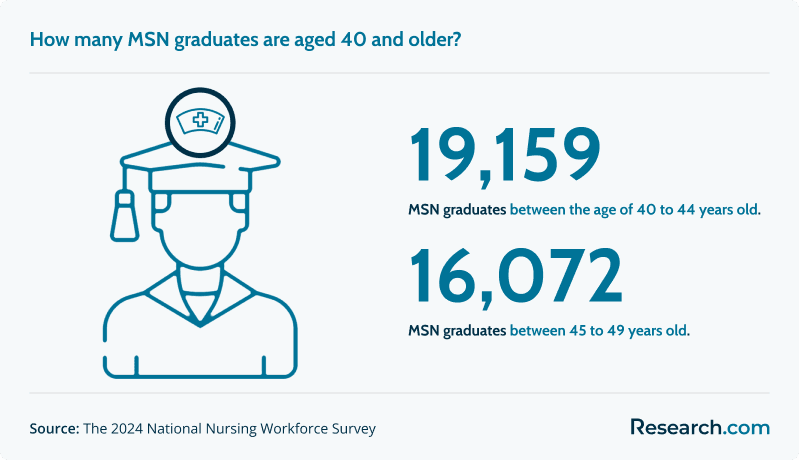
There is no standard age requirement for admission. Many applicants are experienced nurses in their late 30s or 40s who are returning to school after years in clinical practice. According to data cited in the Journal of Nursing Regulation, registered nurses aged 35 and older are more likely to hold an advanced nursing degree than younger nurses. The image below shows the age distribution of MSN graduates.
How much do accelerated RN to BSN to MSN online bridge programs cost?
Online RN to BSN to MSN bridge programs commonly cost between $20,000 and $60,000, depending on the university, tuition rate, total credit requirement, concentration, transfer credits, residency status, and fees. Many programs charge between $330 and $750 per credit hour, while total credit requirements often range from 60 to 90 credits after transfer evaluation. Pricing models vary across graduate programs; for comparison, some best online mba in management programs use bundled tuition structures that can change the effective per-credit cost.
Tuition is only part of the total cost. Students should also budget for technology fees, clinical placement or practicum fees, graduation fees, books, online course materials, lab kits, background checks, drug screening, immunization documentation, and certification exam preparation. If the program requires travel for campus intensives, skills checks, or clinical orientation, those expenses should be included in the decision.
Financial aid can reduce out-of-pocket cost. Eligible students may use FAFSA-based federal aid, state assistance, university scholarships, employer tuition reimbursement, hospital partnership discounts, military tuition reductions, or nursing-specific scholarships. Nurse practitioner students and members may also review national options such as the American Association of Nurse Practitioners Scholarship Program.
Questions to ask before comparing tuition
- Is the quoted tuition based on undergraduate credits, graduate credits, or a blended rate?
- How many credits will transfer from my ADN or nursing diploma?
- Are clinical placement, background check, technology, and graduation fees included?
- Will I pay in-state, out-of-state, military, partner, or locked tuition rates?
- Does the NP track cost more than the leadership, educator, or informatics track?
- Will employer tuition reimbursement apply to both the BSN and MSN portions?
What courses do RN to BSN to MSN students take?
Bridge programs combine undergraduate BSN completion content with graduate MSN coursework. The BSN phase strengthens professional nursing competencies in leadership, population health, research use, and evidence-based care. The MSN phase prepares students for advanced practice, administration, informatics, teaching, public health, or other specialized nursing roles.
Common BSN-level courses
- Health Assessment: Students build the assessment skills needed to evaluate patients across the lifespan using a comprehensive, patient-centered approach.
- Nursing Research and Evidence-Based Practice: This course trains nurses to read, evaluate, and apply research findings to improve care quality and outcomes.
- Community and Public Health Nursing: Students study health promotion, disease prevention, and nursing interventions for populations and communities.
- Leadership and Management in Nursing: Coursework examines communication, team coordination, leadership models, and decision-making in healthcare settings.
- Pathophysiology: Students review disease processes and how altered body systems affect clinical judgment and nursing care.
Common MSN-level courses
- Advanced Pharmacology: Students study medication management, pharmacotherapeutics, and safe prescribing concepts for advanced nursing roles.
- Advanced Health Assessment: This course deepens physical assessment and diagnostic reasoning skills for complex patient evaluation.
- Healthcare Policy and Ethics: Students analyze legal, ethical, regulatory, and policy issues that shape healthcare delivery.
- Theoretical Foundations of Nursing: Coursework explores nursing theories and conceptual frameworks used in advanced practice, education, and research.
- Evidence-Based Practice and Research Methods: Students learn to critique research designs, interpret data, and implement evidence in advanced nursing practice.
How do clinical hours and practicums work in online bridge programs?
Even when coursework is fully online, clinical hours and practicums are completed in person at approved sites. This is especially important for NP tracks, where direct patient care experience is required for certification and licensure preparation. Non-clinical tracks may use administrative, educational, leadership, or informatics practicums instead of traditional primary care or acute care clinical rotations.
Some schools allow students to complete practicum hours at their current workplace, but usually not in their usual role or under their regular supervisor. The site must meet program objectives, and the preceptor must meet faculty approval standards. This mix of online coursework and in-person skill development is also seen in programs such as the fastest online certified nursing assistant programs, though MSN-level clinical expectations are much more advanced.
During the BSN portion, students commonly complete around 60 to 90 clinical hours in areas such as community health, leadership, or evidence-based practice. In the MSN portion, requirements vary by track. Nurse practitioner specializations typically require 500 to 700 hours, while non-clinical tracks such as nurse educator or administrator may require 150 to 300 hours.
Schools often provide clinical coordinators, approval forms, and placement guidance, but many online students are expected to help identify potential sites and preceptors. Before enrolling, ask whether the school guarantees placements, assists with placements, or leaves most placement outreach to the student.
Which MSN specialization should you choose?
Most accelerated RN to BSN to MSN online bridge programs require students to choose an MSN track. This decision should be based on the work you want to do after graduation, not only on program length or tuition. Nurse practitioner tracks prepare students for direct advanced clinical care. Leadership, educator, informatics, and public health tracks usually prepare graduates for non-bedside or systems-level roles.
| MSN track | Best fit | Typical career direction | Important consideration |
| Family Nurse Practitioner | RNs who want broad primary care preparation across the lifespan | Family practice, outpatient clinics, community health settings | Requires significant clinical hours and national certification |
| Nurse Educator | Nurses interested in teaching students or training staff | Nursing schools, hospitals, professional development departments | Teaching roles may value or require educator certification |
| Nursing Leadership and Administration | RNs aiming for management, operations, or executive roles | Hospitals, health systems, clinics, nursing administration | Leadership experience can matter as much as the degree |
| Nursing Informatics | Nurses who like data, systems, workflow, and technology | Clinical systems, EHR optimization, analytics, quality improvement | Technical skills and project experience can strengthen employability |
| Public Health or Community Health Nursing | RNs focused on prevention, population health, and health equity | Public agencies, community programs, health education roles | Roles may vary widely by state, employer, and funding source |
| Adult-Gerontology Nurse Practitioner | Nurses who want to specialize in adult and older adult care | Primary care, acute care, specialty clinics, gerontology settings | Primary and acute care certification paths differ |
| Psychiatric-Mental Health Nurse Practitioner | RNs interested in mental and behavioral health care | Psychiatric clinics, integrated care, telehealth, behavioral health settings | Requires preparation in assessment, diagnosis, therapy, and medication management |
- Family Nurse Practitioner: This concentration prepares nurses to provide primary and preventive care for patients across age groups, including assessment and management of common acute and chronic conditions.
- Nurse Educator: Students learn curriculum design, instructional methods, clinical teaching, evaluation, and learning assessment for academic or staff-development roles.
- Nursing Leadership and Administration: This pathway focuses on budgeting, organizational change, healthcare policy, team leadership, and operational decision-making.
- Nursing Informatics: For readers asking what does a nurse informaticist do?, the role blends nursing knowledge with data, analytics, and health information systems to improve care delivery and clinical workflows.
- Public Health or Community Health Nursing: This option emphasizes health promotion, prevention, community education, and population-level care. If you are asking “What is a community health nurse?”, the role centers on improving community wellness through outreach, education, advocacy, and accessible care.
- Adult-Gerontology Nurse Practitioner: Students prepare to care for adolescent, adult, and older adult patients in primary or acute settings, depending on the chosen AGNP pathway.
- Psychiatric-Mental Health Nurse Practitioner: This track prepares nurses to assess, diagnose, and treat mental health conditions across the lifespan using psychotherapy, medication management, and behavioral health interventions.
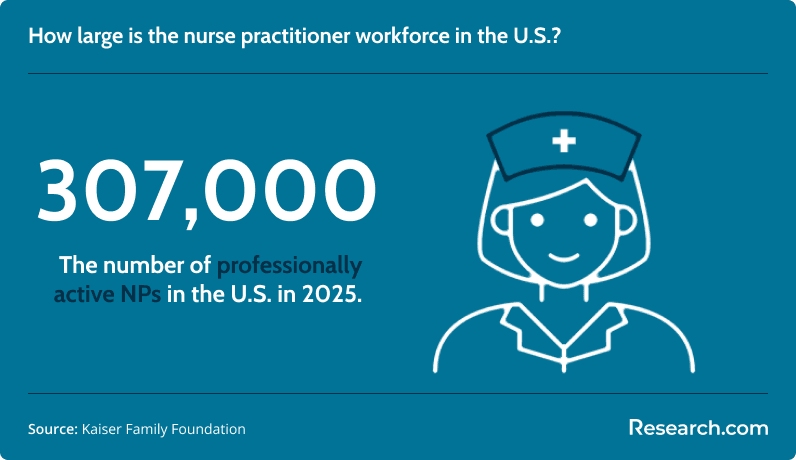
Choosing a specialization is one of the highest-stakes decisions in the program because it affects clinical hour requirements, certification eligibility, state licensure, and job options. The nurse practitioner workforce is large and includes many specialty areas, which is reflected in the image below. For many RNs, an NP track can offer more clinical autonomy, while non-clinical tracks may open doors to leadership, education, technology, or population health roles.
Will you need a certification exam after finishing the MSN?
In many MSN specializations, graduation alone is not the final step. Advanced practice and specialty roles often require a national certification exam, and state licensure requirements may also apply. Certification requirements vary by track, role, state, and employer, so students should confirm eligibility before enrolling.
- Family Nurse Practitioner (FNP-BC or NP-C): FNP graduates typically take a national certification exam through the American Nurses Credentialing Center (ANCC) or the American Academy of Nurse Practitioners Certification Board (AANPCB).
- Adult-Gerontology Primary/Acute Care Nurse Practitioner (AGPCNP-BC or AGACNP-BC): Nurses pursuing careers in gerontology through AGNP preparation generally need certification through the ANCC or AANPCB, depending on whether they choose primary or acute care.
- Psychiatric-Mental Health Nurse Practitioner (PMHNP-BC): PMHNP graduates must pass the ANCC Psychiatric-Mental Health Nurse Practitioner certification exam to qualify for many mental and behavioral health roles.
- Certified Nurse Educator (CNE): Certification is not always mandatory, but nurse educator graduates may pursue the National League for Nursing (NLN) Certified Nurse Educator credential to demonstrate teaching expertise.
- Nurse Executive (NE-BC or NEA-BC): Leadership and administration graduates may pursue ANCC nurse executive certification to document skills in management and organizational leadership.
- Informatics Nursing Certification (RN-BC): Informatics graduates may sit for the ANCC informatics certification to show competence in clinical systems, data, and technology-supported care.
- Certified in Public Health (CPH) or Advanced Public Health Nurse (APHN-BC): Public and community health graduates may consider the CPH through the National Board of Public Health Examiners (NBPHE) or APHN-BC through the ANCC, depending on job requirements.
Each certification body sets its own eligibility rules, which may include graduate coursework, clinical or practicum hours, role-specific experience, and current RN licensure. Certification can strengthen employment options, but it should not be viewed as automatic. Students should ask programs for recent certification pass-rate information by track.
The chart below summarizes 2024 nursing certification pass-rate data. In that data, the Adult-Gerontology Clinical Nurse Specialist certification had the highest pass rate at 90%, while Adult-Gerontology Primary Care Nurse Practitioner and Family Nurse Practitioner exams reported pass rates of 85% and 83%, respectively. These outcomes suggest that accredited programs with strong certification preparation can support student success, but individual results are never guaranteed.
What are the main challenges in accelerated RN to BSN to MSN online bridge programs?
The biggest challenge is time. Students often try to complete graduate-level work while continuing RN shifts, managing family responsibilities, and arranging clinical or practicum hours. Accelerated courses move quickly, so falling behind in one 7- or 8-week term can affect the next course sequence.
The second challenge is the jump from undergraduate completion work to graduate expectations. MSN courses require more analysis, scholarly writing, evidence appraisal, leadership application, and independent clinical judgment. For NP students, clinical documentation and preceptor feedback add another layer of responsibility.
Clinical placement is another common obstacle. Some programs provide strong placement support, while others expect students to identify preceptors and sites. This can be difficult in competitive markets or specialty areas such as psychiatric-mental health, women’s health, or acute care.
Online learning can also feel isolating for nurses who are used to team-based environments. Successful students usually communicate early with faculty, use advising services, create weekly study routines, and build peer support through discussion boards, cohort groups, or professional networks.
Common mistakes to avoid
| Mistake | Why it matters | Better approach |
| Choosing the fastest program without checking workload | A short timeline can be unrealistic for nurses working full time | Ask for sample weekly time commitments and course schedules |
| Ignoring nursing accreditation | Accreditation can affect certification, licensure, transferability, and employer acceptance | Verify CCNE or ACEN nursing accreditation before applying |
| Assuming the school will find every clinical site | Placement responsibility varies widely by program | Ask whether placement is guaranteed, assisted, or student-led |
| Comparing tuition without counting fees | Technology, clinical, background check, and travel costs can add up | Request a full estimated cost of attendance by track |
| Choosing an NP track without checking state rules | Online programs may not meet every state’s clinical or licensure requirements | Confirm state authorization and board of nursing requirements |
| Relying only on rankings | A highly ranked school may not offer your needed specialty or clinical support | Match the program to your license, location, schedule, and career goal |
How can you advance your career after earning an MSN?
After completing the MSN, your next step depends on your concentration. Nurse practitioner graduates typically pursue national certification, state advanced practice recognition, and clinical roles in primary care, acute care, psychiatry, women’s health, adult-gerontology, or family care. Graduates from leadership, education, informatics, or public health tracks may move into management, teaching, systems improvement, quality, policy, or community-based roles.
Some MSN-prepared nurses continue into doctoral education, including Doctor of Nursing Practice (DNP) or PhD in Nursing pathways. A DNP may support advanced clinical leadership, healthcare systems improvement, and executive roles, while a PhD is more commonly connected to research and academic careers.
Specialty credentials, professional organizations, fellowships, and post-graduate certificates can also help nurses refine their expertise. For example, MSN graduates interested in pediatric advanced practice may compare options such as affordable online pediatric nurse practitioner graduate certificate programs.
Career growth also depends on the setting where you build experience. The chart below shows that 49% of nurse anesthetists, nurse midwives, and nurse practitioners work in physicians’ offices, followed by 25% in hospitals, with smaller shares working in outpatient care centers, offices of other health practitioners, and educational institutions. These settings can shape salary, schedule, autonomy, and advancement opportunities.
What is the job market for MSN-prepared nurses?
MSN-prepared nurses can pursue a range of clinical and non-clinical roles, and salary varies by specialty, employer, location, experience, certification, and scope of practice. Reported salaries include nurse practitioners at an average of $130,295 per year, nurse midwives at around $113,401, nurse administrator salary at around $84,334, and nurse educators at $102,263, according to ZipRecruiter, 2025. These figures should be treated as estimates, not guaranteed outcomes.
Demand for advanced practice nurses remains strong. By 2033, the U.S. will need approximately 427,900 nurse practitioners and 7,700 nurse midwives. Between 2023 and 2033, nurse midwife employment is projected to grow by 7%, according to BLS, 2024.
The image below highlights the growth trajectory for nurse practitioners, which are among the fastest-growing occupations in the U.S. This trend reflects ongoing demand for accessible advanced healthcare providers across outpatient care, hospitals, community settings, and specialized practices. For RNs choosing an RN to BSN to MSN pathway, the strongest career outcomes usually come from matching the MSN track to a clear labor-market need and completing the certification or licensure steps required for that role.
What accreditation should you verify before enrolling?
Accreditation is one of the most important quality checks for any RN to BSN to MSN bridge program. At the institutional level, the college or university should be recognized by an appropriate accrediting body. At the nursing program level, look for accreditation from the Commission on Collegiate Nursing Education (CCNE) or the Accreditation Commission for Education in Nursing (ACEN).
Accreditation can affect eligibility for federal financial aid, graduate transfer options, employer recognition, certification exam eligibility, and state licensure review. Before applying, confirm the nursing accreditation status directly with the accreditor and the school, not only from marketing pages. Students comparing cost-conscious options can also review RN-BSN programs online affordable to understand how accreditation and affordability should be evaluated together.
What career support and mentorship should online bridge programs provide?
Strong online bridge programs offer more than asynchronous coursework. Look for academic advising, faculty access, clinical placement support, certification exam preparation, writing support, career coaching, and alumni networking. Mentorship can be especially valuable for nurses moving from bedside practice into advanced clinical, leadership, education, or informatics roles.
Ask whether the program provides résumé reviews, interview preparation, preceptor guidance, specialty-specific advising, and job-market insights. If your long-term goal is advanced clinical leadership or doctoral preparation, you may also want to compare RN to BSN to MSN pathways with the shortest DNP program options to understand whether stopping at the MSN or continuing to a doctorate makes more sense.
How do RN to BSN to MSN bridge programs compare with direct-entry nurse practitioner programs?
Accelerated RN to BSN to MSN bridge programs are intended for people who are already licensed registered nurses, usually with an ADN or nursing diploma. These programs build on existing RN education and clinical experience, then add BSN-level competencies and MSN specialization.
Direct-entry nurse practitioner programs serve a different audience: students who already hold a bachelor’s degree in a non-nursing field and need foundational nursing education before graduate-level NP preparation. Because the starting point is different, the curriculum, clinical sequencing, admissions requirements, and timeline can differ significantly. If you are not already an RN, review this list of direct entry nurse practitioner programs instead of applying to an RN bridge pathway.
| Pathway | Who it is for | Main advantage | Main limitation |
| RN to BSN to MSN bridge | Licensed RNs with an ADN or nursing diploma | Uses existing RN licensure and prior nursing education to shorten the path to MSN preparation | Requires active RN licensure and may still involve significant clinical or practicum hours |
| Direct-entry nurse practitioner program | Non-nurses with a bachelor’s degree in another field | Creates a nursing pathway for career changers | Includes foundational nursing preparation and may take a different route to RN and NP eligibility |
| RN-to-BSN then MSN separately | RNs who want more time before choosing a graduate specialty | Allows career exploration before committing to an MSN track | May take longer than an integrated bridge program |
How to choose the right accelerated RN to BSN to MSN online program
The best program is not always the fastest or cheapest. The right choice is the one that fits your license, state, schedule, specialty goal, clinical placement needs, budget, and certification plan.
- Start with your target role. Decide whether you want direct patient care as an NP, a teaching role, a leadership position, informatics work, or public health practice.
- Confirm state authorization and licensure alignment. This is especially important for nurse practitioner tracks and out-of-state online students.
- Verify nursing accreditation. Look for current CCNE or ACEN accreditation and confirm it with the accrediting organization.
- Request a transfer credit evaluation. The number of accepted ADN or diploma credits can change your cost and graduation timeline.
- Ask about clinical placement responsibilities. Find out whether the school places students, helps students, or expects students to secure their own sites.
- Compare full program cost, not just tuition. Include fees, books, background checks, travel, certification preparation, and lost work hours if applicable.
- Review certification pass-rate support. Ask how the program prepares students for ANCC, AANPCB, NLN, or other specialty exams.
- Talk to current students or alumni if possible. They can give practical insight into workload, faculty responsiveness, and practicum challenges.
What graduates say about accelerated RN to BSN to MSN online bridge programs
- Jessica: "Completing the RN to BSN to MSN pathway online made it possible for me to keep working and still be available for my family. I could study after my shifts, plan assignments around my schedule, and stay connected with instructors when I needed help. The format was flexible, but it still felt academically serious. I would not have been able to make the same progress in a campus-based program."
- Luis: "My program gave me a clear structure for board preparation. The FNP coursework connected well with certification topics, and the clinical experience helped me apply what I was studying to real patient situations. By the time I sat for the exam, I felt ready rather than overwhelmed. Passing on the first attempt gave me the confidence to begin practicing in my new role."
- Nattie: "The bridge program changed the direction of my career. I entered as a bedside RN who wanted more responsibility but did not know how to move forward. After finishing the MSN, I stepped into a nurse administrator role and began leading a hospital nursing team. The leadership courses, faculty support, and graduate credential helped me make that transition."
Key Insights
- Accelerated RN to BSN to MSN online bridge programs are best for licensed RNs with an ADN or diploma who already know they want graduate nursing preparation.
- The shortest programs may take 16 to 18 months, but many realistic timelines are closer to 2 to 3.5 years, especially for nurse practitioner tracks.
- Program cost often ranges from $20,000 to $60,000, with many schools charging between $330 and $750 per credit hour.
- Clinical requirements remain in person even when coursework is online; NP tracks typically require more clinical hours than leadership, educator, or informatics tracks.
- Choosing the right MSN specialization is the most important career decision in the program because it affects certification, licensure, job options, and daily responsibilities.
- Always verify CCNE or ACEN nursing accreditation, state authorization, clinical placement support, transfer credits, and certification eligibility before enrolling.
- Do not choose a program based only on speed or tuition. The strongest choice is the program that aligns with your license, location, career goal, budget, and capacity to complete an accelerated workload.
References:
- Bureau of Labor Statistics. (2023). Fastest growing occupations. U.S. Department of Labor. https://www.bls.gov/ooh/fastest-growing.htm
- Bureau of Labor Statistics. (2024). Nurse anesthetists, nurse midwives, and nurse practitioners. U.S. Department of Labor. https://www.bls.gov/ooh/healthcare/nurse-anesthetists-nurse-midwives-and-nurse-practitioners.htm
- Kaiser Family Foundation. (2025). State health facts: Nurses and physician assistants. https://www.kff.org/state-category/providers-service-use/nurses-and-physician-assistants/
- American Nurses Credentialing Center. (2024). 2024 ANCC certification data. https://www.nursingworld.org/globalassets/docs/ancc/ancc-cert-data-website.pdf
- ZipRecruiter. (2024). Nurse practitioner salary. https://www.ziprecruiter.com/Salaries/Nurse-Practitioner-Salary
- ZipRecruiter. (2024). Nurse educator salary. https://www.ziprecruiter.com/Salaries/Nurse-Educator-Salary
- ZipRecruiter. (2024). Public health nurse salary. https://www.ziprecruiter.com/Salaries/Public-Health-Nurse-Salary
- ZipRecruiter. (2024). Nurse administrator salary. https://www.ziprecruiter.com/Salaries/Nurse-Administrator-Salary
- ZipRecruiter. (2024). Informatics nurse specialists salary. https://www.ziprecruiter.com/Salaries/Informatics-Nurse-Specialists-Salary
- ZipRecruiter. (2024). Nurse midwife salary. https://www.ziprecruiter.com/Salaries/Nurse-Midwife-Salary
Other Things To Know About Accelerated RN to BSN to MSN Online Bridge Programs
Most RN to BSN to MSN bridge programs require about 500 to 1,000 clinical hours for the MSN portion, plus any BSN practicum hours. These hours are completed through precepted experiences in approved settings and must meet the clinical requirements of the nursing school and state board rules.
Eligibility for accelerated RN to BSN to MSN online programs in 2027 typically requires an active RN license, a nursing diploma or associate degree, and a minimum GPA. Some programs might also require clinical experience or prerequisite courses. Check specific program requirements for detailed criteria.