
2027 Best RN to BSN 6-Months Online Programs

Co-Founder and Chief Data Scientist
Choosing an accelerated online RN to BSN program is not just about finding the shortest calendar. For working registered nurses, the better question is whether a fast completion pathway is accredited, affordable, realistic with your work schedule, and useful for the roles you want next. Some programs advertise very short timelines, while others require two semesters, 10 months, one year, or longer depending on transfer credits, prerequisites, clinical or practicum expectations, and course load.
This guide is designed for licensed RNs comparing fast online RN to BSN options in the USA. It explains what these programs include, how online study compares with campus-based learning, what costs and aid options to check, which prerequisites matter, and how to evaluate whether a program supports your career goals. It also reviews listed accelerated RN to BSN programs and highlights practical decision factors such as accreditation, curriculum, local clinical requirements, employer reimbursement, and long-term graduate study options.
Quick Answer: Are 6-Month RN to BSN Online Programs Worth Considering?
A 6-month RN to BSN online program may be worth considering if you already hold an active RN license, have most general education and nursing transfer credits completed, can handle an intensive course load, and choose a properly accredited program. However, many “fast” RN to BSN options are closer to two semesters, 10 months, or 12 months in practice. Before enrolling, confirm the exact timeline, total cost, CCNE or ACEN accreditation, transfer credit policy, clinical or practicum requirements, and whether the program fits your state licensure and employer requirements.
What are the main benefits of earning an online RN to BSN degree?
- Broader career options: A BSN can help registered nurses qualify for roles in hospitals, clinics, long-term care, public health, telehealth, leadership, education, and specialty practice settings.
- Flexible scheduling for working nurses: Online RN to BSN programs are often built for licensed nurses who need to continue working while completing upper-division nursing coursework.
- Stronger salary potential: BSN-prepared RNs are associated with higher earnings in the salary figures cited in this guide, including a median annual wage of $71,730 for BSN-prepared RNs.
- Preparation for graduate nursing study: A BSN is commonly used as the next academic step before MSN, DNP, nurse practitioner, educator, informatics, or leadership pathways.
What can I expect from an online RN to BSN degree?
An online RN to BSN program builds on the clinical training and patient-care experience you already have as a registered nurse. Instead of repeating basic nursing preparation, the curriculum usually focuses on upper-division topics such as leadership, population health, evidence-based practice, healthcare policy, informatics, quality improvement, and professional nursing judgment.
Most programs use a learning management system where you review lectures, submit assignments, join discussions, complete group projects, communicate with faculty, and access library resources. Courses may be asynchronous, meaning you can complete weekly work on your own schedule, or they may include live online sessions.
| Program Component | What It Usually Means for Working RNs |
| Core nursing courses | You can expect advanced coursework in topics such as health assessment, nursing research, leadership, pathophysiology, pharmacology, and community health. |
| Evidence-based practice | You learn how to evaluate research and use current evidence to improve patient care, safety, and outcomes. |
| Online learning platform | You access readings, assignments, faculty feedback, peer discussions, exams, and digital library tools online. |
| Clinical or practicum work | Some programs require supervised clinical, practicum, capstone, or community-based projects; others structure these requirements differently or allow local completion. |
| Flexible pacing | Accelerated tracks move quickly, while part-time options may be better for nurses balancing full-time shifts, family responsibilities, or rotating schedules. |
| Career mobility | The BSN can support advancement into leadership, specialty practice, public health, quality improvement, or graduate nursing education. |
Where can I work with an online RN to BSN degree?
An online RN to BSN degree can support employment in many of the same healthcare environments where registered nurses already work, while also improving eligibility for roles that prefer or require baccalaureate preparation. The degree is especially useful when employers value leadership training, population health knowledge, quality improvement experience, and evidence-based practice skills.
- Hospitals: BSN-prepared nurses may work in medical-surgical units, critical care, emergency departments, specialty departments, care coordination, or nurse management.
- Clinics and outpatient settings: Graduates may work in primary care offices, specialty clinics, ambulatory surgery centers, community health centers, or care management roles.
- Long-term care and home-based care: Opportunities include skilled nursing facilities, assisted living, rehabilitation, hospice, and home health.
- Public and community health: BSN coursework in population health can be useful for health promotion, prevention programs, community outreach, and public health nursing.
- Telehealth and occupational health: Nurses with stronger digital, communication, and care coordination skills may pursue roles in remote patient monitoring, employee health, or virtual care.
- Education and academia: Some BSN-prepared nurses move into staff education or continue into graduate study for teaching roles.
How much can I make with an online RN to BSN degree?
Salary depends on location, employer, experience, shift differentials, specialty, union status, and role level. The figures below show the salary comparisons cited for nurses with BSN preparation versus nurses with associate degree preparation. They should be used as general benchmarks, not guaranteed outcomes.
| Pay Measure | BSN-Prepared Nurses | Associate Degree Nurses |
| Hourly wage | $44.50 per hour | $38.78 per hour |
| Monthly salary | Approximately $7,710 per month | Approximately $6,720 per month |
| Annual salary | Around $92,560 per year | Around $80,660 per year |
These numbers can be helpful when estimating return on investment, but the most accurate salary expectations will come from local employer postings, hospital pay scales, state labor data, and specialty-specific compensation information.
- 2027 Best RN to BSN 6-Months Online Programs
- How long does it take to complete an RN to BSN degree program?
- How does an online RN to BSN degree compare to an on-campus program?
- What is the average cost of an RN to BSN degree program?
- What are the financial aid options for RN to BSN students?
- What are the prerequisites for enrolling in an RN to BSN degree program?
- What courses are typically included in an RN to BSN degree program?
- What types of specializations are available in RN to BSN degree programs?
- Can a paramedic bridge directly into an RN to BSN pathway?
- What student support services help online RN to BSN students succeed?
- Can an RN to BSN degree lead to advanced nursing degrees?
- Can an RN to BSN degree support specialization in geriatric care?
- What challenges should online RN to BSN students expect?
- Is the online RN to BSN degree a worthwhile investment?
- What emerging trends are shaping RN to BSN education?Return on investment factors
- Can I enter an RN to BSN program with less competitive credentials?
- Should I pursue advanced nursing degrees after my BSN?
- How are online RN to BSN programs preparing nurses for digital healthcare transformation?
- How do you choose the best RN to BSN degree program?
- Can an RN to BSN degree accelerate my journey to a DNP?
- How can an RN to BSN degree open doors to specialized nursing roles?
- What career paths are available for RN to BSN graduates?
- What is the job market for graduates with an RN to BSN degree?Other considerationsAdditional decision factors
2027 Best RN to BSN 6-Months Online Programs
How do we rank schools?
Because RN to BSN students are often balancing tuition costs, work schedules, transfer credits, and career goals, rankings should be read as one decision tool rather than the only factor. Our school evaluation process uses information from respected data sources, including the IPEDS database, Peterson's database and its Distance Learning Licensed Data Set, the College Scorecard database, and the National Center for Education Statistics. Students should still verify current tuition, admissions rules, clinical requirements, and accreditation directly with each institution before applying.
1. University of Texas Health Science Center at Houston
The Cizik School of Nursing at the University of Texas Health Science Center offers an RN to BSN pathway for registered nurses who want to complete baccalaureate-level nursing education while continuing their professional practice. The program uses a hybrid structure that combines online coursework with some in-person clinical practice. Its curriculum emphasizes evidence-based care, leadership development, and community health, and students benefit from the clinical environment connected to the Texas Medical Center, one of the world’s largest medical complexes.
- Program Length: 12 months full-time or up to 24 months part-time
- Tracks/Concentrations: No specified concentration; the curriculum highlights leadership, evidence-based practice, and community health.
- Tuition Cost: In-state: $13,350 per year; out-of-state: $22,800 per year
- Required Credits to Graduate: 30 credits
- Accreditation: Commission on Collegiate Nursing Education (CCNE)
2. University of Utah
The University of Utah provides a fully online RN to BS program for licensed registered nurses seeking professional growth and career flexibility. Students may complete the program in 2, 3, or 4 semesters. Coursework covers health promotion, leadership, health policy, public and global health, and evidence-based practice. The optional Geriatric Nursing Leadership emphasis may appeal to nurses interested in culturally competent care for older adults. Applicants need a current RN license and must satisfy prerequisite general education requirements; out-of-state students must complete required in-person clinical hours in Utah.
- Program Length: 2 to 4 semesters
- Tracks/Concentrations: Standard RN to BS; RN to BS with Geriatric Nursing Leadership emphasis
- Tuition Cost: $260 per credit hour; total approximately $7,800, subject to change
- Required Credits to Graduate: 30 credits
- Accreditation: Commission on Collegiate Nursing Education (CCNE)
3. University of Texas Medical Branch (UTMB)
The RN to BSN program at the University of Texas Medical Branch (UTMB) is an online completion option for working registered nurses who want an accelerated route to the BSN. The program is structured around leadership, nursing research, health promotion, nursing theory, community health, and advanced health assessment. Students generally complete the curriculum in two semesters, and clinical components may often be completed in the student’s local area.
- Program Length: 2 semesters
- Tracks/Concentrations: General RN to BSN, with an option to continue into an MSN program after graduation
- Tuition Cost: Approximately $1,570 per credit for residents; $1,988 per credit for non-residents
- Required Credits to Graduate: 10 courses, typically completed in two semesters
- Accreditation: Commission on Collegiate Nursing Education (CCNE)
4. Texas Tech University Health Sciences Center
The RN to BSN program at Texas Tech University Health Sciences Center (TTUHSC) is fully online and designed for nurses who want to keep working while completing upper-division nursing coursework. Students may finish in as little as two semesters full-time or three semesters part-time. The program uses five-week courses and does not require clinical hours, which may make scheduling easier for nurses with demanding shifts. Coursework includes leadership, healthcare information technology, advanced nursing concepts, and electives such as holistic nursing, infection prevention, and global health.
- Program Length: 2 semesters full-time or 3 semesters part-time
- Tracks/Concentrations: General RN to BSN curriculum with electives such as Holistic Nursing Practice and Global Health
- Tuition Cost: Approximately $6,105 in-state; $12,945 out-of-state
- Required Credits to Graduate: 30 credit hours with prerequisites already completed
- Accreditation: Commission on Collegiate Nursing Education (CCNE)
5. George Mason University
The RN to BSN program at George Mason University is a fully online option for licensed registered nurses in the U.S. Students may enroll full-time or part-time, and courses are offered in a seven-week format. Full-time students can complete the program in as little as two semesters. The curriculum emphasizes leadership, evidence-based practice, and clinical skill development. Applicants must hold an active RN license, complete required nursing prerequisites and core courses, and meet admissions expectations, including a minimum GPA of 2.0 in previous coursework.
- Program Length: As little as two semesters full-time
- Tracks/Concentrations: No specific concentration; general RN to BSN pathway
- Tuition Cost: Approximately $603 per credit hour in-state; $1,552 per credit hour out-of-state
- Required Credits to Graduate: 120 credits, including transfer credits
- Accreditation: Commission on Collegiate Nursing Education (CCNE)
6. California State University
The RN to BSN program at California State University-Fullerton (CSUF) serves registered nurses pursuing a Bachelor of Science in Nursing through either a full-time or part-time plan. Students may complete the program in as little as two semesters or spread it across four semesters. Most coursework is online, but two lab courses, Health Assessment Lab (NURS 340L) and Population Health Nursing Lab (NURS 402L), are exceptions. The program may award up to 20 credits for passing the NCLEX exam, and students without a previous bachelor’s degree must complete an additional six upper-division general education credits along with nursing coursework.
- Program Length: 2 semesters full-time or 4 semesters part-time
- Tracks/Concentrations: General RN to BSN
- Tuition Cost: Approximately $50 per lecture unit and $100 per lab unit, plus standard tuition fees; total costs depend on units taken
- Required Credits to Graduate: 24 nursing credits, plus general education as applicable
- Accreditation: Commission on Collegiate Nursing Education (CCNE)
7. Georgia Southern University
Georgia Southern University offers a fully online RN to BSN program for registered nurses who need a flexible completion pathway. Full-time students may finish in as little as two semesters, while others may take three to four semesters. The program includes eight courses centered on evidence-based practice, leadership, and advanced nursing knowledge. The design emphasizes affordability, online resources, and reduced fees.
- Program Length: 2-4 semesters depending on full-time or part-time enrollment
- Tracks/Concentrations: Not specified; general BSN focus
- Tuition Cost: Approximately $169 per credit hour in-state; $600 per credit hour out-of-state
- Required Credits to Graduate: 57 credit hours
- Accreditation: Commission on Collegiate Nursing Education (CCNE) and Georgia Board of Nursing
8. University of South Alabama
The RN to BSN program at the University of South Alabama is fully online and built for registered nurses seeking an efficient BSN completion option. The curriculum includes six nursing courses totaling 24 credit hours that must be completed at the university. Students receive 30 credits at graduation for prior nursing experience. The program allows a self-paced approach, with completion possible in as few as two semesters or over as long as five years.
- Program Length: Minimum 2 semesters; maximum 5 years
- Tracks/Concentrations: RN to BSN pathway
- Tuition Cost: Approximately $329 per credit hour in-state; $658 per credit hour out-of-state
- Required Credits to Graduate: 24 nursing credits, plus general education prerequisites
- Accreditation: Commission on Collegiate Nursing Education (CCNE)
9. University of Central Oklahoma
The University of Central Oklahoma offers an online RN to BSN program for registered nurses who want to advance their education while maintaining flexibility. Students may complete the program in as little as 10 months on a full-time schedule, with part-time pacing available. The curriculum includes evidence-based practice, leadership, community health, and advanced clinical concepts. The program requires 24 credit hours of nursing coursework and may provide up to 35 credit hours of advanced standing for prior nursing education and experience. Admission requires an associate degree in nursing, completed prerequisites, a minimum GPA of 2.5, and an active, unencumbered nursing license.
- Program Length: As little as 10 months full-time, with part-time options available
- Tracks/Concentrations: RN to BSN
- Tuition Cost: Approximately $8,500 total for in-state students, with slight variation based on credits
- Required Credits to Graduate: 59 nursing credits; up to 124 total credits depending on prior coursework
- Accreditation: Commission on Collegiate Nursing Education (CCNE)
10. University of Toledo
The University of Toledo offers an online RN to BSN completion program for registered nurses with an associate degree or diploma in nursing. The curriculum focuses on leadership, health promotion, population-focused care, evidence-based practice, nursing informatics, quality and safety, professional development, and advanced health assessment. A practicum is required. Students complete at least 30 credits at UToledo, while the full degree requires 120 credits including transfer credits.
- Program Length: Typically one year full-time or two years part-time
- Tracks/Concentrations: No specific track; general nursing leadership and evidence-based practice focus
- Tuition Cost: Approximately $5,940 in-state and $13,110 out-of-state annually, excluding fees
- Required Credits to Graduate: 120 credits, including transfer credits and 30 UToledo residency credits
- Accreditation: Commission on Collegiate Nursing Education (CCNE)
11. Texas State University
The RN to BSN program at Texas State University is an online pathway for registered nurses who want to build on their prior nursing education. The program offers five admission cycles per year, which can help students select a start date that fits their work and personal schedules. Hosted by St. David's School of Nursing, the curriculum emphasizes advanced nursing concepts, leadership, evidence-based practice, technology, and innovative learning strategies.
- Program Length: Approximately one year, depending on enrollment and transfer credits
- Tracks/Concentrations: No specific track; general advanced nursing practice focus
- Tuition Cost: Varies; contact the university for specific in-state and out-of-state rates
- Required Credits to Graduate: 30 credits in the RN to BSN track, building on an associate degree or diploma in nursing
- Accreditation: Commission on Collegiate Nursing Education (CCNE)
12. Shenandoah University
Shenandoah University offers an online RN to BSN program for registered nurses seeking a supportive completion pathway. The program emphasizes evidence-based practice, leadership, patient-centered care, faculty mentorship, and small class sizes. Students have access to academic resources and a personalized learning environment intended to support both professional development and preparation for graduate nursing education.
- Program Length: Can be completed in 12–18 months depending on transfer credits and course load
- Tracks/Concentrations: General RN to BSN curriculum
- Tuition Cost: $12,300 in-state; $12,300 out-of-state
- Required Credits to Graduate: 121 credits, with transfer credits accepted for prior coursework
- Accreditation: Commission on Collegiate Nursing Education (CCNE)
13. University of Central Missouri
The University of Central Missouri (UCM) offers a 100% online RN to BSN program for working registered nurses. The program emphasizes flexibility, affordability, leadership, community health, and evidence-based practice. Bedside clinical hours are not required, and faculty members with nursing experience support students throughout the program. Students may also choose to attend an in-person pinning ceremony and graduation in Warrensburg.
- Program Length: As little as 1 year
- Tracks/Concentrations: General RN to BSN curriculum
- Tuition Cost: $6,240 with no out-of-state tuition differential
- Required Credits to Graduate: 120 credits, including transfer credits
- Accreditation: Commission on Collegiate Nursing Education (CCNE)
14. Midwestern State University
Midwestern State University (MSU) provides a fully online RN to BSN program that can be completed while students continue full-time employment. The program may be finished in as little as three semesters, depending on prior credits. Coursework focuses on leadership, evidence-based practice, and community health. MSU also works with Texas community colleges to support smoother credit transfer into the BSN pathway.
- Program Length: 9–12 months, or three semesters
- Tracks/Concentrations: General RN to BSN curriculum
- Tuition Cost: $5,600 in-state; $6,200 out-of-state
- Required Credits to Graduate: 120 credits, including transferred credits
- Accreditation: Commission on Collegiate Nursing Education (CCNE)
15. Delta State University
Delta State University offers a fully online RN to BSN program for working registered nurses who need flexibility and affordability. The program develops competencies in leadership, evidence-based practice, and patient-centered care. Delta State also supports students through streamlined admissions and transfer credit policies intended to make the transition into BSN study more manageable.
- Program Length: Can be completed in as little as 12 months
- Tracks/Concentrations: General RN to BSN curriculum
- Tuition Cost: $351 per credit hour in-state; $351 per credit hour out-of-state
- Required Credits to Graduate: 120 credits, including transferred credits
- Accreditation: Commission on Collegiate Nursing Education (CCNE)
How long does it take to complete an RN to BSN degree program?
Most RN to BSN programs can be completed in 12 to 18 months, but the real timeline depends on your transfer credits, completed prerequisites, enrollment status, course sequence, and whether the program allows accelerated terms. Some programs in this guide list two-semester, 10-month, one-year, or 12–18 month timelines; others allow part-time study over several semesters or years.
A fast timeline is usually most realistic for RNs who have already completed general education requirements and can take multiple courses each term. Nurses with missing prerequisites, heavy work schedules, or family responsibilities may be better served by a part-time plan. Licensed practical nurses comparing earlier nursing pathways may also review LPN to RN bridge programs.
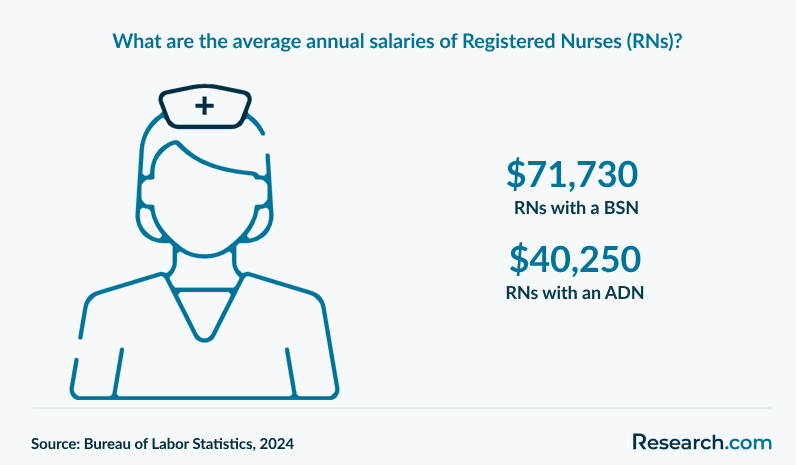
Registered Nurses with a Bachelor of Science in Nursing typically earn more than nurses with an Associate Degree in Nursing in the figures cited here. The average annual salary for BSN-prepared RNs is $71,730, compared with $40,250 for ADN-prepared RNs. That earnings gap is one reason many working nurses consider completing the BSN.
Some nurses use the BSN as a bridge to graduate study, including MSN pathways and programs listed among the best online FNP programs in the USA.
How does an online RN to BSN degree compare to an on-campus program?
RN to BSN online programs are often the better fit for licensed nurses who need to continue working. Campus programs may appeal to students who prefer in-person faculty access, structured class meetings, and on-site networking. The best choice depends on your schedule, learning style, clinical requirements, and local support system.
| Factor | Online RN to BSN | On-Campus RN to BSN |
| Schedule | Often more flexible; may include asynchronous weekly assignments | Usually requires set class times and commuting |
| Work compatibility | Typically designed for working RNs | Can be harder to manage with rotating shifts |
| Faculty and peer interaction | Virtual discussions, email, video meetings, online office hours | Face-to-face class discussions, campus events, informal networking |
| Clinical or practicum access | May require local placements, projects, or limited in-person components | May offer more direct access to campus-affiliated clinical sites or labs |
| Best for | Self-directed students who need flexibility | Students who learn best with in-person structure |
What is the average cost of an RN to BSN degree program?
The average cost of an RN to BSN online program varies by school type, location, residency status, transfer credits, fees, and program length. A common program range is $7,000 to $20,000 for the full program, although some listed programs fall below or above that range depending on tuition structure and residency status.
Cost factors to compare before enrolling
- Public versus private institution: Public universities often offer lower tuition, especially for in-state students.
- In-state versus out-of-state tuition: Residency can substantially affect cost unless the school charges one online rate.
- Transfer credits: A generous transfer policy can reduce both time and tuition.
- Fees: Technology, online learning, lab, clinical, graduation, and course fees can change the total price.
- Books and supplies: Electronic resources may reduce costs, but students should still budget for course materials.
- Lost income or reduced shifts: Accelerated study may require fewer work hours, which affects total affordability.
- Employer reimbursement: Hospital or healthcare system tuition benefits can meaningfully lower out-of-pocket cost.
Examples of RN to BSN cost figures
- University of Central Florida: In-state tuition is about $3,152 for 30 credits, while out-of-state tuition is $18,483.
- New Mexico Highlands University: Tuition costs $325 per credit, totaling approximately $7,750 for 31 credits.
- University of Louisville: Tuition is $375 per credit for non-military students, totaling $11,625 for 31 credits.
For the most accurate estimate, request a written cost breakdown from each school. Ask the admissions or financial aid office to include tuition, required fees, transfer credits accepted, books, clinical or practicum costs, and the expected number of credits you personally must complete. You can also compare institutions using College Scorecard.
What are the financial aid options for students enrolling in an RN to BSN degree program?
RN to BSN students may qualify for federal aid, state aid, employer tuition assistance, scholarships, grants, and loans. The right mix depends on enrollment status, school eligibility, income, state programs, and employer benefits.
Federal Financial Aid
- Federal Pell Grant: This grant may be available to undergraduate students with exceptional financial need.
- Federal Direct Loans: Eligible students may use subsidized and unsubsidized federal direct loans to help pay for school.
- Federal Work-Study: This program provides part-time work opportunities for students who qualify based on financial need.
State Grants and Scholarships
- State grants: Some states provide targeted aid for nursing students, including RN to BSN students.
- Nursing scholarships: Professional nursing organizations, hospitals, foundations, and local community groups may offer scholarships for nurses advancing their education.
Employer Tuition Reimbursement
- Healthcare employer benefits: Many hospitals and healthcare organizations support RN education through tuition reimbursement or tuition assistance programs. Always ask about grade requirements, annual reimbursement caps, work commitments, and repayment clauses if you leave the employer.
Private Loans
- Private student loans: Private loans may help cover costs not met by federal, state, or employer aid, but they should be compared carefully because interest rates, repayment rules, and borrower protections vary.
Steps to reduce your out-of-pocket cost
- Complete the Free Application for Federal Student Aid, or FAFSA, as early as possible.
- Ask your employer whether RN to BSN tuition assistance is available and whether certain schools are preferred partners.
- Search for nursing scholarships from hospitals, state nursing associations, professional groups, and local foundations.
- Request a transfer credit evaluation before committing to a school.
- Compare total program cost, not just per-credit tuition.
- Ask the financial aid office how aid applies to accelerated terms, part-time enrollment, and online fees.
What are the prerequisites for enrolling in an RN to BSN degree program?
RN to BSN programs are intended for licensed registered nurses, so admissions requirements typically center on prior nursing education, active licensure, academic performance, and completion of general education prerequisites.
- Active RN license: Most programs require a current, valid RN license in your state of residence or practice.
- ADN or nursing diploma: Applicants usually need an Associate Degree in Nursing or a diploma from an accredited nursing program.
- Minimum GPA: Many programs set a minimum GPA, commonly around 2.5 or 3.0.
- Prerequisite coursework: General education and science courses may need to be completed before enrollment or before progression into upper-division courses.
- Basic skills or placement tests: Some schools may require TEAS, Accuplacer, or other academic readiness assessments.
Students exploring nursing from another healthcare background may also consider fast track medical LPN courses as an earlier step toward nursing careers.
The share of newly licensed RNs entering practice with a baccalaureate degree as their first nursing credential has increased. In 2015, 39% of newly licensed RNs held a BSN. That figure rose to 41.8% in both 2017 and 2020, and then to 47.2% by 2022. This trend reflects the growing role of BSN education in the nursing workforce.
What courses are typically in an RN to BSN degree program?
RN to BSN coursework is designed to strengthen professional nursing practice rather than replace your RN training. The exact curriculum varies by school, but most programs focus on leadership, evidence-based practice, health assessment, community health, research, informatics, and quality improvement.
| Common Course | What Students Usually Learn |
| Advanced Health Assessment | More comprehensive assessment techniques, health histories, and physical examination skills. |
| Nursing Research | Research design, data interpretation, literature review, and the connection between research and clinical decisions. |
| Leadership and Management | Leadership theories, unit-level decision-making, healthcare policy, team communication, and management principles. |
| Pathophysiology | How disease processes affect body systems and clinical presentation. |
| Pharmacology | Medication principles, adverse effects, administration considerations, and therapeutic monitoring. |
| Community Health | Population health, prevention, health promotion, community assessment, and public health nursing. |
| Evidence-Based Practice | How to find, evaluate, and apply evidence to improve care quality and safety. |
Always review the current catalog for each school before applying. Some options, including RN to BSN online no clinicals programs, may structure experiential requirements differently from programs with traditional clinical rotations.
What types of specializations are available in RN to BSN degree programs?
Most RN to BSN programs are generalist completion degrees, not deep specialty training programs. They are meant to broaden professional practice, leadership, and population health skills. That said, some schools offer electives, emphases, or focused projects in specific areas. When comparing academic options, students sometimes ask questions such as whether is HR an easy degree; nursing students should make a similar but more career-specific comparison by weighing academic rigor, clinical expectations, licensing relevance, and long-term professional payoff.
- Gerontology: Focuses on older adult care, chronic disease management, geriatric assessment, and end-of-life considerations.
- Pediatrics: Covers care for infants, children, and adolescents, including developmental stages and common pediatric conditions.
- Medical-surgical nursing: Strengthens care for patients with acute and chronic medical or surgical needs.
- Public health nursing: Emphasizes prevention, health promotion, community assessment, and population-level care.
- Informatics: Introduces healthcare technology, electronic health records, health data, and information systems.
Specialized RN to BSN coursework can help clarify your interests, but advanced specialty roles often require graduate education, certification, or advanced practice preparation. For example, nurses interested in psychiatric advanced practice may later compare options such as the cheapest online PMHNP programs.
Can a paramedic bridge directly into an RN to BSN pathway?
Paramedics usually do not move straight into a standard RN to BSN program unless they already hold RN licensure. A more realistic route is often a paramedic-to-RN bridge first, followed by RN to BSN completion after becoming a licensed registered nurse. Paramedic experience may be valuable because it develops emergency assessment, triage, and rapid decision-making skills, but each nursing program sets its own credit, prerequisite, and clinical placement rules. Students comparing this route should review accreditation, state approval, admissions requirements, and clinical site availability. A useful starting point is this guide to a paramedic to rn bridge program online.
What student support services boost success in online RN to BSN programs?
Online RN to BSN students are often experienced clinicians, but they may be returning to academic writing, research, statistics, or online learning after years away from school. Strong support services can make a major difference, especially in accelerated formats.
- Academic advising: Helps students map transfer credits, prerequisites, degree requirements, and course sequencing.
- Technical support: Provides help with learning platforms, exam tools, document submission, and online classroom access.
- Online library access: Supports research assignments, evidence-based practice projects, and literature reviews.
- Writing and tutoring services: Useful for APA formatting, research papers, discussion posts, and capstone projects.
- Career services: Helps students translate BSN coursework into resumes, promotion applications, and graduate school plans.
- Clinical or practicum coordination: Important when programs require local placements, community projects, or preceptor arrangements.
Students seeking a different bridge route may also compare LPN to BSN programs, especially if they are not yet licensed as RNs.
Can an RN to BSN Degree Serve as a Stepping Stone to Advanced Nursing Degrees?
Yes. For many nurses, the RN to BSN is the academic bridge between entry-level RN preparation and graduate nursing study. A strong BSN completion program introduces research, evidence-based practice, leadership, quality improvement, community health, and professional writing skills that are useful in MSN and DNP programs. If your long-term goal is advanced practice, education, administration, or doctoral study, choose an RN to BSN program with recognized accreditation, strong advising, and coursework that supports graduate prerequisites. Nurses comparing doctoral options can also review accredited DNP programs online.
Can an RN to BSN degree advance my specialization in geriatric care?
An RN to BSN degree can support geriatric nursing interests when the curriculum includes aging, chronic disease management, community health, care coordination, health promotion, and end-of-life care. Some programs also offer gerontology electives or a geriatric leadership emphasis. This preparation can be useful in long-term care, home health, rehabilitation, hospice, population health, and community-based programs serving older adults. For a broader view of related career directions, review what can I do with a gerontology degree.
What challenges might students encounter during an online RN to BSN program?
Accelerated online programs can be convenient, but they are not easy by default. The most common difficulties involve time management, academic writing, technology, isolation, and balancing shift work with deadlines.
| Common Challenge | Better Strategy |
| Assuming online means self-paced with no deadlines | Check whether courses are asynchronous, synchronous, cohort-based, or accelerated before enrolling. |
| Underestimating weekly workload | Ask advisors how many hours per week students typically spend per course. |
| Struggling with research papers | Use writing support, library tutorials, and faculty office hours early. |
| Technology problems | Test the learning platform, webcam, internet connection, and exam software before classes begin. |
| Clinical or practicum confusion | Confirm whether you must find your own site, whether your workplace can be used, and what state restrictions apply. |
| Feeling isolated | Join discussion groups, virtual study sessions, and cohort communication channels. |
Nurses who want a different structure or who are entering nursing from a non-nursing background may also investigate online direct entry MSN programs.
Is the Online RN to BSN Degree a Worthwhile Investment?
An online RN to BSN degree can be a worthwhile investment when it improves your eligibility for promotions, specialty roles, graduate programs, or employers that prefer baccalaureate-prepared nurses. The investment is strongest when tuition is manageable, transfer credits reduce the number of courses required, employer reimbursement lowers out-of-pocket cost, and the program is accredited.
To evaluate ROI, compare your current pay and career ceiling with likely opportunities after graduation. Also consider non-salary benefits such as leadership readiness, graduate school access, professional confidence, and mobility into public health, care coordination, education, or informatics. Cost-sensitive students can compare RN to BSN online programs focused on affordability.
What emerging trends are shaping RN to BSN education?
RN to BSN education is changing as healthcare becomes more digital, team-based, data-informed, and population-focused. Many programs now include more emphasis on telehealth, simulation, informatics, quality improvement, interprofessional collaboration, health equity, and evidence-based decision-making. These changes reflect what nurses increasingly encounter in hospitals, outpatient care, home monitoring, public health, and virtual care environments.
- Telehealth and remote care: Nurses need stronger communication and assessment skills for virtual patient interactions.
- Healthcare data and informatics: BSN coursework increasingly addresses electronic records, data use, documentation quality, and safety indicators.
- Population health: Programs place more emphasis on prevention, chronic disease, community assessment, and social factors affecting care.
- Interprofessional practice: Nurses are being prepared to collaborate more effectively with physicians, pharmacists, therapists, social workers, and care teams.
- Pathways to advanced specialties: BSN graduates may later move toward advanced practice roles, where compensation varies by specialty and geography, as reflected in resources such as psych nurse practitioner salary data.
Can I Enter an RN to BSN Program with Less Competitive Credentials?
Yes, some RN to BSN programs admit students with modest GPAs or less competitive academic records, particularly when applicants hold an active RN license and meet prerequisite requirements. However, “easier admission” should not be the only criterion. Look closely at accreditation, graduation support, transfer credit policies, tutoring, faculty access, and whether the program has realistic course pacing for your situation. Students comparing less selective pathways may also review easiest nursing schools to get into in California, while keeping in mind that admissions flexibility should never replace program quality or state approval.
Should I Pursue Advanced Nursing Degrees After My BSN?
Pursuing an advanced nursing degree after the BSN makes sense if your long-term goals require graduate preparation. Nurse practitioner, nurse educator, nurse anesthetist, nurse midwife, clinical leadership, health administration, informatics, and doctoral practice roles may require an MSN, DNP, certification, or additional licensure. Before committing, compare prerequisites, cost, clinical hour requirements, specialty fit, state scope-of-practice rules, and employer demand. Nurses seeking cost-conscious doctoral routes can review the best affordable DNP programs.
How are online RN to BSN programs preparing nurses for digital healthcare transformation?
Online RN to BSN programs increasingly use digital learning tools while also teaching nurses how technology affects care delivery. Students may encounter simulation exercises, telehealth case studies, informatics assignments, virtual collaboration, data interpretation, and quality improvement projects. These experiences can strengthen readiness for remote patient monitoring, electronic documentation, patient education through digital channels, and interdisciplinary communication. Nurses who want to continue into technology-informed doctoral pathways may compare affordable online BSN to DNP programs.
How do you choose the best RN to BSN degree program?
The best RN to BSN program is the one that is accredited, affordable, realistic for your schedule, compatible with your state and employer requirements, and aligned with your next career step. Rankings can help you build a shortlist, but your final choice should be based on verified program details.
Checklist for comparing RN to BSN programs
- Accreditation: Confirm that the program is accredited by the Commission on Collegiate Nursing Education (CCNE) or the Accreditation Commission for Education in Nursing (ACEN).
- Transfer credit policy: Ask for an official evaluation so you know exactly how many credits you must complete.
- Total cost: Compare tuition, fees, books, technology charges, lab fees, and clinical or practicum expenses.
- Clinical or practicum requirements: Verify whether any in-person work is required and whether it can be completed near you.
- Schedule format: Determine whether courses are five-week, seven-week, semester-based, asynchronous, synchronous, full-time, or part-time.
- Faculty expertise: Review faculty experience in leadership, evidence-based practice, community health, informatics, and specialty areas.
- Student support: Look for advising, tutoring, writing help, library access, technical support, and career services.
- Graduate school alignment: If you plan to pursue an MSN or DNP, confirm that the BSN meets admissions expectations for future programs.
- Employer recognition: Ask your hospital or healthcare system whether it recognizes the school for tuition reimbursement or advancement.
Common mistakes to avoid
- Choosing the shortest program without confirming accreditation.
- Comparing only tuition per credit instead of total degree cost.
- Assuming all online programs have no in-person requirements.
- Ignoring transfer credit rules until after admission.
- Taking an accelerated load while working full-time without a realistic weekly study plan.
- Assuming salary increases are automatic after graduation.
- Relying only on rankings instead of asking program-specific questions.
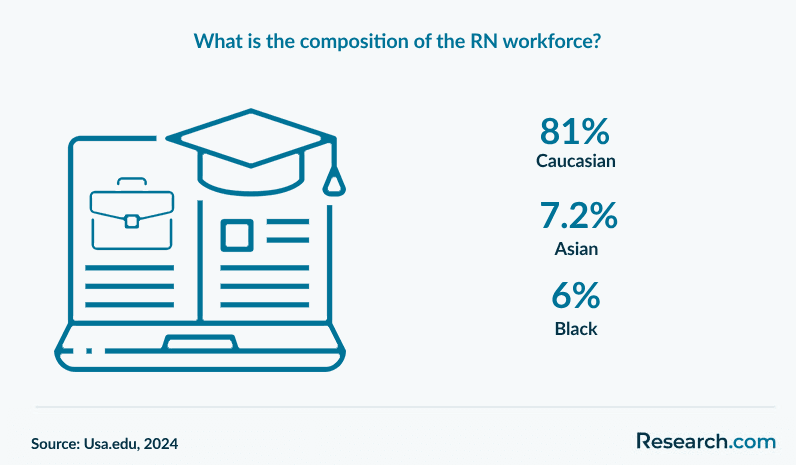
The RN workforce is diverse, although Caucasian nurses remain the largest group at 81%. Asian nurses account for 7.2%, Black nurses for 6%, and Hispanic nurses for 5.6%. The continued diversification of the workforce reflects broader demographic changes in the U.S. population.
Can an RN to BSN Degree Accelerate My Journey to a DNP?
An RN to BSN degree can shorten the path toward a DNP if it helps you meet baccalaureate prerequisites for BSN-to-DNP or MSN programs. BSN coursework in research, quality improvement, leadership, and evidence-based practice also introduces concepts that appear in doctoral nursing education. However, acceleration depends on the graduate program’s admissions rules, transfer policies, clinical hour expectations, and specialty requirements. Nurses comparing doctoral options may also explore the easiest DNP program, while still checking accreditation, clinical placement support, and state licensure alignment.
How Can an RN to BSN Degree Open Doors to Specialized Nursing Roles?
The RN to BSN can strengthen your profile for specialty nursing roles by adding leadership, research, population health, quality, and systems-level thinking to your clinical experience. It may help nurses move into areas such as critical care, pediatrics, geriatrics, case management, women’s health, public health, or informatics. For many advanced specialty roles, the BSN is also the required foundation for graduate study and certification. Nurses interested in women’s health advanced practice can compare cheapest online womens health nurse practitioner programs after completing appropriate BSN preparation.
What career paths are available for graduates of RN to BSN degree programs?
RN to BSN graduates may remain in direct patient care, move into specialty units, pursue leadership, support quality initiatives, or continue into graduate nursing education. The degree does not replace licensure or specialty certification requirements, but it can improve eligibility for roles that value or require BSN preparation.
| Career Direction | Examples | How the BSN Helps |
| Direct patient care | Staff nurse in hospitals, clinics, community health, home health, or long-term care | Strengthens assessment, evidence-based practice, communication, and professional nursing judgment. |
| Specialty nursing | Critical care, emergency nursing, pediatrics, geriatrics, oncology, medical-surgical nursing | Supports specialty readiness and may improve competitiveness for unit transfers or certification preparation. |
| Leadership | Charge nurse, nurse manager, unit coordinator, clinical leader | Adds leadership, policy, systems, and quality improvement training. |
| Education | Staff educator, preceptor, clinical training support | Develops teaching, evidence review, and professional communication skills. |
| Administration and quality | Nurse administrator, quality improvement nurse, care coordinator, case manager | Builds knowledge of healthcare systems, outcomes, safety, and population health. |
| Informatics and consulting | Nurse informaticist, nurse consultant, workflow improvement roles | Provides a foundation in technology, data-informed practice, and process improvement. |
| Graduate study | Nurse practitioner, clinical nurse specialist, educator, DNP pathway | Meets a common academic prerequisite for MSN, DNP, and certificate programs. |
After the BSN, some nurses continue through a master’s degree and later compare options such as the shortest post master's FNP program pathways.
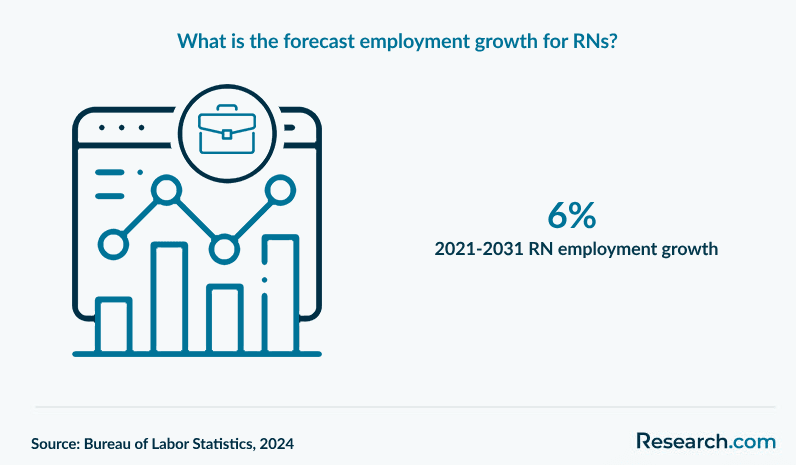
The Bureau of Labor Statistics projects 6% growth in RN employment from 2021 to 2031, faster than the average for all occupations. This projected growth is tied to demand for healthcare services and the needs of an aging population.
What is the job market for graduates with an RN to BSN degree?
The job market for RN to BSN graduates is generally strong across hospitals, clinics, public health agencies, home health, long-term care, and specialty settings. Many employers prefer or require BSN-prepared nurses for certain positions, especially in leadership, specialty care, care coordination, community health, and organizations focused on higher patient care standards. The BSN also supports progression into MSN and DNP programs.
Salary Expectations
- Average Salary: The average BSN nurse salary is $71,730 annually in the U.S., compared with about $40,250 for RNs with an Associate Degree in Nursing.
- Top Earning States: California, New Jersey, and the District of Columbia are cited among the highest-paying locations for BSN-educated nurses, with average salaries ranging from $94,000 to $95,700.
- Career Advancement: BSN graduates may qualify for higher-paying leadership and specialty clinical roles, though actual pay depends on employer, location, experience, and specialty.
In 2023, the median annual salary for BSN-prepared Registered Nurses was $86,070. Salaries ranged from $63,720 for the bottom 10% of earners to $132,680 for the top 10%. The 25th and 75th percentile salaries were $75,990 and $104,670, respectively.
Those salary ranges show why local context matters. A nurse’s pay can vary widely by state, metro area, years of experience, specialty, shift, employer type, and leadership responsibilities.
Job Growth
The Bureau of Labor Statistics predicts 6% employment growth for registered nurses between 2021 and 2031. BSN-prepared nurses may be better positioned for opportunities in competitive hospitals, specialty units, and organizations that prefer baccalaureate education.
Additional credentials in related health fields, including programs from online nutrition schools, may also support specific career interests, although they are not a substitute for nursing licensure or BSN requirements.
Locations with High Demand
- States with large healthcare systems, including Texas, New York, and California, offer significant employment opportunities and competitive salaries.
- Metropolitan areas such as Houston, Secaucus, and Washington, D.C., are cited as lucrative markets, with salaries exceeding $85,000 annually in some cases.
Overall, a BSN can strengthen career mobility for registered nurses, but the degree should be evaluated alongside cost, time commitment, employer expectations, and personal career goals.
Here’s What Graduates Have to Say About Their RN to BSN Nursing Degree
-
: "
Completing my BSN through an accelerated online format changed the way I viewed my nursing career. I was able to build on my RN experience quickly while still managing work and family responsibilities. The leadership and evidence-based practice courses helped me feel more prepared to contribute at a higher level in patient care. Linda
"
-
: "
I was nervous about returning to school as a working nurse, but the online structure made it possible. The faculty support mattered, and the assignments connected directly to situations I see in practice. I could apply what I was learning almost immediately with my patients and team. Madison
"
-
: "
Earning my BSN online was one of the most important professional decisions I have made. The program pushed me in research, leadership, and quality improvement, but the flexibility allowed me to keep up with work and family. I now feel more confident pursuing new nursing opportunities. Ernesto
"
Key Insights
- Fast RN to BSN programs are not all truly 6 months; many realistic accelerated options take two semesters, 10 months, one year, or 12–18 months depending on transfer credits and pacing.
- Accreditation should be nonnegotiable. Prioritize programs accredited by CCNE or ACEN and verify requirements directly with the school.
- Total cost matters more than tuition per credit. Compare fees, transfer credits, books, clinical or practicum expenses, and employer reimbursement.
- Online RN to BSN programs are usually best for self-directed working nurses, while campus programs may better support students who want face-to-face structure.
- BSN-prepared RNs are associated with higher salary figures in this guide, including $71,730 annually compared with about $40,250 for ADN-prepared RNs in cited comparisons.
- In 2023, the median annual salary for BSN-prepared RNs was $86,070, with a range from $63,720 for the bottom 10% to $132,680 for the top 10%.
- The Bureau of Labor Statistics projects 6% RN employment growth from 2021 to 2031.
- A BSN can support advancement into leadership, specialty nursing, community health, informatics, education, and graduate nursing pathways.
- The strongest RN to BSN choice is the program that fits your state, schedule, budget, transfer credits, employer expectations, and long-term career plan.
References:
- Bureau of Labor Statistics, U.S. Department of Labor. (2023). Occupational Outlook Handbook: Registered Nurses. Bureau of Labor Statistics.
- Data USA. (n.d.). Registered nurses. Data USA.
- National Council of State Boards of Nursing (NCSBN). (2022). The 2022 national nursing workforce survey. Journal of Nursing Regulation.
- National Council of State Boards of Nursing. (2023). Nursing education in the pandemic: Outcomes, trends, and regulatory changes. Journal of Nursing Regulation, 14(1), S2155-8256(23)00047-9. National Council of State Boards of Nursing.
- New Mexico Highlands University. (2024). RN to BSN tuition and fees. New Mexico Highlands University.
- Salary.com. (2024). RN BSN salary in Texas. Salary.com.
- Salary.com. (2024). What are the salary differences between BSN and ADN nurses? Salary.com.
- University of Central Florida. (2024). RN to BSN program details. University of Central Florida.
- University of Louisville. (2024). Tuition for RN to BSN program. University of Louisville.
- USAHS. (2024). 60 key nursing statistics and trends for 2021. University of St. Augustine for Health Sciences.
- U.S. Bureau of Labor Statistics (BLS). (2022). Registered nurses: Job outlook and wages. Occupational Outlook Handbook. U.S. Bureau of Labor Statistics.
Other Things You Should Know About RN to BSN Degree Programs
Several RN to BSN programs in 2027 offer accelerated completion within six months. Top programs include those from universities like the University of Texas at Arlington, Western Governors University, and Chamberlain University. These programs are designed for motivated students seeking swift advancement in their nursing careers.
Yes, if the BSN is from a CCNE- or ACEN-accredited school, state boards of nursing usually accept it for academic advancement. These programs do not grant RN licensure; they add upper-division nursing credits, often 30 to 36 semester hours, for registered nurses already licensed in the United States.


