
2027 Best Online Nutrition Programs

Co-Founder and Chief Data Scientist
In today's fast-changing job landscape, the demand for qualified dieticians and nutritionists is on the rise. With a projected growth rate of 6% from 2024 to 2034, opportunities abound in this field. However, many aspiring professionals struggle to find reputable and accessible educational pathways to pursue this rewarding career.
As someone deeply involved in career planning and education for 10+ years, I recognize the importance of navigating these options wisely. In this guide, drawing upon my expertise and insights, I aim to shed light on the best online nutrition programs. From discussing the job outlook for dieticians and nutritionists to assessing the effectiveness of online programs, this article seeks to empower individuals to make informed decisions about their education and career paths.
What are the benefits of a degree from the best online nutrition programs?
- A degree in nutrition or dietetics opens doors to diverse job roles in healthcare, food industry, research, and community nutrition programs.
- Graduates can expect a median annual salary of around $66,450, offering financial stability and growth potential in the field of nutrition and dietetics.
- Pursuing a degree in nutrition or dietetics online provides the flexibility to balance education with personal and professional commitments, making it accessible to a wider range of learners.
What can I expect from the best online nutrition programs?
The best online nutrition programs offer comprehensive coursework covering fundamental principles of nutrition science, dietetics, and food systems. These programs are designed to provide students with a deep understanding of nutritional needs across diverse populations and settings. Expect interactive learning modules, virtual labs, and engaging multimedia resources that facilitate hands-on experience and critical thinking skills development. Additionally, top online nutrition programs often feature experienced faculty members who are leaders in the field, offering personalized guidance and mentorship to students. Practical experiences such as internships, clinical rotations, and research projects may also be integrated into the curriculum, allowing students to apply theoretical knowledge in real-world scenarios. Furthermore, expect robust support services, including academic advising, career counseling, and networking opportunities to enhance your educational journey and prepare you for success in the dynamic field of nutrition and dietetics.
Where can I work with a degree from the best online nutrition programs?
With a degree from the best online nutrition programs, you can explore employment opportunities across various industries and states. The top industries employing the most nutritionists and dieticians in 2025 include general medical and surgical hospitals (20,220), outpatient care centers (6,590), offices of other health practitioners (6,330), special food services (7,190), and nursing care facilities (6,000).
Moreover, states like New York (7,289), Florida (6,264), Texas (8,140), and Pennsylvania (5,188) boast substantial employment opportunities for nutritionists and dieticians. With a total workforce population of 69,880, the field offers diverse career paths and settings for professionals to pursue.
Whether in hospitals, outpatient care centers, health practitioner offices, food services, or nursing care facilities, a degree from the best online nutrition programs equips you with the knowledge and skills to thrive in various professional environments across the United States.
How much can I make with a degree from the best online nutrition programs?
With a degree from the best online nutrition programs, your earning potential varies based on factors such as experience, location, and industry. In 2025, the median annual salary for nutritionists and dieticians was $73,850. However, specializing in certain sectors can yield higher incomes. For instance, working in outpatient care centers offered a median salary of $75,860, while the government sector provided $66,370. Hospitals and nursing or residential care facilities offered median salaries ranging from $64,310 to $66,170 respectively. Advancing in your career with experience and additional certifications can also increase your earning potential.
- 2027 Best Online Nutrition Programs Best Programs
- How long does it take to complete an online nutrition program? Completion Time
- How does an online nutrition program compare to an on-campus program? How does an online nutrition program compare to an on-campus program?
- What is the average cost of an online nutrition program? Average Cost
- What are the financial aid options for students enrolling in an online master's degree in education program? Financial Aid
- What are the prerequisites for enrolling in an online nutrition program? Requirements
- What courses are typically in an online nutrition program? What courses are typically in an online nutrition program?
- What types of specializations are available in an online nutrition program? What types of specializations are available in an online nutrition program?
- How do you choose the best online nutrition program? How do you choose the best online nutrition program?
- What career paths are available for graduates of online nutrition programs? What career paths are available for graduates of online nutrition programs?
- What is the job market for graduates of online nutrition programs? Job Outlook
- How do online nutrition programs incorporate technology to enhance learning? How do online nutrition programs incorporate technology to enhance learning?
- How can mastering healthcare administration skills boost your nutrition career? How can mastering healthcare administration skills boost your nutrition career?
- How do affordable online master's programs impact career advancement in nutrition? How do affordable online master's programs impact career advancement in nutrition?
- Can accelerated medical assistant programs complement my online nutrition education? Can accelerated medical assistant programs complement my online nutrition education?
- Should you add short-term healthcare certifications to your nutrition degree? Should you add short-term healthcare certifications to your nutrition degree?
- How do online nutrition programs foster professional networking and development? How do online nutrition programs foster professional networking and development?
- How do online nutrition programs offer targeted career placement support? How do online nutrition programs offer targeted career placement support?
- Can interdisciplinary healthcare degrees complement your online nutrition credentials? Can interdisciplinary healthcare degrees complement your online nutrition credentials?
- What certifications can enhance your career prospects after completing an online nutrition program? What certifications can enhance your career prospects after completing an online nutrition program?
- Is pursuing an accelerated PharmD program beneficial alongside your online nutrition degree? Is pursuing an accelerated PharmD program beneficial alongside your online nutrition degree?
- How do online nutrition programs uphold academic quality and credibility? How do online nutrition programs uphold academic quality and credibility?
Best Online Nutrition Programs for 2027
Choosing an online nutrition program is not just a question of convenience. The bigger decision is whether the degree fits your career goal: becoming a Registered Dietitian Nutritionist, moving into wellness coaching, working in public health, supporting athletes, entering food service management, or preparing for graduate study. The right program should match your schedule, budget, accreditation needs, transfer-credit situation, and long-term credential requirements.
This guide explains how online nutrition degrees work, how they compare with campus-based programs, what they cost, what courses and specializations to expect, and which career paths may be available after graduation. It also highlights common mistakes to avoid, especially for students who need an accredited pathway toward dietetics credentials.
Quick Answer: What Is the Best Online Nutrition Program?
The best online nutrition program is the one that aligns with your intended career outcome. Students who want to pursue dietetics should prioritize programs connected to recognized nutrition and dietetics accreditation, such as ACEND. Students interested in wellness, food science, public health, sports nutrition, or graduate study may have more flexibility, but they should still verify institutional accreditation, curriculum depth, faculty expertise, practicum options, and total cost.
Based on the programs reviewed here, online bachelor’s degrees in nutrition commonly require 120 credits and take about 4 years for full-time students, although transfer credits, part-time enrollment, and program structure can change the timeline.
How We Ranked Online Nutrition Programs
Research.com evaluates online nutrition programs using a structured ranking process designed to compare programs consistently. Our team reviews institutional and program-level information using our ranking methodology, along with data from reputable education sources such as the IPEDS database from the National Center for Education Statistics, Peterson's database Distance Learning Licensed Data Set, and the College Scorecard. These sources help us assess factors such as distance-learning availability, institutional characteristics, and program information.
Rankings should be used as a starting point, not the only decision tool. Before enrolling, confirm the program’s current accreditation status, tuition, online course format, internship or supervised practice requirements, and whether the curriculum supports your specific career path.
Online Nutrition Programs at a Glance
| School | Degree | Credits | Cost per Credit | Best Fit |
| University of Arizona | BS in Nutritional Sciences | 120 | $525 | Students choosing between Nutrition and Dietetics emphases |
| The University of Alabama | BS in Food and Nutrition | 120 | $385 | Students seeking a flexible online pathway related to food, nutrition, and dietetics preparation |
| Purdue Global University | BS in Nutrition | 180 | $371 | Students interested in nutrition, wellness, holistic nutrition, and optional internship experience |
| University of Northern Colorado | BS in Dietetics | 120 | $484 | Students who need a distance-based ACEND-accredited Didactic Program in Dietetics pathway |
| Kansas State University | BS in Nutrition and Health | 120 | $468 | Students seeking a customizable nutrition and health curriculum |
1. University of Arizona — BS in Nutritional Sciences
The University of Arizona offers an online Bachelor of Science in Nutritional Sciences focused on how food and nutrients affect health, disease risk, and human development across the lifespan. Students study areas such as nutritional biology, food science, nutrition assessment, and therapeutic diets.
The program offers two emphases: Nutrition and Dietetics. The Dietetics emphasis is designed for students preparing for dietetic internships and the pathway toward registration as a dietitian through the Academy of Nutrition and Dietetics. The Nutrition emphasis may be better suited for students interested in health-related careers, research, food science, or graduate study outside the RDN pathway.
- Program length: 4 years
- Specializations: Nutrition; Dietetics
- Required credits to graduate: 120
- Cost per credit: $525
- Accreditation: Accreditation Council of Education in Nutrition and Dietetics (ACEND)
2. The University of Alabama — BS in Food and Nutrition
The University of Alabama offers an online BS in Food and Nutrition that combines nutrition science, food systems, and education-oriented coursework. The program is designed for students who want to understand the relationship between diet and health while preparing for nutrition-related roles or a registered dietitian pathway.
The online structure may be especially useful for working adults because it allows students to complete coursework without relocating. Prospective students should ask how the program supports supervised practice planning, advising for dietetics requirements, and preparation for post-bachelor’s credential steps.
- Program length: 4 years
- Required credits to graduate: 120
- Cost per credit: $385
- Accreditation: Academy of Nutrition and Dietetics
3. Purdue Global University — BS in Nutrition
Purdue Global University offers an online BS in Nutrition covering topics such as dietary decisions, pharmacology, metabolism, and nutrition needs across life stages. Students may also pursue a holistic nutrition concentration, which can appeal to learners interested in wellness-oriented or alternative health approaches.
The program includes optional internship opportunities and may support preparation for credentials such as Board Certified in Holistic Nutrition, Certified Clinical Nutritionist, Certified Dietary Manager, and SafeServ Food Manager. Students should confirm which certifications require additional exams, experience, education, or third-party eligibility review.
- Program length: 4 years
- Required credits to graduate: 180
- Cost per credit: $371
- Accreditation: Higher Learning Commission (HLC); National Association of Nutrition Professionals (NANP)
4. University of Northern Colorado — BS in Dietetics
The University of Northern Colorado offers a Distance Dietetic Program through its ACEND-accredited Didactic Program in Dietetics. The distance option follows the on-campus curriculum while giving students more flexibility to complete coursework remotely.
The program includes 15 online courses, with other required coursework completed through regionally accredited institutions. It may be a strong option for students pursuing a first bachelor’s degree, completing missing dietetics requirements, or preparing to apply for dietetic internships and later RDN eligibility.
- Program length: 4 years
- Required credits to graduate: 120
- Cost per credit: $484
- Accreditation: Accreditation Council of Education in Nutrition and Dietetics (ACEND)
5. Kansas State University — BS in Nutrition and Health
Kansas State University offers an online BS in Nutrition and Health built around the science of food, wellness, and human health. The curriculum allows students to tailor coursework toward their interests, which can be helpful for learners considering health education, wellness, clinical support, food systems, or graduate study.
Courses may cover topics such as personal wellness, allergies and intolerances, nutrition for athletes, clinical nutrition, and health care organization administration. Students should speak with an advisor about whether the program meets their intended credential or graduate-school requirements.
- Program length: 4 years
- Required credits to graduate: 120
- Cost per credit: $468
- Accreditation: Accreditation Council of Education in Nutrition and Dietetics (ACEND)
What Graduates Say About Online Nutrition Degrees
- : "My goal was to work with athletes, and the online format helped me keep building toward that career without pausing the rest of my life. The coursework helped me understand how nutrition supports training, performance, and recovery. — Jake"
- : "The degree gave me a stronger foundation for talking with patients about food, lifestyle, and chronic condition management. Because the program was online, I could continue working full-time while improving my nutrition knowledge. — Michael"
- : "As someone interested in food entrepreneurship, I valued learning about nutrition science, food behavior, and product ideas while still having time to test recipes and develop a business concept. — Daniel"
Key Findings
- Many online bachelor’s nutrition programs take about 4 years and require 120 credits, although some programs use a different credit structure, such as Purdue Global University’s 180-credit program.
- Students pursuing Registered Dietitian Nutritionist preparation should carefully verify dietetics accreditation and post-degree requirements before enrolling.
- The average cost of the online nutrition programs reviewed is approximately $58,100 in total tuition, with an average cost per credit of around $447 and a listed range from $371 to $525 per credit.
- Career outcomes vary widely. A nutrition degree can support roles in dietetics, wellness, public health, sports nutrition, food service, research, and nutrition education, but not every degree leads to the same credentials.
- Online programs can be a strong fit for working adults, but students still need to plan for labs, internships, supervised practice, transfer credits, and any credential-specific requirements.
How Long Does It Take to Finish an Online Nutrition Program?
A full-time student can often complete an online bachelor’s degree in nutrition or dietetics in about 4 years. The actual timeline depends on the number of required credits, how many courses the student takes each term, whether the school accepts transfer credits, and whether the program includes internships, labs, or supervised practice requirements.
| Program Level | Typical Timeframe | What Can Change the Timeline? |
| Bachelor’s degree | About 4 years for full-time students | Transfer credits, part-time enrollment, repeated science courses, internship planning, and program credit requirements |
| Master’s degree | 1 to 2 years | Thesis requirements, practicum expectations, specialization, and full-time or part-time status |
| Doctorate | 3 to 5 years | Research scope, dissertation timeline, faculty supervision, and student commitment |
Students who already hold a bachelor’s degree may consider an online master’s degree in nutrition for advanced study. Those interested in research-intensive roles may compare doctoral options within a broader nutritional science degree pathway.
In 2025, the industries with the highest workforce population were general medical and surgical hospitals, with 20,220 workers, and special food services, with 7,190 workers.
Online vs. On-Campus Nutrition Programs: Which Format Is Better?
Online and on-campus nutrition programs can both provide rigorous academic preparation when they are properly accredited and well designed. The better option depends on your learning style, schedule, location, and whether the program requires in-person labs, supervised practice, or local field experiences.
| Factor | Online Nutrition Program | On-Campus Nutrition Program |
| Schedule | Often better for working adults, caregivers, and students who need flexible study time | Better for students who prefer fixed class times and in-person structure |
| Interaction | Uses discussion boards, video meetings, online advising, virtual labs, and digital collaboration tools | Offers face-to-face faculty access, campus labs, student organizations, and live peer interaction |
| Hands-on learning | May use virtual labs, local placements, or arranged supervised experiences | May provide easier access to campus kitchens, labs, clinics, and partner sites |
| Best for | Students who need location flexibility and can manage independent learning | Students who want campus support, in-person lab access, and more direct daily structure |
Online learning works especially well for lecture-heavy and theory-based courses. Similar flexibility can be seen in other healthcare education areas, from diagnostic medical sonographer schools to programs that teach healthcare administration courses. However, nutrition students should not assume every requirement can be completed virtually.
If you are comparing an online nutrition degree with a campus program, ask whether labs, internships, dietetic supervised practice, or state-specific credential requirements require in-person participation.
How Much Does an Online Nutrition Program Cost?
The average total tuition for the online nutrition programs reviewed is approximately $58,100. The average cost per credit is around $447, with listed per-credit costs ranging from $371 to $525. These figures help estimate tuition, but they do not always include books, technology fees, lab supplies, application fees, background checks, exam fees, transportation to field sites, or supervised practice costs.
| Cost Factor | Why It Matters |
| Tuition per credit | This is the clearest starting point for comparing programs, but it is not the full cost. |
| Total required credits | A lower per-credit rate may not mean lower total tuition if the program requires more credits. |
| Transfer-credit policy | Accepted credits can reduce both time and cost. |
| Fees and materials | Online, lab, textbook, and assessment fees can increase the real price. |
| Credential costs | Certification, licensing, or dietetics-related steps may require additional expenses after graduation. |
From an ROI perspective, students should compare program cost with realistic career outcomes rather than assuming a degree guarantees a specific salary. The field’s job outlook is described as positive, with experts estimating 5,000 new job openings every year from 2024 to 2034. In 2025, the median annual salary for nutritionists and dieticians was $73,850.
What Financial Aid Can Online Nutrition Students Use?
Online nutrition students may qualify for several types of financial aid, depending on the school’s eligibility, the student’s enrollment status, financial need, and academic standing. Always confirm that the program participates in federal aid before assuming you can use FAFSA-based funding.
- Federal student loans: Direct Subsidized and Unsubsidized Loans may help eligible students pay tuition and other education-related costs. Borrowers should review interest, repayment terms, and total debt before accepting loans.
- Grants: Aid such as the Pell Grant, Federal Supplemental Educational Opportunity Grant (FSEOG), and state grant programs may help eligible students reduce out-of-pocket costs without repayment.
- Scholarships: Universities, professional associations, nonprofits, and private organizations may award scholarships based on academic performance, service, identity, career goals, or financial need. Scholarship opportunities exist across many healthcare education paths, including community college programs such as the best online pharmacy technician associate programs.
- Work-study programs: Eligible students may earn money through part-time work connected to a federal or institutional work-study award.
- Employer tuition reimbursement: Some employers help pay for additional education, especially when the degree supports promotion, retention, or workforce development. Healthcare workers may also compare related advancement routes, such as an online degree in healthcare administration.
What Are the Admission Requirements for Online Nutrition Programs?
Admission requirements vary by degree level and school. Bachelor’s programs usually focus on high school preparation and foundational science readiness, while graduate programs typically expect prior college coursework in nutrition, biology, chemistry, physiology, statistics, or related fields.
Bachelor’s Degree Requirements
- High school diploma or equivalent
- Prerequisite or recommended coursework in biology, chemistry, mathematics, and health sciences
- Standardized test scores, such as the SAT or ACT, if required by the school
- Letters of recommendation, depending on the institution
- Personal statement or essay describing academic goals and career interests
Master’s Degree Requirements
- Bachelor’s degree in nutrition, dietetics, or a related field from an accredited institution
- Minimum GPA requirement, usually around 3.0 on a 4.0 scale
- Prerequisite coursework in nutrition science, biochemistry, physiology, and statistics
- GRE scores, if required by the program
- Letters of recommendation
- Personal statement or essay explaining research interests, professional goals, and reasons for graduate study
Doctorate Degree Requirements
- Master’s degree in Nutrition, Dietetics, or a related field from an accredited institution
- Minimum GPA requirement, typically higher than the requirement for master’s admission
- Advanced coursework in nutrition, research methods, and statistics
- GRE scores, if required
- Letters of recommendation
- Curriculum vitae or resume showing academic and professional experience
- Statement of purpose describing research interests, career plans, and doctoral-study goals
Students preparing for nutrition careers should also review broader healthcare career requirements, especially if they plan to work in clinical environments, public health agencies, or regulated roles.
What Courses Are Included in an Online Nutrition Program?
Online nutrition programs typically combine life science, food science, health behavior, assessment, counseling, and population-health coursework. The exact curriculum depends on whether the degree is designed for dietetics preparation, general nutrition, wellness, food systems, or graduate study.
| Course Area | What Students Learn |
| Introduction to Nutrition | Core nutrient functions, dietary guidelines, energy balance, and the role of diet in health. |
| Human Anatomy and Physiology | How body systems work and how nutrition affects physiological processes. |
| Nutrition Assessment and Counseling | How to evaluate dietary needs, interpret nutrition data, and communicate practical recommendations. |
| Food Science and Technology | Food composition, processing, preservation, safety, quality control, and food-industry systems. |
| Public Health Nutrition | Community nutrition, chronic disease prevention, nutrition policy, and population-level interventions. |
Nutrition Degree vs. Dietetics Degree
Nutrition and dietetics programs overlap, but they are not always interchangeable. A nutrition degree may prepare students for wellness, education, public health, research support, food industry, or graduate-study pathways. A dietetics-focused degree is more directly connected to preparation for Registered Dietitian Nutritionist pathways and clinical nutrition practice.
If your goal is to become an RDN, do not choose a general nutrition program without confirming whether it meets dietetics education requirements. If your goal is health education, sports wellness, food entrepreneurship, or public health programming, a broader nutrition degree may provide more flexibility.
What Specializations Are Available in Online Nutrition Programs?
Specializations help students shape a nutrition degree around specific industries and roles. Not every program offers every concentration, so students should compare electives, faculty expertise, practicum options, and credential alignment.
| Specialization | Focus | Potential Fit |
| Clinical Nutrition | Nutrition assessment and dietary planning for people with medical conditions | Students interested in hospitals, clinics, long-term care, or dietetics pathways |
| Sports Nutrition | Fueling, recovery, hydration, and performance nutrition | Students who want to work with athletes, teams, fitness centers, or active populations |
| Public Health Nutrition | Community programs, prevention, policy, and population-level health | Students interested in agencies, nonprofits, schools, and public health initiatives |
| Nutrition Education and Counseling | Behavior change, communication, coaching, and group education | Students who want to teach, coach, or support lifestyle change |
| Food Service Management | Menu planning, food safety, nutrition regulations, and operations | Students interested in hospitals, schools, corporate dining, or long-term care food service |
Specialization choice can affect where graduates are most competitive. In 2025, the highest-paying industry for nutritionists and dieticians was the merchant wholesalers, nondurable goods sector, with pay listed at $96,520.
How to Choose the Best Online Nutrition Program
The best program is not always the cheapest, fastest, or highest-ranked. It is the program that supports your target credential, learning needs, budget, and career plan. Use the checklist below before applying.
- Confirm accreditation: If you plan to pursue dietetics, verify whether the program is accredited by a recognized body such as the Accreditation Council for Education in Nutrition and Dietetics (ACEND).
- Match the curriculum to your goal: Look for coursework in biochemistry, metabolism, clinical nutrition, food science, counseling, and public health if those areas matter for your career.
- Review faculty qualifications: Check whether instructors have nutrition, dietetics, research, clinical, or industry experience aligned with your interests.
- Calculate the full cost: Compare tuition, fees, books, transfer-credit savings, practicum expenses, and future credential costs.
- Compare specializations: Choose a program that offers relevant electives or concentrations, such as sports nutrition, clinical nutrition, public health nutrition, or food service management.
- Check flexibility: Ask whether courses are asynchronous, whether part-time study is available, and whether labs or internships require in-person attendance.
- Assess student support: Look for academic advising, technical help, career coaching, internship guidance, writing support, and access to faculty.
Questions to Ask Before Enrolling
- Does this program meet the education requirements for the credential I want?
- Is the accreditation current, and where can I verify it?
- How many transfer credits will the school accept?
- Are any labs, practicums, or internships required in person?
- What percentage of students complete the program on time?
- What career services are available to online students?
- What additional costs are not included in tuition?
What Careers Can You Pursue With an Online Nutrition Degree?
An online nutrition degree can support several career directions, but eligibility depends on the degree type, accreditation, certification, state rules, and experience. Some roles require additional supervised practice, exams, graduate education, or licensure.
- Registered Dietitian Nutritionist: RDNs work in hospitals, healthcare systems, private practice, community agencies, and food service settings. Students pursuing this path should verify dietetics education, internship, exam, and continuing education requirements.
- Clinical nutritionist: Clinical nutritionists assess patient or client nutrition needs and may develop dietary strategies in healthcare or wellness settings, depending on credential rules.
- Public health nutritionist: Graduates interested in public health degree careers may work on nutrition education, community programs, prevention campaigns, policy, and advocacy.
- Sports nutritionist: Sports nutrition professionals support athletes and active clients with performance, fueling, recovery, and body-composition goals. Students with exercise science interests may also explore what you can do with an exercise science bachelor degree.
- Food and nutrition researcher: Research-focused graduates may support studies, analyze nutrition data, or continue into graduate education.
- Nutrition educator: Nutrition educators design lessons, workshops, and community programs that help individuals and groups make informed food choices.
- Food industry specialist: Graduates may apply nutrition knowledge in product development, labeling, marketing, regulatory compliance, or quality assurance.
What Is the Job Market for Online Nutrition Program Graduates?
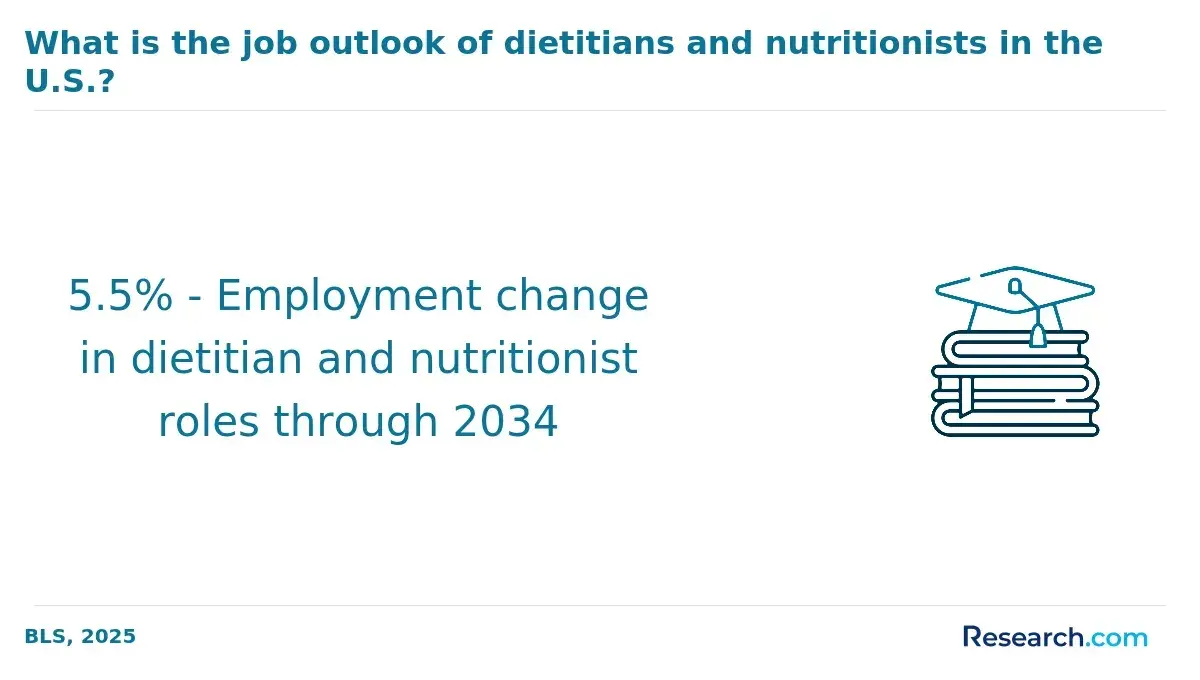
The job market for dietitians and nutritionists is projected to grow, with an average of 5,000 job openings per year from 2024 to 2034. The cited outlook reflects a 6% increase in job opportunities, with the number of jobs expected to rise yearly.
Students should interpret job-market data carefully. A degree can help build qualifications, but hiring depends on location, credential status, work experience, internships, specialization, and employer requirements. Clinical and regulated roles may require credentials beyond the bachelor’s degree.
How Do Online Nutrition Programs Use Technology?
Online nutrition programs use digital tools to deliver lectures, organize coursework, support collaboration, and simulate applied learning. Strong programs do more than post readings online; they create structured learning environments that help students practice analysis, communication, and problem-solving.
- Learning management systems: Platforms such as Canvas, Blackboard, or Moodle may host lectures, assignments, quizzes, grades, discussion forums, and course announcements.
- Virtual labs and simulations: Some programs use simulations for nutrition assessment, food analysis, counseling scenarios, or applied science activities.
- Multimedia learning tools: Videos, animations, interactive charts, and infographics can help explain metabolism, nutrient function, food systems, and health outcomes.
- Health apps and wearable technology: Programs may incorporate digital tools for tracking food intake, physical activity, and health metrics.
- Collaboration platforms: Zoom, Microsoft Teams, Google Workspace, and discussion boards can support group projects, advising, peer review, and live sessions.
Can Healthcare Administration Skills Strengthen a Nutrition Career?
Healthcare administration skills can be useful for nutrition professionals who want to move beyond direct education or counseling into program coordination, clinic operations, reimbursement workflows, or leadership. Knowledge of billing, coding, documentation, and interprofessional healthcare systems can help nutrition professionals communicate more effectively with clinical and administrative teams.
Students interested in administrative skills may compare targeted options such as online classes for medical billing and coding, especially if they plan to work in healthcare settings where documentation and reimbursement processes matter.
Can an Affordable Online Master’s in Nutrition Help With Advancement?
An affordable online master’s program may make sense for nutrition professionals who want deeper expertise in clinical nutrition, public health, nutrition research, or leadership without taking on unnecessary debt. Graduate study can also be useful for students whose career goals require advanced coursework or stronger research preparation.
Affordability should not be the only factor. Students should verify accreditation, faculty experience, practicum options, graduation requirements, and whether the degree supports roles such as nutrition program director, policy advisor, research specialist, or advanced clinical nutrition professional. A good starting point is to compare nutrition masters programs online by cost, structure, and career alignment.
Can Medical Assistant Training Complement Nutrition Education?
Accelerated medical assistant training can be helpful for nutrition students who want more direct exposure to patient care, clinic workflows, vital signs, documentation, and healthcare-team communication. This combination may be useful for students pursuing nutrition counseling, community health, or entry-level clinical support roles.
It is not a substitute for a nutrition or dietetics credential, but it can strengthen practical healthcare familiarity. Students exploring fast clinical training options can review what the fastest medical assistant program may involve.
Should You Add Short-Term Healthcare Certifications to a Nutrition Degree?
Short-term healthcare certifications can add practical skills to a nutrition degree, especially for students targeting patient-facing, community health, or healthcare operations roles. Examples may include medical assisting, phlebotomy, or community health worker training. These credentials are most useful when they directly support your career plan.
For example, a community health credential may complement public health nutrition by strengthening outreach, education, and population-support skills. Students interested in moving into leadership later can also compare administrative routes such as 1 year MHA programs online, where nutrition knowledge and healthcare management can intersect.
How Do Online Nutrition Programs Support Networking?
Strong online programs create opportunities for students to connect with faculty, classmates, alumni, and employers. Networking may happen through virtual career events, discussion boards, group projects, alumni panels, professional webinars, faculty mentoring, and online student communities.
Networking matters because many nutrition careers depend on internships, supervised practice, local partnerships, referrals, and professional credibility. Students comparing affordable options can also review online degrees in nutrition while asking each school how it helps distance learners build professional contacts.
What Career Placement Support Should Online Nutrition Programs Offer?
Online nutrition students should expect career support that is accessible remotely. Useful services include resume reviews, interview preparation, internship guidance, employer connections, job boards, alumni networking, and advising for certifications or graduate school.
Before enrolling, ask whether the career office understands nutrition-specific pathways. A general career center may not be enough if you need help with dietetic internships, public health roles, sports nutrition opportunities, or food industry positions. Students exploring job options can use a nutrition careers list to compare roles, responsibilities, and salary considerations.
Can Interdisciplinary Healthcare Degrees Complement Nutrition Credentials?
Nutrition increasingly intersects with clinical care, pharmaceuticals, informatics, public health, behavioral health, and healthcare administration. Interdisciplinary coursework can help nutrition professionals understand how diet, medication, chronic disease management, and care coordination fit together.
Some students may explore advanced healthcare pathways, such as an online PharmD, to understand medication therapy and interdisciplinary treatment planning. This is a specialized route and should be considered only after weighing admission requirements, licensing implications, cost, and long-term career goals.
What Certifications Can Improve Career Prospects After an Online Nutrition Program?
Certifications can strengthen credibility, but they are not interchangeable. The right credential depends on whether you want to work in clinical dietetics, private practice, sports nutrition, wellness coaching, food service, or community health. Students researching how to become a nutritionist should confirm education, supervised experience, exam, and state requirements before choosing a program.
- Registered Dietitian Nutritionist: The RDN is one of the most recognized credentials in the field. It requires an accredited education pathway, supervised practice through a dietetic internship or approved model, a national exam, and continuing education.
- Certified Nutrition Specialist: The CNS is an advanced credential often associated with graduate-level nutrition education and clinical nutrition counseling.
- Certified Clinical Nutritionist: The CCN focuses on clinical nutrition knowledge and typically involves an exam and field-related preparation.
- Sports nutrition certification: Credentials such as the Certified Specialist in Sports Dietetics may fit professionals who want to work with athletes or active populations.
- Health and wellness coach certification: Coaching credentials may support roles focused on behavior change, lifestyle planning, and wellness programming.
Is an Accelerated PharmD Useful Alongside a Nutrition Degree?
An accelerated PharmD pathway may be relevant for students who want to combine nutrition knowledge with pharmacy, medication management, and clinical decision-making. This is not necessary for most nutrition careers, but it may appeal to professionals planning a broader interdisciplinary healthcare role.
Because pharmacy education is a major commitment, students should review accreditation, licensure requirements, clinical rotations, cost, and workload before enrolling. Those comparing this route can review accelerated online PharmD programs as part of a broader healthcare education plan.
How Do Online Nutrition Programs Maintain Academic Quality?
Credible online nutrition programs use accreditation review, qualified faculty, structured assessments, student outcome tracking, and regular curriculum updates to maintain academic standards. Quality programs should clearly disclose accreditation, course requirements, faculty credentials, student support services, and any in-person obligations.
Students should treat accreditation as a minimum requirement, not a bonus feature. This is especially important in healthcare fields, where credibility and credential eligibility matter. Similar quality checks apply across advanced online healthcare education, including top online PharmD programs accredited.
Common Mistakes to Avoid When Choosing an Online Nutrition Program
| Mistake | Why It Can Hurt You | Better Approach |
| Choosing based only on tuition | The cheapest program may not meet your credential, internship, or career needs. | Compare total cost, accreditation, curriculum, support, and outcomes. |
| Ignoring accreditation | You may graduate from a program that does not support your intended credential pathway. | Verify institutional and programmatic accreditation before applying. |
| Assuming online means fully remote | Some programs may require labs, supervised practice, or local placements. | Ask about all in-person, practicum, and fieldwork requirements. |
| Confusing nutrition and dietetics | A general nutrition degree may not prepare you for RDN eligibility. | Match the degree type to your specific career goal. |
| Overlooking transfer policies | You may repeat courses and pay more than necessary. | Request a transfer-credit review before committing. |
| Relying only on rankings | A highly ranked school may not be the best fit for your budget, schedule, or credential plan. | Use rankings as one tool, then verify fit through advising and program details. |
References
- U.S. Bureau of Labor Statistics. (2024). Dietitians and nutritionists. Retrieved March 11, 2024, from BLS.
- U.S. Bureau of Labor Statistics. (2024). Occupational employment and wages, dietitians and nutritionists. Retrieved March 11, 2024, from BLS.
- Zippia. (2024, July 21). Nutritionist demographics and statistics [2024]: Number of nutritionists in the US. Retrieved March 11, 2024, from Zippia.
Key Insights
- The best online nutrition program depends on your target role. Dietetics students should prioritize accredited pathways tied to RDN preparation, while wellness, food science, public health, and sports nutrition students may have more program flexibility.
- Online nutrition degrees can offer strong flexibility, but students must confirm whether any labs, internships, supervised practice, or exams require in-person participation.
- Cost comparisons should include more than tuition. Credit requirements, transfer policies, fees, books, certification expenses, and fieldwork costs can change the true price of the degree.
- Career outcomes are not automatic. Credentials, experience, specialization, location, and employer expectations strongly affect job options after graduation.
- Before enrolling, ask three essential questions: Is the program accredited for my goal? Does the curriculum match my intended career path? Can I afford the full cost without taking on unnecessary debt?
Other Things You Should Know About Online Nutrition Program
Yes. Programs that lead to nutrition licensure or registered dietitian eligibility usually require supervised practice, often 1,000 to 1,200 hours completed after coursework. The Academy of Nutrition and Dietetics’ Accreditation Council for Education in Nutrition and Dietetics sets the standards for these practice requirements.
Enrolling in a non-accredited nutrition program can have several consequences for individuals pursuing a career in nutrition:
- Limited career opportunities: Graduates of non-accredited programs may encounter challenges in obtaining employment or professional credentials, as many employers and licensing bodies require graduation from accredited programs.
- Ineligibility for certifications: Without accreditation, graduates may not be eligible to sit for national certification exams or obtain professional credentials such as the Registered Dietitian Nutritionist (RDN) credential, limiting their career advancement and recognition in the field.
- Quality of education: Non-accredited programs may not meet established standards for curriculum, faculty qualifications, and student support services, potentially resulting in a subpar educational experience and inadequate preparation for professional practice.
- Difficulty transferring credits: Credits earned from non-accredited programs may not be recognized by other institutions or accrediting bodies, making it challenging for students to transfer to accredited programs or pursue further education.
Consumer trust and credibility: Accreditation ensures that programs adhere to quality standards and ethical guidelines, providing assurance to consumers and employers regarding the credibility and legitimacy of the education and training received by graduates.
In summary, enrolling in a non-accredited nutrition program can limit career prospects, hinder professional development, and compromise the quality and credibility of education in the field of nutrition. It is crucial for individuals aspiring to become nutrition professionals to choose accredited programs to ensure the highest standards of education and recognition in the profession.
Many online nutrition programs in 2027 include in-person components such as weekend residencies or field internships to provide practical experience. These vary by program, so it's essential to check individual requirements regarding location and duration before enrolling.
In 2027, top online nutrition programs offer virtual internships, live case studies, and partnerships with local health clinics to provide students with practical experience. These experiences aim to bridge theoretical learning with real-world applications, enhancing skills in client interaction and nutritional assessment.


