2027 Best Online Pharmacy Technician Associate Programs

Co-Founder and Chief Data Scientist
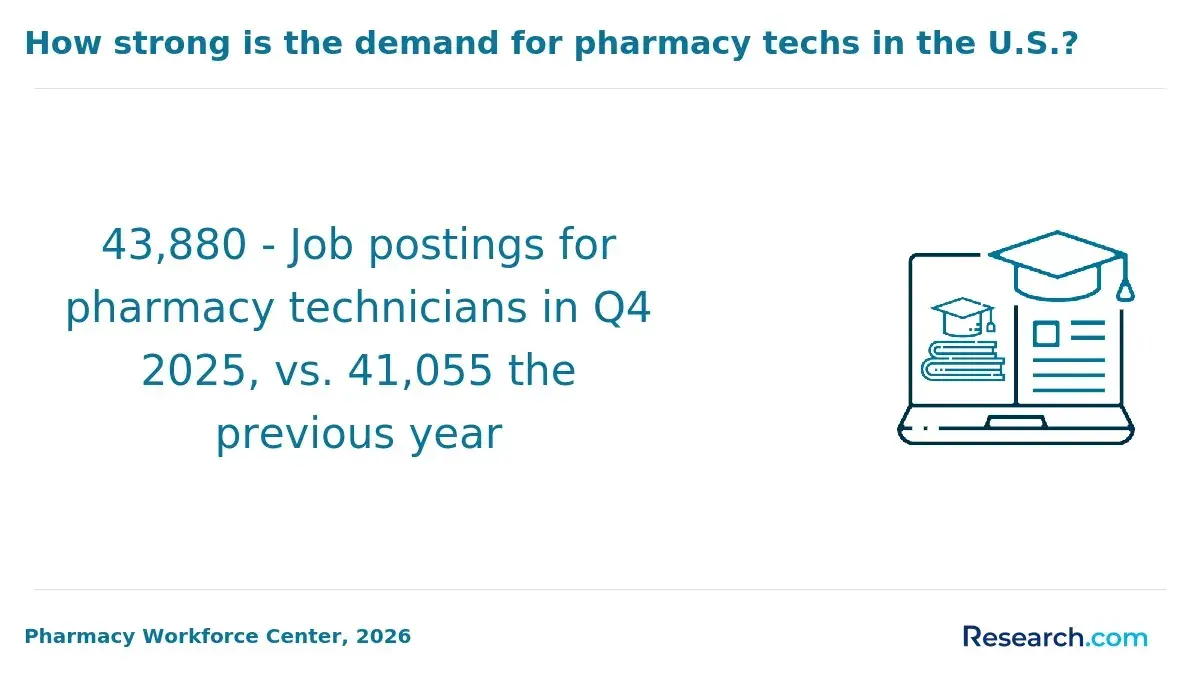
Choosing an online pharmacy technician associate program is a practical decision for students who want a healthcare career without committing immediately to a four-year degree or a PharmD. Demand is part of the reason this path is getting attention: according to the Pharmacy Workforce Center, pharmacy technician job postings rose in 2025 and reached 43,880 by year-end. Because technicians support medication access, prescription processing, inventory, insurance coordination, and patient-facing pharmacy services, shortages can affect how quickly pharmacies and health systems serve patients.
This guide explains how online pharmacy technician associate programs work, what they cost, how to compare accredited schools, what jobs graduates can pursue, and when this path makes sense. It is designed for first-time college students, working adults, career changers, and current pharmacy support workers who want a clearer route into certification, employment, or further education in pharmacy and healthcare.
Best Online Pharmacy Technician Associate Programs Table of Contents
- Best Online Pharmacy Technician Associate Programs in 2027
- What is a pharmacy technician associate program?
- What can I do with a pharmacy technician associate program?
- Things to Look for in an Online Pharmacy Technician Associate Program?
- Exploring Career Transition Paths Beyond Pharmacy Technician Roles
- How are hands-on training opportunities managed in online pharmacy technician programs?
- What emerging trends are shaping the future role of pharmacy technicians?
- Top Online Pharmacy Technician Programs for 2027
- What certifications can boost a pharmacy technician’s career?
- What Emerging Technologies are Transforming Online Pharmacy Technician Education?
- How do online pharmacy technician programs pave the way for an accelerated PharmD program?
- How can online pharmacy technician programs support career advancement?
- What are the advanced education opportunities for pharmacy technicians?
- What Essential Skills Should I Develop to Excel as a Pharmacy Technician?
- How Can Job Placement Assistance Enhance My Pharmacy Technician Career?
Quick Answer: Is an Online Pharmacy Technician Associate Program Worth It?
An online pharmacy technician associate program can be worth it if you want structured training, eligibility for certification preparation, and a credential that may help you compete for pharmacy roles in retail, hospital, long-term care, mail-order, and specialty settings. The best programs are not fully online in the casual sense: they usually combine online classes with in-person labs, clinical practice, internships, or externships.
The strongest choice is usually an accredited program that fits your state requirements, prepares you for certification through organizations such as the Pharmacy Technician Certification Board or NHA, offers local experiential placements, and has transparent tuition, fees, completion expectations, and career support. Students who want the fastest possible entry into work may prefer a certificate, while students who want a broader academic credential and possible transfer pathway may prefer the associate degree.
| Question | Direct answer |
| Typical length | Usually about 1 to 2 years, depending on full-time, part-time, or accelerated enrollment. |
| Typical cost | Online pharmacy technician associate program tuition can range from $3,000 to $10,000, before additional fees and aid are considered. |
| Best for | Students who want a healthcare support role, prefer medication-focused work, and are comfortable with accuracy, math, technology, regulations, and patient interaction. |
| Must-check factor | Accreditation, state requirements, externship availability, certification exam preparation, and total program cost. |
| Career outcome | Graduates commonly pursue pharmacy technician, certified pharmacy technician, hospital pharmacy technician, specialty pharmacy technician, or pharmaceutical support roles. |
Best Online Pharmacy Technician Associate Programs for 2027
The programs below are online or hybrid options that pair remote coursework with required hands-on training. That distinction matters: pharmacy technician education cannot rely only on lectures because students must learn medication preparation, pharmacy systems, safety protocols, calculations, and workplace procedures in supervised settings. Use this list as a starting point, then confirm current tuition, state eligibility, placement locations, and certification preparation directly with each school.
How do we rank schools?
Research.com uses a transparent methodology that combines independent data sources with program-level review. The process considers enrollment, outcomes, and cost information from the federal IPEDS database, distance-learning details from Peterson’s database, and pricing and outcomes signals from the College Scorecard database. Programs are then reviewed for online availability, accreditation, affordability, student support, and career relevance.
| Rank | School and program | Program cost | Duration | Credits | Accreditation |
| 1 | North Dakota State College of Science — Pharmacy Technician | $220.54/credit | 2 years | 61 credits | ASHP/ACPE; HLC |
| 2 | San Jacinto College — Health Science Pharmacy Technician Pathway | $83/credit (in-district) | 2 years | 60 credits | ASHP/ACPE; SACSCOC |
| 3 | Wake Technical Community College — Pharmacy Technology | $76/credit (NC resident) | ~2 years | 66 credits | ASHP/ACPE; SACSCOC |
| 4 | Fayetteville Technical Community College — Pharmacy Technology | $76/credit (NC resident) | ~2 years | 65 credits | ASHP/ACPE; SACSCOC |
| 5 | Gaston College — Pharmacy Technology (AAS) | $76/credit (NC resident) | ~2 years | 65 credits | ASHP/ACPE; SACSCOC |
| 6 | Durham Technical Community College — Pharmacy Technology (AAS) | $76/credit (NC resident) | ~2 years | 66 credits | ASHP/ACPE; SACSCOC |
| 7 | Cape Fear Community College — Pharmacy Technology (AAS) | $76/credit (NC resident) | ~2 years | 66 credits | ASHP/ACPE; SACSCOC |
| 8 | Vance-Granville Community College — Pharmacy Technology (AAS) | $76/credit (NC resident) | ~2 years | 65 credits | ASHP/ACPE; SACSCOC |
| 9 | North Central Missouri College — Pharmacy Technician (AAS) | $182/credit (MO resident) | 2 years | 60 credits | ASHP/ACPE; HLC |
| 10 | Guilford Technical Community College — Pharmacy Technology | $76/credit (NC resident) | ~2 years | 65 credits | ASHP/ACPE; SACSCOC |
Program Notes for the Ranked Schools
- North Dakota State College of Science: This career-focused college offers two-year training with online flexibility, small-class support, employer-informed instruction, advising, tutoring, and clinical experiences arranged through community partners.
- San Jacinto College: Located in the Greater Houston region, San Jacinto combines affordable workforce education with advising, tutoring, career services, and schedules that can support working students.
- Wake Technical Community College: Wake Tech serves Raleigh and nearby communities with online learning, stackable credentials, transfer pathways, employer relationships, and health programs tied to experiential learning.
- Fayetteville Technical Community College: FTCC supports adult learners and the local military community through flexible coursework, advising, academic resources, and pharmacy-related practical experiences.
- Gaston College: Gaston College emphasizes affordable tuition, supportive faculty, flexible formats, and allied-health training that connects online study with applied pharmacy practice.
- Durham Technical Community College: Durham Tech offers healthcare education in the Research Triangle with online delivery, tutoring, advising, transfer pathways, and training aligned with pharmacy practice standards.
- Cape Fear Community College: CFCC provides online coursework, personalized advising, employer connections, and applied learning for students preparing for pharmacy environments along the North Carolina coast.
- Vance-Granville Community College: VGCC serves a four-county region north of Raleigh with small learning environments, tutoring, advising, career support, and supervised pharmacy practice.
- North Central Missouri College: NCMC combines online classes with community-based clinical experience, individualized support, advising, and preparation for pharmacy workflows in several settings.
- Guilford Technical Community College: GTCC offers online options, hands-on training, faculty support, tutoring, advising, and regional healthcare employer connections in the Piedmont Triad.
What is a pharmacy technician associate program?
A pharmacy technician associate program is a college-level credential that prepares students to assist pharmacists in medication-related work. Pharmacy technicians may work in retail pharmacies, hospitals, long-term care facilities, specialty pharmacies, mail-order operations, and other medication distribution settings. Their work can include entering prescription information, preparing medications, checking inventory, supporting billing workflows, communicating with patients, and following strict safety and legal procedures.
These programs are commonly offered by community colleges, vocational institutions, and schools that also provide broader healthcare pathways such as online health science degree programs. A typical associate program includes online didactic courses, pharmacy laboratory practice, and supervised experience in an approved pharmacy site. Students study drug classifications, medication safety, pharmacy law, calculations, dosage forms, compounding, pharmacology, and pharmacy operations.
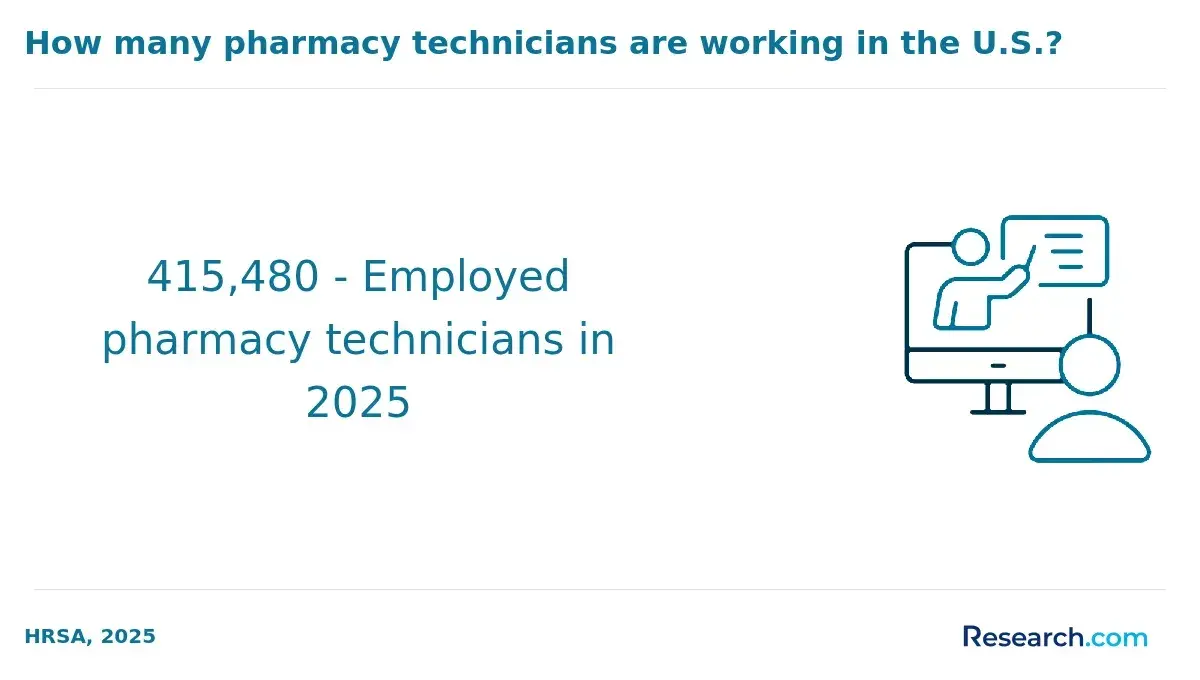
As of 2025, there were 415,480 pharmacy technicians in the U.S. (HRSA, 2025). Online associate programs help students build the operational, technical, and communication skills needed in this workforce. Because technicians handle sensitive patient information and medication processes, programs also emphasize accuracy, professional ethics, technology use, and clear communication with pharmacists, patients, insurers, and other healthcare professionals.
Graduates may receive an associate degree or, in shorter programs, a certificate, depending on the school’s structure. Many students then pursue national certification. According to the NHA Industry Outlook survey, 75% of employers screen candidates with certifications, which makes exam preparation an important factor when comparing programs.
Associate Degree vs. Certificate: Which Pharmacy Technician Path Fits You?
| Option | Best for | Typical advantage | Potential trade-off |
| Associate degree | Students who want a broader college credential, general education courses, and possible transfer options. | Can provide stronger academic depth and a more complete college record for future study. | Usually takes longer than a short certificate program. |
| Certificate | Students who want focused job preparation and faster entry into pharmacy technician work. | May require fewer courses and less time in school. | May offer fewer general education credits for transfer. |
| Employer training plus certification prep | Students who already have access to pharmacy work and want to build credentials while employed. | Can connect training directly to real pharmacy workflows. | May not provide the same structured academic credential as a college program. |
How long does it take to complete an online pharmacy technician associate program?
Most online pharmacy technician associate programs take about 1 to 2 years, depending on the school calendar, credit load, clinical requirements, and whether you enroll full time or part time. Some accelerated or intensive formats may be completed in around 9 to 12 months, while part-time students may need longer.
Even when lectures are online, programs typically include structured skills training. At least 48 hours may be assigned to Pharmacology, 40 hours to Institutional Pharmacy Practice, and 60 hours to Pharmaceutical Calculations in an online program. Full-time associate programs generally require about 2 years because students complete pharmacy coursework, labs, experiential requirements, and general education classes.
Part-time formats can be useful for students who work, care for family, or need a slower course load. Before enrolling, ask whether required labs or externships are scheduled on weekdays, evenings, weekends, or fixed blocks. A “flexible online” program may still require you to be available at specific times for proctored assessments, live sessions, campus labs, or site-based training.
How much does an online pharmacy technician associate program cost?
Program cost depends on residency status, school type, credit requirements, fees, textbooks, technology, background checks, uniforms, immunizations, certification exam preparation, and licensing-related expenses. Online pharmacy technician associate program tuition can range from $3,000 to $10,000, but students should compare the full cost of attendance rather than tuition alone.
Some community colleges are especially affordable for in-district or in-state students, while out-of-state online learners may pay more. Financial aid, scholarships, grants, loans, employer tuition support, and payment plans may reduce out-of-pocket cost, but eligibility varies by program and student status.
| Cost item | Why it matters | Question to ask |
| Tuition per credit | This is the largest visible expense, but it does not show the full price by itself. | Is the listed rate for in-district, in-state, or online students? |
| Program fees | Lab, clinical, technology, and course fees can change the real cost. | Are fees included in the published estimate? |
| Books and supplies | Pharmacy references, access codes, uniforms, and lab materials may be required. | Can I see a semester-by-semester supply list? |
| Background checks and health requirements | Externship sites may require screenings, immunizations, or documentation. | Who pays for these requirements, and when are they due? |
| Certification and licensing expenses | Graduates may need exam, application, or registration fees depending on the state and employer. | Does the program include exam preparation or exam fees? |
Students should also review scholarships, grants, and loans for eligible learners. Pharmacy, healthcare, and community organizations may support students entering medication-related careers. Examples include the National Association of Chain Drug Stores (NACDS) Foundation, the American Association of Colleges of Pharmacy (AACP), and local pharmacy associations. Students comparing health-related fields may also find it helpful to understand the curriculum expectations in areas such as healthcare management courses.
What can I do with a pharmacy technician associate program?
Graduates of pharmacy technician associate programs can pursue several pharmacy and pharmaceutical support roles. Career options depend on state rules, employer requirements, certification status, prior experience, and the type of pharmacy setting. Students should review role expectations in their state and compare local job postings before choosing a program. External career resources, including pharmacy technician career information, can also help clarify daily responsibilities.
Common paths include the following:
| Career path | Typical work | Median annual salary | When this path may fit |
| Pharmacy Technician | Supports pharmacists with prescription processing, dispensing tasks, inventory, customer service, and pharmacy workflow. | $43,460 | Good for students seeking the most direct entry point after training. |
| Certified Pharmacy Technician (CPhT) | Performs technician duties while holding a recognized certification, often improving competitiveness for certain employers. | $45,770 | Useful if local employers prefer or require national certification. A 2025 NHA survey found that 39% of employers found it challenging to hire qualified pharmacy technicians. |
| Hospital Pharmacy Technician | Prepares, distributes, and tracks medications in hospital settings while working closely with pharmacists and clinical teams. | $59,289 | Best for students interested in institutional workflows, clinical environments, and potentially more specialized medication systems. According to the BLS, 17% of pharmacy technicians work in hospitals. |
| Specialty Pharmacy Technician | Supports specialized medication areas such as compounding, sterile products, oncology, or nuclear pharmacy. | $40,074 | Appropriate for technicians who want to build expertise in a focused practice area. |
| Pharmaceutical Manufacturing and Sales | May assist in manufacturing, quality control, research support, sales, marketing, or pharmaceutical operations. | $51,000 | Can fit students who want to move beyond direct dispensing environments. Pharmaceutical and medicine manufacturing industries employed around 1,640 pharmacy technicians, according to the BLS. |
Some pharmacy technicians later move toward informatics, administration, or clinical support roles. For example, technicians interested in medication data, electronic records, and healthcare systems may eventually consider an online master’s degree in health informatics.
Things to Look for in Pharmacy Technician Online Schools
There are many online pharmacy technician programs, but not all are equally useful for certification, employment, or state eligibility. Your goal is not simply to find the cheapest or fastest program. You need a program that is recognized, practical, transparent, and aligned with the pharmacy setting where you want to work.
How to Compare Online Pharmacy Technician Associate Programs
| Factor | What to verify | Why it affects your decision |
| Accreditation | Look for recognized accreditation, including ASHP and PTAC in coordination with ACPE, where applicable. | Accreditation indicates that the program meets defined educational quality standards and may affect employer recognition, certification preparation, and state expectations. |
| State requirements | Confirm whether the program meets pharmacy technician registration, licensing, training, or certification rules in your state. | A program can be legitimate but still not meet every state’s requirements. |
| Program format | Check whether courses are asynchronous, live online, hybrid, full time, part time, or accelerated. | The schedule must match your work, family, transportation, and clinical availability. |
| Hands-on training | Ask where labs, externships, or internships occur and whether the school helps arrange placements. | Practical experience is essential for building workplace readiness. |
| Certification outcomes | Request graduation, placement, and certification exam results when available. | According to the PTCB, the 2025 pass rate for certified pharmacy technicians is 69%. |
| Faculty and student support | Review instructor pharmacy experience, tutoring, advising, technical help, and career services. | Strong support can matter more in online programs because students must stay organized and connected. |
| Total cost | Compare tuition, fees, supplies, exam preparation, externship costs, and financial aid. | The lowest tuition may not be the lowest total price. |
Accreditation should be one of your first checks. For pharmacy technician education, recognized bodies include the American Society of Health-System Pharmacists (ASHP) and the Pharmacy Technician Accreditation Commission (PTAC), working with the Accreditation Council for Pharmacy Education (ACPE). Accreditation can help confirm that a program meets defined standards; research also emphasizes that accreditation is tied to program quality expectations.
Hands-on learning should also be clear before you enroll. Other healthcare programs, such as online master’s in speech pathology programs, require supervised practice with clients; pharmacy technician programs similarly need structured practical experience. Faculty expertise is another important signal. Just as online graduate nutrition programs rely on qualified nutrition professionals and the best diagnostic medical sonography programs depend on skilled sonography instruction, pharmacy technician students should look for instructors with relevant pharmacy practice experience.
What are the admission requirements for an online pharmacy technician associate program?
Admission rules vary by school, but most online pharmacy technician associate programs ask for evidence that you are academically prepared and eligible for pharmacy practice training. Some requirements also come from clinical sites rather than the college itself.
- High school diploma or equivalent: Most programs require a high school diploma, GED, homeschool completion, or an equivalent credential.
- Transcripts: Schools may request official high school and prior college transcripts to verify your academic history.
- Minimum GPA: Some programs set a minimum GPA for admission or for competitive selection into the pharmacy technology major.
- Prerequisite courses: Biology, chemistry, mathematics, English, or related courses may be required before entry or before clinical placement.
- Background check: Because students work with medications and patient information, many programs and externship sites require a background screening.
- English language proficiency: Applicants whose first language is not English may need to show proficiency through exams such as TOEFL or IELTS so they can communicate safely in pharmacy settings.
Courses to Expect in an Online Pharmacy Technician Associate Program
Online pharmacy technician curricula vary, but accredited and career-focused programs usually cover medication knowledge, calculations, legal requirements, dispensing workflows, technology, and patient safety. Pharmacy education research has noted that institutions are increasingly able to deliver pharmacy technician education through structured online and hybrid formats.
| Course area | What students learn |
| Introduction to Pharmacy Practice | The technician’s role, pharmacy settings, professional ethics, workflow, and basic legal responsibilities. |
| Pharmaceutical Calculations | Dosage math, unit conversions, compounding calculations, measurement systems, and accuracy checks. |
| Pharmacology | Drug categories, mechanisms of action, therapeutic uses, adverse effects, and interactions. |
| Pharmacy Dispensing and Compounding | Prescription interpretation, medication preparation, labeling, dispensing procedures, and compounding methods. |
| Pharmacotherapy | Common disease states, medication treatments, dosage considerations, and therapeutic decision support. |
| Pharmacy Technician Practice and Procedures | Medication safety, prescription processing, patient communication, insurance-related workflows, and customer service. |
| Pharmacy Information Systems | Pharmacy management systems, electronic health records, dispensing technology, and digital documentation. |
Exploring Career Transition Paths Beyond Pharmacy Technician Roles
A pharmacy technician associate degree can be either an endpoint or a starting point. Some graduates use it to enter the workforce quickly, while others use technician experience to decide whether they want to move into pharmacy, healthcare administration, informatics, research support, sales, or another health profession.
The most direct upward path is the Doctor of Pharmacy degree. A PharmD can lead to pharmacist licensure after students complete the required education, clinical experiences, and regulatory steps. Cost is a major consideration, so future pharmacists may want to compare affordable PharmD programs before committing to a long academic route.
Another option is healthcare administration. Pharmacy technicians who enjoy operations, compliance, scheduling, billing processes, inventory, or staff coordination may be well suited to healthcare management study. Others may add training in medical billing and coding, health informatics, regulatory compliance, or clinical research to move into hybrid roles that combine pharmacy knowledge with data, administration, or pharmaceutical operations.
Pharmaceutical sales, training, quality control support, and clinical research organization roles may also be possible for technicians who can translate medication knowledge into business, research, or product-support environments. The best transition depends on your strengths: patient communication, technology, detail accuracy, leadership, research interest, or business development.
How Can a Pharmacy Technician Program Pave the Way to Becoming a Pharmacist?
A pharmacy technician program can help future pharmacists by introducing core concepts used in pharmacy school: medication classifications, dosage calculations, safety procedures, dispensing systems, pharmacy law, and patient communication. Technician work can also expose students to pharmacist responsibilities, pharmacy team dynamics, and real medication-use processes before they commit to advanced study.
However, an associate degree by itself does not make someone a pharmacist. Students must still complete PharmD prerequisites, apply to pharmacy school, finish the professional curriculum, complete required experiential education, and meet licensure requirements. Anyone considering this route should compare timelines, admissions requirements, costs, and state rules. A detailed overview is available in Research.com’s guide to how long it takes to become a pharmacist.
How are hands-on training opportunities managed in online pharmacy technician programs?
Online pharmacy technician programs usually manage practical training through hybrid requirements. Students complete theory courses online, then participate in campus labs, simulation activities, clinical externships, internships, or supervised pharmacy site experiences. These hands-on components allow students to practice dispensing, compounding, inventory control, medication safety procedures, patient communication, and use of pharmacy technology.
Accredited programs should be clear about how placements work. Some schools arrange externship sites for students, while others require students to help identify approved locations. Digital simulations, remote proctoring, virtual modules, and online practice tools may support learning, but they do not replace all real-world experience. Students exploring broader healthcare education options can compare related pathways in guides to online medical degree programs.
Questions to Ask About Externships Before Enrolling
- Does the school place students, or do students find their own pharmacy sites?
- Are placements available in my state or local area?
- Can working students complete externship hours on evenings or weekends?
- Are background checks, immunizations, drug screenings, or liability insurance required?
- What happens if a student cannot secure a placement by the required deadline?
- Do externship hours prepare students for certification or state registration requirements?
What emerging trends are shaping the future role of pharmacy technicians?
Pharmacy technician work is becoming more technology-driven and more integrated with healthcare operations. Automation systems, inventory platforms, telepharmacy, electronic health records, and artificial intelligence applications are changing how medications are prepared, tracked, checked, and delivered. These tools do not eliminate the need for careful technicians; they increase the need for technicians who can follow safety protocols while using digital systems accurately.
Technicians may also face expanding expectations in billing support, medication access, prior authorization workflows, specialty pharmacy coordination, and patient communication. Additional knowledge in areas such as medical billing and coding course cost can help technicians understand the administrative side of medication access and reimbursement.
Top Pharmacy Technician Online Schools
In addition to the ranked associate programs above, Research.com reviewed other pharmacy technician online schools and program options based on program offerings, outcomes, program completer employment, and certification pass rates. Students should use these examples to compare curriculum design, externship requirements, accreditation, technology tools, and credential outcomes.
North Seattle College — Associate of Applied Science Degree: Pharmacy Technician
North Seattle College offers a pharmacy technician AAS curriculum designed to prepare students for employment and foundational pharmacy practice. Students study skills such as reading prescriptions, entering orders, and preparing medications. The program requires 94 credits and is accredited by the American Society of Health-System Pharmacists (ASHP).
The certificate option can prepare graduates for pharmacy environments in Washington. Graduates of the certificate program approved by the Washington State Board of Pharmacy may qualify for roles such as inpatient pharmacy technician and outpatient pharmacy technician.
American National University — Pharmacy Technician Associate Degree
The American National University pharmacy technician associate degree is built around medication knowledge, laboratory skills, and field experience. Students study pharmaceutical technology, pharmacology, record keeping, pharmacy law and ethics, and pharmacy techniques.
The curriculum prepares students to assist licensed pharmacists with stocking, obtaining, packaging, and handling prescription and nonprescription medications. Students must pass a background check before the program begins. The school’s partnership with Pioneer Rx gives learners exposure to pharmacy software used to simulate real pharmacy workflows before externship and employment.
Lakeshore Technical College — Pharmacy Technician Associate Program
Lakeshore Technical College offers a pharmacy technician program that may be completed in one or two semesters, depending on whether students begin in August or January. Coursework can include business applications, medical terminology, pharmacy law, health insurance and payment, and related topics. Students who later want to become pharmacists should plan for clinical work experience, preferably in both hospital and community pharmacy settings.
The Cleveland, Wisconsin-based program is accredited by the American Society of Health-System Pharmacists and uses a PioneerRx partnership to provide a realistic pharmacy workflow environment for training.
North Central Missouri College — Pharmacy Technician Program
North Central Missouri College offers a two-year pharmacy technician program that can be completed online or in person. Online students must come to campus several times during the semester for lab components attached to selected courses. At the end of the program, students complete an internship that lets them apply classroom learning in a pharmacy-related facility.
Graduates are prepared to create patient profiles, enter prescription orders, fill prescriptions accurately, compound solutions, ointments, lotions, suppositories, and other medications, and follow ethical dispensing practices.
Allen Community College — Pharmacy Technician Applied Science Associate Degree
Allen Community College prepares students for pharmacy technician opportunities in the pharmaceutical field. The applied science associate degree develops skills in prescription order support, over-the-counter medication questions, medical record maintenance, and medical office settings.
Graduates are expected to be ready for technician roles in retail, hospital, and institutional pharmacies. Program outcomes include safe medication preparation, dosage and solution calculations, and professional performance in clinical environments.
What certifications can boost a pharmacy technician’s career?
An associate degree can provide structured preparation, but certification is often the credential employers notice first. The most recognized pathway is the Certified Pharmacy Technician credential through the Pharmacy Technician Certification Board or the National Healthcareer Association. Certification can show employers that you have met a defined standard in pharmacy knowledge, safety, and technician practice.
Some technicians also pursue specialized credentials or training in sterile compounding, oncology pharmacy, nuclear pharmacy, medication history, billing support, or other focused areas. These options may be especially useful for technicians who want hospital, specialty, or advanced operational roles.
Students who are comparing multiple short healthcare credentials can also review quick medical certifications that may lead to other healthcare support roles. This can be helpful if you are deciding between pharmacy technology, medical billing and coding, medical assisting, or another allied health path.
| Credential or training area | Why it may help | Best fit |
| CPhT certification | Signals national-level technician knowledge and can improve competitiveness for many roles. | Entry-level and experienced technicians seeking stronger job-market recognition. |
| Sterile compounding | Builds skills for preparing sterile medications under strict safety procedures. | Technicians interested in hospital or specialized medication preparation. |
| Oncology pharmacy | Supports work involving cancer medications and specialized handling procedures. | Technicians seeking focused clinical pharmacy environments. |
| Nuclear pharmacy | Prepares technicians for specialized medication handling in nuclear pharmacy settings. | Technicians who want a niche area with strict technical procedures. |
| Billing, coding, or informatics-related training | Expands understanding of reimbursement, documentation, and health information systems. | Technicians interested in administrative, data, or hybrid pharmacy roles. |
What Emerging Technologies are Transforming Online Pharmacy Technician Education?
Online pharmacy technician programs increasingly use digital tools that mirror modern pharmacy practice. Students may encounter automated dispensing systems, telepharmacy platforms, electronic health record integrations, inventory systems, virtual simulation labs, interactive case modules, and medication-management technologies supported by artificial intelligence.
The value of these tools depends on how they are integrated. A strong program does not use technology as decoration; it uses technology to teach safe workflow, documentation, medication verification support, and communication across pharmacy teams. Students interested in roles that combine clinical knowledge and operations may also compare pharmacy training with broader administrative pathways, including the best accelerated online healthcare administration degree programs.
How do online pharmacy technician programs pave the way for an accelerated PharmD program?
Online pharmacy technician programs can help students prepare for accelerated PharmD study by building familiarity with medication terminology, pharmacology basics, sterile compounding concepts, pharmacy systems, and medication safety. They also help students test whether they genuinely enjoy pharmacy work before investing in a professional doctorate.
That said, pharmacy technician coursework does not automatically replace PharmD prerequisites or guarantee admission. Students considering an accelerated PharmD program should compare prerequisite science courses, transfer-credit rules, GPA expectations, clinical experience requirements, admissions timelines, and licensure steps.
How can online pharmacy technician programs support career advancement?
The best online pharmacy technician programs help students move beyond course completion. They connect education to certification, externship experience, employer expectations, and future academic options. Career support is especially important for online learners, who may not have the same informal campus networking opportunities as in-person students.
- Certification preparation: Programs may include review materials, exam-focused courses, practice assessments, or guidance for PTCB and NHA certification pathways.
- Specialized training: Additional coursework in compounding, oncology, nuclear pharmacy, medication history, or pharmacy technology can support advancement into more focused roles.
- Transferable credits: Some associate programs may include credits that can apply toward bachelor’s degrees in health sciences, healthcare administration, pharmacology-related fields, or other health programs.
- Professional development: Workshops, webinars, and seminars can help students stay current on pharmacy law, customer service, safety expectations, and technology changes.
- Career services: Resume assistance, interview preparation, employer connections, and alumni networks can help graduates move from school to work.
- Externships and internships: Supervised experience can build confidence, provide references, and help students understand which pharmacy setting fits them best.
What are the advanced education opportunities for pharmacy technicians?
Pharmacy technicians who want to continue their education have several possible routes. The right path depends on whether they want to become pharmacists, move into management, specialize technically, work with healthcare data, or enter pharmaceutical research and operations.
A bachelor’s degree in health sciences, healthcare administration, biology, chemistry, pharmacology-related study, or another health field may be useful for broader healthcare roles. Technicians interested in research, pharmacogenomics, or personalized medicine may eventually explore graduate science options such as master’s in genetics programs.
Specialized technician training in nuclear pharmacy, sterile compounding, chemotherapy preparation, or medication safety can also support advancement without requiring a full graduate degree. For leadership roles, healthcare administration or business management education may be a better fit than additional clinical training.
What Essential Skills Should I Develop to Excel as a Pharmacy Technician?
Successful pharmacy technicians combine precision, professionalism, and communication. Medication work leaves little room for careless habits, so students should treat every course, lab, and externship as preparation for a safety-sensitive workplace.
| Skill | Why it matters in pharmacy work | How to build it during school |
| Accuracy and attention to detail | Prescription entry, dosage calculations, labeling, and inventory tasks require careful checking. | Practice calculation problems, use checklists, and review errors instead of rushing past them. |
| Pharmaceutical calculations | Technicians must understand units, conversions, dosages, and compounding quantities. | Complete extra practice sets and ask for tutoring early if math is a weakness. |
| Medication safety awareness | Pharmacy work involves high-risk processes, patient information, and regulated substances. | Study safety protocols, look-alike/sound-alike medications, and documentation rules. |
| Communication | Technicians interact with pharmacists, patients, prescribers’ offices, insurers, and coworkers. | Practice clear, calm explanations and learn when to refer questions to a pharmacist. |
| Technology fluency | Modern pharmacies rely on dispensing systems, records platforms, inventory tools, and automation. | Use simulation software seriously and learn the logic behind pharmacy information systems. |
| Professional judgment | Technicians must know their scope of practice and follow legal and ethical boundaries. | Study pharmacy law, ask scenario-based questions, and observe experienced technicians. |
These skills can also support movement into broader healthcare roles. Students comparing long-term options may want to explore other medical jobs that pay well to understand how pharmacy technician work compares with other healthcare careers.
How Can Job Placement Assistance Enhance My Pharmacy Technician Career?
Job placement support can make a major difference, especially for students entering healthcare for the first time. Strong programs may offer resume workshops, mock interviews, employer introductions, job boards, career counseling, externship coordination, and networking opportunities with pharmacies, hospitals, long-term care facilities, or healthcare employers.
When evaluating a program, ask whether career services are general college services or pharmacy-specific support. Pharmacy-specific employer relationships can help students understand local hiring requirements, certification preferences, and common interview expectations. Students comparing other quick-entry healthcare tracks can also review how a fast-paced medical assistant program approaches workforce preparation.
Common Mistakes to Avoid When Choosing an Online Pharmacy Technician Program
| Mistake | Why it can hurt you | Better approach |
| Choosing only by lowest tuition | Fees, supplies, travel, exams, and placement costs can change the real price. | Compare total program cost and available aid. |
| Ignoring accreditation | Employers, certification bodies, or state boards may not recognize weak programs. | Verify accreditation before applying. |
| Assuming “online” means no campus or site visits | Labs, externships, and assessments may require in-person attendance. | Ask for a complete list of required on-site activities. |
| Not checking state requirements | Pharmacy technician rules vary, and a program may not meet your state’s expectations. | Confirm state registration, licensing, certification, and training rules. |
| Skipping certification planning | Some employers prefer or screen for certified candidates. | Choose a program that clearly prepares students for PTCB or NHA certification. |
| Overlooking externship logistics | A distant or unavailable placement can delay graduation. | Ask how placements are secured in your area before enrolling. |
| Assuming salary outcomes are guaranteed | Pay depends on location, employer, certification, experience, and setting. | Compare local job postings and wage data before deciding. |
Step-by-Step: How to Choose the Right Online Pharmacy Technician Associate Program
- Check your state rules first. Look up pharmacy technician registration, licensing, training, and certification expectations where you plan to work.
- Shortlist accredited programs. Prioritize recognized accreditation and programs with transparent outcomes.
- Compare the full cost. Include tuition, fees, supplies, background checks, transportation for labs or externships, and certification expenses.
- Confirm hands-on requirements. Ask where labs and externships happen, who arranges them, and whether sites are available near you.
- Review certification preparation. Find out whether the curriculum aligns with PTCB or NHA exam content and whether practice exams are included.
- Evaluate student support. Online students should look for tutoring, advising, technology help, faculty access, and career services.
- Ask about outcomes. Request graduation rates, certification pass rates, employment support, and employer partnerships when available.
- Match the program to your goal. Choose a shorter certificate for fast entry, an associate degree for broader academic preparation, or a transfer-friendly path if you may pursue a bachelor’s or PharmD later.
Start Your Career in Pharmacy with an Online Pharmacy Technician Program
The pharmacy technician shortage creates an opportunity for students who want a healthcare career with a relatively short training timeline. In many cases, students can begin preparing for pharmacy technician work in less than two years while building skills that may later support specialized technician roles, healthcare administration, informatics, or advanced pharmacy education.
Online and hybrid pharmacy technician programs make this pathway more accessible, but students should be realistic about the format. Most quality programs still require in-person labs, clinical experiences, or externships. The flexibility comes from completing much of the academic coursework online while still developing hands-on competence in supervised settings.
Pharmacy technology is one of several healthcare pathways that may not require extensive graduate education for entry-level work. Students comparing alternatives may also be interested in how to become an ultrasound technician or may want to review online second degree nursing programs if they are considering nursing as a second career.
Key Insights
- Demand is real, but program choice still matters: Pharmacy technician job postings reached 43,880 by the end of 2025, but students should still choose based on accreditation, state eligibility, externship access, and certification preparation.
- The career outlook is favorable: The job outlook for pharmacy technicians through 2034 is 6.4%, or around 49,000 annual job openings throughout the decade.
- Online does not mean fully remote: Most strong online pharmacy technician associate programs combine web-based classes with labs, simulations, internships, or externships.
- Associate programs are usually broader than certificates: A certificate may be faster, but an associate degree can provide general education credits and a stronger foundation for future study.
- Cost should be evaluated in full: Tuition for an online pharmacy technician associate program can range from $3,000 to $10,000, but fees, supplies, background checks, and certification expenses also matter.
- Certification can improve competitiveness: Graduates often pursue PTCB or NHA certification, and the NHA Industry Outlook survey found that 75% of employers screen candidates with certifications.
- Career settings vary widely: Pharmacy technicians can work in retail pharmacies, hospitals, long-term care facilities, mail-order pharmacies, specialty pharmacies, and pharmaceutical manufacturing environments.
- Technology is reshaping the role: Automation, telepharmacy, electronic records, inventory systems, and AI-supported tools are increasing the value of digital literacy and careful workflow management.
- Do not skip state verification: Pharmacy technician requirements differ by location, so students should confirm that a program meets the rules where they intend to work.
References:
- Health Resources and Services Administration. (2025, December). State of the U.S. Health Care Workforce, 2025. National Center for Health Workforce Analysis. https://bhw.hrsa.gov/sites/default/files/bureau-health-workforce/data-research/State-of-US-Health-Care-Workforce-2025.pdf
- National Healthcareer Association. (2025). 2025 Industry Outlook. https://info.nhanow.com/hubfs/Marketing/Campaigns/Industry%20Outlook/2025/9-NHA-HS-Q125-industry-outlook-2025.pdf
- PayScale. (2026). Average Certified Pharmacy Technician (CPHT) Hourly Pay. Retrieved February 2026, from https://www.payscale.com/research/US/Job=Certified_Pharmacy_Technician_(CPHT)/Hourly_Rate
- Pharmacy Technician Certification Board. (2025). Credentials by the Numbers. Retrieved February 2026, from https://ptcb.org/history/credentials-by-the-numbers
- Pharmacy Workforce Center. (2026, January). Pharmacy Demand Report Executive Summary 4th Quarter 2025. https://www.aacp.org/sites/default/files/2026-01/pharmacy-demand-report-1.26.26.pdf
- U.S. Bureau of Labor Statistics. (2024). Occupational Employment and Wage Statistics. Retrieved February 2026, from https://data.bls.gov/oes/#/industry/000000
- U.S. Bureau of Labor Statistics. (2025, August 28). Occupational projections, 2024–2034, and worker characteristics. Retrieved February 2026, from https://www.bls.gov/emp/tables/occupational-projections-and-characteristics.htm
Other Things You Should Know About Online Pharmacy Technician Associate Programs
Yes. Many programs require a criminal background check, drug screening, or both before students can start clinical rotations or externships. These requirements are common because pharmacy sites often follow state board rules and employer policies, especially for patient-facing training placements.
Many online pharmacy technician associate programs for 2027 include internships or practical experiences. Typically, these require students to complete around 150-200 hours in a clinical setting approved by the program, essential for gaining real-world pharmacy practice skills and meeting certification prerequisites.
Admission requirements for online pharmacy technician associate programs in 2027 typically include a high school diploma or GED, completion of prerequisite courses in subjects like biology and chemistry, and sometimes standardized test scores. Some programs may also require a background check or interviews during the application process.