
2027 How to Become a Substance Abuse Counselor in Newark, NJ: Requirements & Certification

Co-Founder and Chief Data Scientist
If you want to become a substance abuse counselor in Newark, your main decision is which credentialing route fits your goals: New Jersey’s Certified Alcohol and Drug Counselor (CADC) pathway or the Licensed Clinical Alcohol and Drug Counselor (LCADC) pathway. Newark sits inside the New York, Newark, and Jersey City metro area, giving future counselors access to hospitals, outpatient programs, residential treatment providers, community health agencies, and nonprofit recovery organizations.
This guide explains how the Newark pathway works in practical terms: education, supervised training, exams, internship options, salary expectations, job demand, career alternatives, and the questions you should ask before choosing a program or credential. It is written for students, career changers, social-service workers, and behavioral health professionals who want a clear route into addiction counseling in New Jersey.
Quick Answer: Becoming a Substance Abuse Counselor in Newark, NJ
- New Jersey recognizes two core addiction counseling credentials: CADC and LCADC. Both involve approved education, supervised experience, and the International Certification and Reciprocity Consortium exam.
- The average salary for substance abuse counselors in Newark, NJ is approximately $71,000 per year, with entry-level roles starting near $52,000 and advanced or supervisory roles exceeding $85,000.
- Newark offers strong exposure to diverse client populations, integrated healthcare settings, community-based treatment, and recovery support services, which can help new counselors build practical skills quickly.
- The occupation is considered high demand locally, with expected job growth of about 18% over the next ten years and several hundred current openings in Newark.
- What education do Newark substance abuse counselors need?
- What licensing and credentialing requirements apply in Newark?
- Can a Newark addiction counseling credential transfer to another state?
- Where can aspiring counselors find internships in Newark?
- How much do substance abuse counselors earn in Newark?
- Is there demand for substance abuse counselors in Newark?
- How do counselors keep their license active and improve professionally?
- Can marriage and family therapy training expand addiction counseling careers?
- Which trends are changing addiction counseling in Newark?
- Which additional certifications can strengthen a Newark counseling career?
- What are the mental health counselor requirements in Newark?
- Where do substance abuse counselors work in Newark?
- What related careers can substance abuse counselors pursue?
- Is Newark a good city for substance abuse counseling careers?
- What challenges should Newark counselors expect?
What are the academic requirements to become a substance abuse counselor in Newark, NJ?
The right academic path depends on whether you are aiming for entry-level addiction counseling work, the CADC credential, the LCADC credential, or a broader counseling license. In Newark, employers commonly look for coursework in addiction, counseling methods, ethics, assessment, treatment planning, crisis response, group counseling, and co-occurring mental health conditions.
A bachelor’s degree in psychology, counseling, social work, human services, or a closely related field can help you build the foundation needed for addiction counseling roles. A master’s degree is often the better choice for students who want advanced clinical responsibility, stronger mobility, or eligibility for higher-level counseling credentials.
| Education option | Best for | What to check before enrolling |
| Bachelor’s degree in psychology, counseling, social work, or a related field | Students preparing for entry-level behavioral health roles or future graduate study | Whether the program includes addiction-focused coursework, practicum options, and advising for New Jersey credentialing |
| Master’s degree in addiction counseling, clinical psychology, counseling, or social work | Students seeking advanced clinical training, supervisory potential, or broader counseling opportunities | Whether coursework aligns with state requirements and whether supervised placements are available in or near Newark |
| Certificate or post-degree addiction counseling coursework | Career changers or graduates who need approved education in substance use disorder treatment | Whether the coursework is accepted for CADC or LCADC preparation and whether the provider documents hours properly |
| Supervised practicum or internship | Students who need direct client exposure before employment or credentialing | Whether supervision is provided by appropriately credentialed professionals and whether duties match addiction counseling competencies |
Most students should look for programs that combine classroom study with supervised fieldwork. A program may sound strong academically, but if it does not help you secure a practicum, document supervised experience, or prepare for the required exam, it may slow your progress toward credentialing.
Before choosing a school, ask whether the curriculum addresses New Jersey credentialing expectations, whether internship sites serve clients with substance use disorders, and whether faculty or advisors understand the CADC and LCADC process. Students comparing counseling fields can also review counseling psychology career requirements to understand how addiction counseling fits within the broader counseling profession.
What are the licensing requirements for substance abuse counselors in Newark, NJ?
Newark counselors follow New Jersey rules, not a separate city licensing system. The two addiction counseling credentials most relevant to this career are the Certified Alcohol and Drug Counselor and the Licensed Clinical Alcohol and Drug Counselor. Both require approved education, supervised clinical experience, and a passing score on the International Certification and Reciprocity Consortium exam.
The credential you pursue affects your scope of practice, job options, supervision requirements, and long-term advancement. Students considering online coursework should confirm that the school’s curriculum and field placement support New Jersey requirements before enrolling. A good starting point for program comparison is Research.com’s guide to the best online counseling degree programs.
| Credential or pathway | Typical purpose | Decision point for students |
| CADC | Prepares counselors for addiction-focused work under the standards set for certified alcohol and drug counseling | Useful if you want a dedicated substance use counseling credential and do not necessarily need the broadest clinical license |
| LCADC | Supports a higher-level clinical addiction counseling role in New Jersey | Best for students seeking greater clinical responsibility, broader employment options, or advanced addiction treatment roles |
| LAC to LPC route | Applies to the broader professional counseling pathway, including passing the NCE or NCMHCE, receiving the Licensed Associate Counselor credential, and completing at least 3,000 hours or two years of supervised clinical experience before applying for Licensed Professional Counselor status | Worth considering if you want a wider mental health counseling scope beyond addiction treatment alone |
Common steps include submitting an application with required fees, documenting education, verifying supervised experience, passing the required examination, and meeting renewal rules. Counselors who pursue broader professional counseling credentials may also encounter the National Counselor Examination or the National Clinical Mental Health Counseling Examination, depending on the license pathway.
Because credentialing rules can change, do not rely only on a school website or job posting. Confirm requirements directly with the appropriate New Jersey licensing or certification authority before you pay for coursework, accept a practicum, or assume your supervised hours will count.
Can Newark, NJ substance abuse counselors practice in other states?
A New Jersey substance abuse counseling credential does not automatically let you practice in another state. Each state sets its own rules for addiction counseling, including education, supervised hours, examinations, background checks, continuing education, and scope of practice.
If you plan to move, provide telehealth services across state lines, or work for a multistate employer, contact the licensing board in the destination state before accepting clients. You may need to apply through endorsement, reciprocity, or a comparable credential review process. Some states may also require a jurisprudence exam, additional documentation, or state-specific training.
To make future mobility easier, keep organized records from the beginning: official transcripts, syllabi for addiction coursework, supervisor names and credentials, signed hour logs, exam results, and license or certification renewal documents. A national credential from the National Association for Alcoholism and Drug Abuse Counselors can also support your professional profile, although it does not replace state authorization.
Are there internship opportunities for substance abuse counselors in Newark, NJ?
Internships matter because they translate coursework into real counseling skills. In addiction treatment, classroom knowledge is not enough; counselors must learn intake procedures, group facilitation, relapse prevention planning, crisis response, documentation, referral coordination, and ethical boundaries under supervision.
Newark and the surrounding area offer internship settings that may expose students to outpatient care, inpatient services, community health, and integrated behavioral health. Examples include:
- Newark Community Health Center: Internship experiences may run 6 to 12 months and can help students work with diverse urban populations facing substance use and related health concerns.
- Horizon Behavioral Health: This nearby Jersey City option offers a 9-month internship structure focused on evidence-based treatment and supervised clinical development.
- Newark Beth Israel Medical Center: Internship options lasting 6 to 12 months may involve integrated care across inpatient and outpatient settings.
When comparing internships, do not choose only by name recognition. Ask who will supervise you, whether the supervisor’s credential meets New Jersey standards, what client populations you will serve, how hours are documented, and whether interns participate in assessment, treatment planning, group counseling, or case coordination. Students still exploring counseling specialties can compare career paths with a counseling degree before committing to a placement.
The chart below shows cities where substance abuse counselors are compensated highest.
How much do substance abuse counselors in Newark, NJ earn?
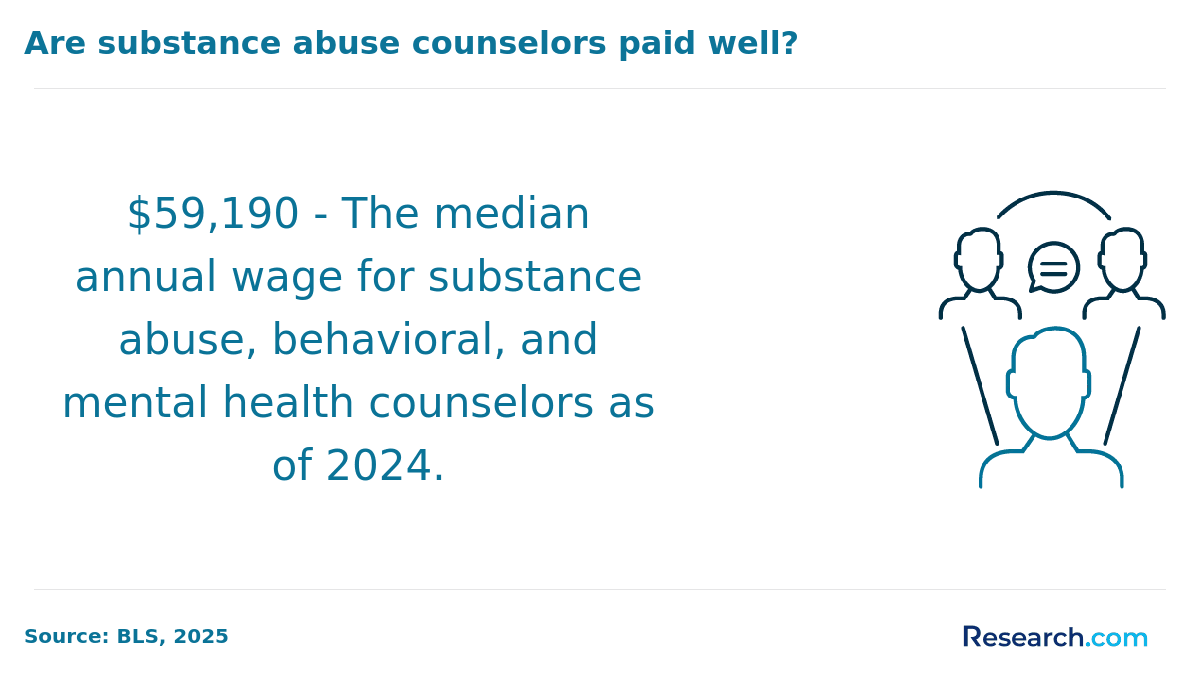
Recent labor statistics show an average annual income of approximately $71,000 for substance abuse counselors in Newark, or about $34 per hour. Entry-level jobs commonly begin near $52,000, while experienced counselors with advanced credentials, specialized responsibilities, or supervisory duties can earn over $85,000.
Related counseling roles with a wider clinical scope may pay more. Licensed mental health counselors in the Newark area average close to $88,000 annually, which is one reason some addiction counselors later pursue broader mental health credentials.
| Salary factor | How it affects pay in Newark | What you can do |
| Experience | Compensation often improves after 3–5 years of direct counseling work | Build strong documentation, crisis intervention, group counseling, and case management skills early |
| Credential level | Licensed or advanced clinicians usually qualify for more responsible and better-paid roles | Choose education and supervision that align with CADC, LCADC, or broader counseling goals |
| Work setting | Hospitals and private clinics may pay more than some community agencies | Compare benefits, caseloads, supervision, and advancement opportunities, not salary alone |
| Specialization | Co-occurring disorders, family work, program leadership, and clinical supervision can increase marketability | Pursue continuing education tied to the populations and settings you want to serve |
Graduate education can increase long-term options, but cost matters. Before enrolling, compare tuition, fees, transfer credit policies, practicum support, and expected credential outcomes. Some students researching lower-cost graduate routes may want to review options such as the most affordable online Christian counseling master's degree, while still confirming that any program meets their intended licensing needs.
Are substance abuse counselors in demand in Newark, NJ?
Yes. Newark’s need for substance abuse counselors is supported by local treatment demand, broader behavioral health workforce needs, and expanded attention to substance use disorders. The local outlook aligns with a projected growth rate of about 18% over the next ten years.
There are currently several hundred current openings in Newark. Employers may include hospitals, recovery centers, outpatient programs, residential treatment providers, correctional or reentry programs, community health organizations, and nonprofits.
- Projected growth is about 18% over the coming decade.
- Newark has several hundred current openings connected to behavioral health and substance use treatment.
- Demand is influenced by greater addiction awareness, treatment expansion, and funding for mental health services.
- Candidates improve their odds by completing recognized education, documenting supervised experience correctly, and developing local professional contacts.
How do substance abuse counselors maintain licensure and advance their professional skills in Newark, NJ?
Credential maintenance is not just an administrative task. Continuing education helps counselors stay current on ethics, trauma-informed care, relapse prevention, co-occurring disorders, medication-assisted treatment coordination, cultural responsiveness, documentation standards, and telehealth practices.
Newark counselors should track renewal deadlines, fees, required continuing education units, and any topic-specific training rules. Keep certificates and course descriptions in a secure file because employers and licensing bodies may ask for proof. If you are considering a broader clinical counseling path, Research.com’s guide on how to become an LPC in Newark can help you compare addiction counseling with the Licensed Professional Counselor route.
| Professional development move | Why it matters | Best timing |
| Ethics and legal training | Reduces risk in confidentiality, consent, mandated reporting, and documentation | Every renewal cycle and whenever regulations change |
| Co-occurring disorder training | Many clients present with both substance use and mental health concerns | Early career through advanced practice |
| Clinical supervision training | Can prepare experienced counselors for leadership or supervisory roles | After several years of direct practice |
| Specialized treatment workshops | Improves competence in evidence-based interventions and population-specific care | Whenever your caseload or employer focus changes |
How can additional certifications, such as marriage and family therapy, broaden career prospects in Newark, NJ?
Substance use disorders often affect entire households, not only the individual client. Training in family systems, couples counseling, or marriage and family therapy can help addiction counselors understand communication patterns, relapse triggers, family stress, and recovery support dynamics.
This does not mean every addiction counselor should become a marriage and family therapist. It makes the most sense if you want to work in family-centered treatment, adolescent recovery, community programs, or integrated behavioral health teams. To compare that route with addiction counseling, review marriage and family therapist education requirements in Newark.
What emerging trends are shaping substance abuse counseling in Newark, NJ?
Several trends are changing how addiction counselors work in Newark and similar urban treatment markets. Tele-counseling has made some services easier to access, although counselors must still follow state rules and employer policies. Integrated care is also becoming more important as clients often need help with mental health, primary care, housing, employment, and family stability at the same time.
Data-informed treatment planning is another growing expectation. Counselors are increasingly asked to document outcomes, coordinate with multidisciplinary teams, and use evidence-based approaches. Collaboration with medical professionals is especially important in settings that combine behavioral health and physical care. Students interested in interdisciplinary practice can see how adjacent healthcare roles develop by reading about how to become a nurse practitioner in Newark.
What additional certifications can elevate your career as a substance abuse counselor in Newark, NJ?
Additional credentials can make sense when they match your client population, employer needs, and long-term career plan. The goal is not to collect certifications randomly. The goal is to become more effective in a defined practice area, such as co-occurring disorders, behavioral interventions, family recovery, clinical supervision, or program leadership.
Some counselors also explore adjacent behavioral health credentials when they work with clients who need structured behavioral supports. For example, professionals interested in applied behavior analysis can learn more about how to become a BCBA in Newark. Before investing in any credential, confirm whether it will expand your scope, improve employability, or support advancement with your current or target employers.
What are the mental health counselor requirements in Newark, NJ?
Addiction counseling and mental health counseling overlap, but they are not identical career paths. Substance abuse counselors focus heavily on substance use disorders, recovery planning, relapse prevention, and addiction-related treatment. Mental health counselors usually train for a broader range of concerns, including anxiety, depression, trauma, relationship issues, and co-occurring conditions.
If you want to treat a broader set of mental health conditions, pursue private practice opportunities, or qualify for roles requiring a wider clinical license, you may need additional education, supervised clinical hours, and examination requirements. Review the mental health counselor requirements in Newark before choosing between an addiction-specific credential and a broader counseling pathway.
Where do substance abuse counselors work in Newark, NJ?
Substance abuse counselors in Newark work across medical, nonprofit, residential, outpatient, and community-based settings. The right workplace depends on the type of clients you want to serve, your tolerance for crisis work, your supervision needs, and whether you prefer structured clinical teams or community outreach.
- Newark Beth Israel Medical Center: Counselors in hospital-connected settings may help with assessment, treatment planning, detox or rehabilitation support, discharge coordination, and referrals.
- Prevention Links, Inc.: Community-oriented nonprofit work may involve prevention education, group support, family engagement, recovery programming, and outreach.
- Newark Recovery Center: Counselors in outpatient or residential treatment environments may provide case management, relapse prevention planning, group counseling, and coordination with other healthcare providers.
| Work setting | Common responsibilities | Best fit for counselors who want |
| Hospitals and medical centers | Assessment, crisis response, integrated care, discharge planning | Fast-paced clinical environments and multidisciplinary teamwork |
| Outpatient treatment programs | Individual counseling, group sessions, relapse prevention, progress documentation | Ongoing client relationships and structured treatment planning |
| Residential programs | Daily recovery support, group facilitation, case coordination, crisis management | Intensive client contact and team-based care |
| Nonprofits and community agencies | Education, outreach, prevention, referral support, family services | Community impact and public health work |
What other careers can substance abuse counselors pursue in Newark, NJ?
Substance abuse counseling can be a long-term career, but it can also lead to adjacent roles in behavioral health, case management, prevention, administration, and clinical leadership. The best next step depends on whether you want more direct counseling, higher pay, broader licensure, or program-level responsibility.
- Mental health counselor: Provides care for a wider range of psychological concerns in outpatient clinics, community agencies, and private practice. In Newark, most salaries fall in the $68,000–$80,000 range, with experienced clinicians exceeding $90,000.
- Case manager: Coordinates treatment plans, social services, healthcare referrals, housing resources, and client support systems. Newark compensation often ranges from $42,000–$60,000, with higher earnings possible in hospital or government roles and with additional certifications.
- Behavioral disorder technician: Supports licensed clinicians in rehabilitation, residential, or behavioral programs. Average annual pay is $48,000–$55,000, reflecting hourly wages near $25.
- Community outreach coordinator: Develops prevention, education, and engagement programs for public health agencies and nonprofits. Salaries commonly range from $58,000–$84,000, depending on program size and funding.
- Addiction program director: Manages staff, budgets, compliance, services, and clinical operations for treatment programs. Newark leadership roles typically pay $130,000–$190,000, with higher earnings in large hospital networks or state-funded facilities.
If you want to move into advanced counseling, supervision, or leadership, graduate study may become important. Cost-conscious students can compare the ranking of cheapest online master’s in counseling degree programs while confirming that each program supports their intended license or credential.
The chart below compares projected growth rates of substance abuse counselors with other behavioral health professions.
Is Newark, NJ a good place to work as a substance abuse counselor?
Newark can be a strong location for addiction counseling careers, especially for people who want meaningful community-based work and access to a large behavioral health network. It is also a demanding market. Counselors may encounter high caseloads, complex client needs, limited resources, and emotionally intense work.
| Potential advantage | Why it matters | Possible trade-off |
| Consistent demand | Local treatment needs and public health initiatives support ongoing hiring | Busy programs may assign heavy caseloads |
| Range of employers | Hospitals, nonprofits, recovery centers, and public health agencies create varied job options | Pay, benefits, and supervision quality can differ widely |
| Career development | Expanding behavioral health services can create room for specialization and advancement | Advancement may require additional credentials or graduate education |
| Community impact | Counselors can serve clients with urgent and complex recovery needs | Burnout risk is real without strong boundaries and employer support |
- : "“The challenges here are real. Caseloads can be overwhelming at times, and resources are not always plentiful. But there’s a genuine sense of purpose when you help clients navigate recovery in a community that truly needs it.”"
That perspective from a Newark substance abuse counselor captures the trade-off clearly. The work can be difficult, but counselors who find supportive employers, maintain healthy boundaries, and continue developing their skills may find the city professionally rewarding.
What challenges do substance abuse counselors face in Newark, NJ?
Newark counselors must be prepared for both clinical and systems-level challenges. Clients may need more than counseling alone; they may also need medical care, housing support, employment services, legal help, family support, or treatment for co-occurring mental health conditions.
- High client demand: Heavy caseloads can make scheduling, documentation, and follow-up difficult if employers do not provide enough support.
- Socioeconomic barriers: Poverty, unemployment, transportation problems, and limited healthcare access can interfere with treatment consistency.
- Regulatory complexity: Counselors must keep up with New Jersey credentialing rules, documentation standards, supervised practice requirements, and renewal obligations.
- Need for multidisciplinary coordination: Effective care often requires communication with physicians, social workers, case managers, probation officers, family members, and community agencies.
- Cultural and community responsiveness: Newark’s diverse population requires counselors to adapt communication, treatment planning, and engagement strategies.
- Burnout risk: Addiction counseling can involve crisis work, relapse, trauma exposure, and emotional fatigue, making supervision and self-care essential.
Common mistakes to avoid when entering this career
| Mistake | Why it causes problems | Better approach |
| Choosing a program without checking credential alignment | Coursework may not support CADC, LCADC, or broader counseling goals | Ask the school to explain exactly how its curriculum maps to New Jersey requirements |
| Focusing only on tuition | A cheaper program can become costly if it lacks practicum support or accepted coursework | Compare total cost, field placement help, exam preparation, and transfer policies |
| Assuming online coursework is automatically accepted | Online delivery does not guarantee that courses meet credentialing standards | Confirm approval before enrolling and keep syllabi and transcripts |
| Not documenting supervised hours carefully | Missing signatures or unclear duties can delay credential review | Maintain signed logs with dates, hours, settings, duties, and supervisor credentials |
| Relying only on salary averages | Actual pay depends on credential, setting, experience, and caseload expectations | Evaluate salary together with supervision, benefits, workload, and advancement opportunities |
What Substance Abuse Counselors in Newark, NJ Say About Their Careers
- “Building a career in Newark’s addiction counseling field has given me a level of stability I did not expect. Treatment programs continue to need qualified counselors, and the pay is strong enough to make the work feel sustainable. More importantly, I can see the impact of what I do every week.” – Joseph
- “The work is complex because clients often bring multiple needs into the room at once. Newark has taught me how to listen carefully, solve problems quickly, and stay grounded when situations are difficult. It is demanding, but it has made me a much better clinician.” – Amy
- “Professional growth has been a real advantage here. Workshops, community partnerships, and nearby universities make it easier to keep learning and apply newer treatment approaches. That support helps me serve clients more effectively.” – Emma
Related Articles for Nearby Cities
- 2027 How to Become a Substance Abuse Counselor in Jersey City, NJ: Requirements & Certification
- 2027 How to Become a Substance Abuse Counselor in New York City: Requirements & Certification
- 2027 How to Become a Substance Abuse Counselor in Philadelphia, PA: Requirements & Certification
- 2027 How to Become a Substance Abuse Counselor in Baltimore, MD: Requirements & Certification
- 2027 How to Become a Substance Abuse Counselor in Boston, MA: Requirements & Certification
- 2027 How to Become a Substance Abuse Counselor in Washington DC: Requirements & Certification
- 2027 How to Become a Substance Abuse Counselor in Richmond, VA: Requirements & Certification
- 2027 How to Become a Substance Abuse Counselor in Buffalo, NY: Requirements & Certification
- 2027 How to Become a Substance Abuse Counselor in Virginia Beach, VA: Requirements & Certification
- 2027 How to Become a Substance Abuse Counselor in Norfolk, VA: Requirements & Certification
References:
- Garnet, M. & Miniño, A. (December 2024). Drug Overdose Deaths in the United States, 2003–2023. Centers for Disease Control and Prevention. https://stacks.cdc.gov/view/cdc/170565
- Gotadki, R. (May 2025). Substance Abuse Treatment Market Research Report Information By Type (Alcohol Dependence and Tobacco & Drug Abuse), By End User (Outpatient Treatment Centers, Residential Treatment Centers, and Inpatient Treatment Centers), and By Region (North America, Europe, Asia-Pacific, And Rest Of The World) – Market Forecast Till 2032. Market Research Future. https://www.marketresearchfuture.com/reports/substance-abuse-treatment-market-7230
- IBISWorld (November 2024). Drug & Alcohol Rehabilitation Clinics in the US - Market Research Report (2014-2029). https://www.ibisworld.com/united-states/industry/drug-alcohol-rehabilitation-clinics/4619
- International Certification & Reciprocity Consortium (n.d.). Alcohol & Drug Counselor (ADC). https://internationalcredentialing.org/icrc-credentials/credentials Data retrieved May 2025
- Mikulic, M. (May 2024). Total substance abuse funding by National Institutes for Health 2013-2025. Statista. https://www.statista.com/statistics/713359/substance-abuse-funding-by-the-national-institutes-for-health
- National Center for Drug Abuse Statistics (2023). Average Cost of Drug Rehab. https://drugabusestatistics.org/cost-of-rehab
- National Center for Health Workforce Analysis (November 2024). State of the Behavioral Health Workforce, 2024. Bureau of Health Workforce. https://bhw.hrsa.gov/sites/default/files/bureau-health-workforce/state-of-the-behavioral-health-workforce-report-2024.pdf
- National Center for Health Workforce Analysis (n.d.). Workforce Projections. Health Resources and Services Administration. https://data.hrsa.gov/topics/health-workforce/workforce-projections Data retrieved May 2025
- O*NET OnLine (n.d.). O*NET OnLine Help. https://www.onetonline.org/help/online/find_occ Data retrieved May 2025
- O*NET OnLine (n.d.). Substance Abuse and Behavioral Disorder Counselors, 21-1011.00. https://www.onetonline.org/link/details/21-1011.00 Data retrieved May 2025
- Reinert, M., Fritze, D. & Nguyen, T.(July 2024). The State of Mental Health in America 2024. Mental Health America. https://mhanational.org/wp-content/uploads/2024/12/2024-State-of-Mental-Health-in-America-Report.pdf
- Shatterproof (April 2025). Shatterproof Statement on SAMHSA National Survey on Drug Use and Health Staffing Cuts. PR Newswire. https://www.prnewswire.com/news-releases/shatterproof-statement-on-samhsa-national-survey-on-drug-use-and-health-staffing-cuts-302421026.html
- Substance Abuse and Mental Health Services Administration (July 2024). Key Substance Use and Mental Health Indicators in the United States: Results from the 2023 National Survey on Drug Use and Health. https://www.samhsa.gov/data/sites/default/files/reports/rpt47095/National%20Report/National%20Report/2023-nsduh-annual-national.pdf
- U.S. Bureau of Labor Statistics (April 2024). Occupational Employment and Wages, May 2023, 21-1018 Substance Abuse, Behavioral Disorder, and Mental Health Counselors. https://www.bls.gov/oes/2023/may/oes211018.htm
- U.S. Bureau of Labor Statistics (April 2025). Substance Abuse, Behavioral Disorder, and Mental Health Counselors. https://www.bls.gov/ooh/community-and-social-service/substance-abuse-behavioral-disorder-and-mental-health-counselors.htm
- U.S. Bureau of Labor Statistics (n.d.). Occupational Employment and Wage Statistics, Industry: Cross-industry, Private, Federal, State, and Local Government, Period: May 2024. https://data.bls.gov/oes/#/industry/000000 Data retrieved May 2025
- Vankar, P. (November 2024). Number of people in the U.S. who received treatment for alcohol use 2023, by age. Statista. https://www.statista.com/statistics/620295/people-with-alcohol-use-treatment-in-the-us-by-age-group
- Vankar, P. (November 2024). Share of people in the U.S. who received treatment for alcohol use 2023, by ethnicity. Statista. https://www.statista.com/statistics/620318/alcohol-use-treatment-in-the-us-by-ethnicity
- Vankar, P. (March 2025). Most important health issues facing the U.S. according to U.S. adults 2024. Statista. https://www.statista.com/statistics/986209/most-important-health-issues-facing-america-us
- Vankar, P. (April 2025). Addiction treatment among U.S. college students receiving mental healthcare 2010-2024. Statista. https://www.statista.com/statistics/827363/addiction-treatment-among-college-students-receiving-mental-health-services-us-by-year
- Vankar, P. (April 2025). Substance use among adults in the United States as of 2023, by any mental illness. Statista. https://www.statista.com/statistics/252470/substance-use-among-us-adults-by-any-mental-illnes
- Yang, J. (December 2024). Number of substance abuse treatment facilities in the U.S. by operation type 2023. Statista. https://www.statista.com/statistics/452517/number-of-substance-abuse-treatment-facilities-in-the-us-by-operation-type
- Yang, J. (December 2024). Number of substance abuse treatment facilities in the U.S. 2003-2023. Statista. https://www.statista.com/statistics/450281/total-number-of-substance-abuse-treatment-facilities-in-the-us
- Yang, J. (December 2024). Share of substance abuse treatment facilities in the U.S. by care setting 2023. Statista. https://www.statista.com/statistics/452486/distribution-of-substance-abuse-treatment-facilities-in-the-us-by-care-type
- Zippia (January 2025). Substance Abuse Counselor demographics and statistics in the US. https://www.zippia.com/substance-abuse-counselor-jobs/demographics
- Zippia (January 2025). Substance Abuse Counselor Education Requirements. https://www.zippia.com/substance-abuse-counselor-jobs/education
- Zippia (January 2025). Substance Abuse Counselor skills for your resume and career. https://www.zippia.com/substance-abuse-counselor-jobs/skills
Key Insights
- Newark’s main addiction counseling credentials are CADC and LCADC. Choose the credential based on your desired scope of practice, clinical responsibility, and long-term career goals.
- Education alone is not enough. You also need supervised experience, proper documentation, and exam preparation tied to New Jersey requirements.
- Salary potential is solid but varies by setting. Newark substance abuse counselors average about $71,000 per year, but hospitals, private clinics, advanced credentials, and leadership roles can change earnings significantly.
- Demand is strong, but the work can be intense. Projected growth of about 18% and several hundred current openings point to opportunity, while caseloads and resource limits require resilience.
- The best program is the one that supports licensure, fieldwork, and career fit. Before enrolling, verify credential alignment, practicum support, total cost, supervisor qualifications, and transferability if you may work outside New Jersey.
Other Things You Should Know About Being a Substance Abuse Counselor in Newark, NJ
The New Jersey Addiction Professional Certification Board (NJAPCB) oversees many substance use counselor credentials in Newark. It sets certification standards, reviews applications, and requires documented education, supervised experience, and passing scores on approved exams such as the IC&RC Alcohol and Drug Counselor exam.
Yes, prospective substance abuse counselors in Newark, NJ are required to undergo a criminal background check via the New Jersey Board of Social Work Examiners. This ensures that candidates meet ethical standards before obtaining certification to practice in 2027.
In 2027, those seeking certification as substance abuse counselors in Newark, NJ, should check specific state licensing requirements. Online programs can be accepted if they meet credential standards set by the New Jersey Division of Consumer Affairs and industry accreditation boards.


