
2027 How to Become a Licensed Counselor (LPC) in Virginia

Co-Founder and Chief Data Scientist
Becoming a Licensed Professional Counselor (LPC) in Virginia requires more than earning a counseling degree. You need the right graduate coursework, supervised residency hours, an approved licensing exam, a background check, and annual renewal requirements through the Virginia Board of Counseling. For many students, the most difficult part is not deciding whether counseling is meaningful work; it is understanding which program will actually move them toward licensure without wasting time or money.
This guide is designed for prospective counseling students, psychology graduates, career changers, and current behavioral health professionals who want a practical roadmap to LPC licensure in Virginia. It explains education requirements, program options, online versus campus study, costs, supervised experience, specializations, job outlook, and career paths. It also highlights common mistakes to avoid so you can compare counseling programs with a clear understanding of accreditation, licensure fit, clinical training, and return on investment.
The need for qualified counselors remains urgent. In Virginia, 1 in 4 (25%) of adults with mental illness reported an unmet need for mental health treatment in 2024. Aspiring LPCs can help address that gap, but only if they choose a compliant, high-quality path into the profession.
Quick Answer: How do you become an LPC in Virginia?
To become an LPC in Virginia, you generally need a master’s degree or higher in counseling or a closely related field from a regionally accredited institution, complete required counseling coursework, finish supervised clinical training, complete a supervised residency totaling 3,400 hours, pass the National Counselor Examination for Licensure and Certification (NCE) or the National Clinical Mental Health Counseling Examination (NCMHCE), submit a complete application to the Virginia Board of Counseling, and maintain the license through annual continuing education.
| Step | What Virginia LPC candidates should confirm |
| Graduate education | Program is regionally accredited and aligned with Virginia Board of Counseling academic requirements. |
| Program accreditation | CACREP accreditation, or an equivalent accrediting body recognized by the Virginia Board of Counseling, can simplify licensure review. |
| Clinical experience | Required practicum, internship, and post-graduate supervised residency are built into the career plan. |
| Residency hours | Virginia requires 3,400 hours of supervised residency in counseling practice, including 2,000 direct client counseling hours. |
| Exam | Candidates must pass the NCE or NCMHCE. |
| Renewal | LPCs must complete 20 hours of continuing education each year, including at least two hours focused on ethics, standards of practice, or Virginia behavioral science laws. |
Key Benefits of Becoming an LPC in Virginia
- Licensed counselors in Virginia can work in multiple environments, including private practices, hospitals, schools, correctional facilities, community mental health agencies, and integrated healthcare settings.
- According to 2026 data, the median salary for licensed counselors in Virginia typically ranges from $55,000 to $72,000 per year.
- Tuition costs may range from $10,000 to $20,000 per year, though the actual amount depends on residency status, institutional type, delivery format, fees, and available financial aid.
- Graduate preparation is the norm in this profession: 89% of LPCs in Virginia have a master's degree, while the remaining 11% have doctorate degrees.
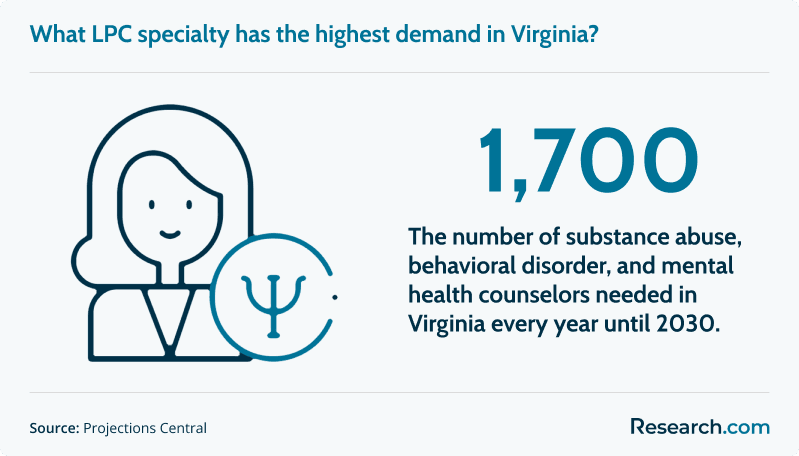
- Employment projections are especially favorable for substance abuse, behavioral disorder, and mental health counselors in Virginia, with jobs in this role expected to grow by 6.6% until 2030.
- 2027 Best Counseling Programs in Virginia
- What are the educational requirements for licensed counselors in Virginia?
- What is the licensure application and renewal process for licensed professional counselors in Virginia?
- How long does it take to become a licensed professional counselor in Virginia?
- Are online counseling programs accepted for LPC licensure in Virginia?
- How does an online counseling program in Virginia compare to an on-campus program?
- What is the average cost of LPC programs in Virginia?
- How to choose the best LPC program in Virginia?
- What types of specializations are available within counseling in Virginia?
- How does licensure for LPCs in Virginia compare to other counseling professions?
- What career paths are available for LPCs in Virginia?
- How can counselors specialize in substance abuse counseling in Virginia?
- What is the scope of practice for LPCs in Virginia?
- What is the job market for licensed counselors in Virginia?
- What are the affordable education and financial aid options for LPC aspirants in Virginia?
- How can mentorship and professional networking propel my counseling career in Virginia?
- Can social work complement my counseling career in Virginia?
- Can I integrate behavior analysis into my counseling career in Virginia?
- What are the advanced career opportunities for licensed counselors in Virginia?
- What are the next steps after becoming an LPC in Virginia?
- How can I secure quality clinical supervision for licensure in Virginia?
- How can I effectively prepare for licensure examinations in Virginia?
- What legal and regulatory responsibilities do I need to meet as an LPC in Virginia?
- Should I Consider Transitioning to School Counseling in Virginia?
- How can I maintain a competitive edge as an LPC in Virginia?
- What is the easiest counseling degree to get in Virginia?
2027 Best Counseling Programs in Virginia
The counseling programs below can help students compare Virginia-based graduate options that support professional counseling preparation. Rankings and school data are informed by established education sources, including the IPEDS database, the National Center for Education Statistics, Peterson's database, including distance learning information, and the College Scorecard database. For more detail on how Research.com evaluates programs, review the methodology page.
Use this list as a starting point, not as a substitute for checking current licensure alignment with the Virginia Board of Counseling. Program accreditation, practicum and internship structure, residency support, exam preparation, and total cost should all be verified before enrolling.
1. Virginia Tech Master of Arts in Education in Counselor Education
The Clinical Mental Health Counseling Program at the Virginia Tech Roanoke campus offers a CACREP-approved MA Ed. in Counselor Education. The program is structured for two years of full-time graduate study and includes 60 hours of graduate-level preparation. Students study core counseling theory and practice while also taking focused coursework in areas such as crisis intervention, addiction counseling, and creative counseling approaches. The program includes a 600-hour internship, which counts toward the required residency hours.
- Program Length: 2 years
- Tracks/Concentrations: School counseling, clinical mental health counseling
- Cost: N/A
- Required Credits to Graduate: 60 credit hours
- Accreditation: CACREP accredited
2. College of William & Mary M.Ed. in Clinical Mental Health Counseling with a Couples, Marriage and Family Counseling Concentration
The College of William & Mary offers an M.Ed. in Clinical Mental Health Counseling with a Couples, Marriage, and Family concentration for students who want training in both clinical mental health counseling and relational work with couples and families. The curriculum is designed to meet the academic criteria for LPC licensure in Virginia. Students complete 63 semester hours of classroom and clinical coursework, typically across two academic years.
- Program Length: 2 years
- Tracks/Concentrations: Couples, marriage and family counseling concentration
- Cost: N/A
- Required Credits to Graduate: 63 credit hours of classroom and clinical coursework
- Accreditation: CACREP accredited (Council for Accreditation of Counseling and Related Educational Programs)
3. Virginia State University Counselor Education Program
Virginia State University offers a master’s program in Counselor Education with two degree options. The M.Ed. is geared toward professional practice and meets the minimum counseling educational track education requirements of 60 credit hours and a comprehensive examination. The MS option is more research-centered and requires a minimum of 54 credit hours plus a research-based thesis defense. Students may pursue School Counseling (Pre-K-12) or Clinical Mental Health Counseling, depending on their professional goals.
- Program Length: 2 years
- Tracks/Concentrations: School counseling, clinical mental health counseling
- Cost: N/A
- Required Credits to Graduate: 60
- Accreditation: CACREP accredited (Council for Accreditation of Counseling and Related Educational Programs)
4. Old Dominion University Master of Science in Education in Counseling
The CACREP-accredited MS Ed. in Counseling at Old Dominion University prepares students for counseling roles in professional settings. The curriculum covers counseling foundations, human development, and applied practice. Students choose between Clinical Mental Health Counseling and School Counseling. For Virginia residents, tuition is $599 per credit, while nonresidents pay $1,439 per credit.
- Program Length: 1.5 to 2 years
- Tracks/Concentrations: N/A
- Cost: N/A
- Required Credits to Graduate: 60
- Accreditation: CACREP accredited (Council for Accreditation of Counseling and Related Educational Programs)
5. South University Master of Arts in Clinical Mental Health Counseling
South University offers an MA in Clinical Mental Health Counseling that prepares students for professional counseling practice through counseling theory, hands-on learning, research preparation, and study of ethical and legal standards. The program is designed for students seeking a structured graduate route into clinical mental health counseling.
- Program Length: 2 years
- Tracks/Concentrations: N/A
- Cost: N/A
- Required Credits to Graduate: 60
- Accreditation: CACREP accredited (Council for Accreditation of Counseling and Related Educational Programs)
6. Virginia Commonwealth University (VCU) Master of Science (M.S.) in Counselor Education
Virginia Commonwealth University offers a Master of Science (M.S.) in Counselor Education that combines counseling theory with experiential learning. The program emphasizes diversity, equity, and inclusion so graduates can work with complex client needs and varied community contexts. VCU also highlights faculty expertise in research and clinical practice.
- Program Length: 2 years
- Tracks/Concentrations: School counseling, college counseling and student affairs
- Cost: N/A
- Required Credits to Graduate: 60 credit hours
- Accreditation: CACREP accredited (Council for Accreditation of Counseling and Related Educational Programs)
7. James Madison University (JMU) Master of Education (M.Ed.) in Counseling
James Madison University offers a Master of Education (M.Ed.) in Counseling through its Counseling and Psychological Services department. The program emphasizes evidence-based practice, clinical skill development, and ethical decision-making. Faculty experience in counseling practice and research supports students as they prepare for professional roles.
- Program Length: 2 years
- Tracks/Concentrations: School counseling, clinical mental health counseling
- Cost: N/A
- Required Credits to Graduate: 60 credit hours
- Accreditation: CACREP accredited (Council for Accreditation of Counseling and Related Educational Programs)
8. University of Virginia (UVA) Master of Education (M.Ed.) in Counselor Education
The University of Virginia offers a Master of Education (M.Ed.) in Counselor Education through the Curry School of Education and Human Development. Students complete academic and applied training designed to prepare them for diverse client needs. The program also emphasizes professional identity, advocacy, and social justice in counseling practice.
- Program Length: 2 years
- Tracks/Concentrations: Clinical mental health counseling, school counseling
- Cost: N/A
- Required Credits to Graduate: 58
- Accreditation: CACREP accredited (Council for Accreditation of Counseling and Related Educational Programs)
9. George Mason University Master of Arts (M.A.) in Counseling and Development
George Mason University offers a Master of Arts (M.A.) in Counseling and Development through its Counselor Education program. The curriculum combines counseling theory with applied practice and encourages critical thinking and reflective professional development. Students learn from faculty with clinical and scholarly backgrounds.
- Program Length: 2 years
- Tracks/Concentrations: Clinical mental health counseling, school counseling
- Cost: N/A
- Required Credits to Graduate: 60
- Accreditation: Council for Accreditation of Counseling and Related Educational Programs (CACREP)
10. Radford University Master of Science (M.S.) in Clinical Mental Health Counseling
Radford University offers a Master of Science (M.S.) in Clinical Mental Health Counseling through its Counseling and Human Development department. The program focuses on clinical skill development, theoretical understanding, experiential learning, and faculty mentorship. Students are prepared to work with varied mental health needs across client populations.
- Program Length: 2 years
- Tracks/Concentrations: Clinical mental health counseling
- Cost: $17,964
- Required Credits to Graduate: N/A
- Accreditation: Council for Accreditation of Counseling and Related Educational Programs (CACREP)
What should you compare before choosing a Virginia counseling program?
| Selection factor | Why it matters for LPC candidates | Question to ask the school |
| CACREP or equivalent accreditation | Accreditation can affect whether coursework is accepted for licensure review. | Does this exact track meet Virginia LPC academic requirements? |
| Clinical mental health counseling track | Not every counseling track is designed for LPC licensure. | Is this program specifically intended for LPC preparation? |
| Practicum and internship placement support | Clinical placements determine whether students can complete required training on time. | Who finds placements: the student, the school, or both? |
| Cost after aid | Sticker tuition does not show your real out-of-pocket cost. | What is the estimated total cost, including fees, clinical expenses, and books? |
| Exam preparation | Passing the NCE or NCMHCE is required for licensure. | Does the curriculum include exam review or formal test preparation? |
| Residency guidance | Post-graduate supervised experience is a major part of the timeline. | Does the program help graduates identify approved supervisors? |
Here's What Graduates Have to Say About Becoming an LPC in Virginia
"My Virginia counseling program connected classroom learning with practical clinical work. We studied different therapeutic models, then used practicum placements to build skills with guidance from supervisors. In my current counseling role with adolescents in Richmond, I see how trust, consistency, and a safe therapeutic space help young people manage difficult experiences and recognize their strengths." - Tim
"The counseling program I completed in Virginia helped me understand cultural responsiveness in a deeper way. Courses examined how race, ethnicity, and socioeconomic background can shape mental health experiences. That training now informs my work in a community mental health center in Arlington, where I support clients from many backgrounds and work to make care feel respectful and relevant." - Alex
"My program’s focus on research and evidence-based practice changed the way I approach counseling. We learned how to evaluate therapeutic methods and choose interventions carefully. Today, in my private practice in Norfolk, I use research-supported techniques while adapting treatment to each client’s needs." - Brennan
What are the educational requirements for licensed counselors in Virginia?
Virginia LPC candidates need graduate-level preparation that satisfies the state’s academic requirements for counseling practice. If you are still exploring counseling career paths, start by confirming the difference between general psychology education, school counseling preparation, marriage and family therapy, and clinical mental health counseling. These paths can overlap, but they do not always lead to the same license.
- Master's degree or higher. Virginia requires aspiring licensed counselors to hold a master’s degree or higher in counseling or a closely related field from a regionally accredited institution. Coursework should address areas such as counseling theories, human growth and development, group dynamics, multicultural counseling, and counseling techniques.
- Appropriate accreditation. The graduate program should be accredited by the Council for Accreditation of Counseling and Related Educational Programs (CACREP) or an equivalent accrediting body recognized by the Virginia Board of Counseling. Accreditation helps show that the program meets professional preparation standards for counseling practice.
- Supervised clinical training. Students must complete supervised practicum and internship experiences, followed by post-graduate supervised residency requirements. These experiences are where candidates move from academic knowledge into direct counseling practice under qualified supervision.
- Continuing education after licensure. Licensed counselors in Virginia must continue professional development to keep their licenses active. Continuing education may include workshops, seminars, professional conferences, ethics training, or specialized coursework in areas such as Christian counseling programs and other counseling specialties.
What is the licensure application and renewal process for licensed professional counselors in Virginia?
The Virginia LPC process has two major phases: initial licensure and ongoing renewal. Candidates should track documentation carefully because missing transcripts, supervision forms, exam results, or fees can delay approval.
Initial Licensure Application
- Verify education and experience. Applicants must document that their education and supervised experience meet Virginia Board of Counseling standards. Some students begin with related undergraduate or graduate preparation, including the best online psychology degree options or traditional psychology programs, before moving into counseling-specific graduate study. After the qualifying degree, candidates complete a supervised residency in counseling practice totaling 3,400 hours. Of those, 2,000 hours must meet Virginia’s direct client counseling requirement. The residency must be completed in no less than 21 months and no more than four years.
- Pass the required examination. Candidates must pass either the National Counselor Examination for Licensure and Certification (NCE) or the National Clinical Mental Health Counseling Examination (NCMHCE), both administered by the National Board for Certified Counselors (NBCC). Candidates who do not pass may retest after 90 days.
- Complete the background check. Virginia requires a criminal background check as part of licensure review. This step helps the Board evaluate whether applicants meet professional character and fitness expectations.
- Submit the application and fees. Once education, experience, exam, and background requirements are ready, candidates submit the full application package to the Virginia Board of Counseling. The application review process can take up to 30 days after the application is considered complete.
License Renewal Process
- Complete annual continuing education. Virginia LPCs must complete 20 hours of continuing education each year. At least two of those hours must cover ethics, standards of practice, or laws governing behavioral science professions in Virginia.
- Renew resident status when applicable. The Resident Counseling License must be renewed annually and may only be renewed up to five times. Residents must complete three hours of continuing education focused on ethics, standards of practice, or laws governing behavioral science professions in Virginia.
- Maintain professional standing. Renewal may require information about professional activities, good standing, and any disciplinary history during the prior licensure period.
- Pay the renewal fee. Counselors must submit the renewal fee required by the Board to complete the renewal process.
How long does it take to become a licensed professional counselor in Virginia?
The full LPC pathway in Virginia commonly takes around four to six years, although the timeline depends on enrollment pace, transfer credits, clinical placement availability, exam timing, and how quickly candidates complete residency hours.
| Stage | Typical time commitment | What happens during this stage |
| Graduate counseling degree | About two to three years of full-time study | Students complete required counseling coursework, practicum, internship, and degree requirements. |
| Supervised clinical residency | About two years | Candidates complete supervised post-graduate practice, including required direct client counseling hours. |
| Licensure exam and application | Varies by candidate | Candidates pass the NCE or NCMHCE and submit documentation to the Virginia Board of Counseling. |
| Total pathway | Around four to six years | The total depends on school format, residency progress, exam readiness, and application review. |
Students who attend part time, change tracks, struggle to secure clinical placements, or need to retake an exam may take longer. Students who enroll full time and plan supervision early can often avoid unnecessary delays.
Are online counseling programs accepted for LPC licensure in Virginia?
Yes. Virginia can accept online counseling programs for LPC licensure if the program satisfies the educational requirements of the Virginia Board of Counseling. The delivery format alone is not the deciding factor; accreditation, curriculum, clinical training, and licensure alignment are what matter.
Before enrolling in an online program, confirm that it is accredited by a recognized accrediting body, such as the Council for Accreditation of Counseling and Related Educational Programs (CACREP), or another equivalent accrediting agency accepted by the Board. Also ask how the program handles practicum and internship placements in Virginia, since online coursework does not remove the need for supervised in-person or approved clinical experience.
How does an online counseling program in Virginia compare to an on-campus program?
Online and on-campus counseling programs can both prepare students for licensure when they meet Virginia requirements. The better choice depends on your schedule, learning style, clinical placement needs, budget, and access to faculty support.
| Factor | Online counseling program | On-campus counseling program |
| Schedule flexibility | Often better for working adults, caregivers, and students outside commuting distance. | Usually follows set class meeting times and campus-based expectations. |
| Access | Reduces geographic barriers and may expand options for students who cannot relocate. | Works well for students who live near campus and want face-to-face interaction. |
| Learning format | May include asynchronous coursework, virtual classrooms, online discussion, and digital collaboration tools. | Provides in-person discussion, campus resources, and direct peer interaction. |
| Clinical placement | Students must verify whether the school helps arrange Virginia-compliant sites. | Schools may have stronger local placement relationships, depending on the institution. |
| Best fit | Students who need flexibility but can stay organized and independently manage deadlines. | Students who prefer structured schedules, in-person supervision, and campus community. |
- Flexibility. Online programs can make graduate study more manageable for students balancing employment, family responsibilities, or long commutes.
- Accessibility. Distance learning can help students from different regions access counseling education without relocating. It may also support broader exposure to diverse communities, a key issue in counseling and education; related context on access quality education and cultural diversity can help students think about inclusive practice.
- Self-directed learning. Many online formats require strong time management. Students who need external structure should ask how often classes meet live and how faculty monitor progress.
- Technology integration. Online programs often use virtual classrooms, digital counseling resources, multimedia learning, and online collaboration platforms, which can be useful as digital tools become more common in behavioral health settings.
What is the average cost of LPC programs in Virginia?
The cost of LPC preparation in Virginia varies widely by institution type, residency status, delivery format, fees, and financial aid. Tuition costs for LPC programs in Virginia can range from approximately $10,000 to $40,000 per year for in-state students at public institutions. Out-of-state students may pay higher rates, often ranging from $20,000 to $50,000 per year. Private institutions typically have higher tuition costs, averaging between $20,000 and $60,000 per year.
Students should not compare programs by tuition alone. A lower per-credit price may not mean the lowest total cost if the program requires more credits, charges higher fees, offers limited clinical placement support, or extends the time to graduation. Scholarships, grants, assistantships, employer tuition assistance, and federal financial aid may reduce out-of-pocket expenses.
| Cost category | Why it affects total LPC program cost |
| Tuition | Per-credit pricing and total credits determine the largest expense. |
| University fees | Technology, student services, clinical, and graduation fees can add to the bill. |
| Books and materials | Counseling programs may require textbooks, assessment materials, and exam preparation resources. |
| Clinical placement expenses | Travel, background checks, liability insurance, and site requirements may create additional costs. |
| Lost income or reduced work hours | Full-time study and internship schedules may limit employment flexibility. |
| Exam and licensure fees | Budget for exam registration, application costs, renewals, and continuing education. |
How to choose the best LPC program in Virginia?
The best LPC program is the one that meets Virginia licensure requirements, fits your finances and schedule, provides strong clinical training, and prepares you for the population you want to serve. A highly ranked program is not automatically the right choice if it lacks the track, placement support, or format you need.
- Confirm accreditation first. Prioritize programs accredited by the Council for Accreditation of Counseling and Related Educational Programs (CACREP) or another recognized accrediting body accepted by the Virginia Board of Counseling. If you are earlier in your education, comparing affordable online bachelor’s degree in psychology options can help you prepare for graduate study without overspending.
- Match the track to your career goal. Clinical mental health counseling, school counseling, marriage and family therapy, rehabilitation counseling, and substance abuse counseling can lead to different roles and requirements. Counseling is also a common option for students researching what to do with a psychology degree.
- Evaluate faculty and advising. Look for faculty whose expertise aligns with your interests, such as trauma, addiction, child and adolescent counseling, couples work, or community mental health. Ask how accessible faculty are outside class and whether students receive mentorship.
- Ask about licensure preparation. A strong program should clearly explain how its coursework maps to Virginia LPC requirements and how it prepares students for the NCE or NCMHCE.
- Compare real costs. Review tuition, fees, books, travel, clinical placement expenses, and the amount of aid you are likely to receive. Also ask whether assistantships, scholarships, or employer tuition benefits are available.
Common mistakes to avoid when choosing a Virginia LPC program
| Mistake | Why it can hurt you | Better approach |
| Choosing a program before checking licensure fit | You may complete coursework that does not satisfy Virginia LPC requirements. | Ask the program and the Virginia Board of Counseling how the curriculum aligns with licensure. |
| Looking only at tuition | Fees, placement costs, and longer timelines can make a cheaper program more expensive. | Calculate total cost through graduation and licensure application. |
| Assuming online always means easier | Online counseling programs still require clinical work, exams, and supervision. | Choose online only if you can manage deadlines and secure approved clinical placements. |
| Ignoring internship support | Limited placement assistance can delay graduation and licensure progress. | Ask for placement outcomes, site lists, and supervisor requirements. |
| Relying only on rankings | A ranked school may not offer your preferred specialization or schedule. | Use rankings as one input alongside accreditation, fit, cost, and clinical quality. |
What types of specializations are available within counseling in Virginia?
Counseling specializations help students focus their training on specific client needs, settings, and career goals. In Virginia, common options include clinical mental health, school counseling, marriage and family work, rehabilitation counseling, trauma counseling, and substance abuse counseling.
- Clinical mental health counseling. This path prepares counselors to work with individuals, groups, and families facing concerns such as anxiety, depression, trauma, and substance abuse.
- School counseling. School counselors support students’ academic, social, emotional, and career development in elementary, middle, and high school settings.
- Marriage and family therapy. This specialization centers on couples, family relationships, communication patterns, and family systems.
- Rehabilitation counseling. Rehabilitation counselors help people with disabilities address barriers related to employment, education, independent living, and personal goals.
- Trauma counseling. Trauma-focused counselors work with clients affected by abuse, violence, accidents, disasters, and other overwhelming experiences. Students from fields such as sociology majors may find this area especially connected to social systems, community context, and inequality.
According to the latest report on Virginia's LPC workforce, 65% of LPCs in the state are focused on the mental health specialty. The chart below provides more detail on the most common primary specialties among Virginia LPCs.
How does licensure for LPCs in Virginia compare to other counseling professions?
Virginia LPC licensure differs from related behavioral health credentials, including Licensed Marriage and Family Therapist (LMFT) licensure. Both paths generally require graduate education and supervised clinical experience, but they prepare professionals for different scopes of work.
LPCs are trained to address a broad range of mental health concerns across individuals, groups, and populations. In Virginia, LPC candidates must complete a master’s degree with at least 60 credit hours, including coursework in areas such as counseling theory, human behavior, and ethics. They must also complete 3,400 hours of supervised post-graduate work experience.
LMFT preparation typically focuses more heavily on family systems, couples therapy, relational patterns, and family dynamics. Supervised clinical hour expectations may differ depending on license level. Exam requirements also differ: LPC candidates take the NCE or NCMHCE, while LMFT candidates commonly complete the Association of Marital and Family Therapy Regulatory Boards (AMFTRB) exam.
If you are comparing these professions, choose based on the clients and problems you most want to address. Students drawn to broad clinical mental health work may prefer the LPC route, while those committed to couples and family systems may want to review how to become a marriage and family therapist in Virginia.
| Profession | Primary focus | Typical fit |
| LPC | Mental health counseling across individuals, groups, families, and varied populations. | Students who want broad clinical counseling practice options. |
| LMFT | Couples, marriage, family systems, and relational dynamics. | Students who want to specialize in relationship-centered therapy. |
| School counselor | Student development, academic planning, social-emotional support, and career guidance. | Students who want to work primarily in educational settings. |
| Substance abuse counselor | Prevention, treatment, recovery support, and addiction-related counseling. | Students who want to focus on substance misuse and behavioral health recovery. |
What career paths are available for LPCs in Virginia?
LPCs in Virginia can work in many settings because counseling needs appear across healthcare, education, public agencies, private practice, and community-based care. The right setting depends on your preferred population, tolerance for administrative work, income goals, desired schedule, and interest in independent practice.
- Private practice. Some LPCs build independent or group practices offering individual, couples, family, or group counseling. This path can provide autonomy and specialization, but it also requires business, billing, marketing, documentation, and risk management skills.
- Community mental health centers. LPCs in community mental health often serve clients facing depression, anxiety, trauma, substance use, housing instability, or limited access to care. These roles can be demanding but provide significant public health impact.
- School counseling. Counselors in schools support students through academic planning, social-emotional development, crisis response, and career exploration. This path may require school-specific credentials beyond LPC preparation.
- Hospitals and healthcare settings. LPCs may work in hospitals, clinics, integrated care teams, or medical practices supporting patients dealing with chronic illness, crisis, grief, behavioral health concerns, or treatment adjustment.
- Correctional facilities. Counselors in correctional settings may provide mental health counseling, substance abuse services, group therapy, crisis intervention, and reentry support for incarcerated individuals.
How can counselors specialize in substance abuse counseling in Virginia?
Counselors who want to focus on substance abuse treatment can strengthen their qualifications through specialized coursework, clinical placements in substance misuse settings, and additional credentials aligned with Virginia practice standards. This specialization is important because substance abuse, behavioral disorder, and mental health counseling roles are among the stronger projected employment areas in the state.
Students should look for programs with addiction counseling coursework, supervised practicum or internship opportunities in treatment environments, and faculty expertise in recovery, co-occurring disorders, trauma, and relapse prevention. For a more targeted route, review this guide on how to become a substance abuse counselor in Virginia.
What is the scope of practice for LPCs in Virginia?
The LPC scope of practice in Virginia determines what services licensed counselors may provide and where their professional boundaries apply. Understanding scope of practice is essential because it protects clients, clarifies professional responsibility, and helps counselors avoid practicing outside their training.
- Assessment and diagnosis. LPCs in Virginia may assess clients and diagnose mental health disorders using interviews, clinical judgment, and appropriate assessment tools. These findings guide treatment planning.
- Therapeutic services. LPCs can provide individual, group, and family therapy. Depending on client needs, they may use approaches such as cognitive-behavioral therapy (CBT), solution-focused therapy, and other evidence-informed methods.
- Crisis intervention. LPCs are trained to respond when clients experience acute distress, safety risks, or mental health emergencies. Crisis planning and stabilization are important parts of ethical practice.
- Treatment planning. LPCs develop individualized treatment plans based on client assessment, diagnosis, goals, interventions, and expected outcomes.
- Collaboration with other professionals. LPCs often coordinate care with physicians, psychologists, social workers, educators, case managers, and community agencies to support client needs comprehensively.
What is the job market for licensed counselors in Virginia?
The job market for licensed counselors in Virginia is generally favorable, although opportunities vary by specialty, region, employer type, and experience level. According to 2024 data, job demand for counselors, all other in Virginia is expected to grow by 13% until 2034. Demand for educational, guidance, school, and vocational counselors is also high, with average annual openings for these roles until 2034.
Virginia still faces challenges meeting residents’ mental health needs as the population grows. The state produces approximately 224 new LPCs each year, based on the average number of graduates from graduate-level counseling programs who obtain Virginia counselor licensing.
The chart below shows the current population of behavioral health workers in Virginia:
What are the affordable education and financial aid options for LPC aspirants in Virginia?
Future LPCs can reduce educational costs by comparing public, private, online, and hybrid programs carefully. The goal is not simply to find the cheapest program; it is to find an accredited, Virginia-compliant program that provides strong clinical preparation at a sustainable price.
Funding options may include federal financial aid, institutional scholarships, graduate assistantships, work-study, employer tuition support, grants, and payment plans. Students who need flexible or lower-cost graduate options may want to compare the most affordable online counseling degrees, while still verifying that the program satisfies Virginia licensure requirements.
Questions to ask about affordability
- What is the total estimated cost from enrollment to graduation?
- Are there separate fees for online learning, clinical placement, background checks, or technology?
- How many credits are required, and are any leveling courses needed?
- What scholarships or assistantships are available to counseling students?
- Does the program help students find paid internships, graduate assistantships, or employer partnerships?
- What percentage of students complete the program within the advertised timeline?
How can mentorship and professional networking propel my counseling career in Virginia?
Mentorship and networking can help counseling students make better decisions about supervision, internships, specialization, and job opportunities. Experienced counselors can explain how Virginia licensure works in practice, what employers expect from new graduates, and which clinical skills are most valuable in local settings.
Students can build networks through faculty relationships, alumni groups, practicum supervisors, professional associations, conferences, and local behavioral health organizations. Graduates of good colleges for psychology in Virginia may also be able to use alumni networks to find internships, referrals, and career leads.
Can social work complement my counseling career in Virginia?
Social work can complement counseling by adding a stronger focus on community advocacy, resource coordination, case management, policy awareness, and systems-level intervention. Counselors who understand social work perspectives may be better prepared to support clients whose mental health is affected by housing, family systems, poverty, healthcare access, disability, or legal issues.
If you are considering a broader human services pathway or a transition into social work, review how to become a social worker in Virginia to compare education, licensure, and career requirements.
Can I integrate behavior analysis into my counseling career in Virginia?
Some LPCs may benefit from learning behavior analysis strategies, especially if they work with clients who have behavioral, developmental, educational, or adaptive functioning needs. Behavior analysis can support assessment, intervention planning, skill building, and behavior change when used within the counselor’s scope and training.
Counselors interested in this area should understand the distinction between counseling licensure and behavior analysis certification. For a separate credential pathway, see how to become a behavior analyst in Virginia.
What are the advanced career opportunities for licensed counselors in Virginia?
Experienced LPCs in Virginia can move beyond entry-level counseling roles by developing a specialty, supervising other professionals, managing programs, teaching, consulting, or opening a private practice. Some counselors pursue additional education or specialized graduate study, including a masters in Christian counseling, depending on their professional focus.
- Specialized practice areas. Counselors may focus on addiction counseling, grief therapy, trauma recovery, child and adolescent counseling, couples work, crisis care, or culturally responsive counseling.
- Supervisory and leadership roles. With experience, LPCs may manage clinical teams, supervise residents, direct programs, or train early-career counselors.
- Private practice ownership. Counselors who want independence may build a solo or group practice, although this requires business planning, compliance knowledge, documentation systems, and referral networks.
What are the next steps after becoming an LPC in Virginia?
After earning the LPC credential, counselors should shift from licensure completion to professional growth. That may include selecting a niche, completing advanced training, seeking supervision or consultation, developing referral relationships, and tracking continuing education obligations. For a broader overview of the pathway, see how to become a licensed mental health counselor in Virginia.
New LPCs should also decide whether they want to remain in agency work, move toward private practice, pursue clinical leadership, specialize in a high-need area, or add complementary credentials. The best next step depends on your long-term career model, not just your first job offer.
How can I secure quality clinical supervision for licensure in Virginia?
Clinical supervision is one of the most important parts of the Virginia LPC pathway because it shapes your clinical judgment, ethics, documentation habits, and readiness for independent practice. A strong supervisor should understand Virginia requirements, provide consistent feedback, model ethical decision-making, and support growth across assessment, treatment planning, crisis work, and professional boundaries.
Before committing to a supervisor, verify credentials, experience, supervision style, availability, fees, documentation processes, and familiarity with Virginia LPC license requirements. Also ask whether supervision will be individual, group-based, in person, virtual, or a combination, and whether the format satisfies current state rules.
How can I effectively prepare for licensure examinations in Virginia?
Exam preparation should begin before graduation, not after residency is complete. Candidates should identify whether they plan to take the NCE or NCMHCE, review exam content areas, create a study schedule, and use reputable practice materials. Study groups, faculty guidance, review courses, and simulated exams can help identify weak areas early.
Some students considering adjacent helping professions may compare other graduate pathways, including the easiest MSW programs to get into. However, LPC candidates should be careful: social work programs and counseling programs lead to different licenses and may not satisfy the same exam or coursework requirements.
What legal and regulatory responsibilities do I need to meet as an LPC in Virginia?
LPCs in Virginia must follow legal and ethical requirements related to confidentiality, informed consent, mandatory reporting, client records, scope of practice, supervision, boundaries, telehealth, and professional competence. These responsibilities are not optional; they are central to public protection and professional trust.
Counselors should regularly review Virginia Board of Counseling updates, complete ethics continuing education, document clinical decisions carefully, and seek consultation when legal or ethical concerns arise. Related licensure paths can also help clarify professional boundaries; for example, students comparing counseling and psychology can review how to become a psychologist in Virginia.
Should I Consider Transitioning to School Counseling in Virginia?
School counseling may be a strong option for LPCs or counseling students who want to work with children and adolescents in educational environments. The role focuses on student development, academic planning, social-emotional support, family communication, crisis response, and career readiness.
Before transitioning, confirm school-specific credential requirements, practicum expectations, and whether your prior clinical counseling training applies. Educational settings have different regulations, calendars, documentation practices, and stakeholder relationships than private practice or community mental health. For a targeted pathway, review becoming a school counselor in Virginia.
How can I maintain a competitive edge as an LPC in Virginia?
LPCs can stay competitive by combining strong clinical fundamentals with ongoing specialization. Valuable areas may include trauma-informed care, addiction counseling, crisis intervention, integrated behavioral health, culturally responsive counseling, supervision, and responsible use of digital therapeutic tools.
Career growth also depends on professional relationships, outcome awareness, documentation quality, ethical consistency, and adaptability to changing employer expectations. If your goal is to move efficiently through the early stages of the profession, compare your options with the fastest way to become a counselor in Virginia.
What is the easiest counseling degree to get in Virginia?
There is no truly “easy” counseling degree that leads to professional responsibility with vulnerable clients. The more useful question is which counseling degree offers the most direct and manageable path toward your goal. If your target is LPC licensure, a master’s degree in clinical mental health counseling is usually the clearest route. Students comparing accessible options can also review the easiest counseling degree to get, but licensure fit should remain the priority.
1. Master's in Clinical Mental Health Counseling
A master's in clinical mental health counseling is one of the most direct degrees for students who want to become LPCs in Virginia. These programs usually include counseling theories, ethics, human development, assessment, diagnosis, clinical practice, practicum, and internship. Many require around 60 credit hours and approximately 2-3 years of full-time study.
This path is not easy in the sense of being low-effort, but it is practical because the curriculum is built around professional counseling preparation.
2. Master's in School Counseling
A master's in school counseling may be a better fit for students who want to work in K-12 educational settings. These programs focus on student development, academic guidance, career planning, social-emotional support, and school systems. They may feel more aligned for students who prefer prevention, student advocacy, and school-based services over broader clinical mental health practice.
However, students should not assume school counseling and LPC preparation are interchangeable. Always verify which license or credential the program is designed to support.
3. Master's in Rehabilitation Counseling
A master's in rehabilitation counseling prepares students to work with people managing physical, mental, emotional, or developmental disabilities. The work often combines counseling, vocational support, advocacy, and resource coordination. Some programs may offer flexible formats for working adults.
4. Online Counseling Degrees
Online counseling degrees can be more accessible for students who need schedule flexibility or cannot relocate. A well-designed online program can offer the same academic rigor as a campus program, but it still must meet accreditation and Virginia licensure requirements.
Online students should pay close attention to clinical placement arrangements. Even if coursework is remote, supervised practicum, internship, and residency requirements still have to be completed in an approved manner.
Related Articles for Nearby States
- 2027 How to Become a Licensed Counselor (LPC) in West Virginia
- 2027 How to Become a Licensed Counselor (LPC) in Maryland
- 2027 How to Become a Licensed Counselor (LPC) in North Carolina
- 2027 How to Become a Licensed Counselor (LPC) in Tennessee
- 2027 How to Become a Licensed Counselor (LPC) in Kentucky
- 2027 How to Become a Licensed Counselor (LPC) in Pennsylvania
- 2027 How to Become a Licensed Counselor (LPC) in South Carolina
- 2027 How to Become a Licensed Counselor (LPC) in Ohio
- 2027 How to Become a Licensed Counselor (LPC) in Delaware
- 2027 How to Become a Licensed Counselor (LPC) in New Jersey
References:
- Arizona State University. (2025). Master of Counseling Clinical Mental Health Counseling Program Evaluation Outcomes Report 2024-2025. https://cisa.asu.edu/sites/g/files/litvpz691/files/2026-02/MC%20Annual%20Program%20Outcome%20Report%202024-2025.pdf
- National Practitioner Data Bank. (n.d.). Self-query basics. NPDB.
- U.S. Bureau of Labor Statistics. (2025). Occupational Outlook Handbook: Substance Abuse, Behavioral Disorder, and Mental Health Counselors. https://www.bls.gov/ooh/community-and-social-service/substance-abuse-behavioral-disorder-and-mental-health-counselors.htm
- U.S. Bureau of Labor Statistics. (2025). Occupational Outlook Handbook: School and Career Counselors and Advisors. https://www.bls.gov/ooh/community-and-social-service/school-and-career-counselors.htm
- U.S. Bureau of Labor Statistics. (2025). Occupational Outlook Handbook: Community and Social Service Occupations. https://www.bls.gov/ooh/community-and-social-service/home.htm
Key Insights
- Virginia LPC licensure requires careful planning: graduate education, supervised clinical training, a 3,400-hour residency, an approved exam, a background check, and annual renewal obligations all matter.
- Do not enroll in a counseling program until you confirm accreditation, track alignment, practicum and internship expectations, and whether the curriculum supports Virginia LPC requirements.
- Online counseling programs can be acceptable in Virginia, but only if they meet Board requirements and provide a realistic plan for supervised clinical experience.
- Cost comparisons should include tuition, fees, clinical placement expenses, exam costs, licensure fees, and potential lost income, not just the advertised per-credit rate.
- The most direct degree for future LPCs is usually a master’s in clinical mental health counseling, while school counseling, rehabilitation counseling, social work, and marriage and family therapy may lead to different credentials or roles.
- Virginia’s mental health access needs create meaningful opportunities for counselors, especially those prepared for high-need areas such as mental health, substance abuse, trauma, and community-based care.
Other Things You Should Know About Becoming an LPC in Virginia
The Virginia Board of Counseling issues LPC licenses and regulates professional counselors in the state. It operates under the Department of Health Professions and sets the education, supervision, examination, renewal, and ethics rules for licensure. Applicants submit materials through the board’s licensing process.
To become an LPC in Virginia in 2027, you need a master's or doctoral degree in counseling or a related field from an accredited program. Additionally, candidates must complete 3,400 clinical hours of supervised experience and pass the National Counselor Examination (NCE) and Virginia's state jurisprudence exam.


